


Key Standards for Thermoplastic Materials: Quality Control, Analysis, and Testing Procedures
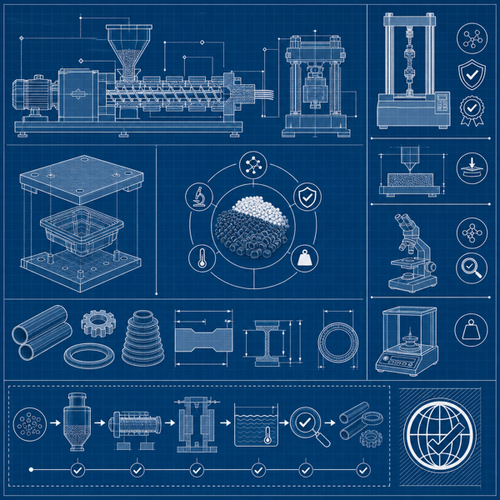
Thermoplastics have become the backbone of countless products and technologies in modern manufacturing. Ensuring consistent quality, safety, and performance is critical for industries relying on materials like vinyl chloride polymers and polyols. This comprehensive article delves into four ISO standards that set the benchmark for thermoplastic material analysis, testing, and quality assurance. Whether you’re in automotive, consumer goods, or industrial applications, understanding and applying these thermoplastic standards is crucial for businesses looking to implement new technologies, improve productivity, and scale operations securely.
Overview / Introduction
Thermoplastic materials are everywhere—from car interiors and smart device casings to medical devices and packaging films. Their versatility, recyclability, and adaptability to new technological trends have fueled their widespread adoption across industries such as automotive, electronics, healthcare, and construction. However, with rapidly evolving requirements for material performance and growing regulatory scrutiny, ensuring the highest quality of these materials is no longer optional.
International standards play a pivotal role in shaping how thermoplastic materials are manufactured, tested, and utilized. These standards provide the framework for:
- Consistent product quality and safety,
- Objective methods for testing and analysis,
- Facilitating global trade and compliance,
- Encouraging innovation while managing risk,
- Satisfying industry-specific and regulatory criteria.
This article covers four key standards that impact quality assurance, safety, and technological advancement in thermoplastic materials:
- Determination of chlorine content in vinyl chloride polymers (ISO 1158:2026),
- Assessment of thermal stability via hydrogen chloride evolution (ISO 182-3:2025),
- Measurement of aldehydes and ketones in polyols (ISO 24829:2026),
- Standard specimen preparation for investigating anisotropy in injection moulded parts (ISO 294-5:2026).
You will learn what each standard covers, who needs to comply, and how adopting these best practices can boost productivity, security, and scalability for organizations.
Detailed Standards Coverage
ISO 1158:2026 - Determination of Chlorine Content in Vinyl Chloride Polymers
Plastics — Vinyl chloride homopolymers and copolymers — Determination of chlorine content
This standard specifies reliable methods for measuring the chlorine content in vinyl chloride homopolymers and copolymers—critical for PVC production and compounders. Manufacturers use this test to validate raw material quality, optimize formulations, and document compliance for technical and safety requirements.
What the Standard Covers
ISO 1158:2026 details two rigorous analytical procedures:
- Method A: Combustion in a bomb.
- Method B: Combustion in a flask.
Both techniques oxidize the test portion, converting chlorine into chloride ions, which are then quantitatively analyzed, usually by titration. All testing is done on polymers free from plasticizers or additives.
Key Requirements and Specifications
- Precise reagent purity and water quality, per ISO 6353-1 and ISO 3696.
- Accurate sample preparation and titration endpoints (potentiometric/volumetric).
- Comprehensive documentation and reporting, including sample specifics, method used, results, and test conditions.
- Specific apparatus and safety precautions are clearly outlined, ensuring operator protection.
Who Should Comply?
- PVC resin manufacturers,
- Compounders blending or modifying vinyl chloride-based products,
- Quality control labs in plastics and chemical industries,
- Regulatory agencies assessing material safety.
Practical Implementation
Accurate chlorine content determination is vital for recipe control in PVC and its copolymers, impacting final product properties such as flame retardancy, chemical resistance, and processability. Both methods outlined are internationally recognized, supporting traceable quality control and third-party validation.
Notable Features
- Updated standard reflects advances in titration, solution preparation, and laboratory safety.
- Both volumetric and potentiometric titration endpoints included.
- Enhanced apparatus requirements and procedural tolerances for repeatability.
Key highlights:
- Essential for PVC manufacturers’ quality control,
- Supports regulatory compliance and safety documentation,
- Enables traceable, repeatable results in global supply chains.
Access the full standard:View ISO 1158:2026 on iTeh Standards
ISO 182-3:2025 - Thermal Stability and Evolution of Acidic Products in PVC
Plastics — Determination of the tendency of compounds and products based on vinyl chloride homopolymers and copolymers to evolve hydrogen chloride and any other acidic products at elevated temperatures — Part 3: Conductometric method
The evolution of hydrogen chloride gas from PVC compounds at high temperatures is a critical safety and quality concern. ISO 182-3:2025 provides an objective, reproducible means to assess thermal stability—especially in formulations that may contain colorants or advanced stabilizers.
What the Standard Covers
This standard outlines the conductometric method for determining the release of acidic products (primarily hydrogen chloride) when PVC-based products are heated. It applies to:
- Compounded PVC materials (including colored and filled compounds),
- Finished or semi-finished products,
- Other thermoplastics that might release hydrogen halides under test conditions.
Key Requirements and Specifications
- Test portions are heated in a controlled nitrogen gas stream.
- Evolved gases are absorbed in demineralized water, and the change in water conductivity is recorded.
- Results are expressed in terms of stability time (how long before significant HCl release occurs).
- Specifics on sample preparation, apparatus (dehydrochlorination cells, measurement cells), flow rates, and temperatures (generally 180–210°C) are strictly prescribed.
Who Should Comply?
- Manufacturers of rigid and flexible PVC compounds,
- Wire and cable manufacturers (for insulation/sheathing),
- Producers of PVC films, sheets, and molded objects,
- Companies seeking to validate new heat stabilizer systems or optimize product durability.
Practical Implementation
Testing according to ISO 182-3:2025 helps specify stabilizer levels, compare performance between suppliers, and ensure that end products won’t degrade or emit hazardous gases in use. It is especially important for electrical, automotive, and construction markets.
Notable Features
- Accommodates colored and complex PVC systems where visual tests are inadequate.
- Defines testing for both sample powders and molded articles.
- Addresses differences from the pH-meter method (ISO 182-2) and references further chloride-specific analysis (ISO 182-4).
Key highlights:
- Provides objective data for heat stability and product safety,
- Critical for certifying wire, cable, and construction plastics,
- Supports continuous product and process improvement.
Access the full standard:View ISO 182-3:2025 on iTeh Standards
ISO 24829:2026 - Determination of Aldehydes and Ketones in Polyether Polyols and Polymer Polyols
Plastics — Polyether polyols and polymer polyols — Determination of aldehydes and ketones
With increasing environmental requirements and a push for higher material purity—especially in automotive, furniture, and consumer applications—this standard offers a precise method for detecting low levels of volatile organic carbonyl compounds in polyol raw materials.
What the Standard Covers
ISO 24829:2026 specifies the high performance liquid chromatography (HPLC) technique to determine the concentrations of key aldehydes (formaldehyde, acetaldehyde, acrolein) and ketones (acetone) in polyether polyols and polymer polyols. These are crucial feedstocks in polyurethane manufacture.
Key Requirements and Specifications
- Samples must be prepared and analyzed under controlled laboratory conditions using reference standards.
- Derivatization is applied for compounds that are hard to detect directly.
- Results are validated using calibration curves and quality assurance criteria (precision, recovery rates).
- Comprehensive reporting is required, including result traceability and HPLC system performance.
Who Should Comply?
- Polyurethane foam producers (for automotive seating, furniture, insulation, adhesives),
- Polyol suppliers and chemical producers,
- Automotive OEMs and suppliers (for material compliance documentation),
- Quality assurance and R&D laboratories.
Practical Implementation
Producers rely on this method to demonstrate their compliance with global emission regulations, uphold OEM contracts, and ensure the final product's safety and acceptability, particularly regarding in-vehicle air quality and consumer exposure concerns.
Notable Features
- Directly aligns with automotive and environmental requirements for VOCs,
- Provides guidance for both formaldehyde and other key low-molecular-weight carbonyls,
- Emphasizes process control, batch certification, and regulatory readiness.
Key highlights:
- Vital for manufacturers in regulated and high-performance industries,
- Ensures raw material compliance for foam and elastomer end products,
- Supports industry sustainability and environmental goals.
Access the full standard:View ISO 24829:2026 on iTeh Standards
ISO 294-5:2026 - Injection Moulding Standard Specimens for Anisotropy Testing
Plastics — Injection moulding of test specimens of thermoplastic materials — Part 5: Preparation of standard specimens for investigating anisotropy
Anisotropy—direction-dependent variation in properties—is a major factor in the design and reliability of injection moulded thermoplastic parts, especially those reinforced with fibers. Accurate anisotropy measurement can determine whether a component will meet structural and safety requirements.
What the Standard Covers
This standard specifies the use of a defined plate mould (type F ISO mould) for creating test specimens through injection moulding. These specimens are analyzed to quantify how material properties differ with direction (flow vs. cross-flow), guiding plastic part designers on the realistic upper and lower bounds of mechanical performance.
Key Requirements and Specifications
- Design and dimensions of the type F mould (80 mm x 120 mm x 2 mm plate), specifically to maximize anisotropy for property evaluation.
- Detailed conditioning and injection moulding procedures ensure sample consistency.
- Instructions for preparing test specimens (machining or stamping) as per ISO 20753 types A22 or B3.
- In-depth guidance for reporting specimen preparation history, critical for reproducibility.
- Strictly not to be used for routine quality control but rather for design and modeling support.
Who Should Comply?
- Injection moulding companies serving safety-critical or technical applications,
- Automotive, aerospace, and consumer goods manufacturers,
- Engineers and designers specifying plastic component performance,
- R&D organizations.
Practical Implementation
Implementing ISO 294-5:2026 helps predict final part performance, especially in reinforced plastics (e.g., fiberglass-filled PA, PP). It enables data-driven design, mitigates risk of unexpected mechanical failure, and provides buyers and stakeholders with realistic material capability assessments.
Notable Features
- Focused on anisotropy from filler or polymer chain orientation,
- Reflects latest knowledge and best practice for plate sizing and mould geometry,
- Suitable for multi-point and single-point testing and multi-industry use.
Key highlights:
- Ensures realistic mechanical design data for plastics engineering,
- Facilitates safer, more reliable product development,
- Supports scalability and transferability of product designs.
Access the full standard:View ISO 294-5:2026 on iTeh Standards
Industry Impact & Compliance
Implementing these thermoplastic standards delivers substantial benefits to manufacturers, suppliers, and end users. High-performing, compliant plastics directly correlate with market success, brand reputation, and regulatory access. Here's why adhering to ISO standards for thermoplastics is strategically important:
Benefits of Adopting these Standards
- Product Consistency: Standardized measurement and preparation methods reduce batch-to-batch variability.
- Regulatory Readiness: Compliance with ISO standards is often a prerequisite for product approvals across global markets.
- Customer Trust: Reliable quality investigations win customer confidence and enable premium pricing.
- Process Optimization: Analytical insights inform process improvements, reducing scrap, rework, and warranty claims.
- Risk Mitigation: Documentation and traceability provide vital evidence in the event of product liability or recall situations.
Compliance Considerations
- Documentation: Maintain detailed laboratory and production records per standard test report requirements.
- Training: Staff must be trained on the latest requirements, test procedures, and safety protocols.
- Audits: Regular internal and third-party audits validate compliance and continuous improvement.
- Supplier Management: Collaborate with suppliers to ensure consistent, compliant raw materials.
Implications for Non-Compliance
- Market access restrictions in regulated industries (e.g., automotive, healthcare).
- Increased risk of product failure, recalls, or liability claims.
- Difficulty scaling or introducing new technology innovations due to inconsistent base material performance.
Implementation Guidance
Succeeding with thermoplastic material standards requires a structured approach—and leveraging support from industry resources.
Common Implementation Approaches
- Gap Assessment: Review current processes against each standard's requirements.
- Training & Certification: Ensure laboratory and production personnel are competent.
- Equipment Validation: Verify the calibration and maintenance of key apparatus (e.g., HPLC, conductance meters, injection moulding machines).
- Method Standardization: Document and harmonize testing methods company-wide.
- Supplier Engagement: Communicate standards down the supply chain.
- Continuous Monitoring: Regularly update procedures based on new editions or technical revisions.
Best Practices
- Pilot Projects: Start with a pilot implementation in one facility or product line before scaling up.
- Data Analytics: Use laboratory data to identify trends and areas for improvement.
- Collaborative Audits: Involve multifunctional teams in routine audits for broader awareness.
- Engage with Industry Groups: Participate in technical committees or benchmarking exercises to stay ahead of evolving standards.
Resources for Organizations
- Full text of ISO standards through iTeh Standards and other authorized platforms.
- Training modules and certification programs for material testing and laboratory best practices.
- Expert consultancy for laboratory set-up, process optimization, and technology transfer.
- Forums for industry updates and regulatory briefing sessions.
Conclusion / Next Steps
Thermoplastic materials are a foundation of modern innovation, but delivering reliable, high-quality, and compliant products demands rigorous adherence to global standards. The four ISO standards highlighted—covering chlorine content, thermal stability, aldehyde and ketone analysis, and anisotropy assessment—are essential for manufacturing excellence and future-ready operations.
Key takeaways:
- Implementing ISO standards is a must for companies seeking competitive advantage in plastics and polymer-based technologies.
- These practices support scalable, secure, and sustainable manufacturing.
- Investment in standards compliance yields long-term rewards in market access, safety, and brand reputation.
Recommendations:
- Evaluate your current compliance with these core ISO standards.
- Empower your teams with up-to-date training and access to full documentation.
- Stay proactive: Monitor for upcoming revisions and emerging requirements as technology and regulations evolve.
Explore these standards in detail and leverage industry best practices through iTeh Standards to ensure your thermoplastic materials, products, and operations set the benchmark for quality, security, and scalable growth.
Categories
- Latest News
- New Arrivals
- Generalities
- Services and Management
- Natural Sciences
- Health Care
- Environment
- Metrology and Measurement
- Testing
- Mechanical Systems
- Fluid Systems
- Manufacturing
- Energy and Heat
- Electrical Engineering
- Electronics
- Telecommunications
- Information Technology
- Image Technology
- Precision Mechanics
- Road Vehicles
- Railway Engineering
- Shipbuilding
- Aircraft and Space
- Materials Handling
- Packaging
- Textile and Leather
- Clothing
- Agriculture
- Food technology
- Chemical Technology
- Mining and Minerals
- Petroleum
- Metallurgy
- Wood technology
- Glass and Ceramics
- Rubber and Plastics
- Paper Technology
- Paint Industries
- Construction
- Civil Engineering
- Military Engineering
- Entertainment