

Nonwoven Filtration and Textile Flammability Standards: Ensuring Safer, Smarter Products
Nonwoven Filtration and Textile Flammability Standards: Ensuring Safer, Smarter Products
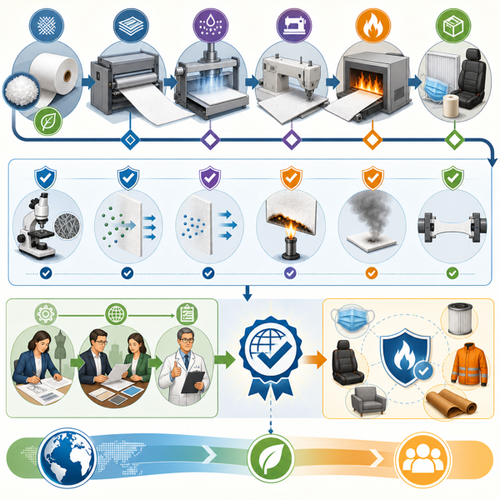
In an era shaped by health awareness and the rapid integration of advanced textiles, the demand for effective filtration properties and fire safety in textile products is at an all-time high. Four key international standards—ISO 24269:2026, ISO 25081:2026, ISO 6940:2026, and ISO 6941:2026—define the benchmark for filtration, safety, and flammability in nonwoven and textile materials. Whether your organization manufactures face coverings or technical fabrics, these standards are your roadmap to compliance, security, and forward-looking competitiveness.
Overview / Introduction
The Textile and Leather industry is deeply entwined with daily life, public health, and global commerce. With the proliferation of nonwoven materials in face masks and protective gear, the focus on particulate filtration and flame resistance has never been sharper. Organizations must adapt to spiraling regulatory demands and consumer expectations by rigorously controlling product performance and safety.
Standards provide:
- Consistent, tested requirements for product quality
- Global alignment for safe trade and scaling
- Measurable guidance for compliance, productivity, and continuous improvement
By reading this article, you’ll understand:
- What each standard covers, in clear language
- Key requirements and how they apply to manufacturers, suppliers, and brands
- Implementation tips and real-world business benefits
- Why compliance is crucial for trust and market access
ISO standards are the lingua franca of safety, especially in textiles. Here’s how these four key documents shape modern textile filtration and flammability control.
Detailed Standards Coverage
ISO 24269:2026 – Nonwovens: Filtration and Safety Requirements for General Use Face Coverings
Full Standard Title: Nonwovens — Performance requirements and test methods for filtration and safety — Materials for general use face coverings
Scope and Essentials: ISO 24269:2026 establishes the performance requirements and test methods for single-use nonwoven face coverings intended for general public use, excluding medical and PPE masks. It fills the crucial gap between high-grade medical respirators and everyday face masks by regulating the effectiveness and safety of general face coverings designed for routine wear.
Key Filtration Properties Assessed:
- Sub-micron particulate filtration efficiency (PFE): Tests the material’s ability to block particles smaller than one micron, including NaCl and polystyrene latex aerosols.
- Bacterial filtration efficiency (BFE) & Viral filtration efficiency (VFE): Measures the face covering’s ability to filter aerosolized bacteria and viruses, mirroring real-life respiratory emissions.
- Pollen particle filtration efficiency: Assures relief for allergy sufferers and greater public comfort.
- Differential pressure (Breathability): Quantifies air permeability to ensure comfortable oxygen intake while wearing.
Mandatory Safety Criteria:
- Free formaldehyde and specific azo dyes: Limits harmful chemical residues, factoring in both health and environmental impacts.
- Heavy metals content: Prevents exposure to toxic contaminants.
- pH: Ensures the product is skin-friendly and not irritating.
Intended Users:
- Manufacturers of nonwoven general use face coverings
- Textile converters producing raw materials
- Regulatory authorities and supply chain validators
Practical Implications: Adopting ISO 24269 helps companies reduce recalls and liability, improve market access, and reassure consumers that their products perform reliably. It sets defined test protocols—like using EN 14683 for breathability and ISO 14184-1 for formaldehyde—that laboratories and QA teams can follow.
Key highlights:
- Clear separation between requirements for general use vs. medical and PPE masks
- Rigorous, yet realistic, safety and filtration benchmarks for materials
- Enables innovation in safer, hypoallergenic mask materials
Access the full standard:View ISO 24269:2026 on iTeh Standards
ISO 25081:2026 – Nonwovens: Test Methods for Filtration of Particulate Matter
Full Standard Title: Nonwovens — Test methods for filtration of particulate matter
Scope and Essentials: ISO 25081:2026 is a laboratory method for evaluating the particulate matter filtration performance of nonwoven materials used in air filtration applications (such as HVAC filters, automotive cabin filters, and mask media). It responds to the inconsistency previously seen across regions by harmonizing test definitions, apparatus, and procedures.
Test Core Elements Include:
- Apparatus and Sample Preparation: Details on filter tester design, aerosol generators, and preconditioning methods
- Airflow and Particle Measurement: Tests conducted at specified flow rates, with parameters like initial/final airflow resistance and dust-hold capacity calculated as performance indicators
- Filtration Efficiency Metrics: Considers both initial filtration (at start of use) and load filtration (performance as filter becomes saturated)
Target Users:
- Nonwoven producers supplying filtration media
- Filter manufacturers and OEMs
- Labs and regulatory agencies verifying filter performance
Implementation and Impact: ISO 25081 is foundational for building data-driven claims of filter effectiveness and lifecycle, especially for companies scaling up production or entering new air filtration markets. Adhering to the standard supports consumer trust and enhances R&D by giving a clear basis for product comparison.
Key highlights:
- Consistent, verifiable way to test nonwoven filter performance
- Focuses on particulate removal efficiency under controlled conditions
- Supports demand for higher indoor air quality and pollution control products
Access the full standard:View ISO 25081:2026 on iTeh Standards
ISO 6940:2026 – Textile Fabrics: Determination of Ease of Ignition
Full Standard Title: Textile fabrics — Burning behaviour — Determination of ease of ignition of vertically oriented specimens
Scope and Essentials: ISO 6940:2026 specifies a method for measuring how easily textile fabrics ignite when exposed to a small, controlled flame in a vertical orientation. The method is applicable for all textile fabric forms—single or multi-component, coated, quilted, multilayer, or sandwich constructions—often used in upholstery, apparel, transportation, and technical textiles.
Using specially designed apparatus, specimen holders, and precise timing devices, labs can assess:
- The minimum flame application time required to cause sustained combustion of the fabric
- Afterflame time (duration the fabric keeps burning after flame removal)
- Effects of seams and trim on ignition behaviour
Who Needs Compliance:
- Furniture and automotive textile suppliers
- Public space and transportation outfitting companies
- Garment and outdoor equipment brands
Implementation Benefits: Testing according to ISO 6940 quantifies ignition risks, enabling safer product design and faster regulatory approval. The standard helps manufacturers document due diligence and risk control—fundamental for liability mitigation and insurance.
Key highlights:
- Applies realistic ignition sources, ensuring direct relevance for real-world fire risk
- Suitable for multiple fabric types, including those with integrated seams and decorative trims
- Supports integrated product safety labeling and certification
Access the full standard:View ISO 6940:2026 on iTeh Standards
ISO 6941:2026 – Textile Fabrics: Measurement of Flame Spread Properties
Full Standard Title: Textile fabrics — Burning behaviour — Measurement of flame spread properties of vertically oriented specimens
Scope and Essentials: ISO 6941:2026 complements ISO 6940 by defining the test procedure for measuring flame spread time in vertically oriented textile specimens when exposed to a small defined flame. Key for settings where textiles are part of walls, ceilings, furnishings, or curtains, this standard tracks how quickly a material allows flames to travel along its surface or structure.
Core Test Elements:
- Surface or bottom edge ignition tests using a calibrated burner
- Measurement of flame front travel between marker threads at set distances
- Application to composite, layered, and trimmed fabrics
Applicable Industries:
- Construction materials and contract textiles
- Interior and vehicle designers
- Home textile, bedding, and hospitality supply chains
Compliance Advantages: ISO 6941 test reports allow manufacturers to objectively demonstrate compliance with fire safety codes—often a requirement for building and furnishing approvals worldwide. Transparent results streamline procurement, boost confidence across B2B relationships, and enable product scaling to new markets.
Key highlights:
- Ensures textiles meet or exceed minimum flame spread safety standards
- Facilitates product approvals in regulated environments (transport, hospitality, healthcare)
- Supports progress toward genuinely fire-safe, responsible textiles
Access the full standard:View ISO 6941:2026 on iTeh Standards
Industry Impact & Compliance
Why These Standards are Essential for Businesses Today
The global competitive landscape, advances in material science, and increased safety scrutiny make compliance with these ISO standards a must. The COVID-19 pandemic, for example, revealed the critical need for high-quality, safe face coverings and exposure reduction in public spaces. In parallel, demands for flame-retardant furnishings, transport interiors, and apparel keep rising as cities densify and legislation tightens.
Key business impacts:
- Market differentiation: Certification under these standards signals commitment to quality and user safety, building strong brand trust.
- Risk management: Clear, standardized test methods for filtration and flammability reduce liability from product failures and recalls.
- Faster product launch: Conformance simplifies procurement and accelerates regulatory approvals globally, essential in fast-paced markets.
- Enabling scaling: Standards-based processes ensure consistent product quality as you scale production across factories or geographies.
Risks of non-compliance include:
- Loss of market access due to regulatory checks
- Potential product recalls, penalties, or bans
- Damaged reputation and loss of customer trust
- Higher insurance premiums or canceled coverage
Competitive, safe, and sustainable business operations require up-to-date standards implementation. This is especially critical as new materials and smart textile technologies enter mass production.
Implementation Guidance
Steps and Best Practices for Standards Adoption
Successfully implementing these standards in your organization means weaving them into both R&D and operational processes. Here’s how to get started:
- Gap analysis:
- Review your current product specs, processes, and QC protocols against standard requirements.
- Staff training and awareness:
- Train technical, laboratory, and production staff on standard principles and test methods.
- Testing and validation:
- Use certified labs familiar with ISO methodologies, or invest in in-house test setups as described in the standards.
- Documentation and traceability:
- Keep clear records of materials, test results, and safety data for regulatory and client audits.
- Continuous improvement:
- Monitor for standard updates and adapt promptly, leveraging new insights for better, safer products.
Additional Resources
- iTeh Standards platform: Access the latest standard versions, guidance documents, and expert commentary.
- ISO and national standardization bodies: Provide technical support and certified interpretation if ambiguities arise.
- Industry bodies and trade associations: Offer benchmarking, implementation toolkits, and peer networking.
High-quality implementation of textile standards ensures that your products are not only compliant but also competitive, safer, and more sustainable.
Conclusion / Next Steps
The future of textiles—especially nonwovens and technical fabrics—demands strict attention to tested, standardized safety and performance. From community mask makers to global auto-interior giants, businesses that leverage standards like ISO 24269, ISO 25081, ISO 6940, and ISO 6941 unlock safer products, regulatory confidence, and the ability to scale and innovate responsibly.
Key takeaways:
- ISO standards offer a robust framework for filtration efficiency and fire safety in textiles
- Compliance is critical for risk reduction, global trade, and consumer confidence
- Investment in standards-based systems supports secure, productive, and scalable business models
Recommended Actions:
- Audit your current textile products and processes against these standards
- Access and study the full documents directly on iTeh Standards
- Integrate compliance checkpoints into your quality management system
- Stay alert for updates and periodic revisions to keep your competitive edge
Explore these international standards further, empower your teams, and let your products embody the highest levels of safety and performance in the evolving textile industry.
Categories
- Latest News
- New Arrivals
- Generalities
- Services and Management
- Natural Sciences
- Health Care
- Environment
- Metrology and Measurement
- Testing
- Mechanical Systems
- Fluid Systems
- Manufacturing
- Energy and Heat
- Electrical Engineering
- Electronics
- Telecommunications
- Information Technology
- Image Technology
- Precision Mechanics
- Road Vehicles
- Railway Engineering
- Shipbuilding
- Aircraft and Space
- Materials Handling
- Packaging
- Textile and Leather
- Clothing
- Agriculture
- Food technology
- Chemical Technology
- Mining and Minerals
- Petroleum
- Metallurgy
- Wood technology
- Glass and Ceramics
- Rubber and Plastics
- Paper Technology
- Paint Industries
- Construction
- Civil Engineering
- Military Engineering
- Entertainment