


ASTM D4275-17
(Test Method)Standard Test Method for Determination of Butylated Hydroxy Toluene (BHT) in Polymers of Ethylene and Ethylene–Vinyl Acetate (EVA) Copolymers by Gas Chromatography
Standard Test Method for Determination of Butylated Hydroxy Toluene (BHT) in Polymers of Ethylene and Ethylene–Vinyl Acetate (EVA) Copolymers by Gas Chromatography
SIGNIFICANCE AND USE
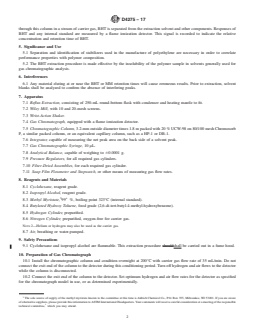
5.1 Separation and identification of stabilizers used in the manufacture of polyethylene are necessary in order to correlate performance properties with polymer composition.
5.2 The BHT extraction procedure is made effective by the insolubility of the polymer sample in solvents generally used for gas chromatographic analysis.
SCOPE
1.1 This test method describes a procedure for the determination of butylated hydroxy toluene (BHT) (2,6-di-t-butyl-4-methyl-hydroxybenzene) in polymers of ethylene and ethylene-vinyl acetate (EVA) copolymers by solvent extraction followed by gas chromatographic analysis. Detection of the compound is achieved by flame ionization, and quantitative analysis is obtained by use of internal or external standards, as described in Practices E260, E355, and E594.
1.2 The values stated in SI units are to be regarded as the standard. The values given in parentheses are for information only.
1.3 This standard does not purport to address all of the safety concerns, if any, associated with its use. It is the responsibility of the user of this standard to establish appropriate safety and health practices and determine the applicability of regulatory limitations prior to use. Specific precautionary statements are given in Section 9.
Note 1: There is no known ISO equivalent for this test method.
General Information
- Status
- Published
- Publication Date
- 28-Feb-2017
- Technical Committee
- D20 - Plastics
- Drafting Committee
- D20.70 - Analytical Methods
Relations
- Effective Date
- 01-Mar-2017
- Effective Date
- 01-Feb-2024
- Effective Date
- 01-Nov-2023
- Effective Date
- 01-Jan-2020
- Effective Date
- 01-Sep-2019
- Effective Date
- 01-Sep-2019
- Effective Date
- 01-Aug-2019
- Refers
ASTM D4968-19a - Standard Practice for Annual Review of Test Methods and Specifications for Plastics - Effective Date
- 01-Aug-2019
- Refers
ASTM D4968-19 - Standard Practice for Annual Review of Test Methods and Specifications for Plastics - Effective Date
- 01-May-2019
- Effective Date
- 15-Apr-2019
- Effective Date
- 01-Feb-2019
- Effective Date
- 01-Dec-2018
- Effective Date
- 01-Nov-2018
- Effective Date
- 15-Aug-2017
- Refers
ASTM D4968-17 - Standard Practice for Annual Review of Test Methods and Specifications for Plastics - Effective Date
- 01-Aug-2017
Overview
ASTM D4275-17: Standard Test Method for Determination of Butylated Hydroxy Toluene (BHT) in Polymers of Ethylene and Ethylene–Vinyl Acetate (EVA) Copolymers by Gas Chromatography is a widely recognized method for the accurate determination of BHT stabilizer levels in polyethylene (PE) and EVA polymers. This standard specifies solvent extraction followed by gas chromatographic (GC) analysis, using flame ionization detection, to quantify BHT concentrations. The method ensures that the performance properties of polyolefin materials can be reliably correlated with their additives composition, which is essential for polymer manufacturers, converters, and product quality controllers in the plastics industry.
Key Topics
- BHT Extraction and Detection: The standard details the extraction of butylated hydroxy toluene (2,6-di-tert-butyl-4-methyl-hydroxybenzene) from ethylene, polyethylene, and EVA samples. It outlines the use of cyclohexane or isopropyl alcohol as solvents, taking advantage of the insolubility of these polymers in typical GC solvents.
- Gas Chromatography Analysis: After extraction, samples are analyzed by gas chromatography equipped with a flame ionization detector. Quantitative determination is achieved using either internal or external calibration standards.
- Quantification Methods: Utilizes response factors and calibration curves based on Practices E260, E355, and E594 for accurate quantitation.
- Precision and Bias: Includes information on intra- and interlaboratory precision, providing confidence in the reproducibility of the results received from different testing facilities.
- Safety Precautions: Specific safety guidance is included, particularly handling of flammable solvents and laboratory best practices, ensuring compliance and safe operation.
Applications
Polymer Industry:
- Additive Quality Control: Verification of BHT stabilizer content during production and in finished goods, ensuring compliance with technical specifications.
- Material Research: Correlating polymer performance characteristics such as oxidation resistance and long-term aging with measured BHT levels.
- Regulatory Compliance: Supporting documentation for regulatory submissions and safety assessments where BHT content must be reported or limited.
Testing Laboratories:
- Analytical Consistency: Widely used as a reference method for third-party and in-house testing of ethylene-based polymers, covering applications in packaging, automotive, cable insulation, and medical devices.
- Benchmarking: Establishes a consistent approach for comparing results between manufacturers, users, and regulatory bodies.
Procurement and Specification:
- Supplier Qualification: Enables manufacturers and end-users to specify and validate raw materials and products by BHT content, supporting procurement and quality assurance programs.
Related Standards
- ASTM D883: Terminology Relating to Plastics – Provides definitions and terminology relevant to the plastics sector.
- ASTM D4968: Practice for Annual Review of Test Methods and Specifications for Plastics – Guidelines for regular review and updating of polymer test methods.
- ASTM D7210: Extraction of Additives in Polyolefin Plastics – Alternative or supplementary guidance on additive extraction procedures.
- ASTM E260, E355, and E594: Practices for packed column GC, GC terms and relationships, and FID testing – Underpinning chromatographic practices referenced in D4275-17.
- IEEE/ASTM SI-10: Use of the International System of Units (SI) – Ensures consistent and accurate reporting in SI units.
Note: There is currently no ISO equivalent to ASTM D4275-17, making it the authoritative source for BHT measurement in polyethylene and EVA materials.
Practical Value
Implementing ASTM D4275-17 enables stakeholders across the plastics supply chain to measure and control the concentration of BHT-a critical stabilizer-ensuring material quality, performance, and compliance with industry specifications. This improves reliability in manufacturing, supports product development, and protects end-user safety by managing additive levels in polyethylene and EVA copolymers.
Keywords: ASTM D4275-17, butylated hydroxy toluene, BHT, gas chromatography, polyethylene, ethylene-vinyl acetate, EVA, stabilizer analysis, polymer additives, quality control, plastics testing.
Buy Documents

ASTM D4275-17 - Standard Test Method for Determination of Butylated Hydroxy Toluene (BHT) in Polymers of Ethylene and Ethylene–Vinyl Acetate (EVA) Copolymers by Gas Chromatography
REDLINE ASTM D4275-17 - Standard Test Method for Determination of Butylated Hydroxy Toluene (BHT) in Polymers of Ethylene and Ethylene–Vinyl Acetate (EVA) Copolymers by Gas Chromatography
Get Certified
Connect with accredited certification bodies for this standard

Smithers Quality Assessments
US management systems and product certification.

DIN CERTCO
DIN Group product certification.
Sponsored listings
Frequently Asked Questions
ASTM D4275-17 is a standard published by ASTM International. Its full title is "Standard Test Method for Determination of Butylated Hydroxy Toluene (BHT) in Polymers of Ethylene and Ethylene–Vinyl Acetate (EVA) Copolymers by Gas Chromatography". This standard covers: SIGNIFICANCE AND USE 5.1 Separation and identification of stabilizers used in the manufacture of polyethylene are necessary in order to correlate performance properties with polymer composition. 5.2 The BHT extraction procedure is made effective by the insolubility of the polymer sample in solvents generally used for gas chromatographic analysis. SCOPE 1.1 This test method describes a procedure for the determination of butylated hydroxy toluene (BHT) (2,6-di-t-butyl-4-methyl-hydroxybenzene) in polymers of ethylene and ethylene-vinyl acetate (EVA) copolymers by solvent extraction followed by gas chromatographic analysis. Detection of the compound is achieved by flame ionization, and quantitative analysis is obtained by use of internal or external standards, as described in Practices E260, E355, and E594. 1.2 The values stated in SI units are to be regarded as the standard. The values given in parentheses are for information only. 1.3 This standard does not purport to address all of the safety concerns, if any, associated with its use. It is the responsibility of the user of this standard to establish appropriate safety and health practices and determine the applicability of regulatory limitations prior to use. Specific precautionary statements are given in Section 9. Note 1: There is no known ISO equivalent for this test method.
SIGNIFICANCE AND USE 5.1 Separation and identification of stabilizers used in the manufacture of polyethylene are necessary in order to correlate performance properties with polymer composition. 5.2 The BHT extraction procedure is made effective by the insolubility of the polymer sample in solvents generally used for gas chromatographic analysis. SCOPE 1.1 This test method describes a procedure for the determination of butylated hydroxy toluene (BHT) (2,6-di-t-butyl-4-methyl-hydroxybenzene) in polymers of ethylene and ethylene-vinyl acetate (EVA) copolymers by solvent extraction followed by gas chromatographic analysis. Detection of the compound is achieved by flame ionization, and quantitative analysis is obtained by use of internal or external standards, as described in Practices E260, E355, and E594. 1.2 The values stated in SI units are to be regarded as the standard. The values given in parentheses are for information only. 1.3 This standard does not purport to address all of the safety concerns, if any, associated with its use. It is the responsibility of the user of this standard to establish appropriate safety and health practices and determine the applicability of regulatory limitations prior to use. Specific precautionary statements are given in Section 9. Note 1: There is no known ISO equivalent for this test method.
ASTM D4275-17 is classified under the following ICS (International Classification for Standards) categories: 83.080.20 - Thermoplastic materials. The ICS classification helps identify the subject area and facilitates finding related standards.
ASTM D4275-17 has the following relationships with other standards: It is inter standard links to ASTM D4275-09, ASTM D883-24, ASTM D883-23, ASTM D883-20, ASTM E260-96(2019), ASTM E594-96(2019), ASTM D883-19c, ASTM D4968-19a, ASTM D4968-19, ASTM D883-19a, ASTM D883-19, ASTM D883-18a, ASTM D883-18, ASTM D883-17, ASTM D4968-17. Understanding these relationships helps ensure you are using the most current and applicable version of the standard.
ASTM D4275-17 is available in PDF format for immediate download after purchase. The document can be added to your cart and obtained through the secure checkout process. Digital delivery ensures instant access to the complete standard document.
Standards Content (Sample)
This international standard was developed in accordance with internationally recognized principles on standardization established in the Decision on Principles for the
Development of International Standards, Guides and Recommendations issued by the World Trade Organization Technical Barriers to Trade (TBT) Committee.
Designation: D4275 − 17
Standard Test Method for
Determination of Butylated Hydroxy Toluene (BHT) in
Polymers of Ethylene and Ethylene–Vinyl Acetate (EVA)
Copolymers by Gas Chromatography
This standard is issued under the fixed designation D4275; the number immediately following the designation indicates the year of
original adoption or, in the case of revision, the year of last revision. A number in parentheses indicates the year of last reapproval. A
superscript epsilon (´) indicates an editorial change since the last revision or reapproval.
1. Scope* in Gas or Supercritical Fluid Chromatography
E691 Practice for Conducting an Interlaboratory Study to
1.1 This test method describes a procedure for the determi-
Determine the Precision of a Test Method
nation of butylated hydroxy toluene (BHT) (2,6-di-t-butyl-
IEEE/ASTM SI-10 Practice for Use of the International
4-methyl-hydroxybenzene) in polymers of ethylene and
System of Units (SI) (the Modernized Metric System)
ethylene-vinyl acetate (EVA) copolymers by solvent extraction
followed by gas chromatographic analysis. Detection of the
3. Terminology
compound is achieved by flame ionization, and quantitative
analysis is obtained by use of internal or external standards, as
3.1 Definitions—Units and symbols used in this test method
described in Practices E260, E355, and E594.
are those recommended in Practice IEEE/ASTM SI-10. Chro-
matographic terms and relationships are as described in Prac-
1.2 The values stated in SI units are to be regarded as the
tice E355.
standard. The values given in parentheses are for information
only.
3.2 Abbreviations:
3.2.1 BHT—Butylated hydroxy toluene (2,6-di-tert-butyl-4-
1.3 This standard does not purport to address all of the
methyl-hydroxybenzene).
safety concerns, if any, associated with its use. It is the
responsibility of the user of this standard to establish appro-
3.2.2 MM—Methyl myristate.
priate safety and health practices and determine the applica-
3.2.3 EVA—Ethylene-vinyl acetate copolymers.
bility of regulatory limitations prior to use. Specific precau-
3.2.4 LDPE—Low-density polyethylene.
tionary statements are given in Section 9.
3.2.5 HDPE—High-density polyethylene.
NOTE 1—There is no known ISO equivalent for this test method.
2. Referenced Documents
4. Summary of Test Method
2.1 ASTM Standards:
4.1 The BHT from a finely ground polymer sample is
D883 Terminology Relating to Plastics
extracted by shaking or refluxing with cyclohexane or isopro-
D4968 Practice for Annual Review of Test Methods and
panol. A known volume of this extract is injected into a gas
Specifications for Plastics
chromatographic column packed with a liquid-coated solid
D7210 Practice for Extraction of Additives in Polyolefin
support. Passing through this column in a stream of carrier gas,
Plastics
BHT is separated from the extraction solvent and other
E260 Practice for Packed Column Gas Chromatography
components. Responses of BHT and any internal standard are
E355 Practice for Gas ChromatographyTerms and Relation-
measured by a flame ionization detector. This signal is re-
ships
corded to indicate the relative concentration and retention time
E594 Practice for Testing Flame Ionization Detectors Used
of BHT.
5. Significance and Use
This test method is under the jurisdiction ofASTM Committee D20 on Plastics
and is the direct responsibility of Subcommittee D20.70 on Analytical Methods.
5.1 Separation and identification of stabilizers used in the
Current edition approved March 1, 2017. Published March 2017. Originally
manufacture of polyethylene are necessary in order to correlate
approved in 1983. Last previous edition approved in 2009 as D4275 - 09. DOI:
performance properties with polymer composition.
10.1520/D4275-17.
For referenced ASTM standards, visit the ASTM website, www.astm.org, or
5.2 The BHT extraction procedure is made effective by the
contact ASTM Customer Service at service@astm.org. For Annual Book of ASTM
insolubility of the polymer sample in solvents generally used
Standards volume information, refer to the standard’s Document Summary page on
the ASTM website. for gas chromatographic analysis.
*A Summary of Changes section appears at the end of this standard
Copyright © ASTM International, 100 Barr Harbor Drive, PO Box C700, West Conshohocken, PA 19428-2959. United States
D4275 − 17
6. Interferences not connect the exit end of the column to the detector during
this conditioning period.Turn off hydrogen and air flows to the
6.1 Any material eluting at or near the BHT or MM
detector while the column is disconnected.
retentiontimeswillcauseerroneousresults.Priortoextraction,
solvent blanks shall be analyzed to confirm the absence of 10.2 Connect the exit end of the column to the detector. Set
interfering peaks. optimum hydrogen and air flow rates for the detector as
specified for the chromatograph model in use, or as determined
7. Apparatus
experimentally.
7.1 Reflux Extraction, consisting of 250-mL round-bottom
10.3 Set chromatograph temperatures as follows:
flask with condenser and heating mantle to fit.
10.3.1 Oven (chromatographic column), 160°C.
7.2 Wiley Mill, with 10 and 20-mesh screens. 10.3.2 Injection block, 220°C.
10.3.3 Detector block, 240°C.
7.3 Wrist-Action Shaker.
11. Calibration by Internal Standard
7.4 Gas Chromatograph, equipped with a flame ionization
detector.
11.1 Weigh a syringe containing approximately 80 mg of
methyl myristate.
7.5 Chromatographic Column, 3.2-mm outside diameter
times 1.8 m packed with 20 % UCW-98 on 80/100 mesh
11.2 Transfer syringe contents to a 2-Lvolumetric flask and
Chromosorb P, a similar packed column, or an equivalent
immediately reweigh the syringe (60.1 mg).
capillary column, such as a HP-1 or DB-1.
11.3 Dilute to volume with extraction solvent (cyclohexane
7.6 Integrator,capableofmeasuringthenetpeakareaonthe
or isopropyl alcohol) and store in a tightly stoppered flask.
back side of a solvent peak.
11.4 Weighandtransfer20 60.1mgofBHTintoa500-mL
7.7 Gas Chromatographic Syringe, 10 µL.
volumetric flask.
7.8 Analytical Balance, capable of weighing to 60.0001 g.
11.5 Dissolve BHT in the internal standard solution in
accordance with 11.3 and dilute to volume using this same
7.9 Pressure Regulators, for all required gas cylinders.
solution.
7.10 Filter-Dried Assemblies, for each required gas cylin-
11.6 Inject 2 µL of this calibration mixture into the gas
der.
chromatograph equilibrated to the conditions of 10.3.
7.11 Soap Film Flowmeter and Stopwatch, or other means
11.7 Chromatograph BHT and MM and record their respec-
of measuring gas flow rates.
tive peak areas using an integrator.
8. Reagents and Materials
NOTE 3—The BHT and methyl myristate peak elute at approximately
8.1 Cyclohexane, reagent grade.
3.5 and 8 min, respectively.
8.2 Isopropyl Alcohol, reagent grade. 11.8 Using BHT and MM areas from 11.7, determine the
3 + relative response factor (R) as follows:
f
8.3 Methyl Myristate, 99 %, boiling point 323°C (internal
concentration mg/L BHT 3area MM
standard). ~ !
R 5 (1)
f
concentration ~mg/L! MM 3area BHT
8.4 Butylated Hydroxy Toluene, food grade (2,6-di-tert-
11.9 Averageresponsefactorsforfivereplicateinjectionsof
butyl-4-methyl-hydroxybenzene).
the calibration mixture.
8.5 Hydrogen Cylinder, prepurified.
12. Calibration by External Standard
8.6 Nitrogen Cylinder, prepurified, oxygen-free for carrier
gas.
12.1 Weigh 100 6 1 mg of
...
This document is not an ASTM standard and is intended only to provide the user of an ASTM standard an indication of what changes have been made to the previous version. Because
it may not be technically possible to adequately depict all changes accurately, ASTM recommends that users consult prior editions as appropriate. In all cases only the current version
of the standard as published by ASTM is to be considered the official document.
Designation: D4275 − 09 D4275 − 17
Standard Test Method for
Determination of Butylated Hydroxy Toluene (BHT) in
Polymers of Ethylene and Ethylene–Vinyl Acetate (EVA)
Copolymers Byby Gas Chromatography
This standard is issued under the fixed designation D4275; the number immediately following the designation indicates the year of
original adoption or, in the case of revision, the year of last revision. A number in parentheses indicates the year of last reapproval. A
superscript epsilon (´) indicates an editorial change since the last revision or reapproval.
1. Scope Scope*
1.1 This test method describes a procedure for the determination of butylated hydroxy toluene (BHT) (2,6-di-t-butyl-4-
methyl-hydroxybenzene) in polymers of ethylene and ethylene-vinyl acetate (EVA) copolymers by solvent extraction followed
by gas chromatographic analysis. Detection of the compound is achieved by flame ionization, and quantitative analysis is obtained
by use of internal or external standards, as described in Practices E260, E355, and E594.
1.2 The values stated in SI units are to be regarded as the standard. The values given in parentheses are for information only.
1.3 This standard does not purport to address all of the safety concerns, if any, associated with its use. It is the responsibility
of the user of this standard to establish appropriate safety and health practices and determine the applicability of regulatory
limitations prior to use. Specific precautionary statements are given in Section 9.
NOTE 1—There is no known ISO equivalent for this test method.
2. Referenced Documents
2.1 ASTM Standards:
D883 Terminology Relating to Plastics
D4968 Practice for Annual Review of Test Methods and Specifications for Plastics
D7210 Practice for Extraction of Additives in Polyolefin Plastics
E260 Practice for Packed Column Gas Chromatography
E355 Practice for Gas Chromatography Terms and Relationships
E594 Practice for Testing Flame Ionization Detectors Used in Gas or Supercritical Fluid Chromatography
E691 Practice for Conducting an Interlaboratory Study to Determine the Precision of a Test Method
IEEE/ASTM SI-10 Practice for Use of the International System of Units (SI) (the Modernized Metric System)
3. Terminology
3.1 Definitions—Units and symbols used in this test method are those recommended in Practice IEEE/ASTM SI-10.
Chromatographic terms and relationships are as described in Practice E355.
3.2 Abbreviations:
3.2.1 BHT—Butylated hydroxy toluene (2,6-di-tert-butyl-4-methyl-hydroxybenzene).
3.2.2 MM—Methyl myristate.
3.2.3 EVA—Ethylene-vinyl acetate copolymers.
3.2.4 LDPE—Low-density polyethylene.
3.2.5 HDPE—High-density polyethylene.
4. Summary of Test Method
4.1 The BHT from a finely ground polymer sample is extracted by shaking or refluxing with cyclohexane or isopropanol. A
known volume of this extract is injected into a gas chromatographic column packed with a liquid-coated solid support. Passing
This test method is under the jurisdiction of ASTM Committee D20 on Plastics and is the direct responsibility of Subcommittee D20.70 on Analytical Methods.
Current edition approved Aug. 1, 2009March 1, 2017. Published August 2009March 2017. Originally approved in 1983. Last previous edition approved in 20022009 as
D4275 - 02.D4275 - 09. DOI: 10.1520/D4275-09.10.1520/D4275-17.
For referenced ASTM standards, visit the ASTM website, www.astm.org, or contact ASTM Customer Service at service@astm.org. For Annual Book of ASTM Standards
volume information, refer to the standard’s Document Summary page on the ASTM website.
*A Summary of Changes section appears at the end of this standard
Copyright © ASTM International, 100 Barr Harbor Drive, PO Box C700, West Conshohocken, PA 19428-2959. United States
D4275 − 17
through this column in a stream of carrier gas, BHT is separated from the extraction solvent and other components. Responses of
BHT and any internal standard are measured by a flame ionization detector. This signal is recorded to indicate the relative
concentration and retention time of BHT.
5. Significance and Use
5.1 Separation and identification of stabilizers used in the manufacture of polyethylene are necessary in order to correlate
performance properties with polymer composition.
5.2 The BHT extraction procedure is made effective by the insolubility of the polymer sample in solvents generally used for
gas chromatographic analysis.
6. Interferences
6.1 Any material eluting at or near the BHT or MM retention times will cause erroneous results. Prior to extraction, solvent
blanks shall be analyzed to confirm the absence of interfering peaks.
7. Apparatus
7.1 Reflux Extraction, consisting of 250-mL round-bottom flask with condenser and heating mantle to fit.
7.2 Wiley Mill, with 10 and 20-mesh screens.
7.3 Wrist-Action Shaker.
7.4 Gas Chromatograph, equipped with a flame ionization detector.
7.5 Chromatographic Column, 3.2-mm outside diameter times 1.8 m packed with 20 % UCW-98 on 80/100 mesh Chromosorb
P, a similar packed column, or an equivalent capillary column, such as a HP-1 or DB-1.
7.6 Integrator, capable of measuring the net peak area on the back side of a solvent peak.
7.7 Gas Chromatographic Syringe, 10 μL.
7.8 Analytical Balance, capable of weighing to 60.0001 g.
7.9 Pressure Regulators, for all required gas cylinders.
7.10 Filter-Dried Assemblies, for each required gas cylinder.
7.11 Soap Film Flowmeter and Stopwatch, or other means of measuring gas flow rates.
8. Reagents and Materials
8.1 Cyclohexane, reagent grade.
8.2 Isopropyl Alcohol, reagent grade.
3 +
8.3 Methyl Myristate, 99 %, boiling point 323°C (internal standard).
8.4 Butylated Hydroxy Toluene, food grade (2,6-di-tert-butyl-4-methyl-hydroxybenzene).
8.5 Hydrogen Cylinder, prepurified.
8.6 Nitrogen Cylinder, prepurified, oxygen-free for carrier gas.
NOTE 2—Helium or hydrogen may also be used as the carrier gas.
8.7 Air, breathing or water-pumped.
9. Safety Precautions
9.1 Cyclohexane and isopropyl alcohol are flammable. This extraction procedure shouldshall be carried out in a fume hood.
10. Preparation of Gas Chromatograph
10.1 Install the chromatographic column and condition overnight at 200°C with carrier gas flow rate of 35 mL/min. Do not
connect the exit end of the column to the detector during this conditioning period. Turn off hydrogen and air flows to the detector
while the column is disconnected.
10.2 Connect the exit end of the column to the detector. Set optimum hydrogen and air flow rates for the detector as specified
for the chromatograph model in use, or as determined experimentally.
The sole source of supply of the methyl myristate known to the committee at this time is Aldrich Chemical Co., P.O. Box 355, Milwaukee, WI 53201. If you are aware
of alternative suppliers, please provide this information to ASTM International Headquarters. Your comments will receive careful consideration at a meeting of the responsible
technical committee, which you may attend.
D4275 − 17
10.3 Set chromatograph temperatures as follows:
10.3.1 Oven (chromatographic column), 160°C.
10.3.2 Injection block, 220°C.
10.3.3 Detector block, 240°C.
11. Calibration by Internal Standard
11.1 Weigh a syringe containing approximately 80 mg of methyl myristate.
11.2 Transfer syringe contents to a 2-L volumetric flask and immediately reweigh the syringe (60.1 mg).
11.3 Dilute to volume with extraction solvent (cyclohexane or isopropyl alcohol) and store in a tightly stoppered flask.
11.4 Weigh and transfer 20 6 0.1 mg of BHT into a 500-
...
Questions, Comments and Discussion
Ask us and Technical Secretary will try to provide an answer. You can facilitate discussion about the standard in here.
Loading comments...