


ASTM C773-88(2011)
(Test Method)Standard Test Method for Compressive (Crushing) Strength of Fired Whiteware Materials
Standard Test Method for Compressive (Crushing) Strength of Fired Whiteware Materials
SIGNIFICANCE AND USE
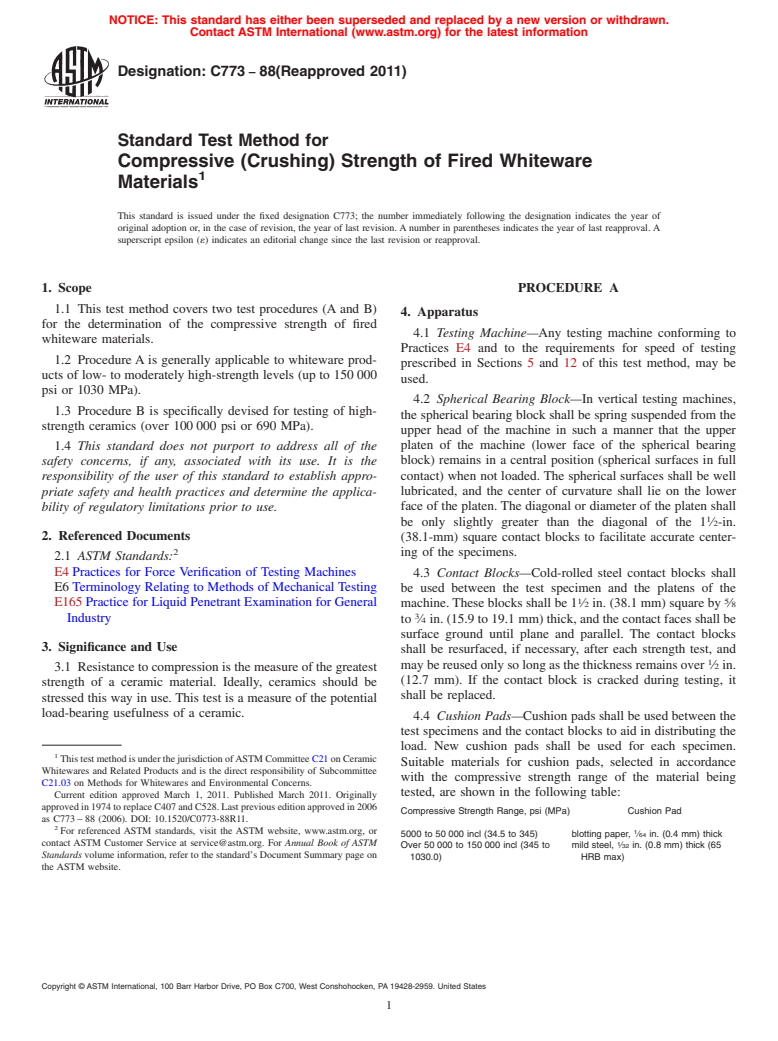
Resistance to compression is the measure of the greatest strength of a ceramic material. Ideally, ceramics should be stressed this way in use. This test is a measure of the potential load-bearing usefulness of a ceramic.
SCOPE
1.1 This test method covers two test procedures (A and B) for the determination of the compressive strength of fired whiteware materials.
1.2 Procedure A is generally applicable to whiteware products of low- to moderately high-strength levels (up to 150 000 psi or 1030 MPa).
1.3 Procedure B is specifically devised for testing of high-strength ceramics (over 100 000 psi or 690 MPa).
1.4 This standard does not purport to address all of the safety concerns, if any, associated with its use. It is the responsibility of the user of this standard to establish appropriate safety and health practices and determine the applicability of regulatory limitations prior to use.
General Information
Relations
Standards Content (Sample)
NOTICE: This standard has either been superseded and replaced by a new version or withdrawn.
Contact ASTM International (www.astm.org) for the latest information
Designation: C773 − 88(Reapproved 2011)
Standard Test Method for
Compressive (Crushing) Strength of Fired Whiteware
1
Materials
This standard is issued under the fixed designation C773; the number immediately following the designation indicates the year of
original adoption or, in the case of revision, the year of last revision. A number in parentheses indicates the year of last reapproval. A
superscript epsilon (´) indicates an editorial change since the last revision or reapproval.
1. Scope PROCEDURE A
1.1 This test method covers two test procedures (A and B)
4. Apparatus
for the determination of the compressive strength of fired
4.1 Testing Machine—Any testing machine conforming to
whiteware materials.
Practices E4 and to the requirements for speed of testing
1.2 Procedure A is generally applicable to whiteware prod-
prescribed in Sections 5 and 12 of this test method, may be
ucts of low- to moderately high-strength levels (up to 150 000
used.
psi or 1030 MPa).
4.2 Spherical Bearing Block—In vertical testing machines,
1.3 Procedure B is specifically devised for testing of high-
the spherical bearing block shall be spring suspended from the
strength ceramics (over 100 000 psi or 690 MPa).
upper head of the machine in such a manner that the upper
1.4 This standard does not purport to address all of the platen of the machine (lower face of the spherical bearing
block) remains in a central position (spherical surfaces in full
safety concerns, if any, associated with its use. It is the
responsibility of the user of this standard to establish appro- contact) when not loaded. The spherical surfaces shall be well
lubricated, and the center of curvature shall lie on the lower
priate safety and health practices and determine the applica-
bility of regulatory limitations prior to use. face of the platen. The diagonal or diameter of the platen shall
1
be only slightly greater than the diagonal of the 1 ⁄2-in.
2. Referenced Documents
(38.1-mm) square contact blocks to facilitate accurate center-
2
ing of the specimens.
2.1 ASTM Standards:
E4 Practices for Force Verification of Testing Machines
4.3 Contact Blocks—Cold-rolled steel contact blocks shall
E6 Terminology Relating to Methods of Mechanical Testing
be used between the test specimen and the platens of the
1 5
E165 Practice for Liquid Penetrant Examination for General
machine. These blocks shall be 1 ⁄2 in. (38.1 mm) square by ⁄8
3
Industry
to ⁄4 in. (15.9 to 19.1 mm) thick, and the contact faces shall be
surface ground until plane and parallel. The contact blocks
3. Significance and Use
shall be resurfaced, if necessary, after each strength test, and
1
may be reused only so long as the thickness remains over ⁄2 in.
3.1 Resistance to compression is the measure of the greatest
(12.7 mm). If the contact block is cracked during testing, it
strength of a ceramic material. Ideally, ceramics should be
shall be replaced.
stressed this way in use. This test is a measure of the potential
load-bearing usefulness of a ceramic.
4.4 Cushion Pads—Cushion pads shall be used between the
test specimens and the contact blocks to aid in distributing the
load. New cushion pads shall be used for each specimen.
1
ThistestmethodisunderthejurisdictionofASTMCommitteeC21onCeramic
Suitable materials for cushion pads, selected in accordance
Whitewares and Related Products and is the direct responsibility of Subcommittee
with the compressive strength range of the material being
C21.03 on Methods for Whitewares and Environmental Concerns.
tested, are shown in the following table:
Current edition approved March 1, 2011. Published March 2011. Originally
approvedin1974toreplaceC407andC528.Lastpreviouseditionapprovedin2006
Compressive Strength Range, psi (MPa) Cushion Pad
as C773 – 88 (2006). DOI: 10.1520/C0773-88R11.
2
For referenced ASTM standards, visit the ASTM website, www.astm.org, or 1
5000 to 50 000 incl (34.5 to 345) blotting paper, ⁄64 in. (0.4 mm) thick
contact ASTM Customer Service at service@astm.org. For Annual Book of ASTM 1
Over 50 000 to 150 000 incl (345 to mild steel, ⁄32 in. (0.8 mm) thick (65
Standards volume information, refer to the standard’s Document Summary page on
1030.0) HRB max)
the ASTM website.
Copyright © ASTM International, 100 Barr Harbor Drive, PO Box C700, West Conshohocken, PA 19428-2959. United States
1
---------------------- Page: 1 ----------------------
C773 − 88 (2011)
TABLE 1 Typical Loading Rates to Cause Failure in 1 min NOTE 1—It is desirable to include details of the origin of the specimen
and subsequent treatment.
NOTE 1—The loading rate of 16 000 lbf/min (70 kN/min) shall be used
for the first three tests of an unknown material to determine the general
8. Precision and Bias
strength classification group. Some specimens crack before ultimate
8.1 Interlaboratory Test Data—An interlaboratory
...
Questions, Comments and Discussion
Ask us and Technical Secretary will try to provide an answer. You can facilitate discussion about the standard in here.