


ASTM F1079-87(2014)
(Specification)Standard Specification for Inserted and Noninserted Surgical Scissors
Standard Specification for Inserted and Noninserted Surgical Scissors
ABSTRACT
This specification covers the general workmanship aspects of inserted and noninserted 410, 410K, 416, 420, 420A, and 420B martensitic stainless steel scissors intended for reuse in surgery. Inserts should be made of stellite, tungsten carbide, or other suitable materials. The instruments should conform to the required values of corrosion resistance cutting ability, Rockwell hardness, and physical properties after passivation and heat treatment. The products should also have finger rings, joints, cutting edges, pivot screws, and finish that are of the required quality.
SCOPE
1.1 This specification covers general workmanship aspects of inserted and noninserted stainless steel scissors fabricated from stainless steel and intended for reuse in surgery.
1.2 The following safety hazards caveat pertains only to the test method described in this specification: This standard does not purport to address all of the safety concerns, if any, associated with its use. It is the responsibility of the user of this standard to establish appropriate safety and health practices and determine the applicability of regulatory limitations prior to use.
General Information
Buy Standard

Standards Content (Sample)
NOTICE: This standard has either been superseded and replaced by a new version or withdrawn.
Contact ASTM International (www.astm.org) for the latest information
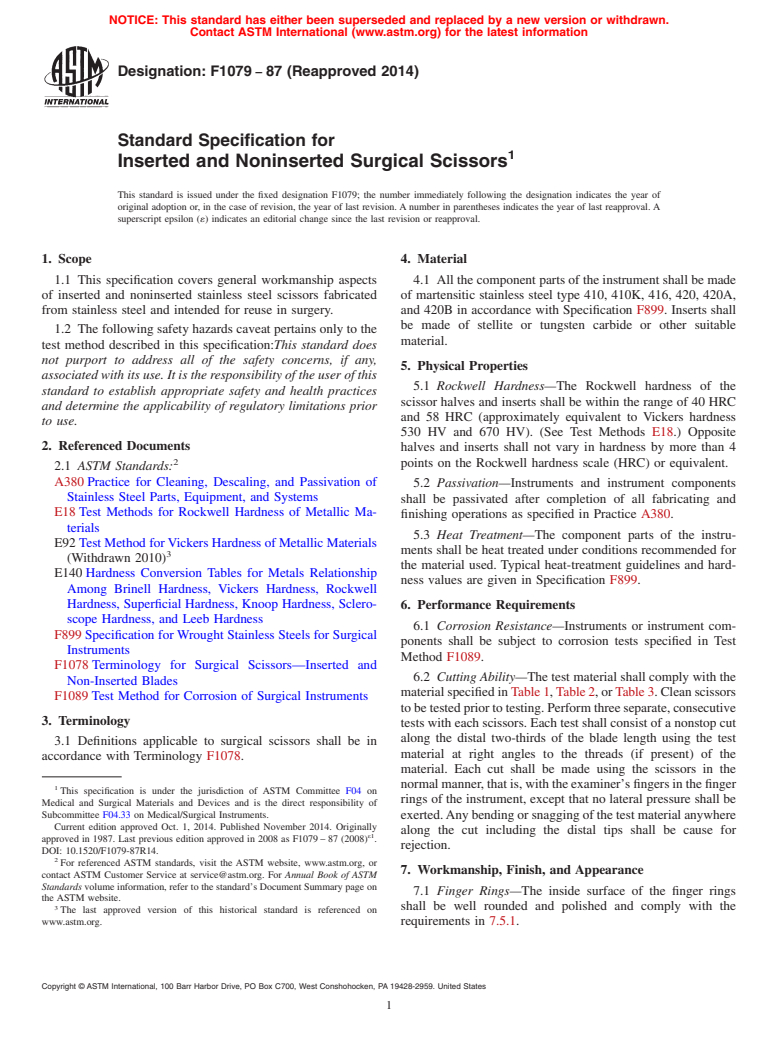
Designation:F1079 −87 (Reapproved 2014)
Standard Specification for
Inserted and Noninserted Surgical Scissors
This standard is issued under the fixed designation F1079; the number immediately following the designation indicates the year of
original adoption or, in the case of revision, the year of last revision. A number in parentheses indicates the year of last reapproval. A
superscript epsilon (´) indicates an editorial change since the last revision or reapproval.
1. Scope 4. Material
1.1 This specification covers general workmanship aspects 4.1 All the component parts of the instrument shall be made
of inserted and noninserted stainless steel scissors fabricated of martensitic stainless steel type 410, 410K, 416, 420, 420A,
from stainless steel and intended for reuse in surgery. and 420B in accordance with Specification F899. Inserts shall
be made of stellite or tungsten carbide or other suitable
1.2 The following safety hazards caveat pertains only to the
material.
test method described in this specification:This standard does
not purport to address all of the safety concerns, if any,
5. Physical Properties
associatedwithitsuse.Itistheresponsibilityoftheuserofthis
5.1 Rockwell Hardness—The Rockwell hardness of the
standard to establish appropriate safety and health practices
scissor halves and inserts shall be within the range of 40 HRC
and determine the applicability of regulatory limitations prior
and 58 HRC (approximately equivalent to Vickers hardness
to use.
530 HV and 670 HV). (See Test Methods E18.) Opposite
2. Referenced Documents
halves and inserts shall not vary in hardness by more than 4
points on the Rockwell hardness scale (HRC) or equivalent.
2.1 ASTM Standards:
A380 Practice for Cleaning, Descaling, and Passivation of
5.2 Passivation—Instruments and instrument components
Stainless Steel Parts, Equipment, and Systems
shall be passivated after completion of all fabricating and
E18 Test Methods for Rockwell Hardness of Metallic Ma-
finishing operations as specified in Practice A380.
terials
5.3 Heat Treatment—The component parts of the instru-
E92 Test Method for Vickers Hardness of Metallic Materials
ments shall be heat treated under conditions recommended for
(Withdrawn 2010)
the material used. Typical heat-treatment guidelines and hard-
E140 Hardness Conversion Tables for Metals Relationship
ness values are given in Specification F899.
Among Brinell Hardness, Vickers Hardness, Rockwell
Hardness, Superficial Hardness, Knoop Hardness, Sclero-
6. Performance Requirements
scope Hardness, and Leeb Hardness
6.1 Corrosion Resistance—Instruments or instrument com-
F899 Specification for Wrought Stainless Steels for Surgical
ponents shall be subject to corrosion tests specified in Test
Instruments
Method F1089.
F1078 Terminology for Surgical Scissors—Inserted and
6.2 CuttingAbility—The test material shall comply with the
Non-Inserted Blades
materialspecifiedinTable1,Table2,orTable3.Cleanscissors
F1089 Test Method for Corrosion of Surgical Instruments
tobetestedpriortotesting.Performthreeseparate,consecutive
3. Terminology
tests with each scissors. Each test shall consist of a nonstop cut
along the distal two-thirds of the blade length using the test
3.1 Definitions applicable to surgical scissors shall be in
material at right angles to the threads (if present) of the
accordance with Terminology F1078.
material. Each cut shall be made using the scissors in the
normalmanner,thatis,withtheexaminer’sfingersinthefinger
This specification is under the jurisdiction of ASTM Committee F04 on
rings of the instrument, except that no lateral pressure shall be
Medical and Surgical Materials and Devices and is the direct responsibility of
Subcommittee F04.33 on Medical/Surgical Instruments.
exerted.Anybendingorsnaggingofthetestmaterialanywhere
Current edition approved Oct. 1, 2014. Published November 2014. Originally
along the cut including the distal tips shall be cause for
ε1
approved in 1987. Last previous edition approved in 2008 as F1079 – 87 (2008) .
rejection.
DOI: 10.1520/F1079-87R14.
For referenced ASTM standards, visit the ASTM we
...
This document is not an ASTM standard and is intended only to provide the user of an ASTM standard an indication of what changes have been made to the previous version. Because
it may not be technically possible to adequately depict all changes accurately, ASTM recommends that users consult prior editions as appropriate. In all cases only the current version
of the standard as published by ASTM is to be considered the official document.
´1
Designation: F1079 − 87 (Reapproved 2008) F1079 − 87 (Reapproved 2014)
Standard Specification for
Inserted and Noninserted Surgical Scissors
This standard is issued under the fixed designation F1079; the number immediately following the designation indicates the year of
original adoption or, in the case of revision, the year of last revision. A number in parentheses indicates the year of last reapproval. A
superscript epsilon (´) indicates an editorial change since the last revision or reapproval.
ε NOTE—Editorial changes were made throughout in June 2008.
1. Scope
1.1 This specification covers general workmanship aspects of inserted and noninserted stainless steel scissors fabricated from
stainless steel and intended for reuse in surgery.
1.2 The following safety hazards caveat pertains only to the test method described in this specification:This standard does not
purport to address all of the safety concerns, if any, associated with its use. It is the responsibility of the user of this standard to
establish appropriate safety and health practices and determine the applicability of regulatory limitations prior to use.
2. Referenced Documents
2.1 ASTM Standards:
A380 Practice for Cleaning, Descaling, and Passivation of Stainless Steel Parts, Equipment, and Systems
E18 Test Methods for Rockwell Hardness of Metallic Materials
E92 Test Method for Vickers Hardness of Metallic Materials (Withdrawn 2010)
E140 Hardness Conversion Tables for Metals Relationship Among Brinell Hardness, Vickers Hardness, Rockwell Hardness,
Superficial Hardness, Knoop Hardness, Scleroscope Hardness, and Leeb Hardness
F899 Specification for Wrought Stainless Steels for Surgical Instruments
F1078 Terminology for Surgical Scissors—Inserted and Non-Inserted Blades
F1089 Test Method for Corrosion of Surgical Instruments
3. Terminology
3.1 Definitions applicable to surgical scissors shall be in accordance with Terminology F1078.
4. Material
4.1 All the component parts of the instrument shall be made of martensitic stainless steel type 410, 410K, 416, 420, 420A, and
420B in accordance with Specification F899. Inserts shall be made of stellite or tungsten carbide or other suitable material.
5. Physical Properties
5.1 Rockwell Hardness—The Rockwell hardness of the scissor halves and inserts shall be within the range of 40 HRC and 58
HRC (approximately equivalent to Vickers hardness 530 HV and 670 HV). (See Test Methods E18.) Opposite halves and inserts
shall not vary in hardness by more than 4 points on the Rockwell hardness scale (HRC) or equivalent.
5.2 Passivation—Instruments and instrument components shall be passivated after completion of all fabricating and finishing
operations as specified in Practice A380.
5.3 Heat Treatment—The component parts of the instruments shall be heat treated under conditions recommended for the
material used. Typical heat-treatment guidelines and hardness values are given in Specification F899.
This specification is under the jurisdiction of ASTM Committee F04 on Medical and Surgical Materials and Devices and is the direct responsibility of Subcommittee
F04.33 on Medical/Surgical Instruments.
Current edition approved Feb. 1, 2008Oct. 1, 2014. Published March 2008November 2014. Originally approved in 1987. Last previous edition approved in 20022008 as
ε1
F1079 – 87 (2002).(2008) . DOI: 10.1520/F1079-87R08E01.10.1520/F1079-87R14.
For referenced ASTM standards, visit the ASTM website, www.astm.org, or contact ASTM Customer Service at service@astm.org. For Annual Book of ASTM Standards
volume information, refer to the standard’s Document Summary page on the ASTM website.
The last approved version of this historical standard is referenced on www.astm.org.
Copyright © ASTM International, 100 Barr Harbor Drive, PO Box C700, West Conshohocken, PA 19428-2959. United States
F1079 − 87 (2014)
6. Performance Requirements
6.1 Corrosion Resistance—Instruments or instrument components shall be subject to corrosion tests specified in Test Method
F1089.
6.2 Cutting Ability—The test material sha
...
Questions, Comments and Discussion
Ask us and Technical Secretary will try to provide an answer. You can facilitate discussion about the standard in here.