

ASTM D2143-21
(Test Method)Standard Test Method for Cyclic Pressure Strength of Reinforced, Thermosetting Plastic Pipe
General Information
- Abstract
SIGNIFICANCE AND USE
5.1 The values obtained by this test method are applicable only to conditions that specifically duplicate the procedures used.
5.2 After the regression characteristics of a pipe material and manufacturing process have been determined by this test method, one pressure may be used for quality-control purposes. This pressure shall be one of the points used in the original determination and be agreed upon between the individuals concerned.
5.3 This test method deals with cyclic internal pressure performance of a pipe and omits creep and nonrecoverable deformation measurements.
5.4 For determination of the cyclic hydrostatic design basis using data from this test method see Practice D2992.
5.5 In the application of the following test requirements and recommendations it is assumed that test specimens of a given sample of pipe are truly representative of that material and manufacturing process. In tests conducted to show the effect of temperature and pressures on the life span of the pipe, great care must be taken to ensure that the specimens being tested are representative of the group being studied. Departure from this assumption could introduce discrepancies that are greater than those introduced by departure from the details of the procedure outlined in this test method.
SCOPE
1.1 This test method covers the determination of the failure characteristics of reinforced plastic pipe when subjected to cyclic internal hydraulic pressure. It is limited to pipe in which the ratio of outside diameter to wall thickness is 10:1 or more.
1.2 The values stated in inch-pound units are to be regarded as the standard. The values in parentheses are for information only.
1.3 This standard does not purport to address all of the safety concerns, if any, associated with its use. It is the responsibility of the user of this standard to establish appropriate safety, health, and environmental practices and determine the applicability of regulatory limitations prior to use.
Note 1: There is no known ISO equivalent to this standard.
1.4 This international standard was developed in accordance with internationally recognized principles on standardization established in the Decision on Principles for the Development of International Standards, Guides and Recommendations issued by the World Trade Organization Technical Barriers to Trade (TBT) Committee.
- Status
- Published
- Publication Date
- 31-Mar-2021
- Technical Committee
- D20 - Plastics
Buy Documents

ASTM D2143-21 - Standard Test Method for Cyclic Pressure Strength of Reinforced, Thermosetting Plastic Pipe
REDLINE ASTM D2143-21 - Standard Test Method for Cyclic Pressure Strength of Reinforced, Thermosetting Plastic Pipe
Overview
ASTM D2143-21: Standard Test Method for Cyclic Pressure Strength of Reinforced, Thermosetting Plastic Pipe provides a consistent method for determining the failure characteristics of reinforced plastic pipe when subjected to cyclic internal hydraulic pressure. This test method is specifically applicable to pipe with an outside diameter to wall thickness ratio of 10:1 or more. Developed by ASTM, it is widely recognized for establishing quality control benchmarks and supporting the hydrostatic and pressure design basis for fiberglass-reinforced thermosetting resin piping systems.
The standard ensures pipes can withstand repeated pressure cycles without premature failure, which is key in assessing their long-term durability for various industrial and municipal applications.
Key Topics
- Cyclic Pressure Testing: The primary focus is to test reinforced thermosetting plastic pipes by exposing specimens to varying levels of cyclic internal hydraulic pressure and monitoring the number of cycles to failure.
- Applicable Pipe Types: Restricted to pipes where the ratio of outside diameter to wall thickness is at least 10:1, which commonly includes many types of fiberglass-reinforced pipes.
- Failure Criteria: The standard defines failure as any form of fluid transmission through the pipe wall, including wall fracture, localized leaking, or weeping, detectable using a failure detector.
- Temperature and Pressure Control: Test procedures use controlled test fluids-typically saltwater or municipal water-and maintain strict temperature tolerances to replicate service conditions.
- Data Use: Results from this method serve for quality control and assist in determining cyclic hydrostatic design basis when used in conjunction with related standards such as ASTM D2992.
- Safety and Representation: The standard stresses the importance of appropriate safety, health, and environmental practices and the need to ensure tested specimens accurately represent the material and manufacturing process.
Applications
ASTM D2143-21 has significant practical value for industries and sectors where reinforced thermosetting plastic pipes are subjected to fluctuating internal pressures, such as:
- Water and Wastewater Infrastructure: Ensuring the long-term reliability of fiberglass and other reinforced plastic pipes in municipal supply and sewer systems.
- Industrial Pipelines: Supporting the design and quality control for chemical processing plants, where cyclic pressure loads are common.
- Quality Assurance: Enabling manufacturers to set and confirm production quality targets by using cyclic pressure tests as part of their routine pipeline quality management programs.
- Design Basis Confirmation: Supplying core data for the calculation of cyclic hydrostatic design basis, influencing safe design limits and expected service life.
- Research and Development: Providing a standard approach for evaluating new pipe materials or manufacturing processes before widespread adoption.
Related Standards
Several related standards complement ASTM D2143-21 for comprehensive testing and classification of reinforced plastic piping:
- ASTM D2992: Practice for Obtaining Hydrostatic or Pressure Design Basis for “Fiberglass” (Glass-Fiber-Reinforced Thermosetting-Resin) Pipe and Fittings, used for statistical calculations and extended design analysis.
- ASTM D618: Practice for Conditioning Plastics for Testing, referenced for preconditioning specimens.
- ASTM D3567: Practice for Determining Dimensions of “Fiberglass” Pipe and Fittings, ensuring accurate dimensional measurement before testing.
Note: There is no known ISO equivalent for ASTM D2143-21, making this standard particularly important for practitioners and manufacturers who require internationally recognized guidelines specific to cyclic pressure strength of reinforced thermosetting plastic pipes.
Relevant keywords: cyclic pressure strength, reinforced thermosetting plastic pipe, ASTM D2143, fiberglass pipe, hydraulic pressure testing, pipe failure, quality control, pipe design basis, long-term pipe durability.
Relations
- Effective Date
- 01-Apr-2012
- Effective Date
- 01-Dec-2011
- Effective Date
- 01-Nov-2008
- Effective Date
- 15-Oct-2006
- Effective Date
- 15-Oct-2006
- Effective Date
- 01-Nov-2005
- Effective Date
- 10-Nov-2002
- Effective Date
- 10-Jun-2001
- Effective Date
- 10-Jun-2001
- Effective Date
- 10-Nov-2000
- Effective Date
- 10-Nov-1997
Buy Documents
ASTM D2143-21 - Standard Test Method for Cyclic Pressure Strength of Reinforced, Thermosetting Plastic Pipe
REDLINE ASTM D2143-21 - Standard Test Method for Cyclic Pressure Strength of Reinforced, Thermosetting Plastic Pipe
Get Certified
Connect with accredited certification bodies for this standard

Institut za varilstvo d.o.o. (Welding Institute)
Slovenia's leading welding institute since 1952. ISO 3834, EN 1090, pressure equipment certification, NDT personnel, welder qualification. Only IIW Au
Sponsored listings
Frequently Asked Questions
ASTM D2143-21 is a standard published by ASTM International. Its full title is "Standard Test Method for Cyclic Pressure Strength of Reinforced, Thermosetting Plastic Pipe". This standard covers: SIGNIFICANCE AND USE 5.1 The values obtained by this test method are applicable only to conditions that specifically duplicate the procedures used. 5.2 After the regression characteristics of a pipe material and manufacturing process have been determined by this test method, one pressure may be used for quality-control purposes. This pressure shall be one of the points used in the original determination and be agreed upon between the individuals concerned. 5.3 This test method deals with cyclic internal pressure performance of a pipe and omits creep and nonrecoverable deformation measurements. 5.4 For determination of the cyclic hydrostatic design basis using data from this test method see Practice D2992. 5.5 In the application of the following test requirements and recommendations it is assumed that test specimens of a given sample of pipe are truly representative of that material and manufacturing process. In tests conducted to show the effect of temperature and pressures on the life span of the pipe, great care must be taken to ensure that the specimens being tested are representative of the group being studied. Departure from this assumption could introduce discrepancies that are greater than those introduced by departure from the details of the procedure outlined in this test method. SCOPE 1.1 This test method covers the determination of the failure characteristics of reinforced plastic pipe when subjected to cyclic internal hydraulic pressure. It is limited to pipe in which the ratio of outside diameter to wall thickness is 10:1 or more. 1.2 The values stated in inch-pound units are to be regarded as the standard. The values in parentheses are for information only. 1.3 This standard does not purport to address all of the safety concerns, if any, associated with its use. It is the responsibility of the user of this standard to establish appropriate safety, health, and environmental practices and determine the applicability of regulatory limitations prior to use. Note 1: There is no known ISO equivalent to this standard. 1.4 This international standard was developed in accordance with internationally recognized principles on standardization established in the Decision on Principles for the Development of International Standards, Guides and Recommendations issued by the World Trade Organization Technical Barriers to Trade (TBT) Committee.
SIGNIFICANCE AND USE 5.1 The values obtained by this test method are applicable only to conditions that specifically duplicate the procedures used. 5.2 After the regression characteristics of a pipe material and manufacturing process have been determined by this test method, one pressure may be used for quality-control purposes. This pressure shall be one of the points used in the original determination and be agreed upon between the individuals concerned. 5.3 This test method deals with cyclic internal pressure performance of a pipe and omits creep and nonrecoverable deformation measurements. 5.4 For determination of the cyclic hydrostatic design basis using data from this test method see Practice D2992. 5.5 In the application of the following test requirements and recommendations it is assumed that test specimens of a given sample of pipe are truly representative of that material and manufacturing process. In tests conducted to show the effect of temperature and pressures on the life span of the pipe, great care must be taken to ensure that the specimens being tested are representative of the group being studied. Departure from this assumption could introduce discrepancies that are greater than those introduced by departure from the details of the procedure outlined in this test method. SCOPE 1.1 This test method covers the determination of the failure characteristics of reinforced plastic pipe when subjected to cyclic internal hydraulic pressure. It is limited to pipe in which the ratio of outside diameter to wall thickness is 10:1 or more. 1.2 The values stated in inch-pound units are to be regarded as the standard. The values in parentheses are for information only. 1.3 This standard does not purport to address all of the safety concerns, if any, associated with its use. It is the responsibility of the user of this standard to establish appropriate safety, health, and environmental practices and determine the applicability of regulatory limitations prior to use. Note 1: There is no known ISO equivalent to this standard. 1.4 This international standard was developed in accordance with internationally recognized principles on standardization established in the Decision on Principles for the Development of International Standards, Guides and Recommendations issued by the World Trade Organization Technical Barriers to Trade (TBT) Committee.
ASTM D2143-21 is classified under the following ICS (International Classification for Standards) categories: 23.040.20 - Plastics pipes. The ICS classification helps identify the subject area and facilitates finding related standards.
ASTM D2143-21 has the following relationships with other standards: It is inter standard links to ASTM D2992-12, ASTM D3567-97(2011), ASTM D618-08, ASTM D3567-97(2006), ASTM D2992-06, ASTM D618-05, ASTM D3567-97(2002), ASTM D2992-01, ASTM D2992-96e1, ASTM D618-00, ASTM D3567-97. Understanding these relationships helps ensure you are using the most current and applicable version of the standard.
ASTM D2143-21 is available in PDF format for immediate download after purchase. The document can be added to your cart and obtained through the secure checkout process. Digital delivery ensures instant access to the complete standard document.
Standards Content (Sample)
This international standard was developed in accordance with internationally recognized principles on standardization established in the Decision on Principles for the
Development of International Standards, Guides and Recommendations issued by the World Trade Organization Technical Barriers to Trade (TBT) Committee.
Designation: D2143 − 21
Standard Test Method for
Cyclic Pressure Strength of Reinforced, Thermosetting
Plastic Pipe
This standard is issued under the fixed designation D2143; the number immediately following the designation indicates the year of
original adoption or, in the case of revision, the year of last revision. A number in parentheses indicates the year of last reapproval. A
superscript epsilon (´) indicates an editorial change since the last revision or reapproval.
1. Scope* 3. Terminology
3.1 Definitions of Terms Specific to This Standard:
1.1 This test method covers the determination of the failure
3.1.1 failure—the transmission of the test fluid through the
characteristics of reinforced plastic pipe when subjected to
pipe wall in any manner, whether it be wall fracture, localized
cyclic internal hydraulic pressure. It is limited to pipe in which
leaking, or weeping at a distance greater than one diameter
the ratio of outside diameter to wall thickness is 10:1 or more.
from the end closure (specimens failing within one diameter of
1.2 The values stated in inch-pound units are to be regarded
the end closure shall be discarded).
as the standard. The values in parentheses are for information
3.1.2 failure detector—a devise that measures the electrical
only.
resistance between the test fluid and a conductive material,
1.3 This standard does not purport to address all of the
wrapped around the circumference of the test specimen, and
safety concerns, if any, associated with its use. It is the
which will indicate failure when 1) the resistance is lowered to
responsibility of the user of this standard to establish appro-
a range from 10 to 20 meg-ohm or 2) for the case of municipal
priate safety, health, and environmental practices and deter-
water, when the first drop of fluid has passed through the wall
mine the applicability of regulatory limitations prior to use.
of the specimen.
NOTE 1—There is no known ISO equivalent to this standard.
3.1.3 localized leaking—failure that occurs as small frac-
tures (one or more in a test specimen) that permit the test fluid
1.4 This international standard was developed in accor-
to be transferred at a rate that is measured by the failure
dance with internationally recognized principles on standard-
detector.
ization established in the Decision on Principles for the
Development of International Standards, Guides and Recom-
3.1.4 weeping—a general transmission of the test fluid
mendations issued by the World Trade Organization Technical
through the pipe, without visible fracture, at a sufficient rate to
Barriers to Trade (TBT) Committee.
be measured by the failure dectector, or in the case of larger
magnitudes of fluid transmission appear to be moisture con-
2. Referenced Documents densation on the specimen.
3.1.5 wall fracture—failure by a break in the pipe wall
2.1 ASTM Standards:
causing immediate loss of test fluid and continued loss at
D618 Practice for Conditioning Plastics for Testing
essentially no pressure.
D2992 Practice for Obtaining Hydrostatic or Pressure De-
sign Basis for “Fiberglass” (Glass-Fiber-Reinforced
4. Summary of Test Method
Thermosetting-Resin) Pipe and Fittings
4.1 This test method consists of exposing pipe specimens to
D3567 Practice for Determining Dimensions of “Fiberglass”
(Glass-Fiber-Reinforced Thermosetting Resin) Pipe and cyclic internal pressures at several different pressure levels and
Fittings measuring the cycles to failure at these different levels. Test
temperatures are obtained by circulating salt water or munici-
pal water through the specimens.
This test method is under the jurisdiction ofASTM Committee D20 on Plastics
5. Significance and Use
and is the direct responsibility of Subcommittee D20.23 on Reinforced Thermoset-
ting Resin Piping Systems and Chemical Equipment.
5.1 The values obtained by this test method are applicable
Current edition approved April 1, 2021. Published April 2021. Originally
only to conditions that specifically duplicate the procedures
approved in 1963. Last previous edition approved in 2015 as D2143 – 15. DOI:
used.
10.1520/D2143-21.
For referenced ASTM standards, visit the ASTM website, www.astm.org, or
5.2 After the regression characteristics of a pipe material
contact ASTM Customer Service at service@astm.org. For Annual Book of ASTM
and manufacturing process have been determined by this test
Standards volume information, refer to the standard’s Document Summary page on
the ASTM website. method,onepressuremaybeusedforquality-controlpurposes.
*A Summary of Changes section appears at the end of this standard
Copyright © ASTM International, 100 Barr Harbor Drive, PO Box C700, West Conshohocken, PA 19428-2959. United States
D2143 − 21
This pressure shall be one of the points used in the original an accumulator which acts as a fluid separator transferring the
determination and be agreed upon between the individuals pressurizing medium to the salt solution or municipal water.
concerned. The solenoid is operated with equal on and off times by an
electric pulsator.
5.3 This test method deals with cyclic internal pressure
6.1.2 Test Fluid—The test fluid shall be a 2 % aqueous
performance of a pipe and omits creep and nonrecoverable
sodium chloride solution when salt water or municipal water is
deformation measurements.
used.
5.4 For determination of the cyclic hydrostatic design basis
6.1.3 Temperature Bath—Athermostatically controlled bath
using data from this test method see Practice D2992.
coupled into the test fluid, which maintains specimen tempera-
5.5 In the application of the following test requirements and ture to within 65°F (63°C). The circulation of this fluid is
pumped on the off portion of the pressure cycle.
recommendations it is assumed that test specimens of a given
sample of pipe are truly representative of that material and 6.1.4 Pressure Gauges—Pressure gauges having a precision
of not less than 1 % of full-scale deflection with a maximum
manufacturing process. In tests conducted to show the effect of
temperature and pressures on the life span of the pipe, great indicating hand. The pres
...
This document is not an ASTM standard and is intended only to provide the user of an ASTM standard an indication of what changes have been made to the previous version. Because
it may not be technically possible to adequately depict all changes accurately, ASTM recommends that users consult prior editions as appropriate. In all cases only the current version
of the standard as published by ASTM is to be considered the official document.
Designation: D2143 − 15 D2143 − 21
Standard Test Method for
Cyclic Pressure Strength of Reinforced, Thermosetting
Plastic Pipe
This standard is issued under the fixed designation D2143; the number immediately following the designation indicates the year of
original adoption or, in the case of revision, the year of last revision. A number in parentheses indicates the year of last reapproval. A
superscript epsilon (´) indicates an editorial change since the last revision or reapproval.
1. Scope*
1.1 This test method covers the determination of the failure characteristics of reinforced plastic pipe when subjected to cyclic
internal hydraulic pressure. It is limited to pipe in which the ratio of outside diameter to wall thickness is 10:1 or more.
1.2 The values stated in inch-pound units are to be regarded as the standard. The values in parentheses are for information only.
1.3 This standard does not purport to address all of the safety concerns, if any, associated with its use. It is the responsibility
of the user of this standard to establish appropriate safety, health, and environmental practices and determine the applicability of
regulatory limitations prior to use.
NOTE 1—There is no known ISO equivalent to this standard.
1.4 This international standard was developed in accordance with internationally recognized principles on standardization
established in the Decision on Principles for the Development of International Standards, Guides and Recommendations issued
by the World Trade Organization Technical Barriers to Trade (TBT) Committee.
2. Referenced Documents
2.1 ASTM Standards:
D618 Practice for Conditioning Plastics for Testing
D2992 Practice for Obtaining Hydrostatic or Pressure Design Basis for “Fiberglass” (Glass-Fiber-Reinforced Thermosetting-
Resin) Pipe and Fittings
D3567 Practice for Determining Dimensions of “Fiberglass” (Glass-Fiber-Reinforced Thermosetting Resin) Pipe and Fittings
3. Terminology
3.1 Definitions of Terms Specific to This Standard:
3.1.1 failure—the transmission of the test fluid through the pipe wall in any manner, whether it be wall fracture, localized leaking,
or weeping at a distance greater than one diameter from the end closure (specimens failing within one diameter of the end closure
shall be discarded).
3.1.2 failure detector—a devise that measures the electrical resistance between the test fluid and a conductive material, wrapped
This test method is under the jurisdiction of ASTM Committee D20 on Plastics and is the direct responsibility of Subcommittee D20.23 on Reinforced Plastic
Thermosetting Resin Piping Systems and Chemical Equipment.
Current edition approved May 1, 2015April 1, 2021. Published June 2015April 2021. Originally approved in 1963. Last previous edition approved in 20102015 as
D2143 – 00D2143 – 15.(2010). DOI: 10.1520/D2143-15.10.1520/D2143-21.
For referenced ASTM standards, visit the ASTM website, www.astm.org, or contact ASTM Customer Service at service@astm.org. For Annual Book of ASTM Standards
volume information, refer to the standard’s Document Summary page on the ASTM website.
*A Summary of Changes section appears at the end of this standard
Copyright © ASTM International, 100 Barr Harbor Drive, PO Box C700, West Conshohocken, PA 19428-2959. United States
D2143 − 21
around the circumference of the test specimen, and which will indicate failure when 1) the resistance is lowered to a range from
10 to 20 meg-ohm or 2) for the case of municipal water, when the first drop of fluid has passed through the wall of the specimen.
3.1.3 localized leaking—failure that occurs as small fractures (one or more in a test specimen) that permit the test fluid to be
transferred at a rate that is measured by the failure detector.
3.1.4 weeping—a general transmission of the test fluid through the pipe, without visible fracture, at a sufficient rate to be measured
by the failure dectector, or in the case of larger magnitudes of fluid transmission appear to be moisture condensation on the
specimen.
3.1.5 wall fracture—failure by a break in the pipe wall causing immediate loss of test fluid and continued loss at essentially no
pressure.
4. Summary of Test Method
4.1 This test method consists of exposing pipe specimens to cyclic internal pressures at several different pressure levels and
measuring the cycles to failure at these different levels. Test temperatures are obtained by circulating salt water or municipal water
through the specimens.
5. Significance and Use
5.1 The values obtained by this test method are applicable only to conditions that specifically duplicate the procedures used.
5.2 After the regression characteristics of a pipe material and manufacturing process have been determined by this test method,
one pressure may be used for quality-control purposes. This pressure shall be one of the points used in the original determination
and be agreed upon between the individuals concerned.
5.3 This test method deals with cyclic internal pressure performance of a pipe and omits creep and nonrecoverable deformation
measurements.
5.4 For determination of the cyclic hydrostatic design basis using data from this test method see Practice D2992.
5.5 In the application of the following test requirements and recommendations it is assumed that test specimens of a given sample
of pipe are truly representative of that material and manufacturing process. In tests conducted to show the effect of temperature
and pressures on the life span of the pipe, great care must be taken to ensure that the specimens being tested are representative
of the group being studied. Departure from this assumption could introduce discrepancies that are greater than those introduced
by departure from the details of the procedure outlined in this test method.
6. Apparatus
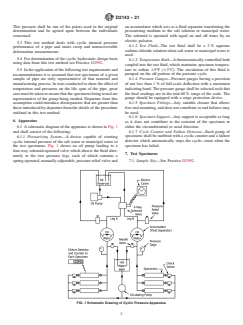
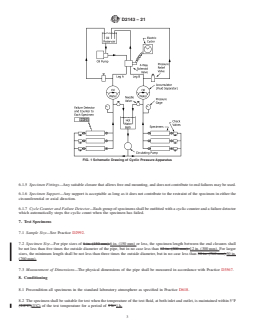
6.1 A schematic diagram of the apparatus is shown in Fig. 1 and shall consist of the following:
6.1.1 Pressurizing System—A device capable of exerting cyclic internal pressure of the salt water or municipal water to the test
specimens. Fig. 1 shows an oil pump leading to a four-way solenoid-operated valve which directs the fluid alternately to the two
pressure legs, each of which contains a spring-operated, manually adjustable, pressure relief valve and an accumulator which acts
as a fluid separator
...