


ASTM B543/B543M-18
(Specification)Standard Specification for Welded Copper and Copper-Alloy Heat Exchanger Tube
Standard Specification for Welded Copper and Copper-Alloy Heat Exchanger Tube
ABSTRACT
This specification covers welded tube of specific copper and various copper alloys of a limited range of diameters, for use in surface condensers, evaporators, heat exchangers, and general engineering applications. The product shall be manufactured by forming the material into a tubular shape on a suitable forming mill. Welding of tube shall be accomplished by forge-welding, fusion-welding, or full finishing that produces a forge weld leaving no crevice in the weld seam visible to the unaided eye. The tube shall conform to tensile strength and yield strength requirements, and shall be subject to expansion, flattening, and reverse bend tests. Mercurous nitrate or ammonia vapor tests shall be required only for selected UNS Numbers of Copper Alloys. Each tube shall be subjected to eddy-current, hydrostatic, and pneumatic tests.
SIGNIFICANCE AND USE
20.1 For purposes of determining compliance with the specified limits for requirements of the properties listed in the following table, an observed value or a calculated value shall be rounded as indicated in accordance with the rounding method of Practice E29.
Property
Rounded Unit for Observed or
Calculated Value
Chemical composition
nearest unit in the last righthand place
of figures
Tensile strength and yield strength
nearest ksi (Nearest 5 MPa)
Grain size: Up to 0.055 mm, incl,
Over 0.055 mm
nearest multiple of 0.005 mm
to the nearst 0.010 mm
Expansion:
Nearest 1 %
SCOPE
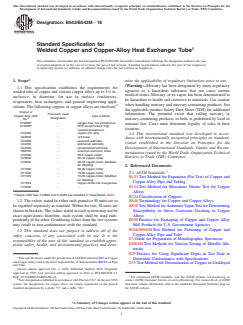
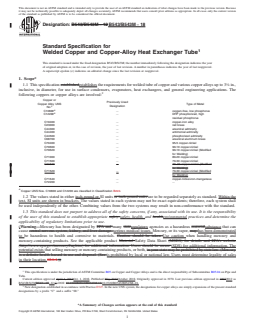
1.1 This specification establishes the requirements for welded tube of copper and various copper alloys up to 31/8 in., inclusive, in diameter, for use in surface condensers, evaporators, heat exchangers, and general engineering applications. The following coppers or copper alloys are involved:2
Copper or
Copper Alloy UNS No.2
Previously Used
Designation
Type of Metal
C10800A
...
oxygen-free, low phosphorus
C12200A
...
DHP phosphorized, high
residual phosphorus
C19400
...
copper-iron alloy
C23000
...
red brass
C44300
...
arsenical admiralty
C44400
...
antimonial admiralty
C44500
...
phosphorized admiralty
C68700
...
arsenical aluminum brass
C70400
...
95-5 copper-nickel
C70600
...
90-10 copper-nickel
C70620
...
90-10 copper-nickel (Modified
for Welding)
C71000
...
80-20 copper-nickel
C71500
...
70-30 copper-nickel
C71520
...
70-30 copper-nickel (Modified
for Welding)
C71640
...
copper-nickel-iron-manganese
C72200
...
...
1.2 The values stated in either inch-pound or SI units are to be regarded separately as standard. Within the text, SI units are shown in brackets. The values stated in each system may not be exact equivalents; therefore, each system shall be used independently of the other. Combining values from the two systems may result in non-conformance with the standard.
1.3 This standard does not purport to address all of the safety concerns, if any, associated with its use. It is the responsibility of the user of this standard to establish appropriate safety, health, and environmental practices and determine the applicability of regulatory limitations prior to use.
(Warning—Mercury has been designated by many regulatory agencies as a hazardous substance that can cause serious medical issues. Mercury, or its vapor, has been demonstrated to be hazardous to health and corrosive to materials. Use caution when handling mercury and mercury-containing products. See the applicable product Safety Data Sheet (SDS) for additional information. The potential exists that selling mercury or mercury-containing products, or both, is prohibited by local or national law. Users must determine legality of sales in their location.
1.4 This international standard was developed in accordance with internationally recognized principles on standardization esta...
General Information
- Status
- Published
- Publication Date
- 30-Sep-2018
- Technical Committee
- B05 - Copper and Copper Alloys
- Drafting Committee
- B05.04 - Pipe and Tube
Relations
- Replaces
ASTM B543/B543M-12 - Standard Specification for Welded Copper and Copper-Alloy Heat Exchanger Tube - Effective Date
- 01-Oct-2018
- Effective Date
- 01-Jan-2024
- Effective Date
- 01-Aug-2019
- Effective Date
- 01-Jan-2019
- Effective Date
- 01-Jun-2018
- Effective Date
- 01-Mar-2018
- Effective Date
- 15-Jul-2016
- Effective Date
- 01-May-2015
- Effective Date
- 01-Feb-2015
- Effective Date
- 01-Jul-2014
- Effective Date
- 01-Dec-2013
- Effective Date
- 01-Jun-2013
- Effective Date
- 15-Nov-2012
- Effective Date
- 01-Oct-2012
- Effective Date
- 01-Oct-2012
Overview
ASTM B543/B543M-18 is the definitive international specification for welded copper and copper-alloy heat exchanger tubes. Developed by ASTM International, this standard details the requirements and guidelines for the production of welded tubes from copper and designated copper alloys, covering tubes with outside diameters up to 3 1/8 inches (inclusive). These tubes are intended for use in surface condensers, evaporators, heat exchangers, and general engineering applications. The standard ensures the product meets quality and performance criteria, including mechanical properties, chemical composition, and testing protocols.
Key Topics
- Material Scope: The specification applies to welded tubes made from a range of copper and copper alloys, each identified by a Unified Numbering System (UNS) designation, such as C10800 (oxygen-free, low phosphorus copper), C12200 (DHP phosphorized copper), C23000 (red brass), C70600 (90-10 copper-nickel), and several others.
- Manufacturing Processes: Tubes included under ASTM B543/B543M-18 may be manufactured by:
- Forming copper or copper-alloy strip into a tube shape
- Joining the seam by forge-welding, fusion-welding, or full finishing
- No Visible Weld Crevice: The weld seam must be finished such that no crevice is visible to the unaided eye, ensuring integrity and leak-tightness, which is vital for heat exchanger performance.
- Mechanical Properties: The standard specifies tensile strength, yield strength, and expansion requirements. Products must undergo expansion, flattening, and reverse bend tests as part of the quality assurance protocol.
- Corrosion Resistance Testing: Select alloys require mercurous nitrate or ammonia vapor tests to assess stress corrosion cracking susceptibility.
- Non-destructive Testing: Every tube is subject to eddy-current testing. Optional hydrostatic and pneumatic tests are available depending on purchaser requirements.
- Dimensional Tolerances: Strict limits are set for diameter, wall thickness, length, and squareness of cut, ensuring precise and consistent tubing for demanding engineering tasks.
- Safety and Compliance: The standard highlights the importance of safe handling, especially regarding hazardous materials like mercury, and requires awareness of local and national regulations.
Applications
Welded copper and copper-alloy heat exchanger tubes produced under ASTM B543/B543M-18 are utilized in several key industrial sectors:
- Power Generation: Tubes are installed in surface condensers and heat exchangers in power plants for efficient thermal management.
- HVAC & Refrigeration: Reliable, corrosion-resistant tubes are essential components in evaporators and condensers used in heating, ventilation, air conditioning, and industrial refrigeration systems.
- Marine & Chemical Processing: Copper-nickel alloys, in particular, are ideal for marine condensers due to their superior resistance to seawater corrosion.
- General Engineering: The specification covers a range of general engineering uses where high-quality, welded copper tubes are needed for reliable heat transfer and corrosion resistance.
- OEM Manufacturing: Many original equipment manufacturers use these standardized tubes for assembling reliable, international-market-ready heat exchange units.
Related Standards
For comprehensive fabrication, testing, and terminology guidance, the following related ASTM and industry standards are frequently referenced in conjunction with ASTM B543/B543M-18:
- ASTM B153: Test Method for Expansion (Pin Test) of Copper and Copper-Alloy Pipe and Tubing
- ASTM B154: Test Method for Mercurous Nitrate Test for Copper Alloys
- ASTM E243: Practice for Electromagnetic (Eddy-Current) Examination of Copper and Copper-Alloy Tubes
- ASTM B224: Classification of Coppers
- ASTM B846: Terminology for Copper and Copper Alloys
- ASTM B968/B968M: Test Method for Flattening
- ASTM E8/E8M: Test Methods for Tension Testing of Metallic Materials
- ASME Boiler and Pressure Vessel Code: For pressure applications and compliance in jurisdictions that require it
Utilizing ASTM B543/B543M-18 ensures quality, reliability, and regulatory compliance when specifying welded copper and copper-alloy tubes for heat exchange and related applications.
Buy Documents
ASTM B543/B543M-18 - Standard Specification for Welded Copper and Copper-Alloy Heat Exchanger Tube
REDLINE ASTM B543/B543M-18 - Standard Specification for Welded Copper and Copper-Alloy Heat Exchanger Tube
Get Certified
Connect with accredited certification bodies for this standard

Element Materials Technology
Materials testing and product certification.

Inštitut za kovinske materiale in tehnologije
Institute of Metals and Technology. Materials testing, metallurgical analysis, NDT.
Sponsored listings
Frequently Asked Questions
ASTM B543/B543M-18 is a technical specification published by ASTM International. Its full title is "Standard Specification for Welded Copper and Copper-Alloy Heat Exchanger Tube". This standard covers: ABSTRACT This specification covers welded tube of specific copper and various copper alloys of a limited range of diameters, for use in surface condensers, evaporators, heat exchangers, and general engineering applications. The product shall be manufactured by forming the material into a tubular shape on a suitable forming mill. Welding of tube shall be accomplished by forge-welding, fusion-welding, or full finishing that produces a forge weld leaving no crevice in the weld seam visible to the unaided eye. The tube shall conform to tensile strength and yield strength requirements, and shall be subject to expansion, flattening, and reverse bend tests. Mercurous nitrate or ammonia vapor tests shall be required only for selected UNS Numbers of Copper Alloys. Each tube shall be subjected to eddy-current, hydrostatic, and pneumatic tests. SIGNIFICANCE AND USE 20.1 For purposes of determining compliance with the specified limits for requirements of the properties listed in the following table, an observed value or a calculated value shall be rounded as indicated in accordance with the rounding method of Practice E29. Property Rounded Unit for Observed or Calculated Value Chemical composition nearest unit in the last righthand place of figures Tensile strength and yield strength nearest ksi (Nearest 5 MPa) Grain size: Up to 0.055 mm, incl, Over 0.055 mm nearest multiple of 0.005 mm to the nearst 0.010 mm Expansion: Nearest 1 % SCOPE 1.1 This specification establishes the requirements for welded tube of copper and various copper alloys up to 31/8 in., inclusive, in diameter, for use in surface condensers, evaporators, heat exchangers, and general engineering applications. The following coppers or copper alloys are involved:2 Copper or Copper Alloy UNS No.2 Previously Used Designation Type of Metal C10800A ... oxygen-free, low phosphorus C12200A ... DHP phosphorized, high residual phosphorus C19400 ... copper-iron alloy C23000 ... red brass C44300 ... arsenical admiralty C44400 ... antimonial admiralty C44500 ... phosphorized admiralty C68700 ... arsenical aluminum brass C70400 ... 95-5 copper-nickel C70600 ... 90-10 copper-nickel C70620 ... 90-10 copper-nickel (Modified for Welding) C71000 ... 80-20 copper-nickel C71500 ... 70-30 copper-nickel C71520 ... 70-30 copper-nickel (Modified for Welding) C71640 ... copper-nickel-iron-manganese C72200 ... ... 1.2 The values stated in either inch-pound or SI units are to be regarded separately as standard. Within the text, SI units are shown in brackets. The values stated in each system may not be exact equivalents; therefore, each system shall be used independently of the other. Combining values from the two systems may result in non-conformance with the standard. 1.3 This standard does not purport to address all of the safety concerns, if any, associated with its use. It is the responsibility of the user of this standard to establish appropriate safety, health, and environmental practices and determine the applicability of regulatory limitations prior to use. (Warning—Mercury has been designated by many regulatory agencies as a hazardous substance that can cause serious medical issues. Mercury, or its vapor, has been demonstrated to be hazardous to health and corrosive to materials. Use caution when handling mercury and mercury-containing products. See the applicable product Safety Data Sheet (SDS) for additional information. The potential exists that selling mercury or mercury-containing products, or both, is prohibited by local or national law. Users must determine legality of sales in their location. 1.4 This international standard was developed in accordance with internationally recognized principles on standardization esta...
ABSTRACT This specification covers welded tube of specific copper and various copper alloys of a limited range of diameters, for use in surface condensers, evaporators, heat exchangers, and general engineering applications. The product shall be manufactured by forming the material into a tubular shape on a suitable forming mill. Welding of tube shall be accomplished by forge-welding, fusion-welding, or full finishing that produces a forge weld leaving no crevice in the weld seam visible to the unaided eye. The tube shall conform to tensile strength and yield strength requirements, and shall be subject to expansion, flattening, and reverse bend tests. Mercurous nitrate or ammonia vapor tests shall be required only for selected UNS Numbers of Copper Alloys. Each tube shall be subjected to eddy-current, hydrostatic, and pneumatic tests. SIGNIFICANCE AND USE 20.1 For purposes of determining compliance with the specified limits for requirements of the properties listed in the following table, an observed value or a calculated value shall be rounded as indicated in accordance with the rounding method of Practice E29. Property Rounded Unit for Observed or Calculated Value Chemical composition nearest unit in the last righthand place of figures Tensile strength and yield strength nearest ksi (Nearest 5 MPa) Grain size: Up to 0.055 mm, incl, Over 0.055 mm nearest multiple of 0.005 mm to the nearst 0.010 mm Expansion: Nearest 1 % SCOPE 1.1 This specification establishes the requirements for welded tube of copper and various copper alloys up to 31/8 in., inclusive, in diameter, for use in surface condensers, evaporators, heat exchangers, and general engineering applications. The following coppers or copper alloys are involved:2 Copper or Copper Alloy UNS No.2 Previously Used Designation Type of Metal C10800A ... oxygen-free, low phosphorus C12200A ... DHP phosphorized, high residual phosphorus C19400 ... copper-iron alloy C23000 ... red brass C44300 ... arsenical admiralty C44400 ... antimonial admiralty C44500 ... phosphorized admiralty C68700 ... arsenical aluminum brass C70400 ... 95-5 copper-nickel C70600 ... 90-10 copper-nickel C70620 ... 90-10 copper-nickel (Modified for Welding) C71000 ... 80-20 copper-nickel C71500 ... 70-30 copper-nickel C71520 ... 70-30 copper-nickel (Modified for Welding) C71640 ... copper-nickel-iron-manganese C72200 ... ... 1.2 The values stated in either inch-pound or SI units are to be regarded separately as standard. Within the text, SI units are shown in brackets. The values stated in each system may not be exact equivalents; therefore, each system shall be used independently of the other. Combining values from the two systems may result in non-conformance with the standard. 1.3 This standard does not purport to address all of the safety concerns, if any, associated with its use. It is the responsibility of the user of this standard to establish appropriate safety, health, and environmental practices and determine the applicability of regulatory limitations prior to use. (Warning—Mercury has been designated by many regulatory agencies as a hazardous substance that can cause serious medical issues. Mercury, or its vapor, has been demonstrated to be hazardous to health and corrosive to materials. Use caution when handling mercury and mercury-containing products. See the applicable product Safety Data Sheet (SDS) for additional information. The potential exists that selling mercury or mercury-containing products, or both, is prohibited by local or national law. Users must determine legality of sales in their location. 1.4 This international standard was developed in accordance with internationally recognized principles on standardization esta...
ASTM B543/B543M-18 is classified under the following ICS (International Classification for Standards) categories: 77.150.30 - Copper products. The ICS classification helps identify the subject area and facilitates finding related standards.
ASTM B543/B543M-18 has the following relationships with other standards: It is inter standard links to ASTM B543/B543M-12, ASTM E8/E8M-24, ASTM B846-19a, ASTM B846-19, ASTM E243-18, ASTM B858-06(2018), ASTM E8/E8M-16, ASTM B224-15, ASTM E8/E8M-15, ASTM B224-14, ASTM E243-13, ASTM E8/E8M-13, ASTM E112-12, ASTM B154-12e1, ASTM B154-12. Understanding these relationships helps ensure you are using the most current and applicable version of the standard.
ASTM B543/B543M-18 is available in PDF format for immediate download after purchase. The document can be added to your cart and obtained through the secure checkout process. Digital delivery ensures instant access to the complete standard document.
Standards Content (Sample)
This international standard was developed in accordance with internationally recognized principles on standardization established in the Decision on Principles for the
Development of International Standards, Guides and Recommendations issued by the World Trade Organization Technical Barriers to Trade (TBT) Committee.
Designation:B543/B543M −18
Standard Specification for
Welded Copper and Copper-Alloy Heat Exchanger Tube
This standard is issued under the fixed designation B543/B543M; the number immediately following the designation indicates the year
of original adoption or, in the case of revision, the year of last revision. A number in parentheses indicates the year of last reapproval.
A superscript epsilon (´) indicates an editorial change since the last revision or reapproval.
1. Scope* mine the applicability of regulatory limitations prior to use.
(Warning—Mercury has been designated by many regulatory
1.1 This specification establishes the requirements for
agencies as a hazardous substance that can cause serious
welded tube of copper and various copper alloys up to 3 ⁄8 in.,
medicalissues.Mercury,oritsvapor,hasbeendemonstratedto
inclusive, in diameter, for use in surface condensers,
be hazardous to health and corrosive to materials. Use caution
evaporators, heat exchangers, and general engineering appli-
2 when handling mercury and mercury-containing products. See
cations. The following coppers or copper alloys are involved:
the applicable product Safety Data Sheet (SDS) for additional
Copper or
Previously Used
information. The potential exists that selling mercury or
Copper Alloy UNS Type of Metal
Designation
No. mercury-containing products, or both, is prohibited by local or
A
C10800 . oxygen-free, low phosphorus
national law. Users must determine legality of sales in their
A
C12200 . DHP phosphorized, high
location.
residual phosphorus
C19400 . copper-iron alloy 1.4 This international standard was developed in accor-
C23000 . red brass
dance with internationally recognized principles on standard-
C44300 . arsenical admiralty
ization established in the Decision on Principles for the
C44400 . antimonial admiralty
C44500 . phosphorized admiralty
Development of International Standards, Guides and Recom-
C68700 . arsenical aluminum brass
mendations issued by the World Trade Organization Technical
C70400 . 95-5 copper-nickel
Barriers to Trade (TBT) Committee.
C70600 . 90-10 copper-nickel
C70620 . 90-10 copper-nickel (Modified
for Welding)
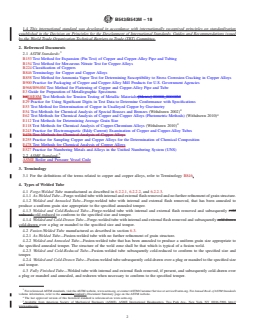
2. Referenced Documents
C71000 . 80-20 copper-nickel
C71500 . 70-30 copper-nickel 2.1 ASTM Standards:
C71520 . 70-30 copper-nickel (Modified
B153 Test Method for Expansion (Pin Test) of Copper and
for Welding)
Copper-Alloy Pipe and Tubing
C71640 . copper-nickel-iron-manganese
C72200 . .
B154 Test Method for Mercurous Nitrate Test for Copper
Alloys
A
Copper UNS Nos. C10800 and C12200 are classified in Classification B224.
B224 Classification of Coppers
1.2 The values stated in either inch-pound or SI units are to B846 Terminology for Copper and Copper Alloys
be regarded separately as standard.Within the text, SI units are B858 Test Method forAmmoniaVaporTest for Determining
showninbrackets.Thevaluesstatedineachsystemmaynotbe Susceptibility to Stress Corrosion Cracking in Copper
exact equivalents; therefore, each system shall be used inde- Alloys
pendentlyoftheother.Combiningvaluesfromthetwosystems B900 Practice for Packaging of Copper and Copper Alloy
may result in non-conformance with the standard. Mill Products for U.S. Government Agencies
B968/B968M Test Method for Flattening of Copper and
1.3 This standard does not purport to address all of the
Copper-Alloy Pipe and Tube
safety concerns, if any, associated with its use. It is the
E3 Guide for Preparation of Metallographic Specimens
responsibility of the user of this standard to establish appro-
E8/E8M Test Methods for Tension Testing of Metallic Ma-
priate safety, health, and environmental practices and deter-
terials
E29 Practice for Using Significant Digits in Test Data to
ThisspecificationisunderthejurisdictionofASTMCommitteeB05onCopper
Determine Conformance with Specifications
and CopperAlloys and is the direct responsibility of Subcommittee B05.04 on Pipe
E53 Test Method for Determination of Copper in Unalloyed
and Tube.
Current edition approved Oct. 1, 2018. Published October 2018. Originally
approved in 1970. Last previous edition approved in 2012 as B543/B543M–12.
DOI: 10.1520/B0543/B0543M–18. For referenced ASTM standards, visit the ASTM website, www.astm.org, or
NewdesignationestablishedinaccordancewithPracticeE527.InthenewUNS contact ASTM Customer Service at service@astm.org. For Annual Book of ASTM
system, the designations for copper alloys are simply expansions of the present Standards volume information, refer to the standard’s Document Summary page on
standard designations by a prefix “C” and a suffix “00.” the ASTM website.
*A Summary of Changes section appears at the end of this standard
Copyright © ASTM International, 100 Barr Harbor Drive, PO Box C700, West Conshohocken, PA 19428-2959. United States
B543/B543M−18
Copper by Gravimetry 4.3 Fully Finished Tube—Welded tube with internal and
E54 Test Methods for ChemicalAnalysis of Special Brasses external flash removed, if present, and subsequently cold-
and Bronzes (Withdrawn 2002) drawn over a plug or mandrel and annealed, and redrawn when
E62 Test Methods for Chemical Analysis of Copper and necessary to conform to the specified temper.
CopperAlloys(PhotometricMethods)(Withdrawn2010)
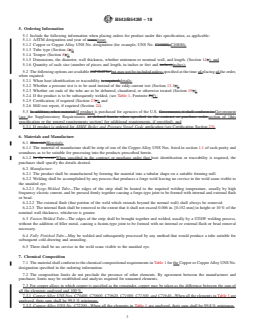
5. Ordering Information
E112 Test Methods for Determining Average Grain Size
5.1 Include the following information when placing orders
E118 Test Methods for Chemical Analysis of Copper-
for product under this specification, as applicable:
Chromium Alloys (Withdrawn 2010)
5.1.1 ASTM designation and year of issue;
E243 Practice for Electromagnetic (Eddy Current) Examina-
5.1.2 Copper or Copper Alloy UNS No. designation (for
tion of Copper and Copper-Alloy Tubes
example, UNS No. C10800);
E255 Practice for Sampling Copper and Copper Alloys for
5.1.3 Tube type (Section 4);
the Determination of Chemical Composition
5.1.4 Temper (Section 8);
E478 Test Methods for ChemicalAnalysis of CopperAlloys
5.1.5 Dimensions, the diameter, wall thickness, whether
E527 Practice for Numbering Metals and Alloys in the
minimum or nominal wall, and length, (Section 14); and
Unified Numbering System (UNS)
5.1.6 Quantity of each size (number of pieces and length, in
2.2 ASME Standard:
inches or feet and inches);
ASME Boiler and Pressure Vessel Code
5.2 The following options are available but may not be
3. Terminology
included unless specified at the time of placing of the order,
3.1 For the definitions of the terms related to copper and
when required:
copper alloys, refer to Terminology B846.
5.2.1 When heat identification or traceability details;
5.2.2 Whether a pressure test is to be used instead of the
4. Types of Welded Tube
eddy-current test (Section 13.1);
4.1 Forge-Welded Tube manufactured as described in
5.2.3 Whether cut ends of the tube are to be deburred,
6.2.2.1, 6.2.2.2, and 6.2.2.3.
chamfered, or otherwise treated (Section 15);
4.1.1 As-WeldedTube—Forge-weldedtubewithinternaland
5.2.4 If the product is to be subsequently welded, (see Table
external flash removed and no further refinement of grain
1, Footnote F);
structure.
5.2.5 Certification, if required (Section 23); and
4.1.2 Welded and Annealed Tube—Forge-welded tube with
5.2.6 Mill test report, if required (Section 24).
internal and external flash removed, that has been annealed to
5.3 If product is purchased for agencies of the U.S. Gov-
produce a uniform grain size appropriate to the specified
ernment (see the Supplementary Requirements section of {this
annealed temper.
specification or the general requirements section} for addi-
4.1.3 Welded and Cold-Reduced Tube—Forge-welded tube
tional requirements, if specified), and
with internal and external flash removed and subsequently
5.3.1 If product is ordered for ASME Boiler and Pressure
cold-reduced to conform to the specified size and temper.
Vessel Code application (see Certification Section 23).
4.1.4 Welded and Cold-Drawn Tube—Forge-welded tube
with internal and external flash removed and subsequently
6. Materials and Manufacture
cold-drawn over a plug or mandrel to the specified size and
6.1 Materials:
temper.
6.1.1 The material of manufacture shall be strip of one of
4.2 Fusion-Welded Tube manufactured as described in sec-
the CopperAlloy UNS Nos. listed in section 1.1 of such purity
tion 6.3.
andsoundnessastobesuitableforprocessingintotheproducts
4.2.1 As-Welded Tube—Fusion-welded tube with no further
prescribed herein.
refinement of grain structure.
6.1.2 When specified in the contract or purchase order that
4.2.2 Welded and Annealed Tube—Fusion-welded tube that
heat identification or traceability is required, the purchaser
has been annealed to produce a uniform grain size appropriate
shall specify the details desired.
tothespecifiedannealedtemper.Thestructureoftheweldzone
6.2 Manufacture:
shall be that which is typical of a fusion weld.
6.2.1 The product shall be manufactured by forming the
4.2.3 Welded and Cold-Reduced Tube—Fusion-welded tube
material into a tubular shape on a suitable forming mill.
subsequently cold-reduced to conform to the specified size and
6.2.2 Welding shall be accomplished by any process that
temper.
produces a forge weld leaving no crevice in the weld seam
4.2.4 Welded and Cold-Drawn Tube—Fusion-welded tube
visible to the unaided eye.
subsequently cold-drawn over a plug or mandrel to the
6.2.2.1 Forge-Welded Tube—The edges of the strip shall be
specified size and temper.
heated to the required welding temperature, usually by high
frequency electric current, and be pressed firmly together
The last approved version of this historical standard is referenced on
causing a forge-type joint to be formed with internal and
www.astm.org.
external flash or bead.
Available from American Society of Mechanical Engineers (ASME), ASME
6.2.2.2 The external flash (that portion of the weld which
International Headquarters, Two Park Ave., New York, NY 10016-5990, http://
www.asme.org. extends beyond the normal wall) shall always be removed.
B543/B543M−18
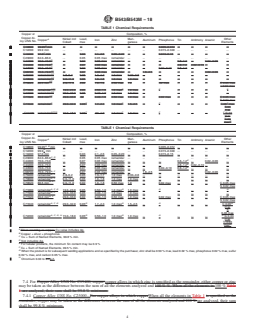
TABLE 1 Chemical Requirements
Composition, %
Copper or
Copper Al-
Nickel incl Lead, Man- Other
A
Copper Iron Zinc Aluminum Phosphorus Tin Antimony Arsenic
loy UNS No.
Cobalt max ganese Elements
A, B
C10800 99.95 min . . . . . . 0.005–0.012 . . . .
A
C12200 99.9 min . . . . . . 0.015–0.040 . . . .
C19400 97.0 min . 0.03 2.1–2.6 0.05–0.20 . . 0.015–0.15 . . . .
C, D
C23000 84.0–86.0 . 0.05 0.05 max remainder . . . . . . .
E
C44300 70.0–73.0 . 0.07 0.06 max remainder . . . 0.8–1.2 . 0.02–0.06 .
E
C44400 70.0–73.0 . 0.07 0.06 max remainder . . . 0.8–1.2 0.02–0.10 . .
E
C44500 70.0–73.0 . 0.07 0.06 max remainder . . 0.02–0.10 0.8–1.2 . . .
A, F
C68700 76.0–79.0 . 0.07 0.06 max remainder . 1.8–2.5 . . . 0.02–0.06 .
A, F
C70400 remainder 4.8–6.2 0.05 1.3–1.7 1.0 max 0.30–0.8 . . . . . .
A, F
C70600 remainder 9.0–11.0 0.05 1.0–1.8 1.0 max 1.0 max . . . . . .
A, F
C70620 86.5 min 9.0–11.0 0.02 1.0–1.8 0.50 max 1.0 . 0.02 max . . . C 0.05 max
S0.02max
A, F, G G G G
C71000 remainder 19.0–23.0 0.05 0.50–1.0 1.0 max 1.0 max . . . .
A, F
C71500 remainder 29.0–33.0 0.05 0.40–1.0 1.0 max 1.0 max . . . . .
A, F
C71520 65.0 min 29.0–33.0 0.02 0.40–1.0 0.50 max 1.0 max . 0.02 max . . . C 0.05 max
S0.02max
A, F, G G G G G
C71640 remainder 29.0–32.0 0.05 1.7–2.3 1.0 max 1.5–2.5 . . . . C 0.06
max
S0.03max
A, C, G, H G G G G
C72200 remainder 15.0–18.0 0.05 0.50–1.0 1.0 max 1.0 max . . . . Si 0.03
max
Ti 0.03
H
max
A
Cu value includes Ag.
B
Copper + silver + phosphorus.
C
Cu + Sum of Named Elements, 99.8 % min.
D
Not including Ag.
E
For tubular products, the minimum Sn content may be 0.9 %
F
Cu + Sum of Named Elements, 99.5 % min.
G
When the product is for subsequent welding applications and so specified by the purchaser, zinc shall be 0.50 % max, lead 0.02 % max, phosphorus 0.02 % max, sulfur
0.02 % max, and carbon 0.05 % max.
H
Chromium 0.30 to 0.7.
6.2.2.3 The internal flash shall be removed to the extent that 7.3.2 Copper Alloy UNS No. C72200—When all the ele-
it shall not exceed 0.006 in. [0.152 mm] in height or 10 % of ments in Table 1 are analyzed, their sum shall be 99.8 %
the nominal wall thickness, whichever is greater. minimum.
6.3 Fusion-Welded Tube—The edges of the strip shall be
7.4 For copper alloys in which zinc is specified as the
brought together and welded, usually by a GTAW welding remainder, either copper or zinc may be taken as the difference
process, without the addition of filler metal, causing a fusion-
between the sum of all the elements analyzed and 100 %.
type joint to be formed with no internal or external flash or 7.4.1 Copper Alloy UNS No. C23000—When all the ele-
bead removal necessary.
ments in Table 1 are analyzed, their sum shall be 99.8 %
minimum.
6.4 Fully Finished Tube—May be welded and subsequently
7.4.2 Copper Alloy UNS Nos. C44300, C44400, and
processed by any method that would produce a tube suitable
C44500—When all the elements in Table 1 are analyzed, their
for subsequent cold-drawing and annealing.
sum shall be 99.6 % minimum.
6.5 There shall be no crevice in the weld seam visible to the
7.4.3 Copper Alloy UNS No. C68700—When all the ele-
unaided eye.
ments in Table 1 are analyzed, their sum shall be 99.5 %
minimum.
7. Chemical Composition
7.1 The material shall conform to the chemical composi-
8. Temper
tional requirements in Table 1 for the Copper or CopperAlloy
8.1 Tube tempers shall be designated as follows:
UNS No. designation specified in the ordering information.
8.1.1 Welded and annealed WO61.
7.2 The composition limits do not preclude the presence of
8.1.1.1 Welded and light cold worked WC55.
other elements. By agreement between the manufacturer and
8.2 Other tempers shall be produced to the mechanical
purchaser, limits may be established and analysis required for
unnamed elements. propertiesasagreeduponbetweenthemanufacturerorsupplier
and the purchaser.
7.3 For copper alloys in which copper is specified as the
remainder, copper may be taken as the difference between the 8.3 Tubes of Copper Alloy UNS Nos. C23000, C44300,
sum of all the elements analyzed and 100 %. C44400, C44500, and C68700 shall be furnished in the
7.3.1 Copper Alloy UNS Nos. C70400, C70600, C70620, annealed temper or the stress-relieved condition as specified in
C71000, C71500, and C71640—When all the elements in the purchase order unless otherwise agreed upon between the
Table 1 are analyzed, their sum shall be 99.5 % minimum. purchaser and the manufacturer or supplier.
B543/B543M−18
8.4 Tubes of Copper Alloy UNS Nos. C12200, C19400, 10.2.1 Acceptance or rejection based upon mechanical
C70400, C70600, C70620, C71000, C71500, C71520, properties shall depend only on tensile strength and yield
C71640, and C72200 are normally supplied in the temper strength.
specified in the purchase order without stress-relief treatment.
11. Performance Requirements
NOTE 1—Some tubes, when subjected to aggressive environments, may
11.1 Expansion Test Requirements:
be subject to stress-corrosion cracking failure because of the residual
tensile stresses developed in straightening. For such applications, it is
11.1.1 Product in the annealed tempers and the light cold-
suggested that tubes of Copper Alloy UNS Nos. C23000, C44300,
worked temper shall withstand expansion in accordance with
C44400, C44500, and C68700 be subjected to a stress-relieving thermal
Test Method B153 to the degree specified in Table 4.
treatment subsequent to straightening. If required, this must be specified
11.1.2 The expanded tube area shall be free of defects, but
on the purchase order or contract. Tolerances for roundness and length,
blemishes of a nature that do not interfere with the intended
and the condition of straightness, for tube so ordered, shall be to the
requirements agreed upon between the manufacturer and the purchaser.
application are acceptable.
11.2 Flattening Test:
9. Grain Size for Annealed Tempers
11.2.1 The flattening test shall be performed in accordance
9.1 Samples of annealed temper tubes shall be examined at
with the Test Method section in B968/B968M.
a magnification of 75 diameters. The grain size shall be
11.3 Reverse Bend Test:
determined in the wall beneath the internal enhancement.
11.3.1 When specified in the contract or purchase order, the
While there is not grain size range, the microstructure shall
reverse bend test described in 19.2.8 of the Test Methods
show complete recrystallization and the weld zone shall have a
section shall be performed.
structure typical of hot-forged welds.
11.3.2 The sample shall be free of defects, but blemishes of
a nature that do not interfere with the intended application are
10. Mechanical Property Requirements
acceptable.
10.1 Tensile Strength and Yield Strength Requirements:
12. Other Requirements
10.2 Product furnished under this specification shall con-
form to the tensile and yield strength requirements prescribed 12.1 Mercurous Nitrate Test or Ammonia Vapor Test:
in Table 2 or Table 3 when tested in accordance with Test 12.1.1 The mercurous nitrate or ammonia vapor test is
Methods E8/E8M. required only for Copper Alloys UNS Nos. C23000; C44300;
TABLE 2 Tensile Requirements—Inch-Pound Values
NOTE 1—See Table 3 for tensile requirements—SI values.
Yield Strength at 0.5 %
Temper
Tensile Strength,
Copper or Copper Alloy UNS No. Extension Under Load, min,
A
min, ksi
A
Designation Name
ksi
B
C10800, C12200 W061 annealed 30 9
WC55 light cold-worked 32 15
C19400 W061 annealed 45 15
WC55 light cold-worked 45 22
C23000 W061 annealed 40 12
WC55 light cold-worked 42 20
C44300, C44400, C44500 W061 annealed 45 15
WC55 light cold-worked 50 35
C68700 W061 annealed 50 18
CC
WC55 light cold-worked
C70400 W061 annealed 38 12
WC55 light cold-worked 40 30
C70600 W061 annealed 40 15
WC55 light cold-worked 45 35
C70620 WO61 annealed 40 15
WC55 light cold-worked 45 35
C71000 W061 annealed 45 16
WC55 light cold-worked 50 35
C71500 W061 annealed 52 18
WC55 light cold-worked 54 35
C71520 WO61 annealed 52 18
WC55 light cold-worked 54 35
C71640 W061 annealed 63 25
WC55 light cold-worked 75 40
C72200 W061 annealed 45 16
WC55 light cold-worked 50 30
A
ksi = 1000 psi.
B
Light straightening operation is permitted.
C
Where no properties are shown, strength requirements shall be as agreed upon between the purchaser and the manufacturer or supplier.
B543/B543M−18
TABLE 3 Tensile Requirements—SI Values
NOTE 1—See Table 2 for tensile requirements—inch-pound values.
Yield Strength at 0.5 %
Temper
Copper or Copper Alloy Tensile Strength,
Extension Under Load, min,
UNS No. min, MPA
Designation Name
MPA
A
C10800, C12200 W061 annealed 205 60
WC55 light cold-worked 220 105
C19400 W061 annealed 310 105
WC55 light cold-worked 310 150
C23000 W061 annealed 275 85
WC55 light cold-worked 290 140
C44300, C44400, C44500 W061 annealed 310 105
WC55 light cold-worked 345 240
C68700 W061 annealed 345 125
BB
WC55 light cold-worked
C70400 W061 annealed 260 85
WC55 light cold-worked 275 205
C70600 W061 annealed 275 105
WC55 light cold-worked 310 240
C70620 WO61 annealed 275 105
WC55 light cold-worked 310 240
C71000 W061 annealed 310 110
WC55 light cold-worked 345 240
C71500 W061 annealed 360 125
WC55 light cold-worked 370 240
C71520 WO61 annealed 360 125
WC55 light cold-worked 370 240
C71640 W061 annealed 435 170
WC55 light cold-worked 515 275
C72200 W061 annealed 310 110
WC55 light cold-worked 345 205
A
Light straightening operation is permitted.
B
Where no properties are shown, strength requirements shall be as agreed upon between the purchaser and the manufacturer or supplier.
TABLE 4 Expansion Requirements
C44400;C44500;C60800;andC68700;whenpurchasedifnot
Expansion of Tube supplied in an annealed temper (Warning—Mercury is a
Copper or Copper Alloy Outside Diameter,
definite health hazard. With the Mercurous Nitrate Test, equip-
Temper
UNS No. in Percent of Origi-
ment for the detection and removal of mercury vapor produced
nal Outside Diameter
in volatilization, and the use of protective gloves is recom-
Annealed C10800 30
C12200 30 mended.)
C19400 20
12.1.2 Thetestspecimens,cut6in.[152mm]inlengthfrom
C23000 20
the enhanced section shall withstand, without cracking, an
C44300, C44400, 20
C44500
immersion in the standard mercurous nitrate solution in Test
C68700 20
Method B154 or immersion in the ammonia vapor solution as
C70400 30
defined in Test Method B858.
C70600 30
C70620 30
12.1.3 Unless otherwise agreed upon between the manufac-
C71000 30
turer or supplier and the purchaser, the manufacturer shall have
C71500 30
C71520 30 the option of using either the mercurous nitrate test or the
C71640 30
ammonia vapor test. If agreement cannot be reached, the
C72200 30
mercurous nitrate test standard shall be utilized.
Light cold-worked C10800 20 12.1.4 If the ammonia vapor test is selected, the appropriate
C12200 20
risk level pH value for the test solution shall be agreed upon by
C19400 20
the manufacturer and purchaser, or alternately, if the purchaser
C70400 20
C70600 20 defers to the manufacturer’s expertise for the selection of the
C70620 20
test pH value, the minimum value selected shall be 9.8.
C71000 20
C71500 20
C71520 20
13. Nondestructive Testing
C71640 20
C72200 20 13.1 Each tube shall be subjected to the eddy-current test in
13.1.1. Fully finished tube (see 4.3) may be tested in the final
Annealed and light cold- C23000 20
drawn, annealed, or heat-treatment temper or in the drawn
worked, stress relieved C44300, C44400, 20
C44500
temper prior to the final anneal or heat treatment, unless
C68700 20
otherwise agreed upon between the manufacturer or supplier
and the purchaser. Tube supplied welded and annealed (see
4.1.2) may be tested in the welded condition before anneal or
B543/B543M−18
TABLE 6 Notch Depth—SI Values
heat treatment, unless otherwise agreed upon between the
manufacturer or supplier and the purchaser.The purchaser may
NOTE 1—See Table 5 for notch depth—inch-pound values.
specify either of the tests in 13.1.2 or 13.1.3 as an alternative
Tube Outside Diameter, mm
Tube Wall
to the eddy-current test.
Over 6 to 19, Over 19 to 32, Over 32 to 80,
Thickness, mm
13.1.1 Eddy Current Test—Each tube shall be passed
incl incl incl
through an eddy-current testing unit adjusted to provide
Over 0.4–0.8 0.13 0.15 0.18
Incl 0.8–1.3 0.15 0.15 0.19
information on the suitability of the tube for the intended
Incl 1.3–2.1 0.18 0.19 0.20
application. Testing shall follow the procedures of Practice
Incl 2.1–2.8 0.19 0.22 0.24
E243, except as modified in 13.1.1.2.
Incl 2.8–3.0 0.23 0.23 0.28
13.1.1.1 The depth of the round-bottom transverse notches
and the diameters of the drilled holes in the calibrating tube
TABLE 7 Diameter of Drilled Holes—Inch-Pound Values
used to adjust the sensitivity of the test unit are shown in Table
5 or Table 6 and Table 7 or Table 8 respectively.
NOTE 1—See Table 8 for diameter of drilled holes—SI values.
13.1.1.2 The discontinuities used to calibrate the test system
Diameter of Drilled
Tube Outside Diameter
may be placed in the strip from which the tube will be
Holes
Drill No.
manufactured. These calibration discontinuities will pass
in. in.
1 3
through the continuous operations of forming, welding, and
⁄4 – ⁄4, incl 0.025 72
Over ⁄4 –1, incl 0.031 68
eddy-current testing. The test unit sensitivity required to detect
Over 1–1 ⁄4, incl 0.036 64
the resultant discontinuities shall be equivalent to or greater
1 1
Over 1 ⁄4 –1 ⁄2, incl 0.042 58
1 3
thanthatrequiredtodetectthenotchesordrilledholesofTable
Over 1 ⁄2 –1 ⁄4, incl 0.046 56
Over 1 ⁄4 –2, incl 0.052 55
5 or Table 6 and Table 7 or Table 8 respectively, or other
calibration discontinuities that may be used by mutual agree-
ment between the manufacturer or supplier and the purchaser.
TABLE 8 Diameter of Drilled Holes—SI Values
Calibration discontinuities may be on the outside tube surface,
the internal tube surface, or through the tube wall and shall be NOTE 1—See Table 7 for diameter of drilled holes—inch-pound values.
spaced to provide signal resolution adequate for interpretation.
Diameter of Drilled
Tube Outside Diameter
Holes
Drill No.
Each calibration discontinuity shall be detected by the eddy-
mm mm
current tester.
6.0–19.0, incl 0.65 72
13.1.1.3 Tubes that do not actuate the signaling device of
Over 19.0–25.4, incl 0.80 68
theeddy-currenttestershallbeconsideredasconformingtothe
Over 25.4–31.8, incl 0.92 64
requirements of this test. Tubes causing irrelevant signals
Over 31.8–38.1, incl 1.1 58
Over 38.1–44.4, incl 1.2 56
becauseofmoisture,soil,andlikeeffectsmaybereconditioned
Over 44.4–50.8, incl 1.3 55
and retested. Such tubes, when retested to the original test
parameters, shall be considered to conform if they do not cause
output signals beyond the acceptable limits. Tubes causing
under tension. The tube need not be tested at a hydrostatic
irrelevant signals because of visible and identifiable handling
pressure over 1000 psig [7.0 MPa] unless so specified.
marks may be retested by the hydrostatic test prescribed in
P 5 2St/ D 2 0.8t (1)
13.1.2, or the pneumatic test prescribed in 13.1.3. Tubes ~ !
meeting requirements of either test shall be considered to
where:
conformifthetubedimensionsarewithintheprescribedlimits,
P = hydrostatic pressure, psig [MPa],
unless otherwise agreed to by the manufacturer or supplier and
t = thickness of tube wall, in. [mm],
the purchaser.
D = outside diameter of the tube, in. [mm], and
13.1.2 HydrostaticTest—Whenspecified,eachtubeselected
S = allowable stress of the material, psi [MPa].
in accordance with 13.1 shall withstand, without showing
13.1.3 Pneumatic Test—When specified, each tube shall be
evidence of leakage, an internal hydrostatic pressure
...
This document is not an ASTM standard and is intended only to provide the user of an ASTM standard an indication of what changes have been made to the previous version. Because
it may not be technically possible to adequately depict all changes accurately, ASTM recommends that users consult prior editions as appropriate. In all cases only the current version
of the standard as published by ASTM is to be considered the official document.
Designation: B543/B543M − 12 B543/B543M − 18
Standard Specification for
Welded Copper and Copper-Alloy Heat Exchanger Tube
This standard is issued under the fixed designation B543/B543M; the number immediately following the designation indicates the year
of original adoption or, in the case of revision, the year of last revision. A number in parentheses indicates the year of last reapproval.
A superscript epsilon (´) indicates an editorial change since the last revision or reapproval.
1. Scope*
1.1 This specification establishedestablishes the requirements for welded tube of copper and various copper alloys up to 3 ⁄8 in.,
inclusive, in diameter, for use in surface condensers, evaporators, heat exchangers, and general engineering applications. The
following coppers or copper alloys are involved:
Copper or
Previously Used
Copper Alloy UNS Type of Metal
Designation
No.
A
C10800 . oxygen-free, low phosphorus
A
C12200 . DHP phosphorized, high
residual phosphorus
C19400 . copper-iron alloy
C23000 . red brass
C44300 . arsenical admiralty
C44400 . antimonial admiralty
C44500 . phosphorized admiralty
C68700 . arsenical aluminum brass
C70400 . 95-5 copper-nickel
C70600 . 90-10 copper-nickel
C70620 . 90-10 copper-nickel (Modified
for Welding)
C71000 . 80-20 copper-nickel
C71500 . 70-30 copper-nickel
C71520 . 70–30 copper-nickel (Modified
for Welding)
C71520 . 70-30 copper-nickel (Modified
for Welding)
C71640 . copper-nickel-iron-manganese
C72200 . .
A
Copper UNS Nos. C10800 and C12200 are classified in Classification B224.
1.2 The values stated in either inch-pound or SI units or inch-pound units are to be regarded separately as standard. Within the
text, SI units are shown in brackets. The values stated in each system may not be exact equivalents; therefore, each system shall
be used independently of the other. Combining values from the two systems may result in non-conformance with the standard.
1.3 This standard does not purport to address all of the safety concerns, if any, associated with its use. It is the responsibility
of the user of this standard to establish appropriate safety safety, health, and healthenvironmental practices and determine the
applicability of regulatory limitations prior to use.
(Warning—Mercury has been designated by EPA and many stateregulatory agencies as a hazardous materialsubstance that can
cause central nervous system, kidney, and liver damage. serious medical issues. Mercury, or its vapor, may has been demonstrated
to be hazardous to health and corrosive to materials. Caution should be taken Use caution when handling mercury and
mercury-containing products. See the applicable product Material Safety Data Sheet (MSDS) for details and EPA’s website
(http://www.epa.gov/mercury/faq.htm) for additional information. Users should be aware (SDS) for additional information. The
potential exists that selling mercury or mercury-containing products, or both, in your state may be prohibited by state law. (Mercury
is a definite health hazard in use and disposal. (See is prohibited by local or national law. Users must determine legality of sales
in their location.12.1.1.))
This specification is under the jurisdiction of ASTM Committee B05 on Copper and Copper Alloys and is the direct responsibility of Subcommittee B05.04 on Pipe and
Tube.
Current edition approved April 1, 2012Oct. 1, 2018. Published May 2012October 2018. Originally approved in 1970. Last previous edition approved in 20072012 as
ε1
B543/B543MB543 – 07–12. . DOI: 10.1520/B0543/B0543M-12.10.1520/B0543/B0543M–18.
New designation established in accordance with Practice E527. In the new UNS system, the designations for copper alloys are simply expansions of the present standard
designations by a prefix “C” and a suffix “00.”
*A Summary of Changes section appears at the end of this standard
Copyright © ASTM International, 100 Barr Harbor Drive, PO Box C700, West Conshohocken, PA 19428-2959. United States
B543/B543M − 18
1.4 This international standard was developed in accordance with internationally recognized principles on standardization
established in the Decision on Principles for the Development of International Standards, Guides and Recommendations issued
by the World Trade Organization Technical Barriers to Trade (TBT) Committee.
2. Referenced Documents
2.1 ASTM Standards:
B153 Test Method for Expansion (Pin Test) of Copper and Copper-Alloy Pipe and Tubing
B154 Test Method for Mercurous Nitrate Test for Copper Alloys
B224 Classification of Coppers
B846 Terminology for Copper and Copper Alloys
B858 Test Method for Ammonia Vapor Test for Determining Susceptibility to Stress Corrosion Cracking in Copper Alloys
B900 Practice for Packaging of Copper and Copper Alloy Mill Products for U.S. Government Agencies
B968/B968M Test Method for Flattening of Copper and Copper-Alloy Pipe and Tube
E3 Guide for Preparation of Metallographic Specimens
E8E8/E8M Test Methods for Tension Testing of Metallic Materials [Metric] E0008_E0008M
E29 Practice for Using Significant Digits in Test Data to Determine Conformance with Specifications
E53 Test Method for Determination of Copper in Unalloyed Copper by Gravimetry
E54 Test Methods for Chemical Analysis of Special Brasses and Bronzes (Withdrawn 2002)
E62 Test Methods for Chemical Analysis of Copper and Copper Alloys (Photometric Methods) (Withdrawn 2010)
E112 Test Methods for Determining Average Grain Size
E118 Test Methods for Chemical Analysis of Copper-Chromium Alloys (Withdrawn 2010)
E243 Practice for Electromagnetic (Eddy Current) Examination of Copper and Copper-Alloy Tubes
E478 Test Methods for Chemical Analysis of Copper Alloys
E255 Practice for Sampling Copper and Copper Alloys for the Determination of Chemical Composition
E478 Test Methods for Chemical Analysis of Copper Alloys
E527 Practice for Numbering Metals and Alloys in the Unified Numbering System (UNS)
2.2 ASME Standard:
ASME Boiler and Pressure Vessel Code
3. Terminology
3.1 For the definitions of the terms related to copper and copper alloys, refer to Terminology B846.
4. Types of Welded Tube
4.1 Forge-Welded Tube manufactured as described in 6.2.2.1, 6.2.2.2, and 6.2.2.3.
4.1.1 As-Welded Tube—Forge-welded tube with internal and external flash removed and no further refinement of grain structure.
4.1.2 Welded and Annealed Tube—Forge-welded tube with internal and external flash removed, that has been annealed to
produce a uniform grain size appropriate to the specified annealed temper.
4.1.3 Welded and Cold-Reduced Tube—Forge-welded tube with internal and external flash removed and subsequently cold
reduced cold-reduced to conform to the specified size and temper.
4.1.4 Welded and Cold-Drawn Tube—Forge-welded tube with internal and external flash removed and subsequently cold drawn
cold-drawn over a plug or mandrel to the specified size and temper.
4.2 Fusion-Welded Tube manufactured as described in section 6.3.
4.2.1 As-Welded Tube—Fusion-welded tube with no further refinement of grain structure.
4.2.2 Welded and Annealed Tube—Fusion-welded tube that has been annealed to produce a uniform grain size appropriate to
the specified annealed temper. The structure of the weld zone shall be that which is typical of a fusion weld.
4.2.3 Welded and Cold-Reduced Tube—Fusion-welded tube subsequently cold-reduced to conform to the specified size and
temper.
4.2.4 Welded and Cold-Drawn Tube—Fusion-welded tube subsequently cold-drawn over a plug or mandrel to the specified size
and temper.
4.3 Fully Finished Tube—Welded tube with internal and external flash removed, if present, and subsequently cold-drawn over
a plug or mandrel and annealed, and redrawn when necessary to conform to the specified temper.
For referenced ASTM standards, visit the ASTM website, www.astm.org, or contact ASTM Customer Service at service@astm.org. For Annual Book of ASTM Standards
volume information, refer to the standard’sstandard’s Document Summary page on the ASTM website.
The last approved version of this historical standard is referenced on www.astm.org.
Available from American Society of Mechanical Engineers (ASME), ASME International Headquarters, Two Park Ave., New York, NY 10016-5990, http://
www.asme.org.
B543/B543M − 18
5. Ordering Information
5.1 Include the following information when placing orders for product under this specification, as applicable:
5.1.1 ASTM designation and year of issue,issue;
5.1.2 Copper or Copper Alloy UNS No. designation (for example, UNS No. C10800),C10800);
5.1.3 Tube type (Section 4),);
5.1.4 Temper (Section 8),);
5.1.5 Dimensions, the diameter, wall thickness, whether minimum or nominal wall, and length, (Section 14),); and
5.1.6 Quantity of each size (number of pieces and length, in inches or feet and inches),inches);
5.2 The following options are available and shall be but may not be included unless specified at the time of placing of the order,
when required:
5.2.1 When heat identification or traceability is required,details;
5.2.2 Whether a pressure test is to be used instead of the eddy-current test (Section 13.1),);
5.2.3 Whether cut ends of the tube are to be deburred, chamfered, or otherwise treated (Section 15),);
5.2.4 If the product is to be subsequently welded, (see Table 1, Footnote F)F);
5.2.5 Certification, if required (Section 23),); and
5.2.6 Mill test report, if required (Section 24).
5.3 In addition, when material If product is purchased for agencies of the U.S. Government, it shall conform to Government
(see the Supplementary Requirements as defined herein when specified in the contract or purchase order.section of {this
specification or the general requirements section} for additional requirements, if specified), and
5.3.1 If product is ordered for ASME Boiler and Pressure Vessel Code application (see Certification Section 23).
6. Materials and Manufacture
6.1 Material:Materials:
6.1.1 The material of manufacture shall be strip of one of the Copper Alloy UNS Nos. listed in section 1.1 of such purity and
soundness as to be suitable for processing into the products prescribed herein.
6.1.2 In the event When specified in the contract or purchase order that heat identification or traceability is required, the
purchaser shall specify the details desired.
6.2 Manufacture:
6.2.1 The product shall be manufactured by forming the material into a tubular shape on a suitable forming mill.
6.2.2 Welding shall be accomplished by any process that produces a forge weld leaving no crevice in the weld seam visible to
the unaided eye.
6.2.2.1 Forge-Welded Tube—The edges of the strip shall be heated to the required welding temperature, usually by high
frequency electric current, and be pressed firmly together causing a forge-type joint to be formed with internal and external flash
or bead.
6.2.2.2 The external flash (that portion of the weld which extends beyond the normal wall) shall always be removed.
6.2.2.3 The internal flash shall be removed to the extent that it shall not exceed 0.006 in. [0.152 mm] in height or 10 % of the
nominal wall thickness, whichever is greater.
6.3 Fusion-Welded Tube—The edges of the strip shall be brought together and welded, usually by a GTAW welding process,
without the addition of filler metal, causing a fusion-type joint to be formed with no internal or external flash or bead removal
necessary.
6.4 Fully Finished Tube—May be welded and subsequently processed by any method that would produce a tube suitable for
subsequent cold-drawing and annealing.
6.5 There shall be no crevice in the weld seam visible to the unaided eye.
7. Chemical Composition
7.1 The material shall conform to the chemical compositional requirements in Table 1 for the Copper or Copper Alloy UNS No.
designation specified in the ordering information.
7.2 The composition limits do not preclude the presence of other elements. By agreement between the manufacturer and
purchaser, limits may be established and analysis required for unnamed elements.
7.3 For copper alloys in which copper is specified as the remainder, copper may be taken as the difference between the sum of
all the elements analyzed and 100 %.
7.3.1 Copper Alloy UNS Nos. C70400, C70600, C70620, C71000, C71500, and C71640—When all the elements in Table 1 are
analyzed, their sum shall be 99.5 % minimum.
7.3.2 Copper Alloy UNS No. C72200—When all the elements in Table 1 are analyzed, their sum shall be 99.8 % minimum.
B543/B543M − 18
TABLE 1 Chemical Requirements
Composition, %
Copper or
Copper Al-
Nickel incl Lead, Man- Other
A
Copper Iron Zinc Aluminum Phosphorus Tin Antimony Arsenic
loy UNS No.
Cobalt max ganese Elements
B
C10800 99.95 min . . . . . . 0.005–0.012 . . . .
C12200 99.9 min . . . . . . 0.015–0.040 . . . .
C
C19400 97.0 min . 0.03 2.1–2.6 0.05–0.20 . . 0.015–0.15 . . . .
C23000 84.0–86.0 . 0.05 0.05 max remainder . . . . . . .
D
C44300 70.0–73.0 . 0.07 0.06 max remainder . . . 0.8–1.2 . 0.02–0.06 .
D
C44400 70.0–73.0 . 0.07 0.06 max remainder . . . 0.8–1.2 0.02–0.10 . .
D
C44500 70.0–73.0 . 0.07 0.06 max remainder . . 0.02–0.10 0.8–1.2 . . .
AE
C68700 76.0–79.0 . 0.07 0.06 max remainder . 1.8–2.5 . . . 0.02–0.06 .
AE
C70400 remainder 4.8–6.2 0.05 1.3–1.7 1.0 max 0.30–0.8 . . . . . .
AE
C70600 remainder 9.0–11.0 0.05 1.0–1.8 1.0 max 1.0 max . . . . . .
AE
C70620 86.5 min 9.0–11.0 0.02 1.0–1.8 0.50 max 1.0 . .02 max . . . C 0.05 max
s 0.02 max
AEF F F F
C71000 remainder 19.0–23.0 0.05 0.50–1.0 1.0 max 1.0 max . . . .
AE
C71500 remainder 29.0–33.0 0.05 0.40–1.0 1.0 max 1.0 max . . . . .
AE
C71520 65.0 min 29.0–33.0 .02 0.40–1.0 0.50 max 1.0 max . 0.02 max . . . C 0.05 max
S 0.02 max
F F F F F
C71640 remainder 29.0–32.0 0.05 1.7–2.3 1.0 max 1.5–2.5 . . . . C.06 max
S.03
max
AFCG F F F F
C72200 remainder 15.0–18.0 0.05 .50–1.0 1.0 max 1.0 max . . . . Si.03
max
Ti.03
G
max
TABLE 1 Chemical Requirements
Composition, %
Copper or
Copper Al-
Nickel incl Lead, Man- Other
A
Copper Iron Zinc Aluminum Phosphorus Tin Antimony Arsenic
loy UNS No.
Cobalt max ganese Elements
A, B
C10800 99.95 min . . . . . . 0.005–0.012 . . . .
A
C12200 99.9 min . . . . . . 0.015–0.040 . . . .
C19400 97.0 min . 0.03 2.1–2.6 0.05–0.20 . . 0.015–0.15 . . . .
C, D
C23000 84.0–86.0 . 0.05 0.05 max remainder . . . . . . .
E
C44300 70.0–73.0 . 0.07 0.06 max remainder . . . 0.8–1.2 . 0.02–0.06 .
E
C44400 70.0–73.0 . 0.07 0.06 max remainder . . . 0.8–1.2 0.02–0.10 . .
E
C44500 70.0–73.0 . 0.07 0.06 max remainder . . 0.02–0.10 0.8–1.2 . . .
A, F
C68700 76.0–79.0 . 0.07 0.06 max remainder . 1.8–2.5 . . . 0.02–0.06 .
A, F
C70400 remainder 4.8–6.2 0.05 1.3–1.7 1.0 max 0.30–0.8 . . . . . .
A, F
C70600 remainder 9.0–11.0 0.05 1.0–1.8 1.0 max 1.0 max . . . . . .
A, F
C70620 86.5 min 9.0–11.0 0.02 1.0–1.8 0.50 max 1.0 . 0.02 max . . . C 0.05 max
S 0.02 max
A, F, G G G G
C71000 remainder 19.0–23.0 0.05 0.50–1.0 1.0 max 1.0 max . . . .
A, F
C71500 remainder 29.0–33.0 0.05 0.40–1.0 1.0 max 1.0 max . . . . .
A, F
C71520 65.0 min 29.0–33.0 0.02 0.40–1.0 0.50 max 1.0 max . 0.02 max . . . C 0.05 max
S 0.02 max
A, F, G G G G G
C71640 remainder 29.0–32.0 0.05 1.7–2.3 1.0 max 1.5–2.5 . . . . C 0.06
max
S
0.03 max
A, C, G, H G G G G
C72200 remainder 15.0–18.0 0.05 0.50–1.0 1.0 max 1.0 max . . . . Si 0.03
max
Ti 0.03
H
max
A
Silver counting as copper. Cu value includes Ag.
B
Copper + silver + phosphorus.
C
Cu + Sum of Named Elements, 99.8 % min.
D
Not including Ag.
E
For tubular products, the minimum Sn content may be 0.9 %
F
Cu + Sum of Named Elements, 99.5 % min.
G
When the product is for subsequent welding applications and so specified by the purchaser, zinc shall be 0.50 % max, lead 0.02 % max, phosphorus 0.02 % max, sulfur
0.02 % max, and carbon 0.05 % max.
H
Chromium 0.30 to 0.70.7.
7.4 For Copper Alloy UNS No. C19400, copper copper alloys in which zinc is specified as the remainder, either copper or zinc
may be taken as the difference between the sum of all the elements analyzed and 100 % %. When all the elements in 100 %.Table
1 are analyzed, their sum shall be 99.8 % minimum.
7.4.1 Copper Alloy UNS No. C23000—For copper alloys in which copperWhen all the elements in Table 1 is specified as the
remainder, copper may be taken as the difference between the sum of all the elements analyzed and 100 %.are analyzed, their sum
shall be 99.8 % minimum.
B543/B543M − 18
7.3.1.1 Copper Alloy UNS Nos. C70400, C70600, C70620, C71000, C71500, C71520, and C71640—When all the elements in
Table 1 are analyzed, their sum shall be 99.5 % minimum.
7.3.1.2 Copper Alloy UNS No. C72200—When all the elements in Table 1 are analyzed, their sum shall be 99.8 % minimum.
7.4.2 Copper Alloy UNS Nos. C44300, C44400, and C44500—For copper alloys in which zincWhen all the elements in Table
1 is specified as the remainder, either copper or zinc may be taken as the difference between the sum of all the elements analyzed
and 100 %.are analyzed, their sum shall be 99.6 % minimum.
7.3.2.1 Copper Alloy UNS No. C23000—When all the elements in Table 1 are analyzed, their sum shall be 99.8 % minimum.
7.3.2.2 Copper Alloy UNS Nos. C44300, C44400, and C44500—When all the elements in Table 1 are analyzed, their sum shall
be 99.6 % minimum.
7.3.2.3 Copper Alloy UNS No. C68700—When all the elements in Table 1 are analyzed, their sum shall be 99.5 % minimum.
7.4.3 Copper Alloy UNS No. C68700—When all the elements in Table 1 are analyzed, their sum shall be 99.5 % minimum.
8. Temper
8.1 Tube tempers shall be designated as follows:
8.1.1 Welded and annealed WO61.
8.1.1.1 Welded and light cold worked WC55.
8.2 Other tempers shall be produced to the mechanical properties as agreed upon between the manufacturer or supplier and the
purchaser.
8.3 Tubes of Copper Alloy UNS Nos. C23000, C44300, C44400, C44500, and C68700 shall be furnished in the annealed temper
or the stress relieved stress-relieved condition as specified in the purchase order unless otherwise agreed upon between the
purchaser and the manufacturer or supplier.
8.4 Tubes of Copper Alloy UNS Nos. C12200, C19400, C70400, C70600, C70620, C71000, C71500, C71520, C71640, and
C72200 are normally supplied in the temper specified in the purchase order without stress relief stress-relief treatment.
NOTE 1—Some tubes, when subjected to aggressive environments, may be subject to stress-corrosion cracking failure because of the residual tensile
stresses developed in straightening. For such applications, it is suggested that tubes of Copper Alloy UNS Nos. C23000, C44300, C44400, C44500, and
C68700 be subjected to a stress relieving stress-relieving thermal treatment subsequent to straightening. If required, this must be specified on the purchase
order or contract. Tolerances for roundness and length, and the condition of straightness, for tube so ordered, shall be to the requirements agreed upon
between the manufacturer and the purchaser.
9. Grain Size for Annealed Tempers
9.1 Samples of annealed temper tubes shall be examined at a magnification of 75 diameters. The grain size shall be determined
in the wall beneath the internal enhancement. While there is not grain size range, the microstructure shall show complete
recrystallization and the weld zone shall have a structure typical of hot-forged welds.
10. Mechanical Property Requirements
10.1 Tensile Strength and Yield Strength Requirements:
10.2 Product furnished under this specification shall conform to the tensile and yield strength requirements prescribed in Table
2 or Table 3 when tested in accordance with Test MethodMethods E8E8/E8M.
10.2.1 Acceptance or rejection based upon mechanical properties shall depend only on tensile strength and yield strength.
11. Performance Requirements
11.1 Expansion Test Requirements:
11.1.1 Product in the annealed tempers and the light cold-worked temper shall withstand expansion in accordance with Test
Method B153 to the degree specified in Table 4.
11.1.2 The expanded tube area shall be free of defects, but blemishes of a nature that do not interfere with the intended
application are acceptable.
11.2 Flattening Test:
11.2.1 The flattening test shall be performed in accordance with the Test Method section in B968/B968M.
11.3 Reverse Bend Test:
11.3.1 When specified in the contract or purchase order, the reverse bend test described in the19.2.8 Test Method section inof
the Test Methods 19.2.8section shall be performed.
11.3.2 The sample shall be free of defects, but blemishes of a nature that do not interfere with the intended application are
acceptable.
12. Other Requirements
12.1 Mercurous Nitrate Test or Ammonia Vapor Test:
B543/B543M − 18
TABLE 2 Tensile Requirements — Inch-Pound Requirements—Inch-Pound Values
NOTE 1—See Table 3 for tensile requirements — SI requirements—SI values.
Yield Strength at 0.5 %
Temper
Tensile Strength,
Copper or Copper Alloy UNS No. Extension Under Load, min,
A
min, ksi
A
Designation Name
ksi
B
C10800, C12200 W061 annealed 30 9
WC55 light cold-worked 32 15
C19400 W061 annealed 45 15
WC55 light cold-worked 45 22
C23000 W061 annealed 40 12
WC55 light cold-worked 42 20
C44300, C44400, C44500 W061 annealed 45 15
WC55 light cold-worked 50 35
C68700 W061 annealed 50 18
C C
WC55 light cold-worked
C70400 W061 annealed 38 12
WC55 light cold-worked 40 30
C70600 W061 annealed 40 15
WC55 light cold-worked 45 35
C70620 WO61 annealed 40 15
WC55 light cold-worked 45 35
C71000 W061 annealed 45 16
WC55 light cold-worked 50 35
C71500 W061 annealed 52 18
WC55 light cold-worked 54 35
C71520 WO61 annealed 52 18
WC55 light cold-worked 54 35
C71640 W061 annealed 63 25
WC55 light cold-worked 75 40
C72200 W061 annealed 45 16
WC55 light cold-worked 50 30
A
ksi = 1000 psi.
B
Light straightening operation is permitted.
C
Where no properties are shown, strength requirements shall be as agreed upon between the purchaser and the manufacturer or supplier.
TABLE 3 Tensile Requirements — SI Requirements—SI Values
NOTE 1—See Table 2 for tensile requirements — inch-pound requirements—inch-pound values.
Yield Strength at 0.5 %
Temper
Copper or Copper Alloy Tensile Strength,
Extension Under Load, min,
UNS No. min, MPA
Designation Name
MPA
A
C10800, C12200 W061 annealed 205 60
WC55 light cold-worked 220 105
C19400 W061 annealed 310 105
WC55 light cold-worked 310 150
C23000 W061 annealed 275 85
WC55 light cold-worked 290 140
C44300, C44400, C44500 W061 annealed 310 105
WC55 light cold-worked 345 240
C68700 W061 annealed 345 125
B B
WC55 light cold-worked
C70400 W061 annealed 260 85
WC55 light cold-worked 275 205
C70600 W061 annealed 275 105
WC55 light cold-worked 310 240
C70620 WO61 annealed 275 105
WC55 light cold-worked 310 240
C71000 W061 annealed 310 110
WC55 light cold-worked 345 240
C71500 W061 annealed 360 125
WC55 light cold-worked 370 240
C71520 WO61 annealed 360 125
WC55 light cold-worked 370 240
C71640 W061 annealed 435 170
WC55 light cold-worked 515 275
C72200 W061 annealed 310 110
WC55 light cold-worked 345 205
A
Light straightening operation is permitted.
B
Where no properties are shown, strength requirements shall be as agreed upon between the purchaser and the manufacturer or supplier.
12.1.1 The mercurous nitrate or ammonia vapor test is required only for Copper Alloys UNS Nos. C23000; C44300; C44400;
C44500; C60800; and C68700; when purchased if not supplied in an annealed temper (Warning—Mercury is a definite health
B543/B543M − 18
TABLE 4 Expansion Requirements
Expansion of Tube
Copper or Copper Alloy Outside Diameter,
Temper
UNS No. in Percent of Origi-
nal Outside Diameter
Annealed C10800 30
C12200 30
C19400 20
C23000 20
C44300, C44400, 20
C44500
C68700 20
C70400 30
C70600 30
C70620 30
C71000 30
C71500 30
C71520 30
C71640 30
C72200 30
Light cold-worked C10800 20
C12200 20
C19400 20
C70400 20
C70600 20
C70620 20
C71000 20
C71500 20
C71520 20
C71640 20
C72200 20
Annealed and light cold- C23000 20
worked, stress relieved C44300, C44400, 20
C44500
C68700 20
hazard and therefore hazard. With the Mercurous Nitrate Test, equipment for the detection and removal of mercury vapor produced
in volitization is recommended. The volatilization, and the use of rubberprotective gloves in testing is advisable.)recommended.)
12.1.2 The test specimens, cut 6 in. [152 mm] in length from the enhanced section shall withstand, without cracking, an
immersion in the standard mercurous nitrate solution in Test Method B154 or immersion in the ammonia vapor solution as defined
in Test Method B858.
12.1.3 Unless otherwise agreed upon between the manufacturer,manufacturer or supplier,supplier and the purchaser, the
manufacturer shall have the option of using either the mercurous nitrate test or the ammonia vapor test. If agreement cannot be
reached, the mercurous nitrate test standard shall be utilized.
12.1.4 If the ammonia vapor test is selected, the appropriate risk level pH value for the test solution shall be agreed upon by
the manufacturer and purchaser, or alternately, if the purchaser defers to the manufacturer’smanufacturer’s expertise for the
selection of the test pH value, the minimum value selected shall be 9.8.
13. Nondestructive Testing
13.1 Each tube shall be subjected to anthe eddy-current test in 13.1.1. Fully finished tube (see 4.3) may be tested in the final
drawn, annealed, or heat-treatment temper or in the drawn temper prior to the final anneal or heat treatment, unless otherwise
agreed upon between the manufacturer or supplier and the purchaser. Tube supplied welded and annealed (see 4.1.2) may be tested
in the welded condition before anneal or heat treatment, unless otherwise agreed upon between the manufacturer or supplier and
the purchaser. The purchaser may specify either of the tests in 13.1.2 or 13.1.3 as an alternative to the eddy-current test.
13.1.1 Eddy Current Test—Each tube shall be passed through an eddy-current testing unit adjusted to provide information on
the suitability of the tube for the intended application. Testing shall follow the procedures of Practice E243, except as modified
in 13.1.1.2.
13.1.1.1 The depth of the round-bottom transverse notches and the diameters of the drilled holes in the calibrating tube used
to adjust the sensitivity of the test unit are shown in Table 5 or Table 6 and Table 7 or Table 8 respectively.
13.1.1.2 The discontinuities used to calibrate the test system may be placed in the strip from which the tube will be
manufactured. These calibration discontinuities will pass through the continuous operations of forming, welding, and eddy-current
testing. The test unit sensitivity required to detect the resultant discontinuities shall be equivalent to or greater than that required
to detect the notches or drilled holes of Table 5 or Table 6 and Table 7 or Table 8 respectively, or other calibration discontinuities
that may be used by mutual agreement between the manufacturer or supplier and the purchaser. Calibration discontinuities may
B543/B543M − 18
TABLE 5 Notch Depth — Inch-Pound Depth—Inch-Pound Values
NOTE 1—See Table 6 for notch depth — SI depth—SI values.
Tube Outside Diameter, in.
Tube Wall
1 3 1
Over ⁄4 to Over ⁄4 to Over 1 ⁄4 to
Thickness, in.
3 1 1
⁄4, incl 1 ⁄4, incl 3 ⁄8, incl
Over 0.017–0.032 0.005 0.006 0.007
Incl 0.032–0.049 0.006 0.006 0.0075
Incl 0.049–0.083 0.007 0.0075 0.008
Incl 0.083–0.109 0.0075 0.0085 0.0095
Incl 0.109–0.120 0.009 0.009 0.011
TABLE 6 Notch Depth — SI Depth—SI Values
NOTE 1—See Table 5 for notch depth — inch-pound depth—inch-
pound values.
Tube Outside Diameter, mm
Tube Wall
Over 6 to 19, Over 19 to 32, Over 32 to 80,
Thickness, mm
incl incl incl
Over 0.4–0.8 0.13 0.15 0.18
Incl 0.8–1.3 0.15 0.15 0.19
Incl 1.3–2.1 0.18 0.19 0.20
Incl 2.1–2.8 0.19 0.22 0.24
Incl 2.8–3.0 0.23 0.23 0.28
TABLE 7 Diameter of Drilled Holes — Inch-Pound Holes—Inch-
Pound Values
NOTE 1—See Table 8 for diameter of drilled holes — SI holes—SI
values.
Diameter of Drilled
Tube Outside Diameter
Holes
Drill No.
in. in.
1 3
⁄4 – ⁄4, incl 0.025 72
Over ⁄4 –1, incl 0.031 68
Over 1–1 ⁄4, incl 0.036 64
1 1
Over 1 ⁄4 –1 ⁄2, incl 0.042 58
1 3
Over 1 ⁄2 –1 ⁄4, incl 0.046 56
Over 1 ⁄4 –2, incl 0.052 55
TABLE 8 Diameter of Drilled Holes — SI Holes—SI Values
NOTE 1—See Table 7 for diameter of drilled holes — inch-pound
holes—inch-pound values.
Diameter of Drilled
Tube Outside Diameter
Holes
Drill No.
mm mm
6.0–19.0, incl 0.65 72
Over 19.0–25.4, incl 0.80 68
Over 25.4–31.8, incl 0.92 64
Over 31.8–38.1, incl 1.1 58
Over 38.1–44.4, incl 1.2 56
Over 44.4–50.8, incl 1.3 55
be on the outside tube surface, the internal tube surface, or through the tube wall and shall be spaced to provide signal resolution
adequate for interpretation. Each calibration discontinuity shall be dete
...
Questions, Comments and Discussion
Ask us and Technical Secretary will try to provide an answer. You can facilitate discussion about the standard in here.
Loading comments...