


ASTM D1474/D1474M-13(2023)
(Test Method)Standard Test Methods for Indentation Hardness of Organic Coatings
Standard Test Methods for Indentation Hardness of Organic Coatings
SIGNIFICANCE AND USE
4.1 Indentation hardness measurements have proven to be useful in rating coatings on rigid substrates for their resistance to mechanical abuse, such as that produced by blows, gouging, and scratching. These measurements do not necessarily characterize the resistance to mechanical abuse of coatings that are required to remain intact when deformed.
SCOPE
1.1 These test methods cover the determination of the indentation hardness of organic materials such as dried paint, varnish, and lacquer coatings, when applied to an acceptable plane rigid surface, for example, metal or glass.
1.2 Two methods are covered as follows:
Sections
Method A—Knoop Indentation Hardness
6 – 12
Method B—Pfund Indentation Hardness
13 – 19
1.3 Method A, which has the greater precision, provides hardness values in terms of Knoop Hardness Number (KHN). Method B provides hardness in terms of Pfund Hardness Number (PHN). Although the hardness value scales of these methods differ, the methods agree in the ranking of coating hardness.
1.4 Test Method A of these test methods is similar in content (but not technically equivalent) to ISO 6441-1 and ISO 6441-2.
1.5 The values stated in either SI units or inch-pound units are to be regarded separately as standard. The values stated in each system are not necessarily exact equivalents; therefore, to ensure conformance with the standard, each system shall be used independently of the other, and values from the two systems shall not be combined.
1.6 This standard does not purport to address the safety concerns, if any, associated with its use. It is the responsibility of the user of this standard to establish appropriate safety, health, and environmental practices and determine the applicability of regulatory limitations prior to use.
1.7 This international standard was developed in accordance with internationally recognized principles on standardization established in the Decision on Principles for the Development of International Standards, Guides and Recommendations issued by the World Trade Organization Technical Barriers to Trade (TBT) Committee.
General Information
Relations
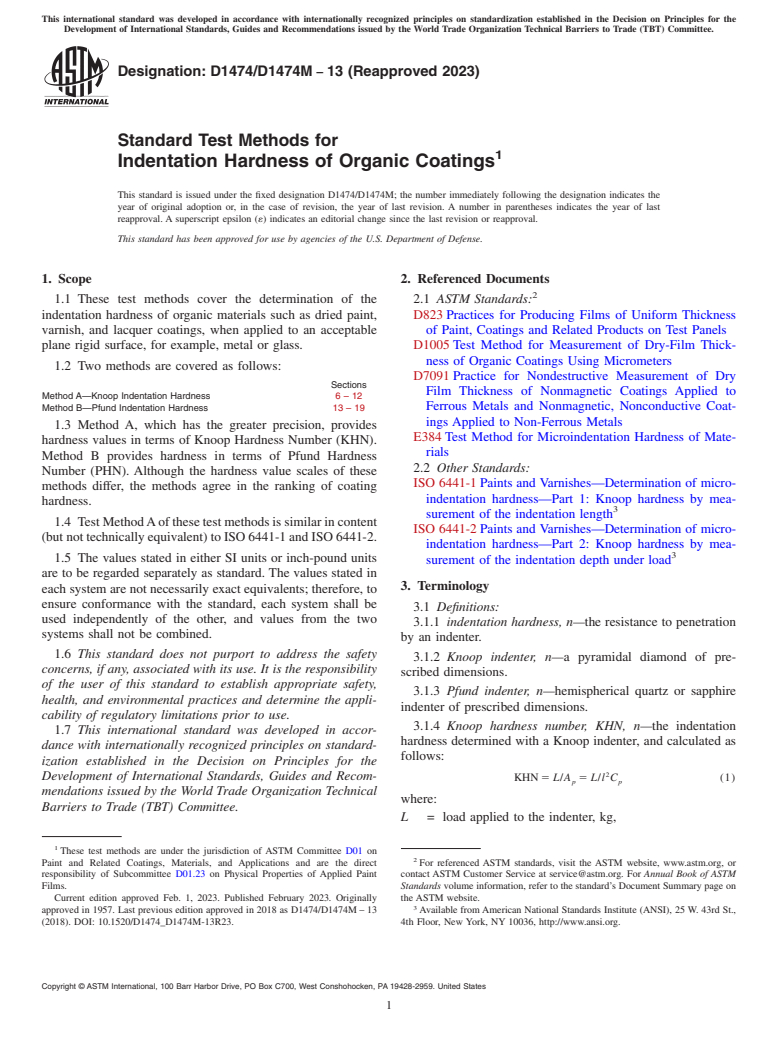
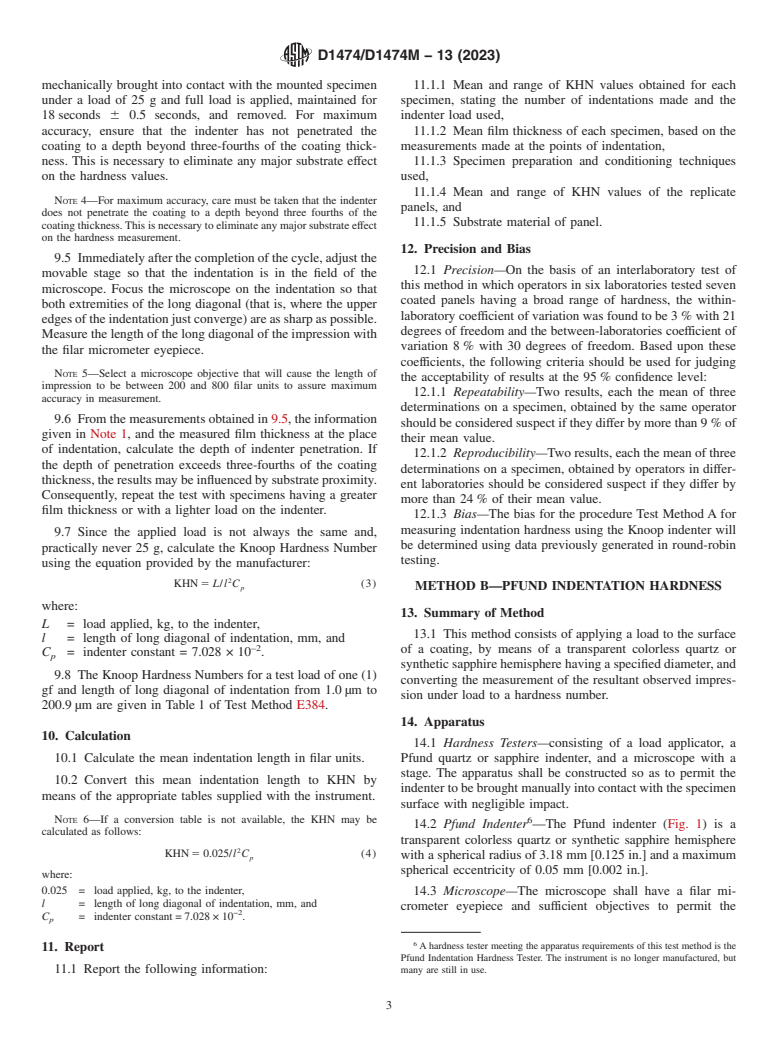
Standards Content (Sample)
This international standard was developed in accordance with internationally recognized principles on standardization established in the Decision on Principles for the
Development of International Standards, Guides and Recommendations issued by the World Trade Organization Technical Barriers to Trade (TBT) Committee.
Designation: D1474/D1474M − 13 (Reapproved 2023)
Standard Test Methods for
1
Indentation Hardness of Organic Coatings
This standard is issued under the fixed designation D1474/D1474M; the number immediately following the designation indicates the
year of original adoption or, in the case of revision, the year of last revision. A number in parentheses indicates the year of last
reapproval. A superscript epsilon (´) indicates an editorial change since the last revision or reapproval.
This standard has been approved for use by agencies of the U.S. Department of Defense.
1. Scope 2. Referenced Documents
2
1.1 These test methods cover the determination of the 2.1 ASTM Standards:
indentation hardness of organic materials such as dried paint, D823 Practices for Producing Films of Uniform Thickness
varnish, and lacquer coatings, when applied to an acceptable of Paint, Coatings and Related Products on Test Panels
plane rigid surface, for example, metal or glass. D1005 Test Method for Measurement of Dry-Film Thick-
ness of Organic Coatings Using Micrometers
1.2 Two methods are covered as follows:
D7091 Practice for Nondestructive Measurement of Dry
Sections
Film Thickness of Nonmagnetic Coatings Applied to
Method A—Knoop Indentation Hardness 6 – 12
Method B—Pfund Indentation Hardness 13 – 19 Ferrous Metals and Nonmagnetic, Nonconductive Coat-
ings Applied to Non-Ferrous Metals
1.3 Method A, which has the greater precision, provides
E384 Test Method for Microindentation Hardness of Mate-
hardness values in terms of Knoop Hardness Number (KHN).
rials
Method B provides hardness in terms of Pfund Hardness
2.2 Other Standards:
Number (PHN). Although the hardness value scales of these
ISO 6441-1 Paints and Varnishes—Determination of micro-
methods differ, the methods agree in the ranking of coating
indentation hardness—Part 1: Knoop hardness by mea-
hardness.
3
surement of the indentation length
1.4 Test Method A of these test methods is similar in content
ISO 6441-2 Paints and Varnishes—Determination of micro-
(but not technically equivalent) to ISO 6441-1 and ISO 6441-2.
indentation hardness—Part 2: Knoop hardness by mea-
3
1.5 The values stated in either SI units or inch-pound units
surement of the indentation depth under load
are to be regarded separately as standard. The values stated in
3. Terminology
each system are not necessarily exact equivalents; therefore, to
ensure conformance with the standard, each system shall be
3.1 Definitions:
used independently of the other, and values from the two
3.1.1 indentation hardness, n—the resistance to penetration
systems shall not be combined.
by an indenter.
1.6 This standard does not purport to address the safety
3.1.2 Knoop indenter, n—a pyramidal diamond of pre-
concerns, if any, associated with its use. It is the responsibility
scribed dimensions.
of the user of this standard to establish appropriate safety,
3.1.3 Pfund indenter, n—hemispherical quartz or sapphire
health, and environmental practices and determine the appli-
indenter of prescribed dimensions.
cability of regulatory limitations prior to use.
3.1.4 Knoop hardness number, KHN, n—the indentation
1.7 This international standard was developed in accor-
hardness determined with a Knoop indenter, and calculated as
dance with internationally recognized principles on standard-
follows:
ization established in the Decision on Principles for the
2
Development of International Standards, Guides and Recom-
KHN 5 L/A 5 L/l C (1)
p p
mendations issued by the World Trade Organization Technical
where:
Barriers to Trade (TBT) Committee.
L = load applied to the indenter, kg,
1
These test methods are under the jurisdiction of ASTM Committee D01 on
2
Paint and Related Coatings, Materials, and Applications and are the direct For referenced ASTM standards, visit the ASTM website, www.astm.org, or
responsibility of Subcommittee D01.23 on Physical Properties of Applied Paint contact ASTM Customer Service at service@astm.org. For Annual Book of ASTM
Films. Standards volume information, refer to the standard’s Document Summary page on
Current edition approved Feb. 1, 2023. Published February 2023. Originally the ASTM website.
3
approved in 1957. Last previous edition approved in 2018 as D1474/D1474M – 13 Available from American National Standards Institute (ANSI), 25 W. 43rd St.,
(2018). DOI: 10.1520/D1474_D1474M-13R23. 4th Floor, New York, NY 10036, http://www.ansi.org.
Copyright © ASTM International, 100 Barr Harbor Drive, PO Box C700, West Conshohocken, PA 19428-2959. United States
1
---------------------- Page: 1 ----------------------
D1474/D1474M − 13 (2023)
indenter into contact with the test surface with negli
...
Questions, Comments and Discussion
Ask us and Technical Secretary will try to provide an answer. You can facilitate discussion about the standard in here.