


ASTM D611-12(2016)
(Test Method)Standard Test Methods for Aniline Point and Mixed Aniline Point of Petroleum Products and Hydrocarbon Solvents
Standard Test Methods for Aniline Point and Mixed Aniline Point of Petroleum Products and Hydrocarbon Solvents
SIGNIFICANCE AND USE
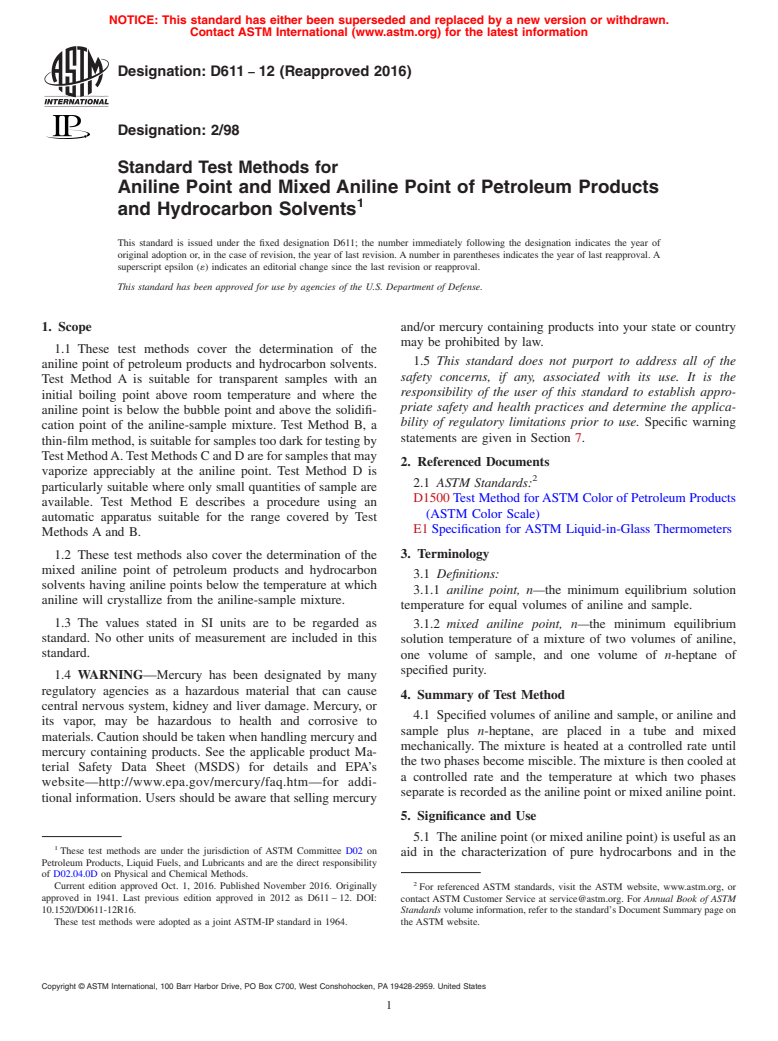
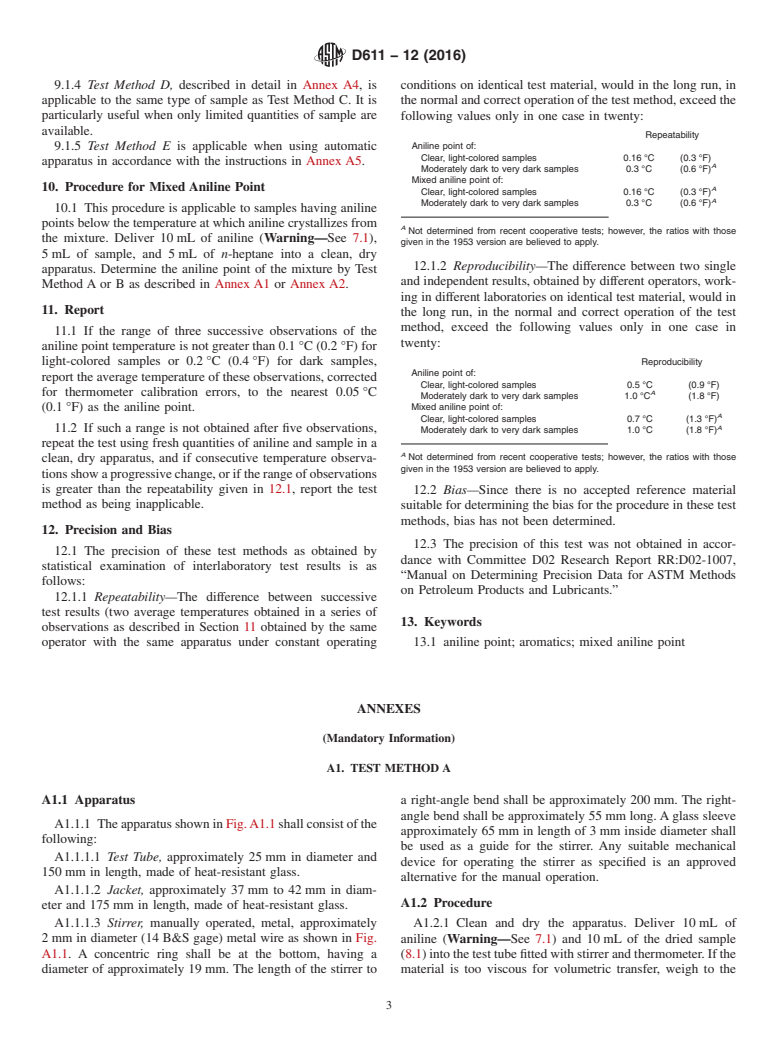
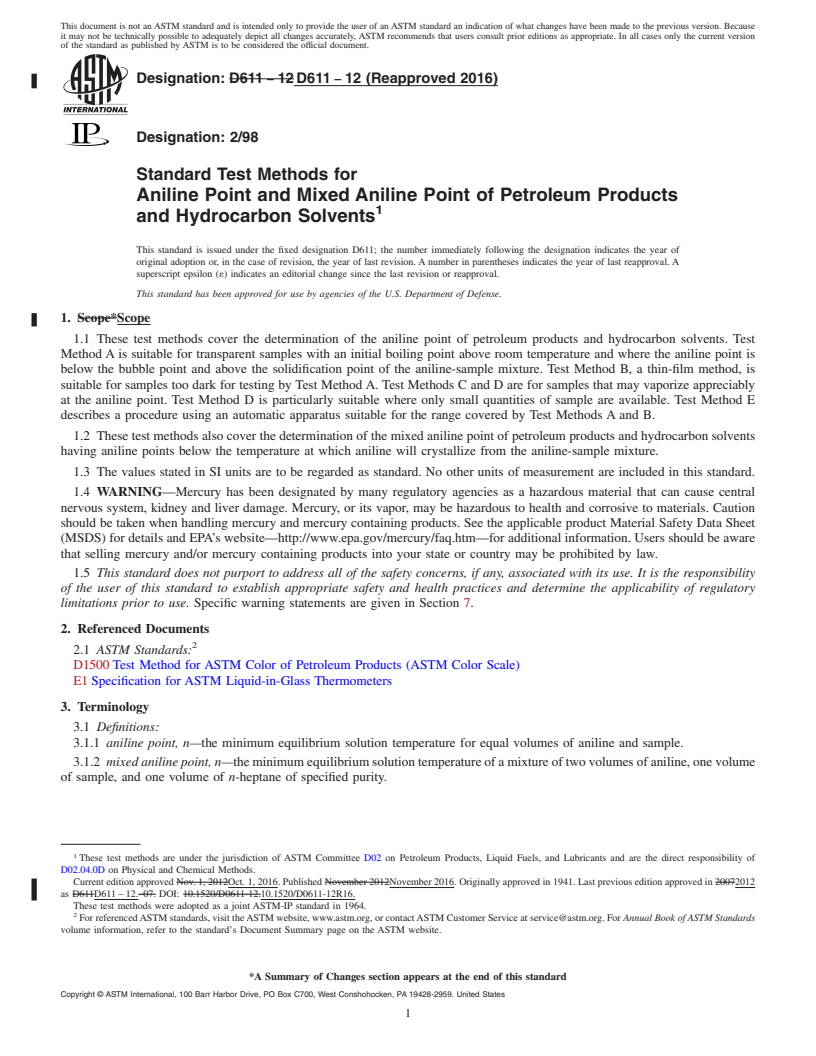
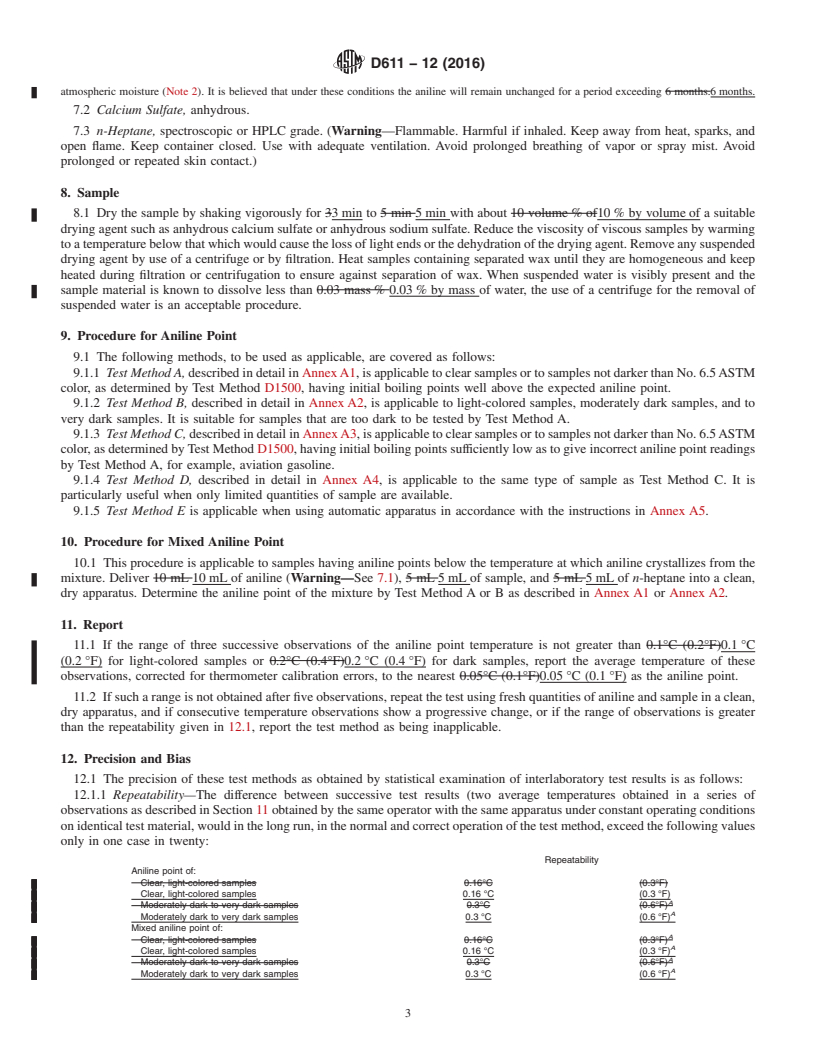
5.1 The aniline point (or mixed aniline point) is useful as an aid in the characterization of pure hydrocarbons and in the analysis of hydrocarbon mixtures. Aromatic hydrocarbons exhibit the lowest, and paraffins the highest values. Cycloparaffins and olefins exhibit values that lie between those for paraffins and aromatics. In homologous series the aniline points increase with increasing molecular weight. Although it occasionally is used in combination with other physical properties in correlative methods for hydrocarbon analysis, the aniline point is most often used to provide an estimate of the aromatic hydrocarbon content of mixtures.
SCOPE
1.1 These test methods cover the determination of the aniline point of petroleum products and hydrocarbon solvents. Test Method A is suitable for transparent samples with an initial boiling point above room temperature and where the aniline point is below the bubble point and above the solidification point of the aniline-sample mixture. Test Method B, a thin-film method, is suitable for samples too dark for testing by Test Method A. Test Methods C and D are for samples that may vaporize appreciably at the aniline point. Test Method D is particularly suitable where only small quantities of sample are available. Test Method E describes a procedure using an automatic apparatus suitable for the range covered by Test Methods A and B.
1.2 These test methods also cover the determination of the mixed aniline point of petroleum products and hydrocarbon solvents having aniline points below the temperature at which aniline will crystallize from the aniline-sample mixture.
1.3 The values stated in SI units are to be regarded as standard. No other units of measurement are included in this standard.
1.4 WARNING—Mercury has been designated by many regulatory agencies as a hazardous material that can cause central nervous system, kidney and liver damage. Mercury, or its vapor, may be hazardous to health and corrosive to materials. Caution should be taken when handling mercury and mercury containing products. See the applicable product Material Safety Data Sheet (MSDS) for details and EPA’s website—http://www.epa.gov/mercury/faq.htm—for additional information. Users should be aware that selling mercury and/or mercury containing products into your state or country may be prohibited by law.
1.5 This standard does not purport to address all of the safety concerns, if any, associated with its use. It is the responsibility of the user of this standard to establish appropriate safety and health practices and determine the applicability of regulatory limitations prior to use. Specific warning statements are given in Section 7.
General Information
Buy Standard
Standards Content (Sample)
NOTICE: This standard has either been superseded and replaced by a new version or withdrawn.
Contact ASTM International (www.astm.org) for the latest information
Designation: D611 − 12 (Reapproved 2016)
Designation: 2/98
Standard Test Methods for
Aniline Point and Mixed Aniline Point of Petroleum Products
and Hydrocarbon Solvents
This standard is issued under the fixed designation D611; the number immediately following the designation indicates the year of
original adoption or, in the case of revision, the year of last revision. A number in parentheses indicates the year of last reapproval. A
superscript epsilon (´) indicates an editorial change since the last revision or reapproval.
This standard has been approved for use by agencies of the U.S. Department of Defense.
1. Scope and/or mercury containing products into your state or country
may be prohibited by law.
1.1 These test methods cover the determination of the
1.5 This standard does not purport to address all of the
aniline point of petroleum products and hydrocarbon solvents.
safety concerns, if any, associated with its use. It is the
Test Method A is suitable for transparent samples with an
responsibility of the user of this standard to establish appro-
initial boiling point above room temperature and where the
priate safety and health practices and determine the applica-
aniline point is below the bubble point and above the solidifi-
bility of regulatory limitations prior to use. Specific warning
cation point of the aniline-sample mixture. Test Method B, a
statements are given in Section 7.
thin-film method, is suitable for samples too dark for testing by
Test Method A. Test Methods C and D are for samples that may
2. Referenced Documents
vaporize appreciably at the aniline point. Test Method D is
2.1 ASTM Standards:
particularly suitable where only small quantities of sample are
D1500 Test Method for ASTM Color of Petroleum Products
available. Test Method E describes a procedure using an
(ASTM Color Scale)
automatic apparatus suitable for the range covered by Test
E1 Specification for ASTM Liquid-in-Glass Thermometers
Methods A and B.
1.2 These test methods also cover the determination of the 3. Terminology
mixed aniline point of petroleum products and hydrocarbon
3.1 Definitions:
solvents having aniline points below the temperature at which
3.1.1 aniline point, n—the minimum equilibrium solution
aniline will crystallize from the aniline-sample mixture.
temperature for equal volumes of aniline and sample.
1.3 The values stated in SI units are to be regarded as
3.1.2 mixed aniline point, n—the minimum equilibrium
standard. No other units of measurement are included in this
solution temperature of a mixture of two volumes of aniline,
standard.
one volume of sample, and one volume of n-heptane of
specified purity.
1.4 WARNING—Mercury has been designated by many
regulatory agencies as a hazardous material that can cause
4. Summary of Test Method
central nervous system, kidney and liver damage. Mercury, or
4.1 Specified volumes of aniline and sample, or aniline and
its vapor, may be hazardous to health and corrosive to
sample plus n-heptane, are placed in a tube and mixed
materials. Caution should be taken when handling mercury and
mechanically. The mixture is heated at a controlled rate until
mercury containing products. See the applicable product Ma-
the two phases become miscible. The mixture is then cooled at
terial Safety Data Sheet (MSDS) for details and EPA’s
a controlled rate and the temperature at which two phases
website—http://www.epa.gov/mercury/faq.htm—for addi-
separate is recorded as the aniline point or mixed aniline point.
tional information. Users should be aware that selling mercury
5. Significance and Use
5.1 The aniline point (or mixed aniline point) is useful as an
These test methods are under the jurisdiction of ASTM Committee D02 on
aid in the characterization of pure hydrocarbons and in the
Petroleum Products, Liquid Fuels, and Lubricants and are the direct responsibility
of D02.04.0D on Physical and Chemical Methods.
Current edition approved Oct. 1, 2016. Published November 2016. Originally For referenced ASTM standards, visit the ASTM website, www.astm.org, or
approved in 1941. Last previous edition approved in 2012 as D611 – 12. DOI: contact ASTM Customer Service at service@astm.org. For Annual Book of ASTM
10.1520/D0611-12R16. Standards volume information, refer to the standard’s Document Summary page on
These test methods were adopted as a joint ASTM-IP standard in 1964. the ASTM website.
Copyright © ASTM International, 100 Barr Harbor Drive, PO Box C700, West Conshohocken, PA 19428-2959. United States
D611 − 12 (2016)
analysis of hydrocarbon mixtures. Aromatic hydrocarbons aniline shall be sufficiently pure such that when tested with
exhibit the lowest, and paraffins the highest values. Cyclopar- n-heptane according to Section 9, it shall give an aniline point
affins and olefins exhibit values that lie between those for of 69.3 °C 6 0.2 °C (156.7 °F 6 0.4 °F) as determined from
paraffins and aromatics. In homologous series the aniline the average of two independent tests having a difference of not
points increase with increasing molecular weight. Although it more than 0.1 °C (0.2 °F). If the aniline point of heptane is
occasionally is used in combination with other physical prop- higher than this specification, the aniline may be dried by
erties in correlative methods for hydrocarbon analysis, the distillation, where the first and last 10 % are discarded. If the
aniline point is most often used to provide an estimate of the aniline point is lower, water may be added until the aniline
aromatic hydrocarbon content of mixtures. meets the specification.
NOTE 3—It is estimated that approximately 400 ppm to 1400 ppm of
6. Apparatus
water in aniline is required to meet the heptane specification.
6.1 For details of the aniline point apparatus required for
NOTE 4—As an alternative to distilling the aniline on the day of use, the
each method see: aniline may be distilled as described in 7.1, collecting the distillate in
ampoules, sealing the ampoules under vacuum or dry nitrogen, and storing
Annex A1 for Test Method A
in a cool dark place for future use. Alternatively, distillate may be stored
Annex A2 for Test Method B
under dry nitrogen in a glass bottle or in single use ampoules kept in a
Annex A3 for Test Method C
cool, dark place. In either case, rigid precaution must be taken to avoid
Annex A4 for Test Method D
contamination from atmospheric moisture (Note 2). It is believed that
Annex A5 for Test Method E
under these conditions the aniline will remain unchanged for a period
NOTE 1—Alternative apparatus may be used, such as the U-tube method
exceeding 6 months.
for dark oils, provided it has been shown to give results of the same
7.2 Calcium Sulfate, anhydrous.
precision and accuracy as those described in the annexes.
6.2 Heating and Cooling Bath—A suitable air bath, a 7.3 n-Heptane, spectroscopic or HPLC grade. (Warning—
Flammable. Harmful if inhaled. Keep away from heat, sparks,
nonvolatile, transparent liquid bath, or an infrared lamp
(250 W to 375 W), provided with means for controlling the and open flame. Keep container closed. Use with adequate
ventilation. Avoid prolonged breathing of vapor or spray mist.
rate of heating.
Avoid prolonged or repeated skin contact.)
NOTE 2—Water should not be used as either a heating or cooling
medium since aniline is hygroscopic and moist aniline will give erroneous
8. Sample
test results. For example, the aniline point of the n-heptane reagent as
measured with aniline containing 0.1 % by volume water is approximately
8.1 Dry the sample by shaking vigorously for 3 min to
0.5 °C (0.9 °F) higher than that measured with dry aniline. If the aniline
5 min with about 10 % by volume of a suitable drying agent
point is below the dew point of the atmosphere, pass a slow stream of dry
such as anhydrous calcium sulfate or anhydrous sodium
inert gas into the aniline point tube to blanket the aniline-sample mixture.
sulfate. Reduce the viscosity of viscous samples by warming to
6.3 Thermometers, or other temperature sensing devices,
a temperature below that which would cause the loss of light
such as thermocouples or platinum resistance thermometers
ends or the dehydration of the drying agent. Remove any
that cover the temperamental range of interest and can provide
suspended drying agent by use of a centrifuge or by filtration.
equivalent or better accuracy and precision, may be used in
Heat samples containing separated wax until they are homo-
place of the thermometers having the following ranges and
geneous and keep heated during filtration or centrifugation to
conforming to the requirements of the designated ASTM or IP
ensure against separation of wax. When suspended water is
specification:
visibly present and the sample material is known to dissolve
ASTM
Range IP less than 0.03 % by mass of water, the use of a centrifuge for
(Specification E1)
the removal of suspended water is an acceptable procedure.
−38 °C to + 42 °C (−36.5 °F 33C, 33F 20C
to + 107.5 °F)
9. Procedure for Aniline Point
25 °C to 105 °C (77 °F to 221 °F) 34C, 34F 21C
90 °C to 170 °C (194 °F to 338 °F) 35C, 35F 59C
9.1 The following methods, to be used as applicable, are
6.4 Pipets, or equivalent volume dispensing devices, ca- covered as follows:
pable of delivering volumes with capacities of 10 mL 6 9.1.1 Test Method A, described in detail in Annex A1, is
0.04 mL and 5 mL 6 0.02 mL, for use in the test. applicable to clear samples or to samples not darker than No.
6.5 ASTM color, as determined by Test Method D1500, having
6.5 Balance—A laboratory balance sensitive to 0.01 g, suit-
initial boiling points well above the expected aniline point.
able for weighing the tube and sample when the sample cannot
9.1.2 Test Method B, described in detail in Annex A2, is
be pipetted conveniently.
applicable to light-colored samples, moderately dark samples,
6.6 Safety Goggles.
and to very dark samples. It is suitable for samples that are too
6.7 Plastic Gloves, impervious to aniline. dark to be tested by Test Method A.
9.1.3 Test Method C, described in detail in Annex A3, is
7. Reagents
applicable to clear samples or to samples not darker than No.
7.1 Aniline (Warning—Aniline should not be pipetted di- 6.5 ASTM color, as determined by Test Method D1500, having
rectly by mouth because of its extreme toxicity. Aniline is also initial boiling points sufficiently low as to give incorrect aniline
toxic by absorption through the skin even in very small point readings by Test Method A, for example, aviation
quantities, and should be handled with great caution.) The gasoline.
D611 − 12 (2016)
9.1.4 Test Method D, described in detail in Annex A4, is conditions on identical test material, would in the long run, in
applicable to the same type of sample as Test Method C. It is
the normal and correct operation of the test method, exceed the
particularly useful when only limited quantities of sample are following values only in one case in twenty:
available.
Repeatability
Aniline point of:
9.1.5 Test Method E is applicable when using automatic
Clear, light-colored samples 0.16 °C (0.3 °F)
apparatus in accordance with the instructions in Annex A5.
A
Moderately dark to very dark samples 0.3 °C (0.6 °F)
Mixed aniline point of:
10. Procedure for Mixed Aniline Point A
Clear, light-colored samples 0.16 °C (0.3 °F)
A
Moderately dark to very dark samples 0.3 °C (0.6 °F)
10.1 This procedure is applicable to samples having aniline
points below the temperature at which aniline crystallizes from
A
Not determined from recent cooperative tests; however, the ratios with those
the mixture. Deliver 10 mL of aniline (Warning—See 7.1),
given in the 1953 version are believed to apply.
5 mL of sample, and 5 mL of n-heptane into a clean, dry
12.1.2 Reproducibility—The difference between two single
apparatus. Determine the aniline point of the mixture by Test
and independent results, obtained by different operators, work-
Method A or B as described in Annex A1 or Annex A2.
ing in different laboratories on identical test material, would in
11. Report
the long run, in the normal and correct operation of the test
method, exceed the following values only in one case in
11.1 If the range of three successive observations of the
twenty:
aniline point temperature is not greater than 0.1 °C (0.2 °F) for
light-colored samples or 0.2 °C (0.4 °F) for dark samples, Reproducibility
Aniline point of:
report the average temperature of these observations, corrected
Clear, light-colored samples 0.5 °C (0.9 °F)
for thermometer calibration errors, to the nearest 0.05 °C A
Moderately dark to very dark samples 1.0 °C (1.8 °F)
Mixed aniline point of:
(0.1 °F) as the aniline point.
A
Clear, light-colored samples 0.7 °C (1.3 °F)
A
11.2 If such a range is not obtained after five observations,
Moderately dark to very dark samples 1.0 °C (1.8 °F)
repeat the test using fresh quantities of aniline and sample in a
A
Not determined from recent cooperative tests; however, the ratios with those
clean, dry apparatus, and if consecutive temperature observa-
given in the 1953 version are believed to apply.
tions show a progressive change, or if the range of observations
is greater than the repeatability given in 12.1, report the test
12.2 Bias—Since there is no accepted reference material
method as being inapplicable. suitable for determining the bias for the procedure in these test
methods, bias has not been determined.
12. Precision and Bias
12.3 The precision of this test was not obtained in accor-
12.1 The precision of these test methods as obtained by
dance with Committee D02 Research Report RR:D02-1007,
statistical examination of interlaboratory test results is as
“Manual on Determining Precision Data for ASTM Methods
follows:
on Petroleum Products and Lubricants.”
12.1.1 Repeatability—The difference between successive
test results (two average temperatures obtained in a series of
13. Keywords
observations as described in Section 11 obtained by the same
operator with the same apparatus under constant operating 13.1 aniline point; aromatics; mixed aniline point
ANNEXES
(Mandatory Information)
A1. TEST METHOD A
A1.1 Apparatus a right-angle bend shall be approximately 200 mm. The right-
angle bend shall be approximately 55 mm long. A glass sleeve
A1.1.1 The apparatus shown in Fig. A1.1 shall consist of the
approximately 65 mm in length of 3 mm inside diameter shall
following:
be used as a guide for the stirrer. Any suitable mechanical
A1.1.1.1 Test Tube, approximately 25 mm in diameter and
device for operating the stirrer as specified is an approved
150 mm in length, made of heat-resistant glass.
alternative for the manual operation.
A1.1.1.2 Jacket, approximately 37 mm to 42 mm in diam-
...
This document is not an ASTM standard and is intended only to provide the user of an ASTM standard an indication of what changes have been made to the previous version. Because
it may not be technically possible to adequately depict all changes accurately, ASTM recommends that users consult prior editions as appropriate. In all cases only the current version
of the standard as published by ASTM is to be considered the official document.
Designation: D611 − 12 D611 − 12 (Reapproved 2016)
Designation: 2/98
Standard Test Methods for
Aniline Point and Mixed Aniline Point of Petroleum Products
and Hydrocarbon Solvents
This standard is issued under the fixed designation D611; the number immediately following the designation indicates the year of
original adoption or, in the case of revision, the year of last revision. A number in parentheses indicates the year of last reapproval. A
superscript epsilon (´) indicates an editorial change since the last revision or reapproval.
This standard has been approved for use by agencies of the U.S. Department of Defense.
1. Scope*Scope
1.1 These test methods cover the determination of the aniline point of petroleum products and hydrocarbon solvents. Test
Method A is suitable for transparent samples with an initial boiling point above room temperature and where the aniline point is
below the bubble point and above the solidification point of the aniline-sample mixture. Test Method B, a thin-film method, is
suitable for samples too dark for testing by Test Method A. Test Methods C and D are for samples that may vaporize appreciably
at the aniline point. Test Method D is particularly suitable where only small quantities of sample are available. Test Method E
describes a procedure using an automatic apparatus suitable for the range covered by Test Methods A and B.
1.2 These test methods also cover the determination of the mixed aniline point of petroleum products and hydrocarbon solvents
having aniline points below the temperature at which aniline will crystallize from the aniline-sample mixture.
1.3 The values stated in SI units are to be regarded as standard. No other units of measurement are included in this standard.
1.4 WARNING—Mercury has been designated by many regulatory agencies as a hazardous material that can cause central
nervous system, kidney and liver damage. Mercury, or its vapor, may be hazardous to health and corrosive to materials. Caution
should be taken when handling mercury and mercury containing products. See the applicable product Material Safety Data Sheet
(MSDS) for details and EPA’s website—http://www.epa.gov/mercury/faq.htm—for additional information. Users should be aware
that selling mercury and/or mercury containing products into your state or country may be prohibited by law.
1.5 This standard does not purport to address all of the safety concerns, if any, associated with its use. It is the responsibility
of the user of this standard to establish appropriate safety and health practices and determine the applicability of regulatory
limitations prior to use. Specific warning statements are given in Section 7.
2. Referenced Documents
2.1 ASTM Standards:
D1500 Test Method for ASTM Color of Petroleum Products (ASTM Color Scale)
E1 Specification for ASTM Liquid-in-Glass Thermometers
3. Terminology
3.1 Definitions:
3.1.1 aniline point, n—the minimum equilibrium solution temperature for equal volumes of aniline and sample.
3.1.2 mixed aniline point, n—the minimum equilibrium solution temperature of a mixture of two volumes of aniline, one volume
of sample, and one volume of n-heptane of specified purity.
These test methods are under the jurisdiction of ASTM Committee D02 on Petroleum Products, Liquid Fuels, and Lubricants and are the direct responsibility of
D02.04.0D on Physical and Chemical Methods.
Current edition approved Nov. 1, 2012Oct. 1, 2016. Published November 2012November 2016. Originally approved in 1941. Last previous edition approved in 20072012
as D611D611 – 12.–07. DOI: 10.1520/D0611-12.10.1520/D0611-12R16.
These test methods were adopted as a joint ASTM-IP standard in 1964.
For referenced ASTM standards, visit the ASTM website, www.astm.org, or contact ASTM Customer Service at service@astm.org. For Annual Book of ASTM Standards
volume information, refer to the standard’s Document Summary page on the ASTM website.
*A Summary of Changes section appears at the end of this standard
Copyright © ASTM International, 100 Barr Harbor Drive, PO Box C700, West Conshohocken, PA 19428-2959. United States
D611 − 12 (2016)
4. Summary of Test Method
4.1 Specified volumes of aniline and sample, or aniline and sample plus n-heptane, are placed in a tube and mixed mechanically.
The mixture is heated at a controlled rate until the two phases become miscible. The mixture is then cooled at a controlled rate
and the temperature at which two phases separate is recorded as the aniline point or mixed aniline point.
5. Significance and Use
5.1 The aniline point (or mixed aniline point) is useful as an aid in the characterization of pure hydrocarbons and in the analysis
of hydrocarbon mixtures. Aromatic hydrocarbons exhibit the lowest, and paraffins the highest values. Cycloparaffins and olefins
exhibit values that lie between those for paraffins and aromatics. In homologous series the aniline points increase with increasing
molecular weight. Although it occasionally is used in combination with other physical properties in correlative methods for
hydrocarbon analysis, the aniline point is most often used to provide an estimate of the aromatic hydrocarbon content of mixtures.
6. Apparatus
6.1 For details of the aniline point apparatus required for each method see:
Annex A1 for Test Method A
Annex A2 for Test Method B
Annex A3 for Test Method C
Annex A4 for Test Method D
Annex A5 for Test Method E
NOTE 1—Alternative apparatus may be used, such as the U-tube method for dark oils, provided it has been shown to give results of the same precision
and accuracy as those described in the annexes.
6.2 Heating and Cooling Bath—A suitable air bath, a nonvolatile, transparent liquid bath, or an infrared lamp (250(250 W to
375 W), provided with means for controlling the rate of heating.
NOTE 2—Water should not be used as either a heating or cooling medium since aniline is hygroscopic and moist aniline will give erroneous test results.
For example, the aniline point of the n-heptane reagent as measured with aniline containing 0.1 volume % water0.1 % by volume water is approximately
0.5°C (0.9°F)0.5 °C (0.9 °F) higher than that measured with dry aniline. If the aniline point is below the dew point of the atmosphere, pass a slow stream
of dry inert gas into the aniline point tube to blanket the aniline-sample mixture.
6.3 Thermometers, or other temperature sensing devices, such as thermocouples or platinum resistance thermometers that cover
the temperamental range of interest and can provide equivalent or better accuracy and precision, may be used in place of the
thermometers having the following ranges and conforming to the requirements of the designated ASTM or IP specification:
ASTM
Range IP
(Specification E1)
−38 to + 42°C (−36.5 to + 107.5°F) 33C, 33F 20C
−38 °C to + 42 °C (−36.5 °F 33C, 33F 20C
to + 107.5 °F)
25 to 105°C (77 to 221°F) 34C, 34F 21C
25 °C to 105 °C (77 °F to 221 °F) 34C, 34F 21C
90 to 170°C (194 to 338°F) 35C, 35F 59C
90 °C to 170 °C (194 °F to 338 °F) 35C, 35F 59C
6.4 Pipets, or equivalent volume dispensing devices, capable of delivering volumes with capacities of 1010 mL 6 0.04 mL
0.04 mL and 55 mL 6 0.02 mL, 0.02 mL, for use in the test.
6.5 Balance—A laboratory balance sensitive to 0.01 g, 0.01 g, suitable for weighing the tube and sample when the sample
cannot be pipetted conveniently.
6.6 Safety Goggles.
6.7 Plastic Gloves, impervious to aniline.
7. Reagents
7.1 Aniline (Warning—Aniline should not be pipetted directly by mouth because of its extreme toxicity. Aniline is also toxic
by absorption through the skin even in very small quantities, and should be handled with great caution.) The aniline shall be
sufficiently pure such that when tested with n-heptane according to Section 9, it shall give an aniline point of 69.369.3 °C 6 0.2°C
(156.70.2 °C (156.7 °F 6 0.4°F)0.4 °F) as determined from the average of two independent tests having a difference of not more
than 0.1°C (0.2°F).0.1 °C (0.2 °F). If the aniline point of heptane is higher than this specification, the aniline may be dried by
distillation, where the first and last 10 % are discarded. If the aniline point is lower, water may be added until the aniline meets
the specification.
NOTE 3—It is estimated that approximately 400400 ppm to 1400 ppm 1400 ppm of water in aniline is required to meet the heptane specification.
NOTE 4—As an alternative to distilling the aniline on the day of use, the aniline may be distilled as described in 7.1, collecting the distillate in ampoules,
sealing the ampoules under vacuum or dry nitrogen, and storing in a cool dark place for future use. Alternatively, distillate may be stored under dry
nitrogen in a glass bottle or in single use ampoules kept in a cool, dark place. In either case, rigid precaution must be taken to avoid contamination from
D611 − 12 (2016)
atmospheric moisture (Note 2). It is believed that under these conditions the aniline will remain unchanged for a period exceeding 6 months.6 months.
7.2 Calcium Sulfate, anhydrous.
7.3 n-Heptane, spectroscopic or HPLC grade. (Warning—Flammable. Harmful if inhaled. Keep away from heat, sparks, and
open flame. Keep container closed. Use with adequate ventilation. Avoid prolonged breathing of vapor or spray mist. Avoid
prolonged or repeated skin contact.)
8. Sample
8.1 Dry the sample by shaking vigorously for 33 min to 5 min 5 min with about 10 volume % of10 % by volume of a suitable
drying agent such as anhydrous calcium sulfate or anhydrous sodium sulfate. Reduce the viscosity of viscous samples by warming
to a temperature below that which would cause the loss of light ends or the dehydration of the drying agent. Remove any suspended
drying agent by use of a centrifuge or by filtration. Heat samples containing separated wax until they are homogeneous and keep
heated during filtration or centrifugation to ensure against separation of wax. When suspended water is visibly present and the
sample material is known to dissolve less than 0.03 mass % 0.03 % by mass of water, the use of a centrifuge for the removal of
suspended water is an acceptable procedure.
9. Procedure for Aniline Point
9.1 The following methods, to be used as applicable, are covered as follows:
9.1.1 Test Method A, described in detail in Annex A1, is applicable to clear samples or to samples not darker than No. 6.5 ASTM
color, as determined by Test Method D1500, having initial boiling points well above the expected aniline point.
9.1.2 Test Method B, described in detail in Annex A2, is applicable to light-colored samples, moderately dark samples, and to
very dark samples. It is suitable for samples that are too dark to be tested by Test Method A.
9.1.3 Test Method C, described in detail in Annex A3, is applicable to clear samples or to samples not darker than No. 6.5 ASTM
color, as determined by Test Method D1500, having initial boiling points sufficiently low as to give incorrect aniline point readings
by Test Method A, for example, aviation gasoline.
9.1.4 Test Method D, described in detail in Annex A4, is applicable to the same type of sample as Test Method C. It is
particularly useful when only limited quantities of sample are available.
9.1.5 Test Method E is applicable when using automatic apparatus in accordance with the instructions in Annex A5.
10. Procedure for Mixed Aniline Point
10.1 This procedure is applicable to samples having aniline points below the temperature at which aniline crystallizes from the
mixture. Deliver 10 mL 10 mL of aniline (Warning—See 7.1), 5 mL 5 mL of sample, and 5 mL 5 mL of n-heptane into a clean,
dry apparatus. Determine the aniline point of the mixture by Test Method A or B as described in Annex A1 or Annex A2.
11. Report
11.1 If the range of three successive observations of the aniline point temperature is not greater than 0.1°C (0.2°F)0.1 °C
(0.2 °F) for light-colored samples or 0.2°C (0.4°F)0.2 °C (0.4 °F) for dark samples, report the average temperature of these
observations, corrected for thermometer calibration errors, to the nearest 0.05°C (0.1°F)0.05 °C (0.1 °F) as the aniline point.
11.2 If such a range is not obtained after five observations, repeat the test using fresh quantities of aniline and sample in a clean,
dry apparatus, and if consecutive temperature observations show a progressive change, or if the range of observations is greater
than the repeatability given in 12.1, report the test method as being inapplicable.
12. Precision and Bias
12.1 The precision of these test methods as obtained by statistical examination of interlaboratory test results is as follows:
12.1.1 Repeatability—The difference between successive test results (two average temperatures obtained in a series of
observations as described in Section 11 obtained by the same operator with the same apparatus under constant operating conditions
on identical test material, would in the long run, in the normal and correct operation of the test method, exceed the following values
only in one case in twenty:
Repeatability
Aniline point of:
Clear, light-colored samples 0.16°C (0.3°F)
Clear, light-colored samples 0.16 °C (0.3 °F)
A
Moderately dark to very dark samples 0.3°C (0.6°F)
A
Moderately dark to very dark samples 0.3 °C (0.6 °F)
Mixed aniline point of:
A
Clear, light-colored samples 0.16°C (0.3°F)
A
Clear, light-colored samples 0.16 °C (0.3 °F)
A
Moderately dark to very dark samples 0.3°C (0.6°F)
A
Moderately dark to very dark samples 0.3 °C (0.6 °F)
D611 − 12 (2016)
A
Not determined from recent cooperative tests; however, the ratios with those given in the 1953 version are believed to apply.
12.1.2 Reproducibility—The difference between two single and independent results, obtained by different operators, working in
different laboratories on identical test material, would in the long run, in the normal and correct operation of the test method,
exceed the following values only in one case in twenty:
Reproducibility
Aniline point of:
Clear, light-colored samples 0.5°C (0.9°F)
Clear, light-colored samples 0.5 °C (0.9 °F)
A
Moderately dark to very dark samples 1.0°C (1.8°F)
A
Moderately dark to very dark samples 1.0 °C (1.8 °F)
Mixed aniline point of:
A
Clear, light-colored samples 0.7°C (1.3°F)
A
Clear, light-colored samples 0.7 °C (1.3 °F)
A
Moderately dark to very dark samples 1.0°C (1.8°F)
A
Moderately dark to very dark samples 1.0 °C (1.8 °F)
A
Not determined from rece
...
Questions, Comments and Discussion
Ask us and Technical Secretary will try to provide an answer. You can facilitate discussion about the standard in here.