

ASTM D7369-20
(Test Method)Standard Test Method for Determining the Resilient Modulus of Asphalt Mixtures by Indirect Tension Test
General Information
- Abstract
SIGNIFICANCE AND USE
5.1 Resilient modulus can be used in the evaluation of materials quality and as input for pavement design, evaluation, and analysis. With this method, the effects of temperature and load on resilient modulus can also be investigated. This modulus test can be run on pavement cores because of specimen orientation.
Note 1: The quality of the results produced by this standard are dependent on the competence of the personnel performing the procedure and the capability, calibration, and maintenance of the equipment used. Agencies that meet the criteria of Specification D3666 are generally considered capable of competent and objective testing, sampling, inspection, etc. Users of this standard are cautioned that compliance with Specification D3666 alone does not completely ensure reliable results. Reliable results depend on many factors; following the suggestions of Specification D3666 or some similar acceptable guideline provides a means of evaluating and controlling some of those factors.
SCOPE
1.1 This test method covers procedures for preparing and testing laboratory-fabricated or field-recovered cores of asphalt mixtures to determine resilient modulus values using a repeated-load indirect tension test.
1.2 The values stated in SI units are regarded as the standard. Values in parentheses are for informational use.
1.3 A precision and bias statement for this standard has not been developed at this time. Therefore, this standard should not be used for acceptance or rejection of a material for purchasing purposes.
1.4 The text of this standard references notes and footnotes which provide explanatory material. These notes and footnotes (excluding those in tables and figures) shall not be considered as requirements of the standard.
1.5 This standard does not purport to address all of the safety concerns, if any, associated with its use. It is the responsibility of the user of this standard to establish appropriate safety, health, and environmental practices and determine the applicability of regulatory limitations prior to use.
1.6 This international standard was developed in accordance with internationally recognized principles on standardization established in the Decision on Principles for the Development of International Standards, Guides and Recommendations issued by the World Trade Organization Technical Barriers to Trade (TBT) Committee.
- Status
- Published
- Publication Date
- 31-Oct-2020
- Technical Committee
- D04 - Road and Paving Materials
- Drafting Committee
- D04.26 - Fundamental/Mechanistic Tests
Overview
ASTM D7369-20 is the internationally recognized standard test method for determining the resilient modulus of asphalt mixtures by the indirect tension test. Published by ASTM International, this test method outlines procedures for preparing and testing both laboratory-fabricated and field-recovered cores of asphalt mixtures to measure resilient modulus values. Utilizing a repeated-load indirect tension approach, this method provides crucial input for the design, evaluation, and analysis of flexible pavement structures. The resilient modulus measured informs on the quality of materials and helps engineers evaluate the effects of temperature and loading on asphalt pavement performance.
Key Topics
Resilient Modulus Determination: The core of ASTM D7369-20 is the evaluation of a material’s resilient modulus using a repeated-load, indirect tension test. The process involves subjecting a cylindrical asphalt specimen to repeated compressive loads and measuring the resulting horizontal and vertical deformations.
Specimen Types: The method allows for both laboratory-fabricated specimens and field-recovered pavement cores to be tested. The orientation of cores from pavements is particularly useful since it reflects actual in-place conditions.
Temperature and Loading Effects: The procedure enables assessment under varying temperatures and load applications, enabling investigation into how these factors impact the resilient modulus.
Equipment and Calibration: The reliability of test results depends on qualified personnel, calibration, and proper maintenance of testing equipment. Agencies following ASTM Specification D3666 are considered capable of competent testing, though quality control extends beyond basic compliance.
Data Collection: Precise measurement and recording systems are used to monitor deformations and loads in real time. The method emphasizes the use of computer-based data acquisition for accurate and reproducible results.
Specimen Conditioning: Preconditioning and temperature control are key for ensuring uniform, reliable outcomes. Specimens must be conditioned to the specified temperature prior to testing.
Reporting Standards: Detailed records of specimen identification, test conditions, measured values, and any deviations from standard procedures are required for each test.
Applications
ASTM D7369-20 is primarily used in:
- Pavement Material Characterization: Assessing the structural quality of asphalt mixtures, whether from new mixes or existing pavements.
- Flexible Pavement Design: Resilient modulus values determined by this test are vital design parameters for modern pavement design methods, enabling more accurate predictions of pavement performance and lifespan.
- Material Evaluation and Quality Control: By measuring resilient modulus, engineers and agencies can evaluate the performance of various asphalt mixtures, compare the quality of materials from different projects, and ensure specification compliance.
- Laboratory and Field Studies: Since the test can be performed on specimens compacted in the lab or cores obtained from the field, it is adaptable for both research and practical engineering purposes.
- Performance Investigation: The method permits exploration of the impacts of environmental conditions-like temperature changes-and repeated traffic loading on asphalt mixture behavior.
Related Standards
Understanding and applying ASTM D7369-20 often involves reference to several other standards:
- ASTM D8: Terminology Relating to Materials for Roads and Pavements, providing key definitions.
- ASTM D3666: Minimum requirements for agencies testing road and paving materials, ensuring laboratory competence and accuracy.
- ASTM D6925: Procedures for preparing and determining the relative density of asphalt specimens using a Superpave Gyratory Compactor.
- ASTM D6926: Practice for preparing asphalt mixture specimens using Marshall Apparatus.
- ASTM D6931: Test method for indirect tensile strength of asphalt mixtures, used for determining appropriate loading levels.
- NCHRP Project 1-28A: Research results and recommendations for laboratory determination of resilient modulus for flexible pavement design.
By following ASTM D7369-20, organizations ensure best practices in resilient modulus measurement, promoting higher pavement performance, durability, and reliability. This standard is essential for construction professionals, researchers, and pavement design engineers seeking compliance with global quality and testing protocols.
Relations
- Effective Date
- 01-Dec-2023
- Effective Date
- 01-Jan-2020
- Effective Date
- 01-Aug-2019
- Effective Date
- 15-Dec-2018
- Effective Date
- 15-Aug-2018
- Effective Date
- 01-Jul-2018
- Effective Date
- 01-Feb-2018
- Effective Date
- 15-Jul-2017
- Effective Date
- 01-Jul-2017
- Effective Date
- 15-Jun-2017
- Effective Date
- 01-May-2017
- Effective Date
- 01-Mar-2017
- Effective Date
- 15-Dec-2016
- Effective Date
- 01-Dec-2016
- Effective Date
- 01-Oct-2016
Get Certified
Connect with accredited certification bodies for this standard

Zavod za gradbeništvo Slovenije (ZAG) - Inšpekcija
ZAG inspection body for construction products, structures, and materials.
Sponsored listings
Frequently Asked Questions
ASTM D7369-20 is a standard published by ASTM International. Its full title is "Standard Test Method for Determining the Resilient Modulus of Asphalt Mixtures by Indirect Tension Test". This standard covers: SIGNIFICANCE AND USE 5.1 Resilient modulus can be used in the evaluation of materials quality and as input for pavement design, evaluation, and analysis. With this method, the effects of temperature and load on resilient modulus can also be investigated. This modulus test can be run on pavement cores because of specimen orientation. Note 1: The quality of the results produced by this standard are dependent on the competence of the personnel performing the procedure and the capability, calibration, and maintenance of the equipment used. Agencies that meet the criteria of Specification D3666 are generally considered capable of competent and objective testing, sampling, inspection, etc. Users of this standard are cautioned that compliance with Specification D3666 alone does not completely ensure reliable results. Reliable results depend on many factors; following the suggestions of Specification D3666 or some similar acceptable guideline provides a means of evaluating and controlling some of those factors. SCOPE 1.1 This test method covers procedures for preparing and testing laboratory-fabricated or field-recovered cores of asphalt mixtures to determine resilient modulus values using a repeated-load indirect tension test. 1.2 The values stated in SI units are regarded as the standard. Values in parentheses are for informational use. 1.3 A precision and bias statement for this standard has not been developed at this time. Therefore, this standard should not be used for acceptance or rejection of a material for purchasing purposes. 1.4 The text of this standard references notes and footnotes which provide explanatory material. These notes and footnotes (excluding those in tables and figures) shall not be considered as requirements of the standard. 1.5 This standard does not purport to address all of the safety concerns, if any, associated with its use. It is the responsibility of the user of this standard to establish appropriate safety, health, and environmental practices and determine the applicability of regulatory limitations prior to use. 1.6 This international standard was developed in accordance with internationally recognized principles on standardization established in the Decision on Principles for the Development of International Standards, Guides and Recommendations issued by the World Trade Organization Technical Barriers to Trade (TBT) Committee.
SIGNIFICANCE AND USE 5.1 Resilient modulus can be used in the evaluation of materials quality and as input for pavement design, evaluation, and analysis. With this method, the effects of temperature and load on resilient modulus can also be investigated. This modulus test can be run on pavement cores because of specimen orientation. Note 1: The quality of the results produced by this standard are dependent on the competence of the personnel performing the procedure and the capability, calibration, and maintenance of the equipment used. Agencies that meet the criteria of Specification D3666 are generally considered capable of competent and objective testing, sampling, inspection, etc. Users of this standard are cautioned that compliance with Specification D3666 alone does not completely ensure reliable results. Reliable results depend on many factors; following the suggestions of Specification D3666 or some similar acceptable guideline provides a means of evaluating and controlling some of those factors. SCOPE 1.1 This test method covers procedures for preparing and testing laboratory-fabricated or field-recovered cores of asphalt mixtures to determine resilient modulus values using a repeated-load indirect tension test. 1.2 The values stated in SI units are regarded as the standard. Values in parentheses are for informational use. 1.3 A precision and bias statement for this standard has not been developed at this time. Therefore, this standard should not be used for acceptance or rejection of a material for purchasing purposes. 1.4 The text of this standard references notes and footnotes which provide explanatory material. These notes and footnotes (excluding those in tables and figures) shall not be considered as requirements of the standard. 1.5 This standard does not purport to address all of the safety concerns, if any, associated with its use. It is the responsibility of the user of this standard to establish appropriate safety, health, and environmental practices and determine the applicability of regulatory limitations prior to use. 1.6 This international standard was developed in accordance with internationally recognized principles on standardization established in the Decision on Principles for the Development of International Standards, Guides and Recommendations issued by the World Trade Organization Technical Barriers to Trade (TBT) Committee.
ASTM D7369-20 is classified under the following ICS (International Classification for Standards) categories: 93.080.20 - Road construction materials. The ICS classification helps identify the subject area and facilitates finding related standards.
ASTM D7369-20 has the following relationships with other standards: It is inter standard links to ASTM D6925-23, ASTM D6926-20, ASTM D8-19, ASTM D8-18c, ASTM D8-18b, ASTM D8-18a, ASTM D8-18, ASTM D8-17c, ASTM D6931-17, ASTM D8-17b, ASTM D8-17a, ASTM D8-17, ASTM D6926-16, ASTM D8-16b, ASTM D3666-16. Understanding these relationships helps ensure you are using the most current and applicable version of the standard.
ASTM D7369-20 is available in PDF format for immediate download after purchase. The document can be added to your cart and obtained through the secure checkout process. Digital delivery ensures instant access to the complete standard document.
Standards Content (Sample)
This international standard was developed in accordance with internationally recognized principles on standardization established in the Decision on Principles for the
Development of International Standards, Guides and Recommendations issued by the World Trade Organization Technical Barriers to Trade (TBT) Committee.
Designation: D7369 − 20
Standard Test Method for
Determining the Resilient Modulus of Asphalt Mixtures by
Indirect Tension Test
This standard is issued under the fixed designation D7369; the number immediately following the designation indicates the year of
original adoption or, in the case of revision, the year of last revision.Anumber in parentheses indicates the year of last reapproval.A
superscript epsilon (´) indicates an editorial change since the last revision or reapproval.
1. Scope D3666Specification for Minimum Requirements for Agen-
cies Testing and Inspecting Road and Paving Materials
1.1 This test method covers procedures for preparing and
D6925Test Method for Preparation and Determination of
testinglaboratory-fabricatedorfield-recoveredcoresofasphalt
the Relative Density ofAsphalt Mix Specimens by Means
mixtures to determine resilient modulus values using a
of the Superpave Gyratory Compactor
repeated-load indirect tension test.
D6926Practice for Preparation of Asphalt Mixture Speci-
1.2 The values stated in SI units are regarded as the
mens Using Marshall Apparatus
standard. Values in parentheses are for informational use.
D6931Test Method for Indirect Tensile (IDT) Strength of
1.3 Aprecision and bias statement for this standard has not Asphalt Mixtures
2.2 Other Document:
beendevelopedatthistime.Therefore,thisstandardshouldnot
beusedforacceptanceorrejectionofamaterialforpurchasing NCHRP Project 1-28AResearch Results Digest Number
285—Laboratory Determination of Resilient Modulus for
purposes.
Flexible Pavement Design, January 2004
1.4 The text of this standard references notes and footnotes
which provide explanatory material.These notes and footnotes
3. Terminology
(excluding those in tables and figures) shall not be considered
3.1 Definitions—Definitions are in accordance with Termi-
as requirements of the standard.
nology D8.
1.5 This standard does not purport to address all of the
3.2 Definitions of Terms Specific to This Standard:
safety concerns, if any, associated with its use. It is the
3.2.1 contact load (P ), n—the vertical load placed on
contact
responsibility of the user of this standard to establish appro-
the specimen to maintain a positive contact between the
priate safety, health, and environmental practices and deter-
loading strip and the specimen. The suggested contact load is
mine the applicability of regulatory limitations prior to use.
8%ofthemaximumload(0.08 P ).Thecontactloadshould
max
1.6 This international standard was developed in accor-
be not less than 22.2 N (5 lb) and no more than 89.0 N (20 lb).
dance with internationally recognized principles on standard-
ization established in the Decision on Principles for the 3.2.2 core, n—an intact cylindrical specimen of pavement
material, which is removed from the pavement by drilling and
Development of International Standards, Guides and Recom-
mendations issued by the World Trade Organization Technical sampling at the designated location. A core may consist of or
include one, two, or more than two different layers.
Barriers to Trade (TBT) Committee.
3.2.3 cyclic load (resilient vertical load, P ), n—load
cyclic
2. Referenced Documents
applied to a specimen, which is directly used to calculate
2.1 ASTM Standards:
resilient modulus.
D8Terminology Relating to Materials for Roads and Pave-
P 5 P 2 P (1)
cyclic max contact
ments
3.2.4 haversine-shaped load form, n—the required load
pulse for the resilient modulus test. The load pulse is in the
This test method is under the jurisdiction of ASTM Committee D04 on Road
form (1-cos θ)/2 with the cyclic load varying from the contact
and Paving Materials and is the direct responsibility of Subcommittee D04.26 on
load (P ) to the maximum load (P ).
Fundamental/Mechanistic Tests. contact max
Current edition approved Nov. 1, 2020. Published December 2020. Originally
3.2.5 instantaneous resilient modulus, n—determined from
approvedin2009.Lastpreviouseditionapprovedin2011asD7369–11,whichwas
the deformation-time plots (both horizontal and vertical) as
withdrawn January 2020 and reinstated in November 2020. DOI: 10.1520/D7369-
described in Section 10.
20.
For referenced ASTM standards, visit the ASTM website, www.astm.org, or
3.2.6 lift, n—that part of the pavement produced with
contact ASTM Customer Service at service@astm.org. For Annual Book of ASTM
similar material and placed with similar equipment and tech-
Standards volume information, refer to the standard’s Document Summary page on
the ASTM website. niques. The lift thickness is the thickness of the compacted
Copyright © ASTM International, 100 Barr Harbor Drive, PO Box C700, West Conshohocken, PA 19428-2959. United States
D7369 − 20
asphalt mixture that is achieved with one pass of the laydown 6.2 Loading Device—Loading device should be capable of
machine and the subsequent compaction process and can be testing 101.6 or 152.4 mm (4 or 6 in.) diameter specimens of
equal to or less than the core thickness or length. thicknesses up to 63.5 mm (2.5 in.). The device should be
compact enough to be used within an environmental chamber.
3.2.7 maximum applied load (P ), n—the maximum total
max
Itshouldhaveafixedbottomloadingplateandamovingupper
load applied to the sample, including the contact and cyclic
loading plate. The movement of the upper plate should be
(resilient)loads.AP loadof400N(89.9lb)issuggestedfor
max
guided by two columns, one on each side of the specimen and
testing.
equidistant from the loading axis and the loading strips, to
P 5 P 1P (2)
max contact cyclic
ensure it has minimal translational or rotational motion during
3.2.8 test specimen, n—that part of the layer which is used
loading of the specimen. The guide columns shall have a near
for, or in, the specified test. The thickness of the test specimen
frictionless bearing surface. The surface of the guide columns
can be equal to or less than the layer thickness.
shall be frequently inspected for any grooves caused due to
friction. Alignment of the device within the loading system
3.2.9 total deformation, n—determined from the
deformation-time plots (both horizontal and vertical) as de- shall be achieved so that such friction is limited. The upper
plate shall be rigid enough to prevent excessive or undue
scribed in Section 10.
deflection during loading. The loading strips shall be perpen-
4. Summary of Test Method
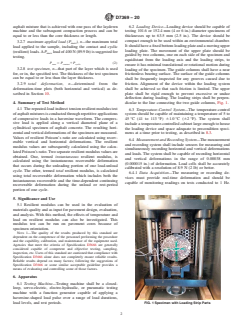
dicular to the line connecting the two guide columns, Fig. 1.
4.1 Therepeated-loadindirecttensionresilientmodulustest
6.3 Temperature-Control System—The temperature-control
ofasphaltmixturesisconductedthroughrepetitiveapplications
system should be capable of maintaining a temperature of 5 to
of compressive loads in a haversine waveform. The compres-
45°C (41 to 113°F) 61.0°C (62°F). The system shall
sive load is applied along a vertical diametral plane of a
includeatemperature-controlledcabinetlargeenoughtohouse
cylindrical specimen of asphalt concrete. The resulting hori-
the loading device and space adequate to precondition speci-
zontalandverticaldeformationsofthespecimenaremeasured.
mens at a time prior to testing, as described in 8.3.
Values of resilient Poisson’s ratio are calculated using recov-
6.4 Measurement and Recording System—Themeasurement
erable vertical and horizontal deformations. The resilient
and recording system shall include sensors for measuring and
modulus values are subsequently calculated using the calcu-
simultaneously recording horizontal and vertical deformations
latedPoisson’sratio.Twoseparateresilientmodulusvaluesare
and loads. The system shall be capable of recording horizontal
obtained. One, termed instantaneous resilient modulus, is
and vertical deformations in the range of 0.00038 mm
calculated using the instantaneous recoverable deformation
(0.000015 in.) of deformation. Load cells shall be accurately
that occurs during the unloading portion of one load-unload
calibrated with a resolution of 8.9 N (2 lb) or better.
cycle. The other, termed total resilient modulus, is calculated
6.4.1 Data Acquisition—The measuring or recording de-
using total recoverable deformation which includes both the
vices must provide real-time deformation and should be
instantaneous recoverable and the time-dependent continuing
capable of monitoring readings on tests conducted to 1 Hz.
recoverable deformation during the unload or rest-period
portion of one cycle.
5. Significance and Use
5.1 Resilient modulus can be used in the evaluation of
materials quality and as input for pavement design, evaluation,
and analysis. With this method, the effects of temperature and
load on resilient modulus can also be investigated. This
modulus test can be run on pavement cores because of
specimen orientation.
NOTE 1—The quality of the results produced by this standard are
dependent on the competence of the personnel performing the procedure
and the capability, calibration, and maintenance of the equipment used.
Agencies that meet the criteria of Specification D3666 are generally
considered capable of competent and objective testing, sampling,
inspection, etc. Users of this standard are cautioned that compliance with
Specification D3666 alone does not completely ensure reliable results.
Reliable results depend on many factors; following the suggestions of
Specification D3666 or some similar acceptable guideline provides a
means of evaluating and controlling some of those factors.
6. Apparatus
6.1 Testing Machine—Testing machine shall be a closed-
loop, servo-electric, electro-hydraulic, or pneumatic testing
machine with a function generator capable of applying a
haversine-shaped load pulse over a range of load durations,
load levels, and rest periods. FIG. 1 Specimen with Loading Strip Parts
D7369 − 20
Computer monitoring systems are recommended. The data the length of the strips. This could be done either by matching
acquisition system shall be capable of collecting 200 scans per the center of specimen with a mark at the center of the strip or
second (a scan includes all deformation and load values at a by positioning the specimen between two marks at the ends of
given point of time). The capability to have real-time plots the specimen thickness, or both.
(simultaneous to the data collection by the computer monitor-
6.6 Marking and Alignment Devices:
ing system) shall also be provided to check the progress of the
6.6.1 TheLVDTalignmentdeviceshouldalignthehorizon-
test. If strip-chart recorders are used without computer moni-
tal and vertical LVDTs simultaneously on the top and bottom
toring systems, the plotting scale shall be adjusted such that
faces of the specimen for gluing. If such a device is not used,
there is a balance between the scale reduction required as a
then a marking device shall be used to mark mutually perpen-
result of the pen reaction time and the scale amplification
dicular axes on the top and bottom faces of the specimen
needed for purposes of accurate measurement of values from a
throughthecenter.Theaxesshallbesimultaneouslymarkedon
plot.Actualloadvalues,andnottheintendedloadvalues,shall
thetopandbottomfacesofthespecimentoensurethattheaxes
be used for calculation purposes and so the data acquisition
on the front and the back lie in a single plane.
system shall also be capable of monitoring the load values
6.6.2 An alignment device shall be used to position and
continuously during testing.
place horizontal and vertical supports for gages or LVDTs
along the horizontal and vertical diameter of the specimen and
NOTE 2—Tests at multiple frequencies can be done. The frequencies of
0.33 and 0.5 Hz are suggested. hold them there until the glue that holds the supports cures. It
shall be easily removable, without disturbing the LVDT (once
6.4.2 Deformation Measurement—Both horizontal and ver-
the glue cures), and shall not be destructively mounted on the
tical deformation shall be measured on the surface of the
specimen. The device shall be capable of mounting the LVDT
specimen by mounting LVDTs between gauge points along the
atagaugelengthofonequarterandonehalfofthediameterof
horizontal and vertical diameters. The gauge length can be of
the specimen. The LVDT shall be as close as possible to (but
threesizesinrelationtothediameterofthespecimen: ⁄4ofthe
nottouching)thesurfaceofthespecimensoastominimizethe
diameteror25.4mmfora101.6mmdiameterofthespecimen
bulging effect. To ensure uniform test results, a spacing of
(1 in. for a 4 in.) or 38.1 mm for a 152.4 mm diameter of the
5.08mm(0.2in.)isrecommended.TheaxisoftheLVDTshall
specimen(1.5in.fora6in.); ⁄2ofthediameteror50.8mmfor
not be at a distance greater than 6.35 mm (0.25 in.) from the
a 101.6 mm diameter of the specimen (2 in. for a 4 in.) or 76.2
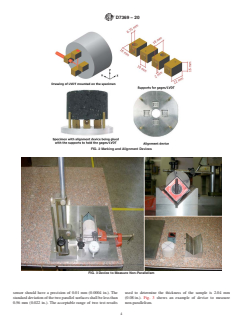
surfaceofthespecimen.Fig.2showsanexampleofalignment
mmfora152.4mmdiameterofthespecimen(3in.fora6in.);
device.
and one diameter or 101.6 for a 101.6 mm diameter of the
specimen (4 in. for a 4 in.) or 152.4 mm for a 152.4 mm
7. Specimens
diameter of the specimen (6 in. for a 6 in.). It is required to
7.1 Specimen Size—Resilient modulus testing shall be con-
have the two LVDTs on each face of the specimen, one
ducted on 101.6 6 3.8 mm (4 in.) or 152.4 6 9 mm (6 in.)
horizontal and one vertical, resulting in a total of four LVDTs
diameter specimens that are 38.1 mm (1.5 in.) to 63.5 mm
for deformation measurement.
(2.5in.) in thickness. The test specimen can be obtained from
NOTE 3—The results obtained with gauge length of ⁄4 of the diameter
field coring or from a Marshall-compacted specimen (Practice
of the specimen have the best precision.
D6926) or from a gyratory-compacted specimen (Test Method
6.4.3 Load Measurement—The repetitive loads shall be
D6925). Depending on the height of the gyratory-compacted
measured with an electronic load cell with a capacity adequate
specimen and the thickness of the test specimen, two or three
forthemaximumrequiredloadingandasensitivityof0.5%of
specimens can be sawed from a compacted specimen.
the intended peak load. During period of resilient modulus
7.2 Core Specimens:
testing, the load cell shall be monitored and checked once a
7.2.1 Cores for test specimen preparation, which may con-
monthwithacalibratedprovingringtoensurethattheloadcell
tainoneormoretestablelayers,musthavesmoothanduniform
is operating properly. Additionally, the load cell shall be
surfaces and must meet specimen diametric and thickness
checked at any time that the QC/QA testing with in-house
requirements summarized in 7.1. Cores that are obviously
synthetic specimen (see 9.1) indicates a change in the system
deformedorhaveanyvisiblecracksmustberejected.Irregular
response or when there is a suspicion of a load cell problem.
top and bottom surfaces shall be trimmed as necessary, and
6.5 Loading Strip—Steel loading strips, with concave individual layer specimens shall be obtained by cutting with a
samplecontactsurfaces,machinedtotheradiusofcurvatureof diamond saw using water or air as coolant. Additional speci-
a101.60 60.10mmdiameterspecimen(4.000 60.004in.)or mens for each layer must be collected in the field in order to
152.40 60.15mmdiameterspecimen(6.000 60.006in.),are perform the pretest tensile strength.
required to apply load to the test specimens. The contact areas 7.2.2 If a core specimen has more than one layer, the layers
of the loading strips shall be 12.7 mm ( ⁄2 in.) and 19 mm shall be separated at the layer interface. Layers containing
( ⁄4in.) wide, respectively, for the 4in. specimen and 6in. more than one lift of the same material may be tested as a
specimen. The outer edges of the curved surface shall be filed single specimen. If sample layers de-bond during testing, the
lightly to remove sharp edges that might cut the specimen results are invalid and shall not be used.
during testing. Thin lines should be drawn along the length of 7.2.3 In order to limit non-parallelism of the two flat sides,
the strip at its center to help alignment. Also, appropriate itisrecommendedtoplacethespecimenonalevelsurfaceand
marking should be made so as to center the specimen within measurethedeparturefromperpendicularity.Thedisplacement
D7369 − 20
FIG. 2 Marking and Alignment Devices
FIG. 3 Device to Measure Non-Parallelism
sensor should have a precision of 0.01 mm (0.0004 in.). The used to determine the thickness of the sample is 2.04 mm
standarddeviationofthetwoparallelsurfacesshallbelessthan (0.08in.). Fig. 3 shows an example of device to measure
0.56 mm (0.022 in.). The acceptable range of two test results non-parallelism.
D7369 − 20
7.3 Laboratory-Molded Specimens—Preparethelaboratory- specific loading frequency for each temperature. P and
max
molded specimens in accordance with acceptable compaction P would need to be tested and adjusted for the different
contact
procedures such as Test Method D6925 and Practice D6926. temperatures.
The specimens’ sizes must meet the requirements of 7.1.
8.2 Testing Prerequisites—Resilient modulus testing shall
7.4 Diametral Axis—Marking of the diametral axis to be
beconductedaftersystemresponsehasbeenverifiedbytesting
tested shall be done using a suitable marking device as synthetic specimens, as outlined in 9.1.
described in 6.6. This diametral axis location can be rotated
8.3 Pretest Tensile Strength—Prior to performing the resil-
slightly,ifnecessary,toavoidcontactoftheloadingstripswith
ient modulus test, the indirect tensile strength shall be deter-
abnormally large aggregate particles or surface voids or to
mined for one test specimen taken from the same layer and as
avoid the mounting of the vertical LVDT over large surface
close as possible to the location of the core specimen(s) to be
voids. The second marking will be perpendicular to the first
tested for resilient modulus. For laboratory specimens, a
markeddiametralaxis.Thesemarkingsarerequiredformount-
sample having the same mix properties will be selected for
ing horizontal and vertical LVDTs.
indirect tensile strength testing. The indirect tensile strength
7.5 Thickness(t)ofeachtestspecimenshallbemeasuredto
test is performed as a basis for selecting the loading levels for
the nearest 0.25 mm (0.01 in.) prior to testing. The thickness
the resilient modulus testing. The test shall be performed in
shallbedeterminedbyaveragingfourmeasurementslocatedat
accordance with Test Method D6931.
1 1
⁄4 points around the sample perimeter, and 12.7 mm ( ⁄2 in.) to
8.4 Temperature Control—The lab-compacted test speci-
25.4 mm (1 in.) in from the specimen edge.
mens designated for resilient modulus testing shall be brought
7.6 Diameter (D) of each test specimen shall be determined
tothetesttemperature25 61°C(77 62°F).Asphaltconcrete
prior to testing to the nearest 0.25 mm (0.01 in.) by averaging
field cores should also be placed in a controlled-temperature
diametral measurements. Measure the diameter of the speci-
cabinet/chamber and brought to the specified test temperature.
men at (1) mid-height, and (2) perpendicular (90°) to the axis
Unless the core specimen temperature is monitored in some
measured in (1) above. The two measurements shall be
manner and the actual temperature known, the cores’samples
averaged to determine the diameter of the test specimen.
shall remain in the cabinet/chamber at 25 6 1°C (77 6 2°F)
for a minimum of 4h prior to testing. Inclusion of a dummy
7.7 Replicates:
sample for temperature verification is also permissible.
7.7.1 The test procedure is applicable to both laboratory-
8.4.1 If temperatures other than 25°C are used, more time
compacted specimens and field cores. Three test specimens,
will be needed to equalize the temperature of the specimens as
each with a total thickness equal to 38.1mm (1.5in.) or
determined by the dummy specimen.
63.5mm (2.5in.), should be tested. It is recommended that
both ends of the compacted specimen be sawed to obtain a
8.5 Alignment and Specimen Seating:
smoothsurface.Thiswillresultinthreereplicatesfromagiven
8.5.1 Position the test specimen so that the mid-thickness
compacted specimen. In the case of field cores, three field
mark (cross mark for the two diametral axes) on the test
specimens are needed from a homogeneous section.
specimenislocatedinthelineofactionoftheactuatorshaftor,
7.7.2 Three test specimens will result in a total of twelve
alternatively, ascertain that the specimen is centered exactly
Poisson’s ratio and resilient modulus values for both instanta-
between end markings on loading strips. The diametral mark-
neous and total (four values for each specimen).
ings are then used to ensure that the specimen is aligned from
top to bottom loading strips.With the use of a mirror, the back
7.8 Specimen Preparation—For deformation measurement
face can be similarly aligned.
in both the horizontal and vertical directions, mount the gauge
8.5.2 The contact surface between the specimen and each
pointsbygluingthemtothetestspecimen.Waituntilthegauge
points are properly set and the glue is dry before removing the loading strip is critical for proper test results. Any pro
...