

ASTM D3666-16
(Specification)Standard Specification for Minimum Requirements for Agencies Testing and Inspecting Road and Paving Materials
General Information
- Abstract
ABSTRACT
This specification covers the minimum requirements for field and laboratory personnel, for establishing and maintaining a quality system, and establishes minimum qualifications for agencies engaged in the testing and inspection of road and paving materials. This specification can be used as a basis to evaluate testing or inspection agencies, or both, and is intended for use for the qualifying or accrediting, or both, of testing or inspection agencies, public or private, engaged in the testing and inspection of road and paving materials. Criteria are provided for evaluating the capability of an agency to properly perform designated tests on road and paving materials, and for establishing guidelines pertaining to an agency's organization, personnel, facilities, and quality system.
SIGNIFICANCE AND USE
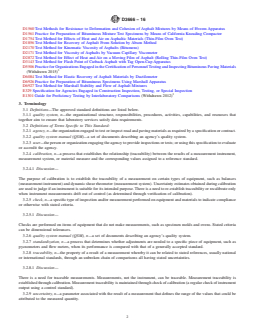
4.1 This specification provides the basic minimum criteria for use in evaluating the qualifications of testing or inspection agencies, or both, for road and paving materials. The criteria may be supplemented by more specific criteria and requirements. An individual user can also use it to judge the qualification of an agency.
4.2 The intent of this specification is to provide a consensus basis for evaluating a testing or inspection agency, or both, with respect to that agency's capability to objectively and competently provide the specific services needed by the user.
4.3 This specification can be used as a basis for accreditation.
SCOPE
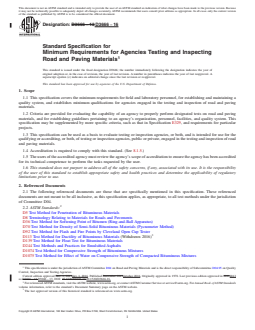
1.1 This specification covers the minimum requirements for field and laboratory personnel, for establishing and maintaining a quality system, and establishes minimum qualifications for agencies engaged in the testing and inspection of road and paving materials.
1.2 Criteria are provided for evaluating the capability of an agency to properly perform designated tests on road and paving materials, and for establishing guidelines pertaining to an agency's organization, personnel, facilities, and quality system. This specification may be supplemented by more specific criteria, such as that in Specification E329, and requirements for particular projects.
1.3 This specification can be used as a basis to evaluate testing or inspection agencies, or both, and is intended for use for the qualifying or accrediting, or both, of testing or inspection agencies, public or private, engaged in the testing and inspection of road and paving materials.
1.4 Accreditation is required to comply with this standard. (See 8.1.5.)
1.5 The users of the accredited agency must review the agency's scope of accreditation to ensure the agency has been accredited for its technical competence to perform the tasks requested by the user.
1.6 This standard does not purport to address all of the safety concerns, if any, associated with its use. It is the responsibility of the user of this standard to establish appropriate safety and health practices and determine the applicability of regulatory limitations prior to use.
- Status
- Published
- Publication Date
- 30-Sep-2016
- Technical Committee
- D04 - Road and Paving Materials
- Drafting Committee
- D04.95 - Quality Control, Inspection and Testing Agencies
Buy Documents
ASTM D3666-16 - Standard Specification for Minimum Requirements for Agencies Testing and Inspecting Road and Paving Materials
REDLINE ASTM D3666-16 - Standard Specification for Minimum Requirements for Agencies Testing and Inspecting Road and Paving Materials
Overview
ASTM D3666-16: Standard Specification for Minimum Requirements for Agencies Testing and Inspecting Road and Paving Materials defines the essential qualifications for agencies conducting tests and inspections on road and paving materials. Issued by ASTM International, this standard applies to both public and private organizations, providing a uniform framework for quality assurance in laboratory and field testing, quality system management, personnel qualifications, and agency accreditation. ASTM D3666-16 is crucial for ensuring reliable and objective testing services, supporting the integrity of road construction and paving projects across the industry.
Key Topics
Agency Qualifications
Agencies must comply with minimum requirements for personnel, equipment, and operational procedures to demonstrate technical competence in testing and inspecting road and paving materials.Quality System Requirements
Every agency must establish and maintain a documented quality system, including a comprehensive Quality System Manual (QSM), procedures for calibration, standardization, equipment checks, and records retention.Personnel Qualifications
The standard outlines required experience, education, certifications, and supervisory responsibilities for management, supervisors, inspectors, and technicians involved in testing and inspection.Equipment Calibration & Maintenance
Regular calibration, standardization, and verification checks are required for all significant testing equipment, adhering to prescribed intervals to ensure accuracy and traceability.Proficiency Sample Programs
Agencies must participate in recognized proficiency sample testing programs for aggregate, asphalt binder, or hot mix asphalt (as applicable), supporting continual validation of competency.Accreditation
Compliance with ASTM D3666-16 requires accreditation from a recognized authority, with users responsible for reviewing their agency’s scope of accreditation for relevant competencies.
Applications
ASTM D3666-16 is widely utilized to:
- Qualify and accredit testing agencies ensuring that only competent and reliable organizations are selected for road and paving materials projects.
- Support public and private procurement by providing an objective basis to compare and select third-party testing and inspection laboratories.
- Aid regulatory compliance for agencies working on infrastructure projects that require independent verification of material quality.
- Standardize quality assurance programs for agencies performing material testing, fostering consistent, reproducible, and accurate results in both laboratory and field environments.
- Guide internal audits and quality improvements by defining clear criteria for management systems, equipment verification, staff competency, and corrective action protocols.
Related Standards
For agencies and users seeking a robust quality framework, the following ASTM standards are closely related or referenced within ASTM D3666-16:
- ASTM E329 – Specification for Agencies Engaged in Construction Inspection, Testing, or Special Inspection
- ASTM D8 – Terminology Relating to Materials for Roads and Pavements
- ASTM D244 – Test Methods and Practices for Emulsified Asphalts
- ASTM D6926/D6927 – Practices and Test Methods for Marshall Stability and Flow of Asphalt Mixtures
- ASTM D2872 – Test Method for Effect of Heat and Air on a Moving Film of Asphalt
- ASTM D5506 – Practice for Organizations Engaged in the Certification of Personnel Testing and Inspecting Bituminous Paving Materials
Practical Value
Adhering to ASTM D3666-16 helps agencies demonstrate technical competence, meet client and regulatory expectations, and achieve reliable, high-quality results. For users, it offers a transparent, consensus-based tool to verify that testing partners operate under rigorous quality standards essential in the construction and paving industry.
Keywords: ASTM D3666-16, testing agencies, pavement inspection, road materials testing, quality system, agency accreditation, paving materials, personnel qualifications, laboratory testing, field inspection
Relations
- Effective Date
- 01-Oct-2016
- Effective Date
- 01-Dec-2023
- Effective Date
- 01-Nov-2023
- Effective Date
- 01-Oct-2023
- Effective Date
- 01-Aug-2019
- Effective Date
- 15-Dec-2018
- Effective Date
- 15-Aug-2018
- Effective Date
- 01-Jul-2018
- Effective Date
- 01-Feb-2018
- Effective Date
- 01-Jan-2018
- Effective Date
- 15-Dec-2017
- Effective Date
- 01-Oct-2017
- Effective Date
- 15-Jul-2017
- Effective Date
- 15-Jun-2017
- Effective Date
- 01-May-2017
Buy Documents
ASTM D3666-16 - Standard Specification for Minimum Requirements for Agencies Testing and Inspecting Road and Paving Materials
REDLINE ASTM D3666-16 - Standard Specification for Minimum Requirements for Agencies Testing and Inspecting Road and Paving Materials
Get Certified
Connect with accredited certification bodies for this standard

Zavod za gradbeništvo Slovenije (ZAG) - Inšpekcija
ZAG inspection body for construction products, structures, and materials.
Sponsored listings
Frequently Asked Questions
ASTM D3666-16 is a technical specification published by ASTM International. Its full title is "Standard Specification for Minimum Requirements for Agencies Testing and Inspecting Road and Paving Materials". This standard covers: ABSTRACT This specification covers the minimum requirements for field and laboratory personnel, for establishing and maintaining a quality system, and establishes minimum qualifications for agencies engaged in the testing and inspection of road and paving materials. This specification can be used as a basis to evaluate testing or inspection agencies, or both, and is intended for use for the qualifying or accrediting, or both, of testing or inspection agencies, public or private, engaged in the testing and inspection of road and paving materials. Criteria are provided for evaluating the capability of an agency to properly perform designated tests on road and paving materials, and for establishing guidelines pertaining to an agency's organization, personnel, facilities, and quality system. SIGNIFICANCE AND USE 4.1 This specification provides the basic minimum criteria for use in evaluating the qualifications of testing or inspection agencies, or both, for road and paving materials. The criteria may be supplemented by more specific criteria and requirements. An individual user can also use it to judge the qualification of an agency. 4.2 The intent of this specification is to provide a consensus basis for evaluating a testing or inspection agency, or both, with respect to that agency's capability to objectively and competently provide the specific services needed by the user. 4.3 This specification can be used as a basis for accreditation. SCOPE 1.1 This specification covers the minimum requirements for field and laboratory personnel, for establishing and maintaining a quality system, and establishes minimum qualifications for agencies engaged in the testing and inspection of road and paving materials. 1.2 Criteria are provided for evaluating the capability of an agency to properly perform designated tests on road and paving materials, and for establishing guidelines pertaining to an agency's organization, personnel, facilities, and quality system. This specification may be supplemented by more specific criteria, such as that in Specification E329, and requirements for particular projects. 1.3 This specification can be used as a basis to evaluate testing or inspection agencies, or both, and is intended for use for the qualifying or accrediting, or both, of testing or inspection agencies, public or private, engaged in the testing and inspection of road and paving materials. 1.4 Accreditation is required to comply with this standard. (See 8.1.5.) 1.5 The users of the accredited agency must review the agency's scope of accreditation to ensure the agency has been accredited for its technical competence to perform the tasks requested by the user. 1.6 This standard does not purport to address all of the safety concerns, if any, associated with its use. It is the responsibility of the user of this standard to establish appropriate safety and health practices and determine the applicability of regulatory limitations prior to use.
ABSTRACT This specification covers the minimum requirements for field and laboratory personnel, for establishing and maintaining a quality system, and establishes minimum qualifications for agencies engaged in the testing and inspection of road and paving materials. This specification can be used as a basis to evaluate testing or inspection agencies, or both, and is intended for use for the qualifying or accrediting, or both, of testing or inspection agencies, public or private, engaged in the testing and inspection of road and paving materials. Criteria are provided for evaluating the capability of an agency to properly perform designated tests on road and paving materials, and for establishing guidelines pertaining to an agency's organization, personnel, facilities, and quality system. SIGNIFICANCE AND USE 4.1 This specification provides the basic minimum criteria for use in evaluating the qualifications of testing or inspection agencies, or both, for road and paving materials. The criteria may be supplemented by more specific criteria and requirements. An individual user can also use it to judge the qualification of an agency. 4.2 The intent of this specification is to provide a consensus basis for evaluating a testing or inspection agency, or both, with respect to that agency's capability to objectively and competently provide the specific services needed by the user. 4.3 This specification can be used as a basis for accreditation. SCOPE 1.1 This specification covers the minimum requirements for field and laboratory personnel, for establishing and maintaining a quality system, and establishes minimum qualifications for agencies engaged in the testing and inspection of road and paving materials. 1.2 Criteria are provided for evaluating the capability of an agency to properly perform designated tests on road and paving materials, and for establishing guidelines pertaining to an agency's organization, personnel, facilities, and quality system. This specification may be supplemented by more specific criteria, such as that in Specification E329, and requirements for particular projects. 1.3 This specification can be used as a basis to evaluate testing or inspection agencies, or both, and is intended for use for the qualifying or accrediting, or both, of testing or inspection agencies, public or private, engaged in the testing and inspection of road and paving materials. 1.4 Accreditation is required to comply with this standard. (See 8.1.5.) 1.5 The users of the accredited agency must review the agency's scope of accreditation to ensure the agency has been accredited for its technical competence to perform the tasks requested by the user. 1.6 This standard does not purport to address all of the safety concerns, if any, associated with its use. It is the responsibility of the user of this standard to establish appropriate safety and health practices and determine the applicability of regulatory limitations prior to use.
ASTM D3666-16 is classified under the following ICS (International Classification for Standards) categories: 93.080.20 - Road construction materials. The ICS classification helps identify the subject area and facilitates finding related standards.
ASTM D3666-16 has the following relationships with other standards: It is inter standard links to ASTM D3666-13, ASTM D139-23, ASTM E329-23, ASTM D244-23, ASTM D8-19, ASTM D8-18c, ASTM D8-18b, ASTM D8-18a, ASTM D8-18, ASTM E329-18, ASTM D70-17, ASTM D244-09(2017), ASTM D8-17c, ASTM D8-17b, ASTM D8-17a. Understanding these relationships helps ensure you are using the most current and applicable version of the standard.
ASTM D3666-16 is available in PDF format for immediate download after purchase. The document can be added to your cart and obtained through the secure checkout process. Digital delivery ensures instant access to the complete standard document.
Standards Content (Sample)
This international standard was developed in accordance with internationally recognized principles on standardization established in the Decision on Principles for the
Development of International Standards, Guides and Recommendations issued by the World Trade Organization Technical Barriers to Trade (TBT) Committee.
Designation:D3666 −16
Standard Specification for
Minimum Requirements for Agencies Testing and Inspecting
Road and Paving Materials
This standard is issued under the fixed designation D3666; the number immediately following the designation indicates the year of
original adoption or, in the case of revision, the year of last revision. A number in parentheses indicates the year of last reapproval. A
superscript epsilon (´) indicates an editorial change since the last revision or reapproval.
This standard has been approved for use by agencies of the U.S. Department of Defense.
1. Scope documents are not meant to be all inclusive, as this specifica-
tion applies, as appropriate, to all test methods under the
1.1 This specification covers the minimum requirements for
jurisdiction of Committee D04.
fieldandlaboratorypersonnel,forestablishingandmaintaining
a quality system, and establishes minimum qualifications for 2.2 ASTM Standards:
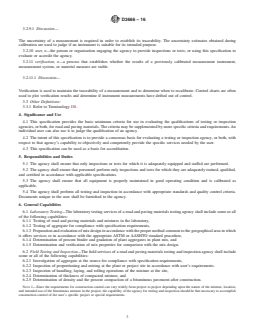
agencies engaged in the testing and inspection of road and D5 Test Method for Penetration of Bituminous Materials
paving materials. D8 Terminology Relating to Materials for Roads and Pave-
ments
1.2 Criteria are provided for evaluating the capability of an
D36 Test Method for Softening Point of Bitumen (Ring-and-
agencytoproperlyperformdesignatedtestsonroadandpaving
Ball Apparatus)
materials, and for establishing guidelines pertaining to an
D70 Test Method for Density of Semi-Solid Bituminous
agency’sorganization,personnel,facilities,andqualitysystem.
Materials (Pycnometer Method)
This specification may be supplemented by more specific
D92 Test Method for Flash and Fire Points by Cleveland
criteria, such as that in Specification E329, and requirements
Open Cup Tester
for particular projects.
D113 Test Method for Ductility of Bituminous Materials
1.3 This specification can be used as a basis to evaluate
(Withdrawn 2016)
testing or inspection agencies, or both, and is intended for use
D139 Test Method for Float Test for Bituminous Materials
for the qualifying or accrediting, or both, of testing or
D244 Test Methods and Practices for Emulsified Asphalts
inspection agencies, public or private, engaged in the testing
D1074 Test Method for Compressive Strength of Bitumi-
and inspection of road and paving materials.
nous Mixtures
1.4 Accreditation is required to comply with this standard. D1075 Test Method for Effect of Water on Compressive
Strength of Compacted Bituminous Mixtures
(See 8.1.5.)
D1560 Test Methods for Resistance to Deformation and
1.5 The users of the accredited agency must review the
Cohesion of Asphalt Mixtures by Means of Hveem
agency’s scope of accreditation to ensure the agency has been
Apparatus
accredited for its technical competence to perform the tasks
D1561 Practice for Preparation of Bituminous Mixture Test
requested by the user.
Specimens by Means of California Kneading Compactor
1.6 This standard does not purport to address all of the
D1754 Test Method for Effects of Heat andAir onAsphaltic
safety concerns, if any, associated with its use. It is the
Materials (Thin-Film Oven Test)
responsibility of the user of this standard to establish appro-
D1856 Test Method for Recovery of Asphalt From Solution
priate safety and health practices and determine the applica-
by Abson Method
bility of regulatory limitations prior to use.
D2170 Test Method for Kinematic Viscosity of Asphalts
(Bitumens)
2. Referenced Documents
D2171 Test Method for Viscosity of Asphalts by Vacuum
2.1 The following referenced documents are those that are
Capillary Viscometer
specifically mentioned in this specification. These referenced
1 2
This specification is under the jurisdiction of ASTM Committee D04 on Road For referenced ASTM standards, visit the ASTM website, www.astm.org, or
and Paving Materials and is the direct responsibility of Subcommittee D04.95 on contact ASTM Customer Service at service@astm.org. For Annual Book of ASTM
Quality Control, Inspection and Testing Agencies. Standards volume information, refer to the standard’s Document Summary page on
Current edition approved Oct. 1, 2016. Published October 2016. Originally the ASTM website.
approved in 1978. Last previous edition approved in 2013 as D3666 – 13. DOI: The last approved version of this historical standard is referenced on
10.1520/D3666-16. www.astm.org.
Copyright © ASTM International, 100 Barr Harbor Drive, PO Box C700, West Conshohocken, PA 19428-2959. United States
D3666−16
D2872 Test Method for Effect of Heat andAir on a Moving as pycnometers and flow meters, when its performance is
Film of Asphalt (Rolling Thin-Film Oven Test) compared with that of a generally accepted standard.
D3143 Test Method for Flash Point of CutbackAsphalt with
3.2.8 traceability, n—the property of a result of a measure-
Tag Open-Cup Apparatus
ment whereby it can be related to stated references, usually
D5506 Practice for Organizations Engaged in the Certifica-
national or international standards, through an unbroken chain
tion of Personnel Testing and Inspecting Bituminous
of comparisons all having stated uncertainties.
Paving Materials (Withdrawn 2015)
3.2.8.1 Discussion—There is a need for traceable measure-
D6084 Test Method for Elastic Recovery of Asphalt Mate-
ments. Measurements, not the instrument, can be traceable.
rials by Ductilometer
Measurement traceability is established through calibration.
D6926 Practice for Preparation of Bituminous Specimens
Measurement traceability is maintained through check of
Using Marshall Apparatus
calibration (a regular check of instrument output using a
D6927 Test Method for Marshall Stability and Flow of
control standard).
Asphalt Mixtures
3.2.9 uncertainty, n—a parameter associated with the result
E329 Specification for Agencies Engaged in Construction
ofameasurementthatdefinestherangeofthevaluesthatcould
Inspection, Testing, or Special Inspection
be attributed to the measured quantity.
E1301 Guide for Proficiency Testing by Interlaboratory
Comparisons (Withdrawn 2012) 3.2.9.1 Discussion—The uncertainty of a measurement is
required in order to establish its traceability. The uncertainty
3. Terminology
estimates obtained during calibration are used to judge if an
3.1 Definitions—The approved standard definitions are instrument is suitable for its intended purpose.
listed below.
3.2.10 user, n—the person or organization engaging the
3.1.1 quality system, n—the organizational structure,
agency to provide inspections or tests; or using this specifica-
responsibilities, procedures, activities, capabilities, and re-
tion to evaluate or accredit the agency.
sources that together aim to ensure that laboratory services
3.2.11 verification, n—aprocessthatestablisheswhetherthe
satisfy data requirements.
results of a previously calibrated measurement instrument,
3.2 Definitions of Terms Specific to This Standard:
measurement system, or material measure are stable.
3.2.1 agency, n—the organization engaged to test or inspect
3.2.11.1 Discussion—Verification is used to maintain the
road and paving materials as required by a specification or
traceability of a measurement and to determine when to
contract.
recalibrate. Control charts are often used to plot verification
3.2.2 quality system manual (QSM)—a set of documents
results and determine if instrument measurements have drifted
describing an agency’s quality system.
out of control.
3.2.3 user—the person or organization engaging the agency
3.3 Other Definitions:
to provide inspections or tests; or using this specification to
3.3.1 Refer to Terminology D8.
evaluate or accredit the agency.
3.2.4 calibration, n—a process that establishes the relation-
4. Significance and Use
ship (traceability) between the results of a measurement
4.1 This specification provides the basic minimum criteria
instrument, measurement system, or material measure and the
for use in evaluating the qualifications of testing or inspection
corresponding values assigned to a reference standard.
agencies, or both, for road and paving materials. The criteria
3.2.4.1 Discussion—The purpose of calibration is to estab-
may be supplemented by more specific criteria and require-
lish the traceability of a measurement on certain types of
ments. An individual user can also use it to judge the
equipment, such as balances (measurement instrument) and
qualification of an agency.
dynamic shear rheometer (measurement system). Uncertainty
estimates obtained during calibration are used to judge if an
4.2 The intent of this specification is to provide a consensus
instrument is suitable for its intended purpose. There is a need
basis for evaluating a testing or inspection agency, or both,
to re-establish traceability or recalibrate only when instrument
with respect to that agency’s capability to objectively and
measurements drift out of control (as determined through
competently provide the specific services needed by the user.
verification of calibration).
4.3 This specification can be used as a basis for accredita-
3.2.5 check, n—a specific type of inspection and/or mea-
tion.
surement performed on equipment and materials to indicate
compliance or otherwise with stated criteria.
5. Responsibilities and Duties
3.2.5.1 Discussion—Checks are performed on items of
equipment that do not make measurements, such as specimen 5.1 Theagencyshallensurethatonlyinspectionsortestsfor
moldsandovens.Statedcriteriacanbedimensionaltolerances.
which it is adequately equipped and staffed are performed.
3.2.6 quality system manual (QSM), n—a set of documents
5.2 The agency shall ensure that personnel perform only
describing an agency’s quality system.
inspections and tests for which they are adequately trained,
3.2.7 standardization, n—a process that determines whether qualified, and certified in accordance with applicable specifi-
adjustments are needed to a specific piece of equipment, such cations.
D3666−16
5.3 The agency shall ensure that all equipment is properly 7.2 Field/Plant Inspector or Testing Technician Supervisor:
maintained in good operating condition and is calibrated as
7.2.1 This person shall have a minimum of 3 years of
applicable.
relevant and progressively more responsible experience in
testing or inspection, or both, of road and paving materials and
5.4 The agency shall perform all testing and inspection in
hot mix asphalt construction as appropriate to their job
accordance with appropriate standards and quality control
classification.
criteria. Documents unique to the user shall be furnished to the
7.2.2 This person shall have applicable technician level or
agency.
inspectorlevel,orhigher,certifications/qualifications(seeNote
2) through a program approved by a state DOTor a national or
6. General Capabilities
regional authority.
6.1 Laboratory Testing—Thelaboratorytestingservicesofa
road and paving materials testing agency shall include some or 7.3 Field/Plant Inspector or Testing Technician:
all of the following capabilities:
7.3.1 This person shall have applicable technician level or
6.1.1 Testing of road and paving materials and mixtures in
inspector level certifications/qualifications (see Note 2)
the laboratory,
through a program approved by a state DOT or a national or
6.1.2 Testing of aggregate for compliance with specification
regional authority.
requirements,
7.3.2 Trainees working toward certification can be used to
6.1.3 Preparation and evaluation of mix design in accor-
perform the inspection or test, or both, if they work under the
dance with the proper method common to the geographical
supervision of a certified/qualified individual as described in
area in which it offers services or in accordance with the
Sections 7.2.2 or 7.3.1, at the same facility, project, or plant.
appropriate ASTM or AASHTO standard procedure,
Thetraineecannotevaluatethetestorinspectionresultsorsign
6.1.4 Determinationofpercentbinderandgradationofplant
acceptance reports. The trainee must achieve certification
aggregates in plant mix, and
within 2 years from the start of work as a trainee.
6.1.5 Determination and verification of mix properties for
7.4 It is satisfactory for a person to fill one or more of the
comparison with the mix design.
levels of management, supervision, inspector, or technician
6.2 Field Testing and Inspection—The field services of a
positions in accordance with 7.1, 7.2, and 7.3 provided that
road and paving materials testing and inspection agency shall
person qualifies for the highest level. It is also recognized that
include some or all of the following capabilities:
frequently a few laboratory control tests are conducted at small
6.2.1 Investigation of aggregate at the source for compli-
field or peripheral locations; it is not the intent of this practice
ance with specification requirements,
that the supervisory personnel be directly present at such
6.2.2 Inspection of proportioning and mixing at the plant or
locations at all times.
project site in accordance with user’s requirements.
NOTE 2—The organization certifying should meet the requirements of
6.2.3 Inspection of handling, laying, and rolling operations
Practice D5506.
of the mixture at the site,
6.2.4 Determination of thickness of compacted mixture, and
8. Quality System Criteria
6.2.5 Determination of density and the percent compaction
of a bituminous pavement after construction.
8.1 The agency shall establish and implement a quality
system which meets the following criteria:
NOTE 1—Since the requirements for construction control can vary
8.1.1 Quality System Manual (QSM)—The agency shall
widely from project to project depending upon the nature of the mixture,
location, and intended use of the bituminous mixture in the project, the
establish and maintain a QSM that conforms to the require-
capabilityoftheagencyfortestingandinspectionshouldbethatnecessary
ments in Section 9. Each document in the QSM shall indicate
to accomplish construction control of the user’s specific project or special
its preparation date. If a document is revised, the date of
requirements.
revision shall be indicated on the document.The QSM shall be
available for use by laboratory staff.
7. Personnel Qualifications
8.1.2 Quality System Management—The agency shall des-
7.1 Management and Supervision—The testing and inspec-
ignate a person(s) having responsibility for determining if
tion services of the agency shall be under the direction of a
quality system implementation activities are being conducted
person charged with scientific or engineering managerial re-
by agency staff in the manner specified in the agency’s quality
sponsibility. This person should be a licensed engineer and a
system manual. This individual(s) shall have direct access to
full-time employee of the agency and shall have a minimum of
top management (see Note 3).
5 years experience in inspecting and testing of road and paving
materials and construction; however, in place of being a NOTE 3—This individual(s) may have other responsibilities (for
example, laboratory manager).
licensed engineer, a person with equivalent science-oriented
NOTE 4—Inspection and testing procedures may reference published
education and experience in having satisfactorily directed
standards.
testing or inspection services, or both, of road and paving
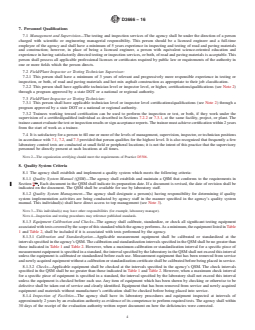
materials is acceptable.This person shall possess all applicable 8.1.3 Equipment Calibration and Checks—The agency shall
professional licenses or certificates required by public law or calibrate, standardize, or check all significant testing equip-
requirements of the authority in one or more fields which the mentassociatedwithtestscoveredbythescopeofthisstandard
person directs. which the agency performs. As a minimum, the equipment
D3666−16
TABLE 2 General Laboratory Test Equipment
listedinTable1andTable2,shallbeincludedifitisassociated
with tests performed by the agency. Interval
Equipment—Test Method Requirement
(Month)
8.1.3.1 Calibration and Standardization—Applicable mea-
Mechanical Shakers Check Sieving 12
surement equipment shall be calibrated or standardized at the
Thoroughness
intervals specified in the agency’s QSM. The calibration and
General Purpose Drying Ovens Standardize Thermometric 12
Device
standardization intervals specified in the QSM shall be no
Coarse Sieves (Openings = 4.75 Check Physical Condition 12
greater than those indicated in Table 1 and Table 2. However,
mm) and Dimensions of
when a maximum calibration or standardization interval for a
Openings
Fine Sieves (Openings < 4.75 mm) Check Physical Condition 12
specific piece of measurement equipment is specified in a
Specimen Molds Check Critical Dimensions 12
standard, the interval specified by the laboratory in the QSM
General Purpose Balances and Standardize 12
shall not exceed this interval unless the equipment is calibrated
Masses
Temperature Measuring Devices Standardize 12
or standardized before each use. Measurement equipment that
Analytical Balances and Masses Calibrate 12
has been removed from service and newly acquired equipment
Calipers Calibrate 12
without a calibration or standardization certificate shall be
Vaccuum/Pressure Gages Standardize 12
calibrated before being placed in service.
8.1.3.2 Checks—Applicable equipment shall be checked at
the intervals specified in the agency’s QSM. The check
8.1.5 Accreditation—Th
...
This document is not an ASTM standard and is intended only to provide the user of an ASTM standard an indication of what changes have been made to the previous version. Because
it may not be technically possible to adequately depict all changes accurately, ASTM recommends that users consult prior editions as appropriate. In all cases only the current version
of the standard as published by ASTM is to be considered the official document.
Designation: D3666 − 13 D3666 − 16
Standard Specification for
Minimum Requirements for Agencies Testing and Inspecting
Road and Paving Materials
This standard is issued under the fixed designation D3666; the number immediately following the designation indicates the year of
original adoption or, in the case of revision, the year of last revision. A number in parentheses indicates the year of last reapproval. A
superscript epsilon (´) indicates an editorial change since the last revision or reapproval.
This standard has been approved for use by agencies of the U.S. Department of Defense.
1. Scope
1.1 This specification covers the minimum requirements for field and laboratory personnel, for establishing and maintaining a
quality system, and establishes minimum qualifications for agencies engaged in the testing and inspection of road and paving
materials.
1.2 Criteria are provided for evaluating the capability of an agency to properly perform designated tests on road and paving
materials, and for establishing guidelines pertaining to an agency’s organization, personnel, facilities, and quality system. This
specification may be supplemented by more specific criteria, such as that in Specification E329, and requirements for particular
projects.
1.3 This specification can be used as a basis to evaluate testing or inspection agencies, or both, and is intended for use for the
qualifying or accrediting, or both, of testing or inspection agencies, public or private, engaged in the testing and inspection of road
and paving materials.
1.4 Accreditation is required to comply with this standard. (See 8.1.5.)
1.5 The users of the accredited agency must review the agency’s scope of accreditation to ensure the agency has been accredited
for its technical competence to perform the tasks requested by the user.
1.6 This standard does not purport to address all of the safety concerns, if any, associated with its use. It is the responsibility
of the user of this standard to establish appropriate safety and health practices and determine the applicability of regulatory
limitations prior to use.
2. Referenced Documents
2.1 The following referenced documents are those that are specifically mentioned in this specification. These referenced
documents are not meant to be all inclusive, as this specification applies, as appropriate, to all test methods under the jurisdiction
of Committee D04.
2.2 ASTM Standards:
D5 Test Method for Penetration of Bituminous Materials
D8 Terminology Relating to Materials for Roads and Pavements
D36 Test Method for Softening Point of Bitumen (Ring-and-Ball Apparatus)
D70 Test Method for Density of Semi-Solid Bituminous Materials (Pycnometer Method)
D92 Test Method for Flash and Fire Points by Cleveland Open Cup Tester
D113 Test Method for Ductility of Bituminous Materials (Withdrawn 2016)
D139 Test Method for Float Test for Bituminous Materials
D244 Test Methods and Practices for Emulsified Asphalts
D1074 Test Method for Compressive Strength of Bituminous Mixtures
D1075 Test Method for Effect of Water on Compressive Strength of Compacted Bituminous Mixtures
This specification is under the jurisdiction of ASTM Committee D04 on Road and Paving Materials and is the direct responsibility of Subcommittee D04.95 on Quality
Control, Inspection and Testing Agencies.
Current edition approved Dec. 1, 2013Oct. 1, 2016. Published December 2013October 2016. Originally approved in 1978. Last previous edition approved in 20112013
as D3666 – 11.D3666 – 13. DOI: 10.1520/D3666-13.10.1520/D3666-16.
For referenced ASTM standards, visit the ASTM website, www.astm.org, or contact ASTM Customer Service at service@astm.org. For Annual Book of ASTM Standards
volume information, refer to the standard’s Document Summary page on the ASTM website.
The last approved version of this historical standard is referenced on www.astm.org.
Copyright © ASTM International, 100 Barr Harbor Drive, PO Box C700, West Conshohocken, PA 19428-2959. United States
D3666 − 16
D1560 Test Methods for Resistance to Deformation and Cohesion of Asphalt Mixtures by Means of Hveem Apparatus
D1561 Practice for Preparation of Bituminous Mixture Test Specimens by Means of California Kneading Compactor
D1754 Test Method for Effects of Heat and Air on Asphaltic Materials (Thin-Film Oven Test)
D1856 Test Method for Recovery of Asphalt From Solution by Abson Method
D2170 Test Method for Kinematic Viscosity of Asphalts (Bitumens)
D2171 Test Method for Viscosity of Asphalts by Vacuum Capillary Viscometer
D2872 Test Method for Effect of Heat and Air on a Moving Film of Asphalt (Rolling Thin-Film Oven Test)
D3143 Test Method for Flash Point of Cutback Asphalt with Tag Open-Cup Apparatus
D5506 Practice for Organizations Engaged in the Certification of Personnel Testing and Inspecting Bituminous Paving Materials
(Withdrawn 2015)
D6084 Test Method for Elastic Recovery of Asphalt Materials by Ductilometer
D6926 Practice for Preparation of Bituminous Specimens Using Marshall Apparatus
D6927 Test Method for Marshall Stability and Flow of Asphalt Mixtures
E329 Specification for Agencies Engaged in Construction Inspection, Testing, or Special Inspection
E1301 Guide for Proficiency Testing by Interlaboratory Comparisons (Withdrawn 2012)
3. Terminology
3.1 Definitions—The approved standard definitions are listed below.
3.1.1 quality system, n—the organizational structure, responsibilities, procedures, activities, capabilities, and resources that
together aim to ensure that laboratory services satisfy data requirements.
3.2 Definitions of Terms Specific to This Standard:
3.2.1 agency, n—the organization engaged to test or inspect road and paving materials as required by a specification or contract.
3.2.2 quality system manual (QSM)—a set of documents describing an agency’s quality system.
3.2.3 user—the person or organization engaging the agency to provide inspections or tests; or using this specification to evaluate
or accredit the agency.
3.2.4 calibration, n—a process that establishes the relationship (traceability) between the results of a measurement instrument,
measurement system, or material measure and the corresponding values assigned to a reference standard.
3.2.4.1 Discussion—
The purpose of calibration is to establish the traceability of a measurement on certain types of equipment, such as balances
(measurement instrument) and dynamic shear rheometer (measurement system). Uncertainty estimates obtained during calibration
are used to judge if an instrument is suitable for its intended purpose. There is a need to re-establish traceability or recalibrate only
when instrument measurements drift out of control (as determined through verification of calibration).
3.2.5 check, n—a specific type of inspection and/or measurement performed on equipment and materials to indicate compliance
or otherwise with stated criteria.
3.2.5.1 Discussion—
Checks are performed on items of equipment that do not make measurements, such as specimen molds and ovens. Stated criteria
can be dimensional tolerances.
3.2.6 quality system manual (QSM), n—a set of documents describing an agency’s quality system.
3.2.7 standardization, n—a process that determines whether adjustments are needed to a specific piece of equipment, such as
pycnometers and flow meters, when its performance is compared with that of a generally accepted standard.
3.2.8 traceability, n—the property of a result of a measurement whereby it can be related to stated references, usually national
or international standards, through an unbroken chain of comparisons all having stated uncertainties.
3.2.8.1 Discussion—
There is a need for traceable measurements. Measurements, not the instrument, can be traceable. Measurement traceability is
established through calibration. Measurement traceability is maintained through check of calibration (a regular check of instrument
output using a control standard).
3.2.9 uncertainty, n—a parameter associated with the result of a measurement that defines the range of the values that could be
attributed to the measured quantity.
D3666 − 16
3.2.9.1 Discussion—
The uncertainty of a measurement is required in order to establish its traceability. The uncertainty estimates obtained during
calibration are used to judge if an instrument is suitable for its intended purpose.
3.2.10 user, n—the person or organization engaging the agency to provide inspections or tests; or using this specification to
evaluate or accredit the agency.
3.2.11 verification, n—a process that establishes whether the results of a previously calibrated measurement instrument,
measurement system, or material measure are stable.
3.2.11.1 Discussion—
Verification is used to maintain the traceability of a measurement and to determine when to recalibrate. Control charts are often
used to plot verification results and determine if instrument measurements have drifted out of control.
3.3 Other Definitions:
3.3.1 Refer to Terminology D8.
4. Significance and Use
4.1 This specification provides the basic minimum criteria for use in evaluating the qualifications of testing or inspection
agencies, or both, for road and paving materials. The criteria may be supplemented by more specific criteria and requirements. An
individual user can also use it to judge the qualification of an agency.
4.2 The intent of this specification is to provide a consensus basis for evaluating a testing or inspection agency, or both, with
respect to that agency’s capability to objectively and competently provide the specific services needed by the user.
4.3 This specification can be used as a basis for accreditation.
5. Responsibilities and Duties
5.1 The agency shall ensure that only inspections or tests for which it is adequately equipped and staffed are performed.
5.2 The agency shall ensure that personnel perform only inspections and tests for which they are adequately trained, qualified,
and certified in accordance with applicable specifications.
5.3 The agency shall ensure that all equipment is properly maintained in good operating condition and is calibrated as
applicable.
5.4 The agency shall perform all testing and inspection in accordance with appropriate standards and quality control criteria.
Documents unique to the user shall be furnished to the agency.
6. General Capabilities
6.1 Laboratory Testing—The laboratory testing services of a road and paving materials testing agency shall include some or all
of the following capabilities:
6.1.1 Testing of road and paving materials and mixtures in the laboratory,
6.1.2 Testing of aggregate for compliance with specification requirements,
6.1.3 Preparation and evaluation of mix design in accordance with the proper method common to the geographical area in which
it offers services or in accordance with the appropriate ASTM or AASHTO standard procedure,
6.1.4 Determination of percent binder and gradation of plant aggregates in plant mix, and
6.1.5 Determination and verification of mix properties for comparison with the mix design.
6.2 Field Testing and Inspection—The field services of a road and paving materials testing and inspection agency shall include
some or all of the following capabilities:
6.2.1 Investigation of aggregate at the source for compliance with specification requirements,
6.2.2 Inspection of proportioning and mixing at the plant or project site in accordance with user’s requirements.
6.2.3 Inspection of handling, laying, and rolling operations of the mixture at the site,
6.2.4 Determination of thickness of compacted mixture, and
6.2.5 Determination of density and the percent compaction of a bituminous pavement after construction.
NOTE 1—Since the requirements for construction control can vary widely from project to project depending upon the nature of the mixture, location,
and intended use of the bituminous mixture in the project, the capability of the agency for testing and inspection should be that necessary to accomplish
construction control of the user’s specific project or special requirements.
D3666 − 16
7. Personnel Qualifications
7.1 Management and Supervision—The testing and inspection services of the agency shall be under the direction of a person
charged with scientific or engineering managerial responsibility. This person should be a licensed engineer and a full-time
employee of the agency and shall have a minimum of 5 years experience in inspecting and testing of road and paving materials
and construction; however, in place of being a licensed engineer, a person with equivalent science-oriented education and
experience in having satisfactorily directed testing or inspection services, or both, of road and paving materials is acceptable. This
person shall possess all applicable professional licenses or certificates required by public law or requirements of the authority in
one or more fields which the person directs.
7.2 Field/Plant Inspector or Testing Technician Supervisor:
7.2.1 This person shall have a minimum of 3 years of relevant and progressively more responsible experience in testing or
inspection, or both, of road and paving materials and hot mix asphalt construction as appropriate to their job classification.
7.2.2 This person shall have applicable technician level or inspector level, or higher, certifications/qualifications (see Note 2)
through a program approved by a state DOT or a national or regional authority.
7.3 Field/Plant Inspector or Testing Technician:
7.3.1 This person shall have applicable technician level or inspector level certifications/qualifications (see Note 2) through a
program approved by a state DOT or a national or regional authority.
7.3.2 Trainees working toward certification can be used to perform the inspection or test, or both, if they work under the
supervision of a certified/qualified individual as described in Sections 7.2.2 or 7.3.1, at the same facility, project, or plant. The
trainee cannot evaluate the test or inspection results or sign acceptance reports. The trainee must achieve certification within 2 years
from the start of work as a trainee.
7.4 It is satisfactory for a person to fill one or more of the levels of management, supervision, inspector, or technician positions
in accordance with 7.1, 7.2, and 7.3 provided that person qualifies for the highest level. It is also recognized that frequently a few
laboratory control tests are conducted at small field or peripheral locations; it is not the intent of this practice that the supervisory
personnel be directly present at such locations at all times.
NOTE 2—The organization certifying should meet the requirements of Practice D5506.
8. Quality System Criteria
8.1 The agency shall establish and implement a quality system which meets the following criteria:
8.1.1 Quality System Manual (QSM)—The agency shall establish and maintain a QSM that conforms to the requirements in
Section 99. Each document in the QSM shall indicate its preparation date. If a document is revised, the date of revision shall be
indicated on the document. The QSM shall be available for use by laboratory staff.
8.1.2 Quality System Management—The agency shall designate a person(s) having responsibility for determining if quality
system implementation activities are being conducted by agency staff in the manner specified in the agency’s quality system
manual. This individual(s) shall have direct access to top management (see Note 3).
NOTE 3—This individual(s) may have other responsibilities (for example, laboratory manager).
NOTE 4—Inspection and testing procedures may reference published standards.
8.1.3 Equipment Calibration and Checks—The agency shall calibrate, standardize, or check all significant testing equipment
associated with tests covered by the scope of this standard which the agency performs. As a minimum, the equipment listed in Table
1 and Table 2, shall be included if it is associated with tests performed by the agency.
8.1.3.1 Calibration and Standardization—Applicable measurement equipment shall be calibrated or standardized at the
intervals specified in the agency’s QSM. The calibration and standardization intervals specified in the QSM shall be no greater than
those indicated in Table 1 and Table 2. However, when a maximum calibration or standardization interval for a specific piece of
measurement equipment is specified in a standard, the interval specified by the laboratory in the QSM shall not exceed this interval
unless the equipment is calibrated or standardized before each use. Measurement equipment that has been removed from service
and newly acquired equipment without a calibration or standardization certificate shall be calibrated before being placed in service.
8.1.3.2 Checks—Applicable equipment shall be checked at the intervals specified in the agency’s QSM. The check intervals
specified in the QSM shall be no greater than those indicated in Table 1 and Table 2. However, when a maximum check interval
for a specific piece of equipment is specified in a standard, the interval specified by the laboratory shall not exceed this interval
unless the equipment is checked before each use. Any item of equipment which has been shown by checking or otherwise to be
defective shall be taken out of service and clearly identified. Equipment that has been removed from service and newly acquired
equipment and materials without manufacturer’s certification shall be checked before being placed into service.
8.1.4 Inspection of Facilities—The agenc
...