


ASTM D2235-04(2016)
(Specification)Standard Specification for Solvent Cement for Acrylonitrile-Butadiene-Styrene (ABS) Plastic Pipe and Fittings
Standard Specification for Solvent Cement for Acrylonitrile-Butadiene-Styrene (ABS) Plastic Pipe and Fittings
SCOPE
1.1 This specification covers solvent cement for joining acrylonitrile-butadiene styrene (ABS) plastic pipe and fittings for pressure and nonpressure systems.
1.2 Recommendation for using solvent cement for joining acrylonitrile-butadiene-styrene (ABS) plastic pipe and fittings is given in Appendix X1. Satisfactory joining of pipe and fittings cannot be made in the presence of water, as water destroys the bonding ability of solvent cement; therefore, all materials must be dry for satisfactory joining.
1.3 The text of this specification references notes, footnotes, and appendixes which provide explanatory material. These notes and footnotes (excluding those in tables and figures) shall not be considered as requirements of the specification.
1.4 The values stated in inch-pound units are to be regarded as standard. The values given in parentheses are mathematical conversions to SI units that are provided for information only and are not considered standard.
1.5 The following safety hazards caveat pertains only to the test methods portion, Section 7, of this specification: This standard does not purport to address all of the safety concerns, if any, associated with its use. It is the responsibility of the user of this standard to establish appropriate safety and health practices and determine the applicability of regulatory limitations prior to use.
General Information
Buy Standard
Standards Content (Sample)
NOTICE: This standard has either been superseded and replaced by a new version or withdrawn.
Contact ASTM International (www.astm.org) for the latest information
Designation:D2235 −04 (Reapproved 2016) An American National Standard
Standard Specification for
Solvent Cement for Acrylonitrile-Butadiene-Styrene (ABS)
Plastic Pipe and Fittings
This standard is issued under the fixed designation D2235; the number immediately following the designation indicates the year of
original adoption or, in the case of revision, the year of last revision. A number in parentheses indicates the year of last reapproval. A
superscript epsilon (´) indicates an editorial change since the last revision or reapproval.
1. Scope D1084 Test Methods for Viscosity of Adhesives
D1527 Specification for Acrylonitrile-Butadiene-Styrene
1.1 This specification covers solvent cement for joining
(ABS) Plastic Pipe, Schedules 40 and 80 (Withdrawn
acrylonitrile-butadiene styrene (ABS) plastic pipe and fittings
2013)
for pressure and nonpressure systems.
D2282 Specification for Acrylonitrile-Butadiene-Styrene
1.2 Recommendation for using solvent cement for joining
(ABS) Plastic Pipe (Withdrawn 2006)
acrylonitrile-butadiene-styrene (ABS) plastic pipe and fittings
D2465 Specification for Threaded Acrylonitrile-Butadiene-
is given in Appendix X1. Satisfactory joining of pipe and
Styrene (ABS) Plastic Pipe Fittings, Schedule 80 (With-
fittings cannot be made in the presence of water, as water 3
drawn 1985)
destroys the bonding ability of solvent cement; therefore, all
D2468 Specification for Acrylonitrile-Butadiene-Styrene
materials must be dry for satisfactory joining.
(ABS) Plastic Pipe Fittings, Schedule 40 (Withdrawn
2003)
1.3 The text of this specification references notes, footnotes,
and appendixes which provide explanatory material. These D2469 Specification for Socket-Type Acrylonitrile-
Butadiene-Styrene (ABS) Plastic Pipe Fittings, Schedule
notesandfootnotes(excludingthoseintablesandfigures)shall
not be considered as requirements of the specification. 80 (Withdrawn 1985)
D2661 Specification for Acrylonitrile-Butadiene-Styrene
1.4 The values stated in inch-pound units are to be regarded
(ABS) Schedule 40 Plastic Drain, Waste, and Vent Pipe
as standard. The values given in parentheses are mathematical
and Fittings
conversions to SI units that are provided for information only
D2680 Specification for Acrylonitrile-Butadiene-Styrene
and are not considered standard.
(ABS) and Poly(Vinyl Chloride) (PVC) Composite Sewer
1.5 The following safety hazards caveat pertains only to the
Piping
test methods portion, Section 7, of this specification: This
D2750 Specification for Acrylonitrile-Butadiene-Styrene
standarddoesnotpurporttoaddressallofthesafetyconcerns,
(ABS) Plastics Utilities Conduit and Fittings (Withdrawn
ifany,associatedwithitsuse.Itistheresponsibilityoftheuser 3
1997)
of this standard to establish appropriate safety and health
D2751 Specification for Acrylonitrile-Butadiene-Styrene
practices and determine the applicability of regulatory limita- 3
(ABS) Sewer Pipe and Fittings (Withdrawn 2014)
tions prior to use.
D1600 Terminology forAbbreviatedTerms Relating to Plas-
tics
2. Referenced Documents
D3965 ClassificationSystemandBasisforSpecificationsfor
2.1 ASTM Standards:
Rigid Acrylonitrile-Butadiene-Styrene (ABS) Materials
D329 Specification for Acetone
for Pipe and Fittings
D618 Practice for Conditioning Plastics for Testing
F402 Practice for Safe Handling of Solvent Cements,
D740 Specification for Methyl Ethyl Ketone
Primers, and Cleaners Used for Joining Thermoplastic
D883 Terminology Relating to Plastics
Pipe and Fittings
F409 Specification for Thermoplastic Accessible and Re-
placeable Plastic Tube and Tubular Fittings
This specification is under the jurisdiction ofASTM Committee F17 on Plastic
F412 Terminology Relating to Plastic Piping Systems
Piping Systems and is the direct responsibility of Subcommittee F17.20 on Joining.
F493 Specification for Solvent Cements for Chlorinated
Current edition approved Nov. 1, 2016. Published November 2016. Originally
Poly(Vinyl Chloride) (CPVC) Plastic Pipe and Fittings
approved in 1963. Last previous edition approved 2011 as D2235 – 04(2011). DOI:
10.1520/D2235-04R16.
For referenced ASTM standards, visit the ASTM website, www.astm.org, or
contact ASTM Customer Service at service@astm.org. For Annual Book of ASTM
Standards volume information, refer to the standard’s Document Summary page on The last approved version of this historical standard is referenced on
the ASTM website. www.astm.org.
Copyright © ASTM International, 100 Barr Harbor Drive, PO Box C700, West Conshohocken, PA 19428-2959. United States
D2235−04 (2016)
F628 Specification for Acrylonitrile-Butadiene-Styrene 5.4 MethylEthyl-Ketone— Commercial or industrial grade
(ABS) Schedule 40 Plastic Drain, Waste, and Vent Pipe of MEK shall be used which complies with Specification
With a Cellular Core D740.
2.2 Federal Standard:
5.5 Acetone—Commercial or industrial grade of acetone
Fed. Std. 123 Marking for Shipment (Civil Agencies)
shall be used which complies with Specification D329.
2.3 Military Standard:
6. Requirements
MIL STD-129 Marking for Shipment and Storage
6.1 Resin Content—The ABS resin content shall be 15 %
2.4 National Sanitation Foundation Standards:
minimum when tested in accordance with 7.3.
Standard No. 14 Plastic Piping Components and Related
Materials
6.2 Dissolution—The cement shall be capable of dissolving
Standard No. 61 for DrinkingWater Systems Components—
10 % by weight of the plastic compound used in the pipe or
Health Effects
fitting, and still be free flowing and not contain lumps or
undissolved resin particles.
3. Terminology
6.3 The cement shall be free flowing and shall not contain
3.1 Definitions are in accordance with Terminologies D883
lumps,undissolvedparticles,orforeignmatter.Itshallshowno
and F412. Abbreviations are in accordance with Terminology
gelation or separation that cannot be removed by stirring.
D1600 unless otherwise indicated. The abbreviation for
6.4 Viscosity—The minimum viscosity shall be 100 cP (100
Acrylonitrile-Butadiene-Styrene plastic is ABS.
mPa·s) when tested in accordance with 7.2.2.
3.2 Definitions of Terms Specific to This Standard:
6.5 Lap Shear Strength—The minimum average lap shear
3.2.1 solventcement—adhesivemadebydissolvingaplastic
strength shall be 800 psi (5.5 MPa) when tested in accordance
resin or compound in a suitable solvent or mixture of solvents.
with 7.4.
The solvent cement dissolves the surfaces of the pipe and
fittings to form a bond between the mating surfaces provided
NOTE 2—The specified shear strength value is used to evaluate the
cement and should not be used for designing pipe joints.
the proper cement is used for the particular materials and
proper techniques are followed.
7. Test Methods
4. Classification
7.1 The properties enumerated in this specification shall be
determined in accordance with the following methods:
4.1 Solvent Cement shall be acrylonitrile-butadiene-styrene
7.1.1 Conditioning—Condition the test specimens at 73.4 6
plastic resin dissolved in either of the following solvents:
3.6°F (23 6 2°C) for not less than 40 h prior to test in
(1) methyl ethyl ketone,
accordance with Procedure A of Practice D618, for those tests
(2) a blend of methyl ethyl ketone and acetone, with
where conditioning is required.
acetone constituting no more than 25 % of the solvent blend by
7.1.2 TestConditions—Conduct tests at 73.4 6 3.6°F (23 6
weight.
2°C), unless otherwise specified in the test methods or in this
NOTE 1—It is recommended that solvent cements made to this speci-
specification.
ficationnot be orange since that color is recommended for use with CPVC
solvent cement under Specification F493. 7.2 Viscosity:
7.2.1 The samples for test shall be representative of the
5. Materials
material under consideration. One sample for every batch shall
be tested in accordance with 7.2.2.
5.1 Material Specification—Virgin ABS material shall con-
7.2.2 MeasuretheviscosityinaccordancewithMethodBof
form to the requirements prescribed in Specification D3965
Test Methods D1084, except that conditioning to temperature
withaminimumcellclassificationof1-1-2-2-2orequivalentto
equilibrium only is required. For qualification purposes, use a
the cell classification for the material being joined.
Model RVF viscometer, a speed of 10 r/min, and the spindle
5.2 Acrylonitrile-Butadiene-Styrene (ABS) Plastic—
that, by trial, gives the closest reading to center range of scale
Plastic containing polymers in which the minimum butadiene
for the cement being tested. Other speeds are used for
content is 6 %, the minimum acrylonitrile content is 15 %, the
qualification purposes.
minimum styrene or substituted styrene content, or both, is
7.3 Total Solids:
15 %, and the maximum content of all other monomers is not
7.3.1 Apparatus:
more than 5 %.
7.3.1.1 Ointment Tins—Style No. 12, 1 oz (30 mL) all
5.3 Rework Material—Only clean regrind material con-
metal.
forming to the requirements of this specification may be used.
7.3.1.2 Vacuum Oven.
7.3.1.3 Desiccator
7.3.1.4 Analytical Balance.
Available from Standardization Documents Order Desk, DODSSP, Bldg. 4,
Section D, 700 Robbins Ave., Philadelphia, PA 19111-5098, http://
dodssp.daps.dla.mil.
5 6
Available from NSF International, P.O. Box 130140, 789 N. Dixboro Rd.,Ann Labline Duo-Vac vacuum oven, or equivalent, has been found satisfactory for
Arbor, MI 48113-0140, http://www.nsf.org. this purpose.
D2235−04 (2016)
7.3.2 Procedure—Stir the sample thoroughly with a spatula 7.4.4 Using a 1-in. (25-mm) natural bristle brush, apply two
before weighing. Weigh 3.0 6 0.5 g of the sample into a tared layers of cement in immediate succession to the complete
ointment tin. Place tin into the vacuum oven and heat at 248°F surface ofa1by 1-in. (25 by 25-mm) sheet section and to the
(120°C) for 45 min. Vacuum must be continually in operation center ofa1by 2-in. (25 by 50-mm) sheet section.
todrawoffflammablesolventsandshouldbemaintainedat0.6 7.4.5 Assemble these sections immediately and rotate the 1
in. Hg (15 mm Hg) minimum. Remove the tin from the oven by 1-in. (25 by 25-mm) section 180° on the 1 by 2-in. (25 by
andcapimmediately.Placeinadesiccatoruntilcooledtoroom 50-mm) section within 5 s using light hand pressure (approxi-
temperature. Weigh the tin and dried sample to the nearest mately ⁄2 lbf (2 N)).
0.015 grains (1 mg). 7.4.6 Place the assembled test specimen on a clean, level
surface, by using the 1 by 2-in. (25 by 50-mm) section as a
NOTE 3—This material is usually nonhomogeneous and shall be
base. After 30 s, place a 4.4-lb (2-kg) weight on the test
thoroughly stirred before weighing. The weighing shall also be accom-
specimen for a period of 3 min, then remove.
plished quickly to avoid loss of solvent by volatization.
7.4.7 Store the assembled test specimens at 73.4 6 3.6°F
7.3.3 The use of a vacuum oven is mandatory for drying the
(23 6 2°C) for 48 to 50 h and test them in a holding fixture
specimen because it has no exposed heating surface nor an
similar to that shown in Fig. 2.
openflame,thusavoidingthedangerofflashing.Theovenalso
7.4.8 Place the specimen in the holding fixture and adjust
provides an open vacuum to exhaust solvent fumes.
the screws to bring the sample to a vertical position with the
7.3.4 The specimen shall be left in the oven for 45 min and
face of the 2-in. (50-mm) specimen in contact with the test jig
no longer. Specimens left in for 1 h or more show a definite
as shown in Fig. 2 (Note 5). Back off the screw in contact with
increase in weight.
the 2-in. specimen slightly, and insert a 0.001-in. (0.02-mm)
7.3.5 Calculation—Calculate the percentage total solids,
shimbetweenthescrewplateandthespecimen.Thenbringthe
TS, as follows:
bearingplateofthetestmachineintocontactwiththetopofthe
TS,%= ((B − A)/(C − A)) × 100
2-in. specimen, using care to ensure that the plate is on a
where:
horizontal plane.
A = weight of ointment tin, 7.4.9 Apply the compressive shear at a speed of 0.05 in.
B = weight of tin and specimen after drying, and (1.25 mm)/min. Express the results in megapascals (or pounds-
C = weight of tin and specimen before drying.
force per square inch).
7.3.6 Precision—Duplicate samples shall be tested for best
NOTE 5—Alternative jigs may be used if they can be shown to be
results. Duplicate results obtained by the same analyst, on the equivalent.
same material, on the same day, in the same laboratory are
7.4.10 Disregard the lowest and highest value for the
suspect if they differ by more than 0.52 % absolute. This
calculation of the average lap shear strength.
procedure has a standard deviation of 0.13.
8. Retest and Rejection
7.4 Lap Shear Strength (Qualification Tests):
7.4.1 Number of Specimens—A minimum of seven speci-
8.1 If the results of any test(s) do not meet the requirements
mens shall be tested for the requirement specified in 6.5. of this specification, the test(s) shall be conducted again only
7.4.2 Cut sections 1 by 1 in. (25 by 25 mm) and 1 by 2 in.
by agreement between the purchaser and the seller. Under such
(25 by 50 mm) from 0.25-in. (6-mm) thick ABS sheets. One agreement, minimum requirements shall not be lowered, nor
section of each size is required for each specimen (Fig. 1).
tests omitted, substituted, changed, or modified, nor shall
7.4.3 Clean the surfaces to be adhered with a cloth damp- specification limits be changed. If, upon retest, failure occurs,
ened with methyl ethyl ketone (MEK).
the quantity of product represented by the test(s) does not meet
the requirements of this specification.
NOTE 4—The cleaning of the surface with an abusive amount of MEK
may affect the performance of the test. Tests should be conducted to
9. Report
determine if this is significant.
9.1 A report of the test results shall include the following:
9.1.1 Name of cement manufacturer,
9.1.2 Lot number, if given,
9.1.3 Total solids, in percent,
9.1.4 Dissolution, pass or fail,
9.1.5 Viscosity, and
FIG. 1 Compression Shear Specimen FIG. 2 Typical Specimen-Holding Device
D2235−04 (2016)
should be in accordance with requirements for chemical extraction, taste,
9.1.6 Average lap shear strength and complete identification
and odor that are no less restrictive than those included in NSF Standard
of ABS sheet stock used for test.
No. 14. The seal or mark of the laboratory making the evaluation should
be included on the container.
10. Container Labeling and Marking
10.2.3 This designation: ASTM D2235.
10.1 Cement shall be packaged in 1-qt containers or smaller
10.2.4 Function of material (example) cement forABS pipe
unless agreed upon by the supplier and the purchaser to use a
for pressure rated, non-pressure rated, and potable water.
larger size.
10.2.5 Procedure or instructions for applica
...
This document is not an ASTM standard and is intended only to provide the user of an ASTM standard an indication of what changes have been made to the previous version. Because
it may not be technically possible to adequately depict all changes accurately, ASTM recommends that users consult prior editions as appropriate. In all cases only the current version
of the standard as published by ASTM is to be considered the official document.
Designation: D2235 − 04 (Reapproved 2011) D2235 − 04 (Reapproved 2016)
Standard Specification for
Solvent Cement for Acrylonitrile-Butadiene-Styrene (ABS)
Plastic Pipe and Fittings
This standard is issued under the fixed designation D2235; the number immediately following the designation indicates the year of
original adoption or, in the case of revision, the year of last revision. A number in parentheses indicates the year of last reapproval. A
superscript epsilon (´) indicates an editorial change since the last revision or reapproval.
1. Scope
1.1 This specification covers solvent cement for joining acrylonitrile-butadiene styrene (ABS) plastic pipe and fittings for
pressure and nonpressure systems.
1.2 Recommendation for using solvent cement for joining acrylonitrile-butadiene-styrene (ABS) plastic pipe and fittings is
given in Appendix X1. Satisfactory joining of pipe and fittings cannot be made in the presence of water, as water destroys the
bonding ability of solvent cement; therefore, all materials must be dry for satisfactory joining.
1.3 The text of this specification references notes, footnotes, and appendixes which provide explanatory material. These notes
and footnotes (excluding those in tables and figures) shall not be considered as requirements of the specification.
1.4 The values stated in inch-pound units are to be regarded as standard. The values given in parentheses are mathematical
conversions to SI units that are provided for information only and are not considered standard.
1.5 The following safety hazards caveat pertains only to the test methods portion, Section 7, of this specification:This standard
does not purport to address all of the safety concerns, if any, associated with its use. It is the responsibility of the user of this
standard to establish appropriate safety and health practices and determine the applicability of regulatory limitations prior to use.
2. Referenced Documents
2.1 ASTM Standards:
D329 Specification for Acetone
D618 Practice for Conditioning Plastics for Testing
D740 Specification for Methyl Ethyl Ketone
D883 Terminology Relating to Plastics
D1084 Test Methods for Viscosity of Adhesives
D1527 Specification for Acrylonitrile-Butadiene-Styrene (ABS) Plastic Pipe, Schedules 40 and 80 (Withdrawn 2013)
D2282 Specification for Acrylonitrile-Butadiene-Styrene (ABS) Plastic Pipe (Withdrawn 2006)
D2465 Specification for Threaded Acrylonitrile-Butadiene-Styrene (ABS) Plastic Pipe Fittings, Schedule 80 (Withdrawn 1985)
D2468 Specification for Acrylonitrile-Butadiene-Styrene (ABS) Plastic Pipe Fittings, Schedule 40 (Withdrawn 2003)
D2469 Specification for Socket-Type Acrylonitrile-Butadiene-Styrene (ABS) Plastic Pipe Fittings, Schedule 80 (Withdrawn
1985)
D2661 Specification for Acrylonitrile-Butadiene-Styrene (ABS) Schedule 40 Plastic Drain, Waste, and Vent Pipe and Fittings
D2680 Specification for Acrylonitrile-Butadiene-Styrene (ABS) and Poly(Vinyl Chloride) (PVC) Composite Sewer Piping
D2750 Specification for Acrylonitrile-Butadiene-Styrene (ABS) Plastics Utilities Conduit and Fittings (Withdrawn 1997)
D2751 Specification for Acrylonitrile-Butadiene-Styrene (ABS) Sewer Pipe and Fittings (Withdrawn 2014)
D1600 Terminology for Abbreviated Terms Relating to Plastics
D3965 Classification System and Basis for Specifications for Rigid Acrylonitrile-Butadiene-Styrene (ABS) Materials for Pipe
and Fittings
F402 Practice for Safe Handling of Solvent Cements, Primers, and Cleaners Used for Joining Thermoplastic Pipe and Fittings
F409 Specification for Thermoplastic Accessible and Replaceable Plastic Tube and Tubular Fittings
This specification is under the jurisdiction of ASTM Committee F17 on Plastic Piping Systems and is the direct responsibility of Subcommittee F17.20 on Joining.
Current edition approved Feb. 1, 2011Nov. 1, 2016. Published March 2011November 2016. Originally approved in 1963. Last previous edition approved 20042011 as
D2235 – 04.D2235 – 04(2011). DOI: 10.1520/D2235-04R11.10.1520/D2235-04R16.
For referenced ASTM standards, visit the ASTM website, www.astm.org, or contact ASTM Customer Service at service@astm.org. For Annual Book of ASTM Standards
volume information, refer to the standard’s Document Summary page on the ASTM website.
The last approved version of this historical standard is referenced on www.astm.org.
Copyright © ASTM International, 100 Barr Harbor Drive, PO Box C700, West Conshohocken, PA 19428-2959. United States
D2235 − 04 (2016)
F412 Terminology Relating to Plastic Piping Systems
F493 Specification for Solvent Cements for Chlorinated Poly(Vinyl Chloride) (CPVC) Plastic Pipe and Fittings
F628 Specification for Acrylonitrile-Butadiene-Styrene (ABS) Schedule 40 Plastic Drain, Waste, and Vent Pipe With a Cellular
Core
2.2 Federal Standard:
Fed. Std. 123 Marking for Shipment (Civil Agencies)
2.3 Military Standard:
MIL STD-129 Marking for Shipment and Storage
2.4 National Sanitation Foundation Standards:
Standard No. 14 Plastic Piping Components and Related Materials
Standard No. 61 for Drinking Water Systems Components—Health Effects
3. Terminology
3.1 Definitions are in accordance with Terminologies D883 and F412. Abbreviations are in accordance with Terminology D1600
unless otherwise indicated. The abbreviation for Acrylonitrile-Butadiene-Styrene plastic is ABS.
3.2 Definitions of Terms Specific to This Standard:
3.2.1 solvent cement—adhesive made by dissolving a plastic resin or compound in a suitable solvent or mixture of solvents. The
solvent cement dissolves the surfaces of the pipe and fittings to form a bond between the mating surfaces provided the proper
cement is used for the particular materials and proper techniques are followed.
4. Classification
4.1 Solvent Cement shall be acrylonitrile-butadiene-styrene plastic resin dissolved in either of the following solvents:
(1) methyl ethyl ketone
(2) a blend of methyl ethyl ketone and acetone, with acetone constituting no more than 25 % of the solvent blend by weight.
(1) methyl ethyl ketone,
(2) a blend of methyl ethyl ketone and acetone, with acetone constituting no more than 25 % of the solvent blend by weight.
NOTE 1—It is recommended that solvent cements made to this specification not be orange since that color is recommended for use with CPVC solvent
cement under Specification F493.
5. Materials
5.1 Material Specification—Virgin ABS material shall conform to the requirements prescribed in Specification D3965 with a
minimum cell classification of 1-1-2-2-2 or equivalent to the cell classification for the material being joined.
5.2 Acrylonitrile-Butadiene-Styrene (ABS) Plastic—
Plastic containing polymers in which the minimum butadiene content is 6 %, the minimum acrylonitrile content is 15 %, the
minimum styrene or substituted styrene content, or both, is 15 %, and the maximum content of all other monomers is not more
than 5 %.
5.3 Rework Material—Only clean regrind material conforming to the requirements of this specification may be used.
5.4 Methyl Ethyl-Ketone— Commercial or industrial grade of MEK shall be used which complies with Specification D740.
5.5 Acetone—Commercial or industrial grade of acetone shall be used which complies with Specification D329.
6. Requirements
6.1 Resin Content—The ABS resin content shall be 15 % minimum when tested in accordance with 7.3.
6.2 Dissolution—The cement shall be capable of dissolving 10 % by weight of the plastic compound used in the pipe or fitting,
and still be free flowing and not contain lumps or undissolved resin particles.
6.3 The cement shall be free flowing and shall not contain lumps, undissolved particles, or foreign matter. It shall show no
gelation or separation that cannot be removed by stirring.
6.4 Viscosity—The minimum viscosity shall be 100 cP (100 mPa·s) when tested in accordance with 7.2.2.
6.5 Lap Shear Strength—The minimum average lap shear strength shall be 800 psi (5.5 MPa) when tested in accordance with
7.4.
NOTE 2—The specified shear strength value is used to evaluate the cement and should not be used for designing pipe joints.
Available from Standardization Documents Order Desk, DODSSP, Bldg. 4, Section D, 700 Robbins Ave., Philadelphia, PA 19111-5098, http://dodssp.daps.dla.mil.
Available from NSF International, P.O. Box 130140, 789 N. Dixboro Rd., Ann Arbor, MI 48113-0140, http://www.nsf.org.
D2235 − 04 (2016)
7. Test Methods
7.1 The properties enumerated in this specification shall be determined in accordance with the following methods:
7.1.1 Conditioning—Condition the test specimens at 73.4 6 3.6°F (23 6 2°C) for not less than 40 h prior to test in accordance
with Procedure A of Practice D618, for those tests where conditioning is required.
7.1.2 Test Conditions—Conduct tests at 73.4 6 3.6°F (23 6 2°C), unless otherwise specified in the test methods or in this
specification.
7.2 Viscosity:
7.2.1 The samples for test shall be representative of the material under consideration. One sample for every batch shall be tested
in accordance with 7.2.2.
7.2.2 Measure the viscosity in accordance with Method B of Test Methods D1084, except that conditioning to temperature
equilibrium only is required. For qualification purposes, use a Model RVF viscometer, a speed of 10 r/min, and the spindle that,
by trial, gives the closest reading to center range of scale for the cement being tested. Other speeds are used for qualification
purposes.
7.3 Total Solids:
7.3.1 Apparatus:
7.3.1.1 Ointment Tins—Style No. 12, 1 oz (30 mL) all metal.
7.3.1.2 Vacuum Oven.
7.3.1.3 Desiccator. Desiccator
7.3.1.4 Analytical Balance.
7.3.2 Procedure—Stir the sample thoroughly with a spatula before weighing. Weigh 3.0 6 0.5 g of the sample into a tared
ointment tin. Place tin into the vacuum oven and heat at 248°F (120°C) for 45 min. Vacuum must be continually in operation to
draw off flammable solvents and should be maintained at 0.6 in. Hg (15 mm Hg) minimum. Remove the tin from the oven and
cap immediately. Place in a desiccator until cooled to room temperature. Weigh the tin and dried sample to the nearest 0.015 grains
(1 mg).
NOTE 3—This material is usually nonhomogeneous and shall be thoroughly stirred before weighing. The weighing shall also be accomplished quickly
to avoid loss of solvent by volatization.
7.3.3 The use of a vacuum oven is mandatory for drying the specimen because it has no exposed heating surface nor an open
flame, thus avoiding the danger of flashing. The oven also provides an open vacuum to exhaust solvent fumes.
7.3.4 The specimen shall be left in the oven for 45 min and no longer. Specimens left in for 1 h or more show a definite increase
in weight.
7.3.5 Calculation—Calculate the percentage total solids,
TS, as follows:
TS, % = ((B − A)/(C − A)) × 100
where:
A = weight of ointment tin,
B = weight of tin and specimen after drying, and
C = weight of tin and specimen before drying.
7.3.6 Precision—Duplicate samples shall be tested for best results. Duplicate results obtained by the same analyst, on the same
material, on the same day, in the same laboratory are suspect if they differ by more than 0.52 % absolute. This procedure has a
standard deviation of 0.13.
7.4 Lap Shear Strength (Qualification Tests):
7.4.1 Number of Specimens—A minimum of seven specimens shall be tested for the requirement specified in 6.5.
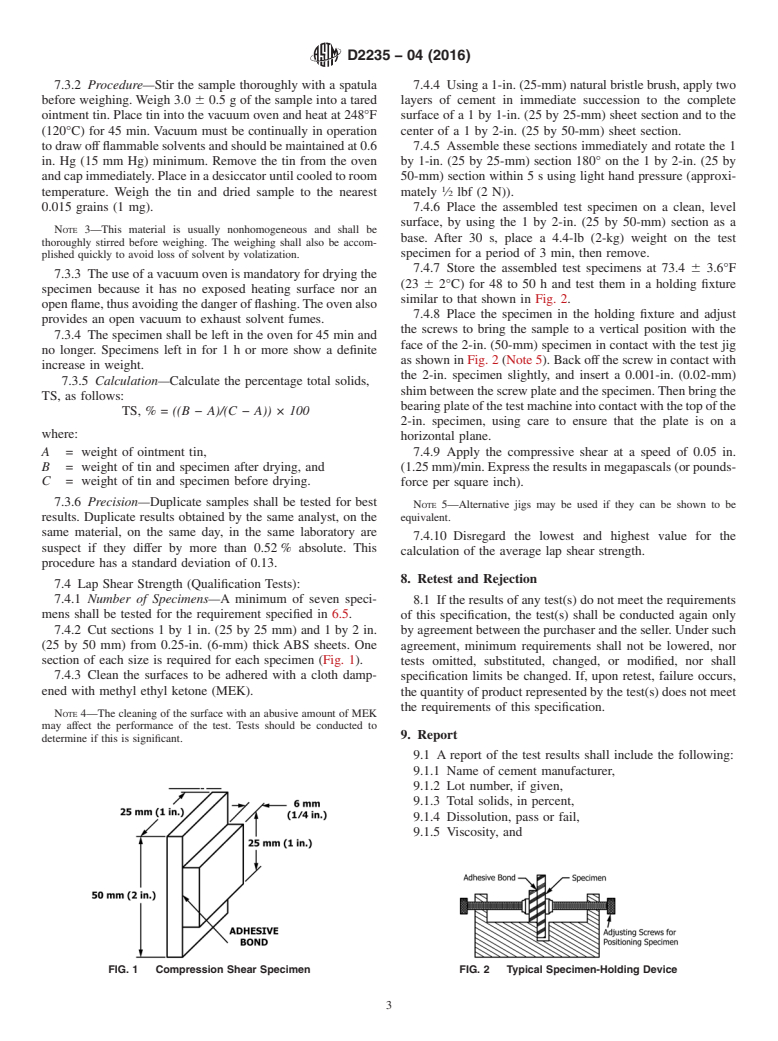
7.4.2 Cut sections 1 by 1 in. (25 by 25 mm) and 1 by 2 in. (25 by 50 mm) from 0.25-in. (6-mm) thick ABS sheets. One section
of each size is required for each specimen (Fig. 1).
7.4.3 Clean the surfaces to be adhered with a cloth dampened with methyl ethyl ketone (MEK).
NOTE 4—The cleaning of the surface with an abusive amount of MEK may affect the performance of the test. Tests should be conducted to determine
if this is significant.
7.4.4 Using a 1-in. (25-mm) natural bristle brush, apply two layers of cement in immediate succession to the complete surface
of a 1 by 1-in. (25 by 25-mm) sheet section and to the center of a 1 by 2-in. (25 by 50-mm) sheet section.
7.4.5 Assemble these sections immediately and rotate the 1 by 1-in. (25 by 25-mm) section 180° on the 1 by 2-in. (25 by
50-mm) section within 5 s using light hand pressure (approximately ⁄2 lbf (2 N)).
7.4.6 Place the assembled test specimen on a clean, level surface, by using the 1 by 2-in. (25 by 50-mm) section as a base. After
30 s, place a 4.4-lb (2-kg) weight on the test specimen for a period of 3 min, then remove.
Labline Duo-Vac vacuum oven, or equivalent, has been found satisfactory for this purpose.
D2235 − 04 (2016)
FIG. 1 Compression Shear Specimen
7.4.7 Store the assembled test specimens at 73.4 6 3.6°F (23 6 2°C) for 48 to 50 h and test them in a holding fixture similar
to that shown in Fig. 2.
7.4.8 Place the specimen in the holding fixture and adjust the screws to bring the sample to a vertical position with the face of
the 2-in. (50-mm) specimen in contact with the test jig as shown in Fig. 2 (Note 5). Back off the screw in contact with the 2-in.
specimen slightly, and insert a 0.001-in. (0.02-mm) shim between the screw plate and the specimen. Then bring the bearing plate
of the test machine into contact with the top of the 2-in. specimen, using care to ensure that the plate is on a horizontal plane.
7.4.9 Apply the compressive shear at a speed of 0.05 in. (1.25 mm)/min. Express the results in megapascals (or pounds-force
per square inch).
NOTE 5—Alternative jigs may be used if they can be shown to be equivalent.
7.4.10 Disregard the lowest and highest value for the calculation of the average lap shear strength.
8. Retest and Rejection
8.1 If the results of any test(s) do not meet the requirements of this specification, the test(s) shall be conducted again only by
agreement between the purchaser and the seller. Under such agreement, minimum requirements shall not be lowered, nor tests
omitted, substituted, changed, or modified, nor shall specification limits be changed. If, upon retest, failure occurs, the quantity of
product represented by the test(s) does not meet the requirements of this specification.
9. Report
9.1 A report of the test results shall include the following:
9.1.1 Name of cement manufacturer,
9.1.2 Lot number, if given,
9.1.3 Total solids, in percent,
9.1.4 Dissolution, pass or fail,
9.1.5 Viscosity, and
9.1.6 Average lap shear strength and complete identification of ABS sheet stock used for test.
10. Container Labeling and Marking
10.1 Ceme
...
Questions, Comments and Discussion
Ask us and Technical Secretary will try to provide an answer. You can facilitate discussion about the standard in here.