


ASTM D7575-11(2017)
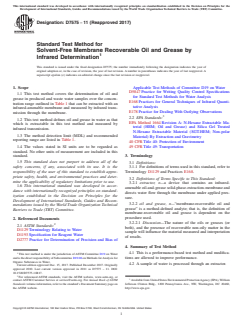
(Test Method)Standard Test Method for Solvent-Free Membrane Recoverable Oil and Grease by Infrared Determination
Standard Test Method for Solvent-Free Membrane Recoverable Oil and Grease by Infrared Determination
SIGNIFICANCE AND USE
5.1 The presence and concentration of oil and grease in domestic and industrial wastewater is of concern to the public because of its deleterious health, environmental, safety, and aesthetic effects.
5.2 Regulations and standards have been established that require monitoring of oil and grease in water and wastewater.4
Note 1: Different oil and grease materials may have different infrared absorptivities. Certain materials, such as synthetic silicone-based or perfluorinated oils, may have absoptivities inconsistent with those of naturally occurring oil and grease materials. Caution should be taken when testing matrices suspected of containing proportions of these materials. In such cases, laboratory spike samples, laboratory check samples, equivalency testing, or combinations thereof, using these materials in question may be appropriate.
SCOPE
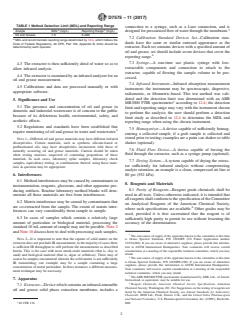
1.1 This test method covers the determination of oil and grease in produced and waste water samples over the concentration range outlined in Table 1 that can be extracted with an infrared-amenable membrane and measured by infrared transmission through the membrane. (A) MDL and recommended reporting range determined by 12.4, which follows the Code of Federal Regulations, 40 CFR, Part 136, Appendix B; limits should be determined by each operator.
1.2 This test method defines oil and grease in water as that which is extractable in this test method and measured by infrared transmission.
1.3 The method detection limit (MDL) and recommended reporting range are listed in Table 1.
1.4 The values stated in SI units are to be regarded as standard. No other units of measurement are included in this standard.
1.5 This standard does not purport to address all of the safety concerns, if any, associated with its use. It is the responsibility of the user of this standard to establish appropriate safety, health, and environmental practices and determine the applicability of regulatory limitations prior to use.
1.6 This international standard was developed in accordance with internationally recognized principles on standardization established in the Decision on Principles for the Development of International Standards, Guides and Recommendations issued by the World Trade Organization Technical Barriers to Trade (TBT) Committee.
General Information
- Status
- Published
- Publication Date
- 14-Dec-2017
- Technical Committee
- D19 - Water
- Drafting Committee
- D19.06 - Methods for Analysis for Organic Substances in Water
Relations
- Effective Date
- 15-Dec-2017
- Effective Date
- 01-May-2020
- Effective Date
- 01-Jun-2016
- Effective Date
- 15-Jun-2012
- Effective Date
- 01-Mar-2010
- Effective Date
- 01-Oct-2008
- Effective Date
- 15-Jan-2008
- Effective Date
- 01-Sep-2006
- Effective Date
- 01-Sep-2006
- Effective Date
- 15-Aug-2006
- Effective Date
- 01-Mar-2006
- Effective Date
- 01-Mar-2006
- Effective Date
- 15-Feb-2006
- Effective Date
- 01-Mar-2004
- Effective Date
- 01-Mar-2004
Overview
ASTM D7575-11(2017): Standard Test Method for Solvent-Free Membrane Recoverable Oil and Grease by Infrared Determination is a globally recognized methodology established by ASTM International for the analysis of oil and grease in water and wastewater. Designed to determine the concentration of oil and grease through infrared transmission after extraction with a membrane, this standard is crucial for environmental monitoring, ensuring compliance with public health and regulatory requirements, and supporting reliable water quality assessments. The method is solvent-free, making it an environmentally friendly alternative to traditional extraction techniques.
Key Topics
Scope
- Targets quantification of oil and grease in produced and waste water that can be extracted by an infrared-amenable membrane.
- Defines the analyte as "membrane-recoverable oil and grease" – analyte recovery depends on the extraction procedure.
- Application range typically from 5 mg/L to 200 mg/L, with detection limits advised by the operator.
- Results are reported in SI units (mg/L).
Significance
- Monitoring oil and grease is essential for water safety, pollution control, and regulatory compliance because of negative impacts on health, aesthetics, and ecosystems.
- The method supports compliance with local and international regulations including those outlined in 40 CFR (U.S. Code of Federal Regulations), which require regular monitoring in both industrial and municipal contexts.
Interferences and Limitations
- Certain synthetic oils (e.g., silicone-based, perfluorinated oils) may impact infrared detection and should be considered when analyzing unusual matrices.
- Solid or particulate-laden samples may require adjustment of sample volumes.
Quality Control
- Method includes provisions for laboratory control samples, method blanks, and matrix spike samples to ensure precision, accuracy, and reliability.
- Calibration and detection limit checks must be regularly performed.
Safety and Best Practices
- Users must address all laboratory, health, and environmental safety requirements and observe relevant safety data for reagents used.
Applications
Environmental Monitoring
- Used by environmental laboratories, regulatory authorities, and industries for routine monitoring and compliance verification of oil and grease in effluents, surface water, and wastewater.
Industrial Wastewater Management
- Applicable in monitoring discharges from industries such as manufacturing, processing, automotive, and food sectors to minimize environmental impacts and comply with discharge permits.
Municipal Water Systems
- Supports municipal water treatment plants in assessing the efficacy of treatment processes and ensuring that discharges meet environmental standards.
Quality Assurance
- Ensures the accuracy and comparability of results for interlaboratory studies and regulatory reporting.
Related Standards
- ASTM D1193: Specification for Reagent Water – outlines water quality for laboratory use.
- ASTM D1129: Terminology Relating to Water – provides essential definitions for water analysis.
- ASTM D2777: Practice for Determination of Precision and Bias – supports method validation.
- ASTM E168: Practices for General Techniques of Infrared Quantitative Analysis – foundational for IR measurement.
- EPA Method 1664: N-Hexane Extractable Materials and Non-polar Materials – an alternative gravimetric method for oil and grease.
- 40 CFR Part 136: U.S. Environmental Protection Agency's procedures for water pollution analysis.
Practical Value
The adoption of ASTM D7575-11(2017) delivers reliable, reproducible, and environmentally considerate oil and grease analyses without the use of hazardous solvents. Laboratories and facilities benefit from simplified workflows, greater analyst safety, and robust quality control, while ensuring results meet the demanding requirements of regulatory agencies worldwide. This standard is an essential tool for water quality assurance, regulatory compliance, and environmental stewardship.
Keywords: ASTM D7575-11, oil and grease analysis, membrane recoverable oil and grease, infrared determination, wastewater monitoring, environmental compliance, water quality testing, solvent-free extraction, laboratory standardization.
Get Certified
Connect with accredited certification bodies for this standard

NSF International
Global independent organization facilitating standards development and certification.

CIS Institut d.o.o.
Personal Protective Equipment (PPE) certification body. Notified Body NB-2890 for EU Regulation 2016/425 PPE.

Kiwa BDA Testing
Building and construction product certification.
Sponsored listings
Frequently Asked Questions
ASTM D7575-11(2017) is a standard published by ASTM International. Its full title is "Standard Test Method for Solvent-Free Membrane Recoverable Oil and Grease by Infrared Determination". This standard covers: SIGNIFICANCE AND USE 5.1 The presence and concentration of oil and grease in domestic and industrial wastewater is of concern to the public because of its deleterious health, environmental, safety, and aesthetic effects. 5.2 Regulations and standards have been established that require monitoring of oil and grease in water and wastewater.4 Note 1: Different oil and grease materials may have different infrared absorptivities. Certain materials, such as synthetic silicone-based or perfluorinated oils, may have absoptivities inconsistent with those of naturally occurring oil and grease materials. Caution should be taken when testing matrices suspected of containing proportions of these materials. In such cases, laboratory spike samples, laboratory check samples, equivalency testing, or combinations thereof, using these materials in question may be appropriate. SCOPE 1.1 This test method covers the determination of oil and grease in produced and waste water samples over the concentration range outlined in Table 1 that can be extracted with an infrared-amenable membrane and measured by infrared transmission through the membrane. (A) MDL and recommended reporting range determined by 12.4, which follows the Code of Federal Regulations, 40 CFR, Part 136, Appendix B; limits should be determined by each operator. 1.2 This test method defines oil and grease in water as that which is extractable in this test method and measured by infrared transmission. 1.3 The method detection limit (MDL) and recommended reporting range are listed in Table 1. 1.4 The values stated in SI units are to be regarded as standard. No other units of measurement are included in this standard. 1.5 This standard does not purport to address all of the safety concerns, if any, associated with its use. It is the responsibility of the user of this standard to establish appropriate safety, health, and environmental practices and determine the applicability of regulatory limitations prior to use. 1.6 This international standard was developed in accordance with internationally recognized principles on standardization established in the Decision on Principles for the Development of International Standards, Guides and Recommendations issued by the World Trade Organization Technical Barriers to Trade (TBT) Committee.
SIGNIFICANCE AND USE 5.1 The presence and concentration of oil and grease in domestic and industrial wastewater is of concern to the public because of its deleterious health, environmental, safety, and aesthetic effects. 5.2 Regulations and standards have been established that require monitoring of oil and grease in water and wastewater.4 Note 1: Different oil and grease materials may have different infrared absorptivities. Certain materials, such as synthetic silicone-based or perfluorinated oils, may have absoptivities inconsistent with those of naturally occurring oil and grease materials. Caution should be taken when testing matrices suspected of containing proportions of these materials. In such cases, laboratory spike samples, laboratory check samples, equivalency testing, or combinations thereof, using these materials in question may be appropriate. SCOPE 1.1 This test method covers the determination of oil and grease in produced and waste water samples over the concentration range outlined in Table 1 that can be extracted with an infrared-amenable membrane and measured by infrared transmission through the membrane. (A) MDL and recommended reporting range determined by 12.4, which follows the Code of Federal Regulations, 40 CFR, Part 136, Appendix B; limits should be determined by each operator. 1.2 This test method defines oil and grease in water as that which is extractable in this test method and measured by infrared transmission. 1.3 The method detection limit (MDL) and recommended reporting range are listed in Table 1. 1.4 The values stated in SI units are to be regarded as standard. No other units of measurement are included in this standard. 1.5 This standard does not purport to address all of the safety concerns, if any, associated with its use. It is the responsibility of the user of this standard to establish appropriate safety, health, and environmental practices and determine the applicability of regulatory limitations prior to use. 1.6 This international standard was developed in accordance with internationally recognized principles on standardization established in the Decision on Principles for the Development of International Standards, Guides and Recommendations issued by the World Trade Organization Technical Barriers to Trade (TBT) Committee.
ASTM D7575-11(2017) is classified under the following ICS (International Classification for Standards) categories: 13.060.50 - Examination of water for chemical substances. The ICS classification helps identify the subject area and facilitates finding related standards.
ASTM D7575-11(2017) has the following relationships with other standards: It is inter standard links to ASTM D7575-11, ASTM D1129-13(2020)e2, ASTM E178-16, ASTM D2777-12, ASTM D1129-10, ASTM E178-08, ASTM D2777-08, ASTM D1129-06a, ASTM D1129-06ae1, ASTM D2777-06, ASTM D1193-06, ASTM E168-06, ASTM D1129-06, ASTM D1129-04e1, ASTM D1129-04. Understanding these relationships helps ensure you are using the most current and applicable version of the standard.
ASTM D7575-11(2017) is available in PDF format for immediate download after purchase. The document can be added to your cart and obtained through the secure checkout process. Digital delivery ensures instant access to the complete standard document.
Standards Content (Sample)
This international standard was developed in accordance with internationally recognized principles on standardization established in the Decision on Principles for the
Development of International Standards, Guides and Recommendations issued by the World Trade Organization Technical Barriers to Trade (TBT) Committee.
Designation: D7575 − 11 (Reapproved 2017)
Standard Test Method for
Solvent-Free Membrane Recoverable Oil and Grease by
Infrared Determination
This standard is issued under the fixed designation D7575; the number immediately following the designation indicates the year of
original adoption or, in the case of revision, the year of last revision. A number in parentheses indicates the year of last reapproval. A
superscript epsilon (´) indicates an editorial change since the last revision or reapproval.
1. Scope Applicable Test Methods of Committee D19 on Water
D5847 Practice for Writing Quality Control Specifications
1.1 This test method covers the determination of oil and
for Standard Test Methods for Water Analysis
grease in produced and waste water samples over the concen-
E168 Practices for General Techniques of Infrared Quanti-
tration range outlined in Table 1 that can be extracted with an
tative Analysis
infrared-amenable membrane and measured by infrared trans-
E178 Practice for Dealing With Outlying Observations
mission through the membrane.
2.2 EPA Standards:
1.2 This test method defines oil and grease in water as that
EPA Method 1664 Revision A: N-Hexane Extractable Ma-
which is extractable in this test method and measured by
terial (HEM; Oil and Grease) and Silica Gel Treated
infrared transmission.
N-Hexane Extractable Material (SGT-HEM; Non-polar
1.3 The method detection limit (MDL) and recommended
Material) By Extraction and Gravimetry
reporting range are listed in Table 1.
40 CFR Title 40: Protection of Environment
49 CFR Title 49: Transportation
1.4 The values stated in SI units are to be regarded as
standard. No other units of measurement are included in this
standard. 3. Terminology
1.5 This standard does not purport to address all of the 3.1 Definitions:
safety concerns, if any, associated with its use. It is the
3.1.1 For definitions of terms used in this standard, refer to
responsibility of the user of this standard to establish appro- Terminology D1129 and Practices E168.
priate safety, health, and environmental practices and deter-
3.2 Definitions of Terms Specific to This Standard:
mine the applicability of regulatory limitations prior to use.
3.2.1 extractor, n—a device that contains an infrared-
1.6 This international standard was developed in accor-
amenable oil-and-grease solid-phase-extraction-membrane and
dance with internationally recognized principles on standard-
directs water flow through the membrane under applied pres-
ization established in the Decision on Principles for the
sure.
Development of International Standards, Guides and Recom-
3.2.2 oil and grease, n—“membrane-recoverable oil and
mendations issued by the World Trade Organization Technical
grease” is a method-defined analyte; that is, the definition of
Barriers to Trade (TBT) Committee.
membrane-recoverable oil and grease is dependent on the
procedure used.
2. Referenced Documents
3.2.2.1 Discussion—The nature of the oils or greases (or
2.1 ASTM Standards:
both), and the presence of recoverable non-oily matter in the
D1129 Terminology Relating to Water
sample will influence the material measured and interpretation
D1193 Specification for Reagent Water
of results.
D2777 Practice for Determination of Precision and Bias of
4. Summary of Test Method
1 4.1 This is a performance-based test method and modifica-
This test method is under the jurisdiction of ASTM Committee D19 on Water
andisthedirectresponsibilityofSubcommitteeD19.06onMethodsforAnalysisfor tions are allowed to improve performance.
Organic Substances in Water.
4.2 A sample of water is processed through an extractor.
Current edition approved Dec. 15, 2017. Published December 2017. Originally
approved 2010. Last current version approved in 2011 as D7575 – 11. DOI:
10.1520/D7575-11R17.
For referenced ASTM standards, visit the ASTM website, www.astm.org, or
contact ASTM Customer Service at service@astm.org. For Annual Book of ASTM AvailablefromUnitedStatesEnvironmentalProtectionAgency(EPA),William
Standards volume information, refer to the standard’s Document Summary page on Jefferson Clinton Bldg., 1200 Pennsylvania Ave., NW, Washington, DC 20460,
the ASTM website. http://www.epa.gov.
Copyright © ASTM International, 100 Barr Harbor Drive, PO Box C700, West Conshohocken, PA 19428-2959. United States
D7575 − 11 (2017)
TABLE 1 Method Detection Limit (MDL) and Reporting Range
connection to a syringe, such as a Luer connection, and is
A A
Analyte MDL (mg/L) Reporting Range (mg/L) designedforpressurizedflowofwaterthroughthemembrane.
Oil and Grease 1.0 5–200
7.2 Calibration Standard Devices Set—Calibration stan-
A
MDL and recommended reporting range determined by 12.4, which follows the
dards have the same or similar outward appearance as the
Code of Federal Regulations, 40 CFR, Part 136, Appendix B; limits should be
determined by each operator. extractor. Each set contains devices with a specified amount of
oil and grease; set should include seven devices that cover the
reporting range.
7.3 Syringe—A one-time use plastic syringe with low-
4.3 The extractor is then sufficiently dried of water so as to
extractable components and connection to attach to the
allow infrared analysis.
extractor, capable of flowing the sample volume to be pro-
4.4 The extractor is examined by an infrared analyzer for an
cessed.
oil and grease measurement.
7.4 Infrared Instrument—Infrared absorption measurement
4.5 Calibrations and data are processed manually or with
instrument; the instrument may be spectroscopic, dispersive,
appropriate software.
radiometric, or filtometric-based. This test method was vali-
dated and the detection limit was determined with an ABB
5. Significance and Use
MB3000 FTIR spectrometer according to 12.4; the detection
5.1 The presence and concentration of oil and grease in
limit and reporting range may vary with the instrument chosen
domestic and industrial wastewater is of concern to the public
to perform the analysis; the user should perform a detection
because of its deleterious health, environmental, safety, and
limit study as described in 12.4 to determine the MDL and
aesthetic effects.
reporting range when using the chosen instrument.
5.2 Regulations and standards have been established that
7.5 Homogenizer—A device capable of sufficiently homog-
require monitoring of oil and grease in water and wastewater.
enizing a collected sample, if a grab sample is collected and
stored prior to testing; examples are a paint can shaker or table
NOTE 1—Different oil and grease materials may have different infrared
absorptivities. Certain materials, such as synthetic silicone-based or shaker (optional).
perfluorinated oils, may have absoptivities inconsistent with those of
7.6 Fluid Flow Device—A device capable of forcing the
naturally occurring oil and grease materials. Caution should be taken
fluid through the extractor, such as a syringe pump (optional).
when testing matrices suspected of containing proportions of these
materials. In such cases, laboratory spike samples, laboratory check
7.7 Drying System—Asystem capable of drying the extrac-
samples, equivalency testing, or combinations thereof, using these mate-
tor sufficiently for infrared analysis without compromising
rials in question may be appropriate.
analyte retention; an example is a clean, compressed air line at
6. Interferences
80 psi (552 kPa).
6.1 Method interferences may be caused by contaminants in
8. Reagents and Materials
instrumentation, reagents, glassware, and other apparatus pro-
8.1 Purity of Reagents—Reagent grade chemicals shall be
ducing artifacts. Routine laboratory method blanks will dem-
used in all tests. Unless otherwise indicated, it is intended that
onstrate all these materials are free from interferences.
allreagentsshallconformtothespecificationoftheCommittee
6.2 Matrix interference may be caused by contaminants that
on Analytical Reagents of the American Chemical Society,
are co-extracted from the sample. The extent of matrix inter-
where such specifications are available. Other grades may be
ferences can vary considerably from sample to sample.
used, provided it is first ascertained that the reagent is of
6.3 In cases of samples which contain a relatively large
sufficiently high purity to permit its use without lessening the
amount of particulate or biological material, processing the
accuracy of the determination.
standard 10 mLamount of sample may not be possible. Note 2
andNote10discusshowtodealwithprocessingsuchsamples.
The sole source of supply of the apparatus known to the committee at this time
NOTE 2—It is important to note that the capture of solid matter on the is Orono Spectral Solutions, P/N 1018SPE (US Patent Application number
extractordoesnotprecludeIRmeasurement;inthemajorityofcasesthere 12/324,688). If you are aware of alternative suppliers, please provide this informa-
tion to ASTM International Headquarters. Your comments will receive careful
is sufficient IR throughput to still perform the measurement as described
consideration at a meeting of the responsible technical committee, which you may
herein. This is the case with most metal-oxide materials (that is, clay or
attend.
sand) and biological material (that is, algae or cellulose). There may of
The sole source of supply of the apparatus known to the committee at this time
course be samples encountered wherein the solid matter is not sufficiently
is Orono Spectral Solutions, P/N 1018SPE-CSD. If you are aware of alternative
IR transmitting; one example may be a sample containing a large
suppliers, please provide this information to ASTM International Headquarters.
concentration of metal particulate. In these instances a different measure-
Your comments will receive careful consideration at a meeting of the responsible
ment technique may be necessary.
technical committee, which you may attend.
TheABB MB3000 FTIR spectrometer manufactured byABB, Ltd., of Zurich,
7. Apparatus
Switzerland, or equivalent, may be suitable for use.
Reagent Chemicals, American Chemical Society Specifications, American
7.1 Extractor—Devicewhichcontainsaninfrared-amenable
Chemical Society, Washington, DC. For Suggestions on the testing of reagents not
oil and grease solid phase extraction membrane, includes a
listed by the American Chemical Society, see Annual Standards for Laboratory
Chemicals, BDH Ltd., Poole, Dorset, U.K., and the United States Pharmacopeia
and National Formulary, U.S. Pharmacopeial Convention, Inc. (USPC), Rockville,
40 CFR 136. MD.
D7575 − 11 (2017)
8.2 Purity of Water—Unless otherwise indicated, references 11. Preparation of Apparatus
to water shall be understood to mean reagent water that meets
11.1 Hexadecane and StearicAcid (1+1) Spiking Solution—
the purity specifications of Type II water, presented in Speci-
Place 400 mg 64 mg hexadecane and 400 mg 64 mg stearic
fication D1193.
acid in a 100-mL volumetric flask and fill to the bottom of the
8.3 Hydrochloric Acid—Concentration of 12.1 M. neck, not to the mark, with acetone.
8.4 Sulfuric Acid—Concentration of 18.4 M; optional re-
NOTE5—Thesolutionmayrequirewarmingforcompletedissolutionof
stearic acid.
placement for hydrochloric acid for preservation.
11.2 After the hexadecane and stearic acid has dissolved,
8.5 Acetone—ACS, residue less than 1 mg/L.
allowtocooltoroomtemperatureandaddacetonetothemark.
8.6 Hexadecane—98 % minimum purity.
Stopper the volumetric flask or transfer the solution to a
8.7 Stearic Acid—98 % minimum purity.
100–150 mL vial with fluoropolymer-lined cap. Mark the
solution level on the vial and store in the dark at room
9. Hazards
temperature.
9.1 Normal laboratory safety applies to this test method.
11.3 Immediately prior to the first use, verify the level on
Analysts should wear safety glasses, gloves, and lab coats
the vial and bring to volume with acetone, if required.Warm to
when working with acids.Analysts should review the Material
redissolveallvisibleprecipitate,ifrequired.Ifthereisdoubtof
Safety Data Sheets (MSDS) for all reagents used in this test
the concentration, remove 10.0 6 0.1 mL with a volumetric
method.Additional hazards may be presented by the particular
pipet, place in a tared weighing pan, and evaporate to dryness
sample being tested so proper care must be taken.
in a fume hood.The weight must be 80 6 1 mg. If not, prepare
a fresh solution (11.1).
10. Sampling
10.1 Fill the sample container. Do not fill the container to 11.4 The spiking solutions should be checked frequently for
signs of degradation or evaporation using the test in 11.3.
the brim; sufficient headspace is required to allow vigorous
homogenization. Do not rinse the sample container with the
11.5 If necessary, this solution can be made more or less
sampletobeanalyzed.Donotallowthesampletooverflowthe
concentrated to suit the concentration needed for the matrix
container during collection. Preventing overflow may not be
spike (MS). A fresh spiking solution should be prepared
possible in all sampling situations; however, measures should
weekly or bi-weekly.
be taken to minimize overflow at all times.
12. Calibration and Standardization
NOTE 3—About 5–10 % of volume headspace has been found to be
suitable for homogenization.
12.1 To ensure analytical values obtained using this test
10.2 Add a sufficient quantity of either sulfuric (see 8.4)or method are valid and accurate within the confidence limits of
hydrochloric acid (see 8.3) to a pH of 2. If analysis is to be the test, the instrument manufacturer’s instructions and the
delayed for more than four hours, refrigerate to 6°C or less, following procedures must be followed when performing this
without freezing, from the time of collection until extraction. test method.
The amount of acid required will be dependent upon the pH
NOTE6—InstrumentsotherthanFTIRspectrometersmayhavedifferent
and buffer capacity of the sample at the time of collection. If
procedures that should be followed according to the manufacturer’s
the amount of acid required is not known, make the pH
instructions.
measurement on a separate sample that will not be analyzed.
12.2 Calibration is carried out using the set of calibration
Introduction of pH paper to an actual sample or sample cap
standard devices (CSD).
may remove some oil from the sample. To more accurately
12.2.1 Take a background reference file through the CSD
calculate the final oil and grease concentration the following
labeled “Background” according to the instrument manufac-
equation can be used:
turer’s instructions.
C 5 C 3 V 1V /V (1) 12.2.2 Scan each of the other CSDs according to the
~ !
S i S A S
instrument manufacturer’s instructions.
where C is the measured concentration, V is the sample
i S
12.2.3 Measure and record the absorbance of the peak
volume, V is the volume of acid added to the sample, and C
A S –1
centered near 2920 cm (3.42 micron) according to Practices
is the sample concentration before the acid was added.
E168. The instrument may include automatic measurement
10.3 If the sample is to be shipped by commercial carrier,
software; if so follow instrument manufacturer’s instructions
U.S. Department of Transportation regulations (see 49 CFR,
for using the software.
Part 172) limit the pH to a minimum of 1.96 if HCl is used and
NOTE 7—Other peaks associated with the methylene moiety may also
1.15ifH SO isused(see40CFR,Part136,TableII,Footnote
2 4
be used; detection limits will be affected so the operator should follow
3).
12.4 to determine the detection limit for the absorbance peaks chosen.
NOTE 4—For those circumstances requiring the collection of multiple
12.2.4 Linear calibration may be used if the coefficient of
aliquots of one sample, each aliquot is to be collected in either of the
determination, r , is >0.95 for the analyte. If one of the
following ways: (1) collect simultaneously in parallel, if possible, or (2)
calibration standards other than the high or low point causes
collect as grab samples in rapid succession, filling ⁄3 of each container at
the r to be <0.95 this point must be reanalyzed. If the point
atimeandcontinuinguntilallcontainersare90–95 %full,consistentwith
Note 3. stillcausesther tobe<0.95,itmaybeexcludedbutminimally
D7575 − 11 (2017)
a six point calibration is required. The high or low point of the recovery must be within the range given in Table 2. This study
calibration may be excluded but the reporting range must be should be repeated until the single operator precision and
modified to reflect this change. If two points must be excluded recovery are within the recommended limits. If a concentration
to attain an r >0.95, calibration must be repeated, and if this other than the recommended concentration is used refer to
still is not achieved, calibration must be repeated with a new PracticeD5847forinformationonapplyingtheFtestandttest
set of calibration standard devices. in evaluating the acceptability of the mean recovery and RSD.
12.2.5 Quadratic calibration may be used if the coefficient
12.6 Laboratory Control Sample (LCS):
of determination, r , is >0.97 for the analyte. If one of the
12.6.1 To be sure this test method is in control, analyze an
calibration standards other than the high or low point causes
LCS prepared with the spiking solution at 40 mg/L in Type II
the r to be <0.97 this point must be reanalyzed. If the point
reagent water.An LCS should be analyzed with each set of 20
stillcausesther tobe<0.97,itmaybeexcludedbutminimally
samples or once a day.
a six point calibration is required. The high or low point of the
12.6.2 The LCS recovery should be within the limits given
calibration may be excluded to attain an r > 0.97, but the
in Table 2. If the result is not within this range, analysis of
reporting range must be modified to reflect this change. If two
samples is halted until the problem is corrected and either all
points must be excluded to attain an r > 0.97 calibration must
samples in the batch must be re-analyzed or the results must be
be repeated, and if this still is not achieved, calibration must be
qualified with a statement indicating they do not fall within the
repeated with a new set of calibration standard devices.
performance criteria of the test.
12.3 If a laboratory has not performed the test before, or if
12.7 Method Blank:
there has been a major change in the measurement system, for
12.7.1 Analyze a reagent water blank with each batch of 20
example a new analyst or new instrument, perform a MDLand
or fewer samples. The blank must be taken through all the
a precision and bias study to demonstrate laboratory capability.
method steps, including the preservation and pretreatment.The
12.4 Method Detection Limit (MDL):
concentration of oil and grease found in the blank must be
12.4.1 The MDL procedure that follows is a paraphrased
below the MDL determined in 12.4 or less than 10 % of the
version of the MDL procedure in the 40 CFR, Part 136,
known concentration of the associated test samples.
Appendix B.
12.7.2 If the concentration of oil and grease in the blank is
12.4.2 Analyze at least seven replicates of a sample at a
found above this level, analysis of samples is halted until the
concentration near three times the expected MDL (that is, 4
contamination is eliminated and the blank shows no contami-
mg/L). A laboratory spike sample, matrix sample, or a sample
nation above this level or the results must be qualified with a
similartothedesiredmatrixtobeexaminedmaybetested.The
statement indicating they do not fall within the performance
complete test method must be followed, including the preser-
criteria of this test method.
vation and pretreatment s
...
Questions, Comments and Discussion
Ask us and Technical Secretary will try to provide an answer. You can facilitate discussion about the standard in here.
Loading comments...