

ASTM C367/C367M-22
(Test Method)Standard Test Methods for Strength Properties of Prefabricated Architectural Acoustical Tile or Lay-In Ceiling Panels
General Information
- Abstract
SIGNIFICANCE AND USE
4.1 Knowledge of hardness is useful in the development and the quality control of acoustical tile and lay-in ceiling panels. Deviation from an established hardness range will assist in pointing out processing errors or defective raw materials, thereby aiding the maintenance of uniform product quality.
4.2 This property is also useful in comparing the relative abilities of materials to resist indentations on the panel surface caused by impacts.
4.3 Since the hardness varies with the thickness, only samples of the same thickness shall be directly compared.
SCOPE
1.1 These test methods cover the determination of the strength properties of prefabricated architectural acoustical tile or lay-in ceiling panels as follows:
Tests
Sections
Hardness
4 to 9
Friability
10 to 16
Sag
17 to 23
Transverse strength
24 to 30
1.2 Not all of the tests described in these test methods are necessary to evaluate any particular product for a specific use. In each instance, it is necessary to determine which properties are required.
1.3 These test methods specify procedures that are used in product development, manufacturing control, specification acceptance, and service evaluation.
1.4 Properties determined by these test methods reflect the performance of the materials under the specific conditions of the test, and do not necessarily indicate performance under conditions other than those specified herein.
1.5 The values stated in either SI units or inch-pound units are to be regarded separately as standard. The values stated in each system are not exact equivalents; therefore, each system shall be used independently of the other. Combining values from the two systems will result in non-conformance with the standard.
1.6 This standard does not purport to address all of the safety concerns, if any, associated with its use. It is the responsibility of the user of this standard to establish appropriate safety, health, and environmental practices and determine the applicability of regulatory limitations prior to use.
1.7 This international standard was developed in accordance with internationally recognized principles on standardization established in the Decision on Principles for the Development of International Standards, Guides and Recommendations issued by the World Trade Organization Technical Barriers to Trade (TBT) Committee.
- Status
- Published
- Publication Date
- 14-May-2022
- Technical Committee
- E33 - Building and Environmental Acoustics
- Drafting Committee
- E33.04 - Application of Acoustical Materials and Systems
Buy Documents
ASTM C367/C367M-22 - Standard Test Methods for Strength Properties of Prefabricated Architectural Acoustical Tile or Lay-In Ceiling Panels
REDLINE ASTM C367/C367M-22 - Standard Test Methods for Strength Properties of Prefabricated Architectural Acoustical Tile or Lay-In Ceiling Panels
Overview
ASTM C367/C367M-22 is the international standard published by ASTM International for determining the strength properties of prefabricated architectural acoustical tile or lay-in ceiling panels. These standardized test methods allow manufacturers, quality control laboratories, and specifiers to evaluate crucial mechanical characteristics of acoustical panels, including hardness, friability, sag resistance, and transverse strength. The results assist in material development, specification compliance, product comparison, and assurance of consistent quality in ceiling systems designed for sound absorption and building aesthetics.
Key Topics
This standard addresses four primary mechanical properties essential for the functional performance of ceiling tiles and lay-in panels:
- Hardness: Measures the resistance of the tile or panel surface to indentation, providing valuable information for development and quality control. Deviations from established hardness ranges can indicate processing issues or defects in raw materials.
- Friability: Assesses the material's tendency to crumble or break, particularly at edges and corners during shipping, handling, and installation. This helps predict potential damage and optimize handling processes.
- Sag Resistance: Evaluates how much a tile or panel deviates from a flat plane under conditions of varying temperature and humidity. This property is vital for ensuring panels maintain their structural integrity and appearance after installation.
- Transverse Strength (Modulus of Rupture): Determines the load-bearing capacity of panels across their width, simulating stresses encountered during suspension and system installation. This is critical for safety and durability in ceiling system applications.
Note: Not all tests are required for every product; property requirements are application-specific.
Applications
The standardized test methods in ASTM C367/C367M-22 are widely applied across multiple stages of the product lifecycle for architectural acoustical tiles and lay-in ceiling panels:
- Product Development: Assists manufacturers in developing new ceiling panels that meet targeted strength and acoustical performance criteria.
- Quality Control: Supports consistent manufacturing quality by identifying deviations in material properties that could impact installation or service life.
- Specification and Contract Acceptance: Provides objective criteria for verifying compliance with project requirements, specifications, or industry benchmarks.
- Service Evaluation: Offers tools for ongoing performance assessment, ensuring that installed ceiling systems maintain their intended function throughout their lifecycle.
Common end users include manufacturers, testing laboratories, architects, engineers, facility managers, and contractors working on commercial, institutional, and public buildings.
Related Standards
To deepen understanding or address broader performance requirements, consider the following related ASTM standards:
- ASTM C634 - Terminology Relating to Building and Environmental Acoustics: Provides definitions used in C367/C367M-22 and related documents.
- Standards addressing the acoustical, fire resistance, and installation aspects of ceiling panels may also be relevant, depending on project scope.
Keywords: ASTM C367, acoustical ceiling panels, lay-in tiles, hardness, friability, sag, transverse strength, test methods, building acoustics, product quality, standard testing.
For those seeking to ensure compliance, optimize product performance, and meet stringent architectural requirements, following ASTM C367/C367M-22 is essential. Regular consultation of the current official ASTM publication is recommended for the most accurate and up-to-date procedures.
Relations
- Effective Date
- 01-Sep-2013
- Effective Date
- 01-Dec-2011
- Effective Date
- 01-Sep-2010
- Effective Date
- 01-Jun-2010
- Effective Date
- 01-Apr-2009
- Effective Date
- 01-Sep-2008
- Effective Date
- 15-Mar-2008
- Effective Date
- 10-Apr-2002
- Effective Date
- 10-Apr-2002
- Effective Date
- 10-Jun-2001
- Effective Date
- 10-Jun-2001
Buy Documents
ASTM C367/C367M-22 - Standard Test Methods for Strength Properties of Prefabricated Architectural Acoustical Tile or Lay-In Ceiling Panels
REDLINE ASTM C367/C367M-22 - Standard Test Methods for Strength Properties of Prefabricated Architectural Acoustical Tile or Lay-In Ceiling Panels
Get Certified
Connect with accredited certification bodies for this standard

DIBt (Deutsches Institut für Bautechnik)
German Institute for Building Technology.
DIN CERTCO
DIN Group product certification.

Aboma Certification B.V.
Specialized in construction, metal, and transport sectors.
Sponsored listings
Frequently Asked Questions
ASTM C367/C367M-22 is a standard published by ASTM International. Its full title is "Standard Test Methods for Strength Properties of Prefabricated Architectural Acoustical Tile or Lay-In Ceiling Panels". This standard covers: SIGNIFICANCE AND USE 4.1 Knowledge of hardness is useful in the development and the quality control of acoustical tile and lay-in ceiling panels. Deviation from an established hardness range will assist in pointing out processing errors or defective raw materials, thereby aiding the maintenance of uniform product quality. 4.2 This property is also useful in comparing the relative abilities of materials to resist indentations on the panel surface caused by impacts. 4.3 Since the hardness varies with the thickness, only samples of the same thickness shall be directly compared. SCOPE 1.1 These test methods cover the determination of the strength properties of prefabricated architectural acoustical tile or lay-in ceiling panels as follows: Tests Sections Hardness 4 to 9 Friability 10 to 16 Sag 17 to 23 Transverse strength 24 to 30 1.2 Not all of the tests described in these test methods are necessary to evaluate any particular product for a specific use. In each instance, it is necessary to determine which properties are required. 1.3 These test methods specify procedures that are used in product development, manufacturing control, specification acceptance, and service evaluation. 1.4 Properties determined by these test methods reflect the performance of the materials under the specific conditions of the test, and do not necessarily indicate performance under conditions other than those specified herein. 1.5 The values stated in either SI units or inch-pound units are to be regarded separately as standard. The values stated in each system are not exact equivalents; therefore, each system shall be used independently of the other. Combining values from the two systems will result in non-conformance with the standard. 1.6 This standard does not purport to address all of the safety concerns, if any, associated with its use. It is the responsibility of the user of this standard to establish appropriate safety, health, and environmental practices and determine the applicability of regulatory limitations prior to use. 1.7 This international standard was developed in accordance with internationally recognized principles on standardization established in the Decision on Principles for the Development of International Standards, Guides and Recommendations issued by the World Trade Organization Technical Barriers to Trade (TBT) Committee.
SIGNIFICANCE AND USE 4.1 Knowledge of hardness is useful in the development and the quality control of acoustical tile and lay-in ceiling panels. Deviation from an established hardness range will assist in pointing out processing errors or defective raw materials, thereby aiding the maintenance of uniform product quality. 4.2 This property is also useful in comparing the relative abilities of materials to resist indentations on the panel surface caused by impacts. 4.3 Since the hardness varies with the thickness, only samples of the same thickness shall be directly compared. SCOPE 1.1 These test methods cover the determination of the strength properties of prefabricated architectural acoustical tile or lay-in ceiling panels as follows: Tests Sections Hardness 4 to 9 Friability 10 to 16 Sag 17 to 23 Transverse strength 24 to 30 1.2 Not all of the tests described in these test methods are necessary to evaluate any particular product for a specific use. In each instance, it is necessary to determine which properties are required. 1.3 These test methods specify procedures that are used in product development, manufacturing control, specification acceptance, and service evaluation. 1.4 Properties determined by these test methods reflect the performance of the materials under the specific conditions of the test, and do not necessarily indicate performance under conditions other than those specified herein. 1.5 The values stated in either SI units or inch-pound units are to be regarded separately as standard. The values stated in each system are not exact equivalents; therefore, each system shall be used independently of the other. Combining values from the two systems will result in non-conformance with the standard. 1.6 This standard does not purport to address all of the safety concerns, if any, associated with its use. It is the responsibility of the user of this standard to establish appropriate safety, health, and environmental practices and determine the applicability of regulatory limitations prior to use. 1.7 This international standard was developed in accordance with internationally recognized principles on standardization established in the Decision on Principles for the Development of International Standards, Guides and Recommendations issued by the World Trade Organization Technical Barriers to Trade (TBT) Committee.
ASTM C367/C367M-22 is classified under the following ICS (International Classification for Standards) categories: 91.120.20 - Acoustics in building. Sound insulation. The ICS classification helps identify the subject area and facilitates finding related standards.
ASTM C367/C367M-22 has the following relationships with other standards: It is inter standard links to ASTM C634-13, ASTM C634-11, ASTM C634-10a, ASTM C634-10, ASTM C634-09, ASTM C634-08a, ASTM C634-08, ASTM C634-02, ASTM C634-02e1, ASTM C634-01, ASTM C634-00. Understanding these relationships helps ensure you are using the most current and applicable version of the standard.
ASTM C367/C367M-22 is available in PDF format for immediate download after purchase. The document can be added to your cart and obtained through the secure checkout process. Digital delivery ensures instant access to the complete standard document.
Standards Content (Sample)
This international standard was developed in accordance with internationally recognized principles on standardization established in the Decision on Principles for the
Development of International Standards, Guides and Recommendations issued by the World Trade Organization Technical Barriers to Trade (TBT) Committee.
Designation: C367/C367M − 22
Standard Test Methods for
Strength Properties of Prefabricated Architectural
Acoustical Tile or Lay-In Ceiling Panels
This standard is issued under the fixed designation C367/C367M; the number immediately following the designation indicates the year
of original adoption or, in the case of revision, the year of last revision.Anumber in parentheses indicates the year of last reapproval.
A superscript epsilon (´) indicates an editorial change since the last revision or reapproval.
INTRODUCTION
Materials used for absorbing sound generally have a porous, low-density structure. In comparison
with many building materials they are relatively fragile. Materials are available that possess adequate
strengthandstabilityandatthesametimeprovidegoodsoundabsorption.Thetestmethodsdescribed
here cover procedures for evaluating those physical properties related to strength.The methods are of
use in developing, manufacturing, and selecting acoustical tile or lay-in panels.
Keep in mind that a property related to strength is only one of several considerations important in
judging the usefulness of an acoustical material. For example, a material judged to be quite weak by
one of these tests is still desired for other reasons, and with adequate precautions, is shipped and
installed successfully.
1. Scope shall be used independently of the other. Combining values
from the two systems will result in non-conformance with the
1.1 These test methods cover the determination of the
standard.
strength properties of prefabricated architectural acoustical tile
1.6 This standard does not purport to address all of the
or lay-in ceiling panels as follows:
safety concerns, if any, associated with its use. It is the
Tests Sections
Hardness 4 to 9 responsibility of the user of this standard to establish appro-
Friability 10 to 16
priate safety, health, and environmental practices and deter-
Sag 17 to 23
mine the applicability of regulatory limitations prior to use.
Transverse strength 24 to 30
1.7 This international standard was developed in accor-
1.2 Not all of the tests described in these test methods are
dance with internationally recognized principles on standard-
necessary to evaluate any particular product for a specific use.
ization established in the Decision on Principles for the
In each instance, it is necessary to determine which properties
Development of International Standards, Guides and Recom-
are required.
mendations issued by the World Trade Organization Technical
1.3 These test methods specify procedures that are used in
Barriers to Trade (TBT) Committee.
product development, manufacturing control, specification
acceptance, and service evaluation. 2. Referenced Documents
1.4 Properties determined by these test methods reflect the
2.1 ASTM Standards
performance of the materials under the specific conditions of
C634Terminology Relating to Building and Environmental
the test, and do not necessarily indicate performance under
Acoustics
conditions other than those specified herein.
3. Terminology
1.5 The values stated in either SI units or inch-pound units
are to be regarded separately as standard. The values stated in
3.1 Terms used in this standard are defined either in Termi-
each system are not exact equivalents; therefore, each system
nology C634 or within this standard. The definition of terms
explicitly given within this standard take precedence over
definitions given in Terminology C634. The definitions within
These test methods are under the jurisdiction of ASTM Committee E33 on
Building and EnvironmentalAcoustics and are the direct responsibility of Subcom-
mittee E33.04 on Application of Acoustical Materials and Systems. For referenced ASTM standards, visit the ASTM website, www.astm.org, or
Current edition approved May 15, 2022. Published May 2022. Originally contact ASTM Customer Service at service@astm.org. For Annual Book of ASTM
approved in 1955. Last previous edition approved in 2021 as C367/C367M–16 Standards volume information, refer to the standard’s Document Summary page on
(2021). DOI: 10.1520/C0367_C0367M-22. the ASTM website.
Copyright © ASTM International, 100 Barr Harbor Drive, PO Box C700, West Conshohocken, PA 19428-2959. United States
C367/C367M − 22
penetrator first contacts the specimen.
Terminology C634 and this standard take precedence over any
other definitions of defined terms found in any other
8.2.1 When possible, the penetrator shall bear between
documents, including other documents that may be referenced
perforations or fissures when testing perforated or fissured
in this standard.
material.
3.2 Definitions of Terms Specific to This Standard:
8.3 Record the load shown on the testing machine when the
3.2.1 fissures, n—irregular depressions of varying lengths
penetrator reaches the specified depression as the hardness of
widths, and depths extending below the basic product face.
the specimen in newtons or pounds-force [newtons].
3.2.2 friable, adj—easily crumbled.
9. Report
3.2.3 sag, n—deviation of the acoustical tile or panel at its
geometric center from the plane formed by the edges.
9.1 The report shall include the following:
9.1.1 Identification of the test material,
9.1.2 Method of conditioning including time of
HARDNESS
conditioning, temperature, °F or [°C] , and relative humid-
ity,%,
4. Significance and Use
9.1.3 Statement describing whether the finished or unfin-
4.1 Knowledgeofhardnessisusefulinthedevelopmentand
ishedsurfacewastestedandwhetherthefaceorthebackofthe
the quality control of acoustical tile and lay-in ceiling panels.
specimen was tested,
Deviation from an established hardness range will assist in
9.1.4 Average thickness for the five specimens, in. or [mm],
pointing out processing errors or defective raw materials,
9.1.5 Individual thicknesses for each of the five specimens,
thereby aiding the maintenance of uniform product quality.
in. or [mm],
4.2 This property is also useful in comparing the relative
9.1.6 Average hardness for the five specimens, lbf or [N],
abilities of materials to resist indentations on the panel surface
and
caused by impacts.
9.1.7 Individual hardness for each of the five specimens, lbf
4.3 Since the hardness varies with the thickness, only
or [N].
samples of the same thickness shall be directly compared.
FRIABILITY
5. Apparatus
10. Significance and Use
5.1 Testing Machine—Any standard mechanical or hydrau-
lic testing machine capable of applying and measuring the 10.1 The friability test measures the susceptibility of an
requiredloadwithinanaccuracyof 61%shallbeused.Itshall
acoustical product to edge and corner damage sustained during
be equipped with a 2.00 in. [50.8 mm] diameter metal ball, or shipping, handling, and installing. Products that are friable and
hemispherically shaped penetrator that bears upon the speci-
soft will erode considerably when subjected to rough treat-
men surface. ment.
6. Test Specimens
11. Apparatus
6.1 Cut five 4 by 4in. [100 by 100 mm] specimens from a
11.1 Balance, accurate to within 0.5% of the weight of the
single tile or panel. Cut the five specimens from representative
smallest specimen tested.
areas of the tile or ceiling panel.
11.2 Testing Container, consisting of an oak box with inside
3 1
dimensions of 7 ⁄4 in. [200 mm] square by 7 ⁄2 in. [190 mm]
7. Conditioning
deep and fitted with a cover on one end for inserting and
7.1 The strength properties of acoustical materials often
removing the specimens. The box shall be mounted so that it
depend on the moisture content at the time of the test.
can be rotated at 60 62 r/min on a horizontal axis that is
Therefore,conditionmaterialsfortestunder“roomconditions”
perpendicular to its square dimension.
toconstantweight(within 61%)inanatmospheremaintained
3 1
11.3 Red or White Oak Cubes,24, ⁄4 6 ⁄32in.[19 61mm]
at a relative humidity of 50 6 2%, and a temperature of 73 6
on an edge, having a specific gravity of 0.65 6 0.02.
2°F [23 6 1°C]. State in the test report any departure from this
11.3.1 Number each group of wood cubes 1 to 24. At the
recommended condition.
end of every 600-revolution test period, remove one “used”
8. Procedure
cube (follow the number sequence and remove and discard the
oldestcube)andreplacewithacorrespondingnumbered“new”
8.1 Place the specimen in the conditioning chamber and let
cube. In this manner, cube wear is eliminated as an uncon-
it remain until equilibrium is obtained.
trolled variable in the test method. When the corners of the
8.2 Place the specimen on a flat surface under the loading
wood cubes have been worn so that the radius of curvature is
penetrator of the test machine. Force the penetrator into the
greater than ⁄16 in. [1.5 mm] or the cubes have become altered
specimen 0.25 6 0.01 in. [6.5 6 0.3 mm] below the original
so as not to be comparable with new cubes, they shall be
surface (Note 1) at a rate of 0.10 in./min [2.5 mm/min].
discarded and new ones used. A conventional machinist’s
NOTE 1—The original surface is defined as the point where the radius gage shall be used for checking the cube edge wear.
C367/C367M − 22
11.4 Timer, consisting of a watch or clock capable of tions of use, but only the sag properties for the specific
measuring intervals of 10 min within 6 5.0 s. temperature, humidity, exposure time, and mounting condi-
tions used in the test.
12. Test Specimens
18. Apparatus
12.1 Cut twelve 1 by 1in. [25 by 25mm] square specimens
from a single tile or panel. The specimen thickness is equal to
18.1 Controlled-Atmosphere Chamber (Environmental
the tile or panel thickness.
Chamber),capableofoperatingatadry-bulbtemperatureof73
12.2 If the friability of original edges is of importance,
to 90 6 3°F [23.0 to 32.0 6 1.5°C], and relative humidities of
separate tests shall be run on 1 by 1in. [25 by 25mm]
50, 60, 70, 80, or 90 6 2%. The chamber shall be equipped
specimens having one or two original edges.
with suitable recording equipment to record wet- and dry-bulb
temperatures (or dry bulb and relative humidity). This equip-
13. Conditioning
ment shall be checked periodically and calibrated with a
13.1 Maintain standard conditions as described in 7.1 dur-
psychrometer that shall also be used to establish the test
ing preparation and testing of specimens.
conditions.
14. Procedure 18.2 Sample Test Frames and Racks, fabricated from non-
ferrous metal, such as aluminum, and of suitable linear
14.1 Weigh the twelve specimens and record the combined
dimensions as shown in Fig. 1. Frames shall be constructed of
weight to the nearest 0.1 g.
1 1
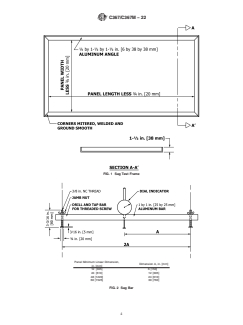
⁄4 by 1 ⁄2 in. [6 by 38 by 38-mm] angle with miter-cut corners.
14.2 Place the 12 specimens and the 24 oak cubes in the
Inside surfaces of corners shall be welded and ground smooth.
testing container. Close the top of the testing container and
Framesshallbefabricatedsotheyarelevelandsquare.Overall
rotate the container about its axis at a speed of 60 rpm for two
insidedimensionsoftheframesshallbesuchthatthepanelsdo
10 min periods.At the end of each 10 min period, remove the
not touch the vertical edges of the frame if they expand under
specimens from the box and determine the percentage of mass
prolonged exposure to conditions of high humidity.
loss, due to pulverization and breakage. In the case of badly
18.2.1 Racks shall b
...
This document is not an ASTM standard and is intended only to provide the user of an ASTM standard an indication of what changes have been made to the previous version. Because
it may not be technically possible to adequately depict all changes accurately, ASTM recommends that users consult prior editions as appropriate. In all cases only the current version
of the standard as published by ASTM is to be considered the official document.
Designation: C367/C367M − 16 (Reapproved 2021) C367/C367M − 22
Standard Test Methods for
Strength Properties of Prefabricated Architectural
Acoustical Tile or Lay-In Ceiling Panels
This standard is issued under the fixed designation C367/C367M; the number immediately following the designation indicates the year
of original adoption or, in the case of revision, the year of last revision. A number in parentheses indicates the year of last reapproval.
A superscript epsilon (´) indicates an editorial change since the last revision or reapproval.
INTRODUCTION
Materials used for absorbing sound generally have a porous, low-density structure. In comparison
with many building materials they are relatively fragile. Materials are available that possess adequate
strength and stability and at the same time provide good sound absorption. The test methods described
here cover procedures for evaluating those physical properties related to strength. The methods are of
use in developing, manufacturing, and selecting acoustical tile or lay-in panels.
Keep in mind that a property related to strength is only one of several considerations important in
judging the usefulness of an acoustical material. For example, a material judged to be quite weak by
one of these tests is still desired for other reasons, and with adequate precautions, is shipped and
installed successfully.
1. Scope
1.1 These test methods cover the determination of the strength properties of prefabricated architectural acoustical tile or lay-in
ceiling panels as follows:
Tests Sections
Hardness 4 to 9
Friability 10 to 16
Sag 17 to 23
Transverse strength 24 to 30
1.2 Not all of the tests described in these test methods are necessary to evaluate any particular product for a specific use. In each
instance, it is necessary to determine which properties are required.
1.3 These test methods specify procedures that are used in product development, manufacturing control, specification acceptance,
and service evaluation.
1.4 Properties determined by these test methods reflect the performance of the materials under the specific conditions of the test,
and do not necessarily indicate performance under conditions other than those specified herein.
1.5 The values stated in either SI units or inch-pound units are to be regarded separately as standard. The values stated in each
These test methods are under the jurisdiction of ASTM Committee E33 on Building and Environmental Acoustics and are the direct responsibility of Subcommittee
E33.04 on Application of Acoustical Materials and Systems.
Current edition approved Jan. 1, 2021May 15, 2022. Published February 2021May 2022. Originally approved in 1955. Last previous edition approved in 20162021 as
C367/C367M – 16.C367/C367M – 16 (2021). DOI: 10.1520/C0367_C0367M-16R21.10.1520/C0367_C0367M-22.
Copyright © ASTM International, 100 Barr Harbor Drive, PO Box C700, West Conshohocken, PA 19428-2959. United States
C367/C367M − 22
system are not exact equivalents; therefore, each system shall be used independently of the other. Combining values from the two
systems will result in non-conformance with the standard.
1.6 This standard does not purport to address all of the safety concerns, if any, associated with its use. It is the responsibility
of the user of this standard to establish appropriate safety, health, and environmental practices and determine the applicability of
regulatory limitations prior to use.
1.7 This international standard was developed in accordance with internationally recognized principles on standardization
established in the Decision on Principles for the Development of International Standards, Guides and Recommendations issued
by the World Trade Organization Technical Barriers to Trade (TBT) Committee.
2. Referenced Documents
2.1 ASTM Standards
C634 Terminology Relating to Building and Environmental Acoustics
3. Terminology
3.1 Terms defined used in this standard are defined either in Terminology C634 or within this standard. The definition of terms
explicitly given within this standard take precedence over definitions given in Terminology C634. The definitions within
Terminology C634. and this standard take precedence over any other definitions of defined terms found in any other documents,
including other documents that may be referenced in this standard.
3.1.1 acoustical material
3.1.2 sound absorption
3.2 Definitions of Terms Specific to This Standard:
3.2.1 fissures—fissures, n—irregular depressions of varying lengths widths, and depths extending below the basic product face.
3.2.2 friable—friable, adj—easily crumbled.
3.2.3 sag—sag, n—deviation of the acoustical tile or panel at its geometric center from the plane formed by the edges.
HARDNESS
4. Significance and Use
4.1 Knowledge of hardness is useful in the development and the quality control of acoustical tile and lay-in ceiling panels.
Deviation from an established hardness range will assist in pointing out processing errors or defective raw materials, thereby aiding
the maintenance of uniform product quality.
4.2 This property is also useful in comparing the relative abilities of materials to resist indentations on the panel surface caused
by impacts.
4.3 Since the hardness varies with the thickness, only samples of the same thickness shall be directly compared.
5. Apparatus
5.1 Testing Machine—Any standard mechanical or hydraulic testing machine capable of applying and measuring the required load
within an accuracy of 61 % shall be used. It shall be equipped with a 2.00 in. [50.8 mm] diameter metal ball, or hemispherically
shaped penetrator that bears upon the specimen surface.
For referenced ASTM standards, visit the ASTM website, www.astm.org, or contact ASTM Customer Service at service@astm.org. For Annual Book of ASTM Standards
volume information, refer to the standard’s Document Summary page on the ASTM website.
C367/C367M − 22
6. Test Specimens
6.1 Cut five 4 by 4 in. [100 by 100 mm] specimens from a single tile or panel. Cut the five specimens from representative areas
of the tile or ceiling panel.
7. Conditioning
7.1 The strength properties of acoustical materials often depend on the moisture content at the time of the test. Therefore, condition
materials for test under “room conditions” to constant weight (within 61 %) in an atmosphere maintained at a relative humidity
of 50 6 2 %, and a temperature of 73 6 2°F [23 6 1°C]. State in the test report any departure from this recommended condition.
8. Procedure
8.1 Place the specimen in the conditioning chamber and let it remain until equilibrium is obtained.
8.2 Place the specimen on a flat surface under the loading penetrator of the test machine. Force the penetrator into the specimen
0.25 6 0.01 in. [6.5 6 0.3 mm] below the original surface (Note 1) at a rate of 0.10 in./min [2.5 mm/min].
NOTE 1—The original surface is defined as the point where the penetrator first contacts the specimen.
8.2.1 When possible, the penetrator shall bear between perforations or fissures when testing perforated or fissured material.
8.3 Record the load shown on the testing machine when the penetrator reaches the specified depression as the hardness of the
specimen in newtons or pounds-force [newtons].
9. Report
9.1 The report shall include the following:
9.1.1 Identification of the test material,
9.1.2 Method of conditioning including time of conditioning, temperature, °F or [°C] , and relative humidity, %,
9.1.3 Statement describing whether the finished or unfinished surface was tested and whether the face or the back of the specimen
was tested,
9.1.4 Average thickness for the five specimens, in. or [mm],
9.1.5 Individual thicknesses for each of the five specimens, in. or [mm],
9.1.6 Average hardness for the five specimens, lbf or [N], and
9.1.7 Individual hardness for each of the five specimens, lbf or [N].
FRIABILITY
10. Significance and Use
10.1 The friability test measures the susceptibility of an acoustical product to edge and corner damage sustained during shipping,
handling, and installing. Products that are friable and soft will erode considerably when subjected to rough treatment.
11. Apparatus
11.1 Balance, accurate to within 0.5 % of the weight of the smallest specimen tested.
3 1
11.2 Testing Container, consisting of an oak box with inside dimensions of 7 ⁄4 in. [200 mm] square by 7 ⁄2 in. [190 mm] deep
C367/C367M − 22
and fitted with a cover on one end for inserting and removing the specimens. The box shall be mounted so that it can be rotated
at 60 62 r/min on a horizontal axis that is perpendicular to its square dimension.
3 1
11.3 Red or White Oak Cubes, 24, ⁄4 6 ⁄32 in. [19 6 1 mm] on an edge, having a specific gravity of 0.65 6 0.02.
11.3.1 Number each group of wood cubes 1 to 24. At the end of every 600-revolution test period, remove one “used” cube (follow
the number sequence and remove and discard the oldest cube) and replace with a corresponding numbered “new” cube. In this
manner, cube wear is eliminated as an uncontrolled variable in the test method. When the corners of the wood cubes have been
worn so that the radius of curvature is greater than ⁄16 in. [1.5 mm] or the cubes have become altered so as not to be comparable
with new cubes, they shall be discarded and new ones used. A conventional machinist’s radius gage shall be used for checking the
cube edge wear.
11.4 Timer, consisting of a watch or clock capable of measuring intervals of 10 min within 6 5.0 s.
12. Test Specimens
12.1 Cut twelve 1 by 1 in. [25 by 25 mm] square specimens from a single tile or panel. The specimen thickness is equal to the
tile or panel thickness.
12.2 If the friability of original edges is of importance, separate tests shall be run on 1 by 1 in. [25 by 25 mm] specimens having
one or two original edges.
13. Conditioning
13.1 Maintain standard conditions as described in 7.1 during preparation and testing of specimens.
14. Procedure
14.1 Weigh the twelve specimens and record the combined weight to the nearest 0.1 g.
14.2 Place the 12 specimens and the 24 oak cubes in the testing container. Close the top of the testing container and rotate the
container about its axis at a speed of 60 rpm for two 10 min periods. At the end of each 10 min period, remove the specimens from
the box and determine the percentage of mass loss, due to pulverization and breakage. In the case of badly abraded specimens,
remove up to twelve of the largest pieces remaining and weigh these for the determination. In rare cases, no pieces may remain
from an individual specimen. In this case, the weight loss shall be reported as 100 %.
15. Calculation
15.1 Calculate the percent mass loss for the 10 min and 20 min periods to two significant figures using Eq 1
mass loss, %5 @~M 2 M !/M #·100 (1)
1 2 1
M 5 original mass, g, and
M 5 mass after 10 min period and mass after 20 min period.
16. Report
16.1 The report shall include the following:
16.1.1 Identification of the test material,
16.1.2 Method of conditioning including time of conditioning, temperature, °F or [°C] , and relative humidity, %, and
16.1.3 Percentage mass loss for the 10 and 20 min periods.
C367/C367M − 22
SAG
17. Significance and Use
17.1 This test method is for the purpose of determining the sag properties of ceiling tile or panels under various conditions of
humidity exposure. Tiles or panels of various sizes can be tested by using appropriately sized supporting frames.
17.2 The test m
...