

ASTM D244-23
(Test Method)Standard Test Methods and Practices for Emulsified Asphalts
General Information
- Abstract
SIGNIFICANCE AND USE
5.1 This test method measures the amount of water present in the emulsified asphalt, as distinguished from either bitumen or petroleum solvent.
SCOPE
1.1 These test methods and practices, given under the headings titled Composition, Consistency, Stability, and Examination of Residue, cover the examination of asphalt emulsions composed principally of a semisolid or liquid asphaltic base, water, and an emulsifying agent. The test methods cover the following tests and practices:
Test
Sections
Composition:
Water Content
4 – 10
Residue and Oil Distillate by Distillation
See Test Method
D6997
Residue by Evaporation
See Test Method
D6934
Particle Charge of Cationic Emulsified Asphalts
See Practice
D7402
Consistency:
Viscosity (Saybolt Furol)
See Test Method
D7496
Stability:
Demulsibility
See Test Method
D6936
Settlement
See Test Method
D6930
Cement Mixing
See Test Method
D6935
Sieve Test
See Test Method
D6933
Aggregate Coating
See Practice
D6998
Miscibility with Water
See Practice
D6999
Freezing
See Practice
D6929
Coating Ability and Water Resistance
11 – 18
Storage Stability of Asphalt Emulsion
See Test Method
D6930
Examination of Residue
19 – 26
Identification Test for Rapid Setting Cationic Emulsified Asphalt
27 – 34
Identification of Cationic Slow Set Emulsions
See Practice
D7402
Field Coating Test on Emulsified Asphalts
35 – 40
Emulsified Asphalt/Job Aggregate Coating Test
41 – 46
Density of Emulsified Asphalt
See Test Method
D6937
Residue by Low-Temperature Vacuum Distillation
See Test Method
D7403
1.2 The values stated in SI units are to be regarded as the standard. The values given in parentheses are for information only.
1.3 This standard does not purport to address all of the safety concerns, if any, associated with its use. It is the responsibility of the user of this standard to establish appropriate safety, health, and environmental practices and determine the applicability of regulatory limitations prior to use.
1.4 This international standard was developed in accordance with internationally recognized principles on standardization established in the Decision on Principles for the Development of International Standards, Guides and Recommendations issued by the World Trade Organization Technical Barriers to Trade (TBT) Committee.
- Status
- Published
- Publication Date
- 30-Sep-2023
- Technical Committee
- D04 - Road and Paving Materials
- Drafting Committee
- D04.42 - Emulsified Asphalt Test
Overview
ASTM D244-23: Standard Test Methods and Practices for Emulsified Asphalts is a comprehensive standard developed by ASTM International for the testing and evaluation of asphalt emulsions. Used primarily in road construction and paving, emulsified asphalts are mixtures of asphalt cement, water, and emulsifying agents. This standard details test methods for analyzing the physical and chemical properties of emulsified asphalts, ensuring their suitability for specific construction applications.
ASTM D244-23 includes procedures under four main headings: Composition, Consistency, Stability, and Examination of Residue. The test methods evaluate characteristics such as water content, viscosity, stability, aggregate coating ability, and properties of the recovered residue, all critical for quality assurance in asphalt emulsions.
Key Topics
Composition Analysis
- Water content determination
- Measurement of residue and oil distillate
- Evaluation of particle charge in cationic emulsions
Consistency Testing
- Saybolt Furol viscosity
- Residue by evaporation and distillation
Stability Assessment
- Demulsibility test to evaluate stability against breakdown
- Settlement and storage stability
- Aggregate coating, miscibility with water, and freezing resistance
Residue Examination
- Specific gravity, ash content, and solubility of residue
- Penetration, ductility, and float tests to assess durability
Field and Laboratory Coating Practices
- Field coating test to determine compatibility with job aggregate
- Coating ability and water resistance rating on both dry and wet aggregate
Identification and Classification
- Procedures to distinguish rapid-setting and slow-setting cationic emulsified asphalts
Applications
ASTM D244-23 is essential in a wide range of applications within the road construction and pavement industry, including:
- Quality Control: Ensuring emulsified asphalt batches meet essential specifications for performance and longevity in road surfaces and pavement maintenance.
- Mix Design Verification: Assessing compatibility and coating effectiveness with various aggregates to optimize asphalt mixtures for specific projects.
- Emulsion Selection: Evaluating physical and chemical properties to select the most appropriate type of asphalt emulsion for distinct weather, traffic, or application needs.
- Field Testing: Conducting quick field tests to verify emulsion-aggregate compatibility on-site, minimizing construction delays.
- Specification Compliance: Meeting regulatory and contractual requirements for public and private sector infrastructure projects.
By adhering to these methods, producers, contractors, and regulators can ensure emulsified asphalts are robust, durable, and deliver consistent performance in the field.
Related Standards
ASTM D244-23 is closely linked with numerous other ASTM standards for asphalt materials and testing methods, including:
- ASTM D977 – Specification for Emulsified Asphalt
- ASTM D6934 – Test Method for Residue by Evaporation of Emulsified Asphalt
- ASTM D6930 – Test Method for Settlement and Storage Stability of Emulsified Asphalts
- ASTM D7496 – Test Method for Viscosity of Emulsified Asphalt by Saybolt Furol Viscometer
- ASTM D6997 – Test Method for Distillation of Emulsified Asphalt
- ASTM D6998/6999 – Practices for Evaluating Aggregate Coating and Miscibility with Water
- ASTM D7402/7403 – Identification and residue analysis for cationic emulsified asphalts
For a complete list of referenced documents and latest updates, users should consult the ASTM website. Compliance with ASTM D244-23 helps guarantee reliable, standardized evaluation of emulsified asphalts-a critical component for safe and effective road infrastructure.
Relations
- Effective Date
- 01-Oct-2023
- Effective Date
- 01-Dec-2023
- Effective Date
- 01-Dec-2023
- Effective Date
- 01-Dec-2023
- Effective Date
- 01-Dec-2023
- Effective Date
- 01-Dec-2023
- Effective Date
- 01-Mar-2023
- Effective Date
- 15-Dec-2017
- Effective Date
- 01-Sep-2017
- Effective Date
- 01-Jun-2016
- Effective Date
- 01-Oct-2023
- Effective Date
- 01-Oct-2023
- Effective Date
- 01-Oct-2023
- Effective Date
- 01-Oct-2023
- Referred By
ASTM D7944-22 - Standard Practice for Recovery of Emulsified Asphalt Residue Using a Vacuum Oven - Effective Date
- 01-Oct-2023
Get Certified
Connect with accredited certification bodies for this standard

DIBt (Deutsches Institut für Bautechnik)
German Institute for Building Technology.
DIN CERTCO
DIN Group product certification.
Zavod za gradbeništvo Slovenije (ZAG) - Inšpekcija
ZAG inspection body for construction products, structures, and materials.
Sponsored listings
Frequently Asked Questions
ASTM D244-23 is a standard published by ASTM International. Its full title is "Standard Test Methods and Practices for Emulsified Asphalts". This standard covers: SIGNIFICANCE AND USE 5.1 This test method measures the amount of water present in the emulsified asphalt, as distinguished from either bitumen or petroleum solvent. SCOPE 1.1 These test methods and practices, given under the headings titled Composition, Consistency, Stability, and Examination of Residue, cover the examination of asphalt emulsions composed principally of a semisolid or liquid asphaltic base, water, and an emulsifying agent. The test methods cover the following tests and practices: Test Sections Composition: Water Content 4 – 10 Residue and Oil Distillate by Distillation See Test Method D6997 Residue by Evaporation See Test Method D6934 Particle Charge of Cationic Emulsified Asphalts See Practice D7402 Consistency: Viscosity (Saybolt Furol) See Test Method D7496 Stability: Demulsibility See Test Method D6936 Settlement See Test Method D6930 Cement Mixing See Test Method D6935 Sieve Test See Test Method D6933 Aggregate Coating See Practice D6998 Miscibility with Water See Practice D6999 Freezing See Practice D6929 Coating Ability and Water Resistance 11 – 18 Storage Stability of Asphalt Emulsion See Test Method D6930 Examination of Residue 19 – 26 Identification Test for Rapid Setting Cationic Emulsified Asphalt 27 – 34 Identification of Cationic Slow Set Emulsions See Practice D7402 Field Coating Test on Emulsified Asphalts 35 – 40 Emulsified Asphalt/Job Aggregate Coating Test 41 – 46 Density of Emulsified Asphalt See Test Method D6937 Residue by Low-Temperature Vacuum Distillation See Test Method D7403 1.2 The values stated in SI units are to be regarded as the standard. The values given in parentheses are for information only. 1.3 This standard does not purport to address all of the safety concerns, if any, associated with its use. It is the responsibility of the user of this standard to establish appropriate safety, health, and environmental practices and determine the applicability of regulatory limitations prior to use. 1.4 This international standard was developed in accordance with internationally recognized principles on standardization established in the Decision on Principles for the Development of International Standards, Guides and Recommendations issued by the World Trade Organization Technical Barriers to Trade (TBT) Committee.
SIGNIFICANCE AND USE 5.1 This test method measures the amount of water present in the emulsified asphalt, as distinguished from either bitumen or petroleum solvent. SCOPE 1.1 These test methods and practices, given under the headings titled Composition, Consistency, Stability, and Examination of Residue, cover the examination of asphalt emulsions composed principally of a semisolid or liquid asphaltic base, water, and an emulsifying agent. The test methods cover the following tests and practices: Test Sections Composition: Water Content 4 – 10 Residue and Oil Distillate by Distillation See Test Method D6997 Residue by Evaporation See Test Method D6934 Particle Charge of Cationic Emulsified Asphalts See Practice D7402 Consistency: Viscosity (Saybolt Furol) See Test Method D7496 Stability: Demulsibility See Test Method D6936 Settlement See Test Method D6930 Cement Mixing See Test Method D6935 Sieve Test See Test Method D6933 Aggregate Coating See Practice D6998 Miscibility with Water See Practice D6999 Freezing See Practice D6929 Coating Ability and Water Resistance 11 – 18 Storage Stability of Asphalt Emulsion See Test Method D6930 Examination of Residue 19 – 26 Identification Test for Rapid Setting Cationic Emulsified Asphalt 27 – 34 Identification of Cationic Slow Set Emulsions See Practice D7402 Field Coating Test on Emulsified Asphalts 35 – 40 Emulsified Asphalt/Job Aggregate Coating Test 41 – 46 Density of Emulsified Asphalt See Test Method D6937 Residue by Low-Temperature Vacuum Distillation See Test Method D7403 1.2 The values stated in SI units are to be regarded as the standard. The values given in parentheses are for information only. 1.3 This standard does not purport to address all of the safety concerns, if any, associated with its use. It is the responsibility of the user of this standard to establish appropriate safety, health, and environmental practices and determine the applicability of regulatory limitations prior to use. 1.4 This international standard was developed in accordance with internationally recognized principles on standardization established in the Decision on Principles for the Development of International Standards, Guides and Recommendations issued by the World Trade Organization Technical Barriers to Trade (TBT) Committee.
ASTM D244-23 is classified under the following ICS (International Classification for Standards) categories: 91.100.50 - Binders. Sealing materials; 93.080.20 - Road construction materials. The ICS classification helps identify the subject area and facilitates finding related standards.
ASTM D244-23 has the following relationships with other standards: It is inter standard links to ASTM D244-09(2017), ASTM D86-23ae1, ASTM D139-23, ASTM D6936-23, ASTM D86-23a, ASTM D140/D140M-16(2023), ASTM D86-23, ASTM D113-17, ASTM D6936-17, ASTM D140/D140M-16, ASTM D3666-16, ASTM D139-16, ASTM D88/D88M-07(2019)e1, ASTM D977-20, ASTM D7944-22. Understanding these relationships helps ensure you are using the most current and applicable version of the standard.
ASTM D244-23 is available in PDF format for immediate download after purchase. The document can be added to your cart and obtained through the secure checkout process. Digital delivery ensures instant access to the complete standard document.
Standards Content (Sample)
This international standard was developed in accordance with internationally recognized principles on standardization established in the Decision on Principles for the
Development of International Standards, Guides and Recommendations issued by the World Trade Organization Technical Barriers to Trade (TBT) Committee.
Designation: D244 − 23 American Association State
Highway and Transportation Officials Standard
AASHTO No.: T59
Standard Test Methods and Practices for
Emulsified Asphalts
This standard is issued under the fixed designation D244; the number immediately following the designation indicates the year of
original adoption or, in the case of revision, the year of last revision. A number in parentheses indicates the year of last reapproval. A
superscript epsilon (´) indicates an editorial change since the last revision or reapproval.
This standard has been approved for use by agencies of the U.S. Department of Defense.
1. Scope
Emulsified Asphalt/Job Aggregate Coating Test 41 – 46
Density of Emulsified Asphalt See Test Method
1.1 These test methods and practices, given under the
D6937
headings titled Composition, Consistency, Stability, and Ex- Residue by Low-Temperature Vacuum Distillation See Test Method
D7403
amination of Residue, cover the examination of asphalt emul-
1.2 The values stated in SI units are to be regarded as the
sions composed principally of a semisolid or liquid asphaltic
standard. The values given in parentheses are for information
base, water, and an emulsifying agent. The test methods cover
only.
the following tests and practices:
Test Sections
1.3 This standard does not purport to address all of the
Composition:
safety concerns, if any, associated with its use. It is the
Water Content 4 – 10
responsibility of the user of this standard to establish appro-
Residue and Oil Distillate by Distillation See Test Method
D6997
priate safety, health, and environmental practices and deter-
Residue by Evaporation See Test Method
mine the applicability of regulatory limitations prior to use.
D6934
1.4 This international standard was developed in accor-
Particle Charge of Cationic Emulsified Asphalts See Practice
D7402
dance with internationally recognized principles on standard-
Consistency:
ization established in the Decision on Principles for the
Viscosity (Saybolt Furol) See Test Method
Development of International Standards, Guides and Recom-
D7496
Stability:
mendations issued by the World Trade Organization Technical
Demulsibility See Test Method
Barriers to Trade (TBT) Committee.
D6936
Settlement See Test Method
D6930
2. Referenced Documents
Cement Mixing See Test Method
D6935
2.1 ASTM Standards:
Sieve Test See Test Method
D5/D5M Test Method for Penetration of Bituminous Mate-
D6933
rials
Aggregate Coating See Practice
D6998
D70/D70M Test Method for Specific Gravity and Density of
Miscibility with Water See Practice
Semi-Solid Asphalt Binder (Pycnometer Method)
D6999
D86 Test Method for Distillation of Petroleum Products and
Freezing See Practice
D6929
Liquid Fuels at Atmospheric Pressure
Coating Ability and Water Resistance 11 – 18
D113 Test Method for Ductility of Asphalt Materials
Storage Stability of Asphalt Emulsion See Test Method
D128 Test Methods for Analysis of Lubricating Grease
D6930
Examination of Residue 19 – 26
D139 Test Method for Float Test for Bituminous Materials
Identification Test for Rapid Setting Cationic Emulsi- 27 – 34
D140/D140M Practice for Sampling Asphalt Materials
fied Asphalt
D2042 Test Method for Solubility of Asphalt Materials in
Identification of Cationic Slow Set Emulsions See Practice
D7402
Trichloroethylene or Toluene
Field Coating Test on Emulsified Asphalts 35 – 40
D3289 Test Method for Density of Semi-Solid and Solid
Asphalt Materials (Nickel Crucible Method)
These test methods and practices are under the jurisdiction of ASTM Commit-
tee D04 on Road and Paving Materials and are the direct responsibility of
Subcommittee D04.42 on Emulsified Asphalt Test. For referenced ASTM standards, visit the ASTM website, www.astm.org, or
Current edition approved Oct. 1, 2023. Published October 2023. Originally contact ASTM Customer Service at service@astm.org. For Annual Book of ASTM
approved in 1926. Last previous edition approved in 2017 as D244 – 09 (2017). Standards volume information, refer to the standard’s Document Summary page on
DOI: 10.1520/D0244-23. the ASTM website.
Copyright © ASTM International, 100 Barr Harbor Drive, PO Box C700, West Conshohocken, PA 19428-2959. United States
D244 − 23
D6929 Practice for Evaluating the Effect of Freezing on D7402 Practice for Identifying Cationic Emulsified Asphalts
Emulsified Asphalts D7403 Test Method for Determination of Residue of Emul-
D6930 Test Method for Settlement and Storage Stability of
sified Asphalt by Low Temperature Vacuum Distillation
Emulsified Asphalts
D7404 Test Method for Determination of Emulsified Asphalt
D6933 Test Method for Oversized Particles in Emulsified
Residue by Moisture Balance Analyzer
Asphalts (Sieve Test)
D7496 Test Method for Viscosity of Emulsified Asphalt by
D6934 Test Method for Residue by Evaporation of Emulsi-
Saybolt Furol Viscometer
fied Asphalt
E1 Specification for ASTM Liquid-in-Glass Thermometers
D6935 Test Method for Determining Cement Mixing of
E11 Specification for Woven Wire Test Sieve Cloth and Test
Emulsified Asphalt
Sieves
D6936 Test Method for Determining Demulsibility of Emul-
sified Asphalt
3. Sample Conditioning for Testing
D6937 Test Method for Determining Density of Emulsified
3.1 All emulsions with viscosity requirements of 50 °C
Asphalt
should be heated to 50 6 3 °C in the original sample container
D6997 Test Method for Distillation of Emulsified Asphalt
D6998 Practice for Evaluating Aggregate Coating using in a 71 °C water bath or oven. The container should be vented
to relieve pressure. After the sample reaches 50 6 3 °C, stir the
Emulsified Asphalts
D6999 Practice for Miscibility of Emulsified Asphalts sample to achieve homogeneity.
D7226 Test Method for Determining the Viscosity of Emul-
sified Asphalts Using a Rotational Paddle Viscometer
COMPOSITION
WATER CONTENT 6.6 Solvent—Xylol or other petroleum distillate conforming
to the following distillation requirements: 98 % distills be-
4. Scope
tween 120 and 250 °C. This distillation shall be conducted in
4.1 This test method covers the procedure for determining
accordance with Test Method D86.
the water content of an emulsified asphalt by reflux distillation
7. Sample
using a water trap.
7.1 Obtain a representative sample of the material for test
5. Significance and Use
using standard procedures as specified in Practice D140/
5.1 This test method measures the amount of water present
D140M.
in the emulsified asphalt, as distinguished from either bitumen
NOTE 1—The difficulties in obtaining representative samples for this
or petroleum solvent.
determination are unusually great, so the importance of sampling cannot
be too strongly emphasized.
6. Apparatus and Materials
6.1 Metal Still—The metal still (Fig. 1(a)) shall be a vertical
8. Procedure
cylindrical vessel, preferably of copper, having a faced flange
8.1 When the material to be tested contains less than 25 %
at the top to which the head is tightly attached by means of a
water, place 100 6 0.1 g of sample in the still. When the
clamp. The head shall be made of metal, preferably brass or
material contains more than 25 % water, use a 50 6 0.1 g
copper, and shall be provided with a tubulation 25.4 mm (1 in.)
sample. Thoroughly mix the sample to be tested with 200 mL
in inside diameter.
of solvent by swirling, taking proper care to avoid any loss of
6.2 Glass Still—The glass still (Fig. 1(b)) shall be a short-
material.
neck, round-bottom flask, made of well-annealed glass, and
8.2 Connect the still, trap, and condenser by means of
having an approximate capacity of 500 mL.
tight-fitting corks as shown in Fig. 1(a) or (b). Adjust the end
6.3 Heat Source—The heat source used with the metal still
of the condenser in the trap to a position which will allow the
shall be a ring gas burner of 100 mm (4 in.) inside diameter or
end to be submerged to a depth of not more than 1 mm below
an electric mantle heater. The heat source for the glass still
the surface of the liquid in the trap after distillation conditions
shall be either an ordinary gas burner or an electric heater.
have been established. When using the metal still, insert a
heavy paper gasket, moistened with the solvent, between the
6.4 Condenser—The condenser shall be a water-cooled
lid and flange before attaching the clamp.
reflux glass-tube type, having a jacket not less than 400 mm in
length, with an inner tube 9.5 to 12.7 mm in outside diameter.
8.3 When the ring burner is used with the metal still, place
The end of the condenser shall be ground to an angle of 30 6
it about 76.2 mm above the bottom of the still at the beginning
5° from the vertical axis of the condenser.
of the distillation, and gradually lower it as the distillation
6.5 Trap—The trap shall be made of annealed glass con- proceeds. Regulate the heat so that the condensate falls from
structed in accordance with Fig. 1(c) and shall be graduated in the end of the condenser at a rate of from 2 to 5 drops per
0.10 mL divisions from 0 to 2 mL, and in 0.20 mL divisions second. Continue the distillation at the specified rate until no
from 2 to 25 mL. water is visible on any part of the apparatus and a constant
D244 − 23
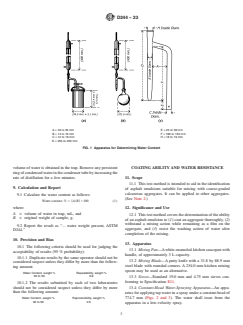
A = 45 to 55 mm E = 25 to 38 mm
B = 14 to 16 mm F = 186 to 194 mm
C = 12 to 16 mm H = 18 to 19 mm
D = 235 to 255 mm
FIG. 1 Apparatus for Determining Water Content
volume of water is obtained in the trap. Remove any persistent COATING ABILITY AND WATER RESISTANCE
ring of condensed water in the condenser tube by increasing the
rate of distillation for a few minutes. 11. Scope
11.1 This test method is intended to aid in the identification
9. Calculation and Report
of asphalt emulsions suitable for mixing with coarse-graded
calcareous aggregates. It can be applied to other aggregates.
9.1 Calculate the water content as follows:
(See Note 2.)
Water content, % 5 ~A/B! × 100 (1)
where: 12. Significance and Use
A = volume of water in trap, mL, and
12.1 This test method covers the determination of the ability
B = original weight of sample, g.
of an asphalt emulsion to (1) coat an aggregate thoroughly, (2)
withstand a mixing action while remaining as a film on the
9.2 Report the result as “. water weight percent, ASTM
aggregate, and (3) resist the washing action of water after
D244.”
completion of the mixing.
10. Precision and Bias
13. Apparatus
10.1 The following criteria should be used for judging the
13.1 Mixing Pan—A white-enameled kitchen saucepan with
acceptability of results (95 % probability):
handle, of approximately 3 L capacity.
10.1.1 Duplicate results by the same operator should not be
13.2 Mixing Blade—A putty knife with a 31.8 by 88.9 mm
considered suspect unless they differ by more than the follow-
steel blade with rounded corners. A 254.0 mm kitchen mixing
ing amount:
spoon may be used as an alternative.
Water Content, weight % Repeatability, weight %
30 to 50 0.8
13.3 Sieves—Standard 19.0 mm and 4.75 mm sieves con-
forming to Specification E11.
10.1.2 The results submitted by each of two laboratories
should not be considered suspect unless they differ by more
13.4 Constant-Head Water-Spraying Apparatus—An appa-
than the following amount:
ratus for applying tap water in a spray under a constant head of
Water Content, weight % Reproducibility, weight %
774.7 mm (Figs. 2 and 3). The water shall issue from the
30 to 50 2.0
apparatus in a low-velocity spray.
D244 − 23
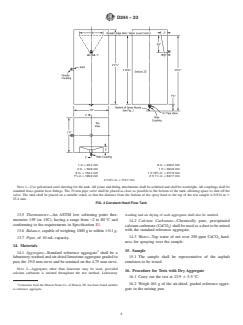
1 in = 25.4 mm 8 in. = 230.2 mm
2 in. = 50.8 mm 1 ft = 304.8 mm
6 in. = 152.4 mm 1 ft 10 ⁄4 in. = 577.9 mm
3 1
7 ⁄4 in = 196.9 mm 2 ft 1 ⁄2 in. = 647.7 mm
2 ft 6 ⁄2 in. = 774.7 mm
NOTE 1—Use galvanized steel sheeting for the tank. All joints and fitting attachments shall be soldered and shall be watertight. All couplings shall be
standard brass garden hose fittings. The 19 mm pipe valve shall be placed as close as possible to the bottom of the tank, allowing space to shut off the
valve. The tank shall be placed on a suitable stand, so that the distance from the bottom of the spray head to the top of the test sample is 0.914 m 6
25.4 mm.
FIG. 2 Constant-Head Flow Tank
washing and air drying of such aggregates shall also be omitted.
13.5 Thermometer—An ASTM low softening point ther-
mometer 15F (or 15C), having a range from −2 to 80 °C and
14.2 Calcium Carbonate—Chemically pure, precipitated
conforming to the requirements in Specification E1.
calcium carbonate (CaCO ) shall be used as a dust to be mixed
with the standard reference aggregate.
13.6 Balance, capable of weighing 1000 g to within 60.1 g.
14.3 Water—Tap water of not over 250 ppm CaCO hard-
13.7 Pipet, of 10 mL capacity. 3
ness for spraying over the sample.
14. Materials
3 15. Sample
14.1 Aggregate—Standard reference aggregate shall be a
15.1 The sample shall be representative of the asphalt
laboratory-washed and air-dried limestone aggregate graded to
pass the 19.0 mm sieve and be retained on the 4.75 mm sieve. emulsion to be tested.
NOTE 2—Aggregates other than limestone may be used, provided
16. Procedure for Tests with Dry Aggregate
calcium carbonate is omitted throughout the test method. Laboratory
16.1 Carry out the test at 23.9 6 5.5 °C.
3 16.2 Weigh 461 g of the air-dried, graded reference aggre-
Limestone from the Monon Stone Co. of Monon, IN, has been found suitable
as reference aggregate. gate in the mixing pan.
D244 − 23
NOTE 1—A Speakman, Model 235S, all brass, fixed shower head has been found acceptable.
NOTE 2—Existing 101.6 mm diameter shower heads may continue to be used.
NOTE 3—0.05 in. = 1.3 mm
6 in. = 152.4 mm
7 ⁄4 in. = 196.9 mm
FIG. 3 Spray Nozzle Assembly
16.3 Weigh 4.0 g of CaCO dust in the mixing pan and mix 16.6 Immediately spray the mixture remaining in the pan
with the 461 g of aggregate for approximately 1 min by means
with tap water from the constant-head water spraying apparatus
of a mixing blade to obtain a uniform film of dust on the
to cover the mixture. The distance from the spray head to the
aggregate particles.
sample shall be 305 6 75 mm. Then carefully pour off the
water. Continue spraying and pouring off the water until the
NOTE 3—The total weight of aggregate and dust shall equal 465 g. If no
calcium carbonate is included, the weight of aggregate alone shall be overflow water runs clear. Carefully drain off the water in the
465 g.
pan. Scoop the mixture from the mixing pan on to absorbent
16.4 Weigh 35 g of the asphalt emulsion into the aggregate
paper for evaluation of coating retention in the washing test.
in the pan and mix vigorously with the mixing blade for 5 min
16.7 Evaluate the mixture immediately by visual estimation
using a tossing action created by a back-and-forth motion in an
as to the total aggregate surface area that is coated with asphalt.
elliptical path of the mixing blade or spoon. At the end of the
mixing period, tilt the pan and permit any excess emulsion not
16.8 Repeat the evaluation by visual estimation of the
on the ag
...
This document is not an ASTM standard and is intended only to provide the user of an ASTM standard an indication of what changes have been made to the previous version. Because
it may not be technically possible to adequately depict all changes accurately, ASTM recommends that users consult prior editions as appropriate. In all cases only the current version
of the standard as published by ASTM is to be considered the official document.
Designation: D244 − 09 (Reapproved 2017) D244 − 23 American Association State
Highway and Transportation Officials Standard
AASHTO No.: T59
Standard Test Methods and Practices for
Emulsified Asphalts
This standard is issued under the fixed designation D244; the number immediately following the designation indicates the year of
original adoption or, in the case of revision, the year of last revision. A number in parentheses indicates the year of last reapproval. A
superscript epsilon (´) indicates an editorial change since the last revision or reapproval.
This standard has been approved for use by agencies of the U.S. Department of Defense.
1. Scope
1.1 These test methods and practices, given under the headings titled Composition, Consistency, Stability, and Examination of
Residue, cover the examination of asphalt emulsions composed principally of a semisolid or liquid asphaltic base, water, and an
emulsifying agent. The test methods cover the following tests and practices:
Test Sections
Composition:
Water Content 4 – 10
Residue and Oil Distillate by Distillation See Test Method
D6997
Residue by Evaporation See Test Method
D6934
Particle Charge of Cationic Emulsified Asphalts See Practice
D7402
Consistency:
Viscosity (Saybolt Furol) See Test Method
D7496
Stability:
Demulsibility See Test Method
D6936
Settlement See Test Method
D6930
Cement Mixing See Test Method
D6935
Sieve Test See Test Method
D6933
Aggregate Coating See Practice
D6998
Miscibility with Water See Practice
D6999
Freezing See Practice
D6929
Coating Ability and Water Resistance 11 – 18
Storage Stability of Asphalt Emulsion See Test Method
D6930
Examination of Residue 19 – 26
Identification Test for Rapid Setting Cationic Emulsi- 27 – 34
fied Asphalt
Identification of Cationic Slow Set Emulsions See Practice
D7402
These test methods and practices are under the jurisdiction of ASTM Committee D04 on Road and Paving Materials and are the direct responsibility of Subcommittee
D04.42 on Emulsified Asphalt Test.
Current edition approved Oct. 1, 2017Oct. 1, 2023. Published October 2017October 2023. Originally approved in 1926. Last previous edition approved in 20092017 as
D244 – 09.D244 – 09 (2017). DOI: 10.1520/D0244-09R17.10.1520/D0244-23.
Copyright © ASTM International, 100 Barr Harbor Drive, PO Box C700, West Conshohocken, PA 19428-2959. United States
D244 − 23
Field Coating Test on Emulsified Asphalts 35 – 40
Emulsified Asphalt/Job Aggregate Coating Test 41 – 46
Density of Emulsified Asphalt See Test Method
D6937
Residue by Low-Temperature Vacuum Distillation See Test Method
D7403
1.2 The values stated in SI units are to be regarded as the standard. The values given in parentheses are for information only.
1.3 This standard does not purport to address all of the safety concerns, if any, associated with its use. It is the responsibility
of the user of this standard to establish appropriate safety, health, and environmental practices and determine the applicability of
regulatory limitations prior to use.
1.4 This international standard was developed in accordance with internationally recognized principles on standardization
established in the Decision on Principles for the Development of International Standards, Guides and Recommendations issued
by the World Trade Organization Technical Barriers to Trade (TBT) Committee.
2. Referenced Documents
2.1 ASTM Standards:
C778 Specification for Standard Sand
D5D5/D5M Test Method for Penetration of Bituminous Materials
D70D70/D70M Test Method for Specific Gravity and Density of Semi-Solid Asphalt Binder (Pycnometer Method)
D86 Test Method for Distillation of Petroleum Products and Liquid Fuels at Atmospheric Pressure
D113 Test Method for Ductility of Asphalt Materials
D128 Test Methods for Analysis of Lubricating Grease
D139 Test Method for Float Test for Bituminous Materials
D140D140/D140M Practice for Sampling Asphalt Materials
D977 Specification for Emulsified Asphalt
D2042 Test Method for Solubility of Asphalt Materials in Trichloroethylene or Toluene
D2397 Specification for Cationic Emulsified Asphalt
D3289 Test Method for Density of Semi-Solid and Solid Asphalt Materials (Nickel Crucible Method)
D6929 Practice for Evaluating the Effect of Freezing on Emulsified Asphalts
D6930 Test Method for Settlement and Storage Stability of Emulsified Asphalts
D6933 Test Method for Oversized Particles in Emulsified Asphalts (Sieve Test)
D6934 Test Method for Residue by Evaporation of Emulsified Asphalt
D6935 Test Method for Determining Cement Mixing of Emulsified Asphalt
D6936 Test Method for Determining Demulsibility of Emulsified Asphalt
D6937 Test Method for Determining Density of Emulsified Asphalt
D6997 Test Method for Distillation of Emulsified Asphalt
D6998 Practice for Evaluating Aggregate Coating using Emulsified Asphalts
D6999 Practice for Miscibility of Emulsified Asphalts
D7226 Test Method for Determining the Viscosity of Emulsified Asphalts Using a Rotational Paddle Viscometer
D7402 Practice for Identifying Cationic Emulsified Asphalts
D7403 Test Method for Determination of Residue of Emulsified Asphalt by Low Temperature Vacuum Distillation
D7404 Test Method for Determination of Emulsified Asphalt Residue by Moisture Balance Analyzer
D7496 Test Method for Viscosity of Emulsified Asphalt by Saybolt Furol Viscometer
E1 Specification for ASTM Liquid-in-Glass Thermometers
E11 Specification for Woven Wire Test Sieve Cloth and Test Sieves
E145 Specification for Gravity-Convection and Forced-Ventilation Ovens
3. Sample Conditioning for Testing
3.1 All emulsions with viscosity requirements of 50 °C should be heated to 50 6 3 °C in the original sample container in a 71 °C
water bath or oven. The container should be vented to relieve pressure. After the sample reaches 50 6 3 °C, stir the sample to
achieve homogeneity.
COMPOSITION
For referenced ASTM standards, visit the ASTM website, www.astm.org, or contact ASTM Customer Service at service@astm.org. For Annual Book of ASTM Standards
volume information, refer to the standard’s Document Summary page on the ASTM website.
D244 − 23
WATER CONTENT
4. Scope
4.1 This test method covers the procedure for determining the water content of an emulsified asphalt by reflux distillation using
a water trap.
5. Significance and Use
5.1 This test method measures the amount of water present in the emulsified asphalt, as distinguished from either bitumen or
petroleum solvent.
6. Apparatus and Materials
6.1 Metal Still—The metal still (Fig. 1(a)) shall be a vertical cylindrical vessel, preferably of copper, having a faced flange at the
A = 45 to 55 mm E = 25 to 38 mm
B = 14 to 16 mm F = 186 to 194 mm
C = 12 to 16 mm H = 18 to 19 mm
D = 235 to 255 mm
FIG. 1 Apparatus for Determining Water Content
top to which the head is tightly attached by means of a clamp. The head shall be made of metal, preferably brass or copper, and
shall be provided with a tubulation 25.4 mm (1 in.) in inside diameter.
6.2 Glass Still—The glass still (Fig. 1(b)) shall be a short-neck, round-bottom flask, made of well-annealed glass, and having an
approximate capacity of 500 mL.
6.3 Heat Source—The heat source used with the metal still shall be a ring gas burner of 100-mm (4-in.) 100 mm (4 in.) inside
diameter or an electric mantle heater. The heat source for the glass still shall be either an ordinary gas burner or an electric heater.
6.4 Condenser—The condenser shall be a water-cooled reflux glass-tube type, having a jacket not less than 400 mm in length, with
an inner tube 9.5 to 12.7 mm in outside diameter. The end of the condenser shall be ground to an angle of 30 6 5° from the vertical
axis of the condenser.
D244 − 23
6.5 Trap—The trap shall be made of annealed glass constructed in accordance with Fig. 1(c) and shall be graduated in 0.10-mL
0.10 mL divisions from 0 to 2 mL, and in 0.20-mL 0.20 mL divisions from 2 to 25 mL.
6.6 Solvent—Xylol or other petroleum distillate conforming to the following distillation requirements: 98 % distills between 120
and 250 °C. This distillation shall be conducted in accordance with Test Method D86.
7. Sample
7.1 Obtain a representative sample of the material for test using standard procedures as specified in Practice D140D140/D140M.
NOTE 1—The difficulties in obtaining representative samples for this determination are unusually great, so that the importance of sampling cannot be too
strongly emphasized.
8. Procedure
8.1 When the material to be tested contains less than 25 % water, place 100 6 0.1 g of sample in the still. When the material
contains more than 25 % water, use a 50 6 0.1-g 0.1 g sample. Thoroughly mix the sample to be tested with 200 mL of solvent
by swirling, taking proper care to avoid any loss of material.
8.2 Connect the still, trap, and condenser by means of tight-fitting corks as shown in Fig. 1(a) or (b). Adjust the end of the
condenser in the trap to a position which will allow the end to be submerged to a depth of not more than 1 mm below the surface
of the liquid in the trap after distillation conditions have been established. When using the metal still, insert a heavy paper gasket,
moistened with the solvent, between the lid and flange before attaching the clamp.
8.3 When the ring burner is used with the metal still, place it about 76.2 mm above the bottom of the still at the beginning of the
distillation, and gradually lower it as the distillation proceeds. Regulate the heat so that the condensate falls from the end of the
condenser at a rate of from 2 to 5 drops per second. Continue the distillation at the specified rate until no water is visible on any
part of the apparatus and a constant volume of water is obtained in the trap. Remove any persistent ring of condensed water in
the condenser tube by increasing the rate of distillation for a few minutes.
9. Calculation and Report
9.1 Calculate the water content as follows:
Water content,%5 A/B ×100 (1)
~ !
where:
A = volume of water in trap, mL, and
B = original weight of sample, g.
9.2 Report the result as “. water weight percent, ASTM D244.”
10. Precision and Bias
10.1 The following criteria should be used for judging the acceptability of results (95 % probability):
10.1.1 Duplicate results by the same operator should not be considered suspect unless they differ by more than the following
amount:
Water Content, weight % Repeatability, weight %
30 to 50 0.8
10.1.2 The results submitted by each of two laboratories should not be considered suspect unless they differ by more than the
following amount:
D244 − 23
Water Content, weight % Reproducibility, weight %
30 to 50 2.0
COATING ABILITY AND WATER RESISTANCE
11. Scope
11.1 This test method is intended to aid in the identification of asphalt emulsions suitable for mixing with coarse-graded calcareous
aggregates. It can be applied to other aggregates. (See Note 2.)
12. Significance and Use
12.1 This test method covers the determination of the ability of an asphalt emulsion to (1) coat an aggregate thoroughly, (2)
withstand a mixing action while remaining as a film on the aggregate, and (3) resist the washing action of water after completion
of the mixing.
13. Apparatus
13.1 Mixing Pan—A white-enameled kitchen saucepan with handle, of approximately 3-L3 L capacity.
13.2 Mixing Blade—A putty knife with a 31.8 by 88.9-mm 88.9 mm steel blade with rounded corners. A 254.0-mm 254.0 mm
kitchen mixing spoon may be used as an alternative.
13.3 Sieves—Standard 19.0-mm and 4.75-mm 19.0 mm and 4.75 mm sieves conforming to Specification E11.
13.4 Constant-Head Water-Spraying Apparatus—An apparatus for applying tap water in a spray under a constant head of 774.7
mm (Figs. 2 and 3). The water shall issue from the apparatus in a low-velocity spray.
13.5 Thermometer—An ASTM low softening point thermometer 15F (or 15C), having a range from −2 to 80 °C and conforming
to the requirements in Specification E1.
13.6 Balance, capable of weighing 1000 g to within 60.1 g.
13.7 Pipet, of 10-mL 10 mL capacity.
14. Materials
14.1 Aggregate—Standard reference aggregate shall be a laboratory-washed and air-dried limestone aggregate graded to pass the
19.0-mm 19.0 mm sieve and be retained on the 4.75-mm 4.75 mm sieve.
NOTE 2—Aggregates other than limestone may be used, provided calcium carbonate is omitted throughout the test method. Laboratory washing and air
drying of such aggregates shall also be omitted.
14.2 Calcium Carbonate—Chemically pure, precipitated calcium carbonate (CaCO ) shall be used as a dust to be mixed with the
standard reference aggregate.
14.3 Water—Tap water of not over 250 ppm CaCO hardness for spraying over the sample.
15. Sample
15.1 The sample shall be representative of the asphalt emulsion to be tested.
Limestone from the Monon Stone Co. of Monon, IN, has been found suitable as reference aggregate.
D244 − 23
1 in = 25.4 mm 8 in. = 230.2 mm
2 in. = 50.8 mm 1 ft = 304.8 mm
6 in. = 152.4 mm 1 ft 10 ⁄4 in. = 577.9 mm
3 1
7 ⁄4 in = 196.9 mm 2 ft 1 ⁄2 in. = 647.7 mm
2 ft 6 ⁄2 in. = 774.7 mm
NOTE 1—Use galvanized steel sheeting for the tank. All joints and fitting attachments shall be soldered and shall be watertight. All couplings shall be
standard brass garden hose fittings. The 19-mm 19 mm pipe valve shall be placed as close as possible to the bottom of the tank, allowing space to shut
off the valve. The tank shall be placed on a suitable stand, so that the distance from the bottom of the spray head to the top of the test sample is 0.914
m 6 25.4 mm.
FIG. 2 Constant-Head Flow Tank
16. Procedure for Tests with Dry Aggregate
16.1 Carry out the test at 23.9 6 5.5 °C.
16.2 Weigh 461 g of the air-dried, graded reference aggregate in the mixing pan.
16.3 Weigh 4.0 g of CaCO dust in the mixing pan and mix with the 461 g of aggregate for approximately 1 min by means of
a mixing blade to obtain a uniform film of dust on the aggregate particles.
NOTE 3—The total weight of aggregate and dust shall equal 465 g. If no calcium carbonate is included, the weight of aggregate alone shall be 465 g.
16.4 Weigh 35 g of the asphalt emulsion into the aggregate in the pan and mix vigorously with the mixing blade for 5 min using
a tossing action created by a back-and-forth motion in an elliptical path of the mixing blade or spoon. At the end of the mixing
period, tilt the pan and permit any excess emulsion not on the aggregate to drain from the pan.
16.5 Remove approximately one half of the mixture from the pan and place it on absorbent paper and evaluate the coating.
D244 − 23
NOTE 1—A Speakman, Model 235S, all brass, fixed shower head has been found acceptable.
NOTE 2—Existing 101.6-mm 101.6 mm diameter shower heads may continue to be used.
NOTE 3—0.05 in. = 1.3 mm
6 in. = 152.4 mm
7 ⁄4 in. = 196.9 mm
FIG. 3 Spray Nozzle Assembly
16.6 Immediately spray the mixture remaining in the pan with tap water from the constant-head water spraying apparatus to cover
the mixture. The distance from the sprayhead spray head to the sample shall be 305 6 75 mm. Then carefully pour off the water.
Continue spraying and pouring off the water until the overflow water runs clear.
...