

ASTM F386-17(2022)
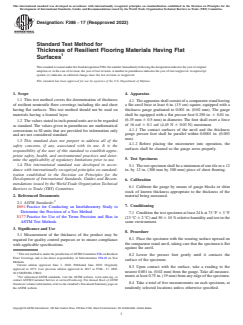
(Test Method)Standard Test Method for Thickness of Resilient Flooring Materials Having Flat Surfaces
General Information
- Abstract
SIGNIFICANCE AND USE
3.1 Measurement of the thickness of the product may be required for quality control purposes or to ensure compliance with applicable specifications.
SCOPE
1.1 This test method covers the determination of thickness of resilient nontextile floor coverings including tile and sheet having flat surfaces. This test method should not be used on materials having a foamed layer.
1.2 The values stated in inch-pound units are to be regarded as standard. The values given in parentheses are mathematical conversions to SI units that are provided for information only and are not considered standard.
1.3 This standard does not purport to address all of the safety concerns, if any, associated with its use. It is the responsibility of the user of this standard to establish appropriate safety, health, and environmental practices and determine the applicability of regulatory limitations prior to use.
1.4 This international standard was developed in accordance with internationally recognized principles on standardization established in the Decision on Principles for the Development of International Standards, Guides and Recommendations issued by the World Trade Organization Technical Barriers to Trade (TBT) Committee.
- Status
- Published
- Publication Date
- 31-May-2022
- Technical Committee
- F06 - Resilient Floor Coverings
- Drafting Committee
- F06.20 - Test Methods


Overview
ASTM F386-17(2022) is the internationally recognized standard developed by ASTM International for measuring the thickness of resilient flooring materials with flat surfaces. This standard is essential for manufacturers, quality assurance professionals, and regulatory agencies involved with resilient nontextile floor coverings, including tiles and sheets. The method ensures that flooring products meet quality control requirements and comply with relevant industry specifications. It specifically excludes materials with a foamed layer and utilizes clearly defined measurement protocols to deliver consistent and reliable results.
Key Topics
- Purpose: The standard test method is designed to determine the thickness of resilient nontextile floor coverings such as tile and sheet products with flat surfaces.
- Apparatus: The required apparatus consists of a comparator stand featuring a flat anvil base and a precise thickness gauge, fitted with a flat presser foot of specified diameter and applied force, ensuring accurate and repeatable measurements.
- Procedure:
- Specimens must be conditioned in a controlled environment for at least 24 hours before testing.
- Measurements are taken by placing the flooring sample (at least 12x12 inches or one full tile) on the apparatus with its wearing surface facing up.
- Multiple thickness measurements-at least five per specimen-are recorded at randomly selected locations, avoiding edges.
- The average, minimum, and maximum (if required) thickness values are reported to the nearest 0.001 in. (0.02 mm).
- Units of Measurement: Inch-pound units are the primary standard of measurement; metric conversions are provided for informational purposes but are not considered standard.
- Precision and Bias: The method incorporates guidelines from interlaboratory studies to ensure the repeatability and reproducibility of thickness measurements across different laboratories and operators.
Applications
ASTM F386-17(2022) plays a critical role in the flooring industry and related sectors by providing an authoritative method for thickness measurement of resilient floor coverings. Practical applications include:
- Quality Control: Manufacturers use this standard to verify that their vinyl, rubber, or linoleum floor tiles and sheets comply with product thickness specifications, supporting consistent product quality and end-user satisfaction.
- Regulatory Compliance: The test method is referenced by specifiers and regulators for product certification, contract adherence, and to demonstrate conformity with industry requirements and government regulations.
- Product Comparison: Flooring designers, installers, and customers can use measurement results obtained according to ASTM F386 to objectively compare products from various suppliers.
- Laboratory Testing: Accredited test labs rely on standardized procedures to deliver reliable, repeatable results necessary for product development or dispute resolution.
- Defense and Public Projects: The standard is approved for use by US Department of Defense agencies, highlighting its reliability in critical applications.
Related Standards
Organizations involved with resilient flooring products may also reference these related ASTM standards to ensure comprehensive testing and specification compliance:
- ASTM E691 - Practice for Conducting an Interlaboratory Study to Determine the Precision of a Test Method
- ASTM E177 - Practice for Use of the Terms Precision and Bias in ASTM Test Methods
Other related standards for resilient flooring may include requirements or recommended procedures for aspects such as wear resistance, slip resistance, and chemical stability.
Keywords: ASTM F386, resilient flooring, thickness measurement, floor covering test, vinyl tile, rubber flooring, linoleum sheet, quality control, nontextile flooring, flooring standard.
Relations
- Effective Date
- 01-May-2014
- Effective Date
- 01-May-2013
- Effective Date
- 01-May-2013
- Effective Date
- 01-Nov-2011
- Effective Date
- 01-Oct-2010
- Effective Date
- 01-Oct-2008
- Effective Date
- 01-Oct-2008
- Refers
ASTM E177-06b - Standard Practice for Use of the Terms Precision and Bias in ASTM Test Methods - Effective Date
- 15-Nov-2006
- Refers
ASTM E177-06a - Standard Practice for Use of the Terms Precision and Bias in ASTM Test Methods - Effective Date
- 01-Nov-2006
- Effective Date
- 01-Nov-2005
- Refers
ASTM E177-04e1 - Standard Practice for Use of the Terms Precision and Bias in ASTM Test Methods - Effective Date
- 01-Nov-2004
- Effective Date
- 01-Nov-2004
- Effective Date
- 01-Nov-2004
- Refers
ASTM E177-90a(2002) - Standard Practice for Use of the Terms Precision and Bias in ASTM Test Methods - Effective Date
- 10-Jan-2002
- Effective Date
- 10-May-1999
Frequently Asked Questions
ASTM F386-17(2022) is a standard published by ASTM International. Its full title is "Standard Test Method for Thickness of Resilient Flooring Materials Having Flat Surfaces". This standard covers: SIGNIFICANCE AND USE 3.1 Measurement of the thickness of the product may be required for quality control purposes or to ensure compliance with applicable specifications. SCOPE 1.1 This test method covers the determination of thickness of resilient nontextile floor coverings including tile and sheet having flat surfaces. This test method should not be used on materials having a foamed layer. 1.2 The values stated in inch-pound units are to be regarded as standard. The values given in parentheses are mathematical conversions to SI units that are provided for information only and are not considered standard. 1.3 This standard does not purport to address all of the safety concerns, if any, associated with its use. It is the responsibility of the user of this standard to establish appropriate safety, health, and environmental practices and determine the applicability of regulatory limitations prior to use. 1.4 This international standard was developed in accordance with internationally recognized principles on standardization established in the Decision on Principles for the Development of International Standards, Guides and Recommendations issued by the World Trade Organization Technical Barriers to Trade (TBT) Committee.
SIGNIFICANCE AND USE 3.1 Measurement of the thickness of the product may be required for quality control purposes or to ensure compliance with applicable specifications. SCOPE 1.1 This test method covers the determination of thickness of resilient nontextile floor coverings including tile and sheet having flat surfaces. This test method should not be used on materials having a foamed layer. 1.2 The values stated in inch-pound units are to be regarded as standard. The values given in parentheses are mathematical conversions to SI units that are provided for information only and are not considered standard. 1.3 This standard does not purport to address all of the safety concerns, if any, associated with its use. It is the responsibility of the user of this standard to establish appropriate safety, health, and environmental practices and determine the applicability of regulatory limitations prior to use. 1.4 This international standard was developed in accordance with internationally recognized principles on standardization established in the Decision on Principles for the Development of International Standards, Guides and Recommendations issued by the World Trade Organization Technical Barriers to Trade (TBT) Committee.
ASTM F386-17(2022) is classified under the following ICS (International Classification for Standards) categories: 97.150 - Floor coverings. The ICS classification helps identify the subject area and facilitates finding related standards.
ASTM F386-17(2022) has the following relationships with other standards: It is inter standard links to ASTM E177-14, ASTM E691-13, ASTM E177-13, ASTM E691-11, ASTM E177-10, ASTM E691-08, ASTM E177-08, ASTM E177-06b, ASTM E177-06a, ASTM E691-05, ASTM E177-04e1, ASTM E177-04, ASTM E177-06, ASTM E177-90a(2002), ASTM E691-99. Understanding these relationships helps ensure you are using the most current and applicable version of the standard.
ASTM F386-17(2022) is available in PDF format for immediate download after purchase. The document can be added to your cart and obtained through the secure checkout process. Digital delivery ensures instant access to the complete standard document.
Standards Content (Sample)
This international standard was developed in accordance with internationally recognized principles on standardization established in the Decision on Principles for the
Development of International Standards, Guides and Recommendations issued by the World Trade Organization Technical Barriers to Trade (TBT) Committee.
Designation: F386 − 17 (Reapproved 2022)
Standard Test Method for
Thickness of Resilient Flooring Materials Having Flat
Surfaces
ThisstandardisissuedunderthefixeddesignationF386;thenumberimmediatelyfollowingthedesignationindicatestheyearoforiginal
adoption or, in the case of revision, the year of last revision.Anumber in parentheses indicates the year of last reapproval.Asuperscript
epsilon (´) indicates an editorial change since the last revision or reapproval.
This standard has been approved for use by agencies of the U.S. Department of Defense.
1. Scope 4. Apparatus
1.1 This test method covers the determination of thickness
4.1 Theapparatusshallconsistofacomparatorstandhaving
of resilient nontextile floor coverings including tile and sheet
a flat anvil base at least 6 in. (15 cm) square, equipped with a
having flat surfaces. This test method should not be used on
thickness gauge graduated to 0.001 in. (0.02 mm). The gauge
materials having a foamed layer.
shall be equipped with a flat presser foot 0.250 in. 6 0.01 in.
(6.35 mm 6 0.5 mm) in diameter. The foot shall exert a force
1.2 The values stated in inch-pound units are to be regarded
of 16 ozf 6 0.1 ozf (4.45 N 6 0.03 N) maximum.
as standard. The values given in parentheses are mathematical
4.1.1 The contact surfaces of the anvil and the thickness
conversions to SI units that are provided for information only
gauge presser foot shall be parallel within 0.0001 in. (0.003
and are not considered standard.
mm).
1.3 This standard does not purport to address all of the
4.1.2 Before placing the micrometer into operation, the
safety concerns, if any, associated with its use. It is the
surfaces shall be cleaned so the gauge zeros properly.
responsibility of the user of this standard to establish appro-
priate safety, health, and environmental practices and deter-
5. Test Specimens
mine the applicability of regulatory limitations prior to use.
1.4 This international standard was developed in accor-
5.1 The test specimen shall be a minimum of one tile or a 12
dance with internationally recognized principles on standard-
in. by 12 in. (300 mm by 300 mm) piece of sheet flooring.
ization established in the Decision on Principles for the
Development of International Standards, Guides and Recom-
6. Calibration
mendations issued by the World Trade Organization Technical
6.1 Calibrate the gauge by means of gauge blocks or shim
Barriers to Trade (TBT) Committee.
stock of known thickness appropriate to the thickness of the
2. Referenced Documents material being measured.
2.1 ASTM Standards:
7. Conditioning
E691 Practice for Conducting an Interlaboratory Study to
Determine the Precision of a Test Method
7.1 Condition the test specimen at least 24 h at 73 °F 63°F
E177 Practice for Use of the Terms Precision and Bias in
(23 °C 6 2 °C) and 50 6 10 % relative humidity and test in the
ASTM Test Methods
same environment.
3. Significance and Use
8. Procedure
3.1 Measurement of the thickness of the product may be
8.1 Place the specimen with the wearing surface upward on
required for quality control purposes or to ensure compliance
the comparator stand anvil, taking care that the specimen is flat
with applicable specifications.
against the anvil.
ThistestmethodisunderthejurisdictionofASTMCommitteeF06onResilient
8.2 Lower the presser foot gently until it contacts the
Floor Coverings and is the direct responsibility of Subcommittee F06.20 on Test
surface of the specimen.
Methods.
Current edition approved June 1, 2022. Published June 2022. Originally
8.3 Upon contact with the surface, take a reading to the
approved in 1973. Last previous edition approved in 2017 as F386 – 17. DOI:
nearest 0.001 in. (0.02 mm) from the gauge. Take all measure-
10.1520/F0386-17R22.
ments at least 0.75 in. (19 mm) from any edge of the specimen.
For referenced ASTM standards, visit the ASTM website, www.astm.org, or
contact ASTM Customer Service at service@astm.org. For Annual Book of ASTM
8.4 Take a total of five measurements on each specimen, at
Standards volume information, refer to the standard’s Document Summary page on
the ASTM website. randomly selected locations unless otherwise specified.
Copyright © ASTM International, 100 Barr Harbor Drive, PO Box C700, West Conshohocken, PA 19428-2959. United States
F386 − 17 (2022)
9. Calculation 11.1.3 The above terms (repeatability limit and reproduc-
ibility limit) are used as specified in Practice E177.
9.1 Calculate the average thickness of each specimen.
11.1.4 Any judgment in accordance with 11.1.1 and 11.1.2
10. Report
wouldnormallyhaveanapproximate95%probabilityofbeing
correct, however the precision statistics obtained in this ILS
10.1 Report the average thickness of each specimen to the
must not be treated as exact mathematical quantities which are
nearest 0.001 in. (0.02 mm).
applicable to all circumstances and uses. The limited number
10.1.1 Report the min
...