

ASTM F3235-22
(Specification)Standard Specification for Aircraft Storage Batteries
General Information
- Abstract
ABSTRACT
This specification establishes the requirements for the electrical storage battery aspects of airworthiness and design for ”small” aircraft. It prescribes the Aircraft Type Code (ATC) compliance matrix based on airworthiness level, number of engines, type of engine(s), stall speed, cruise speed, meteorological conditions, altitude, and maneuvers. An ATC is defined by taking into account both the technical considerations regarding the design of the aircraft and the airworthiness level established based upon risk-based criteria. The installation requirements defined by this specification cover nickel cadmium batteries. For each nickel cadmium battery installation capable of being used to start an engine or auxiliary power unit, there must be provisions to prevent any hazardous effect on structure or essential systems that may be caused by the maximum amount of heat the battery can generate during a short circuit of the battery or of its individual cells.
SCOPE
1.1 This specification covers electrical storage battery aspects of airworthiness and design for aeroplanes. The material was developed through open consensus of international experts in general aviation. This information was created by focusing on Normal Category aeroplanes. The content may be more broadly applicable; it is the responsibility of the Applicant to substantiate broader applicability as a specific means of compliance. The topics covered within this document are electrical storage batteries, Nickel Cadmium Batteries, and Rechargeable Lithium Batteries.
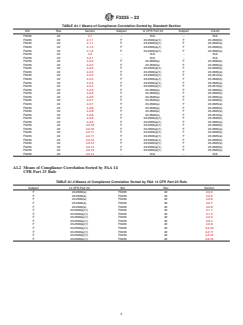
1.2 An applicant intending to propose this information as Means of Compliance for a design approval must seek guidance from their respective oversight authority (for example, published guidance from applicable civil aviation authorities (CAAs)) concerning the acceptable use and application thereof. For information on which oversight authorities have accepted this standard (in whole or in part) as an acceptable Means of Compliance to their regulatory requirements (hereinafter “the Rules”), refer to the ASTM Committee F44 web page (www.astm.org/COMMITTEE/F44.htm. Annex A1 maps the Means of Compliance described in this specification to EASA CS-23, amendment 5, or later, and FAA 14 CFR Part 23, amendment 64, or later.
1.3 This standard does not purport to address all of the safety concerns, if any, associated with its use. It is the responsibility of the user of this standard to establish appropriate safety, health, and environmental practices and determine the applicability of regulatory limitations prior to use.
1.4 This international standard was developed in accordance with internationally recognized principles on standardization established in the Decision on Principles for the Development of International Standards, Guides and Recommendations issued by the World Trade Organization Technical Barriers to Trade (TBT) Committee.
- Status
- Published
- Publication Date
- 31-Jul-2022
- Technical Committee
- F44 - General Aviation Aircraft
- Drafting Committee
- F44.50 - Systems and Equipment
Overview
ASTM F3235-22, Standard Specification for Aircraft Storage Batteries, sets forth international requirements for the electrical storage battery aspects of airworthiness and design in small aircraft, with an emphasis on normal category airplanes. Developed through consensus by expert stakeholders in general aviation, the specification defines compliance criteria for both nickel cadmium (NiCd) and rechargeable lithium batteries used in aircraft systems. It directly supports compliance with airworthiness rules established by regulatory authorities, including EASA CS-23 and FAA 14 CFR Part 23, making it a key reference for manufacturers, applicants, and certification bodies in aviation battery approval and aircraft design.
Key Topics
ASTM F3235-22 covers critical requirements and best practices for the safe integration of aircraft storage batteries, including:
- Battery Types Covered: Nickel cadmium and rechargeable lithium batteries used for essential functions such as engine starting and emergency power.
- Airworthiness Matrix: Aircraft Type Code (ATC) matrix for compliance, addressing variables like airworthiness level, number and type of engines, stall and cruise speeds, meteorological conditions, altitude, and maneuvering flight.
- Safety and Design Compliance: Provisions to prevent hazardous effects on aircraft structure or essential systems from heat generation, short circuits, overheating, failure, or emission of toxic/corrosive materials.
- Battery System Features:
- Automatic charging rate control
- Temperature sensing and warning systems
- Failure sensing and warning, with automatic disconnection on fault detection
- Installation Requirements: Criteria for safe installation, including prevention of unwanted gas accumulation and assurance of flammability standards.
- References to Demonstrative Testing: Acceptance of RTCA/DO-311A as the means for showing compliance with lithium battery safety and performance.
Applications
ASTM F3235-22 is widely applied in general aviation aircraft design and certification, serving as an acceptable means of compliance for:
- Original Equipment Manufacturers (OEMs): Assuring battery design and integration meet current safety and regulatory standards for small aircraft.
- Type Certification Applicants: Using the standard to demonstrate compliance for newly developed or modified aircraft battery systems.
- Civil Aviation Authorities and Certification Bodies: Reference for evaluating and approving battery installations in accordance with FAA and EASA regulations for normal category airplanes.
- Aircraft Battery Designers: Guiding the safe configuration of NiCd and lithium-ion batteries, including mitigation of thermal runaway and hazardous emissions.
- Maintenance and Engineering Teams: Providing a framework for safe operation, overhaul, and upgrading of aircraft battery systems.
By following ASTM F3235-22, stakeholders help ensure the safety, reliability, and regulatory compliance of aircraft storage batteries across varying flight and environmental conditions.
Related Standards
The following standards are referenced or closely related to ASTM F3235-22:
- FAA 14 CFR Part 23: Airworthiness Standards for Normal Category Airplanes
- EASA CS-23: Certification Specifications for Normal, Utility, Aerobatic, and Commuter Aeroplanes
- ASTM F3061/F3061M: Specification for Systems and Equipment in Aircraft
- ASTM F3060: Terminology for Aircraft
- RTCA/DO-311A: Minimum Operational Performance Standards for Rechargeable Lithium Batteries and Battery Systems (official method for compliance demonstration)
- Other References: As regulatory requirements evolve, users should consult national and international authorities for the latest accepted means of compliance.
Practical Value
Implementing ASTM F3235-22 supports enhanced aviation safety, streamlines regulatory approvals, and helps prevent critical battery-related incidents such as fires, overheating, or structural damage. Adhering to this international standard places aircraft designs, manufacturers, and operators at the forefront of current best practices for battery integration in modern aviation. For further information, visit ASTM Committee F44.
Keywords: aircraft storage batteries, aviation batteries, ASTM F3235, nickel cadmium batteries, lithium batteries, airworthiness, FAA Part 23, EASA CS-23, battery safety, regulatory compliance.
Relations
- Effective Date
- 01-Oct-2023
- Effective Date
- 01-Jan-2020
- Effective Date
- 01-Nov-2019
- Effective Date
- 01-Jun-2019
- Effective Date
- 15-Feb-2017
- Effective Date
- 01-Dec-2016
- Effective Date
- 01-Nov-2016
- Effective Date
- 01-Aug-2016
- Effective Date
- 01-Apr-2016
- Effective Date
- 01-Feb-2016
- Effective Date
- 15-Sep-2015
- Effective Date
- 01-May-2015
- Effective Date
- 01-Mar-2015
- Effective Date
- 01-Mar-2015
- Effective Date
- 01-Dec-2014
Get Certified
Connect with accredited certification bodies for this standard

BSI Group
BSI (British Standards Institution) is the business standards company that helps organizations make excellence a habit.

Bureau Veritas
Bureau Veritas is a world leader in laboratory testing, inspection and certification services.

DNV
DNV is an independent assurance and risk management provider.
Sponsored listings
Frequently Asked Questions
ASTM F3235-22 is a technical specification published by ASTM International. Its full title is "Standard Specification for Aircraft Storage Batteries". This standard covers: ABSTRACT This specification establishes the requirements for the electrical storage battery aspects of airworthiness and design for ”small” aircraft. It prescribes the Aircraft Type Code (ATC) compliance matrix based on airworthiness level, number of engines, type of engine(s), stall speed, cruise speed, meteorological conditions, altitude, and maneuvers. An ATC is defined by taking into account both the technical considerations regarding the design of the aircraft and the airworthiness level established based upon risk-based criteria. The installation requirements defined by this specification cover nickel cadmium batteries. For each nickel cadmium battery installation capable of being used to start an engine or auxiliary power unit, there must be provisions to prevent any hazardous effect on structure or essential systems that may be caused by the maximum amount of heat the battery can generate during a short circuit of the battery or of its individual cells. SCOPE 1.1 This specification covers electrical storage battery aspects of airworthiness and design for aeroplanes. The material was developed through open consensus of international experts in general aviation. This information was created by focusing on Normal Category aeroplanes. The content may be more broadly applicable; it is the responsibility of the Applicant to substantiate broader applicability as a specific means of compliance. The topics covered within this document are electrical storage batteries, Nickel Cadmium Batteries, and Rechargeable Lithium Batteries. 1.2 An applicant intending to propose this information as Means of Compliance for a design approval must seek guidance from their respective oversight authority (for example, published guidance from applicable civil aviation authorities (CAAs)) concerning the acceptable use and application thereof. For information on which oversight authorities have accepted this standard (in whole or in part) as an acceptable Means of Compliance to their regulatory requirements (hereinafter “the Rules”), refer to the ASTM Committee F44 web page (www.astm.org/COMMITTEE/F44.htm. Annex A1 maps the Means of Compliance described in this specification to EASA CS-23, amendment 5, or later, and FAA 14 CFR Part 23, amendment 64, or later. 1.3 This standard does not purport to address all of the safety concerns, if any, associated with its use. It is the responsibility of the user of this standard to establish appropriate safety, health, and environmental practices and determine the applicability of regulatory limitations prior to use. 1.4 This international standard was developed in accordance with internationally recognized principles on standardization established in the Decision on Principles for the Development of International Standards, Guides and Recommendations issued by the World Trade Organization Technical Barriers to Trade (TBT) Committee.
ABSTRACT This specification establishes the requirements for the electrical storage battery aspects of airworthiness and design for ”small” aircraft. It prescribes the Aircraft Type Code (ATC) compliance matrix based on airworthiness level, number of engines, type of engine(s), stall speed, cruise speed, meteorological conditions, altitude, and maneuvers. An ATC is defined by taking into account both the technical considerations regarding the design of the aircraft and the airworthiness level established based upon risk-based criteria. The installation requirements defined by this specification cover nickel cadmium batteries. For each nickel cadmium battery installation capable of being used to start an engine or auxiliary power unit, there must be provisions to prevent any hazardous effect on structure or essential systems that may be caused by the maximum amount of heat the battery can generate during a short circuit of the battery or of its individual cells. SCOPE 1.1 This specification covers electrical storage battery aspects of airworthiness and design for aeroplanes. The material was developed through open consensus of international experts in general aviation. This information was created by focusing on Normal Category aeroplanes. The content may be more broadly applicable; it is the responsibility of the Applicant to substantiate broader applicability as a specific means of compliance. The topics covered within this document are electrical storage batteries, Nickel Cadmium Batteries, and Rechargeable Lithium Batteries. 1.2 An applicant intending to propose this information as Means of Compliance for a design approval must seek guidance from their respective oversight authority (for example, published guidance from applicable civil aviation authorities (CAAs)) concerning the acceptable use and application thereof. For information on which oversight authorities have accepted this standard (in whole or in part) as an acceptable Means of Compliance to their regulatory requirements (hereinafter “the Rules”), refer to the ASTM Committee F44 web page (www.astm.org/COMMITTEE/F44.htm. Annex A1 maps the Means of Compliance described in this specification to EASA CS-23, amendment 5, or later, and FAA 14 CFR Part 23, amendment 64, or later. 1.3 This standard does not purport to address all of the safety concerns, if any, associated with its use. It is the responsibility of the user of this standard to establish appropriate safety, health, and environmental practices and determine the applicability of regulatory limitations prior to use. 1.4 This international standard was developed in accordance with internationally recognized principles on standardization established in the Decision on Principles for the Development of International Standards, Guides and Recommendations issued by the World Trade Organization Technical Barriers to Trade (TBT) Committee.
ASTM F3235-22 is classified under the following ICS (International Classification for Standards) categories: 49.020 - Aircraft and space vehicles in general. The ICS classification helps identify the subject area and facilitates finding related standards.
ASTM F3235-22 has the following relationships with other standards: It is inter standard links to ASTM F3061/F3061M-23b, ASTM F3060-20, ASTM F3061/F3061M-19a, ASTM F3061/F3061M-19, ASTM F3061/F3061M-17, ASTM F3061/F3061M-16b, ASTM F3060-16a, ASTM F3061/F3061M-16a, ASTM F3060-16, ASTM F3061/F3061M-16, ASTM F3060-15b, ASTM F3060-15a, ASTM F3060-15, ASTM F3061/F3061M-15, ASTM F3060-14. Understanding these relationships helps ensure you are using the most current and applicable version of the standard.
ASTM F3235-22 is available in PDF format for immediate download after purchase. The document can be added to your cart and obtained through the secure checkout process. Digital delivery ensures instant access to the complete standard document.
Standards Content (Sample)
This international standard was developed in accordance with internationally recognized principles on standardization established in the Decision on Principles for the
Development of International Standards, Guides and Recommendations issued by the World Trade Organization Technical Barriers to Trade (TBT) Committee.
Designation: F3235 −22
Standard Specification for
Aircraft Storage Batteries
This standard is issued under the fixed designation F3235; the number immediately following the designation indicates the year of
original adoption or, in the case of revision, the year of last revision.Anumber in parentheses indicates the year of last reapproval.A
superscript epsilon (´) indicates an editorial change since the last revision or reapproval.
1. Scope 2. Referenced Documents
2.1 Following is a list of external standards referenced
1.1 This specification covers electrical storage battery as-
throughout this specification; the earliest revision acceptable
pects of airworthiness and design for aeroplanes. The material
for use is indicated. In all cases, later document revisions are
wasdevelopedthroughopenconsensusofinternationalexperts
acceptableifshowntobeequivalenttothelistedrevision,orif
in general aviation. This information was created by focusing
otherwise formally accepted by the governing civil aviation
on Normal Category aeroplanes. The content may be more
authority; earlier revisions are not acceptable.
broadly applicable; it is the responsibility of the Applicant to
substantiate broader applicability as a specific means of com- 2.2 ASTM Standards:
pliance.The topics covered within this document are electrical
F3060Terminology for Aircraft
storagebatteries,NickelCadmiumBatteries,andRechargeable F3061/F3061MSpecification for Systems and Equipment in
Lithium Batteries. Aircraft
2.3 EASA Standard:
1.2 An applicant intending to propose this information as
CS-23Normal,Utility,AerobaticandCommuterAeroplanes
Means of Compliance for a design approval must seek guid-
2.4 FAA Standard:
ance from their respective oversight authority (for example,
14 CFR Part 23Airworthiness Standards: Normal Category
published guidance from applicable civil aviation authorities
Airplanes
(CAAs)) concerning the acceptable use and application
2.5 RTCA Standard:
thereof. For information on which oversight authorities have
RTCA/DO-311AMinimum Operational Performance Stan-
accepted this standard (in whole or in part) as an acceptable
dards for Rechargeable Lithium Batteries and Battery
Means of Compliance to their regulatory requirements (here-
Systems
inafter “the Rules”), refer to the ASTM Committee F44 web
page (www.astm.org/COMMITTEE/F44.htm. AnnexA1 maps 3. Terminology
the Means of Compliance described in this specification to
3.1 Terminology specific to this specification is provided
EASACS-23,amendment5,orlater,andFAA14CFRPart23,
below. For general terminology, refer to Terminology F3060.
amendment 64, or later.
3.2 Definitions of Terms Specific to This Standard:
1.3 This standard does not purport to address all of the
3.2.1 aircraft type code, n—anAircraftType Code (ATC) is
safety concerns, if any, associated with its use. It is the
defined by considering both the technical considerations re-
responsibility of the user of this standard to establish appro-
garding the design of the aircraft and the airworthiness level
priate safety, health, and environmental practices and deter-
established based upon risk-based criteria; the method of
mine the applicability of regulatory limitations prior to use.
defining an ATC applicable to this specification is defined in
1.4 This international standard was developed in accor- Specification F3061/F3061M.
dance with internationally recognized principles on standard-
4. Electrical Storage Batteries
ization established in the Decision on Principles for the
NOTE 1—Table 1 provides correlation between various Aircraft Type
Development of International Standards, Guides and Recom-
Codesandtheindividualrequirementscontainedwithinthissection;refer
mendations issued by the World Trade Organization Technical
Barriers to Trade (TBT) Committee.
For referenced ASTM standards, visit the ASTM website, www.astm.org, or
contact ASTM Customer Service at service@astm.org. For Annual Book of ASTM
Standards volume information, refer to the standard’s Document Summary page on
the ASTM website.
1 3
ThisspecificationisunderthejurisdictionofASTMCommitteeF44onGeneral Available from European Union Aviation Safety Agency (EASA), Konrad-
Aviation Aircraft and is the direct responsibility of Subcommittee F44.50 on Adenauer-Ufer 3, D-50668 Cologne, Germany, https://www.easa.europa.eu.
Systems and Equipment. Available from Federal Aviation Administration (FAA), 800 Independence
Current edition approved Aug. 1, 2022. Published August 2022. Originally Ave., SW, Washington, DC 20591, http://www.faa.gov.
approved in 2017. Last previous edition approved in 2021 as F3235–21. DOI: Available from Radio Technical Commission for Aeronautics (RTCA), 1150
10.1520/F3235-22. 18th NW, Suite 910, Washington, DC 20036, https://www.rtca.org.
Copyright © ASTM International, 100 Barr Harbor Drive, PO Box C700, West Conshohocken, PA 19428-2959. United States
F3235 − 22
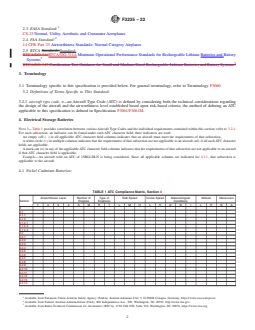
TABLE 1 ATC Compliance Matrix, Section 4
Airworthiness Level Number of Type of Stall Speed Cruise Speed Meteorological Altitude Maneuvers
Section Engines Engine(s) Conditions
12 34 S M R T L M H L H D N I L H N A
4.1
4.1.1
4.1.2
4.1.2.1
4.1.2.2
4.1.2.3
4.2
4.2.1
4.2.2
4.2.3
4.2.4
4.2.5
4.2.6
4.2.7
4.2.8
4.2.9
4.2.10
4.2.11
4.2.12
4.2.13
4.2.14
to 3.2.1. For each subsection, an indicator can be found under each ATC
battery failure sensing and warning system with a means for
character field; three indicators are used:
disconnecting the battery from its charging source in the event
An empty cell ( ) in all applicable ATC character field columns
of battery failure.
indicates that an aircraft must meet the requirements of that subsection.
A white circle (○) in multiple columns indicates that the requirements
4.2 Rechargeable Lithium Batteries:
of that subsection are not applicable to an aircraft only if all such ATC
4.2.1 The provisions of 4.2.2 – 4.2.14 apply only to re-
character fields are applicable.
chargeable lithium batteries.
A mark-out (×) in any of the applicable ATC character field columns
indicates that the requirements of that subsection are not applicable to an 4.2.2 Safe cell temperatures and pressures must be main-
aircraft if that ATC character field is applicable.
tained during any foreseeable charging or discharging condi-
Example—AnaircraftwithanATCof1SRLLDLNisbeingconsidered.
tion.
Since all applicable columns are indicated for 4.1.1, that subsection is
4.2.3 Safe cell temperatures and pressures must be main-
applicable to the aircraft.
tained during any failure of the charging or battery monitoring
4.1 Nickel Cadmium Batteries:
system not shown to be extremely remote.
4.1.1 Each nickel cadmium battery installation capable of
4.2.4 The rechargeable lithium battery installation must
beingusedtostartanengineorauxiliarypowerunitmusthave
preclude explosion in the event of any failure of the charging
provisions to prevent any hazardous effect on structure or
or battery monitoring system not shown to be extremely
essential systems that may be caused by the maximum amount
remote.
of heat the battery can generate during a short circuit of the
4.2.5 Design of the rechargeable lithium batteries must
battery or of its individual cells.
preclude the occurrence of self-sustaining, uncontrolled in-
4.1.2 Nickel cadmium battery installations capable of being
creases in temperature or pressure.
used to start an engine or auxiliary power unit must meet the
4.2.6 No explosive or toxic gases emitted by any recharge-
requirements of either 4.1.2.1, 4.1.2.2,or 4.1.2.3.
able lithium battery in normal operation may accumulate
4.1.2.1 If the requirements of either 4.1.2.2 or 4.1.2.3 are
within the aircraft in such quantities as would cause risk of
not met, nickel cadmium battery installations capable of being
fire/explosion or be harmful to the aircraft occupants, or both.
used to start an engine or auxiliary power unit must have a
4.2.7 No explosive or toxic gases emitted by any recharge-
system to control the charging rate of the battery automatically
ablelithiumbatteryastheresultofanyfailure,notshowntobe
so as to prevent battery overheating.
extremely remote, of the battery charging system, battery
4.1.2.2 If the requirements of either 4.1.2.1 or 4.1.2.3 are
monitoring system, or battery installation may accumulate
not met, nickel cadmium battery installations capable of being
within the aircraft in such quantities as would cause risk of
used to start an engine or auxiliary power unit must have a
fire/explosion or be harmful to the aircraft occupants, or both.
battery temperature sensing and over-temperature warning
system with a means for disconnecting the battery from its 4.2.8 Nocorrosivefluidsorgasesthatmayescapefromany
charging source in the event of an over-temperature condition. rechargeable lithium battery may damage surrounding struc-
4.1.2.3 If the requirements of either 4.1.2.1 or 4.1.2.2 are tureoranyadjacentsystems,equipment,orelectricalwiringof
not met, nickel cadmium battery installations capable of being the airplane in such a way as to cause a major or more severe
used to start an engine or auxiliary power unit must have a failure condition.
F3235 − 22
4.2.9 Each rechargeable lithium battery installation must 4.2.11 Any rechargeable lithium battery installation, the
haveprovisionstopreventanyhazardouseffectonstructureor function of which is required for safe operation of the aircraft,
must incorporate a monitoring and warning feature that will
essential systems caused by the maximum amount of heat the
provide an indication to the appropriate flight crewmembers
battery can generate during a short circuit of the battery or of
whenever the state-of-charge of the batteries has fallen below
its individual cells.
levels considered acceptable for dispatch of the aircraft.
4.2.10 The lithium battery system must have a capability to
4.2.12 Internal and external materials of the rechargeable
control the charging rate of the battery automatically, so as to
lithium battery and battery system shall meet the applicable
prevent battery overheating or overcharging, and the require-
certification flammability requirements of the installation.
ments of either 4.2.10.1 or 4.2.10.2 must be met.
4.2.13 Installations of rechargeable lithium batteries must
4.2.10.1 A battery temperature sensing and over-
meet the applicable Flammable Fluid Fire Protection require-
temperature warning system with a means for automatically
ments of Specification F3061/F3061M.
disconnecting the battery from its
...
This document is not an ASTM standard and is intended only to provide the user of an ASTM standard an indication of what changes have been made to the previous version. Because
it may not be technically possible to adequately depict all changes accurately, ASTM recommends that users consult prior editions as appropriate. In all cases only the current version
of the standard as published by ASTM is to be considered the official document.
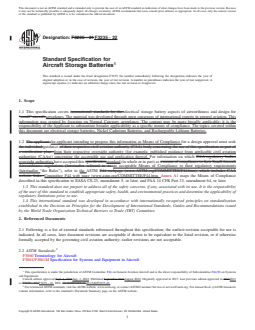
Designation: F3235 − 21 F3235 − 22
Standard Specification for
Aircraft Storage Batteries
This standard is issued under the fixed designation F3235; the number immediately following the designation indicates the year of
original adoption or, in the case of revision, the year of last revision. A number in parentheses indicates the year of last reapproval. A
superscript epsilon (´) indicates an editorial change since the last revision or reapproval.
1. Scope
1.1 This specification covers international standards for the electrical storage battery aspects of airworthiness and design for
“small” aircraft.aeroplanes. The material was developed through open consensus of international experts in general aviation. This
information was created by focusing on Normal Category aeroplanes. The content may be more broadly applicable; it is the
responsibility of the Applicant to substantiate broader applicability as a specific means of compliance. The topics covered within
this document are electrical storage batteries, Nickel Cadmium Batteries, and Rechargeable Lithium Batteries.
1.2 The applicant An applicant intending to propose this information as Means of Compliance for a design approval must seek
the individual guidance of their respective civil aviation authority (CAA) body concerning the use of this specification as part of
a certification plan. from their respective oversight authority (for example, published guidance from applicable civil aviation
authorities (CAAs)) concerning the acceptable use and application thereof. For information on which CAA regulatory bodies
oversight authorities have accepted this specificationstandard (in whole or in part) as a means of compliance to their Small Aircraft
Airworthiness regulations (hereinafter referred to as an acceptable Means of Compliance to their regulatory requirements
(hereinafter “the Rules”), refer to the ASTM F44 webpage (www.ASTM.org/COMMITTEE/F44.htm), which includes CAA
website links. Committee F44 web page (www.astm.org/COMMITTEE/F44.htm. Annex A1 maps the Means of Compliance
described in this specification to EASA CS-23, amendment 5, or later, and FAA 14 CFR Part 23, amendment 64, or later.
1.3 This standard does not purport to address all of the safety concerns, if any, associated with its use. It is the responsibility
of the user of this standard to establish appropriate safety, health, and environmental practices and determine the applicability of
regulatory limitations prior to use.
1.4 This international standard was developed in accordance with internationally recognized principles on standardization
established in the Decision on Principles for the Development of International Standards, Guides and Recommendations issued
by the World Trade Organization Technical Barriers to Trade (TBT) Committee.
2. Referenced Documents
2.1 Following is a list of external standards referenced throughout this specification; the earliest revision acceptable for use is
indicated. In all cases, later document revisions are acceptable if shown to be equivalent to the listed revision, or if otherwise
formally accepted by the governing civil aviation authority; earlier revisions are not acceptable.
2.2 ASTM Standards:
F3060 Terminology for Aircraft
F3061/F3061M Specification for Systems and Equipment in Aircraft
This specification is under the jurisdiction of ASTM Committee F44 on General Aviation Aircraft and is the direct responsibility of Subcommittee F44.50 on Systems
and Equipment.
Current edition approved Sept. 1, 2021Aug. 1, 2022. Published September 2021August 2022. Originally approved in 2017. Last previous edition approved in 20172021
as F3235 – 17a.F3235 – 21. DOI: 10.1520/F3235-21.10.1520/F3235-22.
For referenced ASTM standards, visit the ASTM website, www.astm.org, or contact ASTM Customer Service at service@astm.org. For Annual Book of ASTM Standards
volume information, refer to the standard’s Document Summary page on the ASTM website.
Copyright © ASTM International, 100 Barr Harbor Drive, PO Box C700, West Conshohocken, PA 19428-2959. United States
F3235 − 22
2.3 EASA Standard:
CS-23 Normal, Utility, Aerobatic and Commuter Aeroplanes
2.4 FAA Standard:
14 CFR Part 23 Airworthiness Standards: Normal Category Airplanes
2.5 RTCA Standards:Standard:
RTCA/DO-311RTCA/DO-311A Minimum Operational Performance Standards for Rechargeable Lithium Batteries and Battery
Systems
RTCA/DO-347 Certification Test Guidance for Small and Medium Sized Rechargeable Lithium Batteries and Battery Systems
3. Terminology
3.1 Terminology specific to this specification is provided below. For general terminology, refer to Terminology F3060.
3.2 Definitions of Terms Specific to This Standard:
3.2.1 aircraft type code, n—an Aircraft Type Code (ATC) is defined by considering both the technical considerations regarding
the design of the aircraft and the airworthiness level established based upon risk-based criteria; the method of defining an ATC
applicable to this specification is defined in Specification F3061/F3061M.
4. Electrical Storage Batteries
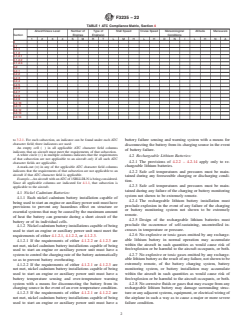
NOTE 1—Table 1 provides correlation between various Aircraft Type Codes and the individual requirements contained within this section; refer to 3.2.1.
For each subsection, an indicator can be found under each ATC character field; three indicators are used:
An empty cell ( ) in all applicable ATC character field columns indicates that an aircraft must meet the requirements of that subsection.
A white circle (○) in multiple columns indicates that the requirements of that subsection are not applicable to an aircraft only if all such ATC character
fields are applicable.
A mark-out (×) in any of the applicable ATC character field columns indicates that the requirements of that subsection are not applicable to an aircraft
if that ATC character field is applicable.
Example—An aircraft with an ATC of 1SRLLDLN is being considered. Since all applicable columns are indicated for 4.1.1, that subsection is
applicable to the aircraft.
4.1 Nickel Cadmium Batteries:
TABLE 1 ATC Compliance Matrix, Section 4
Airworthiness Level Number of Type of Stall Speed Cruise Speed Meteorological Altitude Maneuvers
Section Engines Engine(s) Conditions
1 2 3 4 S M R T L M H L H D N I L H N A
4.1
4.1.1
4.1.2
4.1.2.1
4.1.2.2
4.1.2.3
4.2
4.2.1
4.2.2
4.2.3
4.2.4
4.2.5
4.2.6
4.2.7
4.2.8
4.2.9
4.2.10
4.2.11
4.2.12
4.2.13
4.2.14
Available from European Union Aviation Safety Agency (EASA), Konrad-Adenauer-Ufer 3, D-50668 Cologne, Germany, https://www.easa.europa.eu.
Available from Federal Aviation Administration (FAA), 800 Independence Ave., SW, Washington, DC 20591, http://www.faa.gov.
Available from Radio Technical Commission for Aeronautics (RTCA), 1150 18th NW, Suite 910, Washington, DC 20036, https://www.rtca.org.
F3235 − 22
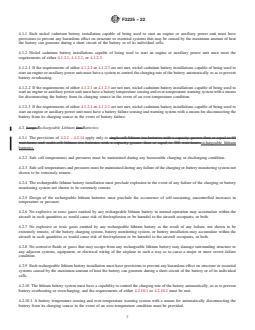
4.1.1 Each nickel cadmium battery installation capable of being used to start an engine or auxiliary power unit must have
provisions to prevent any hazardous effect on structure or essential systems that may be caused by the maximum amount of heat
the battery can generate during a short circuit of the battery or of its individual cells.
4.1.2 Nickel cadmium battery installations capable of being used to start an engine or auxiliary power unit must meet the
requirements of either 4.1.2.1, 4.1.2.2, or 4.1.2.3.
4.1.2.1 If the requirements of either 4.1.2.2 or 4.1.2.3 are not met, nickel cadmium battery installations capable of being used to
start an engine or auxiliary power unit must have a system to control the charging rate of the battery automatically so as to prevent
battery overheating.
4.1.2.2 If the requirements of either 4.1.2.1 or 4.1.2.3 are not met, nickel cadmium battery installations capable of being used to
start an engine or auxiliary power unit must have a battery temperature sensing and over-temperature warning system with a means
for disconnecting the battery from its charging source in the event of an over-temperature condition.
4.1.2.3 If the requirements of either 4.1.2.1 or 4.1.2.2 are not met, nickel cadmium battery installations capable of being used to
start an engine or auxiliary power unit must have a battery failure sensing and warning system with a means for disconnecting the
battery from its charging source in the event of battery failure.
4.2 Large Rechargeable Lithium Ion Batteries:
4.2.1 The provisions of 4.2.2 – 4.2.14 apply only to single-cell lithium ion batteries with a capacity greater than or equal to 60
watt-hours and multi-cell lithium ion batteries with a capacity greater than or equal to 300 watt-hours.rechargeable lithium
batteries.
4.2.2 Safe cell temperatures and pressures must be maintained during any foreseeable charging or discharging condition.
4.2.3 Safe cell temperatures and pressures must be maintained during any failure of the charging or battery monitoring system not
shown to be extremely remote.
4.2.4 The rechargeable lithium battery installation must preclude explosion in the event of any failure of the charging or battery
monitoring system not shown to be extremely remote.
4.2.5 Design of the rechargeable lithium batteries must preclude the occurrence of self-sustaining, uncontrolled increases in
temperature or pressure.
4.2.6 No explosive or toxic gases emitted by any rechargeable lithium battery in normal operation may accumulate within the
aircraft in such quantities as would cause risk of fire/explosion or be harmful to the aircraft occupants, or both.
4.2.7 No explosive or toxic gases emitted by any rechargeable lithium battery as the result of any failure, not shown to be
extremely remote, of the battery charging system, battery monitoring system, or battery installation may accumulate within the
aircraft in such quantities as would cause risk of fire/explosion or be harmful to the aircraft occupants, or both.
4.2.8 No corrosive fluids or gases that may escape from any rechargeable lithium battery may damage surrounding structure or
any adjacent systems, equipment, or electrical wiring of the airplane in such a way as to cause a major or more severe failure
condition.
4.2.9 Each rechargeable lithium battery installation must have provisions to prevent any hazardous effect on structure or essential
systems caused by the maximum amount of heat the battery can generate during a short circuit of the battery or of its individual
cells.
4.2.10 The lithium battery system must have a capability to control the charging rate of the battery automatically, so as to prevent
battery overheating or overcharging, and the requirements of either 4.2.10.1 or 4.2.10.2 must be met.
4.2.10.1 A battery temperature sensing and over-temperature warning system with a means for automatically disconnecting the
battery from its charging source in the event of an over-temperature condition must be provided.
F3235 − 22
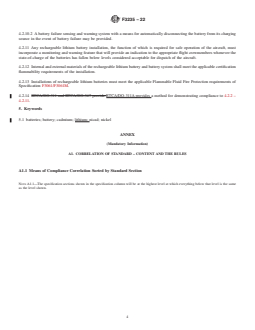
4.2.10.2 A battery failure sensing and warning system with a means for automatically disconnecting the battery from its charging
source in the event of battery failure may be provided.
4.2.11 Any rechargeable lithium battery installation, the function of which is required for safe operation of the aircraft, must
incorporate a monitoring and warning feature that will provide an indication to the appropriate flight crewmembers whenever the
state-of-charge of the batteries has fallen below levels considered acceptable for dispatch of the aircraft.
4.2.12 Internal and external materials of the rechargeable lithium battery and battery system shall meet the applicable certification
flammability requirements of the installation.
4.2.13 Installations of rechargeable lithium batteries must meet the applicable Flammable Fluid Fire Protection requirements of
Specification F3061/F3061M.
4.2.14 RTCA/DO-311 and RTCA/DO-347 provide RTCA/DO-311A provides a method for demonstrating compliance to 4.2.2 –
4.2.11.
5. Keywords
5.1 batteries; battery; cadmium; lithium; nicad; nickel
ANNEX
(Mandatory Information)
A1. CORRELATION OF STANDARD – CONTENT AND THE RULES
A1.1 Means of Compliance Correlation Sorted by Standard Section
NOTE A1.1—The specification sections shown in the specification column will be at the highest level at which everything below that level is the same
as the level shown.
F3235 − 22
TABLE A1.1 Means of Compliance Correlation Sorted by Standard Section
Std Rev Section Subpart 14 CFR Part 23 Subpart CS-23
F3235 17a 4.1 . N/A . N/A
F3235 17a 4.1.1 F 23.2500(a)(1) F 23.2500(b)
F3235 17a 4.1.1 F 23.2500(a)(1) F 23.2505(a)
F3235 17a 4.1.2 F 23.2500(a)(1) F 23.2500(b)
F3235 17a
...