

ASTM F3367-23
(Practice)Standard Practice for Simplified Methods for Addressing High-Intensity Radiated Fields (HIRF) and Indirect Effects of Lightning on Aircraft
General Information
- Abstract
SCOPE
1.1 This practice covers simplified methods for addressing High-Intensity Radiated Fields (HIRF) and the Indirect Effects of Lightning (IEL) on aircraft. The material was developed through open consensus of international experts in general aviation. This information was created by focusing on Aircraft Certification Level 1, Level 2, and Level 3 Normal Category aeroplanes. The content may be more broadly applicable. It is the responsibility of the applicant to substantiate broader applicability as a specific means of compliance. The topics covered within this practice are: Overview; Minimum Design Requirements; Aeroplane Assessment Level; HIRF and IEL Safety Analysis; HIRF Compliance; IEL Compliance.
1.2 An applicant intending to propose this information as Means of Compliance for a design approval must seek guidance from their respective oversight authority (for example, published guidance from applicable CAA) concerning the acceptable use and application thereof. For information on which oversight authorities have accepted this practice (in whole or in part) as an acceptable Means of Compliance to their regulatory requirements (hereinafter “the Rules”), refer to the ASTM Committee F44 web page (www.astm.org/COMMITTEE/F44.htm).
1.3 Units—The values stated in SI units are to be regarded as standard. No other units of measurement are included in this standard.
1.4 This standard does not purport to address all of the safety concerns, if any, associated with its use. It is the responsibility of the user of this standard to establish appropriate safety, health, and environmental practices and determine the applicability of regulatory limitations prior to use.
1.5 This international standard was developed in accordance with internationally recognized principles on standardization established in the Decision on Principles for the Development of International Standards, Guides and Recommendations issued by the World Trade Organization Technical Barriers to Trade (TBT) Committee.
- Status
- Published
- Publication Date
- 30-Sep-2023
- Technical Committee
- F44 - General Aviation Aircraft
- Drafting Committee
- F44.50 - Systems and Equipment
Buy Documents
ASTM F3367-23 - Standard Practice for Simplified Methods for Addressing High-Intensity Radiated Fields (HIRF) and Indirect Effects of Lightning on Aircraft
REDLINE ASTM F3367-23 - Standard Practice for Simplified Methods for Addressing High-Intensity Radiated Fields (HIRF) and Indirect Effects of Lightning on Aircraft
Overview
ASTM F3367-23 is the internationally recognized standard practice for applying simplified methods to address High-Intensity Radiated Fields (HIRF) and the Indirect Effects of Lightning (IEL) on aircraft. Developed by the ASTM Committee F44, this standard offers aviation manufacturers and engineers practical approaches for evaluating and demonstrating compliance with electromagnetic and lightning protection requirements. While the focus is on general aviation and normal category airplanes of Certification Levels 1, 2, and 3, the framework can be adapted for broader categories given appropriate substantiation.
Key Topics
- Minimum Design Requirements: Emphasizes the importance of robust electrical bonding, shielding strategies, and the use of low impedance conductors in aircraft structures. Design considerations address unique needs for aluminum, composite, and tube-and-fabric aircraft.
- Aeroplane Assessment Levels: Provides a method for assigning aeroplane assessment levels (I, II, or III) as a basis for defining the scope and rigor of HIRF and IEL compliance.
- HIRF and IEL Safety Analysis: Guides users in performing system safety analyses to identify critical functions affected by electromagnetic threats or lightning, and classifies potential failure conditions (Catastrophic, Hazardous, Major).
- Compliance Pathways: Outlines standardized pass/fail criteria and acceptable test methods for systems and equipment, focusing on performance during and after exposure to HIRF and lightning.
- Test Approaches: Allows for both system-level and equipment-level testing, referencing industry-accepted methods for simulating radiated and conducted electromagnetic threats.
- Regulatory Coordination: Stresses the need for applicants to coordinate proposed means of compliance with their appropriate oversight authority (such as CAA, EASA, or FAA).
Applications
ASTM F3367-23 is widely applicable in the following areas:
- Aircraft Certification: Streamlines compliance with regulatory requirements for HIRF and lightning protection, supporting efficient means-of-compliance submissions for design approvals.
- Design and Engineering: Assists aircraft designers and engineers in integrating effective electromagnetic protection and lightning mitigation features from the outset, minimizing redesign and certification delays.
- Testing and Validation: Establishes clear criteria for laboratory and field testing of avionics, electrical systems, and airframes under electromagnetic and lightning exposure.
- Modification and Upgrades: Provides a recognized approach for demonstrating continued compliance when modifying or upgrading systems on general aviation aircraft.
- Safety Assurance: Enhances overall aircraft safety by requiring functional hazard analysis and mitigation strategies for failure conditions due to electromagnetic or lightning threats.
Related Standards
ASTM F3367-23 references and aligns with a number of important industry standards and regulatory documents, including:
- ASTM Standards:
- F3060 - Terminology for Aircraft
- F3230 - Practice for Safety Assessment of Systems and Equipment in Small Aircraft
- F3309 - Practice for Simplified Safety Assessment of Systems and Equipment in Small Aircraft
- EUROCAE:
- ED-14E - Environmental Conditions and Test Procedures for Airborne Equipment
- ED-107 - Guide to Certification of Aircraft in a High-Intensity Radiated Field (HIRF) Environment
- EASA:
- CS-23 Amdt 5 - Certification Specifications for Normal-Category Aeroplanes
- AMC 20-136 and AMC 20-158 - Aircraft Electrical/Electronic System Lightning and HIRF Protection
- FAA:
- AC 20-136B - Aircraft Electrical and Electronic System Lightning Protection
- AC 20-158A - Certification of Aircraft Electrical and Electronic Systems for HIRF
- AC 23.1309-1E - System Safety Analysis for Part 23 Aircraft
- RTCA:
- DO-160E - Environmental Conditions and Test Procedures for Airborne Equipment
- SAE:
- ARP 5412B - Aircraft Lightning Environment and Test Waveforms
Practical Value
Adopting ASTM F3367-23 allows aviation organizations to:
- Use internationally recognized, consensus-driven methods for managing electromagnetic and lightning risk.
- Streamline their certification and compliance processes.
- Align with the expectations of major regulatory authorities.
- Mitigate operational disruptions due to electromagnetic interference or lightning strikes.
- Demonstrate a proactive approach to aircraft safety and reliability.
Keywords: HIRF, Indirect Effects of Lightning, aircraft lightning protection, general aviation compliance, electromagnetic compatibility (EMC), ASTM F3367, aircraft certification, aviation safety standards.
Relations
- Effective Date
- 01-Oct-2023
- Effective Date
- 01-Mar-2024
- Effective Date
- 15-Jul-2021
- Effective Date
- 01-Oct-2023
- Effective Date
- 01-Oct-2023
- Effective Date
- 01-Oct-2023
Buy Documents
ASTM F3367-23 - Standard Practice for Simplified Methods for Addressing High-Intensity Radiated Fields (HIRF) and Indirect Effects of Lightning on Aircraft
REDLINE ASTM F3367-23 - Standard Practice for Simplified Methods for Addressing High-Intensity Radiated Fields (HIRF) and Indirect Effects of Lightning on Aircraft
Get Certified
Connect with accredited certification bodies for this standard

BSI Group
BSI (British Standards Institution) is the business standards company that helps organizations make excellence a habit.

Bureau Veritas
Bureau Veritas is a world leader in laboratory testing, inspection and certification services.

DNV
DNV is an independent assurance and risk management provider.
Sponsored listings
Frequently Asked Questions
ASTM F3367-23 is a standard published by ASTM International. Its full title is "Standard Practice for Simplified Methods for Addressing High-Intensity Radiated Fields (HIRF) and Indirect Effects of Lightning on Aircraft". This standard covers: SCOPE 1.1 This practice covers simplified methods for addressing High-Intensity Radiated Fields (HIRF) and the Indirect Effects of Lightning (IEL) on aircraft. The material was developed through open consensus of international experts in general aviation. This information was created by focusing on Aircraft Certification Level 1, Level 2, and Level 3 Normal Category aeroplanes. The content may be more broadly applicable. It is the responsibility of the applicant to substantiate broader applicability as a specific means of compliance. The topics covered within this practice are: Overview; Minimum Design Requirements; Aeroplane Assessment Level; HIRF and IEL Safety Analysis; HIRF Compliance; IEL Compliance. 1.2 An applicant intending to propose this information as Means of Compliance for a design approval must seek guidance from their respective oversight authority (for example, published guidance from applicable CAA) concerning the acceptable use and application thereof. For information on which oversight authorities have accepted this practice (in whole or in part) as an acceptable Means of Compliance to their regulatory requirements (hereinafter “the Rules”), refer to the ASTM Committee F44 web page (www.astm.org/COMMITTEE/F44.htm). 1.3 Units—The values stated in SI units are to be regarded as standard. No other units of measurement are included in this standard. 1.4 This standard does not purport to address all of the safety concerns, if any, associated with its use. It is the responsibility of the user of this standard to establish appropriate safety, health, and environmental practices and determine the applicability of regulatory limitations prior to use. 1.5 This international standard was developed in accordance with internationally recognized principles on standardization established in the Decision on Principles for the Development of International Standards, Guides and Recommendations issued by the World Trade Organization Technical Barriers to Trade (TBT) Committee.
SCOPE 1.1 This practice covers simplified methods for addressing High-Intensity Radiated Fields (HIRF) and the Indirect Effects of Lightning (IEL) on aircraft. The material was developed through open consensus of international experts in general aviation. This information was created by focusing on Aircraft Certification Level 1, Level 2, and Level 3 Normal Category aeroplanes. The content may be more broadly applicable. It is the responsibility of the applicant to substantiate broader applicability as a specific means of compliance. The topics covered within this practice are: Overview; Minimum Design Requirements; Aeroplane Assessment Level; HIRF and IEL Safety Analysis; HIRF Compliance; IEL Compliance. 1.2 An applicant intending to propose this information as Means of Compliance for a design approval must seek guidance from their respective oversight authority (for example, published guidance from applicable CAA) concerning the acceptable use and application thereof. For information on which oversight authorities have accepted this practice (in whole or in part) as an acceptable Means of Compliance to their regulatory requirements (hereinafter “the Rules”), refer to the ASTM Committee F44 web page (www.astm.org/COMMITTEE/F44.htm). 1.3 Units—The values stated in SI units are to be regarded as standard. No other units of measurement are included in this standard. 1.4 This standard does not purport to address all of the safety concerns, if any, associated with its use. It is the responsibility of the user of this standard to establish appropriate safety, health, and environmental practices and determine the applicability of regulatory limitations prior to use. 1.5 This international standard was developed in accordance with internationally recognized principles on standardization established in the Decision on Principles for the Development of International Standards, Guides and Recommendations issued by the World Trade Organization Technical Barriers to Trade (TBT) Committee.
ASTM F3367-23 is classified under the following ICS (International Classification for Standards) categories: 33.100.01 - Electromagnetic compatibility in general; 49.020 - Aircraft and space vehicles in general. The ICS classification helps identify the subject area and facilitates finding related standards.
ASTM F3367-23 has the following relationships with other standards: It is inter standard links to ASTM F3367-21a, ASTM F3309/F3309M-24, ASTM F3309/F3309M-21, ASTM F3264-23, ASTM F3563-22, ASTM F3061/F3061M-23b. Understanding these relationships helps ensure you are using the most current and applicable version of the standard.
ASTM F3367-23 is available in PDF format for immediate download after purchase. The document can be added to your cart and obtained through the secure checkout process. Digital delivery ensures instant access to the complete standard document.
Standards Content (Sample)
This international standard was developed in accordance with internationally recognized principles on standardization established in the Decision on Principles for the
Development of International Standards, Guides and Recommendations issued by the World Trade Organization Technical Barriers to Trade (TBT) Committee.
Designation: F3367 − 23
Standard Practice for
Simplified Methods for Addressing High-Intensity Radiated
Fields (HIRF) and Indirect Effects of Lightning on Aircraft
This standard is issued under the fixed designation F3367; the number immediately following the designation indicates the year of
original adoption or, in the case of revision, the year of last revision. A number in parentheses indicates the year of last reapproval. A
superscript epsilon (´) indicates an editorial change since the last revision or reapproval.
1. Scope mendations issued by the World Trade Organization Technical
Barriers to Trade (TBT) Committee.
1.1 This practice covers simplified methods for addressing
High-Intensity Radiated Fields (HIRF) and the Indirect Effects
2. Referenced Documents
of Lightning (IEL) on aircraft. The material was developed
through open consensus of international experts in general 2.1 Following is a list of external standards referenced
aviation. This information was created by focusing on Aircraft throughout this practice; the earliest revision acceptable for use
Certification Level 1, Level 2, and Level 3 Normal Category is indicated. In all cases, later document revisions are accept-
aeroplanes. The content may be more broadly applicable. It is able if shown to be equivalent to the listed revision, or if
the responsibility of the applicant to substantiate broader otherwise formally accepted by the governing civil aviation
applicability as a specific means of compliance. The topics authority; earlier revisions are not acceptable.
covered within this practice are: Overview; Minimum Design
2.2 ASTM Standards:
Requirements; Aeroplane Assessment Level; HIRF and IEL
F3060 Terminology for Aircraft
Safety Analysis; HIRF Compliance; IEL Compliance.
F3230 Practice for Safety Assessment of Systems and
1.2 An applicant intending to propose this information as Equipment in Small Aircraft
Means of Compliance for a design approval must seek guid- F3309/F3309M Practice for Simplified Safety Assessment of
ance from their respective oversight authority (for example, Systems and Equipment in Small Aircraft
published guidance from applicable CAA) concerning the
2.3 EUROCAE Standards:
acceptable use and application thereof. For information on
ED-14E Environmental Conditions and Test Procedures for
which oversight authorities have accepted this practice (in
Airborne Equipment
whole or in part) as an acceptable Means of Compliance to
ED-107 Guide to Certification of Aircraft in a High-Intensity
their regulatory requirements (hereinafter “the Rules”), refer to
Radiated Field (HIRF) Environment
the ASTM Committee F44 web page (www.astm.org/
2.4 European Aviation Safety Agency (EASA):
COMMITTEE/F44.htm).
CS-23 Amdt 5 Certification Specifications for Normal-
1.3 Units—The values stated in SI units are to be regarded
Category Aeroplanes
as standard. No other units of measurement are included in this
AMC 20-136 Aircraft Electrical And Electronic System
standard.
Lightning Protection
1.4 This standard does not purport to address all of the AMC 20-158 Aircraft Electrical And Electronic System
safety concerns, if any, associated with its use. It is the High-Intensity Radiated Fields (HIRF) Protection
responsibility of the user of this standard to establish appro-
2.5 Federal Aviation Administration (FAA):
priate safety, health, and environmental practices and deter-
AC 20-136B Aircraft Electrical and Electronic System
mine the applicability of regulatory limitations prior to use.
Lightning Protection
1.5 This international standard was developed in accor-
dance with internationally recognized principles on standard-
ization established in the Decision on Principles for the
For referenced ASTM standards, visit the ASTM website, www.astm.org, or
Development of International Standards, Guides and Recom-
contact ASTM Customer Service at service@astm.org. For Annual Book of ASTM
Standards volume information, refer to the standard’s Document Summary page on
the ASTM website.
1 3
This practice is under the jurisdiction of ASTM Committee F44 on General Available from EUROCAE, 9-23 rue Paul Lafargue, "Le Triangle" building,
Aviation Aircraft and is the direct responsibility of Subcommittee F44.50 on 93200 Saint-Denis, France, https://eshop.eurocae.net/.
Systems and Equipment. Available from European Aviation Safety Agency (EASA ), Postfach 10 12 53,
Current edition approved Oct. 1, 2023. Published October 2023. Originally D-50452 Cologne, Germany, https://www.easa.europa.eu.
approved in 2019. Last previous edition approved in 2021 as F3367–21a. DOI: Available from Federal Aviation Administration (FAA), 800 Independence
10.1520/F3367-23. Ave., SW, Washington, DC 20591, http://rgl.faa.gov.
Copyright © ASTM International, 100 Barr Harbor Drive, PO Box C700, West Conshohocken, PA 19428-2959. United States
F3367 − 23
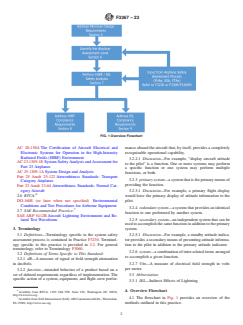
FIG. 1 Overview Flowchart
AC 20-158A The Certification of Aircraft Electrical and mance aboard the aircraft that, by itself, provides a completely
Electronic Systems for Operation in the High-Intensity
recognizable operational capability.
Radiated Fields (HIRF) Environment
3.2.2.1 Discussion—For example, “display aircraft attitude
AC 23.1309-1E System Safety Analysis and Assessment for
to the pilot” is a function. One or more systems may perform
Part 23 Airplanes
a specific function or one system may perform multiple
AC 25.1309-1A System Design and Analysis
functions, or both.
Part 25 Amdt 25-122 Airworthiness Standards: Transport
3.2.3 primary system—a system that is the primary means of
Category Airplanes
providing the function.
Part 23 Amdt 23-64 Airworthiness Standards: Normal Cat-
egory Aircraft 3.2.3.1 Discussion—For example, a primary flight display
would have the primary display of attitude information to the
2.6 RTCA:
DO-160E (or later when not specified) Environmental pilot.
Conditions and Test Procedures for Airborne Equipment
3.2.4 redundant system—a system that provides an identical
2.7 SAE Recommended Practice:
function to one performed by another system.
SAE ARP 5412B Aircraft Lightning Environment and Re-
3.2.5 secondary system—an independent system that can be
lated Test Waveforms
used to accomplish the same function in addition to the primary
3. Terminology
system.
3.1 Definitions—Terminology specific to the system safety 3.2.5.1 Discussion—For example, a standby attitude indica-
assessment process is contained in Practice F3230. Terminol- tor provides a secondary means of presenting attitude informa-
ogy specific to this practice is provided in 3.2. For general
tion to the pilot in addition to the primary attitude indicator.
terminology, refer to Terminology F3060.
3.2.6 system—a combination of inter-related items arranged
3.2 Definitions of Terms Specific to This Standard:
to accomplish a given function.
3.2.1 dB—A measure of signal or field strength attenuation
in decibels. 3.2.7 V/m—A measure of electrical field strength in volts
per meter.
3.2.2 function—intended behavior of a product based on a
set of defined requirements regardless of implementation. The
3.3 Abbreviation:
specific action of a system, equipment, and flight crew perfor-
3.3.1 IEL—Indirect Effects of Lightning
4. Overview Flowchart
Available from RTCA, 1150 18th NW, Suite 910, Washington DC 20036,
http://www.rtca.org.
7 4.1 The flowchart in Fig. 1 provides an overview of the
Available from SAE International (SAE), 400 Commonwealth Dr., Warrendale,
PA 15096, http://www.sae.org. methods outlined in this practice.
F3367 − 23
5. Minimum Design Requirements Assessment but simpler methods may have been employed
depending on the complexity of the system.
5.1 In order to utilize the methods described in this practice,
7.1.2 Identify those failure conditions where exposure to
the following minimum design considerations should be ad-
HIRF or IEL could result in a failure condition that:
dressed. If deviations from these minimum design consider-
7.1.2.1 Would prevent continued safe flight and landing.
ations are desired, the acceptability of the methods described
These failure conditions would be classified as Catastrophic in
must be agreed to by the applicable Civil Aviation Authority.
the assessment discussed in 7.1.1.
5.1.1 Systems that are part of the Type Certificated Engine
7.1.2.2 Would significantly reduce the capability of the
must be installed in accordance with the engine manufacturer’s
aeroplane or the ability of the flight crew to respond to an
requirements. The minimum HIRF and lightning qualification
adverse operating condition. These failure conditions would be
in accordance with Sections 8 and 9 of this ASTM practice
classified as Hazardous in the assessment discussed in 7.1.1.
should be met at the aircraft level.
7.1.2.3 In addressing the requirements of 7.1.2, the nature of
5.1.2 The recommended test levels for a higher Certification
HIRF and IEL should be considered.
Level aeroplane are acceptable in all cases for a lower
(1) The potential for common mode failures across mul-
Certification Level aeroplane. For example, the HIRF require-
tiple systems performing the same or different functions due to
ments specified for a Level 2 or 3 aeroplane may be used on a
the simultaneous exposure to the HIRF and IEL threat must be
Level 1 aeroplane in any frequency band.
considered. Simultaneous and common mode failures due to
5.1.3 The airframe should incorporate low impedance elec-
HIRF or lightning does not have to be assumed for multiple
trical conductors for lightning current to flow through the
systems that contribute to a hazardous failure condition when
aeroplane. The low impedance conductors should be incorpo-
consisting of federated equipment installations that are not
rated into the basic structure of the aeroplane.
identical in design.
5.1.3.1 For aeroplanes with primarily aluminum structure,
(2) The inherent immunity of mechanical systems with no
the aluminum skin provides a low impedance electrical con-
electrical circuitry should also be considered.
ductor. Standard rivets and bolts provide adequate electrical
7.1.2.4 In addressing the requirements of 7.1.2, the effects
bonding between permanent structural joints. Electrical bond-
of HIRF and IEL should not be combined with random failures
ing straps or jumpers should be installed on moving parts or for
that are not the result of the HIRF and Lightning threat.
removable panels or parts.
Additionally, the effects of HIRF and Lightning do not need to
5.1.3.2 For aeroplanes with primarily carbon fiber or fiber-
be considered in combination.
glass structure, metal mesh, metal foil, or expanded metal foil
7.1.3 Identify what systems and equipment are required to
should be incorporated onto the external surfaces of the
prevent the failure conditions identified in 7.1.2.
aeroplane composite structure. This mesh or foil must be
7.1.4 The minimum HIRF and lightning qualification in
joined together electrically and provide a continuous electrical
accordance with Sections 8 and 9 of this ASTM practice should
conductor between the extremities of the aeroplane. Use of
be met at the aircraft level. A minimum of one system must
metallic components internal to the structure of the aeroplane
meet availability requirements, or, specifically for HIRF, mul-
may also be used to provide similar shielding for equipment
tiple systems may be used to show availability requirements
and its wiring.
across the entire frequency band. If multiple systems are used
5.1.3.3 For aeroplanes constructed of tube and fabric, the
to show availability for HIRF, then each of those systems
tube skeleton can be considered as the low impedance electri-
should automatically recover the function after the threat is
cal path through the aeroplane. The bonding also may be
removed. For example, the Primary system meets requirements
achieved by the use of bonding straps or jumpers where
for a certain frequency range while the STBY system meets the
required to electrically bond other metallic sub-structure that
requirements at frequencies the Primary was not able to. In this
might be relied upon to provide bonding for equipment.
example, both the Primary and STBY should automatically
5.1.4 Electrical bonding specifications and verifications
recover the function after the threat is removed.
should be developed and implemented on the production
drawings and instructions for continued airworthiness.
8. HIRF Compliance
6. Aeroplane Assessment Level Assignment
8.1 HIRF compliance may be shown using the methods
described in this section.
6.1 Determine the Aeroplane Assessment Level using the
Assessment Level Selection table(s) in Practice F3230. This
8.2 For the systems and equipment identified in 7.1.3,
Aeroplane Assessment Level assignment of I, II or III will be
establish appropriate pass/fail criteria that ensures the follow-
used to determine the applicable IEL and HIRF requirements
ing requirements are met:
for each aeroplane.
8.2.1 For failure conditions where the loss of a function is
Catastrophic:
7. HIRF and IEL System Safety Analysis
8.2.1.1 The function at the aeroplane level is not adversely
7.1 Perform HIRF and IEL System Safety Analysis: affected during and after the time the aeroplane is exposed at
7.1.1 Obtain the assessment of system failure conditions the HIRF environment. It is not necessary for all redundant
that was performed as part of the system safety assessment systems to pass this requirement provided at least one system
process in accordance with Practices F3230 or F3309/F3309M. maintains the function in the presence of HIRF, in the entire
This will typically take the form of a Functional Hazard frequency band.
F3367 − 23
NOTE 1—At a minimum, the other redundant systems must still be operations of these new technologies may lead to Hazardous failure
tested to the HIRF levels corresponding to the hazard classification conditions that were not previously considered. Therefore, this paragraph
associated directly with the loss of, or erroneous operation of, the is also considered applicable to aircraft that have been approved for VFR
redundant system. operations.
8.2.1.2 When the requirements of 8.2.1.1 are met, recovery 8.2.3.2 When the requirements of 8.2.3.1 are met, recovery
of normal operation of that function in redundant systems for of normal operation of that function in redundant systems is not
Level 1, 2, and 3 aeroplanes can be accomplished by pilot necessary. It is acceptable for the function to be lost in lieu of
action. presenting erroneous or misleading information.
8.2.3.3 If erroneous (Note 5) operation of the function is
NOTE 2—It is accepted that a system upset by the exposure to HIRF will
considered to be Hazardous, then the function shall not be
recover their normal operation after a system reset is performed. The use
adversely affected. The function does not need to recover if the
of a circuit breaker is an acceptable form of resetting the equipment, given
how infrequently this is likely to occur. No HIRF testing is required to
availability is not considered Hazardous.
demonstrate that the affected redundant systems will recover after removal
NOTE 5—Erroneous behavior may be Hazardously Misleading Infor-
of the HIRF threat and a system reset is performed.
mation (HMI) presented to the pilot as well as erroneous information that
8.2.2 When erroneous (Note 3) behavior of a function is
is an input to a system (for example, AP, FADEC, De-Ice, etc.), either of
considered Catastrophic:
which may result in a Hazardous condition for the aircraft.
8.2.2.1 The function shall not be adversely affected during
8.3 Demonstrate that the systems and equipment success-
and after the time the aeroplane is exposed at the HIRF
fully meet the pass criteria established in 8.2 when subjected to
environment, if the adverse effect is considered Catastrophic.
the required HIRF Levels specified in Tables 1 and 2. The
8.2.2.2 If the availability of the function is not considered
demonstration of meeting HIRF levels may be performed via
Catastrophic, then the function does not need to recover normal
test or analysis, or both.
operation. It is acceptable for the function to be lost at the
Catastrophic test level in lieu of presenting erroneous or 9. Indirect Effects of Lightning Compliance
misleading information.
9.1 Indirect Effects of Lightning compliance may be shown
using the methods described in this section.
NOTE 3—Erroneous behavior may be Hazardously Misleading Infor-
mation (HMI) presented to the pilot as well as erroneous information that
9.2 Compliance with the requirements of this section are
is an input to a system (for example, AP, FADEC, De-Ice, etc.), either of
required for those aircraft whose operations are likely to be
which may result in a Catastrophic condition for the aircraft.
struck by lightning.
8.2.3 For Hazardous failure conditions:
9.2.1 Compliance with this section
...
This document is not an ASTM standard and is intended only to provide the user of an ASTM standard an indication of what changes have been made to the previous version. Because
it may not be technically possible to adequately depict all changes accurately, ASTM recommends that users consult prior editions as appropriate. In all cases only the current version
of the standard as published by ASTM is to be considered the official document.
Designation: F3367 − 21a F3367 − 23
Standard Practice for
Simplified Methods for Addressing High-Intensity Radiated
Fields (HIRF) and Indirect Effects of Lightning on Aircraft
This standard is issued under the fixed designation F3367; the number immediately following the designation indicates the year of
original adoption or, in the case of revision, the year of last revision. A number in parentheses indicates the year of last reapproval. A
superscript epsilon (´) indicates an editorial change since the last revision or reapproval.
1. Scope
1.1 This practice covers simplified methods for addressing High-Intensity Radiated Fields (HIRF) and the Indirect Effects of
Lightning (IEL) on aircraft. The material was developed through open consensus of international experts in general aviation. This
information was created by focusing on Aircraft Certification Level 1, Level 2, and Level 3 Normal Category aeroplanes. The
content may be more broadly applicable. It is the responsibility of the applicant to substantiate broader applicability as a specific
means of compliance. The topics covered within this practice are: Overview; Minimum Design Requirements; Aeroplane
Assessment Level; HIRF and IEL Safety Analysis; HIRF Compliance; IEL Compliance.
1.2 An applicant intending to propose this information as Means of Compliance for a design approval must seek guidance from
their respective oversight authority (for example, published guidance from applicable CAA) concerning the acceptable use and
application thereof. For information on which oversight authorities have accepted this practice (in whole or in part) as an
acceptable Means of Compliance to their regulatory requirements (hereinafter “the Rules”), refer to the ASTM Committee F44 web
page (www.astm.org/COMMITTEE/F44.htm).
1.3 Units—The values stated in SI units are to be regarded as standard. No other units of measurement are included in this
standard.
1.4 This standard does not purport to address all of the safety concerns, if any, associated with its use. It is the responsibility
of the user of this standard to establish appropriate safety, health, and environmental practices and determine the applicability of
regulatory limitations prior to use.
1.5 This international standard was developed in accordance with internationally recognized principles on standardization
established in the Decision on Principles for the Development of International Standards, Guides and Recommendations issued
by the World Trade Organization Technical Barriers to Trade (TBT) Committee.
2. Referenced Documents
2.1 Following is a list of external standards referenced throughout this practice; the earliest revision acceptable for use is indicated.
In all cases, later document revisions are acceptable if shown to be equivalent to the listed revision, or if otherwise formally
accepted by the governing civil aviation authority; earlier revisions are not acceptable.
2.2 ASTM Standards:
This practice is under the jurisdiction of ASTM Committee F44 on General Aviation Aircraft and is the direct responsibility of Subcommittee F44.50 on Systems and
Equipment.
Current edition approved Nov. 1, 2021Oct. 1, 2023. Published December 2021October 2023. Originally approved in 2019. Last previous edition approved in 2021 as
F3367–21. DOI: 10.1520/F3367-21A.–21a. DOI: 10.1520/F3367-23.
For referenced ASTM standards, visit the ASTM website, www.astm.org, or contact ASTM Customer Service at service@astm.org. For Annual Book of ASTM Standards
volume information, refer to the standard’s Document Summary page on the ASTM website.
Copyright © ASTM International, 100 Barr Harbor Drive, PO Box C700, West Conshohocken, PA 19428-2959. United States
F3367 − 23
F3060 Terminology for Aircraft
F3230 Practice for Safety Assessment of Systems and Equipment in Small Aircraft
F3309/F3309M Practice for Simplified Safety Assessment of Systems and Equipment in Small Aircraft
2.3 EUROCAE Standards:
ED-14E Environmental Conditions and Test Procedures for Airborne Equipment
ED-107 Guide to Certification of Aircraft in a High-Intensity Radiated Field (HIRF) Environment
2.4 European Aviation Safety Agency (EASA):
CS-23 Amdt 5 Certification Specifications for Normal-Category Aeroplanes
AMC 20-136 Aircraft Electrical And Electronic System Lightning Protection
AMC 20-158 Aircraft Electrical And Electronic System High-Intensity Radiated Fields (HIRF) Protection
2.5 Federal Aviation Administration (FAA):
AC 20-136B Aircraft Electrical and Electronic System Lightning Protection
AC 20-158A The Certification of Aircraft Electrical and Electronic Systems for Operation in the High-Intensity Radiated Fields
(HIRF) Environment
AC 23.1309-1E System Safety Analysis and Assessment for Part 23 Airplanes
AC 25.1309-1A System Design and Analysis
Part 25 Amdt 25-122 Airworthiness Standards: Transport Category Airplanes
Part 23 Amdt 23-64 Airworthiness Standards: Normal Category Aircraft
2.6 RTCA:
DO-160E (or later when not specified) Environmental Conditions and Test Procedures for Airborne Equipment
2.7 SAE Recommended Practice:
SAE ARP 5412B Aircraft Lightning Environment and Related Test Waveforms
3. Terminology
3.1 Definitions—Terminology specific to the system safety assessment process is contained in Practice F3230. Terminology
specific to this practice is provided in 3.2. For general terminology, refer to Terminology F3060.
3.2 Definitions of Terms Specific to This Standard:
FIG. 1 Overview Flowchart
Available from EUROCAE, 9-23 rue Paul Lafargue, "Le Triangle" building, 93200 Saint-Denis, France, https://eshop.eurocae.net/.
Available from European Aviation Safety Agency (EASA ), Postfach 10 12 53, D-50452 Cologne, Germany, https://www.easa.europa.eu.
Available from Federal Aviation Administration (FAA), 800 Independence Ave., SW, Washington, DC 20591, http://rgl.faa.gov.
Available from RTCA, 1150 18th NW, Suite 910, Washington DC 20036, http://www.rtca.org.
Available from SAE International (SAE), 400 Commonwealth Dr., Warrendale, PA 15096, http://www.sae.org.
F3367 − 23
3.2.1 dB—A measure of signal or field strength attenuation in decibels.
3.2.2 function—intended behavior of a product based on a set of defined requirements regardless of implementation. The specific
action of a system, equipment, and flight crew performance aboard the aircraft that, by itself, provides a completely recognizable
operational capability.
3.2.2.1 Discussion—
For example, “display aircraft attitude to the pilot” is a function. One or more systems may perform a specific function or one
system may perform multiple functions, or both.
3.2.3 primary system—a system that is the primary means of providing the function.
3.2.3.1 Discussion—
For example, a primary flight display would have the primary display of attitude information to the pilot.
3.2.4 redundant system—a system that provides an identical function to one performed by another system.
3.2.5 secondary system—an independent system that can be used to accomplish the same function in addition to the primary
system.
3.2.5.1 Discussion—
For example, a standby attitude indicator provides a secondary means of presenting attitude information to the pilot in addition
to the primary attitude indicator.
3.2.6 system—a combination of inter-related items arranged to accomplish a given function.
3.2.7 V/m—A measure of electrical field strength in volts per meter.
3.3 Abbreviation:
3.3.1 IEL—Indirect Effects of Lightning
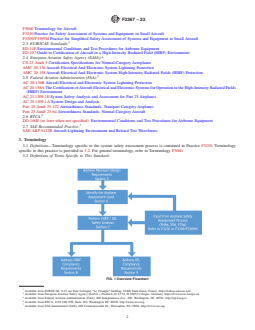
4. Overview Flowchart
4.1 The flowchart in Fig. 1 provides an overview of the methods outlined in this practice.
5. Minimum Design Requirements
5.1 In order to utilize the methods described in this practice, the following minimum design considerations should be addressed.
If deviations from these minimum design considerations are desired, the acceptability of the methods described must be agreed
to by the applicable Civil Aviation Authority.
5.1.1 Systems that are part of the Type Certificated Engine must be installed in accordance with the engine manufacturer’s
requirements. The minimum HIRF and lightning qualification in accordance with Sections 8 and 9 of this ASTM practice should
be met at the aircraft level.
5.1.2 The recommended test levels for a higher Certification Level aeroplane are acceptable in all cases for a lower Certification
Level aeroplane. For example, the HIRF requirements specified for a Level 2 or 3 aeroplane may be used on a Level 1 aeroplane
in any frequency band.
5.1.3 The airframe should incorporate low impedance electrical conductors for lightning current to flow through the aeroplane.
The low impedance conductors should be incorporated into the basic structure of the aeroplane.
5.1.3.1 For aeroplanes with primarily aluminum structure, the aluminum skin provides a low impedance electrical conductor.
Standard rivets and bolts provide adequate electrical bonding between permanent structural joints. Electrical bonding straps or
jumpers should be installed on moving parts or for removable panels or parts.
5.1.3.2 For aeroplanes with primarily carbon fiber or fiberglass structure, metal mesh, metal foil, or expanded metal foil should
be incorporated onto the external surfaces of the aeroplane composite structure. This mesh or foil must be joined together
F3367 − 23
electrically and provide a continuous electrical conductor between the extremities of the aeroplane. Use of metallic components
internal to the structure of the aeroplane may also be used to provide similar shielding for equipment and its wiring.
5.1.3.3 For aeroplanes constructed of tube and fabric, the tube skeleton can be considered as the low impedance electrical path
through the aeroplane. The bonding also may be achieved by the use of bonding straps or jumpers where required to electrically
bond other metallic sub-structure that might be relied upon to provide bonding for equipment.
5.1.4 Electrical bonding specifications and verifications should be developed and implemented on the production drawings and
instructions for continued airworthiness.
6. Aeroplane Assessment Level Assignment
6.1 Determine the Aeroplane Assessment Level using Table 1the Assessment Level Selection table(s) in Practice F3230. This
Aeroplane Assessment Level assignment of I, II or III will be used to determine the applicable IEL and HIRF requirements for
each aeroplane.
7. HIRF and IEL System Safety Analysis
7.1 Perform HIRF and IEL System Safety Analysis:
7.1.1 Obtain the assessment of system failure conditions that was performed as part of the system safety assessment process in
accordance with Practices F3230 or F3309/F3309M. This will typically take the form of a Functional Hazard Assessment but
simpler methods may have been employed depending on the complexity of the system.
7.1.2 Identify those failure conditions where exposure to HIRF or IEL could result in a failure condition that:
7.1.2.1 Would prevent continued safe flight and landing. These failure conditions would be classified as Catastrophic in the
assessment discussed in 7.1.1.
7.1.2.2 Would significantly reduce the capability of the aeroplane or the ability of the flight crew to respond to an adverse
operating condition. These failure conditions would be classified as Hazardous in the assessment discussed in 7.1.1.
7.1.2.3 Would reduce the capability of the aircraft or the ability of the flight crew to cope with adverse operating conditions. These
failure conditions would be classified as Major in the assessment discussed in 7.1.1.
NOTE 1—Compliance with 7.1.2.3 is only required when the cognizant CAA requires major failure conditions to be addressed for HIRF or indirect effects
of lightning, or both.
7.1.2.3 In addressing the requirements of 7.1.2, the nature of HIRF and IEL should be considered.
(1) The potential for common mode failures across multiple systems performing the same or different functions due to the
simultaneous exposure to the HIRF and IEL threat must be considered. Simultaneous and common mode failures due to HIRF or
lightning does not have to be assumed for multiple systems that contribute to a hazardous failure condition when consisting of
federated equipment installations that are not identical in design.
(2) The inherent immunity of mechanical systems with no electrical circuitry should also be considered.
7.1.2.4 In addressing the requirements of 7.1.2, the effects of HIRF and IEL should not be combined with random failures that
are not the result of the HIRF and Lightning threat. Additionally, the effects of HIRF and Lightning do not need to be considered
in combination.
7.1.3 Identify what systems and equipment are required to prevent the failure conditions identified in 7.1.2.
7.1.4 The minimum HIRF and lightning qualification in accordance with Sections 8 and 9 of this ASTM practice should be met
at the aircraft level. A minimum of one system must meet availability requirements, or, specifically for HIRF, multiple systems may
be used to show availability requirements across the entire frequency band. If multiple systems are used to show availability for
HIRF, then each of those systems should automatically recover the function after the threat is removed. For example, the Primary
system meets requirements for a certain frequency range while the STBY system meets the requirements at frequencies the Primary
was not able to. In this example, both the Primary and STBY should automatically recover the function after the threat is removed.
F3367 − 23
8. HIRF Compliance
8.1 HIRF compliance may be shown using the methods described in this section.
8.2 For the systems and equipment identified in 7.1.3, establish appropriate pass/fail criteria that ensures the following
requirements are met:
8.2.1 For failure conditions where the loss of a function is Catastrophic:
8.2.1.1 The function at the aeroplane level is not adversely affected during and after the time the aeroplane is exposed at the HIRF
environment. It is not necessary for all redundant systems to pass this requirement provided at least one system maintains the
function in the presence of HIRF, in the entire frequency band.
NOTE 1—At a minimum, the other redundant systems must still be tested to the HIRF levels corresponding to the hazard classification associated directly
with the loss of, or erroneous operation of, the redundant system.
8.2.1.2 When the requirements of 8.2.1.1 are met, recovery of normal operation of that function in redundant systems for Level
1, 2, and 3 aeroplanes can be accomplished by pilot action.
NOTE 2—It is accepted that a system upset by the exposure to HIRF will recover their normal operation after a system reset is performed. The use of a
circuit breaker is an acceptable form of resetting the equipment, given how infrequently this is likely to occur. No HIRF testing is required to demonstrate
that the affected redundant systems will recover after removal of the HIRF threat and a system reset is performed.
8.2.2 When erroneous (Note 43) behavior of a function is considered Catastrophic:
8.2.2.1 The function shall not be adversely affected during and after the time the aeroplane is exposed at the HIRF environment,
if the adverse effect is considered Catastrophic.
8.2.2.2 If the availability of the function is not considered Catastrophic, then the function does not need to recover normal
operation. It is acceptable for the function to be lost at the Catastrophic test level in lieu of presenting erroneous or misleading
information.
NOTE 3—Erroneous behavior may be Hazardously Misleading Information (HMI) presented to the pilot as well as erroneous information that is an input
to a system (for example, AP, FADEC, De-Ice, etc.), either of which may result in a Catastrophic condition for the aircraft.
8.2.3 For Major/HazardousHazardous failure conditions:
8.2.3.1 Electrical/electronic systems must recover normal operation of that function in a timely manner after the aeroplane is
exposed to the HIRF environment, if the availability of the function is considered to be Major/Hazardous.Hazardous.
NOTE 5—Major failure conditions are only required to be addressed if required by the cognizant CAA.
NOTE 4—Some CAA regulations currently state that requirement only applies to IFR operations. Aircraft approved for VFR operation fly in the same HIRF
environment as IFR approved aircraft. At the time the rule was made, it did not consider certain technologies that have emerged since then (for example,
EVTOL, Unmanned aircraft with fly-by-wire capability, etc.) for aircraft that are approved for VFR operations. The operations of these new technologies
may lead to Major/HazardousHazardous failure conditions that were not previously considered. Therefore, this paragraph is also considered applicable
to aircraft that have been approved for VFR operations.
8.2.3.2 When the requirements of 8.2.3.1 are met, recovery of normal operation of that function in redundant systems is not
necessary. It is acceptable for the function to be lost in lieu of presenting erroneous or misleading information.
8.2.3.3 If erroneous (Note 75) operation of the function is considered to be Hazardous, then the function shall not be adversely
affected. The function does not need to recover if the availability is not considered Major/Hazardous.Hazardous.
NOTE 5—Erroneous behavior may be Hazardously Misleading Information (HMI) presented to the pilot as well as erroneous information that is an input
to a system (for example, AP, FADEC, De-Ice, etc.), either of which may result in a Major/HazardousHazardous condition for the aircraft.
F3367 − 23
8.3 Demonstrate that the systems and equipment successfully meet the pass criteria established in 8.2 when subjected to the
required HIRF Levels specified in Table 2Tables 1 and 2. The demonstration of meeting HIRF levels may be performed via test
or analysis, or both.
9. Indirect Effects of Lightning Compliance
9.1 Indirect Effects of Lightning compliance may be shown using the methods described in this section.
9.2 Compliance with the requirements of this section are required for those aircr
...