

ASTM D7903-14(2020)
(Practice)Standard Practice for Determining the Capacity of Oxygen Removal Ion Exchange Cartridges
General Information
- Abstract
SIGNIFICANCE AND USE
5.1 This practice can be used to evaluate unused oxygen removal ion exchange cartridges for conformance to specifications.
5.2 This practice provides for the calculation of capacity in terms of the volume of water treated to an end point level of dissolved oxygen.
5.3 The practice as written assumes that the oxygen removal ion exchange resins in the cartridge are either partially or fully regenerated. Regeneration of the resins is not part of this practice.
5.4 This practice provides for the calculation of capacity on a cartridge basis.
5.5 This practice may be used to test different size oxygen removal resin cartridges. The flow rate of test water and the frequency of sampling are varied to compensate for the approximate volume of resin in the test cartridge.
SCOPE
1.1 This practice covers the determination of the performance of oxygen removal ion exchange resin cartridges in the regenerated form when used for removing dissolved oxygen from water. The test can be used to determine the initial capacity of unused cartridges or the remaining capacity of used cartridges. In this case, performance is defined as oxygen removal capacity (or throughput) to a defined endpoint.
1.2 The values stated in SI units are to be regarded as standard. No other units of measurement are included in this standard.
1.3 This standard does not purport to address all of the safety concerns, if any, associated with its use. It is the responsibility of the user of this standard to establish appropriate safety, health, and environmental practices and determine the applicability of regulatory limitations prior to use.
1.4 This international standard was developed in accordance with internationally recognized principles on standardization established in the Decision on Principles for the Development of International Standards, Guides and Recommendations issued by the World Trade Organization Technical Barriers to Trade (TBT) Committee.
- Status
- Published
- Publication Date
- 31-Oct-2020
- Technical Committee
- D19 - Water
- Drafting Committee
- D19.08 - Membranes and Ion Exchange Materials


Overview
ASTM D7903-14(2020), Standard Practice for Determining the Capacity of Oxygen Removal Ion Exchange Cartridges, is an international standard developed by ASTM International. This standard outlines procedures for evaluating the performance and capacity of oxygen removal ion exchange resin cartridges used to remove dissolved oxygen from water. It is relevant for both unused and used cartridges in their regenerated form, providing a reliable method for determining cartridge capacity by measuring the volume of water treated to a specified endpoint of dissolved oxygen removal.
Key Topics
- Oxygen Removal Cartridges: Guidance for assessing both new and used ion exchange resin cartridges for effectiveness in oxygen removal applications.
- Capacity Testing: Details how to calculate an ion exchange cartridge's capacity based on the volume of water processed until a prescribed endpoint of dissolved oxygen is reached.
- Equipment and Methods: Specifies the necessary apparatus, measurement techniques, and test protocols to ensure accurate and repeatable results.
- Procedural Flexibility: The standard allows for adaptation to different cartridge sizes and can be used to test a range of flow rates by adjusting water flow and sampling frequency relative to cartridge volume.
- Reporting Requirements: Requires inclusion of calculation methods, endpoint definitions, and specific test conditions in the final report, ensuring clear traceability and result interpretation.
Applications
ASTM D7903-14(2020) is widely applicable to industries that require strict control of dissolved oxygen in water systems, such as:
- Power Generation and Boiler Operations: Preventing corrosion in steam systems by verifying effective oxygen removal.
- Pharmaceutical and Biotechnology Facilities: Ensuring high-purity water for sensitive processes that could be impacted by oxygen contamination.
- Laboratory and Analytical Settings: Routine qualification of ion exchange cartridges used in research, product development, and quality control.
- Manufacturing and Industrial Water Treatment: Monitoring and maintaining water system integrity by confirming cartridge efficacy for oxygen removal.
Regular testing according to this standard helps ensure compliance with internal and external water quality specifications. It also provides an objective basis for cartridge selection, maintenance scheduling, and troubleshooting in critical applications.
Related Standards
To fully implement and complement the practices outlined in ASTM D7903-14(2020), the following related ASTM standards are commonly referenced:
- ASTM D888 - Test Methods for Dissolved Oxygen in Water: Specifies accepted analytical techniques for measuring dissolved oxygen levels before and after cartridge treatment.
- ASTM D1129 - Terminology Relating to Water: Provides standard definitions for terms used within water testing and treatment contexts.
- ASTM D1193 - Specification for Reagent Water: Details requirements for reagent-grade water to ensure consistency and reliability in testing.
Adherence to ASTM D7903-14(2020) supports international best practices in oxygen removal, helping organizations meet operational, regulatory, and quality benchmarks in water treatment. Utilizing this standard enhances the safety, reliability, and performance of water purification and delivery systems, safeguarding both equipment and end-use processes.
Relations
- Effective Date
- 01-May-2020
- Effective Date
- 01-Mar-2012
- Effective Date
- 01-Mar-2012
- Effective Date
- 01-Mar-2010
- Effective Date
- 01-Sep-2006
- Effective Date
- 01-Sep-2006
- Effective Date
- 01-Mar-2006
- Effective Date
- 15-Feb-2006
- Effective Date
- 15-Aug-2005
- Effective Date
- 01-Mar-2004
- Effective Date
- 01-Mar-2004
- Effective Date
- 10-Aug-2003
- Effective Date
- 10-Jun-2003
- Effective Date
- 10-Mar-2003
- Effective Date
- 10-Jul-2002
Get Certified
Connect with accredited certification bodies for this standard

CIS Institut d.o.o.
Personal Protective Equipment (PPE) certification body. Notified Body NB-2890 for EU Regulation 2016/425 PPE.

Kiwa BDA Testing
Building and construction product certification.
Kmetijski inštitut Slovenije
Agricultural Institute of Slovenia. Soil testing, plant health, agricultural product analysis.
Sponsored listings
Frequently Asked Questions
ASTM D7903-14(2020) is a standard published by ASTM International. Its full title is "Standard Practice for Determining the Capacity of Oxygen Removal Ion Exchange Cartridges". This standard covers: SIGNIFICANCE AND USE 5.1 This practice can be used to evaluate unused oxygen removal ion exchange cartridges for conformance to specifications. 5.2 This practice provides for the calculation of capacity in terms of the volume of water treated to an end point level of dissolved oxygen. 5.3 The practice as written assumes that the oxygen removal ion exchange resins in the cartridge are either partially or fully regenerated. Regeneration of the resins is not part of this practice. 5.4 This practice provides for the calculation of capacity on a cartridge basis. 5.5 This practice may be used to test different size oxygen removal resin cartridges. The flow rate of test water and the frequency of sampling are varied to compensate for the approximate volume of resin in the test cartridge. SCOPE 1.1 This practice covers the determination of the performance of oxygen removal ion exchange resin cartridges in the regenerated form when used for removing dissolved oxygen from water. The test can be used to determine the initial capacity of unused cartridges or the remaining capacity of used cartridges. In this case, performance is defined as oxygen removal capacity (or throughput) to a defined endpoint. 1.2 The values stated in SI units are to be regarded as standard. No other units of measurement are included in this standard. 1.3 This standard does not purport to address all of the safety concerns, if any, associated with its use. It is the responsibility of the user of this standard to establish appropriate safety, health, and environmental practices and determine the applicability of regulatory limitations prior to use. 1.4 This international standard was developed in accordance with internationally recognized principles on standardization established in the Decision on Principles for the Development of International Standards, Guides and Recommendations issued by the World Trade Organization Technical Barriers to Trade (TBT) Committee.
SIGNIFICANCE AND USE 5.1 This practice can be used to evaluate unused oxygen removal ion exchange cartridges for conformance to specifications. 5.2 This practice provides for the calculation of capacity in terms of the volume of water treated to an end point level of dissolved oxygen. 5.3 The practice as written assumes that the oxygen removal ion exchange resins in the cartridge are either partially or fully regenerated. Regeneration of the resins is not part of this practice. 5.4 This practice provides for the calculation of capacity on a cartridge basis. 5.5 This practice may be used to test different size oxygen removal resin cartridges. The flow rate of test water and the frequency of sampling are varied to compensate for the approximate volume of resin in the test cartridge. SCOPE 1.1 This practice covers the determination of the performance of oxygen removal ion exchange resin cartridges in the regenerated form when used for removing dissolved oxygen from water. The test can be used to determine the initial capacity of unused cartridges or the remaining capacity of used cartridges. In this case, performance is defined as oxygen removal capacity (or throughput) to a defined endpoint. 1.2 The values stated in SI units are to be regarded as standard. No other units of measurement are included in this standard. 1.3 This standard does not purport to address all of the safety concerns, if any, associated with its use. It is the responsibility of the user of this standard to establish appropriate safety, health, and environmental practices and determine the applicability of regulatory limitations prior to use. 1.4 This international standard was developed in accordance with internationally recognized principles on standardization established in the Decision on Principles for the Development of International Standards, Guides and Recommendations issued by the World Trade Organization Technical Barriers to Trade (TBT) Committee.
ASTM D7903-14(2020) is classified under the following ICS (International Classification for Standards) categories: 13.060.50 - Examination of water for chemical substances. The ICS classification helps identify the subject area and facilitates finding related standards.
ASTM D7903-14(2020) has the following relationships with other standards: It is inter standard links to ASTM D1129-13(2020)e2, ASTM D888-12, ASTM D888-12e1, ASTM D1129-10, ASTM D1129-06ae1, ASTM D1129-06a, ASTM D1193-06, ASTM D1129-06, ASTM D888-05, ASTM D1129-04e1, ASTM D1129-04, ASTM D1129-03a, ASTM D888-03, ASTM D1129-03, ASTM D1129-01. Understanding these relationships helps ensure you are using the most current and applicable version of the standard.
ASTM D7903-14(2020) is available in PDF format for immediate download after purchase. The document can be added to your cart and obtained through the secure checkout process. Digital delivery ensures instant access to the complete standard document.
Standards Content (Sample)
This international standard was developed in accordance with internationally recognized principles on standardization established in the Decision on Principles for the
Development of International Standards, Guides and Recommendations issued by the World Trade Organization Technical Barriers to Trade (TBT) Committee.
Designation: D7903 − 14 (Reapproved 2020)
Standard Practice for
Determining the Capacity of Oxygen Removal Ion Exchange
Cartridges
This standard is issued under the fixed designation D7903; the number immediately following the designation indicates the year of
original adoption or, in the case of revision, the year of last revision. A number in parentheses indicates the year of last reapproval. A
superscript epsilon (´) indicates an editorial change since the last revision or reapproval.
1. Scope 3.1.1 For definitions of terms used in this standard, refer to
Terminology D1129.
1.1 This practice covers the determination of the perfor-
mance of oxygen removal ion exchange resin cartridges in the
4. Summary of Practice
regenerated form when used for removing dissolved oxygen
from water. The test can be used to determine the initial
4.1 This practice will evaluate the capacity of an oxygen
capacity of unused cartridges or the remaining capacity of used
removalcartridgeforwaterbyrunningatestsolutionofknown
cartridges. In this case, performance is defined as oxygen
oxygen content through a cartridge to a specified endpoint.The
removal capacity (or throughput) to a defined endpoint.
volume will enable a determination of the capacity for the
cartridge to remove dissolved oxygen in water.
1.2 The values stated in SI units are to be regarded as
standard. No other units of measurement are included in this
5. Significance and Use
standard.
1.3 This standard does not purport to address all of the
5.1 This practice can be used to evaluate unused oxygen
safety concerns, if any, associated with its use. It is the
removal ion exchange cartridges for conformance to specifi-
responsibility of the user of this standard to establish appro-
cations.
priate safety, health, and environmental practices and deter-
5.2 This practice provides for the calculation of capacity in
mine the applicability of regulatory limitations prior to use.
terms of the volume of water treated to an end point level of
1.4 This international standard was developed in accor-
dissolved oxygen.
dance with internationally recognized principles on standard-
ization established in the Decision on Principles for the
5.3 Thepracticeaswrittenassumesthattheoxygenremoval
Development of International Standards, Guides and Recom-
ion exchange resins in the cartridge are either partially or fully
mendations issued by the World Trade Organization Technical
regenerated. Regeneration of the resins is not part of this
Barriers to Trade (TBT) Committee.
practice.
5.4 This practice provides for the calculation of capacity on
2. Referenced Documents
a cartridge basis.
2.1 ASTM Standards:
5.5 This practice may be used to test different size oxygen
D888 Test Methods for Dissolved Oxygen in Water
removal resin cartridges. The flow rate of test water and the
D1129 Terminology Relating to Water
frequency of sampling are varied to compensate for the
D1193 Specification for Reagent Water
approximate volume of resin in the test cartridge.
3. Terminology
6. Apparatus
3.1 Definitions:
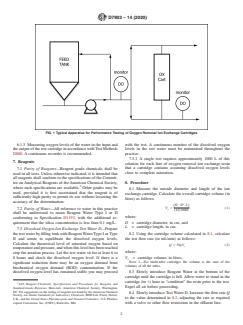
6.1 Test assembly (Fig. 1), consisting of the following:
6.1.1 Cartridge, and pressure vessel, if required. Connec-
tions shall be provided at the top and the bottom for the
This practice is under the jurisdiction of ASTM Committee D19 on Water and
is the direct responsibility of Subcommittee D19.08 on Membranes and Ion
admission and removal of the exhausting solution as described
Exchange Materials.
in 8.3, 8.4, and 8.5.
Current edition approved Nov. 1, 2020. Published November 2020. Originally
6.1.2 Test solution tank. Adequate means of regulating and
approved in 2014. Last previous edition approved in 2014 as D7903 – 14. DOI:
10.1520/D7903-14R20.
measuring flow through the cartridge shall be provided. If the
For referenced ASTM standards, visit the ASTM website, www.astm.org, or
test flow rate (8.2) cannot be obtained by gravity feed, then a
contact ASTM Customer Service at service@astm.org. For Annual Book of ASTM
pump should be used. Make sure all fittings, connections, and
Standards volume information, refer to the standard’s Document Summary page on
the ASTM website. wetted pump portals are secure and tight to the atmosphere.
Copyright © ASTM International, 100 Barr Harbor Drive, PO Box C700, West Conshohocken, PA 19428-2959. United States
D7903 − 14 (2020)
FIG. 1 Typical Apparatus for Performance Testing of Oxygen Removal Ion Exchange Cartridges
6.1.3 Measuring oxygen levels of the water in the input and with the test. A continuous monitor of the dissolved oxygen
theoutputofthetestcartridgeinaccordancewithTestMethods levels in the test water must be maintained throughout the
D888. A continuous recorder is recommended. practice.
7.3.1 A single test requires approximately 1000 L of this
7. Reagents
solution for each litre of oxygen removal ion exchange resin
that a cartridge contains assuming dissolved oxygen levels
7.1 Purity of Reagents—Reagent grade chemicals shall be
used in all tests. Unless otherwise indicated, it is intended that close to complete saturation.
all reagents shall conform to the specifications of the Commit-
tee onAnalytical Reagents of theAmerican Chemical Society, 8. Procedure
where such specifications are available. Other grades may be
8.1 Measure the outside diame
...