

ASTM B507-14(2021)
(Practice)Standard Practice for Design of Articles to Be Electroplated on Racks
General Information
- Abstract
SIGNIFICANCE AND USE
2.1 When an article is to be electroplated, it is necessary to consider not only the characteristics of the electroplating process, but also the design of the part to minimize electroplating and finishing costs and solution dragout as well as to improve appearance and functionality. It is often possible during the design and engineering stages to make small adjustments in shape that will result in considerable benefit toward a better quality part at a lower cost.
2.2 The specific property of an electroplating process that would require some attention to the details of optional designs, is the throwing power of the electroplating solution. This term describes the properties of the solution as it relates to the solution electrical resistance and solution capacitance at the cathode and overall efficiency of the electrolyte system. Throwing power is defined as the improvement of the coating distribution over the primary current distribution on an electrode (usually cathode) in a given solution, under specified conditions.
SCOPE
1.1 This practice covers design information for parts to be electroplated on racks. The recommendations contained herein are not mandatory, but are intended to give guidance toward good practice.
1.2 The values stated in SI units are to be regarded as standard. No other units of measurement are included in this standard.
1.3 This standard does not purport to address all of the safety concerns, if any, associated with its use. It is the responsibility of the user of this standard to establish appropriate safety, health, and environmental practices and determine the applicability of regulatory limitations prior to use.
1.4 This international standard was developed in accordance with internationally recognized principles on standardization established in the Decision on Principles for the Development of International Standards, Guides and Recommendations issued by the World Trade Organization Technical Barriers to Trade (TBT) Committee.
- Status
- Published
- Publication Date
- 31-Mar-2021
- Technical Committee
- B08 - Metallic and Inorganic Coatings
- Drafting Committee
- B08.01 - Ancillary Activities
Overview
ASTM B507-14(2021): Standard Practice for Design of Articles to Be Electroplated on Racks provides comprehensive guidance for engineers and designers involved in electroplating processes. Developed by ASTM International, this standard outlines the critical considerations for designing parts that are to be electroplated, focusing on optimizing quality, minimizing costs, and ensuring efficient use of materials. This guidance is especially relevant for parts designed to be electroplated on racks, which is a widely used industrial practice in the protection and enhancement of metal components.
Key Topics
Part Design and Electroplating Efficiency: The standard highlights the importance of considering the electroplating process during the design phase. Small design modifications can lead to substantial improvements in coating quality while reducing both finishing costs and solution drag-out.
Throwing Power: A central factor in successful electroplating design is the "throwing power" of the electroplating solution. Throwing power refers to a solution’s ability to produce a uniform coating, influenced by electrical resistance and capacitance at the cathode. Solutions with higher throwing power yield more uniform deposits across complex geometries.
Current Distribution and Metal Thickness: The current density during electroplating is never perfectly uniform. High-current density areas (such as edges and corners) tend to accumulate more metal, leading to thicker deposits, while recessed or protected areas may receive less. Design strategies, such as rounding corners and contouring depressions, help to achieve more even distributions of the plated metal.
Geometric Considerations: The standard recommends designing depressions and recesses with a width-to-depth ratio greater than three and rounding all sharp edges and base angles. This prevents excessive material build-up and ensures the integrity and functionality of the finished part.
Racking Methodology: Proper attachment to the rack is essential to maintain good electrical contact and avoid damage or loss during processing. Design features that facilitate solid mounting and adequate drainage help minimize solution drag-out, improve rinsing, and enhance overall process stability.
Applications
ASTM B507-14(2021) is widely used across multiple industries, including automotive, electronics, aerospace, and industrial machinery. Practical applications of this electroplating design standard include:
- Component Protection: Enhancing corrosion resistance and wear protection for parts exposed to harsh environments.
- Improved Appearance: Achieving aesthetically pleasing finishes on consumer and industrial products.
- Cost Optimization: Reducing material wastage and minimizing the need for additional finishing by promoting uniform deposition.
- Functional Requirements: Meeting specific electrical, magnetic, or surface property requirements through carefully controlled plating thickness and distribution.
- Manufacturing Efficiency: Streamlining production with repeatable, quality-driven outcomes by integrating design for electroplating principles from the outset.
Related Standards
Designers and engineers referencing ASTM B507-14(2021) should also consider the following standards for comprehensive guidance:
- ASTM B633 - Standard Specification for Electrodeposited Coatings of Zinc on Iron and Steel
- ASTM B456 - Specification for Electrodeposited Coatings of Copper Plus Nickel Plus Chromium and Nickel Plus Chromium
- ASTM B567 - Test Method for Measurement of Coating Thickness by the Beta-Backscatter Method
- ISO 1456 - Metallic and other inorganic coatings-Electrodeposited coatings of nickel, nickel plus chromium, copper plus nickel and of zinc on ferrous materials
- ISO 2064 - Metallic and other inorganic coatings-Definitions and conventions concerning the measurement of thickness
By following ASTM B507-14(2021), designers and manufacturers can achieve reliable, high-quality, and economically produced electroplated components by integrating best practices into the engineering and design process. This standard is a critical tool for anyone aiming to optimize the performance and longevity of electroplated articles.
Get Certified
Connect with accredited certification bodies for this standard

DVS-ZERT GmbH
German welding certification society.
CARES (UK Certification Authority for Reinforcing Steels)
UK certification for reinforcing steels and construction.
EWF/IIW (European/International Welding Federation)
International welding personnel certification.
Sponsored listings
Frequently Asked Questions
ASTM B507-14(2021) is a standard published by ASTM International. Its full title is "Standard Practice for Design of Articles to Be Electroplated on Racks". This standard covers: SIGNIFICANCE AND USE 2.1 When an article is to be electroplated, it is necessary to consider not only the characteristics of the electroplating process, but also the design of the part to minimize electroplating and finishing costs and solution dragout as well as to improve appearance and functionality. It is often possible during the design and engineering stages to make small adjustments in shape that will result in considerable benefit toward a better quality part at a lower cost. 2.2 The specific property of an electroplating process that would require some attention to the details of optional designs, is the throwing power of the electroplating solution. This term describes the properties of the solution as it relates to the solution electrical resistance and solution capacitance at the cathode and overall efficiency of the electrolyte system. Throwing power is defined as the improvement of the coating distribution over the primary current distribution on an electrode (usually cathode) in a given solution, under specified conditions. SCOPE 1.1 This practice covers design information for parts to be electroplated on racks. The recommendations contained herein are not mandatory, but are intended to give guidance toward good practice. 1.2 The values stated in SI units are to be regarded as standard. No other units of measurement are included in this standard. 1.3 This standard does not purport to address all of the safety concerns, if any, associated with its use. It is the responsibility of the user of this standard to establish appropriate safety, health, and environmental practices and determine the applicability of regulatory limitations prior to use. 1.4 This international standard was developed in accordance with internationally recognized principles on standardization established in the Decision on Principles for the Development of International Standards, Guides and Recommendations issued by the World Trade Organization Technical Barriers to Trade (TBT) Committee.
SIGNIFICANCE AND USE 2.1 When an article is to be electroplated, it is necessary to consider not only the characteristics of the electroplating process, but also the design of the part to minimize electroplating and finishing costs and solution dragout as well as to improve appearance and functionality. It is often possible during the design and engineering stages to make small adjustments in shape that will result in considerable benefit toward a better quality part at a lower cost. 2.2 The specific property of an electroplating process that would require some attention to the details of optional designs, is the throwing power of the electroplating solution. This term describes the properties of the solution as it relates to the solution electrical resistance and solution capacitance at the cathode and overall efficiency of the electrolyte system. Throwing power is defined as the improvement of the coating distribution over the primary current distribution on an electrode (usually cathode) in a given solution, under specified conditions. SCOPE 1.1 This practice covers design information for parts to be electroplated on racks. The recommendations contained herein are not mandatory, but are intended to give guidance toward good practice. 1.2 The values stated in SI units are to be regarded as standard. No other units of measurement are included in this standard. 1.3 This standard does not purport to address all of the safety concerns, if any, associated with its use. It is the responsibility of the user of this standard to establish appropriate safety, health, and environmental practices and determine the applicability of regulatory limitations prior to use. 1.4 This international standard was developed in accordance with internationally recognized principles on standardization established in the Decision on Principles for the Development of International Standards, Guides and Recommendations issued by the World Trade Organization Technical Barriers to Trade (TBT) Committee.
ASTM B507-14(2021) is classified under the following ICS (International Classification for Standards) categories: 25.220.20 - Surface treatment. The ICS classification helps identify the subject area and facilitates finding related standards.
ASTM B507-14(2021) is available in PDF format for immediate download after purchase. The document can be added to your cart and obtained through the secure checkout process. Digital delivery ensures instant access to the complete standard document.
Standards Content (Sample)
This international standard was developed in accordance with internationally recognized principles on standardization established in the Decision on Principles for the
Development of International Standards, Guides and Recommendations issued by the World Trade Organization Technical Barriers to Trade (TBT) Committee.
Designation:B507 −14 (Reapproved 2021)
Standard Practice for
Design of Articles to Be Electroplated on Racks
This standard is issued under the fixed designation B507; the number immediately following the designation indicates the year of
original adoption or, in the case of revision, the year of last revision. A number in parentheses indicates the year of last reapproval. A
superscript epsilon (´) indicates an editorial change since the last revision or reapproval.
1. Scope distribution over the primary current distribution on an elec-
trode (usually cathode) in a given solution, under specified
1.1 This practice covers design information for parts to be
conditions.
electroplated on racks. The recommendations contained herein
are not mandatory, but are intended to give guidance toward
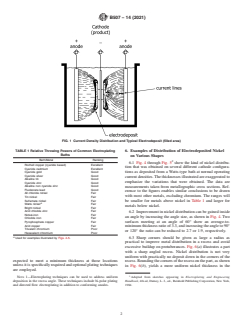
3. Current Distribution and Throwing Power
good practice.
3.1 The apparent current during practical electroplating is
1.2 The values stated in SI units are to be regarded as
never uniform over the surface of the product. Even parallel
standard. No other units of measurement are included in this
plates have a nonuniform distribution of current when freely
standard.
suspended in a bath as shown in Fig. 1. In this example, the
1.3 This standard does not purport to address all of the
current lines tend to concentrate as corners, and edges (high-
safety concerns, if any, associated with its use. It is the
current density) of the part. Consequently more metal is
responsibility of the user of this standard to establish appro-
deposited at the high-current density areas than at the low-
priate safety, health, and environmental practices and deter-
current density areas.
mine the applicability of regulatory limitations prior to use.
1.4 This international standard was developed in accor-
4. Relative Throwing Powers of Different Electrolytes
dance with internationally recognized principles on standard-
4.1 Throwing power is not the same for all metals and all
ization established in the Decision on Principles for the
electroplating baths. Table 1 lists the commonly used electro-
Development of International Standards, Guides and Recom-
plating processes. They are arranged according to decreasing
mendations issued by the World Trade Organization Technical
throwing power.
Barriers to Trade (TBT) Committee.
4.2 A Rochelle-type copper electroplating solution has ex-
2. Significance and Use
cellent throwing power compared to the poor throwing power
2.1 When an article is to be electroplated, it is necessary to
of a chromic acid solution used to deposit chromium. The
consider not only the characteristics of the electroplating widely used Watts-type nickel bath has fair throwing power.
process, but also the design of the part to minimize electro-
plating and finishing costs and solution dragout as well as to 5. Geometric Factors Determining Deposit Distribution
improve appearance and functionality. It is often possible
5.1 Since a metal deposits preferentially at protuberances,
during the design and engineering stages to make small
such as sharp corners, edges, fins, and ribs, these should be
adjustments in shape that will result in considerable benefit
rounded to a radius of at least 0.4 and preferably 0.8 mm to
toward a better quality part at a lower cost.
avoid excessive buildup. Contouring a base corner in a
2.2 The specific property of an electroplating process that
depression is also recommended to avoid thickness deficiency
would require some attention to the details of optional designs, at the location.
is the throwing power of the electroplating solution. This term
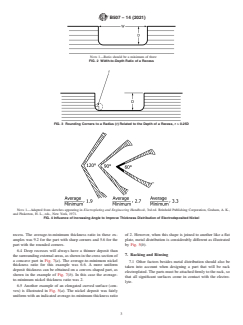
5.2 The width-to-depth ratio of a depression or recess
describes the properties of the solution as it relates to the
should be held to more than three as shown in Fig. 2.
solution electrical resistance and solution capacitance at the
Otherwise, a special auxiliary anode must be employed inside
cathode and overall efficiency of the electrolyte system.
the recess to promote more uniform current distribution. An
Throwing power is defined as the improvement of the coating
auxiliary anode is usually made of the depositing metal and is
placed close to the low-current density areas to enhance metal
deposition at those regions.
This practice is under the jurisdiction of ASTM Committee B08 on Metallic
and Inorganic Coatings and is the direct responsibility of Subcommittee B08.01 on
5.3 All sharp edges and base angles of a recess should be
Ancillary Activities.
rounded to a radius of 0.25 times or more the depth of the
Current edition approved April 1, 2021. Published May 2021. Originally
recess as shown in Fig. 3. When sharp recess angles are
approved in 1970. Last previous edition approved in 2014 as B507 – 14. DOI:
10.1520/B0507-14R21. required for a functional purpose, the electroplater cannot be
Copyright © ASTM International, 100 Barr Harbor Drive, PO Box C700, West Conshohocken, PA 19428-2959. United States
B507−14 (2021)
FIG. 1 Current Density Distribution and Typical Electrodeposit (filled area)
TABLE 1 Relative Throwing Powers of Common Electroplating
6. Examples of Distribution of Electrodeposited Nickel
Baths
on Various Shapes
Bath/Metal Ranking
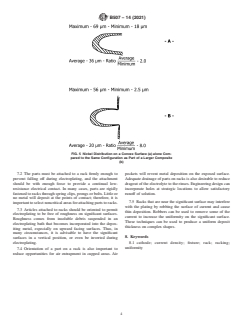
6.1 Fig. 4 through Fig. 5 show the kind of nickel distribu-
Rochell copper (cyanide based) Excellent
tion that was obtained on several different cathode configura-
Cyanide cadmium Excellent
Cyanide gold Good tions as deposited from a Watts-type bath at normal operating
Cyanide silver Good
current densities.The thicknesses illustrated are exaggerated to
Alkaline tin Good
emphasize the variations that were obtained. The data are
Cyanide zinc Good
Alkaline non cyanide zinc Good
measurements taken from metallographic cross sections. Ref-
Fluoborate lead Good
erence to the figures enables similar conclusions to be drawn
All chloride nickel Fair
with most other metals, excluding chromium. The ranges will
Tin nickel Fair
Sulfamate nickel Fair
be smaller for metals above nickel in Table 1 and larger for
A
Watts nickel Fair
metals below nickel.
Bright nickel Fair
Acid chloride zinc Fair
6.2 Improvement in nickel distribution can be gained inside
Nickel-iron Fair
an angle by increasing the angle size, as shown in Fig. 4.Two
C
...