

ASTM C756-87(2021)
(Test Method)Standard Test Method for Cleanability of Surface Finishes
General Information
- Abstract
SIGNIFICANCE AND USE
4.1 This test method was developed to guide the user in selecting a finish coating or material that is resistant to soiling in a particular application.
4.2 The numerical values derived by this test method enables the user to rank finish coatings and materials in regard to soil retention or ease of soil removal.
SCOPE
1.1 This test method covers the numerical evaluation of the ease or difficulty of cleaning soiled surface finishes. This test method is applicable to all surface finishes not affected by water.
1.2 Values given in SI units are to be regarded as the standard. Inch-pound units are provided for information only.
1.3 This standard does not purport to address all of the safety concerns, if any, associated with its use. It is the responsibility of the user of this standard to establish appropriate safety, health, and environmental practices and determine the applicability of regulatory limitations prior to use.
1.4 This international standard was developed in accordance with internationally recognized principles on standardization established in the Decision on Principles for the Development of International Standards, Guides and Recommendations issued by the World Trade Organization Technical Barriers to Trade (TBT) Committee.
- Status
- Published
- Publication Date
- 31-Mar-2021
- Technical Committee
- B08 - Metallic and Inorganic Coatings
- Drafting Committee
- B08.12 - Materials for Porcelain Enamel and Ceramic-Metal Systems
Overview
ASTM C756-87(2021) - Standard Test Method for Cleanability of Surface Finishes provides a systematic and quantitative method for evaluating the ease or difficulty of cleaning soiled surface finishes. Developed by ASTM International, this test is applicable to a wide range of surface finishes that are not affected by water. By using a reliable laboratory procedure involving a fluorescent water-soluble soiling agent and mechanical cleaning, this standard enables industries to compare and rank various finish coatings and materials based on their resistance to soiling and ease of soil removal.
Key benefits of adhering to this standard include improved material selection, enhanced product performance, and the ability to meet stringent cleanliness requirements across multiple industries.
Key Topics
- Numerical Evaluation: The standard specifies how to assign a numeric value-called the Cleanability Index-to quantify the cleanability of surfaces. Index values below 1.0 indicate superior cleanability compared to a standardized reference, while values above 1.0 indicate more difficult cleaning.
- Controlled Soiling and Cleaning: Testing involves the application of a precisely measured, fluorescent water-soluble soil to test specimens, followed by mechanical wiping under controlled laboratory conditions.
- Comparison to Reference Surface: Results are always compared to a standard porcelain enamel reference surface that meets strict resistance criteria, ensuring consistency and reproducibility.
- Detailed Test Procedure: The method outlines step-by-step guidance, from specimen preparation to the measurement of residual soil, ensuring accurate and comparable results.
- Safety and Compliance: Users of the standard are responsible for establishing necessary safety and environmental practices and ensuring regulatory compliance within their region or industry.
- International Recognition: Developed in line with World Trade Organization (WTO) principles, ensuring broad acceptance in global markets.
Applications
ASTM C756-87(2021) is widely used by quality assurance teams, product developers, and materials engineers in various sectors, including:
- Manufacturing of Appliances and Consumer Products: Guides the selection of coatings and materials for products subject to frequent handling or cleaning, such as kitchen appliances, bathroom fixtures, and laboratory equipment.
- Architectural and Building Materials: Supports the evaluation of surface finishes for wall panels, countertops, and other installations where cleanability is crucial.
- Healthcare and Laboratory Facilities: Assists in selecting materials for environments where hygiene and surface cleanliness are regulatory requirements.
- Automotive and Transportation: Used for interior surfaces and components that demand high standards of cleanliness and durability.
The cleanability ranking generated by this method helps manufacturers, specifiers, and maintenance teams make evidence-based decisions about coating and finish selection, ultimately improving product lifespan and user satisfaction.
Related Standards
For a holistic approach to surface finish evaluation, consider these related ASTM standards:
- ASTM C282: Test Method for Acid Resistance of Porcelain Enamels
- ASTM C614: Test Method for Alkali Resistance of Porcelain Enamels
These complementary standards allow users to assess chemical resistance alongside cleanability, leading to more comprehensive material specifications.
Keywords: ASTM C756, cleanability, surface finishes, finish coatings, soiling resistance, cleanliness testing, ISO standards, industrial coatings, quality assurance, material selection, cleanability index, porcelain enamel, surface evaluation.
Relations
- Effective Date
- 01-Apr-2011
- Effective Date
- 01-Nov-2010
- Refers
ASTM C282-10 - Standard Test Method for Acid Resistance of Porcelain Enamels (Citric Acid Spot Test) - Effective Date
- 01-Apr-2010
- Effective Date
- 15-Sep-2005
- Effective Date
- 15-Sep-2005
- Effective Date
- 10-Mar-1999
- Refers
ASTM C282-99 - Standard Test Method for Acid Resistance of Porcelain Enamels (Citric Acid Spot Test) - Effective Date
- 10-Mar-1999
Get Certified
Connect with accredited certification bodies for this standard

DVS-ZERT GmbH
German welding certification society.
CARES (UK Certification Authority for Reinforcing Steels)
UK certification for reinforcing steels and construction.
EWF/IIW (European/International Welding Federation)
International welding personnel certification.
Sponsored listings
Frequently Asked Questions
ASTM C756-87(2021) is a standard published by ASTM International. Its full title is "Standard Test Method for Cleanability of Surface Finishes". This standard covers: SIGNIFICANCE AND USE 4.1 This test method was developed to guide the user in selecting a finish coating or material that is resistant to soiling in a particular application. 4.2 The numerical values derived by this test method enables the user to rank finish coatings and materials in regard to soil retention or ease of soil removal. SCOPE 1.1 This test method covers the numerical evaluation of the ease or difficulty of cleaning soiled surface finishes. This test method is applicable to all surface finishes not affected by water. 1.2 Values given in SI units are to be regarded as the standard. Inch-pound units are provided for information only. 1.3 This standard does not purport to address all of the safety concerns, if any, associated with its use. It is the responsibility of the user of this standard to establish appropriate safety, health, and environmental practices and determine the applicability of regulatory limitations prior to use. 1.4 This international standard was developed in accordance with internationally recognized principles on standardization established in the Decision on Principles for the Development of International Standards, Guides and Recommendations issued by the World Trade Organization Technical Barriers to Trade (TBT) Committee.
SIGNIFICANCE AND USE 4.1 This test method was developed to guide the user in selecting a finish coating or material that is resistant to soiling in a particular application. 4.2 The numerical values derived by this test method enables the user to rank finish coatings and materials in regard to soil retention or ease of soil removal. SCOPE 1.1 This test method covers the numerical evaluation of the ease or difficulty of cleaning soiled surface finishes. This test method is applicable to all surface finishes not affected by water. 1.2 Values given in SI units are to be regarded as the standard. Inch-pound units are provided for information only. 1.3 This standard does not purport to address all of the safety concerns, if any, associated with its use. It is the responsibility of the user of this standard to establish appropriate safety, health, and environmental practices and determine the applicability of regulatory limitations prior to use. 1.4 This international standard was developed in accordance with internationally recognized principles on standardization established in the Decision on Principles for the Development of International Standards, Guides and Recommendations issued by the World Trade Organization Technical Barriers to Trade (TBT) Committee.
ASTM C756-87(2021) is classified under the following ICS (International Classification for Standards) categories: 25.220.20 - Surface treatment. The ICS classification helps identify the subject area and facilitates finding related standards.
ASTM C756-87(2021) has the following relationships with other standards: It is inter standard links to ASTM C614-10(2011)e1, ASTM C614-10, ASTM C282-10, ASTM C614-74(2005), ASTM C282-99(2005), ASTM C614-74(1999), ASTM C282-99. Understanding these relationships helps ensure you are using the most current and applicable version of the standard.
ASTM C756-87(2021) is available in PDF format for immediate download after purchase. The document can be added to your cart and obtained through the secure checkout process. Digital delivery ensures instant access to the complete standard document.
Standards Content (Sample)
This international standard was developed in accordance with internationally recognized principles on standardization established in the Decision on Principles for the
Development of International Standards, Guides and Recommendations issued by the World Trade Organization Technical Barriers to Trade (TBT) Committee.
Designation: C756 − 87 (Reapproved 2021)
Standard Test Method for
Cleanability of Surface Finishes
This standard is issued under the fixed designation C756; the number immediately following the designation indicates the year of
original adoption or, in the case of revision, the year of last revision. A number in parentheses indicates the year of last reapproval. A
superscript epsilon (´) indicates an editorial change since the last revision or reapproval.
INTRODUCTION
This test provides a procedure to quantify the cleanability of acid-resistant porcelain enamel using
a fluorescent water-soluble soil in agent, a reproducible machine-wiping technique, and a means of
measuring the amount of residual soil by fluorescence.
1. Scope and then cleaning the surface with a reproducible machine-
wiping technique. The soil remaining on the specimen after
1.1 This test method covers the numerical evaluation of the
wipingisextractedwithawatersolventandthefluorescenceof
ease or difficulty of cleaning soiled surface finishes. This test
the solution measured. A standard reference surface is treated
method is applicable to all surface finishes not affected by
inasimilarmanner.Thecleanabilityindexofthesurfaceunder
water.
testisexpressedastheratioofthefluorescenceofthesolutions
1.2 Values given in SI units are to be regarded as the
extracted from the test surface and from the standard reference
standard. Inch-pound units are provided for information only.
surface. Cleanability indexes greater than 1.0 indicate that the
1.3 This standard does not purport to address all of the
test surface is more difficult to clean than the standard
safety concerns, if any, associated with its use. It is the
reference surface, while indexes less than 1.0 indicate that the
responsibility of the user of this standard to establish appro-
test surface is more easily cleanable than the standard of
priate safety, health, and environmental practices and deter-
comparison.
mine the applicability of regulatory limitations prior to use.
3.2 The soiling agent used consists of polyethylene glycol,
1.4 This international standard was developed in accor-
a black dye, and a fluorescent tracer, each of which is readily
dance with internationally recognized principles on standard-
water soluble.
ization established in the Decision on Principles for the
Development of International Standards, Guides and Recom-
4. Significance and Use
mendations issued by the World Trade Organization Technical
4.1 This test method was developed to guide the user in
Barriers to Trade (TBT) Committee.
selecting a finish coating or material that is resistant to soiling
2. Referenced Documents
in a particular application.
2.1 ASTM Standards:
4.2 The numerical values derived by this test method
C282 Test Method for Acid Resistance of Porcelain Enam-
enables the user to rank finish coatings and materials in regard
els(Citric Acid Spot Test)
to soil retention or ease of soil removal.
C614 Test Method forAlkali Resistance of Porcelain Enam-
5. Apparatus
els
5.1 Motor-Driven Lapping Plate, 203-mm (8-in.) diameter,
3. Summary of Test Method
speed 163 r/min.
3.1 The test method consists of applying an exact amount of
5.2 Automatic Polishing Unit, 11-s cycle, adjustable to
a fluorescent water-soluble soiling agent to a specimen surface
48-mm (1 ⁄8-in.) stroke.
ThistestmethodisunderthejurisdictionofASTMCommitteeB08onMetallic 5.3 Hypodermic Syringe, glass, 2-mL capacity, without
and Inorganic Coatings and is the direct responsibility of Subcommittee B08.12 on
needle.
Materials for Porcelain Enamel and Ceramic-Metal Systems.
Current edition approved April 1, 2021. Published May 2021. Originally
approvedin1973.Lastpreviouseditionapprovedin2016asC756 – 87(2016).DOI: Suitable lapping plates are available from Buehler Ltd., 2120 Greenwood St.,
10.1520/C0756-87R21. Evanston, IL60204, Struers, Inc., 20102 Progress Drive, Cleveland, OH, 44136; or
For referenced ASTM standards, visit the ASTM website, www.astm.org, or other Metallurgical Supply Sources.
contact ASTM Customer Service at service@astm.org. For Annual Book of ASTM An Olsen “S.M.” Automatic Polisher has been found suitable and is available
Standards volume information, refer to the standard’s Document Summary page on under the code name OLPOL from Struers, Inc., 20102 Progress Drive, Cleveland,
the ASTM website. OH 44136.
Copyright © ASTM International, 100 Barr Harbor Drive, PO Box C700, West Conshohocken, PA 19428-2959. United States
C756 − 87 (2021)
5.4 Repeating Pipet, 0.025 mL (25 µl) capacity. 6. Reagents and Materials
5.5 Repeating Pipet, 10-mL capacity. 6.1 Cleaning Tissues, approximately 127 by 229 mm (5 by
9 in.).
5.6 Desiccator approximately 254 mm (10 in.) diameter.
6.2 Potassium Carbonate.
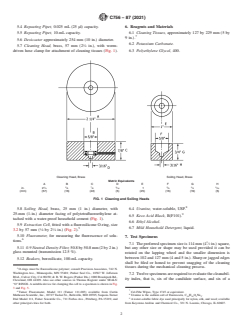
5.7 Cleaning Head, brass, 57 mm (2 ⁄4 in.), with worm-
driven hose clamp for attachment of cleaning tissues (Fig. 1). 6.3 Polyethylene Glycol, 400.
Cleaning Head, Brass Soiling Head, Brass
Metric Equivalents
AB C D E F G H
1 5 7 3 5 3 3
in. 2 ⁄4 ⁄8 ⁄8 ⁄16 1 ⁄8 ⁄4 ⁄16
(mm) (57) (16) (22) (5) (25) (16) (19) (5)
FIG. 1 Cleaning and Soiling Heads
5.8 Soiling Head, brass, 25 mm (1 in.) diameter, with 6.4 Uranine, water-soluble, USP.
25-mm (1-in.) diameter facing of polytetrafluoroethylene at- 9
6.5 Keco Acid Black, B(F101).
tached with a water-proof household cement (Fig. 1).
6.6 Ethyl Alcohol.
5.9 Extraction Cell, fitted with a fluorosilicone O-ring, size
5 6.7 Mild Household Detergent, liquid.
1 1
3.2 by 57 mm ( ⁄8 by 2 ⁄4 in.) (Fig. 2).
5.10 Fluorometer, for measuring the fluorescence of solu-
7. Test Specimens
tions.
7.1 The preferred specimen size is 114 mm (4 ⁄2 in.) square,
5.11 0.9NeutralDensityFilter,50.8by50.8mm(2by2in.)
but any other size or shape may be used provided it can be
glass mounted (transmission 12.5 %).
rotated on the lapping wheel and the smaller dimension is
between 102 and 127 mm (4 and 5 in.). Sharp or jagged edges
5.12 Beakers, borosilicate, 100-mL capacity.
shall be filed or honed to prevent snagging of the cleaning
tissues during the mechanical cleaning process.
O-rings must be fluorosilicone polymer; consult Precision Associates, 742 N.
Washington Ave., Minneapolis, MN 55401; Parker Seal Co., 10567 W. Jefferson
7.2 Twelvespecimensarerequiredtoevaluatethecleanabil-
Blvd., Culver City, CA 90230; & B. W. Rogers (Parker Dis.) 1000 Brookpark Rd.,
ity index, that is, six of the candidate surface, and six of a
Cleveland, OH 44109. Also see other sources in Thomas Register under SEALS:
“O” RINGS.Asuitable device for clamping the cell to a specimen is shown in Fig.
3 and Fig. 5.
Turner Fluorometer, Model 111 (Turner 111-003) available from Curtin Cel-Fibe Wipes, Type 1745 or equivalent.
Matheson Scientific, Inc., 10727 Tucker St., Beltsville, MD 20705, Sequoia-Turner Uranine is the sodium salt of fluorescein, C H O Na .
20 10 5 2
Dial Model 111, Fisher Scientific Co., 711 Forbes Ave., Pittsburg, PA 15219, and Awater-soluble fabric dye used principally for nylon, silk, and wool; available
other principal cities for both. from Keystone Aniline and Chemical Co., 321 N. Loomis, Chicago, IL 60607.
C756 − 87 (2021)
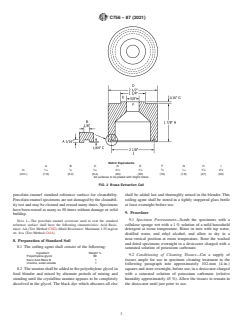
Metric Equivalents
AB C D E F G H I
1 1 1 1 1 5 1 7 1
in. ⁄16 ⁄8 ⁄64 2 ⁄2 1 ⁄4 ⁄8 ⁄16 1 ⁄8 2 ⁄8
(mm.) (1.6) (3.2) (0.4) (64) (32) (16) (1.6) (47) (54)
All surfaces to be plated with bright nickel.
FIG. 2 Brass Extraction Cell
porcelain enamel standard reference surface for cleanability. shall be added last and thoroughly mixed in the blender. This
Porcelain enamel specimens are not damaged by the cleanabil- soiling agent shall be stored in a tightly stoppered glass bottle
ity test and may be cleaned and reused many times. Specimens at least overnight before use.
have been reused as many as 50 times without damage or solid
9. Procedure
buildup.
9.1 Specimen Pretreatment—Scrub the specimens with a
NOTE 1—The porcelain enamel covercoat used to coat the standard
cellulose sponge wet with a 1 % solution of a mild household
reference surface shall have the following characteristics: Acid Resis-
tance:AA(Test Method C282)Alkali Resistance: Maximum 1.55 mg/cm detergent at room temperature. Rinse in turn with tap water,
wt. loss (Test Method C614).
distilled water, and ethyl alcohol, and allow to dry in a
near-vertical position at room temperature. Store the washed
8. Preparation of Standard Soil
and dried specimens overnight in a desiccator charged with a
8.1 The soiling agent shall consist of the following:
saturated solution of potassium carbonate.
Ingredient Weight %
9.2 Conditioning of Cleaning Tissues—Cut a supply of
Polyethylene glycol 98
tissues ample for use in specimen cleaning treatment in the
Keco Acid Black B 1
Uranine, water-soluble 1
following paragraph into approximately 102-mm (4-in.)
8.2 The uranine shall be added to the polyethylene glycol in squares and store overnight, before use, in a desiccator charged
food blender and mixed by alternate periods of mixing and with a saturated solution of potassium carbonate (relative
standing until the crystalline uranine appears to be completely humidity approximately 45 %). Allow the tissues to remain in
dissolved in the glycol. The black dye which obscures all else the desiccator until just prior to use.
C756 − 87 (2021)
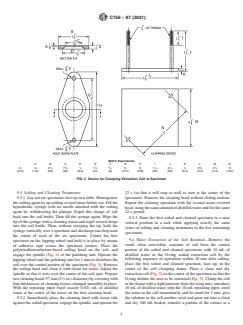
Metric Equivalents
AB C D E F G H I J K L M N
1 1 3 1 7 5 1 1 1 5 5
in. ⁄16 2 ⁄4 1 ⁄8 ⁄4 1 ⁄8 ⁄16 56 1 ⁄4 3 ⁄4 ⁄4 4 ⁄8 4 ⁄8 5
(mm) (1.6) (64) (35) (6.4) (47) (8) (127) (152) (32) (83) (6.4) (117) (117) (127)
FIG. 3 Device for Clamping Extraction Cell to Specimen
9.3 Soiling and Cleaning Treatments: 22 s (so that it will stop as well as start at the center of the
9.3.1 Lay out six specimens face up on a table. Homogenize specimen). Remove the cleaning head without sliding motion.
thesoilingagentbyup-endingseveraltimesbeforeuse.Fillthe
Repeat the cleaning operation with the second tissue-covered
hypodermic syringe with no needle attached with the soiling head,usingthesameamountofdistilledwaterandforthesame
agent by withdrawing the plunger. Expel this charge of soil
22-s period.
back into the soil bottle. Then fill the syringe again. Wipe the
9.3.3 Store the first soiled and cleaned specimen in a near
tipofthesyringewithacleaningtissueandexpelseveraldrops
vertical position in a rack while applying exactly the same
into the soil bottle. Then, without rewiping the tip, hold the
series of soiling and cleaning treatments to the five remaining
syringe vertically over a specimen and discharge one drop near
specimens.
the center of each of the six specimens. Center the first
9.4 Water Extraction of the Soil Retained—Remove the
specimen on the lapping wheel and hold it in place by means
small, often nonvisible, amounts of soil from the central
of adhesive tape across the specimen corners. Place the
portion of the soiled and cleaned specimens with 10 mL of
polytetrafluoroethylene-faced soiling head on the soil, and
distilled water in the O-ring sealed extraction cell by the
engage the spindle (Fig. 4) of the polishing unit. Operate the
following sequence of operations within 30 min after soiling;
lapping wheel and the polishing unit for 1 min to distribute the
place the first soiled and cleaned specimen, face up, in the
soil over the central portion of the specimen (Fig. 5). Remove
center of the cell clamping frame. Place a clean and dry
the soiling head and clean it with tissue for reuse. Adjust the
spindle so that it rests over the center of the soil spot. Prepare extraction cell (Fig. 2) on the center of the specimen so that the
O-ring defines the area to be extracted (Fig. 5). Clamp the cell
twocleaningheads57mm(2 ⁄4in.)diameter)bycoveringwith
fourthicknessesofcleaningtissuesclampedsmoothlyinplace. intheframewithalightpressurefromthewingnuts;introduce
10 mL of distilled water with the 10-mL repeating pipet, swirl
With the repeating pipet expel exactly 0.021 mL of distilled
water at the center of the tissue on the fi
...