

ASTM F22-21
(Test Method)Standard Test Method for Hydrophobic Surface Films by the Water-Break Test
General Information
- Abstract
SIGNIFICANCE AND USE
5.1 The water-break test as described in this test method is rapid, nondestructive, and may be used for control and evaluation of processes for the removal of hydrophobic contaminants. A water-break “free” test is commonly used for in-process verification of the absence of surface contaminants on metal surfaces that may interfere with subsequent surface treatments such as priming, conversion coating, anodizing, plating, or adhesive bonding
5.2 This test method is not quantitative and is typically restricted to applications where a go/no go evaluation of cleanliness will suffice.
5.3 The test may also be used for the detection and control of hydrophobic contaminants in processing environments. For this application, a witness surface free of hydrophobic films is exposed to the environment and subsequently tested. The sensitivity of this test will vary with the level of airborne contaminant and the duration of exposure of the witness surface.
5.4 For quantitative measurement of surface wetting, test methods that measure contact angle of a sessile drop of water or other test liquid may be used in some applications. Measurement methods based on contact angle are shown in Test Methods C813, D5946, and D7490; and Practice D7334.
5.4.1 Devices for in situ measurement of contact angle are available. These devices are limited to a small measurement surface area and may not reflect the cleanliness condition of a larger surface. For larger surface areas, localized contact angle measurement, or other quantitative inspection, combined with water-break testing may be useful.
5.5 For surfaces that cannot be immersed or doused with water, or where such immersion or dousing is impractical, such as previously coated large parts or assemblies, prior to the application of paints, primers or other organic coatings, Test Method F21 may be better suited for the evaluation of surface cleanliness than this test method.
Note 2: This test method is not appropriate where line o...
SCOPE
1.1 This test method covers the detection of the presence of hydrophobic (nonwetting) films on surfaces and the presence of hydrophobic organic materials in processing environments. When properly conducted, the test will enable detection of molecular layers of hydrophobic organic contaminants. On very rough or porous surfaces, the sensitivity of the test may be significantly decreased.
1.2 Units—The values stated in SI units are to be regarded as standard. The values given in parentheses after SI units are provided for information only and are not considered standard.
1.3 This standard does not purport to address all of the safety concerns, if any, associated with its use. It is the responsibility of the user of this standard to establish appropriate safety, health, and environmental practices and determine the applicability of regulatory limitations prior to use.
1.4 This international standard was developed in accordance with internationally recognized principles on standardization established in the Decision on Principles for the Development of International Standards, Guides and Recommendations issued by the World Trade Organization Technical Barriers to Trade (TBT) Committee.
- Status
- Published
- Publication Date
- 30-Nov-2021
- Technical Committee
- E21 - Space Simulation and Applications of Space Technology
- Drafting Committee
- E21.05 - Contamination
Overview
ASTM F22-21 is the globally recognized standard test method for detecting hydrophobic surface films and hydrophobic organic contaminants through the water-break test. Developed by ASTM International, this nondestructive test method is widely used for quick, go/no-go evaluation of surface cleanliness, especially on metallic surfaces prior to further surface treatments. The procedure is simple-apply or immerse the surface in purified water and observe whether the water forms a continuous film or breaks into droplets, indicating the presence of hydrophobic contaminants like oils, greases, or silicones.
This standard is essential for industries requiring high surface cleanliness to ensure effective adhesion, coating, bonding, or surface finishing, as hydrophobic films can lead to failures in subsequent processing steps. ASTM F22-21 is not a quantitative test but is highly valued for its speed, practicality, and minimal equipment requirements.
Key Topics
- Detection of Hydrophobic Films: The water-break test detects the presence of thin, often invisible, organic surface contaminants that impede effective wetting.
- Process Verification: This method offers rapid, in-process verification of cleaning procedures used prior to priming, conversion coating, anodizing, plating, or adhesive bonding.
- Ease of Use: Requires minimal equipment-just purified water and suitable containers-making it adaptable for both laboratory and industrial environments.
- Limitations and Applicability: Best suited for smooth, nonporous materials. On rough or porous surfaces, sensitivity may decrease. It is not intended for surfaces where water application could be impractical or cause damage.
- Non-Quantitative Nature: Provides a direct go/no-go cleanliness evaluation. For quantitative measurement, related contact angle methods are referenced, such as ASTM C813, D5946, D7490, and D7334.
Applications
This standard test method finds use in a wide range of industries and applications, including:
- Aerospace and Defense: Ensures metal surfaces are free of hydrophobic contaminants before coating or bonding operations critical to safety and reliability.
- Automotive Manufacturing: Vital for surface preparation before painting, coating, or assembly line bonding.
- Electronics and Electrical: Used to verify cleanliness of metal components to prevent failures caused by poor adhesion or residue.
- Process Control: Allows manufacturers to monitor the cleanliness of surfaces and processing environments on an ongoing basis, reducing potential defects.
- Environmental Monitoring: The method can be applied by exposing a witness surface in an environment to evaluate the airborne presence of hydrophobic contaminants.
- Surface Finishing: Prepares surfaces for subsequent treatments to maximize the effectiveness and longevity of coatings and adhesives.
Related Standards
The following related ASTM standards provide additional, complementary methods for surface cleanliness and wettability assessment:
- ASTM F21: Atomizer Test for hydrophobic surface films, suitable for cases where immersion is impractical.
- ASTM C813: Test method for hydrophobic contamination on glass using contact angle measurement.
- ASTM D5946: Water contact angle measurements for corona-treated polymer films.
- ASTM D2578: Wetting tension measurement for polyethylene and polypropylene films.
- ASTM D7334: Practice for evaluating surface wettability by advancing the contact angle.
- ASTM D7490: Measurement of the surface tension of solid coatings using contact angle methods.
- ASTM D1193: Specification for reagent water, emphasizing the need for clean, contaminant-free water in testing.
Practical Value
Adhering to ASTM F22-21 helps organizations maintain process quality, product reliability, and regulatory compliance. The water-break test's rapid, straightforward approach to detecting hydrophobic films enables efficient process monitoring and risk mitigation, ensuring surfaces are suitably prepared for critical manufacturing steps. This standard is an indispensable tool for quality assurance in any process where surface cleanliness directly impacts product performance.
Relations
- Effective Date
- 01-Apr-2020
- Effective Date
- 01-Nov-2018
- Effective Date
- 01-May-2017
- Effective Date
- 15-Jan-2014
- Effective Date
- 01-Nov-2009
- Refers
ASTM D2578-09 - Standard Test Method for Wetting Tension of Polyethylene and Polypropylene Films - Effective Date
- 01-Sep-2009
- Effective Date
- 01-Apr-2009
- Effective Date
- 15-Dec-2008
- Refers
ASTM D2578-08 - Standard Test Method for Wetting Tension of Polyethylene and Polypropylene Films - Effective Date
- 01-Nov-2008
- Effective Date
- 01-May-2008
- Effective Date
- 15-Feb-2008
- Effective Date
- 01-Apr-2007
- Effective Date
- 01-Mar-2006
- Effective Date
- 01-Oct-2004
- Refers
ASTM D2578-04a - Standard Test Method for Wetting Tension of Polyethylene and Polypropylene Films - Effective Date
- 01-Aug-2004
Get Certified
Connect with accredited certification bodies for this standard

DVS-ZERT GmbH
German welding certification society.
CARES (UK Certification Authority for Reinforcing Steels)
UK certification for reinforcing steels and construction.
EWF/IIW (European/International Welding Federation)
International welding personnel certification.
Sponsored listings
Frequently Asked Questions
ASTM F22-21 is a standard published by ASTM International. Its full title is "Standard Test Method for Hydrophobic Surface Films by the Water-Break Test". This standard covers: SIGNIFICANCE AND USE 5.1 The water-break test as described in this test method is rapid, nondestructive, and may be used for control and evaluation of processes for the removal of hydrophobic contaminants. A water-break “free” test is commonly used for in-process verification of the absence of surface contaminants on metal surfaces that may interfere with subsequent surface treatments such as priming, conversion coating, anodizing, plating, or adhesive bonding 5.2 This test method is not quantitative and is typically restricted to applications where a go/no go evaluation of cleanliness will suffice. 5.3 The test may also be used for the detection and control of hydrophobic contaminants in processing environments. For this application, a witness surface free of hydrophobic films is exposed to the environment and subsequently tested. The sensitivity of this test will vary with the level of airborne contaminant and the duration of exposure of the witness surface. 5.4 For quantitative measurement of surface wetting, test methods that measure contact angle of a sessile drop of water or other test liquid may be used in some applications. Measurement methods based on contact angle are shown in Test Methods C813, D5946, and D7490; and Practice D7334. 5.4.1 Devices for in situ measurement of contact angle are available. These devices are limited to a small measurement surface area and may not reflect the cleanliness condition of a larger surface. For larger surface areas, localized contact angle measurement, or other quantitative inspection, combined with water-break testing may be useful. 5.5 For surfaces that cannot be immersed or doused with water, or where such immersion or dousing is impractical, such as previously coated large parts or assemblies, prior to the application of paints, primers or other organic coatings, Test Method F21 may be better suited for the evaluation of surface cleanliness than this test method. Note 2: This test method is not appropriate where line o... SCOPE 1.1 This test method covers the detection of the presence of hydrophobic (nonwetting) films on surfaces and the presence of hydrophobic organic materials in processing environments. When properly conducted, the test will enable detection of molecular layers of hydrophobic organic contaminants. On very rough or porous surfaces, the sensitivity of the test may be significantly decreased. 1.2 Units—The values stated in SI units are to be regarded as standard. The values given in parentheses after SI units are provided for information only and are not considered standard. 1.3 This standard does not purport to address all of the safety concerns, if any, associated with its use. It is the responsibility of the user of this standard to establish appropriate safety, health, and environmental practices and determine the applicability of regulatory limitations prior to use. 1.4 This international standard was developed in accordance with internationally recognized principles on standardization established in the Decision on Principles for the Development of International Standards, Guides and Recommendations issued by the World Trade Organization Technical Barriers to Trade (TBT) Committee.
SIGNIFICANCE AND USE 5.1 The water-break test as described in this test method is rapid, nondestructive, and may be used for control and evaluation of processes for the removal of hydrophobic contaminants. A water-break “free” test is commonly used for in-process verification of the absence of surface contaminants on metal surfaces that may interfere with subsequent surface treatments such as priming, conversion coating, anodizing, plating, or adhesive bonding 5.2 This test method is not quantitative and is typically restricted to applications where a go/no go evaluation of cleanliness will suffice. 5.3 The test may also be used for the detection and control of hydrophobic contaminants in processing environments. For this application, a witness surface free of hydrophobic films is exposed to the environment and subsequently tested. The sensitivity of this test will vary with the level of airborne contaminant and the duration of exposure of the witness surface. 5.4 For quantitative measurement of surface wetting, test methods that measure contact angle of a sessile drop of water or other test liquid may be used in some applications. Measurement methods based on contact angle are shown in Test Methods C813, D5946, and D7490; and Practice D7334. 5.4.1 Devices for in situ measurement of contact angle are available. These devices are limited to a small measurement surface area and may not reflect the cleanliness condition of a larger surface. For larger surface areas, localized contact angle measurement, or other quantitative inspection, combined with water-break testing may be useful. 5.5 For surfaces that cannot be immersed or doused with water, or where such immersion or dousing is impractical, such as previously coated large parts or assemblies, prior to the application of paints, primers or other organic coatings, Test Method F21 may be better suited for the evaluation of surface cleanliness than this test method. Note 2: This test method is not appropriate where line o... SCOPE 1.1 This test method covers the detection of the presence of hydrophobic (nonwetting) films on surfaces and the presence of hydrophobic organic materials in processing environments. When properly conducted, the test will enable detection of molecular layers of hydrophobic organic contaminants. On very rough or porous surfaces, the sensitivity of the test may be significantly decreased. 1.2 Units—The values stated in SI units are to be regarded as standard. The values given in parentheses after SI units are provided for information only and are not considered standard. 1.3 This standard does not purport to address all of the safety concerns, if any, associated with its use. It is the responsibility of the user of this standard to establish appropriate safety, health, and environmental practices and determine the applicability of regulatory limitations prior to use. 1.4 This international standard was developed in accordance with internationally recognized principles on standardization established in the Decision on Principles for the Development of International Standards, Guides and Recommendations issued by the World Trade Organization Technical Barriers to Trade (TBT) Committee.
ASTM F22-21 is classified under the following ICS (International Classification for Standards) categories: 25.220.20 - Surface treatment. The ICS classification helps identify the subject area and facilitates finding related standards.
ASTM F22-21 has the following relationships with other standards: It is inter standard links to ASTM F21-20, ASTM D351-18, ASTM D5946-17, ASTM D351-14, ASTM C813-90(2009), ASTM D2578-09, ASTM D5946-09, ASTM D7490-08, ASTM D2578-08, ASTM D351-97(2008)e1, ASTM D7334-08, ASTM F21-65(2007), ASTM D1193-06, ASTM C813-90(2004), ASTM D2578-04a. Understanding these relationships helps ensure you are using the most current and applicable version of the standard.
ASTM F22-21 is available in PDF format for immediate download after purchase. The document can be added to your cart and obtained through the secure checkout process. Digital delivery ensures instant access to the complete standard document.
Standards Content (Sample)
This international standard was developed in accordance with internationally recognized principles on standardization established in the Decision on Principles for the
Development of International Standards, Guides and Recommendations issued by the World Trade Organization Technical Barriers to Trade (TBT) Committee.
Designation: F22 − 21
Standard Test Method for
Hydrophobic Surface Films by the Water-Break Test
ThisstandardisissuedunderthefixeddesignationF22;thenumberimmediatelyfollowingthedesignationindicatestheyearoforiginal
adoptionor,inthecaseofrevision,theyearoflastrevision.Anumberinparenthesesindicatestheyearoflastreapproval.Asuperscript
epsilon (´) indicates an editorial change since the last revision or reapproval.
This standard has been approved for use by agencies of the U.S. Department of Defense.
1. Scope* D5946Test Method for Corona-Treated Polymer Films Us-
ing Water Contact Angle Measurements
1.1 This test method covers the detection of the presence of
D7334Practice for Surface Wettability of Coatings, Sub-
hydrophobic (nonwetting) films on surfaces and the presence
strates and Pigments by Advancing Contact Angle Mea-
of hydrophobic organic materials in processing environments.
surement
When properly conducted, the test will enable detection of
D7490TestMethodforMeasurementoftheSurfaceTension
molecular layers of hydrophobic organic contaminants. On
of Solid Coatings, Substrates and Pigments using Contact
veryroughorporoussurfaces,thesensitivityofthetestmaybe
Angle Measurements
significantly decreased.
F21Test Method for Hydrophobic Surface Films by the
1.2 Units—The values stated in SI units are to be regarded
Atomizer Test
as standard. The values given in parentheses after SI units are
providedforinformationonlyandarenotconsideredstandard.
3. Terminology
1.3 This standard does not purport to address all of the
3.1 Definitions:
safety concerns, if any, associated with its use. It is the
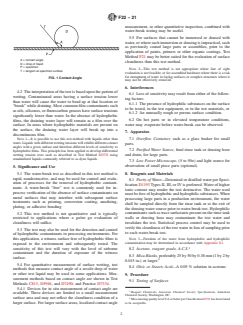
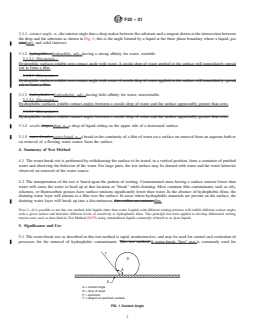
3.1.1 contact angle, n—the interior angle that a drop makes
responsibility of the user of this standard to establish appro-
between the substrate and a tangent drawn at the intersection
priate safety, health, and environmental practices and deter-
between the drop and the substrate as shown in Fig. 1; this is
mine the applicability of regulatory limitations prior to use.
theangleformedbyaliquidatthethreephaseboundarywhere
1.4 This international standard was developed in accor-
a liquid, gas (air), and solid intersect.
dance with internationally recognized principles on standard-
3.1.2 hydrophilic, adj—having a strong affinity for water,
ization established in the Decision on Principles for the
Development of International Standards, Guides and Recom- wettable.
mendations issued by the World Trade Organization Technical
3.1.2.1 Discussion—Hydrophilic surfaces exhibit zero con-
Barriers to Trade (TBT) Committee.
tact angle with water. A sessile drop of water applied to the
surface will immediately spread out to form a film.
2. Referenced Documents
3.1.3 hydrophobic, adj—havinglittleaffinityforwater,non-
2.1 ASTM Standards:
wettable.
C813TestMethodforHydrophobicContaminationonGlass
3.1.3.1 Discussion—Hydrophobic surfaces exhibit contact
by Contact Angle Measurement
angles between a sessile drop of water and the surface
D351Classification for Natural Muscovite Block Mica and
appreciably greater than zero.
Thins Based on Visual Quality
3.1.4 sessile drop, n—a drop of liquid sitting on the upper
D1193Specification for Reagent Water
side of a horizontal surface.
D2578TestMethodforWettingTensionofPolyethyleneand
Polypropylene Films
3.1.5 water-break, n—a break in the continuity of a film of
water on a surface on removal from an aqueous bath or on
removal of a flowing water source from the surface.
This test method is under the jurisdiction of ASTM Committee E21 on Space
Simulation andApplications of SpaceTechnology and is the direct responsibility of
Subcommittee E21.05 on Contamination. 4. Summary of Test Method
Current edition approved Dec. 1, 2021. Published December 2021. Originally
4.1 The water-break test is performed by withdrawing the
approved in 1962. Last previous edition approved in 2021 as F22–13(2021). DOI:
10.1520/F0022-21.
surface to be tested, in a vertical position, from a container of
For referenced ASTM standards, visit the ASTM website, www.astm.org, or
purified water and observing the behavior of the water. For
contact ASTM Customer Service at service@astm.org. For Annual Book of ASTM
large parts, the test surface may be doused with water and the
Standards volume information, refer to the standard’s Document Summary page on
the ASTM website. water behavior observed on removal of the water source.
*A Summary of Changes section appears at the end of this standard
Copyright © ASTM International, 100 Barr Harbor Drive, PO Box C700, West Conshohocken, PA 19428-2959. United States
F22−21
measurement, or other quantitative inspection, combined with
water-break testing may be useful.
5.5 For surfaces that cannot be immersed or doused with
water,orwheresuchimmersionordousingisimpractical,such
as previously coated large parts or assemblies, prior to the
application of paints, primers or other organic coatings, Test
Method F21 may be better suited for the evaluation of surface
A = contact angle
cleanliness than this test method.
D=dropofliquid
P = specimen
NOTE 2—This test method is not appropriate where line of sight
T = tangent at specimen surface
evaluation is not feasible; or for assembled hardware where there is a risk
for entrapment of water in faying surfaces or complex structures where it
FIG. 1 Contact Angle
may not be effectively removed.
6. Interferences
4.2 Theinterpretationofthetestisbaseduponthepatternof
6.1 Loss of sensitivity may result from either of the follow-
wetting. Contaminated areas having a surface tension lower
ing factors:
than water will cause the water to bead up at that location or
6.1.1 The presence of hydrophilic substances on the surface
“break” while draining. Most common film contaminants such
to be tested, in the test equipment, or in the test materials, or
asoils,silicones,orfluorocarbongreaseshavesurfacetensions
6.1.2 An unusually rough or porous surface condition.
significantly lower than water. In the absence of hydrophobic
6.2 On hot parts or in elevated temperature conditions,
films, the draining water layer will remain as a film over the
water may evaporate before water-break can be observed.
surface. In areas where hydrophobic materials are present on
the surface, the draining water layer will break up into a
7. Apparatus
discontinuous film.
7.1 Overflow Container, such as a glass beaker for small
NOTE 1—It is possible to use this test method with liquids other than
water.Liquidswithdifferentwettingtensionswillexhibitdifferentcontact parts.
angles with a given surface and therefore different levels of sensitivity to
7.2 Purified Water Source, final rinse tank or dousing hose
hydrophobic films.This principle has been applied to develop differential
and drain, for large parts.
wetting tension tests such as described in Test Method D2578 using
standardized liquids commonly referred to as dyne liquids.
7.3 Low Power Microscope, (5 to 50×) and light source for
observation of small piece parts (optional).
5. Significance and Use
5.1 The water-break test as described in this test method is 8. Reagents and Materials
rapid, nondestructive, and may be used for control and evalu-
8.1 Purity of Water—DeionizedordistilledwaterperSpeci-
ation of processes for the removal of hydrophobic contami-
ficationD1193TypesII,III,orIVispreferred.Waterofhigher
nants. A water-break “free” test is commonly used for in-
ionic content may render the test destructive. The water used
process verification of the absence of surface contaminants on
mustbefreeofhydrophobicandhydrophilicsubstances.When
metal surfaces that may interfere with subsequent surface
processing large parts in a production environment, the water
treatments such as priming, conversion coating, anodizing,
shall be sampled directly from the rinse tank or at the exit of
plating, or adhesive bonding
thedousingwatersourcepriortowater-breaktest.Hydrophilic
contaminantssuchastracesurfactantspresentontherinsetank
5.2 This test method is not quantitative and is typically
restricted to applications where a go/no go evaluation of walls or dousing hose may contaminate the test water and
invalidate the test. Statistical process control may be used to
cleanliness will suffice.
verifythecleanlinessofthetestwaterinlieuofsamplingprior
5.3 The test may also be used for the detection and control
to each water-break test.
of hydrophobic contaminants in processing environments. For
this application, a witness surface free of hydrophobic films is
NOTE 3—Freedom of the water from hydrophobic and hydrophilic
contamination may be determined in accordance with Appendix X1.
exposed to the environment and subsequently tested. The
sensitivity of this test will vary with the level of airborne
8.2 Acetone, reagent grade, A.C.S.
contaminant and the duration of exposure of the witness
8.3 Mica Blanks,preferably25by50by0.38mm(1by2by
surface.
0.015 in.) or larger.
5.4 For quantitative measurement of surface wetting, test
8.4 Oleic or Stearic Acid—A 0.05% solution in acetone.
methods that measure contact angle of a sessile drop of water
or other test liquid may be used in some applications. Mea-
9. Procedure
surement methods based on contact angle are shown in Test
9.1 Testing of Surfaces
Metho
...
This document is not an ASTM standard and is intended only to provide the user of an ASTM standard an indication of what changes have been made to the previous version. Because
it may not be technically possible to adequately depict all changes accurately, ASTM recommends that users consult prior editions as appropriate. In all cases only the current version
of the standard as published by ASTM is to be considered the official document.
Designation: F22 − 13 (Reapproved 2021) F22 − 21
Standard Test Method for
Hydrophobic Surface Films by the Water-Break Test
This standard is issued under the fixed designation F22; the number immediately following the designation indicates the year of original
adoption or, in the case of revision, the year of last revision. A number in parentheses indicates the year of last reapproval. A superscript
epsilon (´) indicates an editorial change since the last revision or reapproval.
This standard has been approved for use by agencies of the U.S. Department of Defense.
1. Scope Scope*
1.1 This test method covers the detection of the presence of hydrophobic (nonwetting) films on surfaces and the presence of
hydrophobic organic materials in processing environments. When properly conducted, the test will enable detection of molecular
layers of hydrophobic organic contaminants. On very rough or porous surfaces, the sensitivity of the test may be significantly
decreased.
1.2 Units—The values stated in SI units are to be regarded as the standard. The inch-pound values given in parentheses are for
information only.after SI units are provided for information only and are not considered standard.
1.3 This standard does not purport to address all of the safety concerns, if any, associated with its use. It is the responsibility
of the user of this standard to establish appropriate safety, health, and environmental practices and determine the applicability of
regulatory limitations prior to use.
1.4 This international standard was developed in accordance with internationally recognized principles on standardization
established in the Decision on Principles for the Development of International Standards, Guides and Recommendations issued
by the World Trade Organization Technical Barriers to Trade (TBT) Committee.
2. Referenced Documents
2.1 ASTM Standards:
C813 Test Method for Hydrophobic Contamination on Glass by Contact Angle Measurement
D351 Classification for Natural Muscovite Block Mica and Thins Based on Visual Quality
D1193 Specification for Reagent Water
D2578 Test Method for Wetting Tension of Polyethylene and Polypropylene Films
D5946 Test Method for Corona-Treated Polymer Films Using Water Contact Angle Measurements
D7334 Practice for Surface Wettability of Coatings, Substrates and Pigments by Advancing Contact Angle Measurement
D7490 Test Method for Measurement of the Surface Tension of Solid Coatings, Substrates and Pigments using Contact Angle
Measurements
F21 Test Method for Hydrophobic Surface Films by the Atomizer Test
3. Terminology
3.1 Definitions:
This test method is under the jurisdiction of ASTM Committee E21 on Space Simulation and Applications of Space Technology and is the direct responsibility of
Subcommittee E21.05 on Contamination.
Current edition approved April 1, 2021Dec. 1, 2021. Published May 2021December 2021. Originally approved in 1962. Last previous edition approved in 20132021 as
F22 – 13.F22 – 13(2021). DOI: 10.1520/F0022-13R21.10.1520/F0022-21.
For referenced ASTM standards, visit the ASTM website, www.astm.org, or contact ASTM Customer Service at service@astm.org. For Annual Book of ASTM Standards
volume information, refer to the standard’s Document Summary page on the ASTM website.
*A Summary of Changes section appears at the end of this standard
Copyright © ASTM International, 100 Barr Harbor Drive, PO Box C700, West Conshohocken, PA 19428-2959. United States
F22 − 21
3.1.1 contact angle, n—the interior angle that a drop makes between the substrate and a tangent drawn at the intersection between
the drop and the substrate as shown in Fig. 1; this is the angle formed by a liquid at the three phase boundary where a liquid, gas
(air)(air), and solid intersect.
3.1.2 hydrophilic—hydrophilic, adj—having a strong affinity for water, wettable.
3.1.2.1 Discussion—
Hydrophilic surfaces exhibit zero contact angle with water. A sessile drop of water applied to the surface will immediately spread
out to form a film.
3.1.2.1 Discussion—
Hydrophilic surfaces exhibit zero contact angle with water. A sessile drop of water applied to the surface will immediately spread
out to form a film.
3.1.3 hydrophobic—hydrophobic, adj—having little affinity for water, nonwettable.
3.1.3.1 Discussion—
Hydrophobic surfaces exhibit contact angles between a sessile drop of water and the surface appreciably greater than zero.
3.1.3.1 Discussion—
Hydrophobic surfaces exhibit contact angles between a sessile drop of water and the surface appreciably greater than zero.
3.1.4 sessile drop—drop, n—a drop of liquid sitting on the upper side of a horizontal surface.
3.1.5 water-break—water-break, n—a break in the continuity of a film of water on a surface on removal from an aqueous bath or
on removal of a flowing water source from the surface.
4. Summary of Test Method
4.1 The water-break test is performed by withdrawing the surface to be tested, in a vertical position, from a container of purified
water and observing the behavior of the water. For large parts, the test surface may be doused with water and the water behavior
observed on removal of the water source.
4.2 The interpretation of the test is based upon the pattern of wetting. Contaminated areas having a surface tension lower than
water will cause the water to bead up at that location or “break” while draining. Most common film contaminants such as oils,
silicones, or fluorocarbon greases have surface tensions significantly lower than water. In the absence of hydrophobic films, the
draining water layer will remain as a film over the surface. In areas where hydrophobic materials are present on the surface, the
draining water layer will break up into a discontinuous film within one minute.film.
NOTE 1—It is possible to use this test method with liquids other than water. Liquids with different wetting tensions will exhibit different contact angles
with a given surface and therefore different levels of sensitivity to hydrophobic films. This principle has been applied to develop differential wetting
tension tests such as described in Test Method D2578 using standardized liquids commonly referred to as dyne liquids.
5. Significance and Use
5.1 The water-break test as described in this test method is rapid, nondestructive, and may be used for control and evaluation of
processes for the removal of hydrophobic contaminants. This test method A water-break “free” test is commonly used for
A = contact angle
D = drop of liquid
P = specimen
T = tangent at specimen surface
FIG. 1 Contact Angle
F22 − 21
in-process verification of the absence of surface contaminants on metal surfaces that may interfere with subsequent surface
treatments such as priming, conversion coating, anodizing, plating, or adhesive bonding
5.2 This test method is not quantitative and is typically restricted to applications where a go/no go evaluation of cleanliness will
suffice.
5.3 The test may also be used for the detection and control of hydrophobic contaminants in processing environments. For this
application, a witness surface free of hydrophobic films is exposed to the environment and subsequently tested. The sensitivity of
this test will vary with the level of airborne contaminant and the duration of exposure of the witness surface.
5.4 For quantitative measurement of surface wetting, test methods that measure contact angle of a sessile drop of water or other
test liquid may be used in some applications. Measurement methods based on contact angle are shown in Test Methods C813,
D5946, and D7490; and Practice D7334.
5.4.1 Devices for in situ measurement of contact angle are available. These devices are limited to a small measurement surface
area and may not reflect the cleanliness condition of a larger surface. For larger surface areas, localized contact angle measurement,
or other quantitative inspection, combined with water-break testing may be useful.
5.5 For surfaces that cannot be immersed or doused with water, or where such immersion or dousing is impractical, such as
previously coated large parts or assemblies, prior to the application of paints, primers or other organic coatings, Test Method F21
may be useful.better suited for the evaluation of surface cleanliness than this test method.
NOTE 2—This test method is not appropriate where line of sight evaluation is not feasible; or for assembled hardware where there is a risk for entrapment
of water in faying surfaces or complex structures where it may not be effectively removed.
6. Interferences
6.1 Loss of sensitivity may result from either of the following factors:
6.1.1 The presence of hydrophilic substances on the surface to be tested, in the test equipment, or in the test materials, or
6.1.2 An unusually rough or porous surface condition.
6.2 On hot parts or in elevated temperature conditions, water may evaporate before water-break can be observed.
7. Apparatus
7.1 Overflow Container, such as a glass beaker for small parts.
7.2 Purified Water Source, final rinse tank or dousing hose and drain, for large parts.
7.3 Low Power Microscope, (5 to 50×) and light source for observation of small piece parts (optional).
8. Reagents and Materials
8.1 Purity of Water—Deionized or distilled water per Specification D1193 Types II, III, or IV is preferred. Water of higher ionic
content may render the test destructive. The water used must be free of hydrophobic and hydrophilic substances.When substances.
When processing large parts in a production environment, the water shall be sampled directly from the rinse tank or at the exit
of the dousing water source prior to water-break test. Hydrophilic contaminants such as trace surfactants present on the rinse tank
walls or dousing hose may contaminate the test water and invalidate the test. Statistical process control may be used to verify the
cleanliness
...