


ASTM D7633-13(2018)
(Test Method)Standard Test Method for Carbon Black—Carbon Content
Standard Test Method for Carbon Black—Carbon Content
SIGNIFICANCE AND USE
4.1 The total carbon content of a carbon black is a requirement for the calculation and reporting of carbon dioxide emissions. It can also be used in calculations to estimate yield of the process.
SCOPE
1.1 This test method covers the instrumental determination of carbon content in a carbon black sample. Values obtained represent the total carbon content.
1.2 The method is applicable to tread, carcass and specialty type carbon blacks obtained from partial combustion or thermal decomposition processes, which typically contain 95 to 100 % carbon.
1.3 The results of these tests can be expressed as mass % carbon.
1.4 The values stated in SI units are to be regarded as standard. No other units of measurement are included in this standard.
1.5 This standard does not purport to address all of the safety concerns, if any, associated with its use. It is the responsibility of the user of this standard to establish appropriate safety, health, and environmental practices and determine the applicability of regulatory limitations prior to use.
1.6 This international standard was developed in accordance with internationally recognized principles on standardization established in the Decision on Principles for the Development of International Standards, Guides and Recommendations issued by the World Trade Organization Technical Barriers to Trade (TBT) Committee.
General Information
Buy Standard
Standards Content (Sample)
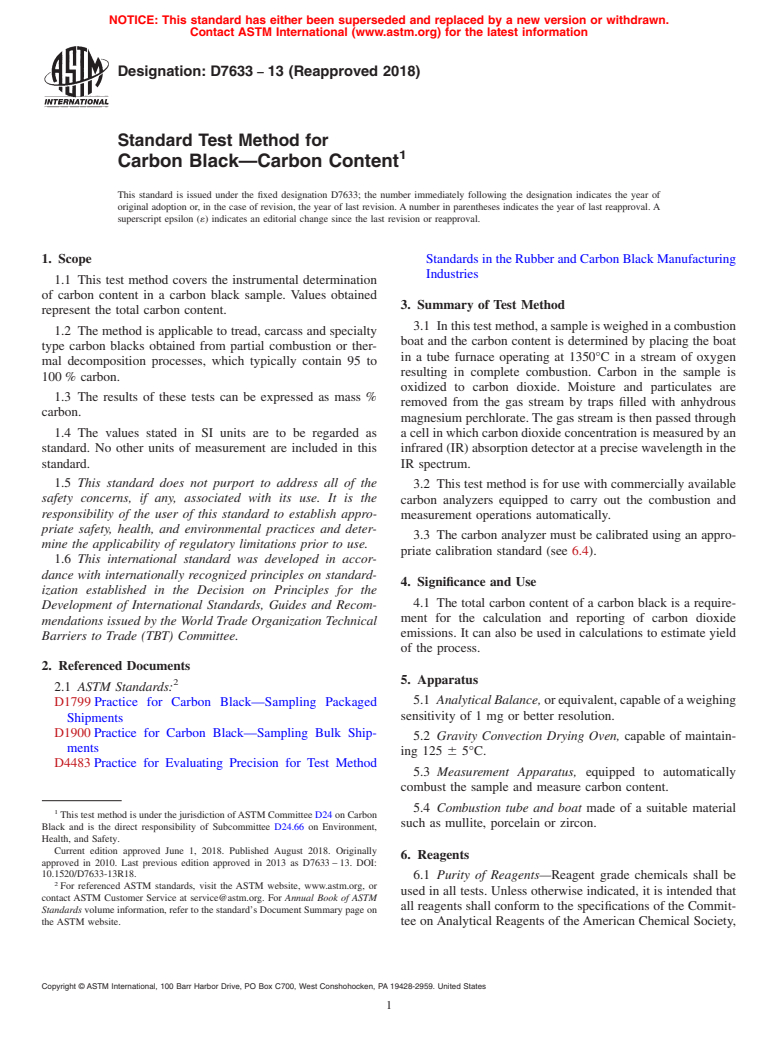
NOTICE: This standard has either been superseded and replaced by a new version or withdrawn.
Contact ASTM International (www.astm.org) for the latest information
Designation: D7633 − 13 (Reapproved 2018)
Standard Test Method for
Carbon Black—Carbon Content
This standard is issued under the fixed designation D7633; the number immediately following the designation indicates the year of
original adoption or, in the case of revision, the year of last revision. A number in parentheses indicates the year of last reapproval. A
superscript epsilon (´) indicates an editorial change since the last revision or reapproval.
1. Scope Standards in the Rubber and Carbon Black Manufacturing
Industries
1.1 This test method covers the instrumental determination
of carbon content in a carbon black sample. Values obtained
3. Summary of Test Method
represent the total carbon content.
3.1 In this test method, a sample is weighed in a combustion
1.2 The method is applicable to tread, carcass and specialty
boat and the carbon content is determined by placing the boat
type carbon blacks obtained from partial combustion or ther-
in a tube furnace operating at 1350°C in a stream of oxygen
mal decomposition processes, which typically contain 95 to
resulting in complete combustion. Carbon in the sample is
100 % carbon.
oxidized to carbon dioxide. Moisture and particulates are
1.3 The results of these tests can be expressed as mass %
removed from the gas stream by traps filled with anhydrous
carbon.
magnesium perchlorate. The gas stream is then passed through
1.4 The values stated in SI units are to be regarded as a cell in which carbon dioxide concentration is measured by an
standard. No other units of measurement are included in this infrared (IR) absorption detector at a precise wavelength in the
standard. IR spectrum.
1.5 This standard does not purport to address all of the
3.2 This test method is for use with commercially available
safety concerns, if any, associated with its use. It is the
carbon analyzers equipped to carry out the combustion and
responsibility of the user of this standard to establish appro-
measurement operations automatically.
priate safety, health, and environmental practices and deter-
3.3 The carbon analyzer must be calibrated using an appro-
mine the applicability of regulatory limitations prior to use.
priate calibration standard (see 6.4).
1.6 This international standard was developed in accor-
dance with internationally recognized principles on standard-
4. Significance and Use
ization established in the Decision on Principles for the
4.1 The total carbon content of a carbon black is a require-
Development of International Standards, Guides and Recom-
ment for the calculation and reporting of carbon dioxide
mendations issued by the World Trade Organization Technical
emissions. It can also be used in calculations to estimate yield
Barriers to Trade (TBT) Committee.
of the process.
2. Referenced Documents
5. Apparatus
2.1 ASTM Standards:
5.1 Analytical Balance,orequivalent,capableofaweighing
D1799 Practice for Carbon Black—Sampling Packaged
sensitivity of 1 mg or better resolution.
Shipments
D1900 Practice for Carbon Black—Sampling Bulk Ship-
5.2 Gravity Convection Drying Oven, capable of maintain-
ments
ing 125 6 5°C.
D4483 Practice for Evaluating Precision for Test Method
5.3 Measurement Apparatus, equipped to automatically
combust the sample and measure carbon content.
5.4 Combustion tube and boat made of a suitable material
This test method is under the jurisdiction ofASTM Committee D24 on Carbon
such as mullite, porcelain or zircon.
Black and is the direct responsibility of Subcommittee D24.66 on Environment,
Health, and Safety.
Current edition approved June 1, 2018. Published August 2018. Originally
6. Reagents
approved in 2010. Last previous edition approved in 2013 as D7633 – 13. DOI:
10.1520/D7633-13R18.
6.1 Purity of Reagents—Reagent grade chemicals shall be
For referenced ASTM standards, visit the ASTM website, www.astm.org, or
used in all tests. Unless otherwise indicated, it is intended that
contact ASTM Customer Service at service@astm.org. For Annual Book of ASTM
all reagents shall conform to the specifications of the Commit-
Standards volume information, refer to the standard’s Document Summary page on
the ASTM website. tee onAnalytical Reagents of theAmerican Chemical Society,
Copyright © ASTM International, 100 Barr Harbor Drive, PO Box C700, West Conshohocken, PA 19428-2959. United States
D7633 − 13 (2018)
where such specifications are available. Other grades may be 10.4 Weigh approximately 0.1 g of the sample or use
used, provided it is first ascertained that the reagent is of recommended mass per manufacturer.
sufficiently high purity to permit its use without lessening the
10.5 Spread the sample in the combustion boat and record
accuracy of the determination.
the sample weight.
6.2 Magnesium Perchlorate.
10.6 Initiate the analysis and place the sample in the
6.3 Oxygen, high purity, 99.9 %. instrument using a boat puller or the auto-sampler mechanism.
6.4 Calibration standard. 10.7 When the analysis is complete, the instrument should
indicate the carbon value. Refer to the manufacturer’s recom-
7. Sampling
mended procedure.
7.1 Samples of candidate carbon blacks shall be taken in
11. Report
accordance with Practice D1799 or D1900.
11.1 The percent carbon value is obtained directly from the
8. Preparation of Apparatus
apparatus.
8.1 Assemble the apparatus according to the manufacturer’s
11.2 Report results from individual determinations to the
instructions.
nearest 0.1 %.
8.2 Stabilize the furnace temperature at 1350 6 15°C.
NOTE 1—The most representative measurement of carbon content in a
carbon black sample is an average value from multiple individual
8.3 Makeaminimumoftwodeterminationstoconditionthe
determinations.Agood practice is to report a minimum of two individual
equipment or follow manufacturer’s recommendation to con-
determinations for a given sample.
dition equipment prior to calibrating the instrument.
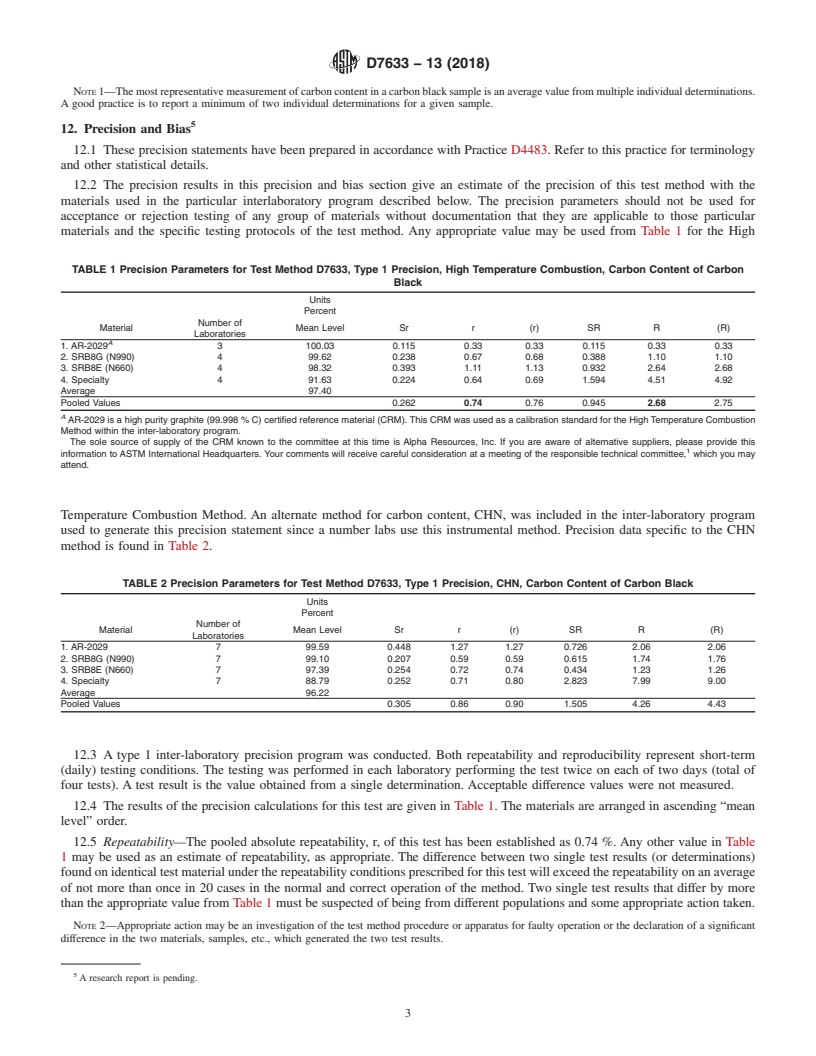
12. Precision and Bias
9. Calibration
12.1 These precision statements have been prepared in
9.1 Calibrate the instrument per manufacturer’s recommen-
accordance with Practice D4483. Refer to this practice for
dation using a carbon calibration standard.
terminology and other statistical details.
9.2 Adjustment of Response of Measurement System—
12.2 The precision results in this precision and bias section
Weigh approximately 0.1 g of calibration standard or use
give an estimate of the precision of this test method with the
recommended mass per manufacturer.Analyze the sample (see
materials used in the particular interlaboratory program de-
Section 10). Repeat this procedure. Adjust instrument as
scribed below.The precision parameters should not be used for
recommended by the manufacturer until the absence of drift is
acceptance or rejection testing of any group of materials
indicated.
without documentation that they are applicable to those par-
9.3 Calibration Procedure—Follow the calibration proce-
ticular materials and the specific testing protocols of the test
dure recommended by the manufacturer. Confirm the calibra-
method. A
...
This document is not an ASTM standard and is intended only to provide the user of an ASTM standard an indication of what changes have been made to the previous version. Because
it may not be technically possible to adequately depict all changes accurately, ASTM recommends that users consult prior editions as appropriate. In all cases only the current version
of the standard as published by ASTM is to be considered the official document.
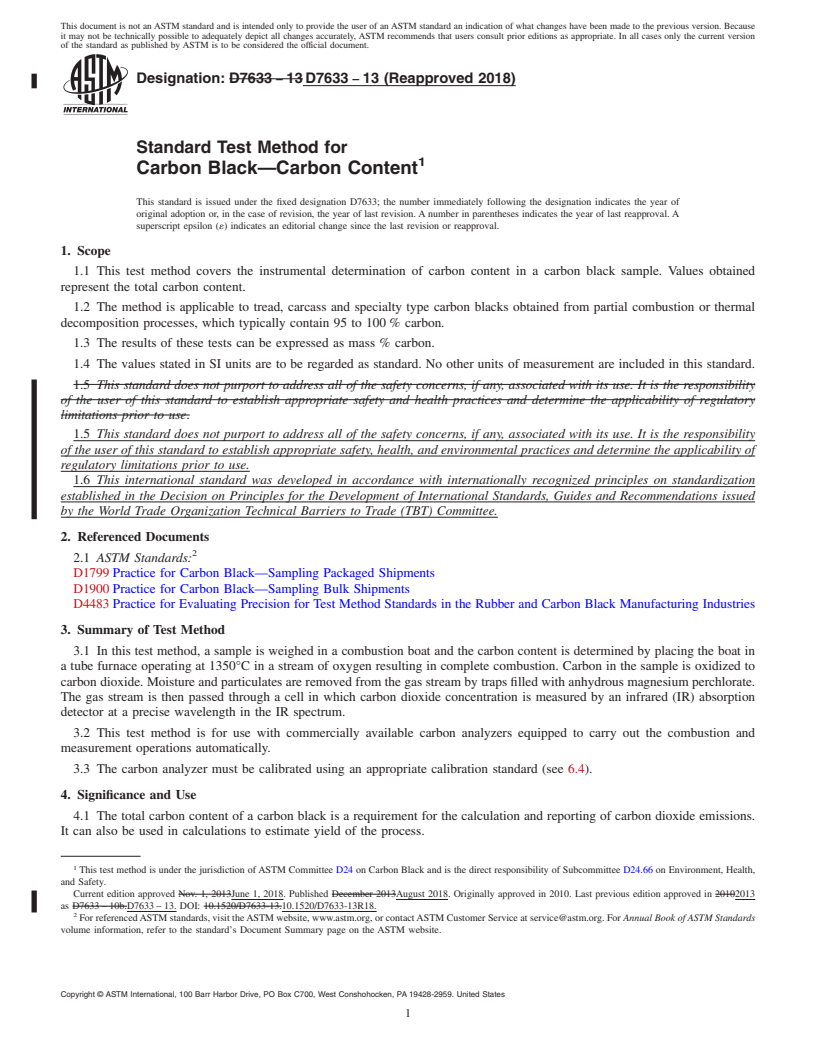
Designation: D7633 − 13 D7633 − 13 (Reapproved 2018)
Standard Test Method for
Carbon Black—Carbon Content
This standard is issued under the fixed designation D7633; the number immediately following the designation indicates the year of
original adoption or, in the case of revision, the year of last revision. A number in parentheses indicates the year of last reapproval. A
superscript epsilon (´) indicates an editorial change since the last revision or reapproval.
1. Scope
1.1 This test method covers the instrumental determination of carbon content in a carbon black sample. Values obtained
represent the total carbon content.
1.2 The method is applicable to tread, carcass and specialty type carbon blacks obtained from partial combustion or thermal
decomposition processes, which typically contain 95 to 100 % carbon.
1.3 The results of these tests can be expressed as mass % carbon.
1.4 The values stated in SI units are to be regarded as standard. No other units of measurement are included in this standard.
1.5 This standard does not purport to address all of the safety concerns, if any, associated with its use. It is the responsibility
of the user of this standard to establish appropriate safety and health practices and determine the applicability of regulatory
limitations prior to use.
1.5 This standard does not purport to address all of the safety concerns, if any, associated with its use. It is the responsibility
of the user of this standard to establish appropriate safety, health, and environmental practices and determine the applicability of
regulatory limitations prior to use.
1.6 This international standard was developed in accordance with internationally recognized principles on standardization
established in the Decision on Principles for the Development of International Standards, Guides and Recommendations issued
by the World Trade Organization Technical Barriers to Trade (TBT) Committee.
2. Referenced Documents
2.1 ASTM Standards:
D1799 Practice for Carbon Black—Sampling Packaged Shipments
D1900 Practice for Carbon Black—Sampling Bulk Shipments
D4483 Practice for Evaluating Precision for Test Method Standards in the Rubber and Carbon Black Manufacturing Industries
3. Summary of Test Method
3.1 In this test method, a sample is weighed in a combustion boat and the carbon content is determined by placing the boat in
a tube furnace operating at 1350°C in a stream of oxygen resulting in complete combustion. Carbon in the sample is oxidized to
carbon dioxide. Moisture and particulates are removed from the gas stream by traps filled with anhydrous magnesium perchlorate.
The gas stream is then passed through a cell in which carbon dioxide concentration is measured by an infrared (IR) absorption
detector at a precise wavelength in the IR spectrum.
3.2 This test method is for use with commercially available carbon analyzers equipped to carry out the combustion and
measurement operations automatically.
3.3 The carbon analyzer must be calibrated using an appropriate calibration standard (see 6.4).
4. Significance and Use
4.1 The total carbon content of a carbon black is a requirement for the calculation and reporting of carbon dioxide emissions.
It can also be used in calculations to estimate yield of the process.
This test method is under the jurisdiction of ASTM Committee D24 on Carbon Black and is the direct responsibility of Subcommittee D24.66 on Environment, Health,
and Safety.
Current edition approved Nov. 1, 2013June 1, 2018. Published December 2013August 2018. Originally approved in 2010. Last previous edition approved in 20102013
as D7633 – 10b.D7633 – 13. DOI: 10.1520/D7633-13.10.1520/D7633-13R18.
For referenced ASTM standards, visit the ASTM website, www.astm.org, or contact ASTM Customer Service at service@astm.org. For Annual Book of ASTM Standards
volume information, refer to the standard’s Document Summary page on the ASTM website.
Copyright © ASTM International, 100 Barr Harbor Drive, PO Box C700, West Conshohocken, PA 19428-2959. United States
D7633 − 13 (2018)
5. Apparatus
5.1 Analytical Balance, or equivalent, capable of a weighing sensitivity of 1 mg or better resolution.
5.2 Gravity Convection Drying Oven, capable of maintaining 125 6 5°C.
5.3 Measurement Apparatus, equipped to automatically combust the sample and measure carbon content.
5.4 Combustion tube and boat made of a suitable material such as mullite, porcelain or zircon.
6. Reagents
6.1 Purity of Reagents—Reagent grade chemicals shall be used in all tests. Unless otherwise indicated, it is intended that all
reagents shall conform to the specifications of the Committee on Analytical Reagents of the American Chemical Society, where
such specifications are available. Other grades may be used, provided it is first ascertained that the reagent is of sufficiently high
purity to permit its use without lessening the accuracy of the determination.
6.2 Magnesium Perchlorate.
6.3 Oxygen, high purity, 99.9 %.
6.4 Calibration standard.
7. Sampling
7.1 Samples of candidate carbon blacks shall be taken in accordance with Practice D1799 or D1900.
8. Preparation of Apparatus
8.1 Assemble the apparatus according to the manufacturer’s instructions.
8.2 Stabilize the furnace temperature at 1350 6 15°C.
8.3 Make a minimum of two determinations to condition the equipment or follow manufacturer’s recommendation to condition
equipment prior to calibrating the instrument.
9. Calibration
9.1 Calibrate the instrument per manufacturer’s recommendation using a carbon calibration standard.
9.2 Adjustment of Response of Measurement System—Weigh approximately 0.1 g of calibration standard or use recommended
mass per manufacturer. Analyze the sample (see Section 10). Repeat this procedure. Adjust instrument as recommended by the
manufacturer until the absence of drift is indicated.
9.3 Calibration Procedure—Follow the calibration procedure recommended by the manufacturer. Confirm the calibration by
analyzing a reference material of known carbon concentration. Reference standards should be similar to carbon black with carbon
content of approximately 95-100 %. The measured value should be within allowable limits of the known value. If not, repeat the
procedure. If acceptable results are not obtained refer to the manufacturer’s instructions for calibration.
10. Procedure
10.1 Sample Preparation—Dry an adequate sample of the carbon black for at least 1 h in a gravity-convection oven set at 125
6 5°C, in an open container of suitable dimensions, so that the depth of black is no more than 10 mm. Cool to room temperature
in a desiccator before use.
10.2 Stabilize and verify calibration of the analyzer (see 8.1 through 9.3).
10.3 Confirm the furnace temperature is 1350 6 15°C.
10.4 Weigh approximately 0.1 g of the sample or use recommended mass per manufacturer.
10.5 Spread the sample in the combustion boat and record the sample weight.
10.6 Initiate the analysis and place the sample in the instrument using a boat puller or the auto-sampler mechanism.
10.7 When the analysis is complete, the instrument should indicate the carbon value. Refer to the manufacturer’s
...
Questions, Comments and Discussion
Ask us and Technical Secretary will try to provide an answer. You can facilitate discussion about the standard in here.