


ASTM E1299-96(2016)
(Specification)Standard Specification for Reusable Phase-Change-Type Fever Thermometer for Intermittent Determination of Human Temperature
Standard Specification for Reusable Phase-Change-Type Fever Thermometer for Intermittent Determination of Human Temperature
SCOPE
1.1 This specification covers reusable phase-change-type clinical thermometers.
1.2 The following safety hazards caveat pertains only to the test method portion, Section 6, of this specification. This standard does not purport to address all of the safety concerns, if any, associated with its use. It is the responsibility of the user of this standard to establish appropriate safety and health practices and determine the applicability of regulatory limitations prior to use.
General Information
Buy Standard
Standards Content (Sample)
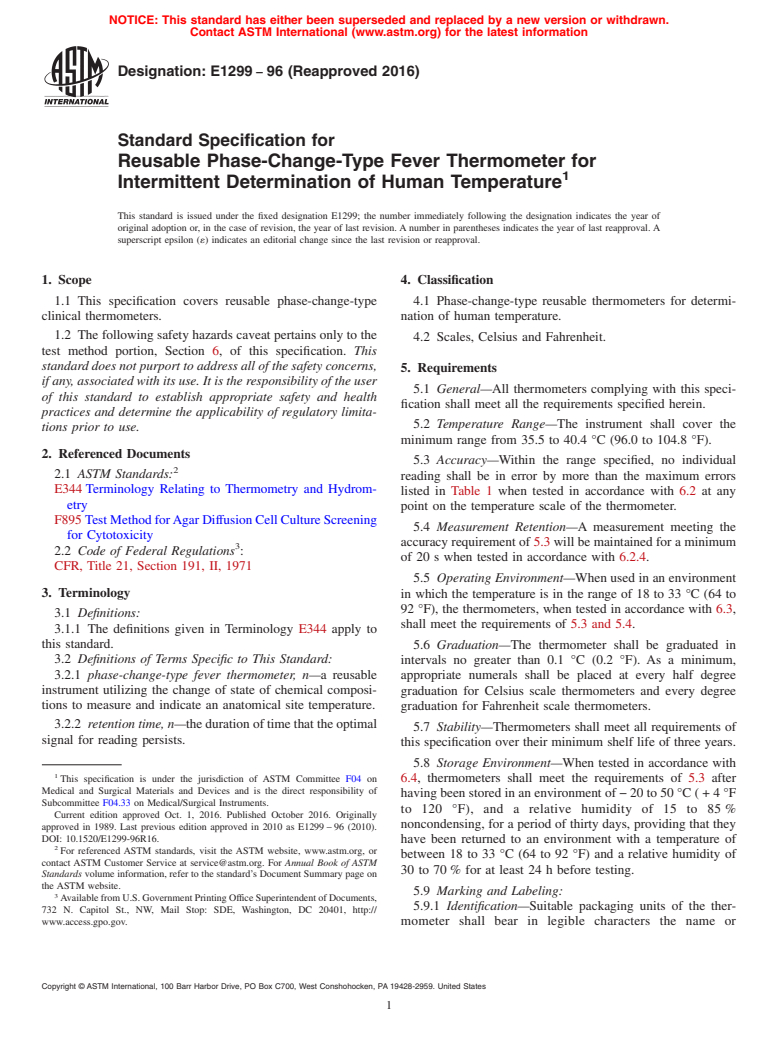
NOTICE: This standard has either been superseded and replaced by a new version or withdrawn.
Contact ASTM International (www.astm.org) for the latest information
Designation: E1299 − 96 (Reapproved 2016)
Standard Specification for
Reusable Phase-Change-Type Fever Thermometer for
Intermittent Determination of Human Temperature
This standard is issued under the fixed designation E1299; the number immediately following the designation indicates the year of
original adoption or, in the case of revision, the year of last revision. A number in parentheses indicates the year of last reapproval. A
superscript epsilon (´) indicates an editorial change since the last revision or reapproval.
1. Scope 4. Classification
1.1 This specification covers reusable phase-change-type 4.1 Phase-change-type reusable thermometers for determi-
clinical thermometers. nation of human temperature.
1.2 The following safety hazards caveat pertains only to the
4.2 Scales, Celsius and Fahrenheit.
test method portion, Section 6, of this specification. This
standard does not purport to address all of the safety concerns,
5. Requirements
if any, associated with its use. It is the responsibility of the user
5.1 General—All thermometers complying with this speci-
of this standard to establish appropriate safety and health
fication shall meet all the requirements specified herein.
practices and determine the applicability of regulatory limita-
5.2 Temperature Range—The instrument shall cover the
tions prior to use.
minimum range from 35.5 to 40.4 °C (96.0 to 104.8 °F).
2. Referenced Documents
5.3 Accuracy—Within the range specified, no individual
2.1 ASTM Standards:
reading shall be in error by more than the maximum errors
E344 Terminology Relating to Thermometry and Hydrom-
listed in Table 1 when tested in accordance with 6.2 at any
etry
point on the temperature scale of the thermometer.
F895 Test Method for Agar Diffusion Cell Culture Screening
5.4 Measurement Retention—A measurement meeting the
for Cytotoxicity
accuracy requirement of 5.3 will be maintained for a minimum
2.2 Code of Federal Regulations :
of 20 s when tested in accordance with 6.2.4.
CFR, Title 21, Section 191, II, 1971
5.5 Operating Environment—When used in an environment
3. Terminology
in which the temperature is in the range of 18 to 33 °C (64 to
92 °F), the thermometers, when tested in accordance with 6.3,
3.1 Definitions:
shall meet the requirements of 5.3 and 5.4.
3.1.1 The definitions given in Terminology E344 apply to
this standard. 5.6 Graduation—The thermometer shall be graduated in
3.2 Definitions of Terms Specific to This Standard:
intervals no greater than 0.1 °C (0.2 °F). As a minimum,
3.2.1 phase-change-type fever thermometer, n—a reusable appropriate numerals shall be placed at every half degree
instrument utilizing the change of state of chemical composi-
graduation for Celsius scale thermometers and every degree
tions to measure and indicate an anatomical site temperature.
graduation for Fahrenheit scale thermometers.
3.2.2 retention time, n—the duration of time that the optimal
5.7 Stability—Thermometers shall meet all requirements of
signal for reading persists.
this specification over their minimum shelf life of three years.
5.8 Storage Environment—When tested in accordance with
This specification is under the jurisdiction of ASTM Committee F04 on 6.4, thermometers shall meet the requirements of 5.3 after
Medical and Surgical Materials and Devices and is the direct responsibility of
having been stored in an environment of − 20 to 50 °C ( + 4 °F
Subcommittee F04.33 on Medical/Surgical Instruments.
to 120 °F), and a relative humidity of 15 to 85 %
Current edition approved Oct. 1, 2016. Published October 2016. Originally
noncondensing, for a period of thirty days, providing that they
approved in 1989. Last previous edition approved in 2010 as E1299 – 96 (2010).
DOI: 10.1520/E1299-96R16.
have been returned to an environment with a temperature of
For referenced ASTM standards, visit the ASTM website, www.astm.org, or
between 18 to 33 °C (64 to 92 °F) and a relative humidity of
contact ASTM Customer Service at service@astm.org. For Annual Book of ASTM
30 to 70 % for at least 24 h before testing.
Standards volume information, refer to the standard’s Document Summary page on
the ASTM website.
5.9 Marking and Labeling:
Available from U.S. Government Printing Office Superintendent of Documents,
5.9.1 Identification—Suitable packaging units of the ther-
732 N. Capitol St., NW, Mail Stop: SDE, Washington, DC 20401, http://
www.access.gpo.gov. mometer shall bear in legible characters the name or
Copyright © ASTM International, 100 Barr Harbor Drive, PO Box C700, West Conshohocken, PA 19428-2959. United States
E1299 − 96 (2016)
TABLE 1 Maximum Error of Temperature Readings
6.2.3 Sampling—For each manufacturing lot, use a mini-
Celsius Scale mum of 200 thermometers in the accuracy determination,
Temperature Range, °C Maximum Error, °C
making at least five measurements with each thermometer. The
Below 35.8 ±0.3
criteria for lot acceptance shall be published by the manufac-
35.8 to 36.9 ±0.2
37.0 to 39.0 ±0.1 turer.
39.1 to 40.4 ±0.2
6.2.4 Measurement of Retention Time—After removing
thermometers from the water bath, wait 20 s and compare the
Fahrenheit Scale
Temperature Range, °F Maximum Error, °F
readings with those obtained immediately upon removing the
Below 98.0 ±0.4
thermometers from the water bath. These thermometers shall
98.0 to 102.0 ±0.2
meet the requirements of 5.3 at the temperature extremes of 18
Above 102.0 ±0.4
and 33 °C (64 and 92 °F) and the relative humidity extremes of
15 and 85 %.
6.3 Operating Environment Test—This test is used to deter-
trademark, or both, of the manufacturer or distributor and a
mine the compliance of the thermometers to the requirement of
designation (either a serial number or a code) to indicate the
5.5.
specific manufacturing lot.
6.3.1 Test Equipment:
5.9.2 Operating Instructions—Operating instructions shall
6.3.1.1 Constant-Temperature Water Baths, (6.2.1),
be provided with the packaging unit.
6.3.1.2 Forced-Circulation Air Oven, capable of heating
5.9.3 Care and Cleaning Instructions—Instructions for the
samples to 32 6 1 °C (90 6 2 °F),
care and cleaning of the thermometer shall be provided with
6.3.1.3 Refrigerated Chamber, capable of cooling samples
the packaging unit. A procedure for decontaminating the
to 19 6 1 °C (66 6 2 °F).
thermometer following each use shall be included with these
instructions.
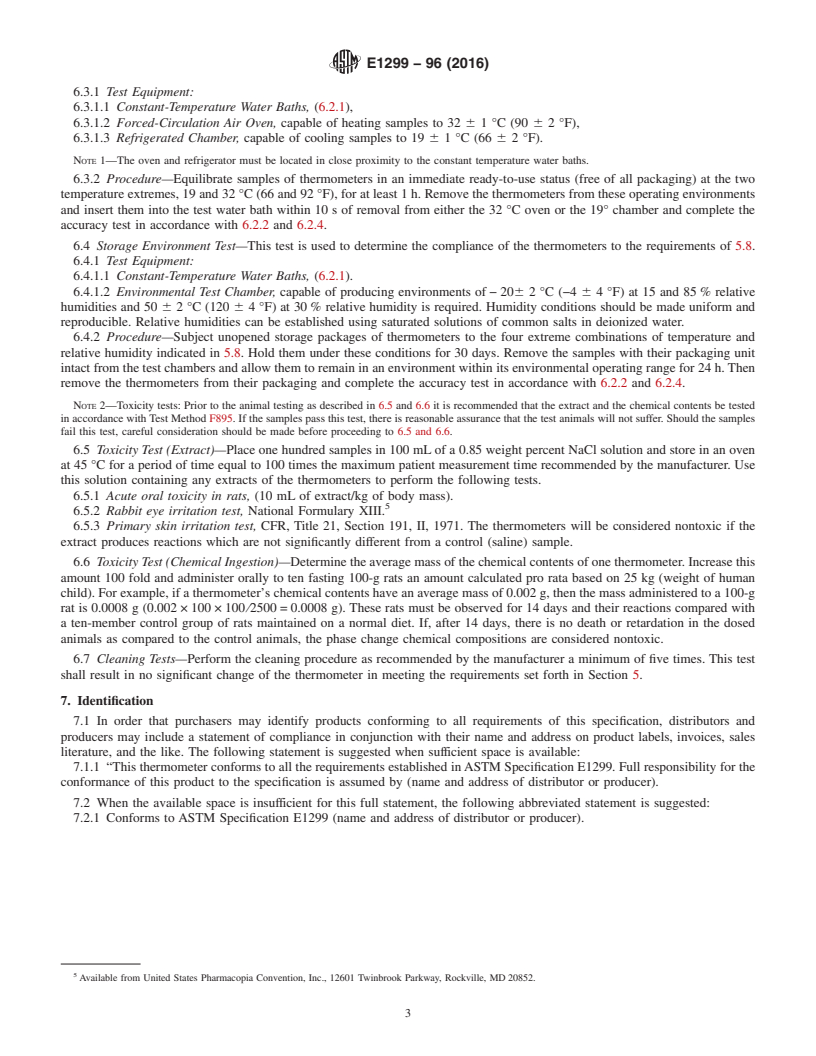
NOTE 1—The oven and refrigerator must be located in close proximity
to the constant temperature water baths.
5.10 Toxicity—When the thermometer is used as specified
6.3.2 Procedure—Equilibrate samples of thermometers in
by the manufacturer, the parts intended for contact with intact
an immediate ready-to-use status (free of all packaging) at the
natural channels or intact body surfaces during patient use and
two temperature extremes, 19 and 32 °C (66 and 92 °F), for at
its phase change chemical compositions shall be nontoxic as
least 1 h. Remove the thermometers from these operating
determined by 6.5.
environments and insert them into the test water bath within 10
6. Test Methods
...
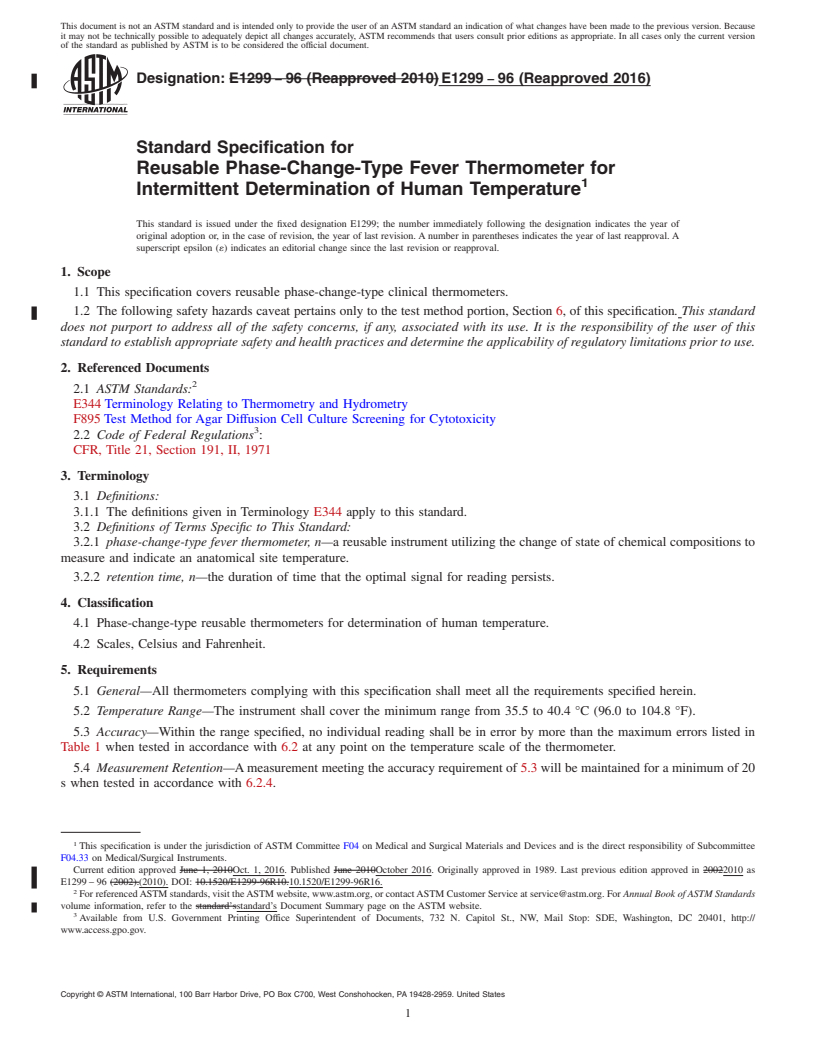
This document is not an ASTM standard and is intended only to provide the user of an ASTM standard an indication of what changes have been made to the previous version. Because
it may not be technically possible to adequately depict all changes accurately, ASTM recommends that users consult prior editions as appropriate. In all cases only the current version
of the standard as published by ASTM is to be considered the official document.
Designation: E1299 − 96 (Reapproved 2010) E1299 − 96 (Reapproved 2016)
Standard Specification for
Reusable Phase-Change-Type Fever Thermometer for
Intermittent Determination of Human Temperature
This standard is issued under the fixed designation E1299; the number immediately following the designation indicates the year of
original adoption or, in the case of revision, the year of last revision. A number in parentheses indicates the year of last reapproval. A
superscript epsilon (´) indicates an editorial change since the last revision or reapproval.
1. Scope
1.1 This specification covers reusable phase-change-type clinical thermometers.
1.2 The following safety hazards caveat pertains only to the test method portion, Section 6, of this specification. This standard
does not purport to address all of the safety concerns, if any, associated with its use. It is the responsibility of the user of this
standard to establish appropriate safety and health practices and determine the applicability of regulatory limitations prior to use.
2. Referenced Documents
2.1 ASTM Standards:
E344 Terminology Relating to Thermometry and Hydrometry
F895 Test Method for Agar Diffusion Cell Culture Screening for Cytotoxicity
2.2 Code of Federal Regulations :
CFR, Title 21, Section 191, II, 1971
3. Terminology
3.1 Definitions:
3.1.1 The definitions given in Terminology E344 apply to this standard.
3.2 Definitions of Terms Specific to This Standard:
3.2.1 phase-change-type fever thermometer, n—a reusable instrument utilizing the change of state of chemical compositions to
measure and indicate an anatomical site temperature.
3.2.2 retention time, n—the duration of time that the optimal signal for reading persists.
4. Classification
4.1 Phase-change-type reusable thermometers for determination of human temperature.
4.2 Scales, Celsius and Fahrenheit.
5. Requirements
5.1 General—All thermometers complying with this specification shall meet all the requirements specified herein.
5.2 Temperature Range—The instrument shall cover the minimum range from 35.5 to 40.4 °C (96.0 to 104.8 °F).
5.3 Accuracy—Within the range specified, no individual reading shall be in error by more than the maximum errors listed in
Table 1 when tested in accordance with 6.2 at any point on the temperature scale of the thermometer.
5.4 Measurement Retention—A measurement meeting the accuracy requirement of 5.3 will be maintained for a minimum of 20
s when tested in accordance with 6.2.4.
This specification is under the jurisdiction of ASTM Committee F04 on Medical and Surgical Materials and Devices and is the direct responsibility of Subcommittee
F04.33 on Medical/Surgical Instruments.
Current edition approved June 1, 2010Oct. 1, 2016. Published June 2010October 2016. Originally approved in 1989. Last previous edition approved in 20022010 as
E1299 – 96 (2002).(2010). DOI: 10.1520/E1299-96R10.10.1520/E1299-96R16.
For referenced ASTM standards, visit the ASTM website, www.astm.org, or contact ASTM Customer Service at service@astm.org. For Annual Book of ASTM Standards
volume information, refer to the standard’sstandard’s Document Summary page on the ASTM website.
Available from U.S. Government Printing Office Superintendent of Documents, 732 N. Capitol St., NW, Mail Stop: SDE, Washington, DC 20401, http://
www.access.gpo.gov.
Copyright © ASTM International, 100 Barr Harbor Drive, PO Box C700, West Conshohocken, PA 19428-2959. United States
E1299 − 96 (2016)
TABLE 1 Maximum Error of Temperature Readings
Celsius Scale
Temperature Range, °C Maximum Error, °C
Below 35.8 ±0.3
35.8 to 36.9 ±0.2
37.0 to 39.0 ±0.1
39.1 to 40.4 ±0.2
Fahrenheit Scale
Temperature Range, °F Maximum Error, °F
Below 98.0 ±0.4
98.0 to 102.0 ±0.2
Above 102.0 ±0.4
5.5 Operating Environment—When used in an environment in which the temperature is in the range of 18 to 33 °C (64 to 92
°F), the thermometers, when tested in accordance with 6.3, shall meet the requirements of 5.3 and 5.4.
5.6 Graduation—The thermometer shall be graduated in intervals no greater than 0.1 °C (0.2 °F). As a minimum, appropriate
numerals shall be placed at every half degree graduation for Celsius scale thermometers and every degree graduation for Fahrenheit
scale thermometers.
5.7 Stability—Thermometers shall meet all requirements of this specification over their minimum shelf life of three years.
5.8 Storage Environment—When tested in accordance with 6.4, thermometers shall meet the requirements of 5.3 after having
been stored in an environment of − 20 to 50 °C ( + 4 °F to 120 °F), and a relative humidity of 15 to 85 % noncondensing, for a
period of thirty days, providing that they have been returned to an environment with a temperature of between 18 to 33 °C (64
to 92 °F) and a relative humidity of 30 to 70 % for at least 24 h before testing.
5.9 Marking and Labeling:
5.9.1 Identification—Suitable packaging units of the thermometer shall bear in legible characters the name or trademark, or
both, of the manufacturer or distributor and a designation (either a serial number or a code) to indicate the specific manufacturing
lot.
5.9.2 Operating Instructions—Operating instructions shall be provided with the packaging unit.
5.9.3 Care and Cleaning Instructions—Instructions for the care and cleaning of the thermometer shall be provided with the
packaging unit. A procedure for decontaminating the thermometer following each use shall be included with these instructions.
5.10 Toxicity—When the thermometer is used as specified by the manufacturer, the parts intended for contact with intact natural
channels or intact body surfaces during patient use and its phase change chemical compositions shall be nontoxic as determined
by 6.5.
6. Test Methods for Performance Verification
6.1 General—This section describes the principles, apparatus, and procedures to be used to determine the conformance of phase
change reusable thermometers to the requirements of this standard. Each manufacturer or distributor when representing products
as conforming to this standard may use statistically based sampling plans that are appropriate. Such essential records as are
necessary to document claims that all of the requirements of this specification are met shall be maintained.
6.2 Accuracy Test:
6.2.1 Test Equipment Required—The test equipment shall include constant-temperature water baths, the temperatures of which
are uniform and are known to be within 60.03 °C (60.05 °F), as measured by a thermometer or thermometer system for which
the temperature calibration is traceable to the International Temperature Scale of 1990 (ITS-90) as maintained by the National
Institute of Standards and Technology (NIST) or another national standards laboratory. The volume of each bath shall be a
minimum of 1 L.
6.2.2 Procedure—Insert the thermometers in the water bath and test in accordance with the procedures specified by the
manufacturer. Use at least 20 temperature points distributed throughout the
...
Questions, Comments and Discussion
Ask us and Technical Secretary will try to provide an answer. You can facilitate discussion about the standard in here.