

ASTM E2104-22
(Practice)Standard Practice for Radiographic Examination of Advanced Aero and Turbine Materials and Components
General Information
- Abstract
SIGNIFICANCE AND USE
4.1 The requirements for radiographic examination in this practice are applicable to all types of metallic and nonmetallic material used in designated applications such as gas turbines and flight structures.
4.2 This practice establishes the basic parameters for the application and control of the radiographic process. This practice may be specified on an engineering drawing, specification, or contract; however, it is not a detailed radiographic technique and must be supplemented. Section 7 and Practices E1030/E1030M and E1032 contain information to help develop detailed radiographic techniques.
SCOPE
1.1 This practice establishes the minimum requirements for radiographic examination of metallic and nonmetallic materials and components used in designated applications such as gas turbine engines and flight structures.
1.2 The requirements in this practice are intended to control the radiographic process to ensure the quality of radiographic images produced for use in designated applications such as gas turbine engines and flight structures; this practice is not intended to establish acceptance criteria for material or components. When examination is performed in accordance with this practice, engineering drawings, specifications, or other applicable documents shall indicate the acceptance criteria.
1.3 All areas of this practice may be open to agreement between the cognizant engineering organization and the supplier, or specific direction from the cognizant engineering organization.
1.4 This standard does not purport to address all of the safety concerns, if any, associated with its use. It is the responsibility of the user of this standard to establish appropriate safety, health, and environmental practices and determine the applicability of regulatory limitations prior to use.
1.5 This international standard was developed in accordance with internationally recognized principles on standardization established in the Decision on Principles for the Development of International Standards, Guides and Recommendations issued by the World Trade Organization Technical Barriers to Trade (TBT) Committee.
- Status
- Published
- Publication Date
- 31-May-2022
- Technical Committee
- E07 - Nondestructive Testing
- Drafting Committee
- E07.01 - Radiography (X and Gamma) Method
Buy Documents
ASTM E2104-22 - Standard Practice for Radiographic Examination of Advanced Aero and Turbine Materials and Components
REDLINE ASTM E2104-22 - Standard Practice for Radiographic Examination of Advanced Aero and Turbine Materials and Components
Overview
ASTM E2104-22: Standard Practice for Radiographic Examination of Advanced Aero and Turbine Materials and Components provides essential procedures for the radiographic inspection of both metallic and nonmetallic materials used in advanced aerospace applications, such as gas turbine engines and flight structures. Developed by ASTM International, this practice establishes the minimum requirements for process control in radiographic examination, ensuring that high-quality radiographic images are consistently produced for critical engineering applications. While it outlines foundational parameters for radiographic procedures, this standard is not a substitute for detailed radiographic technique specifications, which must be developed in conjunction with this document.
Key Topics
Scope of Application
This standard is applicable to all types of metallic and nonmetallic materials and components designated for use in gas turbines and flight structures.Radiographic Process Control
The practice defines basic parameters for applying and controlling the radiographic process. It ensures the repeatable quality of images but does not provide specific acceptance criteria for materials or components.Collaboration and Agreement
Provisions exist for agreements between the cognizant engineering organization and suppliers regarding the specifics of radiographic examination, giving flexibility in implementation.Safety Responsibilities
The standard highlights the responsibility of users to establish appropriate safety, health, and environmental practices in accordance with local regulations when conducting radiographic examinations.Supplemental Guidance
For developing detailed techniques, users are directed to sections within this standard as well as related ASTM documents (such as E1030/E1030M and E1032).
Applications
ASTM E2104-22 is most commonly applied in:
Aerospace Manufacturing
Inspection of aircraft engine parts, airframe structural components, and turbine blades to detect internal defects that could compromise safety and performance.Maintenance and Quality Assurance
Routine or periodic inspection of existing components in flight or power generation systems, ensuring continued compliance with industry standards.New Material Qualification
Evaluation of advanced materials and components during development or procurement processes for aerospace and turbine applications.
By standardizing radiographic examination requirements and process controls, this practice supports manufacturers, quality assurance engineers, and regulatory bodies in ensuring that only components meeting stringent imaging criteria are approved for high-performance use.
Related Standards
ASTM E2104-22 references and aligns with several key standards relevant to nondestructive testing (NDT) and radiographic examination:
- ASTM E543: Agencies Performing Nondestructive Testing
- ASTM E747: Wire Image Quality Indicators for Radiology
- ASTM E999: Quality of Industrial Radiographic Film Processing
- ASTM E1025: Hole-Type Image Quality Indicators
- ASTM E1030/E1030M: Radiographic Examination of Metallic Castings
- ASTM E1032: Radiographic Examination of Weldments
- ASTM E1079: Calibration of Transmission Densitometers
- ASTM E1815/E1817: Film Systems for Industrial Radiography and Radiological Examination by Using Representative Quality Indicators
- ASTM E2033/E2698: Digital and Computed Radiography in NDT
In addition, related regulatory and guidance documents are mentioned, including standards from AWS (ANSI/AWS A2.4), AIA (NAS-410 for personnel qualification), NCRP, and NIST.
Practical Value
Implementing ASTM E2104-22 ensures reliable, consistent radiographic inspection practices, vital for the safety and performance of advanced aerospace and turbine components. Using this standard helps organizations:
- Maintain high-quality radiographic imaging in critical applications
- Satisfy contractual, customer, or regulatory requirements for nondestructive testing
- Streamline communication between engineering, manufacturing, and NDT personnel
- Promote safety and compliance with international best practices
ASTM E2104-22 is an indispensable resource for any organization engaged in the radiographic examination of advanced aero and turbine materials, providing a robust foundation for quality assurance and safety in high-reliability sectors.
Relations
- Effective Date
- 01-Feb-2024
- Effective Date
- 01-Dec-2019
- Effective Date
- 01-Mar-2019
- Effective Date
- 01-Feb-2019
- Effective Date
- 01-Feb-2018
- Effective Date
- 01-Feb-2018
- Effective Date
- 01-Jan-2018
- Effective Date
- 15-Jun-2017
- Effective Date
- 01-Feb-2017
- Effective Date
- 01-Aug-2016
- Effective Date
- 01-Feb-2016
- Effective Date
- 01-Dec-2015
- Effective Date
- 01-Sep-2015
- Refers
ASTM E999-15 - Standard Guide for Controlling the Quality of Industrial Radiographic Film Processing - Effective Date
- 01-Jun-2015
- Effective Date
- 01-Jun-2014
Buy Documents
ASTM E2104-22 - Standard Practice for Radiographic Examination of Advanced Aero and Turbine Materials and Components
REDLINE ASTM E2104-22 - Standard Practice for Radiographic Examination of Advanced Aero and Turbine Materials and Components
Get Certified
Connect with accredited certification bodies for this standard

BUREAU VERITAS Certification Germany
Bureau Veritas certification in Germany.

Element Materials Technology
Materials testing and product certification.

AQMS Ltd.
AQMS provides ISO certification to SMEs across the UK.
Sponsored listings
Frequently Asked Questions
ASTM E2104-22 is a standard published by ASTM International. Its full title is "Standard Practice for Radiographic Examination of Advanced Aero and Turbine Materials and Components". This standard covers: SIGNIFICANCE AND USE 4.1 The requirements for radiographic examination in this practice are applicable to all types of metallic and nonmetallic material used in designated applications such as gas turbines and flight structures. 4.2 This practice establishes the basic parameters for the application and control of the radiographic process. This practice may be specified on an engineering drawing, specification, or contract; however, it is not a detailed radiographic technique and must be supplemented. Section 7 and Practices E1030/E1030M and E1032 contain information to help develop detailed radiographic techniques. SCOPE 1.1 This practice establishes the minimum requirements for radiographic examination of metallic and nonmetallic materials and components used in designated applications such as gas turbine engines and flight structures. 1.2 The requirements in this practice are intended to control the radiographic process to ensure the quality of radiographic images produced for use in designated applications such as gas turbine engines and flight structures; this practice is not intended to establish acceptance criteria for material or components. When examination is performed in accordance with this practice, engineering drawings, specifications, or other applicable documents shall indicate the acceptance criteria. 1.3 All areas of this practice may be open to agreement between the cognizant engineering organization and the supplier, or specific direction from the cognizant engineering organization. 1.4 This standard does not purport to address all of the safety concerns, if any, associated with its use. It is the responsibility of the user of this standard to establish appropriate safety, health, and environmental practices and determine the applicability of regulatory limitations prior to use. 1.5 This international standard was developed in accordance with internationally recognized principles on standardization established in the Decision on Principles for the Development of International Standards, Guides and Recommendations issued by the World Trade Organization Technical Barriers to Trade (TBT) Committee.
SIGNIFICANCE AND USE 4.1 The requirements for radiographic examination in this practice are applicable to all types of metallic and nonmetallic material used in designated applications such as gas turbines and flight structures. 4.2 This practice establishes the basic parameters for the application and control of the radiographic process. This practice may be specified on an engineering drawing, specification, or contract; however, it is not a detailed radiographic technique and must be supplemented. Section 7 and Practices E1030/E1030M and E1032 contain information to help develop detailed radiographic techniques. SCOPE 1.1 This practice establishes the minimum requirements for radiographic examination of metallic and nonmetallic materials and components used in designated applications such as gas turbine engines and flight structures. 1.2 The requirements in this practice are intended to control the radiographic process to ensure the quality of radiographic images produced for use in designated applications such as gas turbine engines and flight structures; this practice is not intended to establish acceptance criteria for material or components. When examination is performed in accordance with this practice, engineering drawings, specifications, or other applicable documents shall indicate the acceptance criteria. 1.3 All areas of this practice may be open to agreement between the cognizant engineering organization and the supplier, or specific direction from the cognizant engineering organization. 1.4 This standard does not purport to address all of the safety concerns, if any, associated with its use. It is the responsibility of the user of this standard to establish appropriate safety, health, and environmental practices and determine the applicability of regulatory limitations prior to use. 1.5 This international standard was developed in accordance with internationally recognized principles on standardization established in the Decision on Principles for the Development of International Standards, Guides and Recommendations issued by the World Trade Organization Technical Barriers to Trade (TBT) Committee.
ASTM E2104-22 is classified under the following ICS (International Classification for Standards) categories: 49.050 - Aerospace engines and propulsion systems. The ICS classification helps identify the subject area and facilitates finding related standards.
ASTM E2104-22 has the following relationships with other standards: It is inter standard links to ASTM E1316-24, ASTM E1316-19b, ASTM E1316-19, ASTM E1032-19, ASTM E2698-18, ASTM E1025-18, ASTM E1316-18, ASTM E1316-17a, ASTM E1316-17, ASTM E1316-16a, ASTM E1316-16, ASTM E1316-15a, ASTM E1316-15, ASTM E999-15, ASTM E1316-14e1. Understanding these relationships helps ensure you are using the most current and applicable version of the standard.
ASTM E2104-22 is available in PDF format for immediate download after purchase. The document can be added to your cart and obtained through the secure checkout process. Digital delivery ensures instant access to the complete standard document.
Standards Content (Sample)
This international standard was developed in accordance with internationally recognized principles on standardization established in the Decision on Principles for the
Development of International Standards, Guides and Recommendations issued by the World Trade Organization Technical Barriers to Trade (TBT) Committee.
Designation: E2104 − 22
Standard Practice for
Radiographic Examination of Advanced Aero and Turbine
Materials and Components
This standard is issued under the fixed designation E2104; the number immediately following the designation indicates the year of
original adoption or, in the case of revision, the year of last revision.Anumber in parentheses indicates the year of last reapproval.A
superscript epsilon (´) indicates an editorial change since the last revision or reapproval.
1. Scope E543Specification forAgencies Performing Nondestructive
Testing
1.1 This practice establishes the minimum requirements for
E747Practice for Design, Manufacture and Material Group-
radiographicexaminationofmetallicandnonmetallicmaterials
ing Classification of Wire Image Quality Indicators (IQI)
and components used in designated applications such as gas
Used for Radiology
turbine engines and flight structures.
E999Guide for Controlling the Quality of Industrial Radio-
1.2 Therequirementsinthispracticeareintendedtocontrol
graphic Film Processing
the radiographic process to ensure the quality of radiographic
E1025 Practice for Design, Manufacture, and Material
imagesproducedforuseindesignatedapplicationssuchasgas
Grouping Classification of Hole-Type Image Quality In-
turbine engines and flight structures; this practice is not
dicators (IQI) Used for Radiography
intended to establish acceptance criteria for material or com-
E1030/E1030MPractice for Radiographic Examination of
ponents. When examination is performed in accordance with
Metallic Castings
this practice, engineering drawings, specifications, or other
E1032PracticeforRadiographicExaminationofWeldments
applicable documents shall indicate the acceptance criteria.
Using Industrial X-Ray Film
1.3 All areas of this practice may be open to agreement
E1079Practice for Calibration of Transmission Densitom-
between the cognizant engineering organization and the
eters
supplier, or specific direction from the cognizant engineering
E1165Test Method for Measurement of Focal Spots of
organization.
Industrial X-Ray Tubes by Pinhole Imaging
1.4 This standard does not purport to address all of the
E1254Guide for Storage of Radiographs and Unexposed
safety concerns, if any, associated with its use. It is the
Industrial Radiographic Films
responsibility of the user of this standard to establish appro-
E1316Terminology for Nondestructive Examinations
priate safety, health, and environmental practices and deter-
E1390Specification for Illuminators Used for Viewing In-
mine the applicability of regulatory limitations prior to use.
dustrial Radiographs
1.5 This international standard was developed in accor-
E1815Test Method for Classification of Film Systems for
dance with internationally recognized principles on standard-
Industrial Radiography
ization established in the Decision on Principles for the
E1817Practice for Controlling Quality of Radiological Ex-
Development of International Standards, Guides and Recom-
amination by Using Representative Quality Indicators
mendations issued by the World Trade Organization Technical
(RQIs)
Barriers to Trade (TBT) Committee.
E2033Practice for Radiographic Examination Using Com-
2. Referenced Documents puted Radiography (Photostimulable Luminescence
Method)
2.1 ASTM Standards:
E2698Practice for Radiographic Examination Using Digital
Detector Arrays
This practice is under the jurisdiction of ASTM Committee E07 on Nonde-
structive Testing and is the direct responsibility of Subcommittee E07.01 on 2.2 AWS Documents:
Radiology (X and Gamma) Method.
ANSI/AWS A2.4Symbols for Welding and Nondestructive
Current edition approved June 1, 2022. Published June 2022. Originally
Testing
approved in 2001. Last previous edition approved in 2015 as E2104 –15. DOI:
10.1520/E2104-22.
For referenced ASTM standards, visit the ASTM website, www.astm.org, or
contact ASTM Customer Service at service@astm.org. For Annual Book of ASTM
Standards volume information, refer to the standard’s Document Summary page on Available from American Welding Society (AWS), 550 NW LeJeune Rd.,
the ASTM website. Miami, FL 33126, http://www.aws.org.
Copyright © ASTM International, 100 Barr Harbor Drive, PO Box C700, West Conshohocken, PA 19428-2959. United States
E2104 − 22
4 A
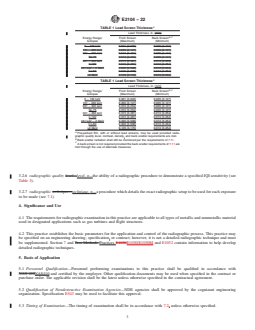
TABLE 1 Lead Screen Thickness
2.3 AIA Documents:
Lead Thickness, in. [mm]
NAS410Certification and Qualification of Nondestructive
B,C
Energy Range/ Front Screen
Test Personnel Back Screen
Isotopes (Maximum) (Minimum)
2.4 NCRP Documents:
0 – 100 keV 0.001 [0.025] 0.005 [0.127]
NCRP 51Radiation Protection Design Guidelines for 0.1-
101 – 200 keV 0.005 [0.127] 0.005 [0.127]
201 – 320 keV 0.010 [0.254] 0.005 [0.127]
100 MeV Particle Accelerator Facilities
Se-75 0.010 [0.254] 0.005 [0.127]
NCRP 91Recommendations on Limits for Exposures to
321 – 450 keV 0.015 [0.381] 0.010 [0.254]
Ionizing Radiation
Ir-192 0.015 [0.381] 0.010 [0.254]
451 keV – 2 MeV 0.020 [0.508] 0.010 [0.254]
2.5 Other Government Documents:
Co-60 0.020 [0.508] 0.010 [0.254]
NIST Handbook 114General Safety Standard for Installa-
>2 MeV 0.125 [3.175] 0.010 [0.254]
A
tions Using Non-Medical X-ray and Sealed Gamma-ray
Pre-packed film, with or without lead screens, may be used provided radio-
Sources, Energies up to 10 MeV graphic quality level, contrast, density, and back scatter requirements are met.
B
Back scatter radiation shall still be monitored per the requirements of 7.11.
C
NOTE 1—DoD Contracts:Unless otherwise specified, the issues of the A back screen is not required provided the back scatter requirements of 7.11 are
met through the use of alternate measures.
documents that are DoD adopted are those listed in the issue of the
Department of Defense Index of Specifications and Standards (DoDISS)
cited in the solicitation.
NOTE 2—Order of Precedence:Contractual requirements and specific
TABLE 2 Maximum Allowable Unsharpness (U ) for Directional
g
direction from the cognizant engineering organization shall take prece-
Exposures
dence over the requirements in this practice. In the event of conflict
Material Thickness (t), in. [mm] U , in. [mm]
g
between the text of this practice and the references cited herein, the text
t# 0.5 [12.7] 0.008 [0.203]
of this practice shall take precedence. However, nothing in this practice
0.5 [12.7] < t# 1.0 [25.4] 0.010 [0.254]
shall supersede applicable laws and regulations unless a specific exemp-
1.0 [25.4] < t# 2.0 [50.8] 0.020 [0.508]
tion has been obtained.
2.0 [50.8] < t# 4.0 [101.6] 0.030 [0.762]
4.0 [101.6] < t 0.040 [1.016]
3. Terminology
3.1 Definitions—Definitions relating to radiographic exami-
TABLE 3 Quality Levels of Examination
nation which appear in Terminology E1316 shall apply to the
Radiographic Maximum IQI Minimum Visible Equivalent IQI
terms used in this practice.
A B C
Quality Level Thickness, % Hole Diameter Sensitivity, %
3.2 Definitions of Terms Specific to This Standard:
1-1T 1 1T 0.7
3.2.1 component, n—the part(s) or element of the system 1-2T 1 2T 1.0
2-1T 2 1T 1.4
assembled or processed to the extent specified by the drawing,
2-2T 2 2T 2.0
purchaseorder,orcontractforwhichradiographicexamination
2-4T 2 4T 2.8
is required.
A
Expressed as a percentage of material thickness.
B
Expressed as a multiple thickness of IQI.
3.2.2 film system, n—the combination of a film and a
C
Equivalent IQI sensitivity is that thickness of the IQI expressed as a percentage
processing system. A processing system is defined by the
of the specimen thickness in which a 2T hole would be clearly visible under the
chemistryusedandthespecifieddeveloperimmersiontimeand
same radiographic conditions.
temperature.
3.2.3 like section, n—a separate section of material that is
similar in shape and cross section to the component or part
3.2.7 radiographic technique, n—a procedure which details
being radiographed, and is made of the same or radiographi- theexactradiographicsetuptobeusedforeachexposuretobe
cally similar material.
made (see 7.1).
3.2.4 material group, n—materials that have the same pre-
4. Significance and Use
dominant alloying elements and which can be examined using
4.1 The requirements for radiographic examination in this
the same IQI.Alisting of common material groups is given in
practice are applicable to all types of metallic and nonmetallic
Practices E747 and E1025.
material used in designated applications such as gas turbines
3.2.5 NDE facility, n—the NDE agency performing the
and flight structures.
radiographic examination.
4.2 This practice establishes the basic parameters for the
3.2.6 radiographic quality level, n—the ability of a radio-
application and control of the radiographic process. This
graphic procedure to demonstrate a specified IQI sensitivity
practice may be specified on an engineering drawing,
(see Table 3).
specification, or contract; however, it is not a detailed radio-
graphic technique and must be supplemented. Section 7 and
Practices E1030/E1030M and E1032 contain information to
Available fromAerospace IndustriesAssociation ofAmerica, Inc. (AIA), 1000
help develop detailed radiographic techniques.
WilsonBlvd.,Suite1700,Arlington,VA22209-3928,http://www.aia-aerospace.org.
Available from National Council on Radiation Protection and Measurements
(NCRP), NCRP Publications, 7910 Woodmount Ave., Suite 800, Bethesda, MD 5. Basis of Application
20814.
5.1 Personnel Qualification—Personnel performing exami-
Available from National Institute of Standards and Technology (NIST), 100
Bureau Dr., Stop 1070, Gaithersburg, MD 20899-1070, http://www.nist.gov. nations to this practice shall be qualified in accordance with
E2104 − 22
NAS410 and certified by the employer. Other qualification 6.2.3 Non-film Recording Media—Analog and digital re-
documents may be used when specified in the contract or cording media or radioscopic devices may be used when
purchase order. The applicable revision shall be the latest approved by the cognizant engineering organization.
unless otherwise specified in the contractual agreement.
6.2.4 Film Holders and Cassettes—Film holders and cas-
settes shall be light tight, constructed of materials that do not
5.2 Qualification of Nondestructive Examination
interfere with the quality or sensitivity of the radiographs and
Agencies—NDE agencies shall be approved by the cognizant
shall be in appropriate working condition.
engineering organization. Specification E543 may be used to
6.2.5 Intensifying Screens:
facilitate this approval.
6.2.5.1 Lead Foil Screens—Intensifying screens of the lead
5.3 Timing of Examination—The timing of examination
foil type shall be used in accordance with 7.8. Screens shall
shall be in accordance with 7.2, unless otherwise specified.
have approximately the same area dimensions as the film used
5.4 Extent of Examination—Theextentofexaminationshall
and shall be in intimate contact with the film during exposure.
be in accordance with 7.3 or 7.18.2.2, as applicable, unless
Screens shall be free from any cracks, creases, scratches, or
otherwise specified.
foreign material that could produce undesirable, nonrelevant
images on the radiograph.
5.5 Reporting Criteria/Acceptance Criteria—Reporting cri-
teria for the examination results shall be in accordance with 6.2.5.2 Other Metallic Screens—Othermetallicscreensmay
8.2, unless otherwise specified. Since acceptance criteria are
be used provided the specified radiographic quality level,
not specified in this practice, they shall be specified in the density, and contrast are obtained and use is approved by the
engineering drawing, specification, or contractual agreement.
cognizant engineering organization.
6.2.5.3 Fluorescent and Fluorometallic Screen/Film
5.6 Reexamination of Repaired/Reworked Items—
Combinations—Fluorescent and fluorometallic screen/film
Reexamination of repaired and reworked items shall be in
combinationsarenotallowedunlessapprovedbythecognizant
accordance with 7.7.7 and 8.3, unless otherwise specified.
engineering organization.
6.2.6 Film Processors—Film processors shall be capable of
6. General Practice
producing radiographs that meet the requirements of this
6.1 Facilities:
practice and shall be maintained and used in accordance with
6.1.1 Safety—The work environment and equipment shall
manufacturers’ recommendations. Film processing shall be
be designed and utilized to ensure the safety of personnel and
controlled and monitored as recommended in Guide E999 and
property. NCRP 51, NCRP 91, and NIST Handbook 114 may
as scheduled in Table 4.
be used as guides to ensure that radiographic procedures are
6.2.7 Film Digitizers—The use of film digitizers is accept-
performed such that personnel do not receive a radiation
ablewhenapprovedbythecognizantengineeringorganization.
dosage exceeding the maximum permitted by city, state, or
6.2.8 Densitometers—Densitometers shall be capable of
national codes.
measuring light transmitted through a radiograph with an
6.1.2 Radiographic Exposure Areas—Radiographic expo-
optical density up to the maximum utilized. The maximum
sure areas shall be clean and equipped so that acceptable
measurable optical density shall be posted on each densitom-
radiographs may be produced in accordance with the require-
eter.
ments of this practice.
6.2.8.1 Densitometersshallbecalibratedinaccordancewith
6.1.3 Darkroom—Darkroom facilities, including equipment
PracticeE1079andTable4fortherangeofopticaldensitiesto
and materials, shall be clean and maintained in such a manner
be utilized. Calibration shall be performed using a calibrated
as to be capable of consistently producing radiographs free of
density strip traceable to NIST.Verification checks using high,
blemishesorartifactswhichmightinterferewithinterpretation
low, and intermediate densities shall be made in accordance
in the area of interest.
with Practice E1079 and as scheduled in Table 4.
6.1.4 Film Viewing Area—Subdued lighting in the viewing
6.2.9 Film Viewers—Viewers used for final interpretation
room is preferred rather than total darkness. Background
illumination lighting shall be arranged such that light reflec- shall meet the following requirements:
tions do not interfere with review of radiographs.
6.2.9.1 Maximum readable optical density shall be deter-
mined as follows:
6.2 Equipment and Materials:
a. The maximum light intensity for each viewing port shall
6.2.1 Radiation Sources:
be determined using a light meter that measures luminance,
6.2.1.1 X-Radiation Sources—X-ray sources that are used
either in footlamberts or candela/m and controlled in accor-
shall be capable of demonstrating the required radiographic
dance with Table 4. (Divide candela/m by 3.426 for conver-
quality level.
sion to footlamberts.)
6.2.1.2 Gamma Radiation Sources—Isotopesourcesthatare
b. Readings shall be taken at the center of spot viewers, and
used shall be capable of demonstrating the required radio-
atthevisuallydimmestareaoftheviewingsurfaceforallother
graphic quality level.
types of viewers.
6.2.2 Film Systems—Only film systems (see 3.2.2) having
cognizant engineering organization approval or meeting the c. The maximum readable optical density shall be deter-
requirementsofTestMethodE1815ClassI,ClassII,orspecial minedinaccordancewithFig.1andpostedoneachviewerfor
shall be used. each viewer port.
E2104 − 22
TABLE 4 Process Control Checks
cognizant engineering organization. The specific magnifier
Device or Calibration Verification Paragraph used shall be determined by the interpretation requirements.
Condition Ref.
Devices used for measuring indication size shall be calibrated
Image Quality Indicators 6.3.5
and verified (that is, visually examined for damage and
Material When
cleanliness) in accordance with Table 4.
Procured
Dimensional When Annually (3)
6.3 Image Quality Indicators (IQIs):
Procured
6.3.1 Hole-Type IQIs—Hole-type IQIs in accordance with
Physical Condition Prior to Each Use (2)
Indication Measuring When Prior to Each Use (2) 6.2.10
Practice E1025 or Annex A1 shall be used unless otherwise
Devices Procured
specified by contract requirements. Other IQI types, if used,
Densitometers Annually Each Shift and (1) 6.2.8.1
shallbeinaccordancewiththerequirementsof6.3.2and6.3.3.
Visible Light Meters Semi-
(footlamberts or annually
6.3.2 Wire-Type IQIs—Wire-type IQIs in accordance with
candelas)
Practice E747 may be used only with approval from the Level
Viewer Intensity When Monthly and (1)
3 radiographer of the cognizant engineering organization.
Procured
Schedule 1 (1) 6.2.9.1
6.3.3 Other IQI Types—The use of other types of IQIs,
Schedule 2 daily (2) 6.2.9.1
modifications to the types specified above, or Representative
Thermometers Semi-
annually QualityIndicators(RQIs)inaccordancewithPracticeE1817is
Automatic Film 6.2.6
permitted upon approval of the Level 3 radiographer of the
Processors
cognizant engineering organization. Details of the design,
Developer Temperature Prior to Each Use (2)
Processor Performance Daily material designation, and thickness identification of the IQI or
Base + Fog Daily
RQI shall be in the written radiographic technique or docu-
Replenishing Rate (1)
mented on a drawing that shall be referenced in the written
Developer Immersion (1)
Time
radiographic technique (see 7.1).
Manual Film Processing 6.2.6
6.3.4 Radiographically Similar IQI/and/or Block
Developer Temperature Prior to Each Use (2)
Material—IQIs of material different from the material to be
Processing Performance Daily
Base + Fog Daily
radiographed may be used provided the IQI material is
Usage Log Daily
determined to be radiographically similar. Materials shall be
Replenishment Log (1)
considered radiographically similar if the following require-
(1) Immediately after preventative maintenance, repair and changes in
configuration, bulb(s), or setup.
ments are satisfied:
(2) Does not need to be documented.
6.3.4.1 Twoblocksofequalthickness,oneofthematerialto
(3) Annual Dimensional and Alloy Verifications of IQI’s are not required when
be radiographed and one of the material of which the IQIs are
they are permanently attached to shims, blocks, or stepwedges, and/or
encased in clear plastic or similar material, provided there is no physical
made, shall be exposed together on the same film at the lowest
evidence of damage.
energy level to be used for production radiographs.
6.3.4.2 The optical density readings shall be between 2.0
and 4.0 for both materials.
6.3.4.3 If the optical density of the material to be radio-
d. Maximum readable optical density values shall be re-
graphed is within the range from 0% to +10% of the IQI
established when the viewer is repaired, altered, or the bulb is
material, it shall be considered radiographically similar. The
changed.
optical density readings shall be between 2.0 and 4.0 for both
e.Ifthefilmvieweroutputexceedstherequiredoutputofthe
materials.AnIQIwithalowerradiographicattenuationmaybe
maximum posted optical density of the viewing screen and
used.
high intensity viewing port, as determined by Fig. 1,by15%
6.3.5 IQI Control—IQIs shall be procured or fabricated to
or more when the bulb was first installed, the intensity will be
the requirements of Practices E747 or E1025,or AnnexA1,as
verified in accordance with Schedule 1, Table 4. Otherwise,
applicable, with certification of compliance for material and
Schedule 2 will be used.
dimensions. IQIs shall be dimensionally verified to be within
6.2.9.2 The light enclosure shall be designed to provide a
drawing tolerances in accordance with Table 4. Users shall
visually uniform brightness level over the entire viewing
visuallyexaminethephysicalconditionofIQIsfordamageand
screen.
cleanliness in accordance with the verification schedule in
6.2.9.3 Viewersshallbeequippedwithafanorothermeans
Table 4.
of preventing thermal damage to the radiographic film while
being viewed.
7. Detail Requirements
6.2.9.4 Except for localized high-intensity viewing ports,
viewers shall be equipped with a translucent material in each 7.1 Radiographic Technique—It shall be the responsibility
viewing port. of the NDE facility to develop and document a workable
radiographic technique that is capable of consistently produc-
6.2.9.5 Aset of opaque masks, an iris-type aperture, or any
other method to reduce the viewing port to suit the size of the ing the desired results and radiographic quality level. Material
and components shall be examined to an approved radio-
area of interest may also be provided.
6.2.10 Film Viewing Aids—Magnifiers may be used to aid graphic technique.
interpretation and determine indication size. Magnification no 7.1.1 The radiographic technique shall be approved by the
greaterthan10×maybeusedunlessotherwiseapprovedbythe NDE facility’s Level 3 radiographer.
E2104 − 22
NOTE 1—Figure 1 is a depiction in graphical form of the data derived in Specification E1390 and ISO5580 (identical to EN25580) for viewer
brightness.Conversionfromtabulardatatoagraphrevealsastepintheline.Theserequirementsderivefromtwosources.Theminimumluminancelevel
required for the average human eye to achieve photopic eye response (where the maximum resolution and contrast discrimination occurs) is at 10
candela/m .Atlevelsbelowthisvalue,theeyerespondsscotopicallywhichresultsinlowercontrastdiscriminationandresolution.Whilephotopicvision
typically occurs at a threshold of 10 candela/m for the average human eye, this curve takes advantage of the fact that at lower optical densities, most
viewerscanachieveanamountoflightthatguaranteesthatvirtuallyalloperators(notjusttheaverage)willbeviewingfilminthephotopicvisionmode.
Thus,forloweropticaldensities(<2.5),atransmittanceof30candela/m isrequired.Additionally,theincreasedbrightnessatloweropticaldensitieshelps
offset the lower contrast exhibited by the films at lower optical densities.
NOTE2—NDTfilmsystemsclassifiedcorrespondingtoTestMethodE1815systemclasses“Special”,IandII,withorwithoutleadscreens,aresuitable
for the extended viewing range above an optical density of 4, due to their high gradient (G =4>6)atD=4 above fog and base.These double sided
D-D
NDTfilmsystemshaveahighsilvercontentanddonotsaturateasearlyasmedicalandclassesIII,W-A,W-B,andW-Cfilmsystems.Theoperatorshould
mask all film areas of lower optical density to avoid blinding (dazzling). Blinding reduces the eye perception and requires longer eye adaptation time.
High brightness viewing stations also heat films depending on the optical density and viewing time.The operator shall prevent overheating to protect the
film integrity.
FIG. 1 Maximum Optical Density Allowable with Film Viewer
7.1.2 When required by contract or purchase order, the 7.1.3.4 Film size and designation, speed or classification,
radiographic technique shall be submitted to the Level 3 including the film load sequence for exposures with multiple
radiographer of the cognizant engineering organization for film loads, intensifying screen type, thickness and location,
approval. filters used and the optical density range.
7.1.3 Unless otherwise specified by the purchase order or
7.1.3.5 Materialandthicknessrangeoftheareaorregionto
contract,theradiographictechniqueshallincludethefollowing
be examined.
information:
7.1.3.6 The IQI type, size, and the required radiographic
7.1.3.1 Adrawing, sketch, or photograph showing the posi-
quality level. If alternate IQIs are used, include details of the
tions of the component, film, and IQI with respect to the
design or reference to applicable documents.
radiation source for each exposure.
7.1.3.7 Material type and thickness for blocks or shims.
7.1.3.2 The angle of the radiation beam in relation to the
7.1.3.8 IdentificationoftheNDEfacility,radiographictech-
component, the source-to-film distance, and any blocking or
nique identification and the date, or revision, of the procedure.
masking material, if used.
7.1.3.9 Radiographicidentificationschemeusedtocorrelate
7.1.3.3 The exposure parameters for X-ray machines;
technique to customer part number and part to film.
voltage, milliamperes, time (or mAs, as applicable), and focal
spotsizeoreffectivefocalspotsizeasrequiredbycontract.For 7.2 Examination Sequence—The sequence for radiographic
radioisotopesources,theisotopetype,curiestrength,time,and examination in the production operation shall be specified in
source size. the manufacturing or assembly process specification, contract,
E2104 − 22
or purchase order. If not specified, radiographic examination 7.7.5 Identification of the NDE facility performing the
shall be performed at a stage in the process of manufacturing examination.
or assembly at which relevant discontinuities can be detected.
7.7.6 Date of the exposure.
7.7.7 Radiographs of a repair/rework area shall be uniquely
7.3 Examination and Coverage—The number of parts
identified (for example, R1, R2, R3,…) indicating the number
examined, and the radiographic coverage of each part shall be
of times that repair/rework was attempted during a repair/
as specified by drawings, radiographic techniques, radio-
rework cycle.
graphicmanuals,orotherspecifications,asapplicable.Areasto
be examined shall be identified on the drawing by using the 7.7.8 Location Markers—Location markers used for the
symbols in accordance withANSI/AWSA2.4 or other systems
correlation of a component to its radiographic image shall be
of designations that are easily identified on the drawing. placed in such a manner as to ensure that the image of the
7.3.1 Acceptance Requirements—When examination is per-
marker does not interfere with the interpretation of the
formedinaccordancewiththispractice,engineeringdrawings, radiograph, and that the required coverage has been obtained.
specifications, or other applicable documents shall indicate the The location marker positions shall be established on the
criteria by which the components are judged acceptable. componentandthepositionofthemarkersshallbemaintained
Components may be divided into zones and separate criteria forthedurationoftheexamination.Iftheentirecomponentcan
assigned to each zone in accordance with its design require- beradiographedwithonefilmforeachviewandtheorientation
ments. When used, direct references to ASTM reference of the component with respect to the film is obvious, then
radiological images (reference radiographs or digital reference location markers are not required.
images) shall include the grade level for each type of discon-
7.7.8.1 As an alternative to location markers, view identifi-
tinuity permitted for each part or zone.
cation markers (see 7.7.4) may be used provided that the
7.3.2 Fatigue Crack Detection—When parts are radio-
orientation of the radiographs to the part can demonstrate the
graphed to detect fatigue cracks, only the area of the film that
requiredradiographiccoverage,andlocationofindicationscan
falls within a 10° cone of radiation (solid angle meas
...
This document is not an ASTM standard and is intended only to provide the user of an ASTM standard an indication of what changes have been made to the previous version. Because
it may not be technically possible to adequately depict all changes accurately, ASTM recommends that users consult prior editions as appropriate. In all cases only the current version
of the standard as published by ASTM is to be considered the official document.
Designation: E2104 − 15 E2104 − 22
Standard Practice for
Radiographic Examination of Advanced Aero and Turbine
Materials and Components
This standard is issued under the fixed designation E2104; the number immediately following the designation indicates the year of
original adoption or, in the case of revision, the year of last revision. A number in parentheses indicates the year of last reapproval. A
superscript epsilon (´) indicates an editorial change since the last revision or reapproval.
1. Scope
1.1 This practice establishes the minimum requirements for radiographic examination of metallic and nonmetallic materials and
components used in designated applications such as gas turbine engines and flight structures.
1.2 The requirements in this practice are intended to control the radiographic process to ensure the quality of radiographic images
produced for use in designated applications such as gas turbine engines and flight structures; this practice is not intended to
establish acceptance criteria for material or components. When examination is performed in accordance with this practice,
engineering drawings, specifications, or other applicable documents shall indicate the acceptance criteria.
1.3 All areas of this practice may be open to agreement between the cognizant engineering organization and the supplier, or
specific direction from the cognizant engineering organization.
1.4 This standard does not purport to address all of the safety concerns, if any, associated with its use. It is the responsibility
of the user of this standard to establish appropriate safety safety, health, and healthenvironmental practices and determine the
applicability of regulatory limitations prior to use.
1.5 This international standard was developed in accordance with internationally recognized principles on standardization
established in the Decision on Principles for the Development of International Standards, Guides and Recommendations issued
by the World Trade Organization Technical Barriers to Trade (TBT) Committee.
2. Referenced Documents
2.1 ASTM Standards:
E543 Specification for Agencies Performing Nondestructive Testing
E747 Practice for Design, Manufacture and Material Grouping Classification of Wire Image Quality Indicators (IQI) Used for
Radiology
E999 Guide for Controlling the Quality of Industrial Radiographic Film Processing
E1025 Practice for Design, Manufacture, and Material Grouping Classification of Hole-Type Image Quality Indicators (IQI)
Used for Radiography
E1030E1030/E1030M Practice for Radiographic Examination of Metallic Castings
E1032 Practice for Radiographic Examination of Weldments Using Industrial X-Ray Film
E1079 Practice for Calibration of Transmission Densitometers
This practice is under the jurisdiction of ASTM Committee E07 on Nondestructive Testing and is the direct responsibility of Subcommittee E07.01 on Radiology (X and
Gamma) Method.
Current edition approved June 1, 2015June 1, 2022. Published June 2015June 2022. Originally approved in 2001. Last previous edition approved in 20092015 as
E2104 - 09.E2104 – 15. DOI: 10.1520/E2104-15.10.1520/E2104-22.
For referenced ASTM standards, visit the ASTM website, www.astm.org, or contact ASTM Customer Service at service@astm.org. For Annual Book of ASTM Standards
volume information, refer to the standard’s Document Summary page on the ASTM website.
Copyright © ASTM International, 100 Barr Harbor Drive, PO Box C700, West Conshohocken, PA 19428-2959. United States
E2104 − 22
E1165 Test Method for Measurement of Focal Spots of Industrial X-Ray Tubes by Pinhole Imaging
E1254 Guide for Storage of Radiographs and Unexposed Industrial Radiographic Films
E1316 Terminology for Nondestructive Examinations
E1390 Specification for Illuminators Used for Viewing Industrial Radiographs
E1316 Terminology for Nondestructive Examinations
E1815 Test Method for Classification of Film Systems for Industrial Radiography
E1817 Practice for Controlling Quality of Radiological Examination by Using Representative Quality Indicators (RQIs)
E2033 Practice for Radiographic Examination Using Computed Radiography (Photostimulable Luminescence Method)
E2698 Practice for Radiographic Examination Using Digital Detector Arrays
2.2 AWS Documents:
ANSI/AWS A2.4 Symbols for Welding and Nondestructive Testing
2.3 AIA Documents:
NAS-410NAS410 Certification and Qualification of Nondestructive Test Personnel
2.4 NCRP Documents:
NCRP 51 Radiation Protection Design Guidelines for 0.1-100 MeV Particle Accelerator Facilities
NCRP 91 Recommendations on Limits for Exposures to Ionizing Radiation
2.5 Other Government Documents:
NIST Handbook 114 General Safety Standard for Installations Using Non-Medical X-ray and Sealed Gamma-ray Sources,
Energies up to 10 MeV
NOTE 1—DoD Contracts:Unless Unless otherwise specified, the issues of the documents that are DoD adopted are those listed in the issue of the
Department of Defense Index of Specifications and Standards (DoDISS) cited in the solicitation.
NOTE 2—Order of Precedence:Contractual Contractual requirements and specific direction from the cognizant engineering organization shall take
precedence over the requirements in this practice. In the event of conflict between the text of this practice and the references cited herein, the text of this
practice shall take precedence. However, nothing in this practice shall supersede applicable laws and regulations unless a specific exemption has been
obtained.
3. Terminology
3.1 Definitions—Definitions relating to radiographic examination which appear in Terminology E1316 shall apply to the terms
used in this practice.
3.2 Definitions of Terms Specific to This Standard:
3.2.1 cognizant engineering organization—the company, government agency or other authority responsible for the design, or end
use, of the material or component for which radiographic examination is required. This, in addition to design personnel, may
include personnel from engineering, material and process engineering, stress analysis, NDE, quality assurance and others, as
appropriate.
3.2.1 component—component, n—the part(s) or element of the system assembled or processed to the extent specified by the
drawing, purchase order, or contract for which radiographic examination is required.
3.2.2 film system—system, n—the combination of a film and a processing system. A processing system is defined by the chemistry
used and the specified developer immersion time and temperature.
3.2.3 like section—section, n—a separate section of material that is similar in shape and cross section to the component or part
being radiographed, and is made of the same or radiographically similar material.
3.2.4 material group—group, n—materials that have the same predominant alloying elements and which can be examined using
the same IQI. A listing of common material groups is given in Practices E747 and E1025.
3.2.5 NDE facility—facility, n—the NDE agency performing the radiographic examination.
Available from American Welding Society (AWS), 550 NW LeJeune Rd., Miami, FL 33126, http://www.aws.org.
Available from Aerospace Industries Association of America, Inc. (AIA), 1000 Wilson Blvd., Suite 1700, Arlington, VA 22209-3928, http://www.aia-aerospace.org.
Available from National Council on Radiation Protection and Measurements (NCRP), NCRP Publications, 7910 Woodmount Ave., Suite 800, Bethesda, MD 20814.
Available from National Institute of Standards and Technology (NIST), 100 Bureau Dr., Stop 1070, Gaithersburg, MD 20899-1070, http://www.nist.gov.
E2104 − 22
A
TABLE 1 Lead Screen Thickness
Lead Thickness, in. (mm)
B,C
Energy Range/ Front Screen
Back Screen
Isotopes (Maximum) (Minimum)
0 – 100 keV 0.001 (0.025) 0.005 (0.127)
101 – 200 keV 0.005 (0.127) 0.005 (0.127)
201 – 320 keV 0.010 (0.254) 0.005 (0.127)
Se-75 0.010 (0.254) 0.005 (0.127)
321 – 450 keV 0.015 (0.381) 0.010 (0.254)
Ir-192 0.015 (0.381) 0.010 (0.254)
451 keV – 2 MeV 0.020 (0.508) 0.010 (0.254)
Co-60 0.020 (0.508) 0.010 (0.254)
>2 MeV 0.125 (3.175) 0.010 (0.254)
A
TABLE 1 Lead Screen Thickness
Lead Thickness, in. [mm]
B,C
Energy Range/ Front Screen
Back Screen
(Minimum)
Isotopes (Maximum)
0 – 100 keV 0.001 [0.025] 0.005 [0.127]
101 – 200 keV 0.005 [0.127] 0.005 [0.127]
201 – 320 keV 0.010 [0.254] 0.005 [0.127]
Se-75 0.010 [0.254] 0.005 [0.127]
321 – 450 keV 0.015 [0.381] 0.010 [0.254]
Ir-192 0.015 [0.381] 0.010 [0.254]
451 keV – 2 MeV 0.020 [0.508] 0.010 [0.254]
Co-60 0.020 [0.508] 0.010 [0.254]
>2 MeV 0.125 [3.175] 0.010 [0.254]
A
Pre-packed film, with or without lead screens, may be used provided radio-
graphic quality level, contrast, density, and back scatter requirements are met.
B
Back scatter radiation shall still be monitored per the requirements of 7.11.
C
A back screen is not required provided the back scatter requirements of 7.11 are
met through the use of alternate measures.
3.2.6 radiographic quality level—level, n—the ability of a radiographic procedure to demonstrate a specified IQI sensitivity (see
Table 3).
3.2.7 radiographic technique—technique, n—a procedure which details the exact radiographic setup to be used for each exposure
to be made (see 7.1).
4. Significance and Use
4.1 The requirements for radiographic examination in this practice are applicable to all types of metallic and nonmetallic material
used in designated applications such as gas turbines and flight structures.
4.2 This practice establishes the basic parameters for the application and control of the radiographic process. This practice may
be specified on an engineering drawing, specification, or contract; however, it is not a detailed radiographic technique and must
be supplemented. Section 7 and Test Methods Practices E1030E1030/E1030M and E1032 contain information to help develop
detailed radiographic techniques.
5. Basis of Application
5.1 Personnel Qualification—Personnel performing examinations to this practice shall be qualified in accordance with
NAS-410NAS410 and certified by the employer. Other qualification documents may be used when specified in the contract or
purchase order. The applicable revision shall be the latest unless otherwise specified in the contractual agreement.
5.2 Qualification of Nondestructive Examination Agencies—NDE agencies shall be approved by the cognizant engineering
organization. Specification E543 may be used to facilitate this approval.
5.3 Timing of Examination—The timing of examination shall be in accordance with 7.2, unless otherwise specified.
E2104 − 22
TABLE 2 Maximum Allowable Unsharpness (U ) for Directional
g
Exposures
Material Thickness (t), in. (mm) U , in. (mm)
g
t # 0.5 (12.7) 0.008 (0.203)
0.5 (12.7) < t # 1.0 (25.4) 0.010 (0.254)
1.0 (25.4) < t # 2.0 (50.8) 0.020 (0.508)
2.0 (50.8) < t # 4.0 (101.6) 0.030 (0.762)
4.0 (101.6) < t 0.040 (1.016)
TABLE 2 Maximum Allowable Unsharpness (U ) for Directional
g
Exposures
Material Thickness (t), in. [mm] U , in. [mm]
g
t # 0.5 [12.7] 0.008 [0.203]
0.5 [12.7] < t # 1.0 [25.4] 0.010 [0.254]
1.0 [25.4] < t # 2.0 [50.8] 0.020 [0.508]
2.0 [50.8] < t # 4.0 [101.6] 0.030 [0.762]
4.0 [101.6] < t 0.040 [1.016]
TABLE 3 Quality Levels of Examination
Radiographic Maximum IQI Minimum Visible Equivalent IQI
A B C
Quality Level Thickness, % Hole Diameter Sensitivity, %
1-1T 1 1T 0.7
1-2T 1 2T 1.0
2-1T 2 1T 1.4
2-2T 2 2T 2.0
2-4T 2 4T 2.8
A
Expressed as a percentage of material thickness.
B
Expressed as a multiple thickness of IQI.
C
Equivalent IQI sensitivity is that thickness of the IQI expressed as a percentage
of the specimen thickness in which a 2T hole would be clearly visible under the
same radiographic conditions.
5.4 Extent of Examination—The extent of examination shall be in accordance with 7.3 or 7.18.2.2, as applicable, unless otherwise
specified.
5.5 Reporting Criteria/Acceptance Criteria—Reporting criteria for the examination results shall be in accordance with 8.2, unless
otherwise specified. Since acceptance criteria are not specified in this standard,practice, they shall be specified in the engineering
drawing, specification, or contractual agreement.
5.6 Reexamination of Repaired/Reworked Items—Reexamination of repaired and reworked items shall be in accordance with 7.7.7
and 8.3, unless otherwise specified.
6. General Practice
6.1 Facilities:
6.1.1 Safety—The work environment and equipment shall be designed and utilized to ensure the safety of personnel and property.
NCRP 51, NCRP 91, and NIST Handbook 114 may be used as guides to ensure that radiographic procedures are performed such
that personnel do not receive a radiation dosage exceeding the maximum permitted by city, state, or national codes.
6.1.2 Radiographic Exposure Areas—Radiographic exposure areas shall be clean and equipped so that acceptable radiographs may
be produced in accordance with the requirements of this practice.
6.1.3 Darkroom—Darkroom facilities, including equipment and materials, shall be clean and maintained in such a manner as to
be capable of consistently producing radiographs free of blemishes or artifacts which might interfere with interpretation in the area
of interest.
6.1.4 Film Viewing Area—Subdued lighting in the viewing room is preferred rather than total darkness. Background illumination
lighting shall be arranged such that light reflections do not interfere with review of radiographs.
E2104 − 22
6.2 Equipment and Materials:
6.2.1 Radiation Sources:
6.2.1.1 X-Radiation Sources—X-ray sources that are used shall be capable of demonstrating the required radiographic quality
level.
6.2.1.2 Gamma Radiation Sources—Isotope sources that are used shall be capable of demonstrating the required radiographic
quality level.
6.2.2 Film Systems—Only film systems (see 3.2.33.2.2) having cognizant engineering organization approval or meeting the
requirements of Test Method E1815 Class I, Class II, or special shall be used.
6.2.3 Non-film Recording Media—Analog and digital recording media or radioscopic devices may be used when approved by the
cognizant engineering organization.
6.2.4 Film Holders and Cassettes—Film holders and cassettes shall be light tight, constructed of materials that do not interfere
with the quality or sensitivity of the radiographs and shall be in appropriate working condition.
6.2.5 Intensifying Screens:
6.2.5.1 Lead Foil Screens—Intensifying screens of the lead foil type shall be used in accordance with 7.8. Screens shall have
approximately the same area dimensions as the film used and shall be in intimate contact with the film during exposure. Screens
shall be free from any cracks, creases, scratches, or foreign material that could produce undesirable, nonrelevant images on the
radiograph.
6.2.5.2 Other Metallic Screens—Other metallic screens may be used provided the specified radiographic quality level, density, and
contrast are obtained and use is approved by the cognizant engineering organization.
6.2.5.3 Fluorescent and Fluorometallic Screen/Film Combinations—Fluorescent and fluorometallic screen/film combinations are
not allowed unless approved by the cognizant engineering organization.
6.2.6 Film Processors—Film processors shall be capable of producing radiographs that meet the requirements of this practice and
shall be maintained and used in accordance with manufacturers’ recommendations. Film processing shall be controlled and
monitored as recommended in Guide E999 and as scheduled in Table 4.
6.2.7 Film Digitizers—The use of film digitizers is acceptable when approved by the cognizant engineering organization.
6.2.8 Densitometers—Densitometers shall be capable of measuring light transmitted through a radiograph with a filman optical
density up to the maximum utilized. The maximum measurable optical density shall be posted on each densitometer.
6.2.8.1 Densitometers shall be calibrated in accordance with Practice E1079 and Table 4 for the range of optical densities to be
utilized. Calibration shall be performed using a calibrated density strip traceable to NIST. Verification checks using high, low, and
intermediate densities shall be made in accordance with Practice E1079 and as scheduled in Table 4.
6.2.9 Film Viewers—Viewers used for final interpretation shall meet the following requirements:
6.2.9.1 Maximum readable filmoptical density shall be determined as follows:
a. The maximum light intensity for each viewing port shall be determined using a light meter that measures luminance, either
2 2
in footlamberts or candelas/mcandela/m and controlled in accordance with Table 4. (Divide candela/m by 3.426 for conversion
to footlamberts.)
b. Readings shall be taken at the center of spot viewers, and at the visually dimmest area of the viewing surface for all other
types of viewers.
c. The maximum readable filmoptical density shall be determined in accordance with Fig. 1 and posted on the each viewer for
each viewer port.
d. Maximum readable filmoptical density values shall be re-established when the viewer is repaired, altered, or the bulb is
changed.
E2104 − 22
TABLE 4 Process Control Checks
Device or Calibration Verification Paragraph
Condition Ref.
Image Quality Indicators 6.3.5
Material When
Procured
Dimensional When Annually (3)
Procured
Physical Condition Prior to Each Use (2)
Indication Measuring When Prior to Each Use (2) 6.2.10
Devices Procured
Densitometers Annually Each Shift and (1) 6.2.8.1
Visible Light Meters Semi-
(footlamberts or annually
candelas)
Viewer Intensity When Monthly and (1)
Procured
Schedule 1 (1) 6.2.9.1
Schedule 2 daily (2) 6.2.9.1
Thermometers Semi-
annually
Automatic Film 6.2.6
Processors
Developer Temperature Prior to Each Use (2)
Processor Performance Daily
Base + Fog Daily
Replenishing Rate (1)
Developer Immersion (1)
Time
Manual Film Processing 6.2.6
Developer Temperature Prior to Each Use (2)
Processing Performance Daily
Base + Fog Daily
Usage Log Daily
Replenishment Log (1)
(1) Immediately after preventative maintenance, repair and changes in
configuration, bulb(s), or setup.
(2) Does not need to be documented.
(3) Annual Dimensional and Alloy Verifications of IQI’s are not required when
they are permanently attached to shims, blocks, or stepwedges, and/or
encased in clear plastic or similar material, provided there is no physical
evidence of damage.
(1) Immediately after preventative maintenance, repair and changes in
configuration, bulb(s), or setup.
(2) Does not need to be documented.
(3) Annual Dimensional and Alloy Verifications of IQI’s are not required when
they are permanently attached to shims, blocks, or stepwedges, and/or encased in
clear plastic or similar material, provided there is no physical evidence of damage.
e. If the posted maximum readable film density exceeds the maximum allowable, film viewer output exceeds the required output
of the maximum posted optical density of the viewing screen and high intensity viewing port, as determined by Fig. 1, by 15 %
or more when the bulb was first installed, the intensity will be verified in accordance with Schedule 1, Table 4. Otherwise, Schedule
2 will be used.
6.2.9.2 The light enclosure shall be designed to provide a visually uniform brightness level over the entire viewing screen.
6.2.9.3 Viewers shall be equipped with a fan or other means of preventing thermal damage to the radiographic film while being
viewed.
6.2.9.4 Except for localized high-intensity viewing ports, viewers shall be equipped with a translucent material in each viewing
port.
6.2.9.5 A set of opaque masks, an iris-type aperture, or any other method to reduce the viewing port to suit the size of the area
of interest may also be provided.
6.2.10 Film Viewing Aids—Magnifiers may be used to aid interpretation and determine indication size. Magnification no greater
than 10× may be used unless otherwise approved by the cognizant engineering organization. The specific magnifier used shall be
determined by the interpretation requirements. Devices used for measuring indication size shall be calibrated and verified (that is,
visually examined for damage and cleanliness) in accordance with Table 4.
E2104 − 22
NOTE 1—Figure 1 is a depiction in graphical form of the data derived in ASTMSpecification E1390 and ISO 5580 (identical to EN 25580) for viewer
brightness. Conversion from tabular data to a graph reveals a step in the line. These requirements derive from two sources. The minimum luminance level
required for the average human eye to achieve photopic eye response ( where (where the maximum resolution and contrast discrimination occurs) is at
10 candela/m . At levels below this value, the eye responds scotopically which results in lower contrast discrimination and resolution. While photopic
vision typically occurs at a threshold of 10 candela/m for the average human eye, this curve takes advantage of the fact that at lower filmoptical densities,
most viewers can achieve an amount of light that guarantees that virtually all operators (not just the average) will be viewing film in the photopic vision
mode. Thus, for lower filmoptical densities (<2.5)(<2.5), a transmittance of 30 candela/m is required. Additionally, the increased brightness at lower
filmoptical densities helps offset the lower contrast exhibited by the films at lower optical densities.
NOTE 2—NDT film systems classified corresponding to Test Method E1815 system classes “Special”, I and II, with or without lead screens, are suitable
for the extended viewing range above a an optical density of 4, due to their high gradient (G = 4 > 6) at D = 4 above fog and base. These double sided
D-D
NDT film systems have a high silver content and do not saturate as early as medical and classes III, W-A, W-BW-B, and W-C film systems. The operator
should mask all film areas of lower optical density to avoid blinding (dazzling). Blinding reduces the eye perception and requires longer eye adaptation
time. High brightness viewing stations also heat films depending on the optical density and viewing time. The operator shall prevent overheating to protect
the film integrity.
FIG. 1 Maximum FilmOptical Density Allowable with Film Viewer
6.3 Image Quality Indicators (IQIs):
6.3.1 Hole-Type IQIs—Hole-type IQIs in accordance with Practice E1025 or Annex A1 shall be used unless otherwise specified
by contract requirements. Other IQI types, if used, shall be in accordance with the requirements of 6.3.2 and 6.3.3.
6.3.2 Wire-Type IQIs—Wire-type IQIs in accordance with Practice E747 may be used only with approval from the Level III3
radiographer of the cognizant engineering organization.
6.3.3 Other IQI Types—The use of other types of IQIs, modifications to the types specified above, or Representative Quality
Indicators (RQIs) in accordance with Practice E1817 is permitted upon approval of the Level III3 radiographer of the cognizant
engineering organization. Details of the design, material designation, and thickness identification of the IQI or RQI shall be in the
written radiographic technique or documented on a drawing that shall be referenced in the written radiographic technique (see 7.1).
6.3.4 Radiographically Similar IQI IQI/and/or Block Material—IQIs of material different from the material to be radiographed
may be used provided the IQI material is determined to be radiographically similar. Materials shall be considered radiographically
similar if the following requirements are satisfied:
E2104 − 22
6.3.4.1 Two blocks of equal thickness, one of the material to be radiographed and one of the material of which the IQIs are made,
shall be exposed together on the same film at the lowest energy level to be used for production radiographs.
6.3.4.2 The filmoptical density readings shall be between 2.0 and 4.0 for both materials.
6.3.4.3 IQI materials shall be considered radiographically similar if the following requirements are satisfied. Two blocks of equal
thickness, one of the material to be radiographed and one of the material of which the IQI’s are made, shall be exposed together
on the same film at the lowest energy level to be used for production radiographs. If the filmIf the optical density of the material
to be radiographed is within the range from 0 % to +10 % of the IQI material, it shall be considered radiographically similar. The
filmoptical density readings shall be between 2.0 and 4.0 for both materials. An IQI with a lower radiographic attenuation may be
used.
6.3.5 IQI Control—IQIs shall be procured or fabricated to the requirements of PracticePractices E747 or E1025, or Annex A1, as
applicable, with certification of compliance for material and dimensions. IQIs shall be dimensionally verified to be within drawing
tolerances in accordance with Table 4. Users shall visually examine the physical condition of IQIs for damage and cleanliness in
accordance with the verification schedule in Table 4.
7. Detail Requirements
7.1 Radiographic Technique—It shall be the responsibility of the NDE facility to develop and document a workable radiographic
technique that is capable of consistently producing the desired results and radiographic quality level. Material and components
shall be examined to an approved radiographic technique.
7.1.1 The radiographic technique shall be approved by the NDE facility’s Level III3 radiographer.
7.1.2 When required by contract or purchase order, the radiographic technique shall be submitted to the Level III3 radiographer
of the cognizant engineering organization for approval.
7.1.3 Unless otherwise specified by the purchase order or contract, the radiographic technique shall include the following
information:
7.1.3.1 A drawing, sketch, or photograph showing the positions of the component, film, and IQI with respect to the radiation
source for each exposure.
7.1.3.2 The angle of the radiation beam in relation to the component, the source-to-film distance, and any blocking or masking
material, if used.
7.1.3.3 The exposure parameters for X-ray machines; voltage, milliamperes, time (or mAs, as applicable), and focal spot size or
effective focal spot size as required by contract. For radioisotope sources, the isotope type, curie strength, time, and source size.
7.1.3.4 Film size and designation, speed or classification, including the film load sequence for exposures with multiple film loads,
intensifying screen type, thickness and location, filters used and the filmoptical density range.
7.1.3.5 Material and thickness range of the area or region to be examined.
7.1.3.6 The IQI type, size, and the required radiographic quality level. If alternate IQIs are used, include details of the design or
reference to applicable documents.
7.1.3.7 Material type and thickness for blocks or shims.
7.1.3.8 Identification of the NDE facility, radiographic technique identification and the date, or revision, of the procedure.
7.1.3.9 Radiographic identification scheme used to correlate technique to customer part number and part to film.
7.2 Examination Sequence—The sequence for radiographic examination in the production operation shall be specified in the
manufacturing or assembly process specification, contract, or purchase order. If not specified, radiographic examination shall be
performed at a stage in the process of manufacturing or assembly at which relevant discontinuities can be detected.
E2104 − 22
7.3 Examination and Coverage—The number of parts examined, and the radiographic coverage of each part shall be as specified
by drawings, radiographic techniques, radiographic manuals, or other specifications, as applicable. Areas to be examined shall be
identified on the drawing by using the symbols in accordance with ANSI/AWS A2.4 or other systems of designations that are easily
identified on the drawing.
7.3.1 Acceptance Requirements—When examination is performed in accordance with this practice, engineering drawings,
specifications, or other applicable documents shall indicate the criteria by which the components are judged acceptable.
Components may be divided into zones and separate criteria assigned to each zone in accordance with its design requirements.
When used, direct references to ASTM reference radiological images (reference radiographs or digital reference images) shall
include the grade level for each type of discontinuity permitted for each part or zone.
7.3.2 Fatigue Crack Detection—When parts are radiographed to detect fatigue cracks, only the area of the film that falls within
a 10° cone of radiation (solid angle measurement) shall be considered valid for interpretation. An alternate technique may be
qualified in another manner when approved by the cognizant engineering organization.
7.4 Nonfilm Techniques—When permitted by the purchase order, contract, or specification, radioscopic/radiological ex
...