


ASTM D3295-20
(Specification)Standard Specification for PTFE Tubing, Miniature Beading and Spiral Cut Tubing
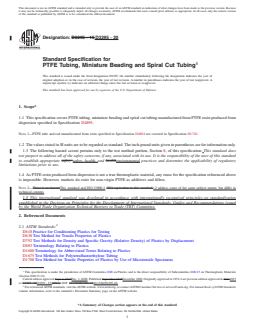
Standard Specification for PTFE Tubing, Miniature Beading and Spiral Cut Tubing
ABSTRACT
This specification covers PTFE tubing, miniature beading and spiral cut tubing-manufactured from PTFE resin produced from dispersion. Five groups of PTFE tubing, miniature beading and spiral cut tubing, differentiated by size and type are presented. The groups are further subdivided into classes based on wall thickness: group 01 - tubing based upon the AWG sizes, group 02 - tubing based upon fractional inch sizes, group 03 - tubing based upon inner diameter and wall thickness, group 04 - tubing cut to form spiral wrap, and group 05 - miniature beading. The types are further differentiated in accordance with increasing wall thickness as follows: class 1 - light wall, class 2 - thin wall, class 3 - standard wall, class 4 - chemical tubing, and class 5 - heavy wall. The tubing and miniature beading shall be made of PTFE meeting the requirements prescribed. The melting point, specific gravity, weight loss, tensile strength, elongation, dielectric breakdown voltage, heat resistance, and dimensional stability shall be tested to meet the requirements specified.
SCOPE
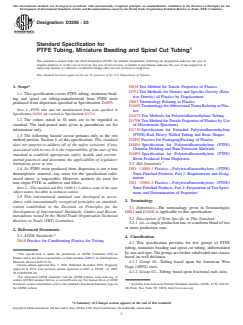
1.1 This specification covers PTFE tubing, miniature beading and spiral cut tubing-manufactured from PTFE resin produced from dispersion specified in Specification D4895.
Note 1: PTFE tube and rod manufactured from resin specified in Specification D4894 are covered in Specification D1710.
1.2 The values stated in SI units are to be regarded as standard. The inch-pound units given in parentheses are for information only.
1.3 The following hazard caveat pertains only to the test method portion, Section 8, of this specification: This standard does not purport to address all of the safety concerns, if any, associated with its use. It is the responsibility of the user of this standard to establish appropriate safety, health, and environmental practices and determine the applicability of regulatory limitations prior to use.
1.4 As PTFE resin produced from dispersion is not a true thermoplastic material, any reuse for the specification referenced above is impossible. However, markets do exist for non-virgin PTFE as additives and fillers.
Note 2: This standard and ISO 13000-1/-2 address some of the same subject matter, but differ in technical content.
1.5 This international standard was developed in accordance with internationally recognized principles on standardization established in the Decision on Principles for the Development of International Standards, Guides and Recommendations issued by the World Trade Organization Technical Barriers to Trade (TBT) Committee.
General Information
- Status
- Published
- Publication Date
- 30-Nov-2020
- Technical Committee
- D20 - Plastics
- Drafting Committee
- D20.15 - Thermoplastic Materials
Relations
- Effective Date
- 01-Feb-2024
- Effective Date
- 01-Nov-2023
- Effective Date
- 01-Jan-2020
- Effective Date
- 01-Aug-2019
- Effective Date
- 01-May-2019
- Effective Date
- 15-Apr-2019
- Effective Date
- 01-Feb-2019
- Effective Date
- 01-Dec-2018
- Effective Date
- 01-Nov-2018
- Effective Date
- 01-Oct-2018
- Effective Date
- 01-May-2018
- Refers
ASTM D1600-18 - Standard Terminology for Abbreviated Terms Relating to Plastics (Withdrawn 2024) - Effective Date
- 01-Jan-2018
- Effective Date
- 15-Aug-2017
- Effective Date
- 01-May-2016
- Effective Date
- 01-Sep-2015
Overview
ASTM D3295-20: Standard Specification for PTFE Tubing, Miniature Beading, and Spiral Cut Tubing sets forth requirements for the manufacturing and testing of tubing and beading products made from polytetrafluoroethylene (PTFE) resin. Specifically, it addresses products fabricated from PTFE produced via dispersion processes. This standard is widely recognized for ensuring high-quality PTFE tubing products, specifying performance, dimensions, tolerances, and material requirements. These PTFE products offer exceptional properties such as high temperature resistance, dielectric strength, and chemical inertness, making them invaluable in critical applications across industries.
Key Topics
- Material Types and Groups:
- Five groups differentiate PTFE tubing, miniature beading, and spiral cut tubing by size and type, including:
- Group 01: Tubing based on American Wire Gauge (AWG) sizes
- Group 02: Tubing based on fractional inch sizes
- Group 03: Tubing based on custom or metric inner diameters and wall thicknesses
- Group 04: Spiral cut tubing for spiral wrap applications
- Group 05: Miniature beading
- Five groups differentiate PTFE tubing, miniature beading, and spiral cut tubing by size and type, including:
- Wall Thickness Classifications:
- Classified according to wall thickness:
- Class 1: Light wall
- Class 2: Thin wall
- Class 3: Standard wall
- Class 4: Chemical tubing
- Class 5: Heavy wall
- Classified according to wall thickness:
- Physical and Mechanical Requirements:
- Specifies minimum melting points, tensile strength, elongation, specific gravity, dielectric breakdown voltage, and weight loss limits.
- Outlines dimensional stability and heat resistance tests for product consistency.
- Testing and Certification:
- Includes specific test method guidelines for sampling, conditioning, and laboratory testing.
- Certification and inspection provisions ensure conformity for each production lot.
Applications
PTFE tubing and beading products addressed by ASTM D3295-20 are extensively used in a variety of demanding sectors due to their robust physical and chemical properties. Key application areas include:
- Electrical Insulation: PTFE’s excellent dielectric properties make it ideal for insulating wires and cables in aerospace, automotive, and electronics.
- Chemical Processing: Chemical resistance of PTFE tubing is essential for fluid transfer, laboratory apparatus, and chemical handling.
- Medical Devices: The biocompatibility and flexibility of PTFE tubing are critical for medical equipment and miniature tubing used in catheters and medical instruments.
- Industrial Wrap and Protection: Spiral cut tubing provides harnessing and abrasion resistance for wire bundles.
- Data and Signal Transmission: Used as protective sleeving for fiber optics and sensitive cabling.
Related Standards
ASTM D3295-20 references several related ASTM and international standards, ensuring compatibility and clarity across specifications:
- ASTM D4895: Specification for PTFE resin produced from dispersion, the base material for D3295 products.
- ASTM D1710: Covers PTFE tube and rod made from a different PTFE resin production method.
- ASTM D618: Standard conditioning practices for plastics testing.
- ASTM D638 / D1708: Tensile properties testing methods for plastics.
- ASTM D1675: Test methods specific to PTFE tubing.
- ISO 13000-1 and ISO 13000-2: International standards for PTFE semi-finished products, with subject matter overlap though differing technical specifics.
Summary
By providing a clear framework for PTFE tubing, miniature beading, and spiral cut tubing, ASTM D3295-20 enables manufacturers and users to ensure product consistency, reliability, and fitness for use in critical environments. Whether the application is in electrical insulation, chemical transfer, or medical devices, adherence to this standard supports safety, efficiency, and international trade compliance.
Keywords: PTFE tubing, ASTM D3295, polytetrafluoroethylene, spiral cut tubing, miniature beading, fluoropolymers, chemical tubing, wire insulation, dielectric strength, industrial standards.
Buy Documents
ASTM D3295-20 - Standard Specification for PTFE Tubing, Miniature Beading and Spiral Cut Tubing
REDLINE ASTM D3295-20 - Standard Specification for PTFE Tubing, Miniature Beading and Spiral Cut Tubing
Get Certified
Connect with accredited certification bodies for this standard

Institut za varilstvo d.o.o. (Welding Institute)
Slovenia's leading welding institute since 1952. ISO 3834, EN 1090, pressure equipment certification, NDT personnel, welder qualification. Only IIW Au
Sponsored listings
Frequently Asked Questions
ASTM D3295-20 is a technical specification published by ASTM International. Its full title is "Standard Specification for PTFE Tubing, Miniature Beading and Spiral Cut Tubing". This standard covers: ABSTRACT This specification covers PTFE tubing, miniature beading and spiral cut tubing-manufactured from PTFE resin produced from dispersion. Five groups of PTFE tubing, miniature beading and spiral cut tubing, differentiated by size and type are presented. The groups are further subdivided into classes based on wall thickness: group 01 - tubing based upon the AWG sizes, group 02 - tubing based upon fractional inch sizes, group 03 - tubing based upon inner diameter and wall thickness, group 04 - tubing cut to form spiral wrap, and group 05 - miniature beading. The types are further differentiated in accordance with increasing wall thickness as follows: class 1 - light wall, class 2 - thin wall, class 3 - standard wall, class 4 - chemical tubing, and class 5 - heavy wall. The tubing and miniature beading shall be made of PTFE meeting the requirements prescribed. The melting point, specific gravity, weight loss, tensile strength, elongation, dielectric breakdown voltage, heat resistance, and dimensional stability shall be tested to meet the requirements specified. SCOPE 1.1 This specification covers PTFE tubing, miniature beading and spiral cut tubing-manufactured from PTFE resin produced from dispersion specified in Specification D4895. Note 1: PTFE tube and rod manufactured from resin specified in Specification D4894 are covered in Specification D1710. 1.2 The values stated in SI units are to be regarded as standard. The inch-pound units given in parentheses are for information only. 1.3 The following hazard caveat pertains only to the test method portion, Section 8, of this specification: This standard does not purport to address all of the safety concerns, if any, associated with its use. It is the responsibility of the user of this standard to establish appropriate safety, health, and environmental practices and determine the applicability of regulatory limitations prior to use. 1.4 As PTFE resin produced from dispersion is not a true thermoplastic material, any reuse for the specification referenced above is impossible. However, markets do exist for non-virgin PTFE as additives and fillers. Note 2: This standard and ISO 13000-1/-2 address some of the same subject matter, but differ in technical content. 1.5 This international standard was developed in accordance with internationally recognized principles on standardization established in the Decision on Principles for the Development of International Standards, Guides and Recommendations issued by the World Trade Organization Technical Barriers to Trade (TBT) Committee.
ABSTRACT This specification covers PTFE tubing, miniature beading and spiral cut tubing-manufactured from PTFE resin produced from dispersion. Five groups of PTFE tubing, miniature beading and spiral cut tubing, differentiated by size and type are presented. The groups are further subdivided into classes based on wall thickness: group 01 - tubing based upon the AWG sizes, group 02 - tubing based upon fractional inch sizes, group 03 - tubing based upon inner diameter and wall thickness, group 04 - tubing cut to form spiral wrap, and group 05 - miniature beading. The types are further differentiated in accordance with increasing wall thickness as follows: class 1 - light wall, class 2 - thin wall, class 3 - standard wall, class 4 - chemical tubing, and class 5 - heavy wall. The tubing and miniature beading shall be made of PTFE meeting the requirements prescribed. The melting point, specific gravity, weight loss, tensile strength, elongation, dielectric breakdown voltage, heat resistance, and dimensional stability shall be tested to meet the requirements specified. SCOPE 1.1 This specification covers PTFE tubing, miniature beading and spiral cut tubing-manufactured from PTFE resin produced from dispersion specified in Specification D4895. Note 1: PTFE tube and rod manufactured from resin specified in Specification D4894 are covered in Specification D1710. 1.2 The values stated in SI units are to be regarded as standard. The inch-pound units given in parentheses are for information only. 1.3 The following hazard caveat pertains only to the test method portion, Section 8, of this specification: This standard does not purport to address all of the safety concerns, if any, associated with its use. It is the responsibility of the user of this standard to establish appropriate safety, health, and environmental practices and determine the applicability of regulatory limitations prior to use. 1.4 As PTFE resin produced from dispersion is not a true thermoplastic material, any reuse for the specification referenced above is impossible. However, markets do exist for non-virgin PTFE as additives and fillers. Note 2: This standard and ISO 13000-1/-2 address some of the same subject matter, but differ in technical content. 1.5 This international standard was developed in accordance with internationally recognized principles on standardization established in the Decision on Principles for the Development of International Standards, Guides and Recommendations issued by the World Trade Organization Technical Barriers to Trade (TBT) Committee.
ASTM D3295-20 is classified under the following ICS (International Classification for Standards) categories: 23.040.20 - Plastics pipes. The ICS classification helps identify the subject area and facilitates finding related standards.
ASTM D3295-20 has the following relationships with other standards: It is inter standard links to ASTM D883-24, ASTM D883-23, ASTM D883-20, ASTM D883-19c, ASTM D4894-19, ASTM D883-19a, ASTM D883-19, ASTM D883-18a, ASTM D883-18, ASTM D1708-18, ASTM D1675-18, ASTM D1600-18, ASTM D883-17, ASTM D4895-16, ASTM D3892-15. Understanding these relationships helps ensure you are using the most current and applicable version of the standard.
ASTM D3295-20 is available in PDF format for immediate download after purchase. The document can be added to your cart and obtained through the secure checkout process. Digital delivery ensures instant access to the complete standard document.
Standards Content (Sample)
This international standard was developed in accordance with internationally recognized principles on standardization established in the Decision on Principles for the
Development of International Standards, Guides and Recommendations issued by the World Trade Organization Technical Barriers to Trade (TBT) Committee.
Designation: D3295 −20
Standard Specification for
PTFE Tubing, Miniature Beading and Spiral Cut Tubing
This standard is issued under the fixed designation D3295; the number immediately following the designation indicates the year of
original adoption or, in the case of revision, the year of last revision. A number in parentheses indicates the year of last reapproval. A
superscript epsilon (´) indicates an editorial change since the last revision or reapproval.
This standard has been approved for use by agencies of the U.S. Department of Defense.
1. Scope* D638 Test Method for Tensile Properties of Plastics
D792 Test Methods for Density and Specific Gravity (Rela-
1.1 This specification covers PTFE tubing, miniature bead-
tive Density) of Plastics by Displacement
ing and spiral cut tubing-manufactured from PTFE resin
D883 Terminology Relating to Plastics
produced from dispersion specified in Specification D4895.
D1600 Terminology forAbbreviatedTerms Relating to Plas-
NOTE 1—PTFE tube and rod manufactured from resin specified in
tics
Specification D4894 are covered in Specification D1710.
D1675 Test Methods for Polytetrafluoroethylene Tubing
1.2 The values stated in SI units are to be regarded as
D1708 Test Method forTensile Properties of Plastics by Use
standard. The inch-pound units given in parentheses are for
of Microtensile Specimens
information only.
D1710 Specification for Extruded Polytetrafluoroethylene
(PTFE) Rod, Heavy Walled Tubing and Basic Shapes
1.3 The following hazard caveat pertains only to the test
D3892 Practice for Packaging/Packing of Plastics
method portion, Section 8, of this specification: This standard
D4894 Specification for Polytetrafluoroethylene (PTFE)
does not purport to address all of the safety concerns, if any,
Granular Molding and Ram Extrusion Materials
associated with its use. It is the responsibility of the user of this
D4895 Specification for Polytetrafluoroethylene (PTFE)
standard to establish appropriate safety, health, and environ-
Resin Produced From Dispersion
mental practices and determine the applicability of regulatory
2.2 ISO Standards:
limitations prior to use.
ISO 13000-1 Plastics—Polytetrafluoroethylene (PTFE)
1.4 As PTFE resin produced from dispersion is not a true
Semi-Finished Products, Part 1: Requirements and Desig-
thermoplastic material, any reuse for the specification refer-
nation
enced above is impossible. However, markets do exist for
ISO 13000-2 Plastics—Polytetrafluoroethylene (PTFE)
non-virgin PTFE as additives and fillers.
NOTE 2—This standard and ISO 13000-1⁄-2 address some of the same
Semi-Finished Products, Part 2: Preparation ofTest Speci-
subject matter, but differ in technical content.
mens and Determination of Properties
1.5 This international standard was developed in accor-
3. Terminology
dance with internationally recognized principles on standard-
ization established in the Decision on Principles for the
3.1 Definitions—The terminology given in Terminologies
Development of International Standards, Guides and Recom-
D883 and D1600 is applicable to this specification.
mendations issued by the World Trade Organization Technical
3.2 Description of Term Specific to This Standard:
Barriers to Trade (TBT) Committee.
3.2.1 lot—asingleproductionrun,orauniformblendoftwo
or more production runs.
2. Referenced Documents
2.1 ASTM Standards:
4. Classification
D618 Practice for Conditioning Plastics for Testing
4.1 This specification provides for five groups of PTFE
tubing, miniature beading and spiral cut tubing, differentiated
bysizeandtype.Thegroupsarefurthersubdividedintoclasses
This specification is under the jurisdiction of ASTM Committee D20 on
based on wall thickness.
Plastics and is the direct responsibility of Subcommittee D20.15 on Thermoplastic
Materials (Section D20.15.12).
4.1.1 Group 01—Tubing based upon the American Wire
Current edition approved Dec. 1, 2020. Published December 2020. Originally
Gage (AWG) sizes.
approved in 1974. Last previous edition approved in 2015 as D3295 - 15. DOI:
4.1.2 Group 02—Tubing based upon fractional inch sizes.
10.1520/D3295-20.
For referenced ASTM standards, visit the ASTM website, www.astm.org, or
contact ASTM Customer Service at service@astm.org. For Annual Book of ASTM
Standards volume information, refer to the standard’s Document Summary page on Available from American National Standards Institute (ANSI), 25 W. 43rd St.,
the ASTM website. 4th Floor, New York, NY 10036, http://www.ansi.org.
*A Summary of Changes section appears at the end of this standard
Copyright © ASTM International, 100 Barr Harbor Drive, PO Box C700, West Conshohocken, PA 19428-2959. United States
D3295 − 20
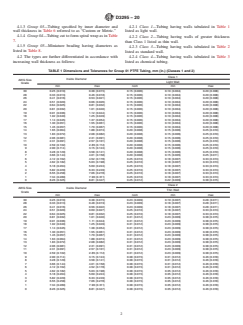
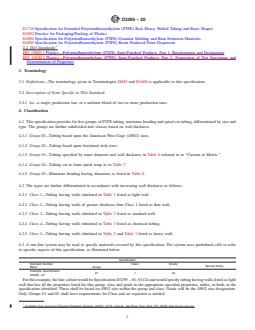
4.1.3 Group 03—Tubing specified by inner diameter and 4.2.1 Class 1—Tubing having walls tabulated in Table 1
wall thickness in Table 6 referred to as “Custom or Metric.” listed as light wall.
4.1.4 Group 04—Tubing cut to form spiral wrap as in Table
4.2.2 Class 2—Tubing having walls of greater thickness
7.
than Class 1 listed as thin wall.
4.1.5 Group 05—Miniature beading having diameters as
4.2.3 Class 3—Tubing having walls tabulated in Table 2
listed in Table 8.
listed as standard wall.
4.2 The types are further differentiated in accordance with 4.2.4 Class 4—Tubing having walls tabulated in Table 3
increasing wall thickness as follows: listed as chemical tubing.
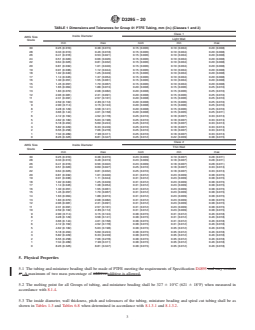
TABLE 1 Dimensions and Tolerances for Group 01 PTFE Tubing, mm (in.) (Classes 1 and 2)
Class 1
Inside Diameter
AWG Size
Light Wall
Grade
min max nom min max
30 0.25 (0.010) 0.38 (0.015) 0.15 (0.006) 0.10 (0.004) 0.20 (0.008)
28 0.33 (0.013) 0.46 (0.018) 0.15 (0.006) 0.10 (0.004) 0.20 (0.008)
26 0.41 (0.016) 0.53 (0.021) 0.15 (0.006) 0.10 (0.004) 0.20 (0.008)
24 0.51 (0.020) 0.66 (0.026) 0.15 (0.006) 0.10 (0.004) 0.20 (0.008)
22 0.64 (0.025) 0.81 (0.032) 0.15 (0.006) 0.10 (0.004) 0.20 (0.008)
20 0.81 (0.032) 1.01 (0.040) 0.15 (0.006) 0.10 (0.004) 0.20 (0.008)
19 0.91 (0.036) 1.12 (0.044) 0.15 (0.006) 0.10 (0.004) 0.20 (0.008)
18 1.02 (0.040) 1.25 (0.049) 0.15 (0.006) 0.10 (0.004) 0.20 (0.008)
17 1.14 (0.045) 1.37 (0.054) 0.15 (0.006) 0.10 (0.004) 0.20 (0.008)
16 1.30 (0.051) 1.55 (0.061) 0.15 (0.006) 0.10 (0.004) 0.20 (0.008)
15 1.45 (0.057) 1.70 (0.067) 0.15 (0.006) 0.10 (0.004) 0.20 (0.008)
14 1.65 (0.064) 1.88 (0.074) 0.20 (0.008) 0.15 (0.006) 0.25 (0.010)
13 1.83 (0.072) 2.08 (0.082) 0.20 (0.008) 0.15 (0.006) 0.25 (0.010)
12 2.06 (0.081) 2.31 (0.091) 0.20 (0.008) 0.15 (0.006) 0.25 (0.010)
11 2.31 (0.091) 2.57 (0.101) 0.20 (0.008) 0.15 (0.006) 0.25 (0.010)
10 2.59 (0.102) 2.85 (0.112) 0.20 (0.008) 0.15 (0.006) 0.25 (0.010)
9 2.90 (0.114) 3.15 (0.124) 0.20 (0.008) 0.15 (0.006) 0.25 (0.010)
8 3.28 (0.129) 3.58 (0.141) 0.20 (0.008) 0.15 (0.006) 0.25 (0.010)
7 3.66 (0.144) 4.01 (0.158) 0.20 (0.008) 0.15 (0.005) 0.25 (0.011)
6 4.12 (0.162) 4.52 (0.178) 0.25 (0.010) 0.18 (0.007) 0.33 (0.013)
5 4.62 (0.182) 5.03 (0.198) 0.25 (0.010) 0.18 (0.007) 0.33 (0.013)
4 5.18 (0.204) 5.69 (0.224) 0.25 (0.010) 0.18 (0.007) 0.33 (0.013)
3 5.82 (0.229) 6.33 (0.249) 0.25 (0.010) 0.18 (0.007) 0.33 (0.013)
2 6.55 (0.258) 7.06 (0.278) 0.25 (0.010) 0.18 (0.007) 0.33 (0.013)
1 7.34 (0.289) 7.90 (0.311) 0.25 (0.010) 0.18 (0.007) 0.33 (0.013)
0 8.26 (0.325) 8.81 (0.347) 0.25 (0.012) 0.22 (0.009) 0.38 (0.015)
Class 2
Inside Diameter
AWG Size
Thin Wall
Grade
min max nom min max
30 0.25 (0.010) 0.38 (0.015) 0.23 (0.009) 0.19 (0.007) 0.28 (0.011)
28 0.33 (0.013) 0.48 (0.019) 0.23 (0.009) 0.18 (0.007) 0.28 (0.011)
26 0.41 (0.016) 0.56 (0.022) 0.23 (0.009) 0.18 (0.007) 0.28 (0.011)
24 0.51 (0.020) 0.69 (0.027) 0.25 (0.010) 0.18 (0.007) 0.33 (0.013)
22 0.64 (0.025) 0.81 (0.032) 0.25 (0.010) 0.18 (0.007) 0.33 (0.013)
20 0.81 (0.032) 1.01 (0.040) 0.31 (0.012) 0.23 (0.009) 0.38 (0.015)
19 0.91 (0.036) 1.11 (0.044) 0.31 (0.012) 0.23 (0.009) 0.38 (0.015)
18 1.02 (0.040) 1.25 (0.049) 0.31 (0.012) 0.23 (0.009) 0.38 (0.015)
17 1.14 (0.045) 1.38 (0.054) 0.31 (0.012) 0.23 (0.009) 0.38 (0.015)
16 1.30 (0.051) 1.55 (0.061) 0.31 (0.012) 0.23 (0.009) 0.38 (0.015)
15 1.45 (0.057) 1.70 (0.067) 0.31 (0.012) 0.23 (0.009) 0.38 (0.015)
14 1.63 (0.064) 1.88 (0.074) 0.31 (0.012) 0.23 (0.009) 0.38 (0.015)
13 1.83 (0.072) 2.08 (0.082) 0.31 (0.012) 0.23 (0.009) 0.38 (0.015)
12 2.06 (0.081) 2.31 (0.091) 0.31 (0.012) 0.23 (0.009) 0.38 (0.015)
11 2.31 (0.091) 2.57 (0.101) 0.31 (0.012) 0.23 (0.009) 0.38 (0.015)
10 2.59 (0.102) 2.85 (0.112) 0.31 (0.012) 0.23 (0.009) 0.38 (0.015)
9 2.90 (0.114) 3.15 (0.124) 0.38 (0.015) 0.31 (0.012) 0.46 (0.018)
8 3.28 (0.129) 3.58 (0.141) 0.38 (0.015) 0.31 (0.012) 0.46 (0.018)
7 3.66 (0.144) 4.01 (0.158) 0.38 (0.015) 0.31 (0.012) 0.46 (0.018)
6 4.12 (0.162) 4.52 (0.178) 0.38 (0.015) 0.31 (0.012) 0.46 (0.018)
5 4.62 (0.182) 5.03 (0.198) 0.38 (0.015) 0.35 (0.012) 0.46 (0.018)
4 5.18 (0.204) 5.69 (0.224) 0.38 (0.015) 0.35 (0.012) 0.46 (0.018)
3 5.82 (0.229) 6.33 (0.249) 0.38 (0.015) 0.35 (0.012) 0.46 (0.018)
2 6.55 (0.258) 7.06 (0.278) 0.38 (0.015) 0.35 (0.012) 0.46 (0.018)
1 7.34 (0.289) 7.90 (0.311) 0.38 (0.015) 0.35 (0.012) 0.46 (0.018)
0 8.26 (0.325) 8.81 (0.347) 0.38 (0.015) 0.35 (0.012) 0.46 (0.018)
D3295 − 20
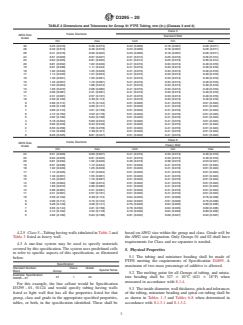
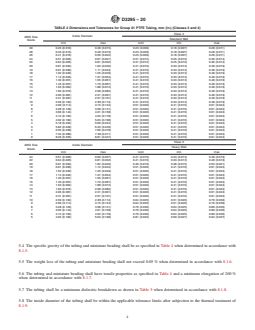
TABLE 2 Dimensions and Tolerances for Group 01 PTFE Tubing, mm (in.) (Classes 3 and 4)
Class 3
Inside Diameter
AWG Size
Standard Wall
Grade
min max nom min max
30 0.25 (0.010) 0.38 (0.015) 0.23 (0.009) 0.18 (0.007) 0.28 (0.011)
28 0.33 (0.013) 0.48 (0.019) 0.23 (0.009) 0.18 (0.007) 0.28 (0.011)
26 0.41 (0.016) 0.56 (0.022) 0.23 (0.009) 0.18 (0.007) 0.28 (0.011)
24 0.51 (0.020) 0.67 (0.027) 0.31 (0.012) 0.25 (0.010) 0.36 (0.014)
22 0.64 (0.025) 0.81 (0.032) 0.31 (0.012) 0.25 (0.010) 0.36 (0.014)
20 0.81 (0.032) 1.02 (0.040) 0.41 (0.016) 0.33 (0.013) 0.48 (0.019)
19 0.91 (0.036) 1.11 (0.044) 0.41 (0.016) 0.33 (0.013) 0.48 (0.019)
18 1.02 (0.040) 1.25 (0.049) 0.41 (0.016) 0.33 (0.013) 0.48 (0.019)
17 1.14 (0.045) 1.37 (0.054) 0.41 (0.016) 0.33 (0.013) 0.48 (0.019)
16 1.30 (0.051) 1.55 (0.061) 0.41 (0.016) 0.33 (0.013) 0.48 (0.019)
15 1.45 (0.057) 1.70 (0.067) 0.41 (0.016) 0.33 (0.013) 0.48 (0.019)
14 1.63 (0.064) 1.88 (0.074) 0.41 (0.016) 0.33 (0.013) 0.48 (0.019)
13 1.83 (0.072) 2.08 (0.082) 0.41 (0.016) 0.33 (0.013) 0.48 (0.019)
12 2.06 (0.081) 2.31 (0.091) 0.41 (0.016) 0.33 (0.013) 0.48 (0.019)
11 2.31 (0.091) 2.57 (0.101) 0.41 (0.016) 0.33 (0.013) 0.48 (0.019)
10 2.59 (0.102) 2.85 (0.112) 0.41 (0.016) 0.33 (0.013) 0.48 (0.019)
9 2.90 (0.114) 3.15 (0.124) 0.51 (0.020) 0.41 (0.016) 0.61 (0.024)
8 3.28 (0.129) 3.58 (0.141) 0.51 (0.020) 0.41 (0.016) 0.61 (0.024)
7 3.66 (0.144) 4.01 (0.158) 0.51 (0.020) 0.41 (0.016) 0.61 (0.024)
6 4.12 (0.162) 4.52 (0.178) 0.51 (0.020) 0.41 (0.016) 0.61 (0.024)
5 4.62 (0.182) 5.03 (0.198) 0.51 (0.020) 0.41 (0.016) 0.61 (0.024)
4 5.18 (0.204) 5.69 (0.224) 0.51 (0.020) 0.41 (0.016) 0.61 (0.024)
3 5.82 (0.229) 6.33 (0.249) 0.51 (0.020) 0.41 (0.016) 0.61 (0.024)
2 6.55 (0.258) 7.06 (0.278) 0.51 (0.020) 0.41 (0.016) 0.61 (0.024)
1 7.34 (0.289) 7.90 (0.311) 0.51 (0.020) 0.41 (0.016) 0.61 (0.024)
0 8.26 (0.325) 8.81 (0.347) 0.51 (0.020) 0.41 (0.016) 0.61 (0.024)
Class 5
Inside Diameter
AWG Size
Heavy Wall
Grade
min max nom min max
24 0.51 (0.020) 0.69 (0.027) 0.41 (0.016) 0.33 (0.013) 0.48 (0.019)
22 0.64 (0.025) 0.81 (0.032) 0.41 (0.016) 0.33 (0.013) 0.48 (0.019)
20 0.81 (0.032) 1.02 (0.040) 0.46 (0.018) 0.38 (0.015) 0.53 (0.021)
19 0.91 (0.036) 1.12 (0.044) 0.51 (0.020) 0.41 (0.016) 0.61 (0.024)
18 1.02 (0.040) 1.25 (0.049) 0.51 (0.020) 0.41 (0.016) 0.61 (0.024)
17 1.14 (0.045) 1.37 (0.054) 0.51 (0.020) 0.41 (0.016) 0.61 (0.024)
16 1.30 (0.051) 1.55 (0.061) 0.51 (0.020) 0.41 (0.016) 0.61 (0.024)
15 1.45 (0.057) 1.70 (0.067) 0.51 (0.020) 0.41 (0.016) 0.61 (0.024)
14 1.63 (0.064) 1.88 (0.074) 0.51 (0.020) 0.41 (0.016) 0.61 (0.024)
13 1.83 (0.072) 2.08 (0.082) 0.51 (0.020) 0.41 (0.016) 0.61 (0.024)
12 2.06 (0.081) 2.31 (0.091) 0.51 (0.020) 0.41 (0.016) 0.61 (0.024)
11 2.31 (0.091) 2.57 (0.101) 0.51 (0.020) 0.41 (0.016) 0.61 (0.024)
10 2.59 (0.102) 2.85 (0.112) 0.64 (0.025) 0.51 (0.020) 0.76 (0.030)
9 2.90 (0.114) 3.15 (0.124) 0.64 (0.025) 0.51 (0.020) 0.76 (0.030)
8 3.28 (0.129) 3.58 (0.141) 0.76 (0.030) 0.64 (0.025) 0.89 (0.035)
7 3.65 (0.144) 4.01 (0.158) 0.76 (0.030) 0.64 (0.025) 0.89 (0.035)
6 4.12 (0.162) 4.52 (0.178) 0.76 (0.030) 0.64 (0.025) 0.89 (0.035)
5 4.62 (0.182) 5.03 (0.198) 0.81 (0.032) 0.69 (0.027) 0.94 (0.037)
4.2.5 Class 5—TubinghavingwallstabulatedinTable2and based on AWG size within the group and class. Grade will be
Table 3 listed as heavy wall. the AWG size designation. Only Groups 01 and 02 shall have
requirements for Class and no separator is needed.
4.3 A one-line system may be used to specify materials
covered by this specification. The system uses predefined cells
5. Physical Properties
to refer to specific aspects of this specification, as illustrated
5.1 The tubing and miniature beading shall be made of
below.
PTFE meeting the requirements of Specification D4895.A
Specification
maximum of two mass percentage of additive is allowed.
Standard Number: Class: Grade:
Special Notes
Block Group:
5.2 The melting point for all Groups of tubing, and minia-
Example: Specification
01 1 24
ture beading shall be 327 6 10°C (621 6 18°F) when
D3295 – 01
measured in accordance with 8.1.4.
For this example, the line callout would be Specification
D3295 – 01, 01124 and would specify tubing having walls 5.3 The inside diameter, wall thickness, pitch and tolerances
listed as light wall that has all the properties listed for that of the tubing, miniature beading and spiral cut tubing shall be
group, class and grade in the appropriate specified properties, as shown in Tables 1-3 and Tables 6-8 when determined in
tables, or both, in the specification identified. These shall be accordance with 8.1.3.1 and 8.1.3.2.
D3295 − 20
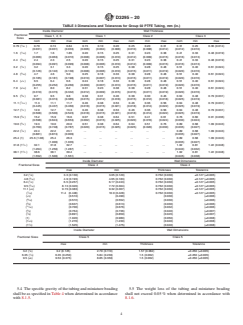
TABLE 3 Dimensions and Tolerances for Group 02 PTFE Tubing, mm (in.)
Inside Diameter Wall Thickness
Fractional
Class 1, 2, 3 Class 1 Class 2 Class 3
Sizes
nom min max nom min max nom min max nom min max
0.79 ( ⁄32 ) 0.79 0.74 0.84 0.15 0.10 0.20 0.25 0.20 0.31 0.31 0.25 0.36 (0.014)
(0.031) (0.031) (0.033) (0.006) (0.004) (0.008) (0.010) (0.008) (0.012) (0.012) (0.010)
1.6 ( ⁄16)1.7 1.6 1.85 0.20 0.15 0.25 0.31 0.23 0.38 0.41 0.33 0.48 (0.019)
(0.066) (0.063) (0.072) (0.008) (0.006) (0.010) (0.012) (0.009) (0.015) (0.016) (0.013)
2.4 ( ⁄32)2.4 2.3 2.5 0.20 0.15 0.25 0.31 0.23 0.38 0.41 0.33 0.48 (0.019)
(0.094) (0.091) (0.099) (0.008) (0.006) (0.010) (0.012) (0.009) (0.015) (0.016) (0.013)
3.2 ( ⁄8)3.2 3.1 3.3 0.20 0.15 0.25 0.38 0.28 0.48 0.51 0.40 0.61 (0.024)
(0.126) (0.122) (0.130) (0.008) (0.006) (0.010) (0.015) (0.011) (0.019) (0.020) (0.016)
4.8 ( ⁄16)4.7 4.6 5.0 0.25 0.18 0.33 0.38 0.28 0.48 0.51 0.40 0.61 (0.024)
(0.185) (0.181) (0.198) (0.010) (0.007) (
...
This document is not an ASTM standard and is intended only to provide the user of an ASTM standard an indication of what changes have been made to the previous version. Because
it may not be technically possible to adequately depict all changes accurately, ASTM recommends that users consult prior editions as appropriate. In all cases only the current version
of the standard as published by ASTM is to be considered the official document.
Designation: D3295 − 15 D3295 − 20
Standard Specification for
PTFE Tubing, Miniature Beading and Spiral Cut Tubing
This standard is issued under the fixed designation D3295; the number immediately following the designation indicates the year of
original adoption or, in the case of revision, the year of last revision. A number in parentheses indicates the year of last reapproval. A
superscript epsilon (´) indicates an editorial change since the last revision or reapproval.
This standard has been approved for use by agencies of the U.S. Department of Defense.
1. Scope*
1.1 This specification covers PTFE tubing, miniature beading and spiral cut tubing-manufactured from PTFE resin produced from
dispersion specified in Specification D4895.
NOTE 1—PTFE tube and rod manufactured from resin specified in Specification D4894 are covered in Specification D1710.
1.2 The values stated in SI units are to be regarded as standard. The inch-pound units given in parentheses are for information only.
1.3 The following hazard caveat pertains only to the test method portion, Section 8, of this specification: This standard does
not purport to address all of the safety concerns, if any, associated with its use. It is the responsibility of the user of this standard
to establish appropriate safety safety, health, and healthenvironmental practices and determine the applicability of regulatory
limitations prior to use.
1.4 As PTFE resin produced from dispersion is not a true thermoplastic material, any reuse for the specification referenced above
is impossible. However, markets do exist for non-virgin PTFE as additives and fillers.
NOTE 2—There is no knownThis standard and ISO 13000-1 ISO equivalent to this standard.⁄-2 address some of the same subject matter, but differ in
technical content.
1.5 This international standard was developed in accordance with internationally recognized principles on standardization
established in the Decision on Principles for the Development of International Standards, Guides and Recommendations issued
by the World Trade Organization Technical Barriers to Trade (TBT) Committee.
2. Referenced Documents
2.1 ASTM Standards:
D618 Practice for Conditioning Plastics for Testing
D638 Test Method for Tensile Properties of Plastics
D792 Test Methods for Density and Specific Gravity (Relative Density) of Plastics by Displacement
D883 Terminology Relating to Plastics
D1600 Terminology for Abbreviated Terms Relating to Plastics
D1675 Test Methods for Polytetrafluoroethylene Tubing
D1708 Test Method for Tensile Properties of Plastics by Use of Microtensile Specimens
This specification is under the jurisdiction of ASTM Committee D20 on Plastics and is the direct responsibility of Subcommittee D20.15 on Thermoplastic Materials
(Section D20.15.12).
Current edition approved Sept. 1, 2015Dec. 1, 2020. Published September 2015December 2020. Originally approved in 1974. Last previous edition approved in 20112015
as D3295 - 06D3295 - 15.(2011). DOI: 10.1520/D3295-15.10.1520/D3295-20.
For referenced ASTM standards, visit the ASTM website, www.astm.org, or contact ASTM Customer Service at service@astm.org. For Annual Book of ASTM Standards
volume information, refer to the standard’s Document Summary page on the ASTM website.
*A Summary of Changes section appears at the end of this standard
Copyright © ASTM International, 100 Barr Harbor Drive, PO Box C700, West Conshohocken, PA 19428-2959. United States
D3295 − 20
D1710 Specification for Extruded Polytetrafluoroethylene (PTFE) Rod, Heavy Walled Tubing and Basic Shapes
D3892 Practice for Packaging/Packing of Plastics
D4894 Specification for Polytetrafluoroethylene (PTFE) Granular Molding and Ram Extrusion Materials
D4895 Specification for Polytetrafluoroethylene (PTFE) Resin Produced From Dispersion
2.2 ISO Standards:
ISO 13000-1 Plastics—Polytetrafluoroethylene (PTFE) Semi-Finished Products, Part 1: Requirements and Designation
ISO 13000-2 Plastics—Polytetrafluoroethylene (PTFE) Semi-Finished Products, Part 2: Preparation of Test Specimens and
Determination of Properties
3. Terminology
3.1 Definitions—The terminology given in Terminologies D883 and D1600 is applicable to this specification.
3.2 Description of Term Specific to This Standard:
3.2.1 lot—a single production run, or a uniform blend of two or more production runs.
4. Classification
4.1 This specification provides for five groups of PTFE tubing, miniature beading and spiral cut tubing, differentiated by size and
type. The groups are further subdivided into classes based on wall thickness.
4.1.1 Group 01—Tubing based upon the American Wire Gage (AWG) sizes.
4.1.2 Group 02—Tubing based upon fractional inch sizes.
4.1.3 Group 03—Tubing specified by inner diameter and wall thickness in Table 6 referred to as “Custom or Metric.”
4.1.4 Group 04—Tubing cut to form spiral wrap as in Table 7.
4.1.5 Group 05—Miniature beading having diameters as listed in Table 8.
4.2 The types are further differentiated in accordance with increasing wall thickness as follows:
4.2.1 Class 1—Tubing having walls tabulated in Table 1 listed as light wall.
4.2.2 Class 2—Tubing having walls of greater thickness than Class 1 listed as thin wall.
4.2.3 Class 3—Tubing having walls tabulated in Table 2 listed as standard wall.
4.2.4 Class 4—Tubing having walls tabulated in Table 3 listed as chemical tubing.
4.2.5 Class 5—Tubing having walls tabulated in Table 2 and Table 3 listed as heavy wall.
4.3 A one-line system may be used to specify materials covered by this specification. The system uses predefined cells to refer
to specific aspects of this specification, as illustrated below.
Specification
Standard Number: Class: Grade:
Special Notes
Block Group:
Example: Specification
01 1 24
D3295 – 01
For this example, the line callout would be Specification D3295 – 01, 01124 and would specify tubing having walls listed as light
wall that has all the properties listed for that group, class and grade in the appropriate specified properties, tables, or both, in the
specification identified. These shall be based on AWG size within the group and class. Grade will be the AWG size designation.
Only Groups 01 and 02 shall have requirements for Class and no separator is needed.
Available from American National Standards Institute (ANSI), 25 W. 43rd St., 4th Floor, New York, NY 10036, http://www.ansi.org.
D3295 − 20
TABLE 1 Dimensions and Tolerances for Group 01 PTFE Tubing, mm (in.) (Classes 1 and 2)
Class 1
Inside Diameter
AWG Size
Light Wall
Grade
min max nom min max
30 0.25 (0.010) 0.38 (0.015) 0.15 (0.006) 0.10 (0.004) 0.20 (0.008)
28 0.33 (0.013) 0.46 (0.018) 0.15 (0.006) 0.10 (0.004) 0.20 (0.008)
26 0.41 (0.016) 0.53 (0.021) 0.15 (0.006) 0.10 (0.004) 0.20 (0.008)
24 0.51 (0.020) 0.66 (0.026) 0.15 (0.006) 0.10 (0.004) 0.20 (0.008)
22 0.64 (0.025) 0.81 (0.032) 0.15 (0.006) 0.10 (0.004) 0.20 (0.008)
20 0.81 (0.032) 1.01 (0.040) 0.15 (0.006) 0.10 (0.004) 0.20 (0.008)
19 0.91 (0.036) 1.12 (0.044) 0.15 (0.006) 0.10 (0.004) 0.20 (0.008)
18 1.02 (0.040) 1.25 (0.049) 0.15 (0.006) 0.10 (0.004) 0.20 (0.008)
17 1.14 (0.045) 1.37 (0.054) 0.15 (0.006) 0.10 (0.004) 0.20 (0.008)
16 1.30 (0.051) 1.55 (0.061) 0.15 (0.006) 0.10 (0.004) 0.20 (0.008)
15 1.45 (0.057) 1.70 (0.067) 0.15 (0.006) 0.10 (0.004) 0.20 (0.008)
14 1.65 (0.064) 1.88 (0.074) 0.20 (0.008) 0.15 (0.006) 0.25 (0.010)
13 1.83 (0.072) 2.08 (0.082) 0.20 (0.008) 0.15 (0.006) 0.25 (0.010)
12 2.06 (0.081) 2.31 (0.091) 0.20 (0.008) 0.15 (0.006) 0.25 (0.010)
11 2.31 (0.091) 2.57 (0.101) 0.20 (0.008) 0.15 (0.006) 0.25 (0.010)
10 2.59 (0.102) 2.85 (0.112) 0.20 (0.008) 0.15 (0.006) 0.25 (0.010)
9 2.90 (0.114) 3.15 (0.124) 0.20 (0.008) 0.15 (0.006) 0.25 (0.010)
8 3.28 (0.129) 3.58 (0.141) 0.20 (0.008) 0.15 (0.006) 0.25 (0.010)
7 3.66 (0.144) 4.01 (0.158) 0.20 (0.008) 0.15 (0.005) 0.25 (0.011)
6 4.12 (0.162) 4.52 (0.178) 0.25 (0.010) 0.18 (0.007) 0.33 (0.013)
5 4.62 (0.182) 5.03 (0.198) 0.25 (0.010) 0.18 (0.007) 0.33 (0.013)
4 5.18 (0.204) 5.69 (0.224) 0.25 (0.010) 0.18 (0.007) 0.33 (0.013)
3 5.82 (0.229) 6.33 (0.249) 0.25 (0.010) 0.18 (0.007) 0.33 (0.013)
2 6.55 (0.258) 7.06 (0.278) 0.25 (0.010) 0.18 (0.007) 0.33 (0.013)
1 7.34 (0.289) 7.90 (0.311) 0.25 (0.010) 0.18 (0.007) 0.33 (0.013)
0 8.26 (0.325) 8.81 (0.347) 0.25 (0.012) 0.22 (0.009) 0.38 (0.015)
Class 2
Inside Diameter
AWG Size
Thin Wall
Grade
min max nom min max
30 0.25 (0.010) 0.38 (0.015) 0.23 (0.009) 0.19 (0.007) 0.28 (0.011)
28 0.33 (0.013) 0.48 (0.019) 0.23 (0.009) 0.18 (0.007) 0.28 (0.011)
26 0.41 (0.016) 0.56 (0.022) 0.23 (0.009) 0.18 (0.007) 0.28 (0.011)
24 0.51 (0.020) 0.69 (0.027) 0.25 (0.010) 0.18 (0.007) 0.33 (0.013)
22 0.64 (0.025) 0.81 (0.032) 0.25 (0.010) 0.18 (0.007) 0.33 (0.013)
20 0.81 (0.032) 1.01 (0.040) 0.31 (0.012) 0.23 (0.009) 0.38 (0.015)
19 0.91 (0.036) 1.11 (0.044) 0.31 (0.012) 0.23 (0.009) 0.38 (0.015)
18 1.02 (0.040) 1.25 (0.049) 0.31 (0.012) 0.23 (0.009) 0.38 (0.015)
17 1.14 (0.045) 1.38 (0.054) 0.31 (0.012) 0.23 (0.009) 0.38 (0.015)
16 1.30 (0.051) 1.55 (0.061) 0.31 (0.012) 0.23 (0.009) 0.38 (0.015)
15 1.45 (0.057) 1.70 (0.067) 0.31 (0.012) 0.23 (0.009) 0.38 (0.015)
14 1.63 (0.064) 1.88 (0.074) 0.31 (0.012) 0.23 (0.009) 0.38 (0.015)
13 1.83 (0.072) 2.08 (0.082) 0.31 (0.012) 0.23 (0.009) 0.38 (0.015)
12 2.06 (0.081) 2.31 (0.091) 0.31 (0.012) 0.23 (0.009) 0.38 (0.015)
11 2.31 (0.091) 2.57 (0.101) 0.31 (0.012) 0.23 (0.009) 0.38 (0.015)
10 2.59 (0.102) 2.85 (0.112) 0.31 (0.012) 0.23 (0.009) 0.38 (0.015)
9 2.90 (0.114) 3.15 (0.124) 0.38 (0.015) 0.31 (0.012) 0.46 (0.018)
8 3.28 (0.129) 3.58 (0.141) 0.38 (0.015) 0.31 (0.012) 0.46 (0.018)
7 3.66 (0.144) 4.01 (0.158) 0.38 (0.015) 0.31 (0.012) 0.46 (0.018)
6 4.12 (0.162) 4.52 (0.178) 0.38 (0.015) 0.31 (0.012) 0.46 (0.018)
5 4.62 (0.182) 5.03 (0.198) 0.38 (0.015) 0.35 (0.012) 0.46 (0.018)
4 5.18 (0.204) 5.69 (0.224) 0.38 (0.015) 0.35 (0.012) 0.46 (0.018)
3 5.82 (0.229) 6.33 (0.249) 0.38 (0.015) 0.35 (0.012) 0.46 (0.018)
2 6.55 (0.258) 7.06 (0.278) 0.38 (0.015) 0.35 (0.012) 0.46 (0.018)
1 7.34 (0.289) 7.90 (0.311) 0.38 (0.015) 0.35 (0.012) 0.46 (0.018)
0 8.26 (0.325) 8.81 (0.347) 0.38 (0.015) 0.35 (0.012) 0.46 (0.018)
5. Physical Properties
5.1 The tubing and miniature beading shall be made of PTFE meeting the requirements of Specification D4895 and may contain
a . A maximum of two mass percentage of additive.additive is allowed.
5.2 The melting point for all Groups of tubing, and miniature beading shall be 327 6 10°C (621 6 18°F) when measured in
accordance with 8.1.4.
5.3 The inside diameter, wall thickness, pitch and tolerances of the tubing, miniature beading and spiral cut tubing shall be as
shown in Tables 1-3 and Tables 6-8 when determined in accordance with 8.1.3.1 and 8.1.3.2.
D3295 − 20
TABLE 2 Dimensions and Tolerances for Group 01 PTFE Tubing, mm (in.) (Classes 3 and 4)
Class 3
Inside Diameter
AWG Size
Standard Wall
Grade
min max nom min max
30 0.25 (0.010) 0.38 (0.015) 0.23 (0.009) 0.18 (0.007) 0.28 (0.011)
28 0.33 (0.013) 0.48 (0.019) 0.23 (0.009) 0.18 (0.007) 0.28 (0.011)
26 0.41 (0.016) 0.56 (0.022) 0.23 (0.009) 0.18 (0.007) 0.28 (0.011)
24 0.51 (0.020) 0.67 (0.027) 0.31 (0.012) 0.25 (0.010) 0.36 (0.014)
22 0.64 (0.025) 0.81 (0.032) 0.31 (0.012) 0.25 (0.010) 0.36 (0.014)
20 0.81 (0.032) 1.02 (0.040) 0.41 (0.016) 0.33 (0.013) 0.48 (0.019)
19 0.91 (0.036) 1.11 (0.044) 0.41 (0.016) 0.33 (0.013) 0.48 (0.019)
18 1.02 (0.040) 1.25 (0.049) 0.41 (0.016) 0.33 (0.013) 0.48 (0.019)
17 1.14 (0.045) 1.37 (0.054) 0.41 (0.016) 0.33 (0.013) 0.48 (0.019)
16 1.30 (0.051) 1.55 (0.061) 0.41 (0.016) 0.33 (0.013) 0.48 (0.019)
15 1.45 (0.057) 1.70 (0.067) 0.41 (0.016) 0.33 (0.013) 0.48 (0.019)
14 1.63 (0.064) 1.88 (0.074) 0.41 (0.016) 0.33 (0.013) 0.48 (0.019)
13 1.83 (0.072) 2.08 (0.082) 0.41 (0.016) 0.33 (0.013) 0.48 (0.019)
12 2.06 (0.081) 2.31 (0.091) 0.41 (0.016) 0.33 (0.013) 0.48 (0.019)
11 2.31 (0.091) 2.57 (0.101) 0.41 (0.016) 0.33 (0.013) 0.48 (0.019)
10 2.59 (0.102) 2.85 (0.112) 0.41 (0.016) 0.33 (0.013) 0.48 (0.019)
9 2.90 (0.114) 3.15 (0.124) 0.51 (0.020) 0.41 (0.016) 0.61 (0.024)
8 3.28 (0.129) 3.58 (0.141) 0.51 (0.020) 0.41 (0.016) 0.61 (0.024)
7 3.66 (0.144) 4.01 (0.158) 0.51 (0.020) 0.41 (0.016) 0.61 (0.024)
6 4.12 (0.162) 4.52 (0.178) 0.51 (0.020) 0.41 (0.016) 0.61 (0.024)
5 4.62 (0.182) 5.03 (0.198) 0.51 (0.020) 0.41 (0.016) 0.61 (0.024)
4 5.18 (0.204) 5.69 (0.224) 0.51 (0.020) 0.41 (0.016) 0.61 (0.024)
3 5.82 (0.229) 6.33 (0.249) 0.51 (0.020) 0.41 (0.016) 0.61 (0.024)
2 6.55 (0.258) 7.06 (0.278) 0.51 (0.020) 0.41 (0.016) 0.61 (0.024)
1 7.34 (0.289) 7.90 (0.311) 0.51 (0.020) 0.41 (0.016) 0.61 (0.024)
0 8.26 (0.325) 8.81 (0.347) 0.51 (0.020) 0.41 (0.016) 0.61 (0.024)
Class 5
Inside Diameter
AWG Size
Heavy Wall
Grade
min max nom min max
24 0.51 (0.020) 0.69 (0.027) 0.41 (0.016) 0.33 (0.013) 0.48 (0.019)
22 0.64 (0.025) 0.81 (0.032) 0.41 (0.016) 0.33 (0.013) 0.48 (0.019)
20 0.81 (0.032) 1.02 (0.040) 0.46 (0.018) 0.38 (0.015) 0.53 (0.021)
19 0.91 (0.036) 1.12 (0.044) 0.51 (0.020) 0.41 (0.016) 0.61 (0.024)
18 1.02 (0.040) 1.25 (0.049) 0.51 (0.020) 0.41 (0.016) 0.61 (0.024)
17 1.14 (0.045) 1.37 (0.054) 0.51 (0.020) 0.41 (0.016) 0.61 (0.024)
16 1.30 (0.051) 1.55 (0.061) 0.51 (0.020) 0.41 (0.016) 0.61 (0.024)
15 1.45 (0.057) 1.70 (0.067) 0.51 (0.020) 0.41 (0.016) 0.61 (0.024)
14 1.63 (0.064) 1.88 (0.074) 0.51 (0.020) 0.41 (0.016) 0.61 (0.024)
13 1.83 (0.072) 2.08 (0.082) 0.51 (0.020) 0.41 (0.016) 0.61 (0.024)
12 2.06 (0.081) 2.31 (0.091) 0.51 (0.020) 0.41 (0.016) 0.61 (0.024)
11 2.31 (0.091) 2.57 (0.101) 0.51 (0.020) 0.41 (0.016) 0.61 (0.024)
10 2.59 (0.102) 2.85 (0.112) 0.64 (0.025) 0.51 (0.020) 0.76 (0.030)
9 2.90 (0.114) 3.15 (0.124) 0.64 (0.025) 0.51 (0.020) 0.76 (0.030)
8 3.28 (0.129) 3.58 (0.141) 0.76 (0.030) 0.64 (0.025) 0.89 (0.035)
7 3.65 (0.144) 4.01 (0.158) 0.76 (0.030) 0.64 (0.025) 0.89 (0.035)
6 4.12 (0.162) 4.52 (0.178) 0.76 (0.030) 0.64 (0.025) 0.89 (0.035)
5 4.62 (0.182) 5.03 (0.198) 0.81 (0.032) 0.69 (0.027) 0.94 (0.037)
5.4 The specific gravity of the tubing and miniature beading shall be as specified in Table 4 when determined in accordance with
8.1.5.
5.5 The weight loss of the tubing and miniature beading shall not exceed 0.05 % when determined in accordance with 8.1.6.
5.6 The tubing and miniature beading shall have tensile properties as specified in Table 4 and a minimum elongation of 200 %
when determined in accordance with 8.1.7.
5.7 The tubing shall be a minimum dielectric breakdown as shown in Table 5 when determined in accordance with 8.1.8.
5.8 The inside diameter of the tubing shall be within the applicable tolerance limits after subjection to the thermal treatment of
8.1.9.
D3295 − 20
TABLE 3 Dimensions and Tolerances for Group 02 PTFE Tubing, mm (in.)
Inside Diameter Wall Thickness
Fractional
Class 1, 2, 3 Class 1 Class 2 Class 3
Sizes
nom min max nom min max nom min max nom min max
0.79 ( ⁄32 ) 0.79 0.74 0.84 0.15 0.10 0.20 0.25 0.20 0.31 0.31 0.25 0.36 (0.014)
(0.031) (0.031) (0.033) (0.
...
Questions, Comments and Discussion
Ask us and Technical Secretary will try to provide an answer. You can facilitate discussion about the standard in here.
Loading comments...