


ASTM E2089-15(2020)
(Practice)Standard Practices for Ground Laboratory Atomic Oxygen Interaction Evaluation of Materials for Space Applications
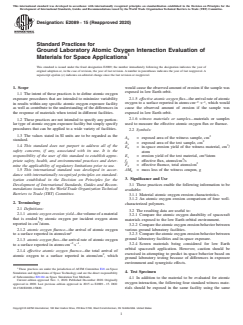
Standard Practices for Ground Laboratory Atomic Oxygen Interaction Evaluation of Materials for Space Applications
SIGNIFICANCE AND USE
3.1 These practices enable the following information to be available:
3.1.1 Material atomic oxygen erosion characteristics.
3.1.2 An atomic oxygen erosion comparison of four well-characterized polymers.
3.2 The resulting data are useful to:
3.2.1 Compare the atomic oxygen durability of spacecraft materials exposed to the low Earth orbital environment.
3.2.2 Compare the atomic oxygen erosion behavior between various ground laboratory facilities.
3.2.3 Compare the atomic oxygen erosion behavior between ground laboratory facilities and in-space exposure.
3.2.4 Screen materials being considered for low Earth orbital spacecraft application. However, caution should be exercised in attempting to predict in-space behavior based on ground laboratory testing because of differences in exposure environment and synergistic effects.
SCOPE
1.1 The intent of these practices is to define atomic oxygen exposure procedures that are intended to minimize variability in results within any specific atomic oxygen exposure facility as well as contribute to the understanding of the differences in the response of materials when tested in different facilities.
1.2 These practices are not intended to specify any particular type of atomic oxygen exposure facility but simply specify procedures that can be applied to a wide variety of facilities.
1.3 The values stated in SI units are to be regarded as the standard.
1.4 This standard does not purport to address all of the safety concerns, if any, associated with its use. It is the responsibility of the user of this standard to establish appropriate safety, health, and environmental practices and determine the applicability of regulatory limitations prior to use.
1.5 This international standard was developed in accordance with internationally recognized principles on standardization established in the Decision on Principles for the Development of International Standards, Guides and Recommendations issued by the World Trade Organization Technical Barriers to Trade (TBT) Committee.
General Information
- Status
- Published
- Publication Date
- 31-Oct-2020
- Technical Committee
- E21 - Space Simulation and Applications of Space Technology
- Drafting Committee
- E21.04 - Space Simulation Test Methods
Overview
ASTM E2089-15(2020), titled Standard Practices for Ground Laboratory Atomic Oxygen Interaction Evaluation of Materials for Space Applications, provides internationally recognized procedures for evaluating the atomic oxygen durability of spacecraft materials. Developed by ASTM Committee E21 on Space Simulation and Applications of Space Technology, this standard addresses the variability and reliability of ground laboratory testing for the effects of atomic oxygen-one of the most significant environmental threats to materials used in low Earth orbit (LEO).
The standard outlines practices to ensure consistent and comparable test results across various laboratory facilities, supporting material screening and comparison with real-space environments. By following these practices, organizations can enhance their understanding of ground-to-space correlation for atomic oxygen effects, facilitate materials selection, and improve spacecraft performance and reliability.
Key Topics
- Atomic Oxygen Erosion Characterization: Procedures to quantify the erosion yield-volume of material eroded per incident atomic oxygen atom-of materials exposed in ground laboratories.
- Use of Witness Materials: Standard witness polymers and materials (e.g., Kapton H or HN polyimide, FEP, PE, and pyrolytic graphite) serve as baselines for effective atomic oxygen flux and fluence determinations.
- Sample Preparation and Handling:
- Recommendations for cleaning, handling, dehydration, and weighing of test and witness samples to avoid contamination and ensure accuracy.
- Detailed protocols for masking, cladding, and controlling exposure area during testing.
- Measurement Techniques:
- Evaluation of atomic oxygen-induced erosion by mass loss or thickness loss, using high-sensitivity balances and surface profiling methods.
- Calculation methods for effective fluence, erosion yield, and comparative data using SI units.
- Cross-Facility and Space Correlation: Guidance on comparing laboratory conditions and results to those from actual LEO exposures, including caveats regarding direct prediction of in-space behavior.
- Reporting Requirements: Specification of essential data to report, including comparative erosion on reference materials, effective fluence, and detailed descriptions of the exposure environment and methods.
Applications
ASTM E2089-15(2020) is a critical tool for the aerospace industry, research institutions, and material developers focused on:
- Spacecraft Material Selection: Screening candidate materials for resistance to atomic oxygen erosion prior to their use in spacecraft destined for LEO.
- Durability Comparisons: Assessing and benchmarking the performance of materials and protective coatings against standardized witness samples and across different test facilities.
- Facility Validation and Calibration: Ensuring ground laboratory simulation facilities produce reliable and comparable results for space mission requirements.
- Research and Development: Supporting the development of new materials or coatings designed for enhanced atomic oxygen resistance in the space environment.
- Quality Assurance: Providing documented, repeatable processes that verify materials' suitability for the challenges of the LEO environment, reducing risk for mission planners and satellite manufacturers.
Related Standards
Organizations working with ASTM E2089-15(2020) may also reference these related standards and guidance documents:
- NASA HDBK-6024: NASA Spacecraft Polymers Atomic Oxygen Durability Handbook
- ASTM E595: Standard Test Method for Total Mass Loss and Collected Volatile Condensable Materials from Outgassing in a Vacuum Environment
- ASTM E512: Standard Practice for Combined Loads Test of Aerospace Structures
- ISO 14624: Space systems-Safety and compatibility of materials
- JPL Publication 95-17: Protocol for Atomic Oxygen Testing of Materials in Ground-Based Facilities
ASTM E2089 supports effective, standardized evaluation of material performance, contributing to safer and more reliable spacecraft and satellites operating in the harsh environment of low Earth orbit. Incorporating these practices can significantly improve material qualification processes and facilitate better interdisciplinary collaboration in aerospace material science.
Get Certified
Connect with accredited certification bodies for this standard

DNV
DNV is an independent assurance and risk management provider.

Lloyd's Register
Lloyd's Register is a global professional services organisation specialising in engineering and technology.
DNV Energy Systems
Energy and renewable energy certification.
Sponsored listings
Frequently Asked Questions
ASTM E2089-15(2020) is a standard published by ASTM International. Its full title is "Standard Practices for Ground Laboratory Atomic Oxygen Interaction Evaluation of Materials for Space Applications". This standard covers: SIGNIFICANCE AND USE 3.1 These practices enable the following information to be available: 3.1.1 Material atomic oxygen erosion characteristics. 3.1.2 An atomic oxygen erosion comparison of four well-characterized polymers. 3.2 The resulting data are useful to: 3.2.1 Compare the atomic oxygen durability of spacecraft materials exposed to the low Earth orbital environment. 3.2.2 Compare the atomic oxygen erosion behavior between various ground laboratory facilities. 3.2.3 Compare the atomic oxygen erosion behavior between ground laboratory facilities and in-space exposure. 3.2.4 Screen materials being considered for low Earth orbital spacecraft application. However, caution should be exercised in attempting to predict in-space behavior based on ground laboratory testing because of differences in exposure environment and synergistic effects. SCOPE 1.1 The intent of these practices is to define atomic oxygen exposure procedures that are intended to minimize variability in results within any specific atomic oxygen exposure facility as well as contribute to the understanding of the differences in the response of materials when tested in different facilities. 1.2 These practices are not intended to specify any particular type of atomic oxygen exposure facility but simply specify procedures that can be applied to a wide variety of facilities. 1.3 The values stated in SI units are to be regarded as the standard. 1.4 This standard does not purport to address all of the safety concerns, if any, associated with its use. It is the responsibility of the user of this standard to establish appropriate safety, health, and environmental practices and determine the applicability of regulatory limitations prior to use. 1.5 This international standard was developed in accordance with internationally recognized principles on standardization established in the Decision on Principles for the Development of International Standards, Guides and Recommendations issued by the World Trade Organization Technical Barriers to Trade (TBT) Committee.
SIGNIFICANCE AND USE 3.1 These practices enable the following information to be available: 3.1.1 Material atomic oxygen erosion characteristics. 3.1.2 An atomic oxygen erosion comparison of four well-characterized polymers. 3.2 The resulting data are useful to: 3.2.1 Compare the atomic oxygen durability of spacecraft materials exposed to the low Earth orbital environment. 3.2.2 Compare the atomic oxygen erosion behavior between various ground laboratory facilities. 3.2.3 Compare the atomic oxygen erosion behavior between ground laboratory facilities and in-space exposure. 3.2.4 Screen materials being considered for low Earth orbital spacecraft application. However, caution should be exercised in attempting to predict in-space behavior based on ground laboratory testing because of differences in exposure environment and synergistic effects. SCOPE 1.1 The intent of these practices is to define atomic oxygen exposure procedures that are intended to minimize variability in results within any specific atomic oxygen exposure facility as well as contribute to the understanding of the differences in the response of materials when tested in different facilities. 1.2 These practices are not intended to specify any particular type of atomic oxygen exposure facility but simply specify procedures that can be applied to a wide variety of facilities. 1.3 The values stated in SI units are to be regarded as the standard. 1.4 This standard does not purport to address all of the safety concerns, if any, associated with its use. It is the responsibility of the user of this standard to establish appropriate safety, health, and environmental practices and determine the applicability of regulatory limitations prior to use. 1.5 This international standard was developed in accordance with internationally recognized principles on standardization established in the Decision on Principles for the Development of International Standards, Guides and Recommendations issued by the World Trade Organization Technical Barriers to Trade (TBT) Committee.
ASTM E2089-15(2020) is classified under the following ICS (International Classification for Standards) categories: 27.120.30 - Fissile materials and nuclear fuel technology. The ICS classification helps identify the subject area and facilitates finding related standards.
ASTM E2089-15(2020) is available in PDF format for immediate download after purchase. The document can be added to your cart and obtained through the secure checkout process. Digital delivery ensures instant access to the complete standard document.
Standards Content (Sample)
This international standard was developed in accordance with internationally recognized principles on standardization established in the Decision on Principles for the
Development of International Standards, Guides and Recommendations issued by the World Trade Organization Technical Barriers to Trade (TBT) Committee.
Designation: E2089 − 15 (Reapproved 2020)
Standard Practices for
Ground Laboratory Atomic Oxygen Interaction Evaluation of
Materials for Space Applications
This standard is issued under the fixed designation E2089; the number immediately following the designation indicates the year of
original adoption or, in the case of revision, the year of last revision.Anumber in parentheses indicates the year of last reapproval.A
superscript epsilon (´) indicates an editorial change since the last revision or reapproval.
1. Scope would cause the observed amount of erosion if the sample was
exposed in low Earth orbit.
1.1 The intent of these practices is to define atomic oxygen
2.1.5 effective atomic oxygen flux—thearrivalrateofatomic
exposure procedures that are intended to minimize variability
−2 −1
oxygen to a surface reported in atoms·cm ·s , which would
in results within any specific atomic oxygen exposure facility
cause the observed amount of erosion if the sample was
as well as contribute to the understanding of the differences in
exposed in low Earth orbit.
the response of materials when tested in different facilities.
2.1.6 witness materials or samples—materials or samples
1.2 These practices are not intended to specify any particu-
used to measure the effective atomic oxygen flux or fluence.
lar type of atomic oxygen exposure facility but simply specify
procedures that can be applied to a wide variety of facilities.
2.2 Symbols:
1.3 The values stated in SI units are to be regarded as the
A = exposed area of the witness sample, cm
k
standard.
A = exposed area of the test sample, cm
s
1.4 This standard does not purport to address all of the
E = in-space erosion yield of the witness material, cm /
k
safety concerns, if any, associated with its use. It is the
atom
responsibility of the user of this standard to establish appro-
E = erosion yield of the test material, cm /atom
s
priate safety, health, and environmental practices and deter- f = effective flux, atoms/cm /s
k
F = effective fluence, total atoms/cm
mine the applicability of regulatory limitations prior to use.
k
∆M = mass loss of the witness coupon, g
1.5 This international standard was developed in accor- k
dance with internationally recognized principles on standard-
3. Significance and Use
ization established in the Decision on Principles for the
Development of International Standards, Guides and Recom-
3.1 These practices enable the following information to be
mendations issued by the World Trade Organization Technical
available:
Barriers to Trade (TBT) Committee.
3.1.1 Material atomic oxygen erosion characteristics.
3.1.2 An atomic oxygen erosion comparison of four well-
2. Terminology
characterized polymers.
2.1 Definitions:
3.2 The resulting data are useful to:
2.1.1 atomic oxygen erosion yield—thevolumeofamaterial
3.2.1 Compare the atomic oxygen durability of spacecraft
that is eroded by atomic oxygen per incident oxygen atom
materials exposed to the low Earth orbital environment.
reported in cm /atom.
3.2.2 Comparetheatomicoxygenerosionbehaviorbetween
2.1.2 atomic oxygen fluence—the arrival of atomic oxygen various ground laboratory facilities.
to a surface reported in atoms/cm 3.2.3 Comparetheatomicoxygenerosionbehaviorbetween
ground laboratory facilities and in-space exposure.
2.1.3 atomic oxygen flux—the arrival rate of atomic oxygen
−2 −1
3.2.4 Screen materials being considered for low Earth
to a surface reported in atoms·cm ·s .
orbital spacecraft application. However, caution should be
2.1.4 effective atomic oxygen fluence—the total arrival of
exercised in attempting to predict in-space behavior based on
atomic oxygen to a surface reported in atoms/cm , which
ground laboratory testing because of differences in exposure
environment and synergistic effects.
These practices are under the jurisdiction of ASTM Committee E21 on Space
4. Test Specimen
Simulation and Applications of Space Technology and are the direct responsibility
of Subcommittee E21.04 on Space Simulation Test Methods.
4.1 In addition to the material to be evaluated for atomic
Current edition approved Nov. 1, 2020. Published December 2020. Originally
oxygen interaction, the following four standard witness mate-
approved in 2000. Last previous edition approved in 2015 as E2089–15. DOI:
10.1520/E2089-15R20. rials should be exposed in the same facility using the same
Copyright © ASTM International, 100 Barr Harbor Drive, PO Box C700, West Conshohocken, PA 19428-2959. United States
E2089 − 15 (2020)
operating conditions and duration exposure within a factor of minimize abrasion, contamination and flexure. The use of soft
3, as the test material: Kapton(R) H or HN polyimide, fluoropolymer tweezers is recommended for handling poly-
tetrafluoroethylene (TFE)-fluorocarbon fluorinated ethylene meric films with protective coatings. For samples too heavy to
propylene (FEP), low-density polyethylene (PE), and pyrolytic be safely held with tweezers, use clean vinyl, latex, or other
graphite (PG). The atomic oxygen effective flux (in gloves which will not allow finger oils to soak through and
−2 −1 2
atoms·cm ·s ) and effective fluence (in atoms/cm ) for Kap- which are lint-free to carefully handle the samples.
tonHorHNpolyimideshouldbereportedalongwiththemass
5.3 Exposure Area Control:
or thickness loss relative to Kapton H or HN polyimide for the
5.3.1 Masking—Frequently it is desirable to limit the expo-
test material, TFE-fluorocarbon FEP, PE, and PG. For atomic
sureofatomicoxygentoonesideofamaterialoralimitedarea
oxygeninteractiontestingateffectivefluencesbeyond2×10
2 on one side of the material. This can be done by wrapping
atoms/cm , Kapton H polyimide has been recommended in the
metalfoil(suchasaluminumfoil)aroundthesample,covering
past,howeverE.I.duPontdeNemoursandCompany(DuPont
2 an area with a sacrificial polymer (such as a polyimide),
(TM )) has discontinued its manufacture. Kapton H polyimide
salt-spraying to produce sites of atomic oxygen protection, or
is the preferred replacement, but Kapton HN polyimide con-
by using glass to cover areas not to be exposed. It is
tains atomic oxygen-resistant inorganic particles which begin
recommended that the protective covering be in intimate
toprotecttheunderlyingpolyimide,thusresultinginanatomic
-24 3 contact with the material to prevent partial exposure of the
oxygen erosion yield in low Earth orbit (2.81 × 10 cm /
-24 masked areas. When using metal foil within the RF or
atom) that is slightly less than that of Kapton H (3.00 × 10
3 3 microwave excitation region of an atomic oxygen source, it is
cm /atom)) (1) .
likely that electromagnetic interactions could take place be-
4.2 It is not necessary to test the four standard witness
tween the metal and the plasma that could cause anomalous
samples for each material exposure if previous data exists at
atomic oxygen fluxes or shielding from charged species, or
the same exposure conditions and if the fluence for the test
both. It is important to expose the four standard witness
sampleiswithinafactorof3ofthestandardwitnessexposure.
coupons in this configuration before any other testing to
When possible, the recommended standard witness polymer
determinetheeffectsofthemaskingontheatomicoxygenflux.
materials should be 0.05 mm thick and of a diameter greater
5.3.2 Cladding—Samples which are coated with protective
than 5 mm. It is recommended that the pyrolytic graphite
coatings on one side can be clad together by means of
witness sample be 2 mm thick and of a diameter greater than
adhesivestoallowtheprotectivecoatingtobeexposedonboth
5 mm. High-fluence tests, which may erode through the full
sides of the sample. The use of thin polyester adhesives (or
thickness of the standard polymer witness, can use the recom-
other non-silicone adhesive) is recommended to perform such
mended thickness sample materials by stacking several layers
cladding. The use of silicone adhesives should be avoided
of the polymer on top of each other.
because of potential silicone contamination of the sample.
Although cladding allows samples to be tested with the
5. Procedure
protectivecoatingsonbothfaces,edgeexposureofthesamples
5.1 Sample Preparation:
and their adhesive does occur and should be accounted for in
5.1.1 Cleaning:
calculating erosion characteristics of the desired surfaces.
5.1.1.1 The samples to be evaluated for atomic oxygen
5.4 Dehydration and Outgassing (for Samples Undergoing
interactions should be chemically representative of materials
Weight Measurement)—Because most nonmetals and nonce-
that would be used in space.Thus, the surface chemistry of the
ramic materials contain significant fractional quantities of
samples should not be altered by exposure to chemicals or
water or other volatiles, or both, it is recommended that these
cleaningsolutionswhichwouldnotberepresentativelyusedon
types of materials be vacuum-dehydrated before weighing to
the functional materials to be used in space.
eliminate errors in weight because of moisture loss. Dehydrate
5.1.1.2 Wiping samples or washing them may significantly
samples of a thickness less than or equal to 0.127 mm (5 mils)
alter surface chemistry and atomic oxygen protection charac-
in a vacuum of a pressure less than 200 millitorr for a duration
teristics of materials, and is therefore not recommended.
of 48 h before sample weighing to ensure that the samples
However, if the typical use in space will require preflight
retain negligible absorbed water. Dehydrate and weigh thicker
solventcleaning,thenperformsuchcleaningtosimulateactual
samples periodically until weight loss indicates that no further
surface conditions expected.
water is being lost. Dehydrate multiple samples in the same
5.2 Handling—The atomic oxygen durability of materials
vacuum chamber provided they do not cross-contaminate each
withprotectivecoatingsmaybesignificantlyalteredasaresult
other,andthattheyarenotofsufficientquantitysoastoinhibit
of mechanical damage associated with handling. In addition,
uniform dehydration of all the samples.
unprotected materials can become contaminated by handling,
resulting in anomalous consequences of atomic oxygen expo- 5.5 Weighing—Because hydration occurs quickly after re-
sure. It is recommended that samples be handled such as to moval of samples from vacuum, weighing the samples should
occurwithinfiveminutesofremovalfromvacuumdehydration
chambers. Reduction of uncertainty associated with moisture
Kapton(R) and DuPont (TM) are trademarks or registered trademarks of E. I.
uptakecanbeminimizedbyweighingthesamplesatmeasured
DuPont de Nemours and Company.
intervals following removal from vacuum and back extrapo-
The boldface numbers in parentheses refer to a list of references at the end of
this standard. lating to the mass at time of removal from vacuum. Weigh
E2089 − 15 (2020)
samples using a balance whose sensitivity is capable of 5.6.3 Inspection and Validation of Standard Witness and
measuring the mass loss of the atomic oxygen fluence witness FluenceWitnessSampleErosion—Visiblyinspectandcompare
samples. For 2.54-cm-diameter by 0.127-mm-thick Kapton H witness samples with previously exposed witness samples that
orHNpolyimidefluencewitnesssamples,abalancesensitivity have demonstrated acceptable performance to validate that
of 1 mg is acceptable for effective fluences of at least 10 contamination of the surface of the sample has not occurred.
atoms/cm . Weigh the samples at room temperature (20 to Contamination can look like oil spots on the surface, a
25°C). If the temperature is outside this range, measure and protective thin film, or other optical deviation from a normally
record at the time of weighing. diffuse reflecting exposed surface. Compare the effective flux
forthewitnesssamplewiththatfromtestspreviouslyknownto
5.6 Effective Fluence Prediction:
be acceptable which were performed in the same facility to
5.6.1 Fluence Witness Samples:
ensure that neither contamination nor anomalous operation has
5.6.1.1 Ifthetestsampleisamaterialthatdoesnothaveany
occurred.
protective coating, then use polyimide Kapton H or HN
5.6.4 Erosion Measurement—Measurement of atomic oxy-
samples to determine the effective atomic oxygen fluence. If
gen erosion of test samples and witness samples generally can
the test sample has an atomic oxygen protective coating, then
be accomplished by weight loss or thickness loss measure-
test an unprotected sample of the substrate material as well.
ments.
The unprotected sample can also be used to determine the
5.6.4.1 Weight Loss—Weigh witness samples within five
effective atomic oxygen fluence provided that in-space erosion
minutes of removal from the vacuum chamber. Remove only
yield data is available. If such in-space data is not available,
one sample at a time for weighing. The rest should rem
...
Questions, Comments and Discussion
Ask us and Technical Secretary will try to provide an answer. You can facilitate discussion about the standard in here.
Loading comments...