


ASTM D5159-04(2014)
(Guide)Standard Guide for Dusting Attrition of Granular Activated Carbon
Standard Guide for Dusting Attrition of Granular Activated Carbon
SIGNIFICANCE AND USE
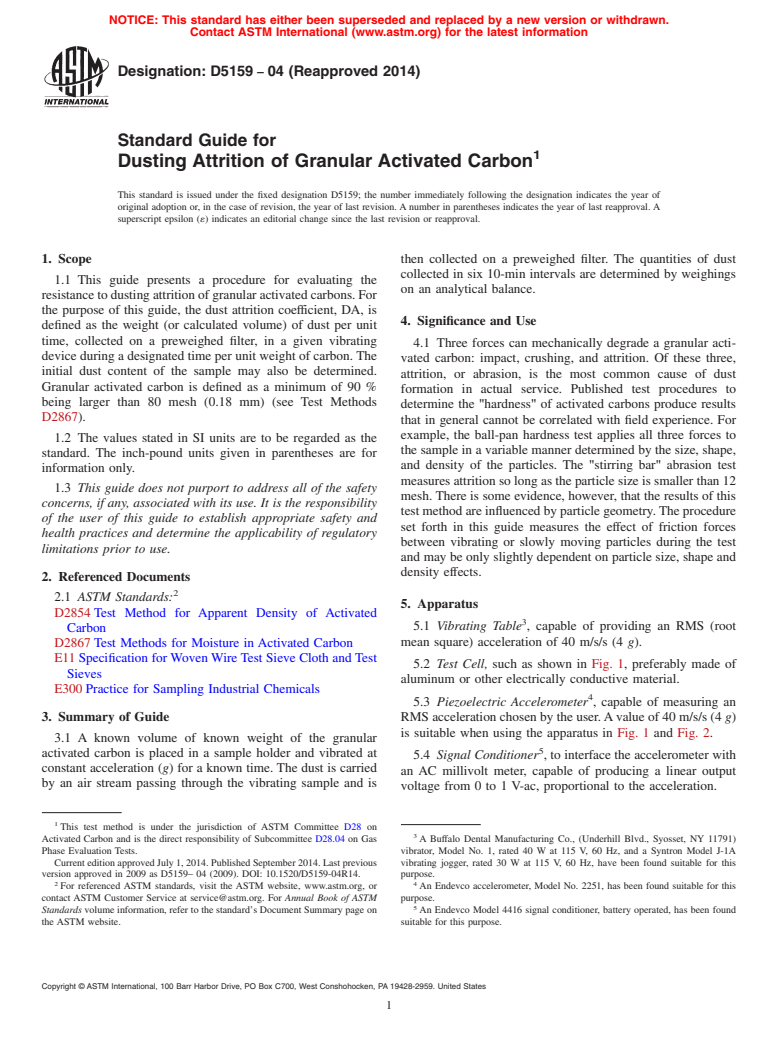
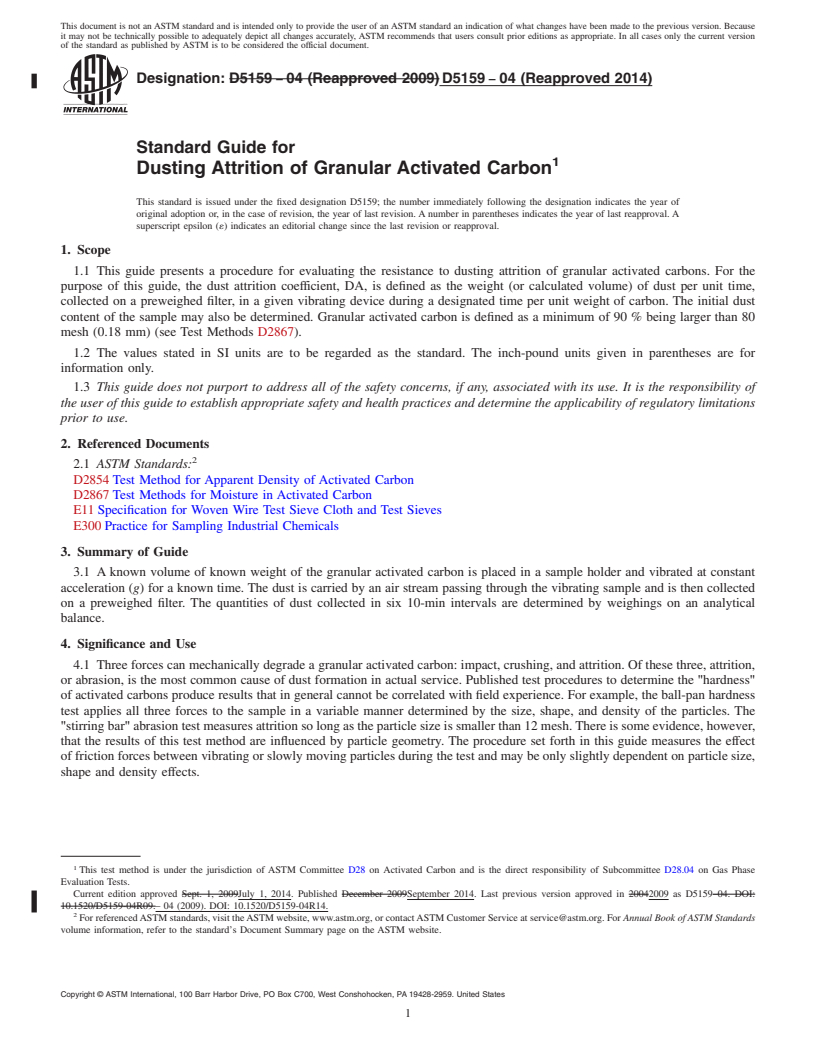
4.1 Three forces can mechanically degrade a granular activated carbon: impact, crushing, and attrition. Of these three, attrition, or abrasion, is the most common cause of dust formation in actual service. Published test procedures to determine the "hardness" of activated carbons produce results that in general cannot be correlated with field experience. For example, the ball-pan hardness test applies all three forces to the sample in a variable manner determined by the size, shape, and density of the particles. The "stirring bar" abrasion test measures attrition so long as the particle size is smaller than 12 mesh. There is some evidence, however, that the results of this test method are influenced by particle geometry. The procedure set forth in this guide measures the effect of friction forces between vibrating or slowly moving particles during the test and may be only slightly dependent on particle size, shape and density effects.
SCOPE
1.1 This guide presents a procedure for evaluating the resistance to dusting attrition of granular activated carbons. For the purpose of this guide, the dust attrition coefficient, DA, is defined as the weight (or calculated volume) of dust per unit time, collected on a preweighed filter, in a given vibrating device during a designated time per unit weight of carbon. The initial dust content of the sample may also be determined. Granular activated carbon is defined as a minimum of 90 % being larger than 80 mesh (0.18 mm) (see Test Methods D2867).
1.2 The values stated in SI units are to be regarded as the standard. The inch-pound units given in parentheses are for information only.
1.3 This guide does not purport to address all of the safety concerns, if any, associated with its use. It is the responsibility of the user of this guide to establish appropriate safety and health practices and determine the applicability of regulatory limitations prior to use.
General Information
Relations
Buy Standard
Standards Content (Sample)
NOTICE: This standard has either been superseded and replaced by a new version or withdrawn.
Contact ASTM International (www.astm.org) for the latest information
Designation: D5159 − 04 (Reapproved 2014)
Standard Guide for
Dusting Attrition of Granular Activated Carbon
This standard is issued under the fixed designation D5159; the number immediately following the designation indicates the year of
original adoption or, in the case of revision, the year of last revision.Anumber in parentheses indicates the year of last reapproval.A
superscript epsilon (´) indicates an editorial change since the last revision or reapproval.
1. Scope then collected on a preweighed filter. The quantities of dust
collected in six 10-min intervals are determined by weighings
1.1 This guide presents a procedure for evaluating the
on an analytical balance.
resistancetodustingattritionofgranularactivatedcarbons.For
the purpose of this guide, the dust attrition coefficient, DA, is
4. Significance and Use
defined as the weight (or calculated volume) of dust per unit
time, collected on a preweighed filter, in a given vibrating
4.1 Three forces can mechanically degrade a granular acti-
deviceduringadesignatedtimeperunitweightofcarbon.The
vated carbon: impact, crushing, and attrition. Of these three,
initial dust content of the sample may also be determined.
attrition, or abrasion, is the most common cause of dust
Granular activated carbon is defined as a minimum of 90 %
formation in actual service. Published test procedures to
being larger than 80 mesh (0.18 mm) (see Test Methods
determine the "hardness" of activated carbons produce results
D2867).
that in general cannot be correlated with field experience. For
example, the ball-pan hardness test applies all three forces to
1.2 The values stated in SI units are to be regarded as the
the sample in a variable manner determined by the size, shape,
standard. The inch-pound units given in parentheses are for
and density of the particles. The "stirring bar" abrasion test
information only.
measuresattritionsolongastheparticlesizeissmallerthan12
1.3 This guide does not purport to address all of the safety
mesh.There is some evidence, however, that the results of this
concerns, if any, associated with its use. It is the responsibility
testmethodareinfluencedbyparticlegeometry.Theprocedure
of the user of this guide to establish appropriate safety and
set forth in this guide measures the effect of friction forces
health practices and determine the applicability of regulatory
between vibrating or slowly moving particles during the test
limitations prior to use.
and may be only slightly dependent on particle size, shape and
density effects.
2. Referenced Documents
2.1 ASTM Standards:
5. Apparatus
D2854Test Method for Apparent Density of Activated
5.1 Vibrating Table , capable of providing an RMS (root
Carbon
mean square) acceleration of 40 m/s/s (4 g).
D2867Test Methods for Moisture in Activated Carbon
E11Specification forWovenWireTest Sieve Cloth andTest
5.2 Test Cell, such as shown in Fig. 1, preferably made of
Sieves
aluminum or other electrically conductive material.
E300Practice for Sampling Industrial Chemicals
5.3 Piezoelectric Accelerometer , capable of measuring an
3. Summary of Guide RMSaccelerationchosenbytheuser.Avalueof40m/s/s(4g)
is suitable when using the apparatus in Fig. 1 and Fig. 2.
3.1 A known volume of known weight of the granular
activated carbon is placed in a sample holder and vibrated at
5.4 Signal Conditioner , to interface the accelerometer with
constant acceleration (g) for a known time. The dust is carried
an AC millivolt meter, capable of producing a linear output
by an air stream passing through the vibrating sample and is
voltage from 0 to 1 V-ac, proportional to the acceleration.
This test method is under the jurisdiction of ASTM Committee D28 on
Activated Carbon and is the direct responsibility of Subcommittee D28.04 on Gas A Buffalo Dental Manufacturing Co., (Underhill Blvd., Syosset, NY 11791)
Phase Evaluation Tests. vibrator, Model No. 1, rated 40 W at 115 V, 60 Hz, and a Syntron Model J-1A
CurrenteditionapprovedJuly1,2014.PublishedSeptember2014.Lastprevious vibrating jogger, rated 30 W at 115 V, 60 Hz, have been found suitable for this
version approved in 2009 as D5159– 04 (2009). DOI: 10.1520/D5159-04R14. purpose.
2 4
For referenced ASTM standards, visit the ASTM website, www.astm.org, or An Endevco accelerometer, Model No. 2251, has been found suitable for this
contact ASTM Customer Service at service@astm.org. For Annual Book of ASTM purpose.
Standards volume information, refer to the standard’s Document Summary page on An Endevco Model 4416 signal conditioner, battery operated, has been found
the ASTM website. suitable for this purpose.
Copyright © ASTM International, 100 Barr Harbor Drive, PO Box C700, West Conshohocken, PA 19428-2959. United States
D5159 − 04 (2014)
3 1
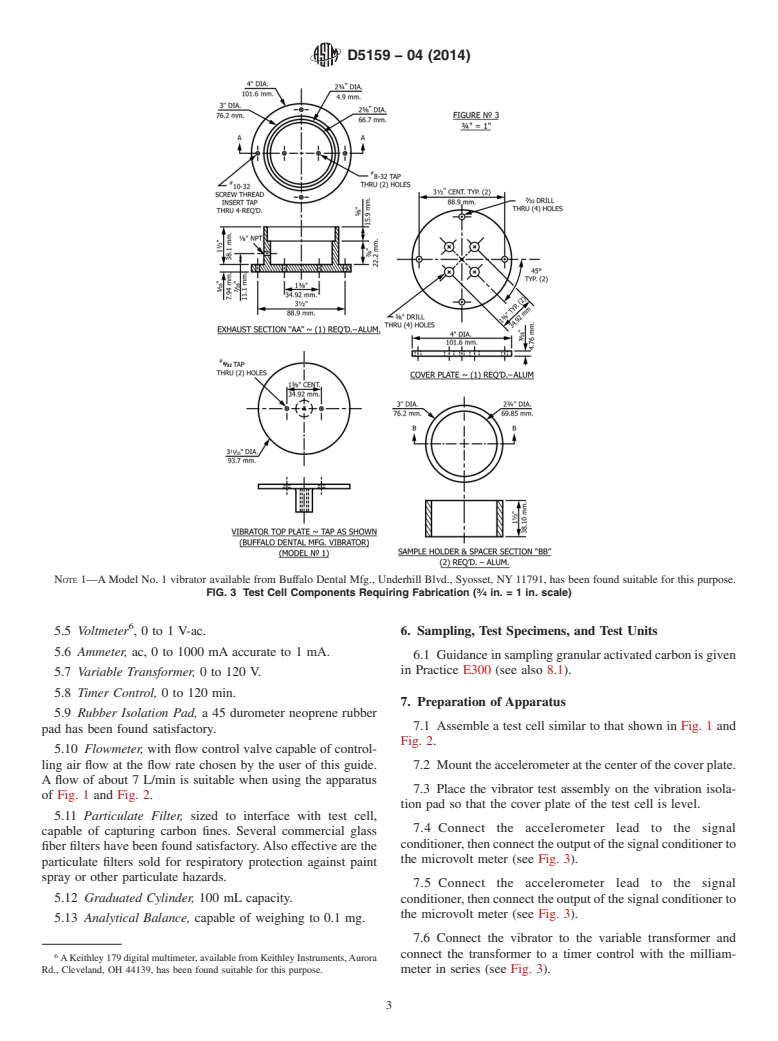
NOTE 1—2 ⁄4 in. (69.9 mm) inside diameter by 3 in. (76.2 mm) outside diameter by ⁄16 in. (1.6 mm) thick.
NOTE 2— Specification E11 wire cloth, 250 µm, stainless wire, 3 in. (76.2 mm) diameter.
NOTE 3—37% open area, fabricated from 24 gage stainless steel with 0.45 in. (11.4 mm) diameter holes on 0.066 in. (1.68 mm) centers, square grid
3 in. (76.2 mm) diameter.
FIG. 1 Dust Attrition Cell (full scale)
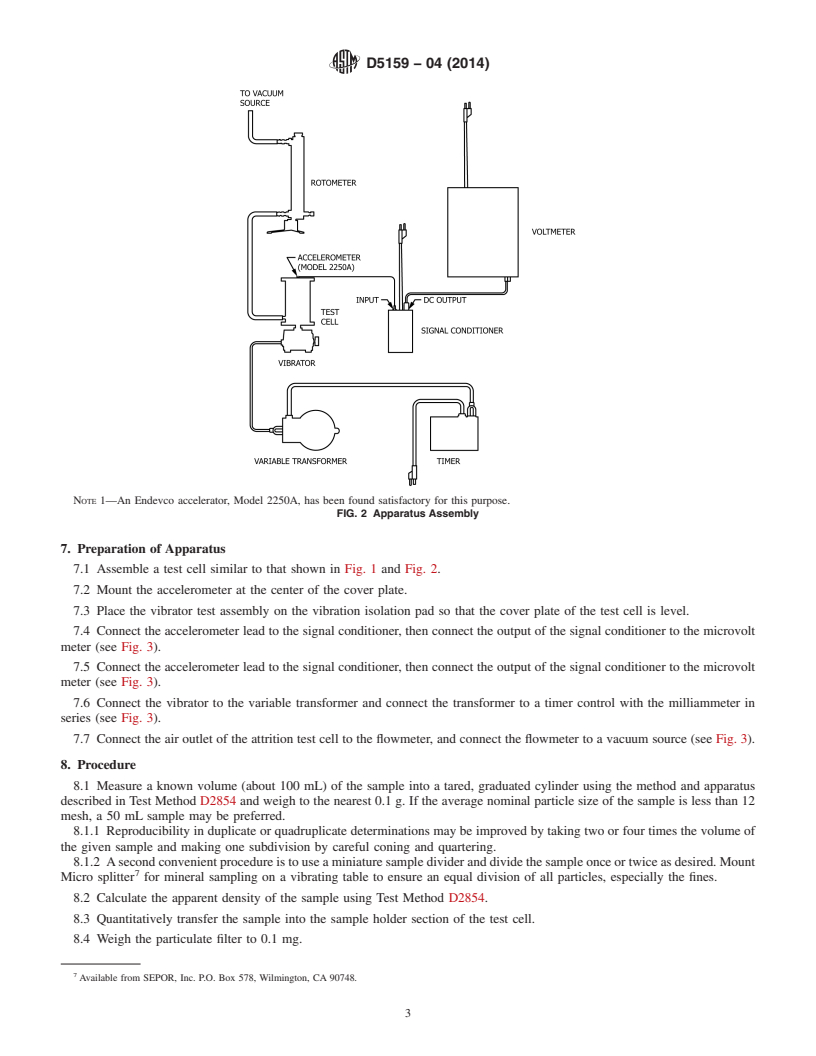
NOTE 1—An Endevco accelerator, Model 2250A, has been found satisfactory for this purpose.
FIG. 2 Apparatus Assembly
D5159 − 04 (2014)
NOTE 1—AModel No. 1 vibrator available from Buffalo Dental Mfg., Underhill Blvd., Syosset, NY11791, has been found suitable for this purpose.
FIG. 3 Test Cell Components Requiring Fabrication ( ⁄4 in.=1in. scale)
5.5 Voltmeter , 0 to 1 V-ac. 6. Sampling, Test Specimens, and Test Units
5.6 Ammeter, ac, 0 to 1000 mA accurate to 1 mA.
6.1 Guidanceinsamplinggranularactivatedcarbonisgiven
in Practice E300 (see also 8.1).
5.7 Variable Transformer,0to120V.
5.8 Timer Control, 0 to 120 min.
7. Preparation of Apparatus
5.9 Rubber Isolation Pad, a 45 durometer neoprene rubber
7.1 Assemble a test cell similar to that shown in Fig. 1 and
pad has been found satisfactor
...
This document is not an ASTM standard and is intended only to provide the user of an ASTM standard an indication of what changes have been made to the previous version. Because
it may not be technically possible to adequately depict all changes accurately, ASTM recommends that users consult prior editions as appropriate. In all cases only the current version
of the standard as published by ASTM is to be considered the official document.
Designation: D5159 − 04 (Reapproved 2009) D5159 − 04 (Reapproved 2014)
Standard Guide for
Dusting Attrition of Granular Activated Carbon
This standard is issued under the fixed designation D5159; the number immediately following the designation indicates the year of
original adoption or, in the case of revision, the year of last revision. A number in parentheses indicates the year of last reapproval. A
superscript epsilon (´) indicates an editorial change since the last revision or reapproval.
1. Scope
1.1 This guide presents a procedure for evaluating the resistance to dusting attrition of granular activated carbons. For the
purpose of this guide, the dust attrition coefficient, DA, is defined as the weight (or calculated volume) of dust per unit time,
collected on a preweighed filter, in a given vibrating device during a designated time per unit weight of carbon. The initial dust
content of the sample may also be determined. Granular activated carbon is defined as a minimum of 90 % being larger than 80
mesh (0.18 mm) (see Test Methods D2867).
1.2 The values stated in SI units are to be regarded as the standard. The inch-pound units given in parentheses are for
information only.
1.3 This guide does not purport to address all of the safety concerns, if any, associated with its use. It is the responsibility of
the user of this guide to establish appropriate safety and health practices and determine the applicability of regulatory limitations
prior to use.
2. Referenced Documents
2.1 ASTM Standards:
D2854 Test Method for Apparent Density of Activated Carbon
D2867 Test Methods for Moisture in Activated Carbon
E11 Specification for Woven Wire Test Sieve Cloth and Test Sieves
E300 Practice for Sampling Industrial Chemicals
3. Summary of Guide
3.1 A known volume of known weight of the granular activated carbon is placed in a sample holder and vibrated at constant
acceleration (g) for a known time. The dust is carried by an air stream passing through the vibrating sample and is then collected
on a preweighed filter. The quantities of dust collected in six 10-min intervals are determined by weighings on an analytical
balance.
4. Significance and Use
4.1 Three forces can mechanically degrade a granular activated carbon: impact, crushing, and attrition. Of these three, attrition,
or abrasion, is the most common cause of dust formation in actual service. Published test procedures to determine the "hardness"
of activated carbons produce results that in general cannot be correlated with field experience. For example, the ball-pan hardness
test applies all three forces to the sample in a variable manner determined by the size, shape, and density of the particles. The
"stirring bar" abrasion test measures attrition so long as the particle size is smaller than 12 mesh. There is some evidence, however,
that the results of this test method are influenced by particle geometry. The procedure set forth in this guide measures the effect
of friction forces between vibrating or slowly moving particles during the test and may be only slightly dependent on particle size,
shape and density effects.
This test method is under the jurisdiction of ASTM Committee D28 on Activated Carbon and is the direct responsibility of Subcommittee D28.04 on Gas Phase
Evaluation Tests.
Current edition approved Sept. 1, 2009July 1, 2014. Published December 2009September 2014. Last previous version approved in 20042009 as D5159–04. DOI:
10.1520/D5159-04R09.– 04 (2009). DOI: 10.1520/D5159-04R14.
For referenced ASTM standards, visit the ASTM website, www.astm.org, or contact ASTM Customer Service at service@astm.org. For Annual Book of ASTM Standards
volume information, refer to the standard’s Document Summary page on the ASTM website.
Copyright © ASTM International, 100 Barr Harbor Drive, PO Box C700, West Conshohocken, PA 19428-2959. United States
D5159 − 04 (2014)
3 1
NOTE 1—2 ⁄4 in. (69.9 mm) inside diameter by 3 in. (76.2 mm) outside diameter by ⁄16 in. (1.6 mm) thick.
NOTE 2— Specification E11 wire cloth, 250 μm, stainless wire, 3 in. (76.2 mm) diameter.
NOTE 3—37 % open area, fabricated from 24 gage stainless steel with 0.45 in. (11.4 mm) diameter holes on 0.066 in. (1.68 mm) centers, square grid
3 in. (76.2 mm) diameter.
FIG. 1 Dust Attrition Cell (full scale)
5. Apparatus
5.1 Vibrating Table , capable of providing an RMS (root mean square) acceleration of 40 m/s/s (4 g).
5.2 Test Cell, such as shown in Fig. 1, preferably made of aluminum or other electrically conductive material.
5.3 Piezoelectric Accelerometer , capable of measuring an RMS acceleration chosen by the user. A value of 40 m/s/s (4 g) is
suitable when using the apparatus in Fig. 1 and Fig. 2.
5.4 Signal Conditioner , to interface the accelerometer with an AC millivolt meter, capable of producing a linear output voltage
from 0 to 1 V-ac, proportional to the acceleration.
5.5 Voltmeter , 0 to 1 V-ac.
5.6 Ammeter, ac, 0 to 1000 mA accurate to 1 mA.
5.7 Variable Transformer, 0 to 120 V.
5.8 Timer Control, 0 to 120 min.
5.9 Rubber Isolation Pad, a 45 durometer neoprene rubber pad has been found satisfactory.
5.10 Flowmeter, with flow control valve capable of controlling air flow at the flow rate chosen by the user of this guide. A flow
of about 7 L/min is suitable when using the apparatus of Fig. 1 and Fig. 2.
5.11 Particulate Filter, sized to interface with test cell, capable of capturing carbon fines. Several commercial glass fiber filters
have been found satisfactory. Also effective are the particulate filters sold for respiratory protection against paint spray or other
particulate hazards.
5.12 Graduated Cylinder, 100 mL capacity.
5.13 Analytical Balance, capable of weighing to 0.1 mg.
6. Sampling, Test Specimens, and Test Units
6.1 Guidance in sampling granular activated carbon is given in Practice E300 (see also 8.1).
A Buffalo Dental Manufacturing Co., (Underhill Blvd., Syosset, NY 11791) vibrator, Model No. 1, rated 40 W at 115 V, 60 Hz, and a Syntron Model J-1A vibrating
jogger, rated 30 W at 115 V, 60 Hz, have been found suitable f
...
Questions, Comments and Discussion
Ask us and Technical Secretary will try to provide an answer. You can facilitate discussion about the standard in here.