


ASTM E2623-14(2021)
(Practice)Standard Practice for Reporting Thermometer Calibrations
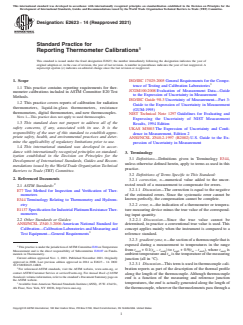
Standard Practice for Reporting Thermometer Calibrations
SIGNIFICANCE AND USE
5.1 This practice is adequate for use with all ASTM Test Methods which require the reporting of temperature measurements.
5.2 The Report of Calibration, however named, is the physical output of the calibration laboratory. It shall be prepared so that both the results of the measurement(s) and the non-technical information necessary to support those results are conveyed in a manner that ensures accurate communication and justification of the results.
5.3 This practice is not meant to supersede requirements of other standards practice such as ISO/IEC 17025 or ANSI/NCSL Z540.3.
SCOPE
1.1 This practice contains reporting requirements for thermometer calibrations included in ASTM Committee E20 Test Methods.
1.2 This practice covers reports of calibration for radiation thermometers, liquid-in-glass thermometers, resistance thermometers, digital thermometers, and new thermocouples.
Note 1: This practice does not apply to used thermocouples.
1.3 This standard does not purport to address all of the safety concerns, if any, associated with its use. It is the responsibility of the user of this standard to establish appropriate safety, health, and environmental practices and determine the applicability of regulatory limitations prior to use.
1.4 This international standard was developed in accordance with internationally recognized principles on standardization established in the Decision on Principles for the Development of International Standards, Guides and Recommendations issued by the World Trade Organization Technical Barriers to Trade (TBT) Committee.
General Information
- Status
- Published
- Publication Date
- 31-Oct-2021
- Technical Committee
- E20 - Temperature Measurement
- Drafting Committee
- E20.07 - Fundamentals in Thermometry
Relations
- Effective Date
- 01-Dec-2023
- Effective Date
- 01-Sep-2019
- Effective Date
- 01-Apr-2018
- Effective Date
- 01-Nov-2016
- Effective Date
- 01-May-2014
- Effective Date
- 01-May-2013
- Effective Date
- 01-May-2012
- Effective Date
- 01-Nov-2010
- Effective Date
- 15-Nov-2008
- Effective Date
- 01-Dec-2007
- Effective Date
- 01-Jun-2007
- Effective Date
- 01-May-2006
- Effective Date
- 01-Nov-2003
- Effective Date
- 10-Oct-2002
- Effective Date
- 10-Oct-2001
Overview
ASTM E2623-14(2021), Standard Practice for Reporting Thermometer Calibrations, provides essential guidance on the reporting requirements for thermometer calibration records used in laboratories and industries. This standard ensures clear, consistent, and justified communication of calibration results for a broad range of temperature measurement devices, including radiation thermometers, liquid-in-glass thermometers, resistance thermometers, digital thermometers, and new thermocouples.
The practice supports traceability, measurement confidence, and harmonization with internationally recognized standards. While ASTM E2623-14(2021) is widely applicable within ASTM Test Methods, it is designed to complement and not override more stringent requirements set by standards like ISO/IEC 17025 or ANSI/NCSL Z540.3.
Key Topics
- Comprehensive Reporting: Outlines mandatory information for calibration certificates to ensure results are traceable, reproducible, and easily interpreted by end users.
- Calibration Coverage: Applies to multiple thermometer types, including:
- Radiation thermometers
- Liquid-in-glass thermometers
- Resistance thermometers (e.g., platinum resistance thermometers)
- Digital thermometers
- New thermocouples (excludes used thermocouples)
- Required Report Elements:
- Title and unique identification
- Name, address, and location of calibration laboratory
- Client details and reference information (e.g., purchase order)
- Clear description of the device and its condition
- Details of the calibration method and any deviations or adjustments
- Measurement results, corrections, and uncertainty estimates
- Environmental conditions during calibration
- Identification and signature of responsible personnel
- Traceability statement to the International System of Units (SI)
- Compliance or non-compliance statements, as relevant
- Device-Specific Provisions: Additional requirements tailored to calibration and reporting for each thermometer type (such as measurement equations or probe details).
- Recordkeeping: Guidance for retention and accessibility of calibration records as defined by the laboratory’s quality system.
Applications
The proper reporting of thermometer calibrations, as required by ASTM E2623-14(2021), has significant practical value in sectors where reliable temperature measurements are critical. Typical applications include:
- Testing and Calibration Laboratories: Ensuring documentation supports measurement traceability and meets client or regulatory requirements.
- Industrial Process Control: Maintaining accuracy in thermal processes by verifying thermometer performance.
- Research and Development: Supporting experimental integrity with robust calibration records.
- Quality Assurance: Facilitating audits and accreditation of laboratories through standardized reports.
- Regulatory Compliance: Providing consistent documentation for temperature measurements referenced in various ASTM test methods or industry-specific protocols.
Related Standards
For comprehensive management of thermometer calibrations and to satisfy additional requirements, users may need to reference related standards, including:
- ISO/IEC 17025: General requirements for the competence of testing and calibration laboratories.
- ANSI/NCSL Z540.3: Requirements for calibration laboratories and measuring/testing equipment.
- JCGM 100:2008 (GUM): Guide to the Expression of Uncertainty in Measurement.
- ASTM E77: Standard Test Method for Inspection and Verification of Thermometers.
- ASTM E1137: Specification for Industrial Platinum Resistance Thermometers.
Adopting ASTM E2623-14(2021) helps laboratories and organizations ensure their thermometer calibration reporting aligns with industry best practices and supports international acceptance.
Get Certified
Connect with accredited certification bodies for this standard

BSMI (Bureau of Standards, Metrology and Inspection)
Taiwan's standards and inspection authority.
Sponsored listings
Frequently Asked Questions
ASTM E2623-14(2021) is a standard published by ASTM International. Its full title is "Standard Practice for Reporting Thermometer Calibrations". This standard covers: SIGNIFICANCE AND USE 5.1 This practice is adequate for use with all ASTM Test Methods which require the reporting of temperature measurements. 5.2 The Report of Calibration, however named, is the physical output of the calibration laboratory. It shall be prepared so that both the results of the measurement(s) and the non-technical information necessary to support those results are conveyed in a manner that ensures accurate communication and justification of the results. 5.3 This practice is not meant to supersede requirements of other standards practice such as ISO/IEC 17025 or ANSI/NCSL Z540.3. SCOPE 1.1 This practice contains reporting requirements for thermometer calibrations included in ASTM Committee E20 Test Methods. 1.2 This practice covers reports of calibration for radiation thermometers, liquid-in-glass thermometers, resistance thermometers, digital thermometers, and new thermocouples. Note 1: This practice does not apply to used thermocouples. 1.3 This standard does not purport to address all of the safety concerns, if any, associated with its use. It is the responsibility of the user of this standard to establish appropriate safety, health, and environmental practices and determine the applicability of regulatory limitations prior to use. 1.4 This international standard was developed in accordance with internationally recognized principles on standardization established in the Decision on Principles for the Development of International Standards, Guides and Recommendations issued by the World Trade Organization Technical Barriers to Trade (TBT) Committee.
SIGNIFICANCE AND USE 5.1 This practice is adequate for use with all ASTM Test Methods which require the reporting of temperature measurements. 5.2 The Report of Calibration, however named, is the physical output of the calibration laboratory. It shall be prepared so that both the results of the measurement(s) and the non-technical information necessary to support those results are conveyed in a manner that ensures accurate communication and justification of the results. 5.3 This practice is not meant to supersede requirements of other standards practice such as ISO/IEC 17025 or ANSI/NCSL Z540.3. SCOPE 1.1 This practice contains reporting requirements for thermometer calibrations included in ASTM Committee E20 Test Methods. 1.2 This practice covers reports of calibration for radiation thermometers, liquid-in-glass thermometers, resistance thermometers, digital thermometers, and new thermocouples. Note 1: This practice does not apply to used thermocouples. 1.3 This standard does not purport to address all of the safety concerns, if any, associated with its use. It is the responsibility of the user of this standard to establish appropriate safety, health, and environmental practices and determine the applicability of regulatory limitations prior to use. 1.4 This international standard was developed in accordance with internationally recognized principles on standardization established in the Decision on Principles for the Development of International Standards, Guides and Recommendations issued by the World Trade Organization Technical Barriers to Trade (TBT) Committee.
ASTM E2623-14(2021) is classified under the following ICS (International Classification for Standards) categories: 17.200.20 - Temperature-measuring instruments. The ICS classification helps identify the subject area and facilitates finding related standards.
ASTM E2623-14(2021) has the following relationships with other standards: It is inter standard links to ASTM E344-23, ASTM E344-19, ASTM E344-18, ASTM E344-16, ASTM E77-14, ASTM E344-13, ASTM E344-12, ASTM E344-10, ASTM E344-08, ASTM E77-07, ASTM E344-07, ASTM E344-06, ASTM E77-98(2003), ASTM E344-02, ASTM E344-00. Understanding these relationships helps ensure you are using the most current and applicable version of the standard.
ASTM E2623-14(2021) is available in PDF format for immediate download after purchase. The document can be added to your cart and obtained through the secure checkout process. Digital delivery ensures instant access to the complete standard document.
Standards Content (Sample)
This international standard was developed in accordance with internationally recognized principles on standardization established in the Decision on Principles for the
Development of International Standards, Guides and Recommendations issued by the World Trade Organization Technical Barriers to Trade (TBT) Committee.
Designation: E2623 − 14 (Reapproved 2021)
Standard Practice for
Reporting Thermometer Calibrations
This standard is issued under the fixed designation E2623; the number immediately following the designation indicates the year of
original adoption or, in the case of revision, the year of last revision. A number in parentheses indicates the year of last reapproval. A
superscript epsilon (´) indicates an editorial change since the last revision or reapproval.
1. Scope ISO/IEC 17025:2005 General Requirements for the Compe-
tence of Testing and Calibration Laboratories
1.1 This practice contains reporting requirements for ther-
JCGM100:2008 Evaluation of Measurement Data—Guide
mometer calibrations included in ASTM Committee E20 Test
to the Expression of Uncertainty in Measurement
Methods.
ISO/IEC Guide 98-3 Uncertainty of Measurement—Part 3:
1.2 This practice covers reports of calibration for radiation
Guide to the Expression of Uncertainty in Measurement
thermometers, liquid-in-glass thermometers, resistance
(GUM:1995)
thermometers, digital thermometers, and new thermocouples.
NIST Technical Note 1297 Guidelines for Evaluating and
NOTE 1—This practice does not apply to used thermocouples.
Expressing the Uncertainty of NIST Measurement
1.3 This standard does not purport to address all of the
Results, 1994 Edition
safety concerns, if any, associated with its use. It is the
UKAS M3003 The Expression of Uncertainty and Confi-
responsibility of the user of this standard to establish appro-
dence in Measurement, Edition 2
priate safety, health, and environmental practices and deter-
ANSI/NCSL Z540.2-1997 (R2002) U.S. Guide to the Ex-
mine the applicability of regulatory limitations prior to use.
pression of Uncertainty in Measurement
1.4 This international standard was developed in accor-
dance with internationally recognized principles on standard-
3. Terminology
ization established in the Decision on Principles for the
3.1 Definitions—Definitions given in Terminology E344,
Development of International Standards, Guides and Recom-
unless otherwise defined herein, apply to terms as used in this
mendations issued by the World Trade Organization Technical
practice.
Barriers to Trade (TBT) Committee.
3.2 Definitions of Terms Specific to This Standard:
2. Referenced Documents
3.2.1 correction, n—numerical value added to the uncor-
rected result of a measurement to compensate for errors.
2.1 ASTM Standards:
3.2.1.1 Discussion—The correction is equal to the negative
E77 Test Method for Inspection and Verification of Ther-
of the estimated errors. Since the systematic error cannot be
mometers
known perfectly, the compensation cannot be complete.
E344 Terminology Relating to Thermometry and Hydrom-
etry
3.2.2 error, n—the indication of a thermometer or tempera-
E1137 SpecificationforIndustrialPlatinumResistanceTher-
ture measuring device minus the true value of the correspond-
mometers
ing input quantity.
2.2 Other Standards or Guides: 3.2.2.1 Discussion—Since the true value cannot be
ANSI/NCSL Z540.3-2006 American National Standard for determined, in practice a conventional true value is used. This
Calibration—Calibration Laboratories and Measuring and concept applies mainly when the instrument is compared to a
Test Equipment—General Requirements reference standard.
3.2.3 gradient zone, n—thesectionofathermocouplethatis
exposed during a measurement to temperatures in the range
ThispracticeisunderthejurisdictionofASTMCommitteeE20onTemperature
from t + 0.1(t – t )to t + 0.9(t – t ), where t is
Measurement and is the direct responsibility of Subcommittee E20.07 on Funda- amb m amb amb m amb amb
mentals in Thermometry.
ambienttemperatureand t isthetemperatureofthemeasuring
m
Current edition approved Nov. 1, 2021. Published November 2021. Originally
junction (all in °C).
approved in 2008. Last previous edition approved in 2014 as E2623 – 14. DOI:
3.2.3.1 Discussion—This term is used in thermocouple cali-
10.1520/E2623-14R21.
bration reports as part of the description of the thermal profile
For referenced ASTM standards, visit the ASTM website, www.astm.org, or
contact ASTM Customer Service at service@astm.org. For Annual Book of ASTM
along the length of the thermocouple. Although thermocouple
Standards volume information, refer to the standard’s Document Summary page on
emf is a function of the measuring and reference junction
the ASTM website.
temperatures, the emf is actually generated along the length of
Available fromAmerican National Standards Institute (ANSI), 25 W. 43rd St.,
4th Floor, New York, NY 10036, http://www.ansi.org. thethermocouple,whereverthethermoelementspassthrougha
Copyright © ASTM International, 100 Barr Harbor Drive, PO Box C700, West Conshohocken, PA 19428-2959. United States
E2623 − 14 (2021)
temperature gradient. The gradient zone definition is intended 6.1.6 Description of the thermometer or thermocouple, the
to describe, in an approximate way, the section of thermo- overall range, and, if different, the calibrated range. This shall
couple that created most of the emf during the calibration. also include the manufacturer, model number (as applicable),
identification or unique serial number, and the condition of the
3.2.4 half-maximum heated length, n—the distance between
thermometer or thermocouple upon receipt.
the tip of the temperature sensor and the position along the
6.1.7 Date of Calibration:
length of the sensor leads or sheath where the temperature
equals the average of the calibration-point and ambient tem-
6.1.7.1 Where applicable, additional dates, including date
peratures. received, date of report preparation and next due date may be
3.2.4.1 Discussion—This term is used in thermocouple cali-
included.
bration reports as part of the description of the thermal profile
6.1.8 Calibration Results—This can take the form of a table
along the length of the thermocouple.
with reading of standard temperature, reading of test
instrument, corrections to be applied and consistent units of
4. Summary of Practice
measureoranyformofreportingasrequestedbythecustomer.
4.1 This practice describes the required information neces-
6.1.8.1 When an instrument has been repaired or adjusted,
sary for reporting results of temperature calibrations included
the calibration results before and after repair or adjustment
in ASTM Test Methods.
shall be reported, if available.
6.1.9 Conditions (for example, environmental conditions)
5. Significance and Use
under which the calibrations were made that have an influence
on the measurement results.
5.1 This practice is adequate for use with all ASTM Test
Methods which require the reporting of temperature measure-
6.1.10 A statement of the estimated uncertainty(ies) of
ments.
measurement and the corresponding level of confidence.
6.1.10.1 Method for estimating uncertainties. Internation-
5.2 The Report of Calibration, however named, is the
ally the BIPM document JCGM100:2008 (“Guide to the
physical output of the calibration laboratory. It shall be
Expression of Uncertianty of Measurement”) is cited, ISO/IEC
prepared so that both the results of the measurement(s) and the
non-technical information necessary to support those results Guide 98-3, NIST Technical Note 1297, UKAS M3003 and
Z540.2-1997 (R2002) also meet this requirement.
areconveyedinamannerthatensuresaccuratecommunication
and justification of the results.
6.1.10.2 Coverage factor and estimated confidence interval.
Typically the coverage factor (k) is 2 for an approximate
5.3 This practice is not meant to supersede requirements of
confidence level of 95%.
other standards practice such as ISO/IEC 17025 or ANSI/
6.1.11 Traceability statement to the International System of
NCSL Z540.3.
Units (SI) through the National Institute of Standards and
6. Procedure Technology (NIST) or other National Metrological Institute
(NMI) of test equipment used in the test or calibration.
6.1 Requirements for Written Report— The requirements in
6.1.12 Signature or equivalent identification of the respon-
6.1.1 through 6.1.14 are mandatory for all written reports
sible party.
issued in compliance with this practice. Subsections 6.1.15
through 6.1.19 include general provisions for information that 6.1.12.1 Other signatures may be required, at the discretion
of the laboratory manager. Each signatory or named person
may be omitted if not required by a calibration procedure or
client/user. accepts responsibility for the contents of the report.
6.1.1 Title Examples—Report of Calibration, Calibration
6.1.13 Astatementspecifyingthatthecalibrationcertificate,
Certificate, Test Report or Test Certificate.
howevernamed,shallnotbereproducedexceptinfull,without
6.1.2 Name and address of the laboratory and location
written approval of the laboratory.
where the calibration was performed, if different from the
6.1.14 Statement of Temperature Scale (for example, Inter-
laboratory address.
national Temperature Scale of 1990 (ITS-90)).
6.1.3 Unique identification of the report or certificate, and
6.1.15 Where appropriate and needed, opinions and
on each page an identification in order to ensure that the page
interpretations, including additional information which may be
is recognized as part of the report or certificate, a clear
required by specific methods, clients or groups of clients.
identification of the end of the report or certificate, and the
6.1.16 Where relevant, a sampling plan and procedure and a
page number and total number of pages.
statement to the effect that the results relate only to the items
6.1.4 Name and address of the client.
calibrated.
6.1.5 Statement and concise description of the test method
6.1.17 Where relevant, a statement of compliance/non-
or calibration procedure used. This statement shall include
compliance with requirements or specification, or both.
revisions and the date of the test method or calibration
procedure. Test methods can consist of published standards 6.1.17.1 Compliancemayrefertoallcriteria,includingboth
(such as ASTM Test Methods), internally developed methods, specifications and maximum permissible error, of a referenced
or a combination of both. standard. When the scope of calibration is limited to only
6.1.5.1 Information describing deviations from previously certain portions of the standard, the statement of compliance
agreed-upon procedures. shall cite and be limited to those sections of the referenced
E2623 − 14 (2021)
standard with which the thermometer complies. If non- 6.4.7 Fitting equation or reference to fitting equation, if
compliance is to be noted, the statement should cite those applicable.
sections of the referenced standard for which the thermometer
6.4.8 Fitting residuals, if applicable.
fails to comply. 6.4.9 Repeatability results, if applicable.
6.1.18 Date of receipt of calibration item where this is
6.5 Additional Requirements for Reported Calibrations of
critical to the validity and application of the results.
Thermocouples—The requirements in 6.5.1 and 6.5.2 are
6.1.19 When applicable, customer purchase order or refer-
mandatory for all written reports for thermocouples issued in
ence number and date.
compliance with this practice. Subsections 6.5.3 – 6.5.6 in-
6.2 Additional Requirements for All Reported Calibrations
clude general provisions for information that may be omitted if
for Radiation Thermometers only: not required by a calibration procedure or the client/user.
6.2.1 Statement of source type (blackbody, filament lamp,
6.5.1 Mathematical description of any fitting equation used
and so forth).
in reporting the results of the calibration. The equation may
6.2.2 Statement of source aperture or diameter of flat type
consist of a deviation function modeling the difference in emf
sources.
from a reference function of a stated thermocouple type, or the
6.2.3 Statement of measuring distances between the objec-
equation may consist of a function giving emf-versus-
tive lens and the source aperture or cavity bottom, or both.
measuring junction temperature.
6.2.4 Statement of aperture distance, if an aperture is used.
6.5.2 Statement whether any allowance is included in the
6.2.5 Statement of field-of-view or size of source (as refer-
uncertainty for thermocouple drift and inhomogeneity.
enced to the thermometer under test).
6.5.3 Immersion depth used during the test.
6.2.6 Statement of emissivity of the thermometer under test
6.5.4 Gradient zone of the thermocouple during the test.
(emissivity setting of the thermometer under test).
6.5.5 Statement of calibration set up, if applicable.
6.2.7 Statement of source emissivity.
6.5.6 Reference junction temperature.
6.2.8 Statement of the spectral response of the thermometer
6.6 Additional Requirements for Reported Calibrations of
under test.
Digital Thermometers—The requirements in 6.6.1 – 6.6.3 are
6.2.9 Statement of traceability of the source through contact
mandatory for all written reports for digital thermometers
or radiation thermometry.
issued in compliance with this practice. Subsections 6.6.4 –
6.3 Additional Requirements for All Reported Calibrations
6.6.6 include general provisions for information that may be
of Liquid-in-Glass Thermometers:
omitted if not required by a calibration procedure or the
6.3.1 Statement of minimum length of time at test tempera-
client/user.
ture before reading.
6.6.1 For digital thermometers with multiple probes or
multiple channels, or both, the report shall identify each
NOTE 2—The time allowed for equilibrium of a liquid-in-glass ther-
mometer is dependent on the type of thermometric liquid used. For the
thermometer probe calibrated and each corresponding channel
purposes of this practice, the timing device for this measurement does not
used for the calibration.
need to be traceable to an National Metrology Institute (NMI).
6.6.2 For digital thermometers that include one or more
6.3.2 Statement of emergent stem temperature either in
algorithms for temperature conversion, the report shall include
chart or text form (for partial immersion thermometers or total
a method of conversion statement, identifying the method(s),
immersion thermometers calibrated with partial immersion
all relevant standards, and identify coefficients (if applicable)
only).
used for each thermometer channel and probe calibrated.
6.6.3 Where a digital thermometer is checked without a
6.4 Additional Requirements for Reported Calibrations of
thermometer probe using either resistance or voltage
Resistance Thermometers—The requirements in 6.4.1 – 6.4.4
simulation, each sensor type or curve, or both, shall be
are mandatory for all written reports for resistance thermom-
reported.
eters issued in compliance with this practice. Subsections 6.4.5
6.6.3.1 Discussion Example—A common digital
– 6.4.9 include general provisions for information that may be
thermometer,havingtwoinputswiththecapabilitytoreadboth
omittedifnotrequiredbyacalibrationprocedureorclient/user.
Type J and K thermocouples, is first calibrated using mV
6.4.1 As found values R(0.01 °C), R(0 °C) or other agreed-
simulation.Secondly,twothermocoupleprobes,oneeachType
upon value.
J and Type K, are calibrated with this unit as a system after
6.4.2 Change in R(0.01 °C) or R(0 °C) observed during
verificationandadjustmentofindividualprobeicepointoffsets
calibration.
on the digital thermometer front panel.
6.4.3 Nominal excitation current.
6.6.4 Repeatability results, if applicable.
6.4.4 Uncertainty of fitted results, if different from the
uncertainty of measurement data. 6.6.5 Referencejunctiontemperature,ifapplicable(thermo-
couple probes only).
6.4.5 Tabulated resisteance, R(t) when specified by the
client/user. 6.6.6 Statementregardingtherecommendeduppertempera-
6.4.6 Hysteresis results, if applicable. ture limit for the probes(s) calibrated (if known).
E2623 − 14 (2021)
7. Recordkeeping Requirements 7.2 Calibration records shall be retained for the period of
time defined by the laboratory’s quality system.
7.1 A record system of all calibrations shall be kept. This
system shall contain sufficient information to permit regenera-
tion of the Certificate, however named, and shall include the
identity of personnel involved in preparation and calibration.
E2623 − 14 (2021)
APPENDIXES
(Nonmandatory Information)
X1. SAMPLE REPORT FOR LIQUID-IN-GLASS THERMOMETERS
ABS Calibration Laboratory
1234 Main Street
City, State 12345-6789
Telephone: (555) 555-5555 Fax: (555) 555-5556
REPORT OF CALIBRATION
FOR
Thermometer
Test Number: S-01-098
Type: Range: Serial #: 12345
Maker: Lab Test #: Calibration Date:
Submitted by:
CUSTOMER NAME
Customer Address
City, State 23456-7890
Calibration Reading of Test Emergent Stem Expanded
Temperature Thermometer Correction Temperature Uncertainty
(°C) (°C) (°C) (°C) (°C)
0.00 0.00 0.00 19 0.04
50.00 49.99 +0.01 20 0.04
100.00 100.02 –0.02 21 0.04
200.00 200.00 0.00 28 0.04
The data in the above table apply only to the item specifically listed on this report.
The temperatures in this Report are those defined by the International Temperature Scale of 1990 (ITS- 90).
The minimum amount of time at test temperature before reading is three minutes.
Uncertainty statement: The combined standard uncertainty includes the standard uncertainty reported for the standard, the standard uncertainty for the
measurement process, and the standard uncertainty for any uncorrected bath gradients. The combined standard uncertainty is multiplied by a coverage factor of 2 to
give an expanded uncertainty, which defines an interval having a level of confidence of approximately 95 percent. The expanded uncertainty presented in this report
is consistent with the JCGM100:2008 Guide to the Expression of Uncertainty in Measurement. The expanded uncertainty is not to be confused with a tolerance limit
for the user during application.
Traceability statement: The standards of ABS Calibration Laboratory are traceable to the International System of Units (SI) through the National Metrology Institute,
and are part of a comprehensive measurement assurance program for ensuring continued accuracy and measurement traceability within the level of uncertainty re-
ported by this laboratory. The laboratory test number identified above is the unique report number to be used in referencing measurement traceability for the ther-
mometer identified in this report only.
E2623 − 14 (2021)
Supplemental Information:
Description of thermometer submitted for calibration: Thermometer has an immersion length of 76 mm. Thermometer received with residue along stem.
Results of physical examination and treatment of thermometer before calibration: The thermometer was examined under a polariscope and strains in the
glass, if any, were judged to be minimal and of no detriment to the functioning of the thermometer. The capillary of the thermometer was examined under magnifica-
tion and no foreign matter, moisture or other evidence of contamination was discovered. No discernible capillary irregularities were noted. This thermometer was in
good working order and suitable for calibration. The thermometer was cleaned of residue using isopropyl alcohol and a soft rag.
As found: In Tolerance As left: In Tolerance Tolerance: 0.1 °C
Environmental conditions at time of calibration:
Temperature: 21 °C Relative humidity: 44 %
Equipment and standards:
Temperature Calibration Bath Standard Used Calibration Due
0 °C Ice Melting Bath N/A N/A
50 °C Atoz Science Oil Bath SPRT # 103456-9 1/1/2004
100 °C Atoz Science Oil Bath SPRT # 103456-9 1/1/2004
200 °C Atoz Science Oil Bath SPRT # 103456-9 1/1/2004
Procedure used: WI-001-5 Rev B dated May 16, 2002 which is based, in part on ASTM E77
...
Questions, Comments and Discussion
Ask us and Technical Secretary will try to provide an answer. You can facilitate discussion about the standard in here.
Loading comments...