

ASTM D5683/D5683M-95(2022)
(Test Method)Standard Test Method for Flexibility of Roofing and Waterproofing Materials and Membranes
General Information
- Abstract
SIGNIFICANCE AND USE
5.1 This test method is designed to aid those interested in the engineering properties of roofing and waterproofing sheet materials and membranes.
5.2 This test method enables a researcher to measure the relative flexibility of roofing and waterproofing sheet materials and membranes under standard conditions in the laboratory.
5.3 The data obtained from this test method will not permit prediction of the service life of a membrane. Membrane flexibility is important during application, and changes in flexibility are believed to be linked to the performance of roofing and waterproofing membranes, but the actual link between test data and performance is unknown and is dependent on the materials and exposure.
SCOPE
1.1 This test method measures the flexibility of roofing or waterproofing sheet materials or membranes by bending the test material over a block containing arcs of specific radii at a standard temperature.
1.2 The values stated in either SI units or inch-pound units are to be regarded separately as standard. The values stated in each system may not be exact equivalents; therefore, each system shall be used independently of the other. Combining values from the two systems may result in nonconformance with the standard.
1.3 This standard does not purport to address all of the safety concerns, if any, associated with its use. It is the responsibility of the user of this standard to establish appropriate safety, health, and environmental practices and determine the applicability of regulatory limitations prior to use.
1.4 This international standard was developed in accordance with internationally recognized principles on standardization established in the Decision on Principles for the Development of International Standards, Guides and Recommendations issued by the World Trade Organization Technical Barriers to Trade (TBT) Committee.
- Status
- Published
- Publication Date
- 31-Oct-2022
- Technical Committee
- D08 - Roofing and Waterproofing
- Drafting Committee
- D08.20 - Roofing Membrane Systems


Overview
ASTM D5683/D5683M-95(2022) is the Standard Test Method for Flexibility of Roofing and Waterproofing Materials and Membranes, developed by ASTM International. This test method provides a laboratory-based procedure to measure the relative flexibility of roofing and waterproofing sheet materials and membranes. It is intended to assist engineers, researchers, and quality assurance professionals in evaluating the physical flexibility of these materials under controlled conditions. While the method supplies valuable comparative data, it does not predict service life or guarantee in-use membrane performance.
Key Topics
- Test Method Purpose: The standard is designed to determine the flexibility of roofing and waterproofing sheet materials and membranes by bending conditioned material specimens over arcs of specific radii at a standard temperature.
- Sample Preparation: Five specimens each must be cut in both machine and cross directions from the material sample.
- Test Conditions: The material specimens are conditioned in a water bath or refrigerated chamber at 4.4°C [40°F].
- Testing Procedure: Each specimen is bent over a test block with arcs of known radii. The smallest radius at which no visible cracking occurs is recorded as the flexibility value.
- Result Reporting: The test results include complete specimen identification, orientation, the smallest radius without cracking, and any additional temperature results.
- Safety Considerations: Users must establish appropriate safety, health, and environmental practices relevant to their facility and check for regulatory requirements.
- Significance: While not providing a direct prediction of service life, membrane flexibility is critical during installation and may be associated with material performance.
Applications
The ASTM D5683/D5683M test method is widely used in:
- Material Validation: Manufacturers utilize this standard to demonstrate the flexibility properties of new or existing roofing and waterproofing products.
- Quality Control: Production facilities implement the method as part of their quality assurance programs to ensure product consistency and compliance with industry norms.
- Research and Development: R&D teams employ this test to compare different formulations, blends, or product designs by quantifying relative flexibility.
- Specification Compliance: Project owners, architects, and engineers reference this standard to verify that roofing or waterproofing membranes meet specified flexibility requirements, especially for products exposed to demanding installation or environmental conditions.
Typical materials tested include:
- Modified bitumen roofing membranes
- Reinforced and non-reinforced waterproofing sheets
- Single-ply roofing products
- Other flexible sheet membranes used in construction
Related Standards
- ASTM D1079: Terminology Relating to Roofing and Waterproofing
- Standards involving cracking resistance, roofing membrane flexibility, and waterproofing membrane evaluation
- International standards developed in accordance with WTO Technical Barriers to Trade (TBT) Committee principles
Users are encouraged to reference additional ASTM and ISO standards related to roofing material performance, flexibility, and durability to ensure comprehensive evaluation and specification compliance.
Conclusion
ASTM D5683/D5683M-95(2022) provides a reliable, standardized approach for assessing the flexibility of roofing and waterproofing sheet materials and membranes. Although not a predictor of field performance, it serves as a critical tool for material specification, product development, and quality assurance. By following this standard, industry professionals contribute to the selection and development of superior roofing and waterproofing solutions, promoting durability and functionality in construction applications.
Relations
- Effective Date
- 01-May-2020
- Effective Date
- 15-Dec-2018
- Effective Date
- 15-Dec-2018
- Effective Date
- 01-Feb-2016
- Effective Date
- 01-Mar-2013
- Effective Date
- 01-Mar-2013
- Effective Date
- 01-Sep-2010
- Effective Date
- 01-Jul-2009
- Effective Date
- 01-Feb-2008
- Effective Date
- 01-Jan-2008
- Effective Date
- 01-Jun-2007
- Effective Date
- 15-Jan-2007
- Effective Date
- 01-Aug-2006
- Effective Date
- 15-Sep-2005
- Refers
ASTM D1079-05 - Standard Terminology Relating to Roofing, Waterproofing, and Bituminous Materials - Effective Date
- 01-Mar-2005
Get Certified
Connect with accredited certification bodies for this standard

DIBt (Deutsches Institut für Bautechnik)
German Institute for Building Technology.
DIN CERTCO
DIN Group product certification.

Aboma Certification B.V.
Specialized in construction, metal, and transport sectors.
Sponsored listings
Frequently Asked Questions
ASTM D5683/D5683M-95(2022) is a standard published by ASTM International. Its full title is "Standard Test Method for Flexibility of Roofing and Waterproofing Materials and Membranes". This standard covers: SIGNIFICANCE AND USE 5.1 This test method is designed to aid those interested in the engineering properties of roofing and waterproofing sheet materials and membranes. 5.2 This test method enables a researcher to measure the relative flexibility of roofing and waterproofing sheet materials and membranes under standard conditions in the laboratory. 5.3 The data obtained from this test method will not permit prediction of the service life of a membrane. Membrane flexibility is important during application, and changes in flexibility are believed to be linked to the performance of roofing and waterproofing membranes, but the actual link between test data and performance is unknown and is dependent on the materials and exposure. SCOPE 1.1 This test method measures the flexibility of roofing or waterproofing sheet materials or membranes by bending the test material over a block containing arcs of specific radii at a standard temperature. 1.2 The values stated in either SI units or inch-pound units are to be regarded separately as standard. The values stated in each system may not be exact equivalents; therefore, each system shall be used independently of the other. Combining values from the two systems may result in nonconformance with the standard. 1.3 This standard does not purport to address all of the safety concerns, if any, associated with its use. It is the responsibility of the user of this standard to establish appropriate safety, health, and environmental practices and determine the applicability of regulatory limitations prior to use. 1.4 This international standard was developed in accordance with internationally recognized principles on standardization established in the Decision on Principles for the Development of International Standards, Guides and Recommendations issued by the World Trade Organization Technical Barriers to Trade (TBT) Committee.
SIGNIFICANCE AND USE 5.1 This test method is designed to aid those interested in the engineering properties of roofing and waterproofing sheet materials and membranes. 5.2 This test method enables a researcher to measure the relative flexibility of roofing and waterproofing sheet materials and membranes under standard conditions in the laboratory. 5.3 The data obtained from this test method will not permit prediction of the service life of a membrane. Membrane flexibility is important during application, and changes in flexibility are believed to be linked to the performance of roofing and waterproofing membranes, but the actual link between test data and performance is unknown and is dependent on the materials and exposure. SCOPE 1.1 This test method measures the flexibility of roofing or waterproofing sheet materials or membranes by bending the test material over a block containing arcs of specific radii at a standard temperature. 1.2 The values stated in either SI units or inch-pound units are to be regarded separately as standard. The values stated in each system may not be exact equivalents; therefore, each system shall be used independently of the other. Combining values from the two systems may result in nonconformance with the standard. 1.3 This standard does not purport to address all of the safety concerns, if any, associated with its use. It is the responsibility of the user of this standard to establish appropriate safety, health, and environmental practices and determine the applicability of regulatory limitations prior to use. 1.4 This international standard was developed in accordance with internationally recognized principles on standardization established in the Decision on Principles for the Development of International Standards, Guides and Recommendations issued by the World Trade Organization Technical Barriers to Trade (TBT) Committee.
ASTM D5683/D5683M-95(2022) is classified under the following ICS (International Classification for Standards) categories: 91.120.30 - Waterproofing. The ICS classification helps identify the subject area and facilitates finding related standards.
ASTM D5683/D5683M-95(2022) has the following relationships with other standards: It is inter standard links to ASTM D1079-20, ASTM D1079-18, ASTM D1079-18e1, ASTM D1079-16, ASTM D1079-13e1, ASTM D1079-13, ASTM D1079-10, ASTM D1079-09, ASTM D1079-08a, ASTM D1079-08, ASTM D1079-07a, ASTM D1079-07, ASTM D1079-06, ASTM D1079-05a, ASTM D1079-05. Understanding these relationships helps ensure you are using the most current and applicable version of the standard.
ASTM D5683/D5683M-95(2022) is available in PDF format for immediate download after purchase. The document can be added to your cart and obtained through the secure checkout process. Digital delivery ensures instant access to the complete standard document.
Standards Content (Sample)
This international standard was developed in accordance with internationally recognized principles on standardization established in the Decision on Principles for the
Development of International Standards, Guides and Recommendations issued by the World Trade Organization Technical Barriers to Trade (TBT) Committee.
Designation: D5683/D5683M −95 (Reapproved 2022)
Standard Test Method for
Flexibility of Roofing and Waterproofing Materials and
Membranes
This standard is issued under the fixed designation D5683/D5683M; the number immediately following the designation indicates the
year of original adoption or, in the case of revision, the year of last revision. A number in parentheses indicates the year of last
reapproval. A superscript epsilon (´) indicates an editorial change since the last revision or reapproval.
1. Scope 4. Summary of Test Method
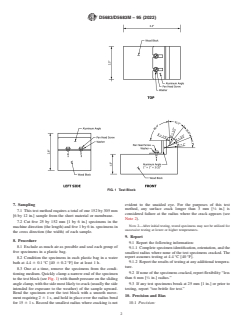
4.1 Bend the five specimens of roofing or waterproofing
1.1 This test method measures the flexibility of roofing or
sheet materials or membrane, conditioned at 4.4 °C [40 °F]
waterproofing sheet materials or membranes by bending the
(see Note 1), over a block (see Fig. 1) designed to provide arcs
test material over a block containing arcs of specific radii at a
1 1
of equal length with 6 mm [ ⁄4 in.], 13 mm [ ⁄2 in.], 19 mm
standard temperature.
[ ⁄4 in.], and 25 mm [1 in.] radii, and the smallest radius is
1.2 The values stated in either SI units or inch-pound units
reported where cracking is not observed in any specimen.
are to be regarded separately as standard. The values stated in
NOTE 1—Other test temperatures may be used in addition to the tests
each system may not be exact equivalents; therefore, each
required at 4.4 °C [40 °F], and refrigerated conditioning chambers may be
system shall be used independently of the other. Combining
used instead of the water bath specified. Follow procedures outlined in
values from the two systems may result in nonconformance
Section 8 if refrigerated chamber is utilized; however, the plastic bag may
with the standard.
be omitted.
1.3 This standard does not purport to address all of the
5. Significance and Use
safety concerns, if any, associated with its use. It is the
5.1 This test method is designed to aid those interested in
responsibility of the user of this standard to establish appro-
the engineering properties of roofing and waterproofing sheet
priate safety, health, and environmental practices and deter-
mine the applicability of regulatory limitations prior to use. materials and membranes.
1.4 This international standard was developed in accor-
5.2 This test method enables a researcher to measure the
dance with internationally recognized principles on standard-
relative flexibility of roofing and waterproofing sheet materials
ization established in the Decision on Principles for the
and membranes under standard conditions in the laboratory.
Development of International Standards, Guides and Recom-
5.3 The data obtained from this test method will not permit
mendations issued by the World Trade Organization Technical
prediction of the service life of a membrane. Membrane
Barriers to Trade (TBT) Committee.
flexibility is important during application, and changes in
flexibility are believed to be linked to the performance of
2. Referenced Documents
roofing and waterproofing membranes, but the actual link
2.1 ASTM Standards: between test data and performance is unknown and is depen-
dent on the materials and exposure.
D1079 Terminology Relating to Roofing and Waterproofing
6. Apparatus
3. Terminology
6.1 Water Bath—A bath with the capacity of at least 10 L
3.1 For definitions of terms used in this test method, refer to
[2.5 gal] and capable of maintaining a temperature of 4.4 6
Terminology D1079.
0.1 °C [40 6 0.2 °F].
6.2 Polyethylene Bags—A sealable plastic bag for condi-
tioning each group of test specimens. Commercial 1 gal
This test method is under the jurisdiction ofASTM Committee D08 on Roofing
sealable polyethylene scrap or food storage bags can perform
and Waterproofing and is the direct responsibility of Subcommittee D08.20 on
Roofing Membrane Systems.
this function.
Current edition approved Nov. 1, 2022. Published November 2022. Originally
6.3 Test Block—The test block (see Fig. 1) may be made
approved in 1995. Last previous edition approved in 2017 as D5683/D5683M – 95
(2017). DOI: 10.1520/D5683_D5683M-95R22.
from any hard, durable material that conforms to the dimen-
For referenced ASTM standards, visit the ASTM website, www.astm.org, or
sions shown in Fig. 1. It is designe
...