

ASTM D5849/D5849M-21
(Test Method)Standard Test Method for Evaluating Resistance of Modified Bituminous Roofing Membrane to Cyclic Fatigue (Joint Displacement)
General Information
- Abstract
SIGNIFICANCE AND USE
5.1 This test method provides data on classifying polymer-modified bituminous membranes by their performance related to the fatigue conditions to which they are subjected.
5.2 This test method is applicable to testing specimens consisting of a single ply of the polymer-modified bitumen material or a multiple-ply composite that includes the polymer-modified bitumen material.
5.3 This test method is conducted on both unaged and heat-aged specimens to determine the effect of heat exposure on the membrane material's ability to resist deterioration from cyclic strain. This test method may also be conducted on specimens subjected to other laboratory exposure conditions that are not specified herein.
SCOPE
1.1 This test method determines the effect of constant cyclic displacement on polymer-modified bituminous membrane specimens. In this test method, a relatively low travel rate of cycling is used and the material is tested for a specified number of cycles under conditions of increased amplitude or lower temperature.
1.2 The values stated in either SI units or inch-pound units are to be regarded separately as standard. The values stated in each system may not be exact equivalents; therefore, each system shall be used independently of the other. Combining values from the two systems may result in nonconformance with the standard.
1.3 This standard does not purport to address all of the safety concerns, if any, associated with its use. It is the responsibility of the user of this standard to establish appropriate safety, health, and environmental practices and determine the applicability of regulatory limitations prior to use.
1.4 This international standard was developed in accordance with internationally recognized principles on standardization established in the Decision on Principles for the Development of International Standards, Guides and Recommendations issued by the World Trade Organization Technical Barriers to Trade (TBT) Committee.
- Status
- Published
- Publication Date
- 31-Dec-2020
- Technical Committee
- D08 - Roofing and Waterproofing
- Drafting Committee
- D08.04 - Felts, Fabrics and Bituminous Sheet Materials
Buy Documents


ASTM D5849/D5849M-21 - Standard Test Method for Evaluating Resistance of Modified Bituminous Roofing Membrane to Cyclic Fatigue (Joint Displacement)

REDLINE ASTM D5849/D5849M-21 - Standard Test Method for Evaluating Resistance of Modified Bituminous Roofing Membrane to Cyclic Fatigue (Joint Displacement)
Overview
ASTM D5849/D5849M-21: Standard Test Method for Evaluating Resistance of Modified Bituminous Roofing Membrane to Cyclic Fatigue (Joint Displacement) establishes a precise laboratory test for determining the durability of polymer-modified bituminous membranes when subjected to cyclic mechanical strain. This method is essential for understanding how roofing materials respond to repeated joint movement, thermal expansion, and contraction-key performance factors in building envelope design.
The standard evaluates both unaged (new) and heat-aged specimens to simulate real-world exposure over time. By subjecting roofing membranes to controlled cyclic displacement at various temperatures and amplitudes, the test method helps manufacturers, architects, and specifiers classify and compare products based on resistance to fatigue-related deterioration.
Key Topics
- Fatigue Resistance Testing: The standard describes procedures for evaluating the ability of both single-ply and multi-ply polymer-modified bitumen roofing membranes to withstand constant cyclic displacement, mimicking movement of building joints.
- Material Classification: Results enable benchmarking of various bituminous membrane products by their resistance to cracking, splitting, tearing, and loss of adhesion under dynamic conditions.
- Specimen Preparation: The protocol covers preparation of membrane samples-including both unexposed and heat-aged variants-and installation on specified substrates using typical methods (e.g., hot asphalt, cold adhesive, or torch-on).
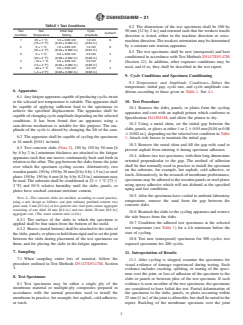
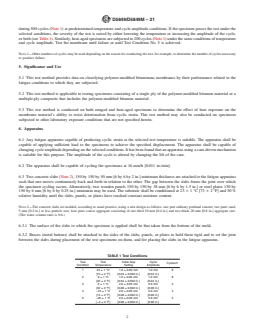
- Test Conditions: Multiple cycles of joint displacement are performed at controlled temperatures and amplitudes. The severity can be increased by lowering the temperature or increasing the cycle amplitude.
- Pass/Fail Criteria: After testing, samples are examined for visible damage. Partial delamination near the joint is acceptable within limits, but cracking, splitting, tearing, or significant loss of adhesion is treated as failure.
- Comprehensive Reporting: The standard outlines detailed requirements for reporting conditions, specimen descriptions, observations, and interpretations of the results.
Applications
ASTM D5849/D5849M-21 is widely used in the roofing industry for:
- Quality Control: Verifying consistency and performance of polymer-modified bitumen membranes prior to market release.
- Product Development: Supporting research and development by enabling comparison of new formulations or reinforcement techniques for enhanced fatigue resistance.
- Specification and Procurement: Helping architects and building owners select roofing materials that will maintain integrity when exposed to temperature fluctuations and joint movement, improving long-term roof durability.
- Code Compliance: Assisting in demonstration of compliance with project specifications and building codes that require validated performance for roofing systems in demanding climates.
- Comparative Analysis: Allowing side-by-side evaluation of products from different manufacturers to inform purchasing and design decisions.
Related Standards
For a comprehensive evaluation of polymer-modified bituminous roofing materials, consider the following related ASTM and international standards:
- ASTM D41/D41M: Specification for Asphalt Primer Used in Roofing, Dampproofing, and Waterproofing
- ASTM D1079: Terminology Relating to Roofing and Waterproofing
- ASTM D5147/D5147M: Test Methods for Sampling and Testing Modified Bituminous Sheet Material
- CGSB 37-GP-56M: Canadian Standard for Modified Bituminous Prefabricated Membranes for Roofing
These referenced standards ensure consistent terminology, specimen preparation, and complementary testing for bituminous roofing systems, supporting robust and reliable performance assessment.
Keywords: ASTM D5849, bituminous membrane, cyclic fatigue, roofing, joint displacement, polymer-modified bitumen, fatigue resistance testing, membrane durability, building envelope, ASTM roofing standards.
Relations
- Effective Date
- 01-May-2020
- Effective Date
- 15-Dec-2018
- Effective Date
- 15-Dec-2018
- Effective Date
- 01-Jul-2018
- Effective Date
- 01-Feb-2016
- Effective Date
- 01-Jan-2014
- Effective Date
- 01-Mar-2013
- Effective Date
- 01-Mar-2013
- Effective Date
- 01-May-2011
- Effective Date
- 01-Jan-2011
- Effective Date
- 01-Jan-2011
- Effective Date
- 01-Sep-2010
- Effective Date
- 01-Jul-2009
- Effective Date
- 01-Feb-2008
- Effective Date
- 01-Jan-2008
Buy Documents
ASTM D5849/D5849M-21 - Standard Test Method for Evaluating Resistance of Modified Bituminous Roofing Membrane to Cyclic Fatigue (Joint Displacement)
REDLINE ASTM D5849/D5849M-21 - Standard Test Method for Evaluating Resistance of Modified Bituminous Roofing Membrane to Cyclic Fatigue (Joint Displacement)
Get Certified
Connect with accredited certification bodies for this standard

DIBt (Deutsches Institut für Bautechnik)
German Institute for Building Technology.
DIN CERTCO
DIN Group product certification.

Aboma Certification B.V.
Specialized in construction, metal, and transport sectors.
Sponsored listings
Frequently Asked Questions
ASTM D5849/D5849M-21 is a standard published by ASTM International. Its full title is "Standard Test Method for Evaluating Resistance of Modified Bituminous Roofing Membrane to Cyclic Fatigue (Joint Displacement)". This standard covers: SIGNIFICANCE AND USE 5.1 This test method provides data on classifying polymer-modified bituminous membranes by their performance related to the fatigue conditions to which they are subjected. 5.2 This test method is applicable to testing specimens consisting of a single ply of the polymer-modified bitumen material or a multiple-ply composite that includes the polymer-modified bitumen material. 5.3 This test method is conducted on both unaged and heat-aged specimens to determine the effect of heat exposure on the membrane material's ability to resist deterioration from cyclic strain. This test method may also be conducted on specimens subjected to other laboratory exposure conditions that are not specified herein. SCOPE 1.1 This test method determines the effect of constant cyclic displacement on polymer-modified bituminous membrane specimens. In this test method, a relatively low travel rate of cycling is used and the material is tested for a specified number of cycles under conditions of increased amplitude or lower temperature. 1.2 The values stated in either SI units or inch-pound units are to be regarded separately as standard. The values stated in each system may not be exact equivalents; therefore, each system shall be used independently of the other. Combining values from the two systems may result in nonconformance with the standard. 1.3 This standard does not purport to address all of the safety concerns, if any, associated with its use. It is the responsibility of the user of this standard to establish appropriate safety, health, and environmental practices and determine the applicability of regulatory limitations prior to use. 1.4 This international standard was developed in accordance with internationally recognized principles on standardization established in the Decision on Principles for the Development of International Standards, Guides and Recommendations issued by the World Trade Organization Technical Barriers to Trade (TBT) Committee.
SIGNIFICANCE AND USE 5.1 This test method provides data on classifying polymer-modified bituminous membranes by their performance related to the fatigue conditions to which they are subjected. 5.2 This test method is applicable to testing specimens consisting of a single ply of the polymer-modified bitumen material or a multiple-ply composite that includes the polymer-modified bitumen material. 5.3 This test method is conducted on both unaged and heat-aged specimens to determine the effect of heat exposure on the membrane material's ability to resist deterioration from cyclic strain. This test method may also be conducted on specimens subjected to other laboratory exposure conditions that are not specified herein. SCOPE 1.1 This test method determines the effect of constant cyclic displacement on polymer-modified bituminous membrane specimens. In this test method, a relatively low travel rate of cycling is used and the material is tested for a specified number of cycles under conditions of increased amplitude or lower temperature. 1.2 The values stated in either SI units or inch-pound units are to be regarded separately as standard. The values stated in each system may not be exact equivalents; therefore, each system shall be used independently of the other. Combining values from the two systems may result in nonconformance with the standard. 1.3 This standard does not purport to address all of the safety concerns, if any, associated with its use. It is the responsibility of the user of this standard to establish appropriate safety, health, and environmental practices and determine the applicability of regulatory limitations prior to use. 1.4 This international standard was developed in accordance with internationally recognized principles on standardization established in the Decision on Principles for the Development of International Standards, Guides and Recommendations issued by the World Trade Organization Technical Barriers to Trade (TBT) Committee.
ASTM D5849/D5849M-21 is classified under the following ICS (International Classification for Standards) categories: 91.120.30 - Waterproofing. The ICS classification helps identify the subject area and facilitates finding related standards.
ASTM D5849/D5849M-21 has the following relationships with other standards: It is inter standard links to ASTM D1079-20, ASTM D1079-18, ASTM D1079-18e1, ASTM D5147/D5147M-18, ASTM D1079-16, ASTM D5147/D5147M-14, ASTM D1079-13e1, ASTM D1079-13, ASTM D5147/D5147M-11a, ASTM D41/D41M-11, ASTM D5147/D5147M-11, ASTM D1079-10, ASTM D1079-09, ASTM D1079-08a, ASTM D1079-08. Understanding these relationships helps ensure you are using the most current and applicable version of the standard.
ASTM D5849/D5849M-21 is available in PDF format for immediate download after purchase. The document can be added to your cart and obtained through the secure checkout process. Digital delivery ensures instant access to the complete standard document.
Standards Content (Sample)
This international standard was developed in accordance with internationally recognized principles on standardization established in the Decision on Principles for the
Development of International Standards, Guides and Recommendations issued by the World Trade Organization Technical Barriers to Trade (TBT) Committee.
Designation: D5849/D5849M −21
Standard Test Method for
Evaluating Resistance of Modified Bituminous Roofing
Membrane to Cyclic Fatigue (Joint Displacement)
This standard is issued under the fixed designation D5849/D5849M; the number immediately following the designation indicates the
year of original adoption or, in the case of revision, the year of last revision. A number in parentheses indicates the year of last
reapproval. A superscript epsilon (´) indicates an editorial change since the last revision or reapproval.
1. Scope 2.2 Canadian General Standards Board Method:
CGSB 37-GP-56M Standard for Membrane, Modified,
1.1 This test method determines the effect of constant cyclic
Bituminous, Prefabricated, and Reinforced for Roofing
displacement on polymer-modified bituminous membrane
specimens. In this test method, a relatively low travel rate of
3. Terminology
cycling is used and the material is tested for a specified number
3.1 For definitions of terms used in this test method, refer to
of cycles under conditions of increased amplitude or lower
Terminology D1079.
temperature.
1.2 The values stated in either SI units or inch-pound units
4. Summary of Test Method
are to be regarded separately as standard. The values stated in
4.1 This test method measures the ability of an unaged
each system may not be exact equivalents; therefore, each
polymer-modified bituminous membrane material to resist
system shall be used independently of the other. Combining
deterioration during 500 cycles (Note 1) at predetermined
values from the two systems may result in nonconformance
temperature and cycle amplitude conditions. If the specimen
with the standard.
passes the test under the selected conditions, the severity of the
1.3 This standard does not purport to address all of the
test is raised by either lowering the temperature or increasing
safety concerns, if any, associated with its use. It is the
the amplitude of the cycle, or both (see Table 1). Similarly,
responsibility of the user of this standard to establish appro-
heat-agedspecimensaresubjectedto200cycles(Note1)under
priate safety, health, and environmental practices and deter-
the same conditions of temperature and cycle amplitude. Test
mine the applicability of regulatory limitations prior to use.
the membrane until failure or until Test Condition No. 5 is
1.4 This international standard was developed in accor-
achieved.
dance with internationally recognized principles on standard-
NOTE1—Othernumbersofcyclesmaybeuseddependingonthereason
ization established in the Decision on Principles for the
for conducting the test, for example, to determine the number of cycles
Development of International Standards, Guides and Recom-
necessary to produce failure.
mendations issued by the World Trade Organization Technical
Barriers to Trade (TBT) Committee.
5. Significance and Use
5.1 This test method provides data on classifying polymer-
2. Referenced Documents
modified bituminous membranes by their performance related
2.1 ASTM Standards:
to the fatigue conditions to which they are subjected.
D41/D41M Specification for Asphalt Primer Used in
5.2 This test method is applicable to testing specimens
Roofing, Dampproofing, and Waterproofing
consisting of a single ply of the polymer-modified bitumen
D1079 Terminology Relating to Roofing and Waterproofing
material or a multiple-ply composite that includes the polymer-
D5147/D5147M Test Methods for Sampling and Testing
modified bitumen material.
Modified Bituminous Sheet Material
5.3 This test method is conducted on both unaged and
heat-aged specimens to determine the effect of heat exposure
This test method is under the jurisdiction ofASTM Committee D08 on Roofing
on the membrane material’s ability to resist deterioration from
andWaterproofing and is the direct responsibility of Subcommittee D08.04 on Felts,
cyclic strain. This test method may also be conducted on
Fabrics and Bituminous Sheet Materials.
Current edition approved Jan. 1, 2021. Published January 2021. Originally
specimens subjected to other laboratory exposure conditions
approved in 1995. Last previous edition approved in 2020 as D5849/D5849M – 07
that are not specified herein.
(2020). DOI: 10.1520/D5849_D5849M-21.
For referenced ASTM standards, visit the ASTM website, www.astm.org, or
contact ASTM Customer Service at service@astm.org. For Annual Book of ASTM
Standards volume information, refer to the standard’s Document Summary page on Available from the Canadian General Standards Board (CGSB), Gatineau,
the ASTM website. Canada, K1A 1G6.
Copyright © ASTM International, 100 Barr Harbor Drive, PO Box C700, West Conshohocken, PA 19428-2959. United States
D5849/D5849M − 21
TABLE 1 Test Conditions
8.2 The dimensions of the test specimens shall be 300 by
Test Test Initial Gap Cycle 50 mm [12 by 2 in.] and oriented such that the weakest tensile
Cycles/h
Condition Temperature Setting Amplitude
direction is tested, either in the machine direction or cross-
1 23±1°C 1.0±0.05mm 1.0 mm 8
machine direction.The weakest orientation may be determined
[73±2°F] [0.04 ± 0.002 in.] [0.04 in.]
by a constant rate tension apparatus.
2 0±1°C 1.0±0.05mm 1.0 mm 8
[32±2°F] [0.04 ± 0.002 in.] [0.04 in.]
8.3 The test specimens shall be new (unexposed) and heat
3 0±1°C 2.0±0.05mm 2.0 mm 4
conditioned in accordance with Test Methods D5147/D5147M
[32±2°F] [0.08 ± 0.002 in.] [0.08 in.]
4 −10 ± 1 °C 2.0±0.05mm 2.0 mm 4
(Section 12). In addition, other exposure conditions may be
[14±2°F] [0.08 ± 0.002 in.] [0.08 in.]
used, and if so, they shall be described in the test report.
5 −20 ± 1 °C 2.0±0.05mm 2.0 mm 4
[−4±2°F] [0.08 ± 0.002 in.] [0.08 in.]
9. Cycle Conditions and Specimen Conditioning
9.1 Temperature and Amplitude Conditions—Select the
temperature, initial gap, cycle rate, and cycle amplitude con-
6. Apparatus
ditions according to those given in Table 1. See 4.1.
6.1 Anyfatigueapparatuscapableofproducingcyclicstrain
at the selected test temperature is suitable. The apparatus shall 10. Test Procedure
be capable of applying sufficient load to the specimens to
10.1 Remove the slabs, panels, or plates from the cycling
achieve the specified displacement. The apparatus shall be
apparatus and coat with an asphalt primer which conforms to
capable of changing cycle amplitude depending on the selected
Specification D41/D41M, and allow the primer to dry.
conditions. It has been found that an apparatus using a
10.2 Using a metal shim, set the initial gap between the
cam-driven mechanism is suitable for this purpose. The am-
slabs, pan
...
This document is not an ASTM standard and is intended only to provide the user of an ASTM standard an indication of what changes have been made to the previous version. Because
it may not be technically possible to adequately depict all changes accurately, ASTM recommends that users consult prior editions as appropriate. In all cases only the current version
of the standard as published by ASTM is to be considered the official document.
Designation: D5849/D5849M − 07 (Reapproved 2020) D5849/D5849M − 21
Standard Test Method for
Evaluating Resistance of Modified Bituminous Roofing
Membrane to Cyclic Fatigue (Joint Displacement)
This standard is issued under the fixed designation D5849/D5849M; the number immediately following the designation indicates the
year of original adoption or, in the case of revision, the year of last revision. A number in parentheses indicates the year of last
reapproval. A superscript epsilon (´) indicates an editorial change since the last revision or reapproval.
1. Scope
1.1 This test method determines the effect of constant cyclic displacement on polymer-modified bituminous membrane specimens.
In this test method, a relatively low travel rate of cycling is used and the material is tested for a specified number of cycles under
conditions of increased amplitude or lower temperature.
1.2 The values stated in either SI units or inch-pound units are to be regarded separately as standard. The values stated in each
system may not be exact equivalents; therefore, each system shall be used independently of the other. Combining values from the
two systems may result in non-conformancenonconformance with the standard.
1.3 This standard does not purport to address all of the safety concerns, if any, associated with its use. It is the responsibility
of the user of this standard to establish appropriate safety, health, and environmental practices and determine the applicability of
regulatory limitations prior to use.
1.4 This international standard was developed in accordance with internationally recognized principles on standardization
established in the Decision on Principles for the Development of International Standards, Guides and Recommendations issued
by the World Trade Organization Technical Barriers to Trade (TBT) Committee.
2. Referenced Documents
2.1 ASTM Standards:
D41/D41M Specification for Asphalt Primer Used in Roofing, Dampproofing, and Waterproofing
D1079 Terminology Relating to Roofing and Waterproofing
D5147/D5147M Test Methods for Sampling and Testing Modified Bituminous Sheet Material
2.2 Canadian General Standards Board Method:
CGSB 37-GP-56M Standard for Membrane, Modified, Bituminous, Prefabricated, and Reinforced for Roofing
3. Terminology
3.1 For definitions of terms used in this test method, refer to Terminology D1079.
4. Summary of Test Method
4.1 This test method measures the ability of an unaged polymer-modified bituminous membrane material to resist deterioration
This test method is under the jurisdiction of ASTM Committee D08 on Roofing and Waterproofing and is the direct responsibility of Subcommittee D08.04 on Felts,
Fabrics and Bituminous Sheet Materials.
Current edition approved Oct. 1, 2020Jan. 1, 2021. Published October 2020January 2021. Originally approved in 1995. Last previous edition approved in 20132020 as
ɛ1
D5849/D5849M – 07 (2013)(2020). . DOI: 10.1520/D5849_D5849M-07R20.10.1520/D5849_D5849M-21.
For referenced ASTM standards, visit the ASTM website, www.astm.org, or contact ASTM Customer Service at service@astm.org. For Annual Book of ASTM Standards
volume information, refer to the standard’s Document Summary page on the ASTM website.
Available from the Canadian General Standards Board (CGSB), Gatineau, Canada, K1A 1G6.
Copyright © ASTM International, 100 Barr Harbor Drive, PO Box C700, West Conshohocken, PA 19428-2959. United States
D5849/D5849M − 21
during 500 cycles (Note 1) at predetermined temperature and cycle amplitude conditions. If the specimen passes the test under the
selected conditions, the severity of the test is raised by either lowering the temperature or increasing the amplitude of the cycle,
or both (see Table 1). Similarly, heat-aged specimens are subjected to 200 cycles (Note 1) under the same conditions of temperature
and cycle amplitude. Test the membrane until failure or until Test Condition No. 5 is achieved.
NOTE 1—Other numbers of cycles may be used depending on the reason for conducting the test, for example, to determine the number of cycles necessary
to produce failure.
5. Significance and Use
5.1 This test method provides data on classifying polymer-modified bituminous membranes by their performance related to the
fatigue conditions to which they are subjected.
5.2 This test method is applicable to testing specimens consisting of a single ply of the polymer-modified bitumen material or a
multiple-ply composite that includes the polymer-modified bitumen material.
5.3 This test method is conducted on both unaged and heat-aged specimens to determine the effect of heat exposure on the
membrane material’s ability to resist deterioration from cyclic strain. This test method may also be conducted on specimens
subjected to other laboratory exposure conditions that are not specified herein.
6. Apparatus
6.1 Any fatigue apparatus capable of producing cyclic strain at the selected test temperature is suitable. The apparatus shall be
capable of applying sufficient load to the specimens to achieve the specified displacement. The apparatus shall be capable of
changing cycle amplitude depending on the selected conditions. It has been found that an apparatus using a cam-driven mechanism
is suitable for this purpose. The amplitude of the cycle is altered by changing the lift of the cam.
6.2 The apparatus shall be capable of cycling the specimens at 16 mm/h [0.011 in./min].
6.3 Two concrete slabs (Note 2), 150 by 150 by 50 mm [6 by 6 by 2 in.] minimum thickness are attached to the fatigue apparatus
such that one moves continuously back and forth in relation to the other. The gap between the slabs forms the joint over which
the specimen cycling occurs. Alternatively, two wooden panels 150 by 150 by 38 mm [6 by 6 by 1.5 in.] or steel plates 150 by
150 by 6 mm [6 by 6 by 0.25 in.] minimum may be used. The substrate shall be conditioned at 23 6 1 °C [73 6 2 °F] and 50 %
relative humidity until the slabs, panels, or plates have reached constant moisture content.
NOTE 2—The concrete slabs are molded, according to usual practice, using a mix design as follows: one part ordinary portland cement; two parts sand,
5 mm [0.2 in.] or less particle size; four parts course aggregate consisting of one third 10 mm [0.4 in.] and two thirds 20 mm [0.8 in.] aggregate size.
(The water cement ratio is 0.6.)
6.3.1 The surface of the slabs to which the specimen is applied shall be that taken from the bottom of the mold.
6.3.2 Braces (metal battens) shall be attached to the sides of the slabs, panels, or plates to hold them rigid and to set the joint
between the slabs during placement of the test specimens on them, and for placing the slabs in the
...