

ASTM A369/A369M-24
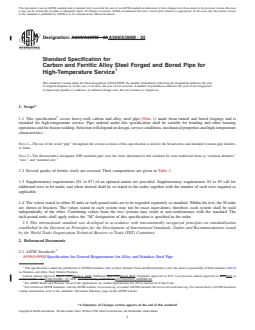
(Specification)Standard Specification for Carbon and Ferritic Alloy Steel Forged and Bored Pipe for High-Temperature Service
General Information
- Abstract
ABSTRACT
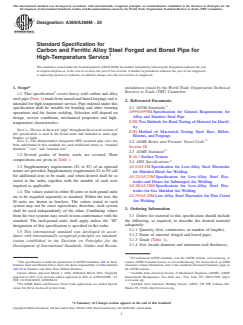
This guide specifies standard specification for heavy-wall carbon and alloy steel pipe made from turned and bored forgings and is intended for high-temperature service. Heat and product analysis shall be conducted on several grades of ferritic steels, wherein the material shall conform to the required chemical composition for carbon, manganese, phosphorus, sulfur, silicon, chromium, and molybdenum. The steel pipe shall conform to the required tensile properties like tensile strength, yield strength, and elongation. Required mechanical tests for the steel pipe include transverse or longitudinal tension test, flattening test, and bend test.
SCOPE
1.1 This specification2 covers heavy-wall carbon and alloy steel pipe (Note 1) made from turned and bored forgings and is intended for high-temperature service. Pipe ordered under this specification shall be suitable for bending and other forming operations and for fusion welding. Selection will depend on design, service conditions, mechanical properties and high-temperature characteristics.
Note 1: The use of the word “pipe” throughout the several sections of this specification is used in the broad sense and intended to mean pipe headers, or leads.
Note 2: The dimensionless designator NPS (nominal pipe size) has been substituted in this standard for such traditional terms as “nominal diameter,” “size,” and “nominal size.”
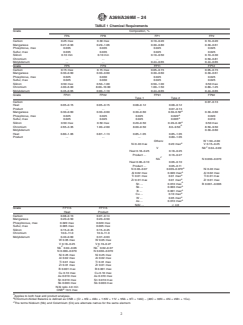
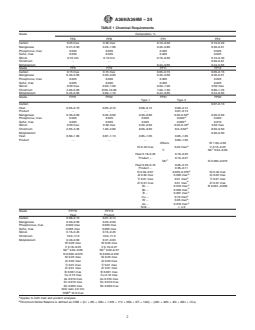
1.2 Several grades of ferritic steels are covered. Their compositions are given in Table 1.
1.3 Supplementary requirements (S1 to S7) of an optional nature are provided. Supplementary requirements S1 to S5 call for additional tests to be made, and when desired shall be so stated in the order, together with the number of such tests required as applicable.
1.4 The values stated in either SI units or inch-pound units are to be regarded separately as standard. Within the text, the SI units are shown in brackets. The values stated in each system may not be exact equivalents; therefore, each system shall be used independently of the other. Combining values from the two systems may result in non-conformance with the standard. The inch-pound units shall apply unless the “M” designation of this specification is specified in the order.
1.5 This international standard was developed in accordance with internationally recognized principles on standardization established in the Decision on Principles for the Development of International Standards, Guides and Recommendations issued by the World Trade Organization Technical Barriers to Trade (TBT) Committee.
- Status
- Published
- Publication Date
- 29-Feb-2024
- Technical Committee
- A01 - Steel, Stainless Steel and Related Alloys
- Drafting Committee
- A01.10 - Stainless and Alloy Steel Tubular Products
Buy Documents
ASTM A369/A369M-24 - Standard Specification for Carbon and Ferritic Alloy Steel Forged and Bored Pipe for High-Temperature Service
REDLINE ASTM A369/A369M-24 - Standard Specification for Carbon and Ferritic Alloy Steel Forged and Bored Pipe for High-Temperature Service
Overview
ASTM A369/A369M-24 is a standard specification developed by ASTM International for carbon and ferritic alloy steel forged and bored pipe designed for high-temperature service applications. This specification covers heavy-wall pipe produced from forged and bored steel, providing detailed requirements for chemical composition, mechanical properties, testing methods, and applicable grades. The standard ensures that pipes are suitable for bending, forming operations, and fusion welding, meeting demanding service and design conditions often encountered in industries where high-temperature resistance and durability are critical.
Key Topics
Scope and Application
- Covers heavy-wall carbon and ferritic alloy steel pipe produced by turning and boring forgings.
- Intended for use in high-temperature environments and operations requiring welded and formed sections.
- Utilizes Nominal Pipe Size (NPS) as the dimensionless designator for sizing.
Material Grades and Composition
- Contains several grades of ferritic steel, each defined by prescribed chemical composition limits for elements such as carbon, manganese, phosphorus, sulfur, silicon, chromium, and molybdenum.
- Chemical requirements are tailored for specific performance characteristics, including enhanced temperature and corrosion resistance.
Heat Treatment and Manufacture
- Pipe supplied under this standard is subjected to heating and tempering processes appropriate to grade specifications, ensuring mechanical integrity and service suitability.
- Pipes must be machined to meet stringent surface finish and dimensional requirements after heat treatment.
- Welding repair, when permitted, must adhere to strict standards with prescribed heat treatment following the repair.
Mechanical and Test Requirements
- Pipes must meet minimum specified values for tensile strength, yield strength, and elongation based on their designated grade.
- Mandatory mechanical tests include transverse or longitudinal tension tests, flattening, and bend tests for verifying ductility and structural integrity.
- Optional supplementary testing (such as ultrasonic inspection and hydrostatic testing) may be specified by the purchaser.
Dual Unit Systems
- Allows the use of either SI units or inch-pound units as separately recognized standards. Orders should specify the preferred unit system to avoid non-conformance.
Applications
ASTM A369/A369M-24 pipes are widely used in:
- Power Generation: Piping systems for high-pressure steam, superheaters, and headers in power plants.
- Petrochemical and Refinery Industries: Critical service lines requiring resistance to elevated temperatures and pressures.
- Industrial Processing Plants: Applications requiring heavy-wall piping for conveying overheated fluids.
- Boiler and Pressure Vessel Construction: As referenced in the ASME Boiler and Pressure Vessel Code, these pipes ensure safety and compliance with industry regulations for high-temperature components.
Their design characteristics make them ideal for environments where material integrity under heat stress is paramount.
Related Standards
ASTM A369/A369M-24 references and aligns with several related standards, including:
- ASTM A999/A999M: General requirements for alloy and stainless steel pipe.
- ASME SA-369: Boiler and Pressure Vessel Code reference for parallel requirements.
- ASME B46.1: Surface texture specifications.
- AWS A5 Series: Welding consumables for low-alloy steel welding processes.
- ASTM E290: Bend testing methods for ductility.
- ASTM E381: Macroetch testing of steel bars, billets, blooms, and forgings.
These related standards provide detailed guidance for manufacturing, testing, and ensuring quality, supporting the consistent implementation of ASTM A369/A369M-24 in high-temperature service applications.
By adhering to ASTM A369/A369M-24, manufacturers and users can ensure that carbon and ferritic alloy steel forged and bored pipe meets rigorous safety and performance criteria, supporting long-term reliability in critical high-temperature environments.
Relations
- Effective Date
- 01-Mar-2024
- Effective Date
- 01-Mar-2024
Buy Documents
ASTM A369/A369M-24 - Standard Specification for Carbon and Ferritic Alloy Steel Forged and Bored Pipe for High-Temperature Service
REDLINE ASTM A369/A369M-24 - Standard Specification for Carbon and Ferritic Alloy Steel Forged and Bored Pipe for High-Temperature Service
Get Certified
Connect with accredited certification bodies for this standard

Institut za varilstvo d.o.o. (Welding Institute)
Slovenia's leading welding institute since 1952. ISO 3834, EN 1090, pressure equipment certification, NDT personnel, welder qualification. Only IIW Au
Sponsored listings
Frequently Asked Questions
ASTM A369/A369M-24 is a technical specification published by ASTM International. Its full title is "Standard Specification for Carbon and Ferritic Alloy Steel Forged and Bored Pipe for High-Temperature Service". This standard covers: ABSTRACT This guide specifies standard specification for heavy-wall carbon and alloy steel pipe made from turned and bored forgings and is intended for high-temperature service. Heat and product analysis shall be conducted on several grades of ferritic steels, wherein the material shall conform to the required chemical composition for carbon, manganese, phosphorus, sulfur, silicon, chromium, and molybdenum. The steel pipe shall conform to the required tensile properties like tensile strength, yield strength, and elongation. Required mechanical tests for the steel pipe include transverse or longitudinal tension test, flattening test, and bend test. SCOPE 1.1 This specification2 covers heavy-wall carbon and alloy steel pipe (Note 1) made from turned and bored forgings and is intended for high-temperature service. Pipe ordered under this specification shall be suitable for bending and other forming operations and for fusion welding. Selection will depend on design, service conditions, mechanical properties and high-temperature characteristics. Note 1: The use of the word “pipe” throughout the several sections of this specification is used in the broad sense and intended to mean pipe headers, or leads. Note 2: The dimensionless designator NPS (nominal pipe size) has been substituted in this standard for such traditional terms as “nominal diameter,” “size,” and “nominal size.” 1.2 Several grades of ferritic steels are covered. Their compositions are given in Table 1. 1.3 Supplementary requirements (S1 to S7) of an optional nature are provided. Supplementary requirements S1 to S5 call for additional tests to be made, and when desired shall be so stated in the order, together with the number of such tests required as applicable. 1.4 The values stated in either SI units or inch-pound units are to be regarded separately as standard. Within the text, the SI units are shown in brackets. The values stated in each system may not be exact equivalents; therefore, each system shall be used independently of the other. Combining values from the two systems may result in non-conformance with the standard. The inch-pound units shall apply unless the “M” designation of this specification is specified in the order. 1.5 This international standard was developed in accordance with internationally recognized principles on standardization established in the Decision on Principles for the Development of International Standards, Guides and Recommendations issued by the World Trade Organization Technical Barriers to Trade (TBT) Committee.
ABSTRACT This guide specifies standard specification for heavy-wall carbon and alloy steel pipe made from turned and bored forgings and is intended for high-temperature service. Heat and product analysis shall be conducted on several grades of ferritic steels, wherein the material shall conform to the required chemical composition for carbon, manganese, phosphorus, sulfur, silicon, chromium, and molybdenum. The steel pipe shall conform to the required tensile properties like tensile strength, yield strength, and elongation. Required mechanical tests for the steel pipe include transverse or longitudinal tension test, flattening test, and bend test. SCOPE 1.1 This specification2 covers heavy-wall carbon and alloy steel pipe (Note 1) made from turned and bored forgings and is intended for high-temperature service. Pipe ordered under this specification shall be suitable for bending and other forming operations and for fusion welding. Selection will depend on design, service conditions, mechanical properties and high-temperature characteristics. Note 1: The use of the word “pipe” throughout the several sections of this specification is used in the broad sense and intended to mean pipe headers, or leads. Note 2: The dimensionless designator NPS (nominal pipe size) has been substituted in this standard for such traditional terms as “nominal diameter,” “size,” and “nominal size.” 1.2 Several grades of ferritic steels are covered. Their compositions are given in Table 1. 1.3 Supplementary requirements (S1 to S7) of an optional nature are provided. Supplementary requirements S1 to S5 call for additional tests to be made, and when desired shall be so stated in the order, together with the number of such tests required as applicable. 1.4 The values stated in either SI units or inch-pound units are to be regarded separately as standard. Within the text, the SI units are shown in brackets. The values stated in each system may not be exact equivalents; therefore, each system shall be used independently of the other. Combining values from the two systems may result in non-conformance with the standard. The inch-pound units shall apply unless the “M” designation of this specification is specified in the order. 1.5 This international standard was developed in accordance with internationally recognized principles on standardization established in the Decision on Principles for the Development of International Standards, Guides and Recommendations issued by the World Trade Organization Technical Barriers to Trade (TBT) Committee.
ASTM A369/A369M-24 is classified under the following ICS (International Classification for Standards) categories: 23.040.10 - Iron and steel pipes. The ICS classification helps identify the subject area and facilitates finding related standards.
ASTM A369/A369M-24 has the following relationships with other standards: It is inter standard links to ASTM A369/A369M-23, ASTM A999/A999M-23. Understanding these relationships helps ensure you are using the most current and applicable version of the standard.
ASTM A369/A369M-24 is available in PDF format for immediate download after purchase. The document can be added to your cart and obtained through the secure checkout process. Digital delivery ensures instant access to the complete standard document.
Standards Content (Sample)
This international standard was developed in accordance with internationally recognized principles on standardization established in the Decision on Principles for the
Development of International Standards, Guides and Recommendations issued by the World Trade Organization Technical Barriers to Trade (TBT) Committee.
Designation: A369/A369M − 24
Standard Specification for
Carbon and Ferritic Alloy Steel Forged and Bored Pipe for
High-Temperature Service
This standard is issued under the fixed designation A369/A369M; the number immediately following the designation indicates the year
of original adoption or, in the case of revision, the year of last revision. A number in parentheses indicates the year of last reapproval.
A superscript epsilon (´) indicates an editorial change since the last revision or reapproval.
1. Scope* mendations issued by the World Trade Organization Technical
2 Barriers to Trade (TBT) Committee.
1.1 This specification covers heavy-wall carbon and alloy
steel pipe (Note 1) made from turned and bored forgings and is
2. Referenced Documents
intended for high-temperature service. Pipe ordered under this
2.1 ASTM Standards:
specification shall be suitable for bending and other forming
A999/A999M Specification for General Requirements for
operations and for fusion welding. Selection will depend on
Alloy and Stainless Steel Pipe
design, service conditions, mechanical properties and high-
E290 Test Methods for Bend Testing of Material for Ductil-
temperature characteristics.
ity
NOTE 1—The use of the word “pipe” throughout the several sections of
E381 Method of Macroetch Testing Steel Bars, Billets,
this specification is used in the broad sense and intended to mean pipe
Blooms, and Forgings
headers, or leads.
NOTE 2—The dimensionless designator NPS (nominal pipe size) has
2.2 ASME Boiler and Pressure Vessel Code:
been substituted in this standard for such traditional terms as “nominal
Section IX
diameter,” “size,” and “nominal size.”
2.3 ASME Standard:
1.2 Several grades of ferritic steels are covered. Their
B 46.1 Surface Texture
compositions are given in Table 1.
2.4 AWS Specifications:
1.3 Supplementary requirements (S1 to S7) of an optional
A5.5/A5.5M Specification for Low-Alloy Steel Electrodes
nature are provided. Supplementary requirements S1 to S5 call
for Shielded Metal Arc Welding
for additional tests to be made, and when desired shall be so
A5.23/A5.23M Specification for Low-Alloy Steel Elec-
stated in the order, together with the number of such tests
trodes and Fluxes for Submerged Arc Welding
required as applicable.
A5.28/A5.28M Specification for Low-Alloy Steel Elec-
trodes for Gas Shielded Arc Welding
1.4 The values stated in either SI units or inch-pound units
A5.29/A5.29M Low-Alloy Steel Electrodes for Flux Cored
are to be regarded separately as standard. Within the text, the
Arc Welding
SI units are shown in brackets. The values stated in each
system may not be exact equivalents; therefore, each system
3. Ordering Information
shall be used independently of the other. Combining values
from the two systems may result in non-conformance with the 3.1 Orders for material to this specification should include
standard. The inch-pound units shall apply unless the “M” the following, as required, to describe the desired material
designation of this specification is specified in the order. adequately:
3.1.1 Quantity (feet, centimetres, or number of lengths),
1.5 This international standard was developed in accor-
3.1.2 Name of material (forged and bored pipe),
dance with internationally recognized principles on standard-
3.1.3 Grade (Table 1),
ization established in the Decision on Principles for the
3.1.4 Size (inside diameter and minimum wall thickness),
Development of International Standards, Guides and Recom-
For referenced ASTM standards, visit the ASTM website, www.astm.org, or
This specification is under the jurisdiction of ASTM Committee A01 on Steel, contact ASTM Customer Service at service@astm.org. For Annual Book of ASTM
Stainless Steel and Related Alloys and is the direct responsibility of Subcommittee Standards volume information, refer to the standard’s Document Summary page on
A01.10 on Stainless and Alloy Steel Tubular Products. the ASTM website.
Current edition approved March 1, 2024. Published March 2024. Originally Available from American Society of Mechanical Engineers (ASME), ASME
approved in 1953. Last previous edition approved in 2023 as A369/A369M – 23. International Headquarters, Two Park Ave., New York, NY 10016-5990, http://
DOI: 10.1520/A0369_A0369M-24. www.asme.org.
2 5
For ASME Boiler and Pressure Vessel Code applications see related Specifi- Available from American Welding Society (AWS), 550 NW LeJeune Rd.,
cation SA-369 in Section II of that Code. Miami, FL 33126, http://www.aws.org.
*A Summary of Changes section appears at the end of this standard
Copyright © ASTM International, 100 Barr Harbor Drive, PO Box C700, West Conshohocken, PA 19428-2959. United States
A369/A369M − 24
TABLE 1 Chemical Requirements
Grade Composition, %
FPA FPB FP1 FP2
Carbon 0.25 max 0.30 max 0.10–0.20 0.10–0.20
Manganese 0.27–0.93 0.29–1.06 0.30–0.80 0.30–0.61
Phosphorus, max 0.035 0.035 0.025 0.025
Sulfur, max 0.035 0.035 0.025 0.025
Silicon 0.10 min 0.10 min 0.10–0.50 0.10–0.30
Chromium . . . 0.50–0.81
Molybdenum . . 0.44–0.65 0.44–0.65
Grade FP5 FP9 FP11 FP12
Carbon 0.15 max 0.15 max 0.05–0.15 0.05–0.15
Manganese 0.30–0.60 0.30–0.60 0.30–0.60 0.30–0.61
Phosphorus, max 0.025 0.030 0.025 0.025
Sulfur, max 0.025 0.030 0.025 0.025
Silicon 0.50 max 0.50–1.00 0.50–1.00 0.50 max
Chromium 4.00–6.00 8.00–10.00 1.00–1.50 0.80–1.25
Molybdenum 0.45–0.65 0.90–1.10 0.44–0.65 0.44–0.65
Grade FP21 FP22 FP91 FP92
Type 1 Type 2
Carbon 0.07–0.13
Heat 0.05–0.15 0.05–0.15 0.08–0.12 0.08–0.12
Product . . . 0.07–0.13
A
Manganese 0.30–0.60 0.30–0.60 0.30–0.60 0.30–0.50 0.30–0.60
A
Phosphorus, max 0.025 0.025 0.025 0.020 0.020
A
Sulfur, max 0.025 0.025 0.025 0.005 0.010
A
Silicon 0.50 max 0.50 max 0.20–0.50 0.20–0.40 0.50 max
A
Chromium 2.65–3.35 1.90–2.60 8.00–9.50 8.0–9.50 8.50–9.50
Molybdenum 0.30–0.60
Heat 0.80–1.06 0.87–1.13 0.85–1.05 0.85–1.05
Product . . . 0.80–1.05
Others: W 1.50–2.00
A
Ni 0.40 max 0.20 max V 0.15–0.25
C
V Nb 0.04–0.09
Heat 0.18–0.25 0.18–0.25
Product . 0.16–0.27
C
Nb N 0.030–0.070
Heat 0.06–0.10 0.06–0.10
Product . 0.05–0.11
A
N 0.03–0.07 0.035–0.070 Ni 0.40 max
A
Al 0.02 max 0.020 max Al 0.02 max
A
Ti 0.01 max 0.01 max Ti 0.01 max
A
Zr 0.01 max 0.01 max Zr 0.01 max
A
Sn . 0.010 max B 0.001–0.006
A
Sb . 0.003 max
A
B . 0.001 max
A
Cu . 0.10 max
A
W . 0.05 max
A
As . 0.010 max
N/Al . $ 4.0
Grade FP115 FP115
Heat Product
Carbon 0.08–0.13 0.07–0.14
Manganese 0.20–0.50 0.20–0.50
Phosphorous, max 0.020 max 0.020 max
Sulfur, max 0.005 max 0.005 max
Silicon 0.15–0.45 0.15–0.45
Chromium 10.0–11.0 10.0–11.0
Molybdenum 0.40–0.60 0.37–0.63
W 0.05 max W 0.05 max
V 0.18–0.25 V 0.16–0.27
C C
Nb 0.02–0.06 Nb 0.02–0.07
N 0.030–0.070 N 0.030–0.070
Ni 0.25 max Ni 0.25 max
Al 0.02 max Al 0.02 max
Ti 0.01 max Ti 0.01 max
Zr 0.01 max Zr 0.01 max
B 0.001 max B 0.001 max
Cu 0.10 max Cu 0.10 max
As 0.010 max As 0.010 max
Sn 0.010 max Sn 0.010 max
Sb 0.003 max Sb 0.003 max
N/Al ratio 4.0 min
B
CNB 10.5 max
A
Applies to both heat and product analyses.
B
Chromium-Nickel Balance is defined as CNB = (Cr + 6Si + 4Mo + 1.5W + 11V + 5Nb + 9Ti + 12Al) – (40C + 30N + 4Ni + 2Mn + 1Cu).
C
The terms Niobium (Nb) and Columbium (Cb) are alternate names for the same element.
A369/A369M − 24
3.1.5 Length (Permissible Variations in Length Section of 5.4.2 Pipe in Grades FPA and FPB as a final heat treatment
Specification A999/A999M), shall be either normalized or shall be given a stress relieving
3.1.6 Verification of tensile and hardness properties at treatment at 1200 to 1300 °F [650 to 705 °C]. Pipe in Grades
mid-thickness for Grade FP91 Type 1 and Type 2 (9.2), FP1, FP2, and FP12, as a final heat treatment shall be given a
3.1.7 End finish (13), stress-relieving treatment at 1200 to 1300 °F [650 to 705 °C].
3.1.8 Optional requirements (Sections 8, Supplementary
NOTE 5—Certain of the ferritic steels covered by this specification tend
Requirements S1 to S7; 13.2),
to harden if cooled rapidly from above their critical temperature. Some
3.1.9 Test report required (Certification Section of Specifi-
will air harden, that is, become hardened to an undesirable degree when
cooled in air from high temperatures. Therefore, operations involving
cation A999/A999M),
heating such steels above their critical temperatures, such as welding,
3.1.10 Specification designation, and
hot-bending and other forming operations, should be followed by suitable
3.1.11 Special requirements or exceptions to this specifica-
heat treatment.
tion.
5.4.3 Except when Supplementary Requirement S6 is speci-
fied by the purchaser, Grade FP91 Type 1 and Type 2 shall be
4. General Requirements
normalized and tempered by reheating within the temperature
4.1 Material furnished under this specification shall con-
range from 1900 to 1975 °F [1040 to 1080 °C], followed by air
form to the applicable requirements of the current edition of
cooling and tempering in the temperature range of 1350 to
Specification A999/A999M, unless otherwise provided herein.
1470 °F [730 to 800 °C].
5.4.4 Except when Supplementary Requirement S6 is speci-
5. Materials and Manufacture
fied by the purchaser, Grade FP92 shall be normalized and
5.1 Discard:
tempered by reheating within the temperature range of 1900 to
5.1.1 A sufficient discard shall be made from each ingot to
1975 °F [1040 to 1080 °C], followed by air cooling and
secure freedom from injurious defects. The steel shall have a
tempering in the temperature range of 1350 to 1470 °F [730 to
homogeneous structure.
800 °C].
5.4.5 Grade FP115 shall be normalized and tempered by
5.2 Manufacture:
reheating within the temperature range of 1920 to 2010 °F
5.2.1 Material for forging shall consist of ingots or of
[1050 to 1100 °C] and tempered in the range of 1380 to 1455
blooms, billets, or solid-rolled bars forged or rolled from an
°F [750 to 790 °C]. The rate of cooling at mid thickness from
ingot, and cut to the required length by a process that will not
1650 to 900 °F [900 to 482 °C] shall be no slower than 9
produce injurious defects in the forging.
°F/minute [5 °C/minute].
5.2.2 The material shall be forged (Note 3) by hammering or
pressing, and shall be brought as nearly as practicable to the
5.5 Repair by Welding:
finished shape and size by hot working.
5.5.1 Weld repair shall be permitted only subject to the
approval of the purchaser and in accordance with Specification
NOTE 3—The cross-sectional area of the solid forging shall have a
A999/A999M.
reduction by forging or by rolling and forging from that of the ingot in the
ratio of not less than 3 to 1. 5.5.2 All repair welds in FP91 shall be made with one of the
following welding processes and consumables: SMAW, A5.5/
5.2.3 Unless otherwise specified, the final forging operation
A5.5M E90XX-B9; SAW, A5.23/A5.23M EB9 + neutral flux;
shall be followed by a treatment suitable to the grade as
GTAW, A5.28/A5.28M ER90S-B9; and FCAW A5.29/A5.29M
specified in 5.4.
E91T1-B9. In addition, the sum of the Ni + Mn content of all
5.3 Machining:
welding consumables used to weld repair FP91 Type 1 and
5.3.1 All forgings shall have both the inner and outer
Type 2 shall not exceed 1.0 %.
surfaces machined.
5.5.3 All repair welds in FP92 shall be made using welding
5.3.2 Afte
...
This document is not an ASTM standard and is intended only to provide the user of an ASTM standard an indication of what changes have been made to the previous version. Because
it may not be technically possible to adequately depict all changes accurately, ASTM recommends that users consult prior editions as appropriate. In all cases only the current version
of the standard as published by ASTM is to be considered the official document.
Designation: A369/A369M − 23 A369/A369M − 24
Standard Specification for
Carbon and Ferritic Alloy Steel Forged and Bored Pipe for
High-Temperature Service
This standard is issued under the fixed designation A369/A369M; the number immediately following the designation indicates the year
of original adoption or, in the case of revision, the year of last revision. A number in parentheses indicates the year of last reapproval.
A superscript epsilon (´) indicates an editorial change since the last revision or reapproval.
1. Scope*
1.1 This specification covers heavy-wall carbon and alloy steel pipe (Note 1) made from turned and bored forgings and is
intended for high-temperature service. Pipe ordered under this specification shall be suitable for bending and other forming
operations and for fusion welding. Selection will depend on design, service conditions, mechanical properties and high-temperature
characteristics.
NOTE 1—The use of the word “pipe” throughout the several sections of this specification is used in the broad sense and intended to mean pipe headers,
or leads.
NOTE 2—The dimensionless designator NPS (nominal pipe size) has been substituted in this standard for such traditional terms as “nominal diameter,”
“size,” and “nominal size.”
1.2 Several grades of ferritic steels are covered. Their compositions are given in Table 1.
1.3 Supplementary requirements (S1 to S7) of an optional nature are provided. Supplementary requirements S1 to S5 call for
additional tests to be made, and when desired shall be so stated in the order, together with the number of such tests required as
applicable.
1.4 The values stated in either SI units or inch-pound units are to be regarded separately as standard. Within the text, the SI units
are shown in brackets. The values stated in each system may not be exact equivalents; therefore, each system shall be used
independently of the other. Combining values from the two systems may result in non-conformance with the standard. The
inch-pound units shall apply unless the “M” designation of this specification is specified in the order.
1.5 This international standard was developed in accordance with internationally recognized principles on standardization
established in the Decision on Principles for the Development of International Standards, Guides and Recommendations issued
by the World Trade Organization Technical Barriers to Trade (TBT) Committee.
2. Referenced Documents
2.1 ASTM Standards:
A999/A999M Specification for General Requirements for Alloy and Stainless Steel Pipe
This specification is under the jurisdiction of ASTM Committee A01 on Steel, Stainless Steel and Related Alloys and is the direct responsibility of Subcommittee A01.10
on Stainless and Alloy Steel Tubular Products.
Current edition approved May 1, 2023March 1, 2024. Published May 2023March 2024. Originally approved in 1953. Last previous edition approved in 20182023 as
A369/A369M – 18a.A369/A369M – 23. DOI: 10.1520/A0369_A0369M-23.10.1520/A0369_A0369M-24.
For ASME Boiler and Pressure Vessel Code applications see related Specification SA-369 in Section II of that Code.
For referenced ASTM standards, visit the ASTM website, www.astm.org, or contact ASTM Customer Service at service@astm.org. For Annual Book of ASTM Standards
volume information, refer to the standard’s Document Summary page on the ASTM website.
*A Summary of Changes section appears at the end of this standard
Copyright © ASTM International, 100 Barr Harbor Drive, PO Box C700, West Conshohocken, PA 19428-2959. United States
A369/A369M − 24
TABLE 1 Chemical Requirements
Grade Composition, %
FPA FPB FP1 FP2
Carbon 0.25 max 0.30 max 0.10–0.20 0.10–0.20
Manganese 0.27–0.93 0.29–1.06 0.30–0.80 0.30–0.61
Phosphorus, max 0.035 0.035 0.025 0.025
Sulfur, max 0.035 0.035 0.025 0.025
Silicon 0.10 min 0.10 min 0.10–0.50 0.10–0.30
Chromium . . . 0.50–0.81
Molybdenum . . 0.44–0.65 0.44–0.65
Grade FP5 FP9 FP11 FP12
Carbon 0.15 max 0.15 max 0.05–0.15 0.05–0.15
Manganese 0.30–0.60 0.30–0.60 0.30–0.60 0.30–0.61
Phosphorus, max 0.025 0.030 0.025 0.025
Sulfur, max 0.025 0.030 0.025 0.025
Silicon 0.50 max 0.50–1.00 0.50–1.00 0.50 max
Chromium 4.00–6.00 8.00–10.00 1.00–1.50 0.80–1.25
Molybdenum 0.45–0.65 0.90–1.10 0.44–0.65 0.44–0.65
Grade FP21 FP22 FP91 FP92
Type 1 Type 2
Carbon 0.07–0.13
Heat 0.05–0.15 0.05–0.15 0.08–0.12 0.08–0.12
Product . . . 0.07–0.13
A
Manganese 0.30–0.60 0.30–0.60 0.30–0.60 0.30–0.50 0.30–0.60
A
Phosphorus, max 0.025 0.025 0.025 0.020 0.020
A
Sulfur, max 0.025 0.025 0.025 0.005 0.010
A
Silicon 0.50 max 0.50 max 0.20–0.50 0.20–0.40 0.50 max
A
Chromium 2.65–3.35 1.90–2.60 8.00–9.50 8.0–9.50 8.50–9.50
Molybdenum 0.30–0.60
Heat 0.80–1.06 0.87–1.13 0.85–1.05 0.85–1.05
Product . . . 0.80–1.05
Others: W 1.50–2.00
A
Ni 0.40 max 0.20 max V 0.15–0.25
C
V Nb 0.04–0.09
Heat 0.18–0.25 0.18–0.25
Product . 0.16–0.27
C
Nb N 0.030–0.070
Heat 0.06–0.10 0.06–0.10
Product . 0.05–0.11
A
N 0.03–0.07 0.035–0.070 Ni 0.40 max
A
Al 0.02 max 0.020 max Al 0.02 max
A
Ti 0.01 max 0.01 max Ti 0.01 max
A
Zr 0.01 max 0.01 max Zr 0.01 max
A
Sn . 0.010 max B 0.001–0.006
A
Sb . 0.003 max
A
B . 0.001 max
A
Cu . 0.10 max
A
W . 0.05 max
A
As . 0.010 max
N/Al . $ 4.0
Grade FP115 FP115
Heat Product
Carbon 0.08–0.13 0.07–0.14
Manganese 0.20–0.50 0.20–0.50
Phosphorous, max 0.020 max 0.020 max
Sulfur, max 0.005 max 0.005 max
Silicon 0.15–0.45 0.15–0.45
Chromium 10.0–11.0 10.0–11.0
Molybdenum 0.40–0.60 0.37–0.63
W 0.05 max W 0.05 max
V 0.18–0.25 V 0.16–0.27
C C
Nb 0.02–0.06 Nb 0.02–0.07
N 0.030–0.070 N 0.030–0.070
Ni 0.25 max Ni 0.25 max
Al 0.02 max Al 0.02 max
Ti 0.01 max Ti 0.01 max
Zr 0.01 max Zr 0.01 max
B 0.001 max B 0.001 max
Cu 0.10 max Cu 0.10 max
As 0.010 max As 0.010 max
Sn 0.010 max Sn 0.010 max
Sb 0.003 max Sb 0.003 max
N/Al ratio 4.0 min
B
CNB 10.5 max
A
Applies to both heat and product analyses.
B
Chromium-Nickel Balance is defined as CNB = (Cr + 6Si + 4Mo + 1.5W + 11V + 5Nb + 9Ti + 12Al) – (40C + 30N + 4Ni + 2Mn + 1Cu).
A369/A369M − 24
C
The terms Niobium (Nb) and Columbium (Cb) are alternate names for the same element.
E290 Test Methods for Bend Testing of Material for Ductility
E381 Method of Macroetch Testing Steel Bars, Billets, Blooms, and Forgings
2.2 ASME Boiler and Pressure Vessel Code:
Section IX
2.3 ASME Standard:
B 46.1 Surface Texture
2.4 AWS Specifications:
A5.5/A5.5M Specification for Low-Alloy Steel Electrodes for Shielded Metal Arc Welding
A5.23/A5.23M Specification for Low-Alloy Steel Electrodes and Fluxes for Submerged Arc Welding
A5.28/A5.28M Specification for Low-Alloy Steel Electrodes for Gas Shielded Arc Welding
A5.29/A5.29M Low-Alloy Steel Electrodes for Flux Cored Arc Welding
3. Ordering Information
3.1 Orders for material to this specification should include the following, as required, to describe the desired material adequately:
3.1.1 Quantity (feet, centimetres, or number of lengths),
3.1.2 Name of material (forged and bored pipe),
3.1.3 Grade (Table 1),
3.1.4 Size (inside diameter and minimum wall thickness),
3.1.5 Length (Permissible Variations in Length Section of Specification A999/A999M),
3.1.6 Verification of tensile and hardness properties at mid-thickness for Grade FP91 Type 1 and Type 2 (9.2),
3.1.7 End finish (13),
3.1.8 Optional requirements (Sections 8, Supplementary Requirements S1 to S7; 13.2),
3.1.9 Test report required (Certification Section of Specification A999/A999M),
3.1.10 Specification designation, and
3.1.11 Special requirements or exceptions to this specification.
4. General Requirements
4.1 Material furnished under this specification shall conform to the applicable requirements of the current edition of Specification
A999/A999M, unless otherwise provided herein.
5. Materials and Manufacture
5.1 Discard:
5.1.1 A sufficient discard shall be made from each ingot to secure freedom from injurious defects. The steel shall have a
homogeneous structure.
5.2 Manufacture:
Available from American Society of Mechanical Engineers (ASME), ASME International Headquarters, Two Park Ave., New York, NY 10016-5990, http://
www.asme.org.
Available from American Welding Society (AWS), 550 NW LeJeune Rd., Miami, FL 33126, http://www.aws.org.
A369/A369M − 24
5.2.1 Material for forging shall consist of ingots or of blooms, billets, or solid-rolled bars forged or rolled from an ingot, and cut
to the required length by a process that will not produce injurious defects in the forging.
5.2.2 The material shall be forged (Note 3) by hammering or pressing, and shall be brought as nearly as practicable to the finished
shape and size by hot working.
NOTE 3—The cross-sectional area of the solid forging shall have a reduction by forging or by rolling and forging from that of the ingot in the ratio of
not less than 3 to 1.
5.2.3 Unless otherwise specified, the final forging operation shall be followed by a treatment suitable to the grade as specified in
5.4.
5.3 Machining:
5.3.1 All forgings shall have both the inner and outer surfaces machined.
5.3.2 After heat treatment, the pipe shall be machined to a finish with a roughness value no greater than 250-μin. [6.4-μm]
arithmetical average deviation (AA), terms as defined in ANSI B 46.1-1962, unless otherwise specified.
5.4 Heat Treatment:
5.4.1 All pipe of the grades shown in Table 1 other than FPA, FPB, FP1, FP2, FP12, FP91 Type 1 and Type 2, FP92, and FP115
shall be reheated and furnished in the full-annealed or normalized and tempered condition. If furnished in the normalized and
tempered condition (Note 4), the temperature for tempering shall be 1250 °F [680 °C] or higher for Grades FP5, FP9, FP21, and
FP22, and 1200 °F [650 °C] or higher for Grades FP36 and FP11.
NOTE 4—It is recommended that the temperature for tempering should be at least 100 °F [50 °C] above the intended service temperature; consequently,
the purchaser should advise the manufacturer if the service temperature is to be over 1100 °F [600 °C].
5.4.2 Pipe in Grades FPA and FPB as a final heat treatment shall be either normalized or shall be given a stress relieving treatment
at 1200 to 1300 °F [650 to 705 °C]. Pipe in Grades FP1, FP2, and FP12, as a final heat treatment shall be given a stress-relieving
treatment at 1200 to 1300 °F [650 to 705 °C].
NOTE 5—Certain of the ferritic steels covered by this specification tend to harden if cooled rapidly from above their critical temperature. Some will air
harden, that is, become hardened to an undesirable degree when cooled in air from high temperatures. Therefore, operations involving heating such steels
above their critical temperatures, such as welding, hot-bending and other forming operations, should be followed by suitable heat treatment.
5.4.3 Except when Supplementary Requirement S6 is specified by the purchaser, Grade FP91 Type 1 and Type 2 shall be
normalized and tempered by reheating within the temperature range from 1900 to 1975 °F [1040 to 1080 °C], followed by air
cooling and tempering in the temperature range of 1350 to 1470 °F [730 to 800 °C].
5.4.4 Except when Supplementary Requirement S6 is specified by the purchaser, Grade FP92 shall be normalized and tempered
by reheating within the temperature range of 1900 to 1975 °F [1040 to
...