

ASTM D1135-86(2020)
(Test Method)Standard Test Methods for Chemical Analysis of Blue Pigments
General Information
- Abstract
SIGNIFICANCE AND USE
3.1 These test methods are suitable for determining if impurities are present and establishing that the required pigments are present. These test methods may be used for manufacturing quality control.
SCOPE
1.1 These test methods cover procedures for the chemical analysis of blue pigments known commercially as iron blue, copper phthalocyanine blue, and ultramarine blue.
1.2 The analytical procedures appear in the following order:
Sections
IRON BLUE PIGMENTS
Identification
6
Moisture by the Brabender Moisture Tester
7 and 8
Moisture by Toluene Distillation
9
Water-Soluble Matter by Extraction
10
Water-Soluble Salts by Electrical Conductivity
11
Detection of Acid-Insoluble Extenders
12 and 13
Detection of Acid-Soluble Extenders
14 to 17
Detection of Organic Colors and Lakes
18
COPPER PHTHALOCYANINE BLUE PIGMENTS
Identification
19
Moisture and Other Volatile Matter
20
Detection of Basic Dye Derivatives
21
Detection of Other Organic Coloring Matter
22
Detection of Ultramarine Blue
23
Detection of Iron Blue
24
ULTRAMARINE BLUE
Identification
25
Moisture and Other Volatile Matter
26
Water-Soluble Matter
27
Detection of Basic Dye Derivatives
28
Detection of Other Organic Coloring Matter
29
1.3 The values stated in SI units are to be regarded as standard. No other units of measurement are included in this standard.
1.4 This standard does not purport to address all of the safety concerns, if any, associated with its use. It is the responsibility of the user of this standard to establish appropriate safety, health, and environmental practices and determine the applicability of regulatory limitations prior to use.
1.5 This international standard was developed in accordance with internationally recognized principles on standardization established in the Decision on Principles for the Development of International Standards, Guides and Recommendations issued by the World Trade Organization Technical Barriers to Trade (TBT) Committee.
- Status
- Published
- Publication Date
- 31-May-2020
- Technical Committee
- D01 - Paint and Related Coatings, Materials, and Applications
- Drafting Committee
- D01.31 - Pigment Specifications
Overview
ASTM D1135-86(2020): Standard Test Methods for Chemical Analysis of Blue Pigments provides recognized procedures for evaluating the chemical composition and purity of blue pigments used commercially. This standard specifically addresses iron blue, copper phthalocyanine blue, and ultramarine blue pigments. The test methods help to determine the presence of impurities, verify required pigment content, and support manufacturing quality control processes. Developed in alignment with World Trade Organization principles, this international standard is widely referenced by industries involved with paint, coatings, plastics, and related materials.
Key Topics
ASTM D1135-86(2020) covers several core analytical procedures and detection methods:
- Identification Tests: Confirm the specific blue pigment present, such as iron blue, copper phthalocyanine blue, or ultramarine blue.
- Moisture Determination: Use of Brabender Moisture Tester and toluene distillation methods to quantify moisture and volatile matter in pigments.
- Water-Soluble Matter: Extraction and quantification of water-soluble components and salts, including measurement by electrical conductivity.
- Detection of Extenders: Identification of both acid-insoluble and acid-soluble extenders, such as silica, barium sulfate, alumina, and magnesium/alakaline earth salts.
- Organic Colors and Lakes: Testing for the presence of organic dyes and lakes, which may affect pigment properties or indicate contamination.
- Specific Tests for Each Pigment Type: Distinct procedures for identification, detection of derivatives, and cross-pigment contamination for iron blue, copper phthalocyanine blue, and ultramarine blue.
- Sample Preparation: Guidelines for sample collection, mixing, grinding, and sieving to ensure test accuracy.
- Safety and Units: All procedures are specified in SI units. Users are responsible for observing safety, health, and environmental protocols.
Applications
The standard is essential for manufacturers, quality control laboratories, and regulatory agencies working with blue pigments in a variety of industries:
- Paint and Coatings: Ensuring pigment purity and compliance with specifications in decorative and industrial paints.
- Plastics and Polymers: Verification of pigment composition for quality and color consistency in plastic products.
- Printing Inks: Assurance of blue pigment identity and performance in ink formulations.
- Textiles: Chemical analysis of pigments in textile dyeing processes.
- Regulatory Compliance: Verification for safety, environmental, and industry-specific regulations.
- Research and Development: Analytical support in developing new pigment types and improving existing formulations.
Related Standards
Several ASTM standards are referenced or complement the procedures in ASTM D1135-86(2020):
- ASTM D280: Test Methods for Hygroscopic Moisture and Other Volatile Matter in Pigments
- ASTM D1193: Specification for Reagent Water
- ASTM D1208: Test Methods for Common Properties of Pigments
- ASTM D2448: Water-Soluble Salts in Pigments by Electrical Conductivity
- ASTM E11: Specification for Woven Wire Test Sieve Cloth and Test Sieves
Practical Value
Adopting ASTM D1135-86(2020) helps organizations:
- Detect and quantify impurities, improving product quality and traceability.
- Verify the type and consistency of blue pigments in processed materials.
- Support compliance with international trade and environmental requirements.
- Enhance manufacturing process control and product certification.
By following standardized methods, manufacturers and labs can confidently assess the chemical makeup of commercial blue pigments, supporting both product quality and regulatory requirements.
Relations
- Effective Date
- 01-Jun-2020
- Effective Date
- 01-Oct-2019
- Effective Date
- 01-Jun-2019
- Effective Date
- 01-Oct-2013
- Effective Date
- 01-Nov-2012
- Effective Date
- 01-Nov-2012
- Effective Date
- 01-Nov-2012
- Effective Date
- 01-May-2009
- Effective Date
- 01-Jun-2007
- Effective Date
- 01-Jun-2007
- Effective Date
- 01-Feb-2007
- Effective Date
- 01-Mar-2006
- Effective Date
- 01-May-2004
- Effective Date
- 10-May-2001
- Effective Date
- 10-May-2001
Frequently Asked Questions
ASTM D1135-86(2020) is a standard published by ASTM International. Its full title is "Standard Test Methods for Chemical Analysis of Blue Pigments". This standard covers: SIGNIFICANCE AND USE 3.1 These test methods are suitable for determining if impurities are present and establishing that the required pigments are present. These test methods may be used for manufacturing quality control. SCOPE 1.1 These test methods cover procedures for the chemical analysis of blue pigments known commercially as iron blue, copper phthalocyanine blue, and ultramarine blue. 1.2 The analytical procedures appear in the following order: Sections IRON BLUE PIGMENTS Identification 6 Moisture by the Brabender Moisture Tester 7 and 8 Moisture by Toluene Distillation 9 Water-Soluble Matter by Extraction 10 Water-Soluble Salts by Electrical Conductivity 11 Detection of Acid-Insoluble Extenders 12 and 13 Detection of Acid-Soluble Extenders 14 to 17 Detection of Organic Colors and Lakes 18 COPPER PHTHALOCYANINE BLUE PIGMENTS Identification 19 Moisture and Other Volatile Matter 20 Detection of Basic Dye Derivatives 21 Detection of Other Organic Coloring Matter 22 Detection of Ultramarine Blue 23 Detection of Iron Blue 24 ULTRAMARINE BLUE Identification 25 Moisture and Other Volatile Matter 26 Water-Soluble Matter 27 Detection of Basic Dye Derivatives 28 Detection of Other Organic Coloring Matter 29 1.3 The values stated in SI units are to be regarded as standard. No other units of measurement are included in this standard. 1.4 This standard does not purport to address all of the safety concerns, if any, associated with its use. It is the responsibility of the user of this standard to establish appropriate safety, health, and environmental practices and determine the applicability of regulatory limitations prior to use. 1.5 This international standard was developed in accordance with internationally recognized principles on standardization established in the Decision on Principles for the Development of International Standards, Guides and Recommendations issued by the World Trade Organization Technical Barriers to Trade (TBT) Committee.
SIGNIFICANCE AND USE 3.1 These test methods are suitable for determining if impurities are present and establishing that the required pigments are present. These test methods may be used for manufacturing quality control. SCOPE 1.1 These test methods cover procedures for the chemical analysis of blue pigments known commercially as iron blue, copper phthalocyanine blue, and ultramarine blue. 1.2 The analytical procedures appear in the following order: Sections IRON BLUE PIGMENTS Identification 6 Moisture by the Brabender Moisture Tester 7 and 8 Moisture by Toluene Distillation 9 Water-Soluble Matter by Extraction 10 Water-Soluble Salts by Electrical Conductivity 11 Detection of Acid-Insoluble Extenders 12 and 13 Detection of Acid-Soluble Extenders 14 to 17 Detection of Organic Colors and Lakes 18 COPPER PHTHALOCYANINE BLUE PIGMENTS Identification 19 Moisture and Other Volatile Matter 20 Detection of Basic Dye Derivatives 21 Detection of Other Organic Coloring Matter 22 Detection of Ultramarine Blue 23 Detection of Iron Blue 24 ULTRAMARINE BLUE Identification 25 Moisture and Other Volatile Matter 26 Water-Soluble Matter 27 Detection of Basic Dye Derivatives 28 Detection of Other Organic Coloring Matter 29 1.3 The values stated in SI units are to be regarded as standard. No other units of measurement are included in this standard. 1.4 This standard does not purport to address all of the safety concerns, if any, associated with its use. It is the responsibility of the user of this standard to establish appropriate safety, health, and environmental practices and determine the applicability of regulatory limitations prior to use. 1.5 This international standard was developed in accordance with internationally recognized principles on standardization established in the Decision on Principles for the Development of International Standards, Guides and Recommendations issued by the World Trade Organization Technical Barriers to Trade (TBT) Committee.
ASTM D1135-86(2020) is classified under the following ICS (International Classification for Standards) categories: 87.060.10 - Pigments and extenders. The ICS classification helps identify the subject area and facilitates finding related standards.
ASTM D1135-86(2020) has the following relationships with other standards: It is inter standard links to ASTM D1135-86(2014), ASTM D2448-85(2019), ASTM D1208-96(2019), ASTM E11-13, ASTM D2448-85(2012), ASTM D280-01(2012), ASTM D1208-96(2012), ASTM E11-09e1, ASTM D2448-85(2007), ASTM D1208-96(2007), ASTM D280-01(2007), ASTM D1193-06, ASTM E11-04, ASTM E11-01, ASTM E11-95. Understanding these relationships helps ensure you are using the most current and applicable version of the standard.
ASTM D1135-86(2020) is available in PDF format for immediate download after purchase. The document can be added to your cart and obtained through the secure checkout process. Digital delivery ensures instant access to the complete standard document.
Standards Content (Sample)
This international standard was developed in accordance with internationally recognized principles on standardization established in the Decision on Principles for the
Development of International Standards, Guides and Recommendations issued by the World Trade Organization Technical Barriers to Trade (TBT) Committee.
Designation: D1135 − 86 (Reapproved 2020)
Standard Test Methods for
Chemical Analysis of Blue Pigments
This standard is issued under the fixed designation D1135; the number immediately following the designation indicates the year of
original adoption or, in the case of revision, the year of last revision. A number in parentheses indicates the year of last reapproval. A
superscript epsilon (´) indicates an editorial change since the last revision or reapproval.
This standard has been approved for use by agencies of the U.S. Department of Defense.
1. Scope 1.5 This international standard was developed in accor-
dance with internationally recognized principles on standard-
1.1 These test methods cover procedures for the chemical
ization established in the Decision on Principles for the
analysis of blue pigments known commercially as iron blue,
Development of International Standards, Guides and Recom-
copper phthalocyanine blue, and ultramarine blue.
mendations issued by the World Trade Organization Technical
1.2 The analytical procedures appear in the following order:
Barriers to Trade (TBT) Committee.
Sections
2. Referenced Documents
IRON BLUE PIGMENTS
2.1 ASTM Standards:
Identification 6
D280 Test Methods for Hygroscopic Moisture (and Other
Moisture by the Brabender Moisture Tester 7 and 8
Matter Volatile Under the Test Conditions) in Pigments
Moisture by Toluene Distillation 9
Water-Soluble Matter by Extraction 10
D1193 Specification for Reagent Water
Water-Soluble Salts by Electrical Conductivity 11
D1208 Test Methods for Common Properties of Certain
Detection of Acid-Insoluble Extenders 12 and 13
Pigments
Detection of Acid-Soluble Extenders 14 to 17
Detection of Organic Colors and Lakes 18
D2448 Test Method for Water-Soluble Salts in Pigments by
Measuring the Specific Resistance of the Leachate of the
COPPER PHTHALOCYANINE BLUE PIGMENTS
Pigment
Identification 19
E11 Specification for Woven Wire Test Sieve Cloth and Test
Moisture and Other Volatile Matter 20
Sieves
Detection of Basic Dye Derivatives 21
Detection of Other Organic Coloring Matter 22
Detection of Ultramarine Blue 23
3. Significance and Use
Detection of Iron Blue 24
3.1 These test methods are suitable for determining if
ULTRAMARINE BLUE
impurities are present and establishing that the required pig-
ments are present. These test methods may be used for
Identification 25
Moisture and Other Volatile Matter 26
manufacturing quality control.
Water-Soluble Matter 27
Detection of Basic Dye Derivatives 28
4. Purity of Reagents and Water
Detection of Other Organic Coloring Matter 29
4.1 Purity of Reagents—Unless otherwise indicated, it is
1.3 The values stated in SI units are to be regarded as
intended that all reagents shall conform to the specifications of
standard. No other units of measurement are included in this
theCommitteeonAnalyticalReagentsoftheAmericanChemi-
standard.
cal Society, where such specifications are available. Other
1.4 This standard does not purport to address all of the
grades may be used, provided it is first ascertained that the
safety concerns, if any, associated with its use. It is the
responsibility of the user of this standard to establish appro-
priate safety, health, and environmental practices and deter-
For referenced ASTM standards, visit the ASTM website, www.astm.org, or
mine the applicability of regulatory limitations prior to use.
contact ASTM Customer Service at service@astm.org. For Annual Book of ASTM
Standards volume information, refer to the standard’s Document Summary page on
the ASTM website.
1 3
These test methods are under the jurisdiction of ASTM Committee D01 on ACS Reagent Chemicals, Specifications and Procedures for Reagents and
Paint and Related Coatings, Materials, and Applications and are the direct Standard-Grade Reference Materials, American Chemical Society, Washington,
responsibility of Subcommittee D01.31 on Pigment Specifications. DC. For suggestions on the testing of reagents not listed by theAmerican Chemical
Current edition approved June 1, 2020. Published June 2020. Originally Society, see Analar Standards for Laboratory Chemicals, BDH Ltd., Poole, Dorset,
approved in 1950. Last previous edition approved in 2014 as D1135 – 86 (2014). U.K., and the United States Pharmacopeia and National Formulary, U.S. Pharma-
DOI: 10.1520/D1135-86R20. copeial Convention, Inc. (USPC), Rockville, MD.
Copyright © ASTM International, 100 Barr Harbor Drive, PO Box C700, West Conshohocken, PA 19428-2959. United States
D1135 − 86 (2020)
reagent is of sufficiently high purity to permit its use without 5.2 Grind extracted pigments to pass a No. 80 (180-µm)
lessening the accuracy of the determination. sieve. Discard any skins that do not pass through the sieve.
Mix the finely ground pigment thoroughly.
4.2 Purity of Water—Unless otherwise indicated, references
towatershallbeunderstoodtomeanreagentwaterconforming
to Type II of Specification D1193.
5. Preparation of Sample
5.1 Mix the sample thoroughly and take a representative
portion for analysis. Reduce any lumps or coarse particles to a
fine powder by grinding. Detailed requirements for this sieve are given in Specification E11.
IRON BLUE
(Prussian Blue, Chinese Blue, Milori Blue)
consistentresults,thespecimenpositionmustnotbechangedandtheoven
IDENTIFICATION
door must not be opened.
6. Procedure
8.3 Calculation and Report—Plot time against percent loss
in weight on rectilinear cross-section paper. Extrapolate the
6.1 To approximately 0.1 g of pigment in a 50-mL beaker,
linear portion of the curve to zero time. That portion beyond
add15mLofNaOHsolution(50g/L).Heattoboiling.Inafew
about 2 h will be essentially linear. Report the percent loss in
minutes the blue color should be completely destroyed, giving
weight at the extrapolated zero time as the percent moisture in
initsplacethecharacteristicreddishbrownprecipitateofferric
the pigment.
hydroxide.Add HCl (1+1) until faintly acid to litmus.The iron
blue should be reformed, yielding again the characteristic blue
NOTE 3—The pigment undergoes a slight loss in weight due to
color.
decomposition during the heating. The method of plotting and extrapola-
tion corrects for this loss.An approximate value for moisture content may
NOTE 1—If the NaOH treatment does not completely destroy the blue
be obtained by taking the reading at the end of the first hour’s heating.An
color, the evidence is strong that a foreign pigment is present. If this
occasional pigment may decompose rapidly at the oven temperature. In
occurs, it is best to filter the alkaline solution, weakly acidify the filtrate
such cases, determine moisture by the toluene distillation method (Section
with HCl (1+1), and add approximately 2 mL of a ferric salt solution
9).
(ferric sulfate or ferric alum (20 g/L)). The formation of a blue precipitate
established the pigment as consisting, at least in part, of iron blue.
MOISTURE BY TOLUENE DISTILLATION
MOISTURE BY THE BRABENDER MOISTURE
9. Procedure
TESTER
9.1 Determine the moisture content in accordance with
7. Apparatus
Sections 7 and 8 of Test Method D1208, but using 25 g of
7.1 Brabender Moisture Tester—The Brabender moisture
pigment and 200 mL of toluene and adjusting the calculation
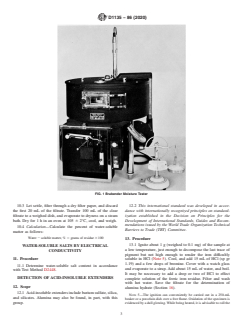
tester (Fig. 1) consists of a constant-temperature oven with
accordingly.
weighing apparatus attached. Specimens placed in the oven
WATER-SOLUBLE MATTER BY EXTRACTION
may be weighed without opening the oven door or removing
the specimen from the oven, as the balance scale is calibrated
10. Procedure
to read directly in percent of moisture.
10.1 Determine whether or not the pigment is easily wet by
8. Procedure
water at room temperature by adding a little to some water in
8.1 Set the temperature control at 160°C and allow the oven
a beaker. If it tends to float on top of the water with very little,
to reach this temperature before checking or making any
if any, tendency to sink to the bottom or disperse throughout
weighing. Check the scale by placing a sample dish containing
the solution, even after agitation, it contains a hydrophobic
9.200 g standard analytical balance weights in the oven. The
treating agent.
apparatus should read 8.0 % moisture. If it does not, adjust to
10.2 Weigh to 1 mg about 2.5 g of the pigment into a
a reading of 8.0 % by turning either the right hand or left hand
250-mL volumetric flask. If the pigment is hydrophobic as
foot screw.
tested above, moisten thoroughly with a few mL of ethyl
8.2 Weigh 10.000 g of the sample into the aluminum dish
alcohol (Note 4). If the pigment is easily wet with water, no
and place in the oven. For a series of specimens, all should be
alcohol is necessary. Fill the flask about half full with water
placed in the oven at as nearly the same time as possible. No
and shake to disperse the pigment thoroughly. Fill to the mark
specimen should occupy the position directly in front of the
and again shake. Allow to remain at room temperature for not
door.Weigh the specimen at the end of each hour for 5 h.After
less than 15 h, shaking from time to time, preferably with an
each weighing, return the specimen to its original place in the
automatic shaking device.
oven.
NOTE 4—Ethyl alcohol denatured with acetone (Formula No. 23A) or
NOTE 2—The dried pigment is very hygroscopic. In order to obtain denatured with methyl alcohol (Formula No. 3A) has been found suitable.
D1135 − 86 (2020)
FIG. 1 Brabender Moisture Tester
10.3 Let settle, filter through a dry filter paper, and discard 12.2 This international standard was developed in accor-
the first 20 mL of the filtrate. Transfer 100 mL of the clear dance with internationally recognized principles on standard-
filtrate to a weighed dish, and evaporate to dryness on a steam ization established in the Decision on Principles for the
bath. Dry for1hinan oven at 105 6 2°C, cool, and weigh. Development of International Standards, Guides and Recom-
mendations issued by the World Trade Organization Technical
10.4 Calculation—Calculate the percent of water-soluble
Barriers to Trade (TBT) Committee.
matter as follows:
Water 2 soluble matter,% 5 grams of residue 3100
13. Procedure
13.1 Ignite about 1 g (weighed to 0.1 mg) of the sample at
WATER-SOLUBLE SALTS BY ELECTRICAL
a low temperature, just enough to decompose the last trace of
CONDUCTIVITY
pigment but not high enough to render the iron difficultly
11. Procedure
soluble in HCl (Note 5). Cool, and add 15 mL of HCl (sp gr
1.19) and a few drops of bromine. Cover with a watch glass
11.1 Determine water-soluble salt content in accordance
and evaporate to a sirup. Add about 15 mL of water, and boil.
with Test Method D2448.
It may be necessary to add a drop or two of HCl to effect
DETECTION OF ACID-INSOLUBLE EXTENDERS complete solution of the ferric iron residue. Filter and wash
with hot water. Save the filtrate for the determination of
12. Scope
alumina hydrate (Section 16).
12.1 Acid-insolubleextendersincludebariumsulfate,silica,
NOTE 5—The ignition can conveniently be carried out in a 250-mL
and silicates. Alumina may also be found, in part, with this
beaker or a porcelain dish over a free flame. Oxidation of the specimen is
group. evidenced by a dull glowing.While being heated, it is advisable to roll the
D1135 − 86 (2020)
specimen around in the be
...