

ASTM D8164-21
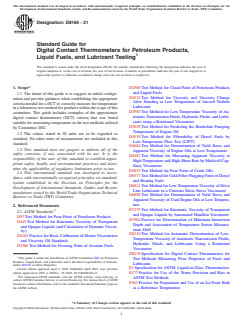
(Guide)Standard Guide for Digital Contact Thermometers for Petroleum Products, Liquid Fuels, and Lubricant Testing
General Information
- Abstract
SIGNIFICANCE AND USE
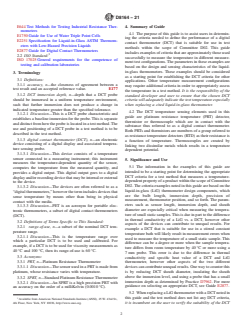
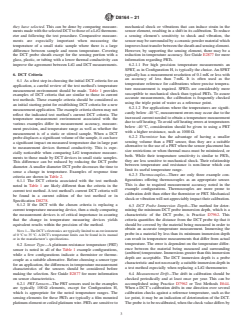
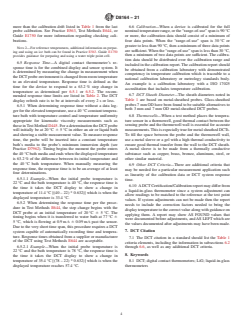
5.1 The information in the examples of this guide are intended to be a starting point for determining the appropriate DCT criteria for a test method that measures a temperature-dependent property of a product within the scope of Committee D02. The criteria examples noted in this guide are based on the liquid-in-glass (LiG) thermometer design components, which are the bulb length, immersion depth, precision of measurement, thermometer position, and so forth. The parameters such as sensor length, immersion depth, and sheath diameter are especially critical when measuring the temperature of small static samples. This is due in part to the difference in thermal conductivity of a LiG vs. a DCT, however other aspects of the devices can contribute to unequal results. For example a DCT that is suitable for use in a stirred constant temperature bath will likely result in measurement errors when used to measure the temperature of a small static sample. This difference can be a degree or more when the sample temperature differs from room temperature by 40 °C or more using a 7 mm probe. This error is due to the difference in thermal conductivity and specific heat value of a DCT and LiG thermometer, however other aspects of the two different devices can contribute unequal results. One way to counter this is by reducing DCT sheath diameter, insulating the sheath above the immersion level, and using a probe that has a small immersion depth as determined by Practice D7962. For more guidance on selecting an appropriate DCT, see Guide E2877.
5.2 When replacing a LiG thermometer with a DCT noted in this guide and the test method does not list any DCT criteria, it is incumbent on the user to verify the suitability of the DCT they have selected. This can be done by comparing measurements made with the selected DCT to those of a LiG thermometer and following the test procedure. Comparative measurements are especially important when measuring the temperature of a small static sample wh...
SCOPE
1.1 The intent of this guide is to suggest an initial configuration and provide guidance when establishing the appropriate criteria needed for a DCT to correctly measure the temperature in a laboratory test method for products within the scope of this committee. This guide includes examples of the approximate digital contact thermometer (DCT) criteria that was found suitable for measuring temperature in the test methods utilized by Committee D02.
1.2 The values stated in SI units are to be regarded as standard. No other units of measurement are included in this standard.
1.3 This standard does not purport to address all of the safety concerns, if any, associated with its use. It is the responsibility of the user of this standard to establish appropriate safety, health, and environmental practices and determine the applicability of regulatory limitations prior to use.
1.4 This international standard was developed in accordance with internationally recognized principles on standardization established in the Decision on Principles for the Development of International Standards, Guides and Recommendations issued by the World Trade Organization Technical Barriers to Trade (TBT) Committee.
- Status
- Published
- Publication Date
- 31-Mar-2021
- Technical Committee
- D02 - Petroleum Products, Liquid Fuels, and Lubricants
- Drafting Committee
- D02.07 - Flow Properties
Buy Documents
ASTM D8164-21 - Standard Guide for Digital Contact Thermometers for Petroleum Products, Liquid Fuels, and Lubricant Testing
REDLINE ASTM D8164-21 - Standard Guide for Digital Contact Thermometers for Petroleum Products, Liquid Fuels, and Lubricant Testing
Overview
The ASTM D8164-21, “Standard Guide for Digital Contact Thermometers for Petroleum Products, Liquid Fuels, and Lubricant Testing,” provides comprehensive guidance for specifying and using digital contact thermometers (DCTs) in laboratory test methods under the jurisdiction of ASTM Committee D02. This guide is particularly relevant for professionals conducting temperature-dependent testing of petroleum products, fuels, and lubricants.
The standard outlines important criteria for selecting, verifying, and applying DCTs, emphasizing factors like probe design, sensor type, immersion depth, precision, and calibration. It also addresses the critical differences between digital contact thermometers and traditional liquid-in-glass (LiG) thermometers, helping users ensure accurate and consistent temperature measurements across various laboratory situations.
Key Topics
- DCT Criteria for Laboratory Testing
- Guidance on initial configuration and selection of digital contact thermometers.
- Emphasis on matching DCT characteristics (sensor type, sheath diameter, probe length) to legacy LiG thermometer designs for seamless replacement.
- Importance of Probe Parameters
- Sensor type options (Platinum Resistance Thermometer, thermistor, thermocouple) and their implications for measurement accuracy.
- Key probe parameters, such as immersion depth and sheath diameter, especially vital for small static samples and temperature-controlled environments.
- Calibration and Measurement Practices
- Recommendations for annual calibration checks, ensuring drift is within acceptable limits.
- Guidance on calibration traceability to national or metrological standards, with appropriate data point requirements over the device’s range-of-use.
- Performance Verification and Comparative Measurements
- Stress on comparative testing between DCTs and LiG thermometers to verify suitability, especially when documentation is incomplete or criteria are absent.
- Methods to minimize measurement discrepancies, such as reduced sheath diameter and using insulating sleeves.
- Response Time and Accuracy
- Acceptable response time benchmarks for different probe diameters.
- Accuracy requirements tailored for specific test methods, ensuring precise measurement for critical analyses.
Applications
ASTM D8164-21 is essential for laboratories and quality assurance personnel who need to measure temperature accurately in test methods for petroleum products, liquid fuels, and lubricants. Key application areas include:
- Replacement of LiG Thermometers: The guide serves as a reference when substituting digital contact thermometers for legacy laboratory thermometers, ensuring that measurement accuracy and consistency are maintained.
- Quality Control in Petroleum Testing: DCTs specified in accordance with this guide can be used in methods like pour point, cloud point, and viscosity measurements (e.g., ASTM D97, D2500, D445).
- Validation and Calibration Support: The guide provides criteria for ongoing calibration and drift checks, helping laboratories stay compliant with ISO 17025 and maintain reliable instrumentation.
- Safety and Compliance: By following recommended DCT criteria, users can meet international and regulatory standards for temperature measurement during hazardous material testing.
Related Standards
- ASTM D8278: Specification for Digital Contact Thermometers for Test Methods Measuring Flow Properties of Fuels and Lubricants.
- ASTM D7962: Practice for Determination of Minimum Immersion Depth and Assessment of Temperature Sensor Measurement Drift.
- ASTM E2877: Guide for Digital Contact Thermometers.
- ASTM E644: Test Methods for Testing Industrial Resistance Thermometers.
- ASTM E1, E2251: Specifications for Liquid-in-Glass Thermometers.
- ISO 17025: General requirements for the competence of testing and calibration laboratories.
Practical Value
Using ASTM D8164-21 ensures that digital contact thermometers are selected and validated correctly, maintaining integrity in temperature-critical testing of petroleum products, fuels, and lubricants. Following this standard promotes reliable results, smoother instrument transitions, and compliance with industry best practices, minimizing errors in laboratory environments. By aligning DCT characteristics with recognized test methods and maintaining robust calibration protocols, laboratories can achieve both regulatory compliance and high analytical accuracy.
Keywords: ASTM D8164, digital contact thermometers, DCT criteria, liquid-in-glass thermometers, petroleum testing, laboratory calibration, ASTM Committee D02, thermometer calibration, accuracy, immersion depth, probe design, ISO 17025 compliance.
Relations
- Effective Date
- 01-Apr-2024
- Refers
ASTM D6371-24 - Standard Test Method for Cold Filter Plugging Point of Diesel and Heating Fuels - Effective Date
- 01-Mar-2024
- Effective Date
- 01-Nov-2023
- Effective Date
- 01-Nov-2023
- Effective Date
- 01-Nov-2023
- Effective Date
- 01-May-2020
- Effective Date
- 01-Nov-2019
- Effective Date
- 01-Jul-2019
- Effective Date
- 01-May-2019
- Effective Date
- 01-May-2019
- Effective Date
- 01-Jul-2018
- Refers
ASTM D3829-18 - Standard Test Method for Predicting the Borderline Pumping Temperature of Engine Oil - Effective Date
- 01-Jun-2018
- Effective Date
- 01-Jun-2018
- Refers
ASTM D3829-17 - Standard Test Method for Predicting the Borderline Pumping Temperature of Engine Oil - Effective Date
- 01-May-2017
- Effective Date
- 01-May-2017
Buy Documents
ASTM D8164-21 - Standard Guide for Digital Contact Thermometers for Petroleum Products, Liquid Fuels, and Lubricant Testing
REDLINE ASTM D8164-21 - Standard Guide for Digital Contact Thermometers for Petroleum Products, Liquid Fuels, and Lubricant Testing
Get Certified
Connect with accredited certification bodies for this standard

BSMI (Bureau of Standards, Metrology and Inspection)
Taiwan's standards and inspection authority.
Sponsored listings
Frequently Asked Questions
ASTM D8164-21 is a guide published by ASTM International. Its full title is "Standard Guide for Digital Contact Thermometers for Petroleum Products, Liquid Fuels, and Lubricant Testing". This standard covers: SIGNIFICANCE AND USE 5.1 The information in the examples of this guide are intended to be a starting point for determining the appropriate DCT criteria for a test method that measures a temperature-dependent property of a product within the scope of Committee D02. The criteria examples noted in this guide are based on the liquid-in-glass (LiG) thermometer design components, which are the bulb length, immersion depth, precision of measurement, thermometer position, and so forth. The parameters such as sensor length, immersion depth, and sheath diameter are especially critical when measuring the temperature of small static samples. This is due in part to the difference in thermal conductivity of a LiG vs. a DCT, however other aspects of the devices can contribute to unequal results. For example a DCT that is suitable for use in a stirred constant temperature bath will likely result in measurement errors when used to measure the temperature of a small static sample. This difference can be a degree or more when the sample temperature differs from room temperature by 40 °C or more using a 7 mm probe. This error is due to the difference in thermal conductivity and specific heat value of a DCT and LiG thermometer, however other aspects of the two different devices can contribute unequal results. One way to counter this is by reducing DCT sheath diameter, insulating the sheath above the immersion level, and using a probe that has a small immersion depth as determined by Practice D7962. For more guidance on selecting an appropriate DCT, see Guide E2877. 5.2 When replacing a LiG thermometer with a DCT noted in this guide and the test method does not list any DCT criteria, it is incumbent on the user to verify the suitability of the DCT they have selected. This can be done by comparing measurements made with the selected DCT to those of a LiG thermometer and following the test procedure. Comparative measurements are especially important when measuring the temperature of a small static sample wh... SCOPE 1.1 The intent of this guide is to suggest an initial configuration and provide guidance when establishing the appropriate criteria needed for a DCT to correctly measure the temperature in a laboratory test method for products within the scope of this committee. This guide includes examples of the approximate digital contact thermometer (DCT) criteria that was found suitable for measuring temperature in the test methods utilized by Committee D02. 1.2 The values stated in SI units are to be regarded as standard. No other units of measurement are included in this standard. 1.3 This standard does not purport to address all of the safety concerns, if any, associated with its use. It is the responsibility of the user of this standard to establish appropriate safety, health, and environmental practices and determine the applicability of regulatory limitations prior to use. 1.4 This international standard was developed in accordance with internationally recognized principles on standardization established in the Decision on Principles for the Development of International Standards, Guides and Recommendations issued by the World Trade Organization Technical Barriers to Trade (TBT) Committee.
SIGNIFICANCE AND USE 5.1 The information in the examples of this guide are intended to be a starting point for determining the appropriate DCT criteria for a test method that measures a temperature-dependent property of a product within the scope of Committee D02. The criteria examples noted in this guide are based on the liquid-in-glass (LiG) thermometer design components, which are the bulb length, immersion depth, precision of measurement, thermometer position, and so forth. The parameters such as sensor length, immersion depth, and sheath diameter are especially critical when measuring the temperature of small static samples. This is due in part to the difference in thermal conductivity of a LiG vs. a DCT, however other aspects of the devices can contribute to unequal results. For example a DCT that is suitable for use in a stirred constant temperature bath will likely result in measurement errors when used to measure the temperature of a small static sample. This difference can be a degree or more when the sample temperature differs from room temperature by 40 °C or more using a 7 mm probe. This error is due to the difference in thermal conductivity and specific heat value of a DCT and LiG thermometer, however other aspects of the two different devices can contribute unequal results. One way to counter this is by reducing DCT sheath diameter, insulating the sheath above the immersion level, and using a probe that has a small immersion depth as determined by Practice D7962. For more guidance on selecting an appropriate DCT, see Guide E2877. 5.2 When replacing a LiG thermometer with a DCT noted in this guide and the test method does not list any DCT criteria, it is incumbent on the user to verify the suitability of the DCT they have selected. This can be done by comparing measurements made with the selected DCT to those of a LiG thermometer and following the test procedure. Comparative measurements are especially important when measuring the temperature of a small static sample wh... SCOPE 1.1 The intent of this guide is to suggest an initial configuration and provide guidance when establishing the appropriate criteria needed for a DCT to correctly measure the temperature in a laboratory test method for products within the scope of this committee. This guide includes examples of the approximate digital contact thermometer (DCT) criteria that was found suitable for measuring temperature in the test methods utilized by Committee D02. 1.2 The values stated in SI units are to be regarded as standard. No other units of measurement are included in this standard. 1.3 This standard does not purport to address all of the safety concerns, if any, associated with its use. It is the responsibility of the user of this standard to establish appropriate safety, health, and environmental practices and determine the applicability of regulatory limitations prior to use. 1.4 This international standard was developed in accordance with internationally recognized principles on standardization established in the Decision on Principles for the Development of International Standards, Guides and Recommendations issued by the World Trade Organization Technical Barriers to Trade (TBT) Committee.
ASTM D8164-21 is classified under the following ICS (International Classification for Standards) categories: 17.200.20 - Temperature-measuring instruments. The ICS classification helps identify the subject area and facilitates finding related standards.
ASTM D8164-21 has the following relationships with other standards: It is inter standard links to ASTM D445-24, ASTM D6371-24, ASTM E1750-23, ASTM D445-23, ASTM D2983-23, ASTM D5481-13(2020), ASTM E644-11(2019), ASTM D8210-19a, ASTM E2877-12(2019), ASTM D8210-19, ASTM D8210-18, ASTM D3829-18, ASTM D6896-18, ASTM D3829-17, ASTM D6896-17. Understanding these relationships helps ensure you are using the most current and applicable version of the standard.
ASTM D8164-21 is available in PDF format for immediate download after purchase. The document can be added to your cart and obtained through the secure checkout process. Digital delivery ensures instant access to the complete standard document.
Standards Content (Sample)
This international standard was developed in accordance with internationally recognized principles on standardization established in the Decision on Principles for the
Development of International Standards, Guides and Recommendations issued by the World Trade Organization Technical Barriers to Trade (TBT) Committee.
Designation: D8164 − 21
Standard Guide for
Digital Contact Thermometers for Petroleum Products,
Liquid Fuels, and Lubricant Testing
This standard is issued under the fixed designation D8164; the number immediately following the designation indicates the year of
original adoption or, in the case of revision, the year of last revision. A number in parentheses indicates the year of last reapproval. A
superscript epsilon (´) indicates an editorial change since the last revision or reapproval.
1. Scope* D2500 Test Method for Cloud Point of Petroleum Products
and Liquid Fuels
1.1 The intent of this guide is to suggest an initial configu-
D2532 Test Method for Viscosity and Viscosity Change
ration and provide guidance when establishing the appropriate
After Standing at Low Temperature of Aircraft Turbine
criteria needed for a DCTto correctly measure the temperature
Lubricants
inalaboratorytestmethodforproductswithinthescopeofthis
D2983 Test Method for Low-Temperature Viscosity of Au-
committee. This guide includes examples of the approximate
tomaticTransmission Fluids, Hydraulic Fluids, and Lubri-
digital contact thermometer (DCT) criteria that was found
cants using a Rotational Viscometer
suitable for measuring temperature in the test methods utilized
D3829 Test Method for Predicting the Borderline Pumping
by Committee D02.
Temperature of Engine Oil
1.2 The values stated in SI units are to be regarded as
D4539 Test Method for Filterability of Diesel Fuels by
standard. No other units of measurement are included in this
Low-Temperature Flow Test (LTFT)
standard.
D4684 Test Method for Determination of Yield Stress and
1.3 This standard does not purport to address all of the
Apparent Viscosity of Engine Oils at Low Temperature
safety concerns, if any, associated with its use. It is the
D5481 Test Method for Measuring Apparent Viscosity at
responsibility of the user of this standard to establish appro-
High-Temperature and High-Shear Rate by Multicell Cap-
priate safety, health, and environmental practices and deter-
illary Viscometer
mine the applicability of regulatory limitations prior to use.
D5853 Test Method for Pour Point of Crude Oils
1.4 This international standard was developed in accor-
D6371 Test Method for Cold Filter Plugging Point of Diesel
dance with internationally recognized principles on standard-
and Heating Fuels
ization established in the Decision on Principles for the
D6821 Test Method for LowTemperatureViscosity of Drive
Development of International Standards, Guides and Recom-
Line Lubricants in a Constant Shear Stress Viscometer
mendations issued by the World Trade Organization Technical
D6896 Test Method for Determination of Yield Stress and
Barriers to Trade (TBT) Committee.
Apparent Viscosity of Used Engine Oils at Low Tempera-
ture
2. Referenced Documents
D7279 Test Method for Kinematic Viscosity of Transparent
2.1 ASTM Standards:
and Opaque Liquids by Automated Houillon Viscometer
D97 Test Method for Pour Point of Petroleum Products
D7962 Practice for Determination of Minimum Immersion
D445 Test Method for Kinematic Viscosity of Transparent
Depth and Assessment of Temperature Sensor Measure-
and Opaque Liquids (and Calculation of Dynamic Viscos-
ment Drift
ity)
D8210 Test Method for Automatic Determination of Low-
D2162 Practice for Basic Calibration of Master Viscometers
Temperature Viscosity of Automatic Transmission Fluids,
and Viscosity Oil Standards
Hydraulic Fluids, and Lubricants Using a Rotational
D2386 Test Method for Freezing Point of Aviation Fuels
Viscometer
D8278 Specification for Digital Contact Thermometers for
This guide is under the jurisdiction of ASTM Committee D02 on Petroleum
Test Methods Measuring Flow Properties of Fuels and
Products, Liquid Fuels, and Lubricants and is the direct responsibility of Subcom-
Lubricants
mittee D02.07 on Flow Properties.
E1 Specification for ASTM Liquid-in-Glass Thermometers
Current edition approved April 1, 2021. Published April 2021. Last previous
edition approved in 2019 as D8164 – 19. DOI: 10.1520/D8164-21.
E177 Practice for Use of the Terms Precision and Bias in
For referenced ASTM standards, visit the ASTM website, www.astm.org, or
ASTM Test Methods
contact ASTM Customer Service at service@astm.org. For Annual Book of ASTM
E563 Practice for Preparation and Use of an Ice-Point Bath
Standards volume information, refer to the standard’s Document Summary page on
the ASTM website. as a Reference Temperature
*A Summary of Changes section appears at the end of this standard
Copyright © ASTM International, 100 Barr Harbor Drive, PO Box C700, West Conshohocken, PA 19428-2959. United States
D8164 − 21
E644 Test Methods for Testing Industrial Resistance Ther- 4. Summary of Guide
mometers
4.1 The purpose of this guide is to assist users in determin-
E1750 Guide for Use of Water Triple Point Cells
ing the criteria needed to define the performance of a digital
E2251 Specification for Liquid-in-Glass ASTM Thermom-
contact thermometer (DCT) that is suitable for use in test
eters with Low-Hazard Precision Liquids
methods within the scope of Committee D02. This guide
E2877 Guide for Digital Contact Thermometers
includes examples of criteria that are approximately those used
2.2 ISO Standard:
successfully to measure the temperature in different measure-
ISO 17025 General requirements for the competence of
ment test configurations. The parameters in these examples are
testing and calibration laboratories
based on the design and sensing characteristics of the liquid-
in-glass thermometers. These examples should be considered
3. Terminology
as a starting point for establishing the DCT criteria for other
3.1 Definitions:
applications. Other temperature measurement configurations
3.1.1 accuracy, n—the closeness of agreement between a
may require additional criteria in order to appropriately assess
test result and an accepted reference value. E177
the temperature in a test method. It is the responsibility of the
3.1.2 DCT immersion depth, n—depth that a DCT probe
standard developer and user to ensure that the chosen DCT
should be immersed in a uniform temperature environment,
criteria will adequately indicate the test temperature especially
such that further immersion does not produce a change in
when replacing a cited liquid-in-glass thermometer.
indicated temperature greater than the specified tolerance.
4.2 The DCT temperature sensing elements used in this
3.1.2.1 Discussion—This is a DCT probe characteristic and
guide are platinum resistance temperature (PRT) detector,
establishes a baseline immersion for the probe.This is separate
thermistor or thermocouple which are in contact with the
anddistinctfromhowtheprobeislocatedinatestmethod.The
substance thus referred to as a digital contact thermometer.
use and positioning of a DCT probe in a test method is to be
Both PRTs and thermistors are members of a group referred to
described in the test method.
as resistance temperature detectors (RTD) as their resistance is
3.1.3 digital contact thermometer (DCT), n—an electronic
a function of temperature. Thermocouples are created by
device consisting of a digital display and associated tempera-
linking two dissimilar metals which results in a temperature
ture sensing probe.
dependent potential.
3.1.3.1 Discussion—This device consists of a temperature
sensor connected to a measuring instrument; this instrument
5. Significance and Use
measures the temperature-dependent quantity of the sensor,
5.1 The information in the examples of this guide are
computes the temperature from the measured quantity, and
intended to be a starting point for determining the appropriate
provides a digital output. This digital output goes to a digital
DCT criteria for a test method that measures a temperature-
displayand/orrecordingdevicethatmaybeinternalorexternal
dependentpropertyofaproductwithinthescopeofCommittee
to the device.
D02.The criteria examples noted in this guide are based on the
3.1.3.2 Discussion—The devices are often referred to as a
liquid-in-glass (LiG) thermometer design components, which
“digital thermometers,” however the term includes devices that
are the bulb length, immersion depth, precision of
sense temperature by means other than being in physical
measurement, thermometer position, and so forth. The param-
contact with the media.
eters such as sensor length, immersion depth, and sheath
3.1.3.3 Discussion—PET is an acronym for portable elec-
diameter are especially critical when measuring the tempera-
tronic thermometers, a subset of digital contact thermometers
ture of small static samples.This is due in part to the difference
(DCT).
in thermal conductivity of a LiG vs. a DCT, however other
3.2 Definitions of Terms Specific to This Standard:
aspects of the devices can contribute to unequal results. For
3.2.1 range-of-use, n—a subset of the nominal DCT tem-
example a DCT that is suitable for use in a stirred constant
perature range.
temperature bath will likely result in measurement errors when
3.2.1.1 Discussion—This is the temperature range over
used to measure the temperature of a small static sample. This
which a particular DCT is to be used and calibrated. For
difference can be a degree or more when the sample tempera-
example, if a DCT is to be used for viscosity measurements as
ture differs from room temperature by 40 °C or more using a
40 °C and 100 °C, then its range-of-use is 60 °C.
7 mm probe. This error is due to the difference in thermal
3.3 Acronyms:
conductivity and specific heat value of a DCT and LiG
3.3.1 PRT, n—Platinum Resistance Thermometer
thermometer, however other aspects of the two different
3.3.1.1 Discussion—The sensor used in a PRTis made from
devices can contribute unequal results. One way to counter this
platinum, whose resistance varies with temperature.
is by reducing DCT sheath diameter, insulating the sheath
above the immersion level, and using a probe that has a small
3.3.2 SPRT, n—Standard Platinum Resistance Thermometer
immersion depth as determined by Practice D7962. For more
3.3.2.1 Discussion—An SPRT is a high precision PRT with
guidance on selecting an appropriate DCT, see Guide E2877.
an accuracy on the order of a milliKelvin (0.0010 °C).
5.2 WhenreplacingaLiGthermometerwithaDCTnotedin
this guide and the test method does not list any DCT criteria,
Available from American National Standards Institute (ANSI), 25 W. 43rd St.,
4th Floor, New York, NY 10036, http://www.ansi.org. it is incumbent on the user to verify the suitability of the DCT
D8164 − 21
they have selected. This can be done by comparing measure- mechanical shock or vibrations that can induce strain in the
ments made with the selected DCTto those of a LiG thermom- sensor element, resulting in a shift in its calibration. To reduce
eter and following the test procedure. Comparative measure- a sensing element’s sensitivity to shock and vibration, the
ments are especially important when measuring the sensor may be surrounded by a ceramic powder material which
temperature of a small static sample where there is a large improvesheattransferbetweenthesheathandsensingelement.
difference between sample and room temperature. Covering However, by supporting the sensing element, there may be a
the DCT probe sheath except for the sensing portion with a reduction in temperature accuracy. See Guide E2877 for more
glass, plastic, or tubing with a lower thermal conductivity can information regarding PRTs.
improve the agreement between LiG and DCT measurements. 6.2.1.1 For high precision temperature measurements an
SPRT, as in Configuration H, is typically the choice.An SPRT
typically has a measurement resolution of 0.1 mK or less with
6. DCT Criteria
an accuracy of less than 7 mK. It is often used as the
6.1 As a first step in choosing the initial DCT criteria for an
temperature reference for calibrations where precise tempera-
application, a careful review of the test method’s temperature
ture measurement is required. SPRTs are considerably more
measurement environment should be made. Table 1 provides
susceptible to mechanical shock than typical PRTs. To assure
examples of DCT criteria that are similar to those in current
accurate measurements, the calibration is frequently checked
test methods. These example criteria should be considered as
using the triple point of water as a reference point.
an initial starting point for establishing DCT criteria for a new
6.2.1.2 For applications where the temperatures are signifi-
measurement application. The example criteria shown may not
cantly below -40 °C, measurement errors may occur due to the
reflect the indicated test method’s current DCT criteria. The
increased current needed to obtain a temperature measurement
temperature measurement environment associated with the
due to self heating.To avoid self heating errors at temperatures
various examples differ in measurement accuracy, measure-
below -40 °C, consideration should be given to using a PRT
ment precision, and temperature range as well as whether the
with a higher resistance, such as 1000Ω.
measurement is of a static or stirred sample. When a DCT
6.2.2 Thermistor has the advantage of having a smaller
probe displaces a significant volume of the sample, it can have
sensing volume than a PRT sensor, thus they are a suitable
a significant impact on measured temperature due in large part
alternative to the use of a PRT when the sensor placement has
to measurement devices thermal conductivity. This is espe-
size restrictions or when thermal mass must be minimized, or
cially noticeable when comparing LiG temperature measure-
both. While their temperature sensitivity is similar to PRTs,
ments to those made by DCT devices in small static samples.
they are less sensitive to mechanical shock. Their relationship
This difference can be reduced by reducing the DCT probe
between temperature and resistance is non-linear which can
diameter.Asmaller diameter DCT probe decreases the time to
limit its useful temperature range.
sense a change in temperature. Examples of response time
6.2.3 Thermocouples—There are only three example con-
criteria are shown in Table 2.
figurations offering thermocouples as an appropriate sensor.
6.1.1 The DCT criteria associated with the test methods
This is due to required measurement accuracy noted in the
noted in Table 1 are likely different than the criteria in the
example configurations. Thermocouples are more prone to
current test method. A test method’s current DCT criteria will
calibration drift than either the thermistor or PRT. Mechanical
be found in a current edition of the test method or in
shockorvibrationwillnotapprec
...
This document is not an ASTM standard and is intended only to provide the user of an ASTM standard an indication of what changes have been made to the previous version. Because
it may not be technically possible to adequately depict all changes accurately, ASTM recommends that users consult prior editions as appropriate. In all cases only the current version
of the standard as published by ASTM is to be considered the official document.
Designation: D8164 − 19 D8164 − 21
Standard Guide for
Digital Contact Thermometers for Petroleum Products,
Liquid Fuels, and Lubricant Testing
This standard is issued under the fixed designation D8164; the number immediately following the designation indicates the year of
original adoption or, in the case of revision, the year of last revision. A number in parentheses indicates the year of last reapproval. A
superscript epsilon (´) indicates an editorial change since the last revision or reapproval.
1. Scope*
1.1 This guide provides examples of criteria needed to define a digital contact thermometer (DCT) suitable for measuring
temperature in the test methods utilized by Committee D02. The DCT criteria are based on the design and sensing characteristics
of the liquid-in-glass thermometers that have been used successfully in Committee D02 test methods. The DCT criteria listed in
a test method take precedence over those listed in this guide.The intent of this guide is to suggest an initial configuration and
provide guidance when establishing the appropriate criteria needed for a DCT to correctly measure the temperature in a laboratory
test method for products within the scope of this committee. This guide includes examples of the approximate digital contact
thermometer (DCT) criteria that was found suitable for measuring temperature in the test methods utilized by Committee D02.
1.2 The values stated in SI units are to be regarded as standard. No other units of measurement are included in this standard.
1.3 This standard does not purport to address all of the safety concerns, if any, associated with its use. It is the responsibility
of the user of this standard to establish appropriate safety, health, and environmental practices and determine the applicability of
regulatory limitations prior to use.
1.4 This international standard was developed in accordance with internationally recognized principles on standardization
established in the Decision on Principles for the Development of International Standards, Guides and Recommendations issued
by the World Trade Organization Technical Barriers to Trade (TBT) Committee.
2. Referenced Documents
2.1 ASTM Standards:
D97 Test Method for Pour Point of Petroleum Products
D445 Test Method for Kinematic Viscosity of Transparent and Opaque Liquids (and Calculation of Dynamic Viscosity)
D2162 Practice for Basic Calibration of Master Viscometers and Viscosity Oil Standards
D2386 Test Method for Freezing Point of Aviation Fuels
D2500 Test Method for Cloud Point of Petroleum Products and Liquid Fuels
D2532 Test Method for Viscosity and Viscosity Change After Standing at Low Temperature of Aircraft Turbine Lubricants
D2983 Test Method for Low-Temperature Viscosity of Automatic Transmission Fluids, Hydraulic Fluids, and Lubricants using
a Rotational Viscometer
D3829 Test Method for Predicting the Borderline Pumping Temperature of Engine Oil
D4539 Test Method for Filterability of Diesel Fuels by Low-Temperature Flow Test (LTFT)
D4684 Test Method for Determination of Yield Stress and Apparent Viscosity of Engine Oils at Low Temperature
This guide is under the jurisdiction of ASTM Committee D02 on Petroleum Products, Liquid Fuels, and Lubricants and is the direct responsibility of Subcommittee
D02.91 on Coordinating Subcommittee on Thermometry.
Current edition approved July 1, 2019April 1, 2021. Published August 2019April 2021. Last previous edition approved in 20182019 as D8164 – 18a.D8164 – 19. DOI:
10.1520/D8164-19.10.1520/D8164-21.
For referenced ASTM standards, visit the ASTM website, www.astm.org, or contact ASTM Customer Service at service@astm.org. For Annual Book of ASTM Standards
volume information, refer to the standard’s Document Summary page on the ASTM website.
*A Summary of Changes section appears at the end of this standard
Copyright © ASTM International, 100 Barr Harbor Drive, PO Box C700, West Conshohocken, PA 19428-2959. United States
D8164 − 21
D5481 Test Method for Measuring Apparent Viscosity at High-Temperature and High-Shear Rate by Multicell Capillary
Viscometer
D5853 Test Method for Pour Point of Crude Oils
D6371 Test Method for Cold Filter Plugging Point of Diesel and Heating Fuels
D6821 Test Method for Low Temperature Viscosity of Drive Line Lubricants in a Constant Shear Stress Viscometer
D6896 Test Method for Determination of Yield Stress and Apparent Viscosity of Used Engine Oils at Low Temperature
D7279 Test Method for Kinematic Viscosity of Transparent and Opaque Liquids by Automated Houillon Viscometer
D7962 Practice for Determination of Minimum Immersion Depth and Assessment of Temperature Sensor Measurement Drift
D8210 Test Method for Automatic Determination of Low-Temperature Viscosity of Automatic Transmission Fluids, Hydraulic
Fluids, and Lubricants Using a Rotational Viscometer
D8278 Specification for Digital Contact Thermometers for Test Methods Measuring Flow Properties of Fuels and Lubricants
E1 Specification for ASTM Liquid-in-Glass Thermometers
E177 Practice for Use of the Terms Precision and Bias in ASTM Test Methods
E563 Practice for Preparation and Use of an Ice-Point Bath as a Reference Temperature
E644 Test Methods for Testing Industrial Resistance Thermometers
E1750 Guide for Use of Water Triple Point Cells
E2251 Specification for Liquid-in-Glass ASTM Thermometers with Low-Hazard Precision Liquids
E2877 Guide for Digital Contact Thermometers
2.2 ISO Standard:
ISO 17025 General requirements for the competence of testing and calibration laboratories
3. Terminology
3.1 Definitions:
3.1.1 accuracy, n—the closeness of agreement between a test result and an accepted reference value. E177
3.1.2 DCT immersion depth, n—depth that a DCT probe should be immersed in a uniform temperature environment, such that
further immersion does not produce a change in indicated temperature greater than the specified tolerance.
3.1.2.1 Discussion—
This is a DCT probe characteristic and establishes a baseline immersion for the probe. This is separate and distinct from how the
probe is located in a test method. The use and positioning of a DCT probe in a test method is to be described in the test method.
3.1.3 digital contact thermometer (DCT), n—an electronic device consisting of a digital display and associated temperature
sensing probe.
3.1.3.1 Discussion—
This device consists of a temperature sensor connected to a measuring instrument; this instrument measures the temperature-
dependent quantity of the sensor, computes the temperature from the measured quantity, and provides a digital output. This digital
output goes to a digital display and/or recording device that may be internal or external to the device.
3.1.3.2 Discussion—
The devices are often referred to as a “digital thermometers,” however the term includes devices that sense temperature by means
other than being in physical contact with the media.
3.1.3.3 Discussion—
PET is an acronym for portable electronic thermometers, a subset of digital contact thermometers (DCT).
3.2 Definitions of Terms Specific to This Standard:
3.2.1 range-of-use, n—a subset of the nominal DCT temperature range.
3.2.1.1 Discussion—
This is the temperature range over which a particular DCT is to be used and calibrated. For example, if a DCT is to be used for
viscosity measurements as 40 °C and 100 °C, then its range-of-use is 60 °C.
3.3 Acronyms:
3.3.1 PRT, n—Platinum Resistance Thermometer
3.3.1.1 Discussion—
The sensor used in a PRT is made from platinum, whose resistance varies with temperature.
Available from American National Standards Institute (ANSI), 25 W. 43rd St., 4th Floor, New York, NY 10036, http://www.ansi.org.
D8164 − 21
3.3.2 SPRT, n—Standard Platinum Resistance Thermometer
3.3.2.1 Discussion—
An SPRT is a high precision PRT with an accuracy on the order of a milliKelvin (0.0010 °C).
4. Summary of Guide
4.1 This guide provides the criteria for several digital contact thermometers (DCT). The DCT criteria were selected so that the
temperature measured by a DCT would be expected to be essentially the same as that measured by a LiG thermometer. These
criteria focus on temperature measurement in Committee D02 test methods or similar measurement situations. In many D02 test
methods, the temperature of a small static sample volume is being made thus the difference between device thermal conductivity
will have a large impact on equivalent measurements.The purpose of this guide is to assist users in determining the criteria needed
to define the performance of a digital contact thermometer (DCT) that is suitable for use in test methods within the scope of
Committee D02. This guide includes examples of criteria that are approximately those used successfully to measure the
temperature in different measurement test configurations. The parameters in these examples are based on the design and sensing
characteristics of the liquid-in-glass thermometers. These examples should be considered as a starting point for establishing the
DCT criteria for other applications. Other temperature measurement configurations may require additional criteria in order to
appropriately assess the temperature in a test method. It is the responsibility of the standard developer and user to ensure that a
specificthe chosen DCT criteria will adequately replace indicate the test temperature especially when replacing a cited
liquid-in-glass thermometer.
4.2 The DCT temperature sensing elements used in this guide are platinum resistance temperature (PRT) detector, thermistor or
thermocouple which are in contact with the substance thus referred to as a digital contact thermometer. Both PRTs and thermistors
are members of a group referred to as resistance temperature detectors (RTD) as their resistance is a function of temperature.
Thermocouples are created by linking two dissimilar metals which results in a temperature dependent potential.
5. Significance and Use
5.1 The examples of DCT criteria noted in information in the examples of this guide are approximately those found intended to
be suitable for replacing some of the noted liquid-in-glass thermometers with a DCT. The criteria a starting point for determining
the appropriate DCT criteria for a test method that measures a temperature-dependent property of a product within the scope of
Committee D02. The criteria examples noted in this guide are based on the liquid-in-glass (LiG) thermometer design components,
which are the bulb length, immersion depth, precision of measurement, thermometer position, and so forth. The parameters for
such as sensor length, immersion depth, and sheath diameter are especially critical when measuring the temperature of small static
samples due to temperature probe thermal conductivity. A samples. This is due in part to the difference in thermal conductivity of
a LiG vs. a DCT, however other aspects of the devices can contribute to unequal results. For example a DCT that is suitable for
use in a stirred constant temperature bath will likely result in measurement errors when used to measure small sample temperature.
These the temperature of a small static sample. This difference can be a degree or more when the sample temperature differs from
room temperature by 40 °C or more using a 7 mm 7 mm probe. This error is due to the difference in thermal conductivity and
specific heat value of a DCT and LiG thermometer. The most effective thermometer, however other aspects of the two different
devices can contribute unequal results. One way to counter this is by reducing DCT sheath diameter, insulating the sheath above
the immersion level, and using a probe that has a small immersion depth as determined by Practice D7962. For more guidance
on selecting an appropriate DCT, see Guide E2877.
5.2 When replacing a LiG thermometer with a DCT noted in this guide and the test method does not list any DCT criteria, it is
incumbent on the user to verify the suitability of the DCT they have selected. This can be done by comparing measurements made
with the selected DCT to those of a LiG thermometer and following the test procedure. Comparative measurements are especially
important when measuring the temperature of a small static sample where there is a large difference between sample and room
temperature. Covering the DCT probe sheath except for the sensing portion with a glass, plastic, or tubing with a lower
thermoconductivity thermal conductivity can improve the agreement between LiG and DCT measurements.
6. DCT Criteria
6.1 The DCT criteria examples shown in As a first step in choosing the initial DCT criteria for an application, a careful review
of the test method’s temperature measurement environment should be made. Table 1 are approximately those cited in the indicated
test methods and provides examples of DCT criteria that are similar to those in current test methods. These example criteria should
be considered as preliminary an initial starting point for establishing DCT criteria for a particular temperature new measurement
D8164 − 21
application. The DCT criteria listed in a test method take precedence over those shown in example criteria shown may not reflect
the indicated test method’s current DCT criteria. The temperature measurement environment associated with the various examples
differ in measurement accuracy, measurement precision, and temperature range as well as whether the measurement is of a static
or stirred sample. Table 1. When replacing a LiG thermometer with a DCT, it is imperative that a study is conducted that compares
the specified LiG thermometer to a DCT. Note that a DCT with a steel sheath has at least 7 times the thermal conductivity of glass,
thus the heat conducted by a DCT probe displaces a significant volume of the sample, it can have a significant impact on measured
temperature due in large part to measurement devices thermal conductivity. This is especially noticeable when comparing LiG
temperature measurements to those made by DCT devices in small static samples. This difference can be reduced by reducing the
DCT probe can cause a significant deviation from the temperature measured by a LiG thermometer. The size of the deviation is
dependent on samplediameter. A smaller diameter DCT probe decreases the time to sense a change in temperature. Examples of
response time criteria are shown in Table 2environment and test conditions.
NOTE 1—The DCT’s electronics are typically limited to an environment of 0 °C to 35 °C. A DCT’s temperature limits can be found in its manual or in
the manufacturer’s specifications.
6.1.1 The DCT criteria associated with the test methods noted in Table 1 are likely different than the criteria in the current test
method. A test method’s current DCT criteria will be found in a current edition of the test method or in Specification D8278.
6.1.2 If the DCT with the chosen criteria is replacing a current temperature measuring device, then a study comparing the
measurement devices is of critical importance in assuring that the change in temperature measuring devices yields equivalent
results within the precision of the method.
NOTE 1—The DCT’s electronics are typically limited to an environment of 0 °C to 35 °C. A DCT’s temperature limits can be found in its manual or in
the manufacturer’s specifications.
6.2 Sensor Type—A platinum resistance temperature (PRT) sensor is noted in all of the Table 1 example configurations, while a
few configurations indicate a thermistor or thermocouple as a suitable alternative. Before choosing a sensor type for an application,
the differences in temperature measurement characteristics of the sensors should be considered before making the selection. See
Guide E2877 for more information on sensor characteristics.
6.2.1 PRT Sensors—The PRT sensors used in the examples are typically 100 Ω elements, except for Configuration H, which is
appropriate for the noted temperature ranges. The sensing elements for these PRTs are typically a film mounted platinum element
or coiled platinum wire. PRTs are sensitive to mechanical shock or vibrations that can induce strain in the sensor element, resulting
in a shift in its calibration. To reduce a sensing element’s sensitivity to shock and vibration, the sensor may be surrounded by a
ceramic powder material which improves heat transfer between the sheath and sensing element. However, by supporting the
sensing element, there may be a reduction in temperature accuracy. See Guide E2877 for more information regarding PRTs.
6.2.1.1 For high precision temperature measurements an SPRT, as in Configuration H, is typically the choice. An SPRT typically
has a measurement resolution of 0.1 mK or less with an accuracy of less than 7 mK. It is often used as the temperature reference
for calibrations where precise temperature measurement is required. SPRTs are considerably more susceptible to mechanical shock
than typical PRTs. To assure accurate measurements, the calibration is frequently checked using the triple point of water as a
reference point.
6.2.1.2 For applications where the temperatures are significantly below -40 °C, measurement errors may occur due to the increased
current needed
...