

ASTM D2983-23
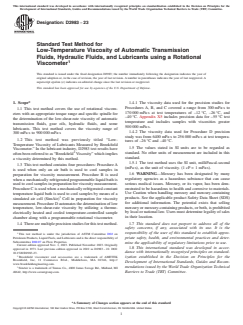
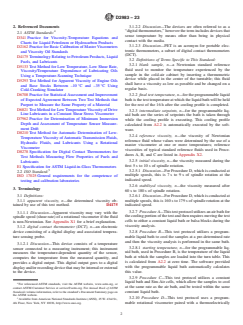
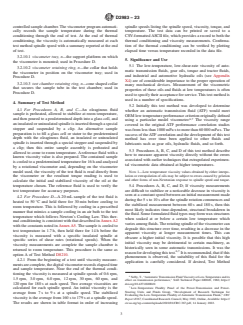
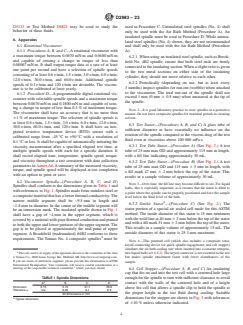
(Test Method)Standard Test Method for Low-Temperature Viscosity of Automatic Transmission Fluids, Hydraulic Fluids, and Lubricants using a Rotational Viscometer
General Information
- Abstract
SIGNIFICANCE AND USE
5.1 The low-temperature, low-shear-rate viscosity of automatic transmission fluids, gear oils, torque and tractor fluids, and industrial and automotive hydraulic oils (see Appendix X4) are of considerable importance to the proper operation of many mechanical devices. Measurement of the viscometric properties of these oils and fluids at low temperatures is often used to specify their acceptance for service. This test method is used in a number of specifications.
5.2 Initially this test method was developed to determine whether an automatic transmission fluid (ATF) would meet OEM low temperature performance criterion originally defined using a particular model viscometer.6, 7 The viscosity range covered in the original ATF performance correlation studies was from less than 1000 mPa·s to more than 60 000 mPa·s. The success of the ATF correlation and the development of this test method has over time been applied to other fluids and lubricants such as gear oils, hydraulic fluids, and so forth.
5.3 Procedures A, B, C, and D of this test method describe how to measure apparent viscosity directly without the errors associated with earlier techniques that extrapolated experimental viscometric data obtained at higher temperatures.
Note 1: Low temperature viscosity values obtained by either interpolation or extrapolation of oils may be subject to errors caused by gelation and other forms of non-Newtonian response to spindle speed and torque.
5.4 Procedures A, B, C, and D; If viscosity measurements are difficult to stabilize or a noticeable decrease in viscosity is seen at a constant speed between an initial measurement made during the 5 s to 10 s after the spindle rotation commences and the stabilized measurement between 60 s and 180 s, then this most likely indicates time-dependent, structural breakdown in the fluid. Some formulated fluid types may form wax structures when soaked at or below a certain low temperature which varies among fluids. The rotating spindle ...
SCOPE
1.1 This test method covers the use of rotational viscometers with an appropriate torque range and specific spindle for the determination of the low-shear-rate viscosity of automatic transmission fluids, gear oils, hydraulic fluids, and some lubricants. This test method covers the viscosity range of 300 mPa·s to 900 000 mPa·s
1.2 This test method was previously titled “Low-Temperature Viscosity of Lubricants Measured by Brookfield Viscometer.” In the lubricant industry, D2983 test results have often been referred to as “Brookfield2 Viscosity” which implies a viscosity determined by this method.
1.3 This test method contains four procedures: Procedure A is used when only an air bath is used to cool samples in preparation for viscosity measurement. Procedure B is used when a mechanically refrigerated programmable liquid bath is used to cool samples in preparation for viscosity measurement. Procedure C is used when a mechanically refrigerated constant temperature liquid bath is used to cool samples by means of a simulated air cell (SimAir)3 Cell in preparation for viscosity measurement. Procedure D automates the determination of low temperature, low-shear-rate viscosity by utilizing a thermoelectrically heated and cooled temperature-controlled sample chamber along with a programmable rotational viscometer.
1.4 There are multiple precision studies for this test method.
1.4.1 The viscosity data used for the precision studies for Procedures A, B, and C covered a range from 300 mPa·s to 170 000 mPa·s at test temperatures of –12 °C, –26 °C, and –40 °C. Appendix X5 includes precision data for –55 °C test temperature and includes samples with viscosities greater 500 000 mPa·s.
1.4.2 The viscosity data used for Procedure D precision study was from 6400 mPa·s to 256 000 mPa·s at test temperatures of –26 °C and –40 °C.
1.5 The values stated in SI units are to be regarded as standard. No other units of measurement ar...
- Status
- Published
- Publication Date
- 31-Oct-2023
- Technical Committee
- D02 - Petroleum Products, Liquid Fuels, and Lubricants
- Drafting Committee
- D02.07 - Flow Properties
Buy Documents
ASTM D2983-23 - Standard Test Method for Low-Temperature Viscosity of Automatic Transmission Fluids, Hydraulic Fluids, and Lubricants using a Rotational Viscometer
REDLINE ASTM D2983-23 - Standard Test Method for Low-Temperature Viscosity of Automatic Transmission Fluids, Hydraulic Fluids, and Lubricants using a Rotational Viscometer
Overview
ASTM D2983-23 is the Standard Test Method for Low-Temperature Viscosity of Automatic Transmission Fluids, Hydraulic Fluids, and Lubricants using a Rotational Viscometer. Published by ASTM International, this standard details procedures for evaluating the low-temperature, low-shear-rate viscosity of essential automotive and industrial fluids, including automatic transmission fluids (ATFs), gear oils, torque and tractor fluids, and various hydraulic oils. Accurate measurement of viscosity at low temperatures ensures reliable fluid performance in cold environments, helping manufacturers, OEMs, and laboratories determine if fluids meet critical service specifications.
Key Topics
Low-Temperature Viscosity Measurement:
The test focuses on evaluating the apparent viscosity of lubricants and oils at sub-zero temperatures, which is crucial for predicting flow behavior and preventing operational failures in mechanical devices during cold starts.Use of Rotational Viscometers:
The method describes the use of rotational viscometers with appropriate torque and spindle specifications to directly measure viscosity, covering a range from 300 mPa·s to 900,000 mPa·s.Test Procedures:
Four distinct procedures (A, B, C, and D) accommodate varying cooling and sample handling methods:- Procedure A: Air bath for cooling,
- Procedure B: Programmable liquid bath,
- Procedure C: Simulated air cell (SimAir) in a constant temperature liquid bath,
- Procedure D: Automated rotational viscometer with thermoelectric temperature control.
Precision and Reliability:
The methodology accounts for potential measurement errors due to non-Newtonian fluid behavior and time-dependent structural breakdown. It provides guidelines for robust, repeatable results across different laboratories and instruments.Significance of Low-Temperature Viscosity:
Measuring viscosity at low temperature is vital for:- Ensuring fluid compatibility with OEM performance standards,
- Predicting start-up and operational behavior in cold climates,
- Preventing equipment wear and failure due to inadequate fluid flow.
Applications
ASTM D2983-23 is widely used in the petroleum, lubricant, and automotive industries for:
Quality Control and Specification Compliance:
Vendors and formulators use the standard to certify the suitability of ATFs, hydraulic fluids, and gear oils for low-temperature service, supporting compliance with industry and OEM specifications.Research and Development:
Laboratories apply this test method in developing new fluid formulations optimized for cold weather performance, ensuring products meet evolving market demands.Product Comparison and Benchmarking:
The standardized approach facilitates comparison of different fluids under identical conditions, informing product selection, system design, and competitive benchmarking.Regulatory and Certification Testing:
Many industry standards, safety regulations, and equipment warranties require documented low-temperature viscosity data generated according to ASTM D2983.
Related Standards
Understanding ASTM D2983-23 is enhanced by familiarity with related standards, including:
- ASTM D341: Practice for Viscosity-Temperature Equations and Charts for Liquid Petroleum or Hydrocarbon Products.
- ASTM D2162: Practice for Basic Calibration of Master Viscometers and Viscosity Oil Standards.
- ASTM D5133: Test Method for Low Temperature, Low Shear Rate, Viscosity/Temperature Dependence of Lubricating Oils Using a Temperature-Scanning Technique.
- ASTM D5293: Test Method for Apparent Viscosity of Engine Oils and Base Stocks Between –10 °C and –35 °C Using Cold-Cranking Simulator.
- ASTM D6821: Test Method for Low Temperature Viscosity of Drive Line Lubricants in a Constant Shear Stress Viscometer.
- ISO 17025: General requirements for the competence of testing and calibration laboratories.
Using ASTM D2983-23 ensures consistent, accurate, and reliable low-temperature viscosity measurements, supporting the safe, efficient, and long-lived operation of automotive and industrial equipment in cold conditions.
Relations
- Effective Date
- 01-Nov-2023
- Effective Date
- 01-Mar-2024
- Refers
ASTM D4175-23a - Standard Terminology Relating to Petroleum Products, Liquid Fuels, and Lubricants - Effective Date
- 15-Dec-2023
- Refers
ASTM D4175-23e1 - Standard Terminology Relating to Petroleum Products, Liquid Fuels, and Lubricants - Effective Date
- 01-Jul-2023
- Effective Date
- 01-May-2021
- Effective Date
- 01-Nov-2023
- Effective Date
- 01-Nov-2023
- Referred By
ASTM D6448-16(2022) - Standard Specification for Industrial Burner Fuels from Used Lubricating Oils - Effective Date
- 01-Nov-2023
- Effective Date
- 01-Nov-2023
- Effective Date
- 01-Nov-2023
- Referred By
ASTM D6823-08(2021) - Standard Specification for Commercial Boiler Fuels With Used Lubricating Oils - Effective Date
- 01-Nov-2023
- Effective Date
- 01-Nov-2023
- Effective Date
- 01-Nov-2023
- Referred By
ASTM D8029-18 - Standard Specification for Biodegradable, Low Aquatic Toxicity Hydraulic Fluids - Effective Date
- 01-Nov-2023
- Effective Date
- 01-Nov-2023
Buy Documents
ASTM D2983-23 - Standard Test Method for Low-Temperature Viscosity of Automatic Transmission Fluids, Hydraulic Fluids, and Lubricants using a Rotational Viscometer
REDLINE ASTM D2983-23 - Standard Test Method for Low-Temperature Viscosity of Automatic Transmission Fluids, Hydraulic Fluids, and Lubricants using a Rotational Viscometer
Get Certified
Connect with accredited certification bodies for this standard

Element Materials Technology
Materials testing and product certification.

ABS Group Brazil
ABS Group certification services in Brazil.

ABS Quality Evaluations Inc.
American Bureau of Shipping quality certification.
Sponsored listings
Frequently Asked Questions
ASTM D2983-23 is a standard published by ASTM International. Its full title is "Standard Test Method for Low-Temperature Viscosity of Automatic Transmission Fluids, Hydraulic Fluids, and Lubricants using a Rotational Viscometer". This standard covers: SIGNIFICANCE AND USE 5.1 The low-temperature, low-shear-rate viscosity of automatic transmission fluids, gear oils, torque and tractor fluids, and industrial and automotive hydraulic oils (see Appendix X4) are of considerable importance to the proper operation of many mechanical devices. Measurement of the viscometric properties of these oils and fluids at low temperatures is often used to specify their acceptance for service. This test method is used in a number of specifications. 5.2 Initially this test method was developed to determine whether an automatic transmission fluid (ATF) would meet OEM low temperature performance criterion originally defined using a particular model viscometer.6, 7 The viscosity range covered in the original ATF performance correlation studies was from less than 1000 mPa·s to more than 60 000 mPa·s. The success of the ATF correlation and the development of this test method has over time been applied to other fluids and lubricants such as gear oils, hydraulic fluids, and so forth. 5.3 Procedures A, B, C, and D of this test method describe how to measure apparent viscosity directly without the errors associated with earlier techniques that extrapolated experimental viscometric data obtained at higher temperatures. Note 1: Low temperature viscosity values obtained by either interpolation or extrapolation of oils may be subject to errors caused by gelation and other forms of non-Newtonian response to spindle speed and torque. 5.4 Procedures A, B, C, and D; If viscosity measurements are difficult to stabilize or a noticeable decrease in viscosity is seen at a constant speed between an initial measurement made during the 5 s to 10 s after the spindle rotation commences and the stabilized measurement between 60 s and 180 s, then this most likely indicates time-dependent, structural breakdown in the fluid. Some formulated fluid types may form wax structures when soaked at or below a certain low temperature which varies among fluids. The rotating spindle ... SCOPE 1.1 This test method covers the use of rotational viscometers with an appropriate torque range and specific spindle for the determination of the low-shear-rate viscosity of automatic transmission fluids, gear oils, hydraulic fluids, and some lubricants. This test method covers the viscosity range of 300 mPa·s to 900 000 mPa·s 1.2 This test method was previously titled “Low-Temperature Viscosity of Lubricants Measured by Brookfield Viscometer.” In the lubricant industry, D2983 test results have often been referred to as “Brookfield2 Viscosity” which implies a viscosity determined by this method. 1.3 This test method contains four procedures: Procedure A is used when only an air bath is used to cool samples in preparation for viscosity measurement. Procedure B is used when a mechanically refrigerated programmable liquid bath is used to cool samples in preparation for viscosity measurement. Procedure C is used when a mechanically refrigerated constant temperature liquid bath is used to cool samples by means of a simulated air cell (SimAir)3 Cell in preparation for viscosity measurement. Procedure D automates the determination of low temperature, low-shear-rate viscosity by utilizing a thermoelectrically heated and cooled temperature-controlled sample chamber along with a programmable rotational viscometer. 1.4 There are multiple precision studies for this test method. 1.4.1 The viscosity data used for the precision studies for Procedures A, B, and C covered a range from 300 mPa·s to 170 000 mPa·s at test temperatures of –12 °C, –26 °C, and –40 °C. Appendix X5 includes precision data for –55 °C test temperature and includes samples with viscosities greater 500 000 mPa·s. 1.4.2 The viscosity data used for Procedure D precision study was from 6400 mPa·s to 256 000 mPa·s at test temperatures of –26 °C and –40 °C. 1.5 The values stated in SI units are to be regarded as standard. No other units of measurement ar...
SIGNIFICANCE AND USE 5.1 The low-temperature, low-shear-rate viscosity of automatic transmission fluids, gear oils, torque and tractor fluids, and industrial and automotive hydraulic oils (see Appendix X4) are of considerable importance to the proper operation of many mechanical devices. Measurement of the viscometric properties of these oils and fluids at low temperatures is often used to specify their acceptance for service. This test method is used in a number of specifications. 5.2 Initially this test method was developed to determine whether an automatic transmission fluid (ATF) would meet OEM low temperature performance criterion originally defined using a particular model viscometer.6, 7 The viscosity range covered in the original ATF performance correlation studies was from less than 1000 mPa·s to more than 60 000 mPa·s. The success of the ATF correlation and the development of this test method has over time been applied to other fluids and lubricants such as gear oils, hydraulic fluids, and so forth. 5.3 Procedures A, B, C, and D of this test method describe how to measure apparent viscosity directly without the errors associated with earlier techniques that extrapolated experimental viscometric data obtained at higher temperatures. Note 1: Low temperature viscosity values obtained by either interpolation or extrapolation of oils may be subject to errors caused by gelation and other forms of non-Newtonian response to spindle speed and torque. 5.4 Procedures A, B, C, and D; If viscosity measurements are difficult to stabilize or a noticeable decrease in viscosity is seen at a constant speed between an initial measurement made during the 5 s to 10 s after the spindle rotation commences and the stabilized measurement between 60 s and 180 s, then this most likely indicates time-dependent, structural breakdown in the fluid. Some formulated fluid types may form wax structures when soaked at or below a certain low temperature which varies among fluids. The rotating spindle ... SCOPE 1.1 This test method covers the use of rotational viscometers with an appropriate torque range and specific spindle for the determination of the low-shear-rate viscosity of automatic transmission fluids, gear oils, hydraulic fluids, and some lubricants. This test method covers the viscosity range of 300 mPa·s to 900 000 mPa·s 1.2 This test method was previously titled “Low-Temperature Viscosity of Lubricants Measured by Brookfield Viscometer.” In the lubricant industry, D2983 test results have often been referred to as “Brookfield2 Viscosity” which implies a viscosity determined by this method. 1.3 This test method contains four procedures: Procedure A is used when only an air bath is used to cool samples in preparation for viscosity measurement. Procedure B is used when a mechanically refrigerated programmable liquid bath is used to cool samples in preparation for viscosity measurement. Procedure C is used when a mechanically refrigerated constant temperature liquid bath is used to cool samples by means of a simulated air cell (SimAir)3 Cell in preparation for viscosity measurement. Procedure D automates the determination of low temperature, low-shear-rate viscosity by utilizing a thermoelectrically heated and cooled temperature-controlled sample chamber along with a programmable rotational viscometer. 1.4 There are multiple precision studies for this test method. 1.4.1 The viscosity data used for the precision studies for Procedures A, B, and C covered a range from 300 mPa·s to 170 000 mPa·s at test temperatures of –12 °C, –26 °C, and –40 °C. Appendix X5 includes precision data for –55 °C test temperature and includes samples with viscosities greater 500 000 mPa·s. 1.4.2 The viscosity data used for Procedure D precision study was from 6400 mPa·s to 256 000 mPa·s at test temperatures of –26 °C and –40 °C. 1.5 The values stated in SI units are to be regarded as standard. No other units of measurement ar...
ASTM D2983-23 is classified under the following ICS (International Classification for Standards) categories: 75.100 - Lubricants, industrial oils and related products. The ICS classification helps identify the subject area and facilitates finding related standards.
ASTM D2983-23 has the following relationships with other standards: It is inter standard links to ASTM D2983-22, ASTM D6708-24, ASTM D4175-23a, ASTM D4175-23e1, ASTM D6708-21, ASTM F631-15(2020), ASTM D8185-18, ASTM D6448-16(2022), ASTM D8046-21, ASTM D8085-17, ASTM D6823-08(2021), ASTM D8164-21, ASTM D8278-20, ASTM D8029-18, ASTM D8210-22. Understanding these relationships helps ensure you are using the most current and applicable version of the standard.
ASTM D2983-23 is available in PDF format for immediate download after purchase. The document can be added to your cart and obtained through the secure checkout process. Digital delivery ensures instant access to the complete standard document.
Standards Content (Sample)
This international standard was developed in accordance with internationally recognized principles on standardization established in the Decision on Principles for the
Development of International Standards, Guides and Recommendations issued by the World Trade Organization Technical Barriers to Trade (TBT) Committee.
Designation: D2983 − 23
Standard Test Method for
Low-Temperature Viscosity of Automatic Transmission
Fluids, Hydraulic Fluids, and Lubricants using a Rotational
Viscometer
This standard is issued under the fixed designation D2983; the number immediately following the designation indicates the year of
original adoption or, in the case of revision, the year of last revision. A number in parentheses indicates the year of last reapproval. A
superscript epsilon (´) indicates an editorial change since the last revision or reapproval.
This standard has been approved for use by agencies of the U.S. Department of Defense.
1. Scope* 1.4.1 The viscosity data used for the precision studies for
Procedures A, B, and C covered a range from 300 mPa·s to
1.1 This test method covers the use of rotational viscom-
170 000 mPa·s at test temperatures of –12 °C, –26 °C, and
eters with an appropriate torque range and specific spindle for
–40 °C. Appendix X5 includes precision data for –55 °C test
the determination of the low-shear-rate viscosity of automatic
temperature and includes samples with viscosities greater
transmission fluids, gear oils, hydraulic fluids, and some
500 000 mPa·s.
lubricants. This test method covers the viscosity range of
1.4.2 The viscosity data used for Procedure D precision
300 mPa·s to 900 000 mPa·s
study was from 6400 mPa·s to 256 000 mPa·s at test tempera-
1.2 This test method was previously titled “Low-
tures of –26 °C and –40 °C.
Temperature Viscosity of Lubricants Measured by Brookfield
1.5 The values stated in SI units are to be regarded as
Viscometer.” In the lubricant industry, D2983 test results have
standard. No other units of measurement are included in this
often been referred to as “Brookfield Viscosity” which implies
standard.
a viscosity determined by this method.
1.5.1 The test method uses the SI unit, milliPascal-second
1.3 This test method contains four procedures: Procedure A
(mPa·s), as the unit of viscosity. (1 cP = 1 mPa·s).
is used when only an air bath is used to cool samples in
1.6 WARNING—Mercury has been designated by many
preparation for viscosity measurement. Procedure B is used
regulatory agencies as a hazardous substance that can cause
when a mechanically refrigerated programmable liquid bath is
serious medical issues. Mercury, or its vapor, has been dem-
used to cool samples in preparation for viscosity measurement.
onstrated to be hazardous to health and corrosive to materials.
Procedure C is used when a mechanically refrigerated constant
Use Caution when handling mercury and mercury-containing
temperature liquid bath is used to cool samples by means of a
products. See the applicable product Safety Data Sheet (SDS)
simulated air cell (SimAir) Cell in preparation for viscosity
for additional information. The potential exists that selling
measurement. Procedure D automates the determination of low
mercury or mercury-containing products, or both, is prohibited
temperature, low-shear-rate viscosity by utilizing a thermo-
by local or national law. Users must determine legality of sales
electrically heated and cooled temperature-controlled sample
in their location.
chamber along with a programmable rotational viscometer.
1.7 This standard does not purport to address all of the
1.4 There are multiple precision studies for this test method.
safety concerns, if any, associated with its use. It is the
responsibility of the user of this standard to establish appro-
This test method is under the jurisdiction of ASTM Committee D02 on
Petroleum Products, Liquid Fuels, and Lubricants and is the direct responsibility of priate safety, health, and environmental practices and deter-
Subcommittee D02.07 on Flow Properties.
mine the applicability of regulatory limitations prior to use.
Current edition approved Nov. 1, 2023. Published November 2023. Originally
1.8 This international standard was developed in accor-
approved in 1971. Last previous edition approved in 2022 as D2983 – 22. DOI:
dance with internationally recognized principles on standard-
10.1520/D2983-23.
Brookfield viscometer and accessories are a trademark of AMETEK
ization established in the Decision on Principles for the
Brookfield, Inc, 11 Commerce Blvd., Middleboro, MA 02346, http://
Development of International Standards, Guides and Recom-
www.brookfieldengineering.com.
mendations issued by the World Trade Organization Technical
SimAir is a trademark of Tannas Co., 4800 James Savage Rd., Midland, MI
48642, http://www.savantgroup.com. Barriers to Trade (TBT) Committee.
*A Summary of Changes section appears at the end of this standard
Copyright © ASTM International, 100 Barr Harbor Drive, PO Box C700, West Conshohocken, PA 19428-2959. United States
D2983 − 23
2. Referenced Documents 3.1.2.2 Discussion—The devices are often referred to as a
4 “digital thermometers,” however the term includes devices that
2.1 ASTM Standards:
sense temperature by means other than being in physical
D341 Practice for Viscosity-Temperature Equations and
contact with the media.
Charts for Liquid Petroleum or Hydrocarbon Products
3.1.2.3 Discussion—PET is an acronym for portable elec-
D2162 Practice for Basic Calibration of Master Viscometers
tronic thermometers, a subset of digital contact thermometers
and Viscosity Oil Standards
(DCT).
D4175 Terminology Relating to Petroleum Products, Liquid
3.2 Definitions of Terms Specific to This Standard:
Fuels, and Lubricants
3.2.1 blank sample, n—a Newtonian standard reference
D5133 Test Method for Low Temperature, Low Shear Rate,
fluid used to monitor the temperature experienced by the
Viscosity/Temperature Dependence of Lubricating Oils
sample in the cold-air cabinet by inserting a thermometric
Using a Temperature-Scanning Technique
device while placed in the center of the turntable; this fluid
D5293 Test Method for Apparent Viscosity of Engine Oils
shall have a viscosity as low as possible and be changed on a
and Base Stocks Between –10 °C and –35 °C Using
regular basis.
Cold-Cranking Simulator
3.2.2 final test temperature, n—for the programmable liquid
D6708 Practice for Statistical Assessment and Improvement
of Expected Agreement Between Two Test Methods that bath is the test temperature at which the liquid bath will be held
for the rest of the 16 h after the cooling profile is completed.
Purport to Measure the Same Property of a Material
D6821 Test Method for Low Temperature Viscosity of Drive
3.2.3 intermediate setpoints, n—for the programmable liq-
Line Lubricants in a Constant Shear Stress Viscometer
uid bath are the series of setpoints the bath is taken through
D7962 Practice for Determination of Minimum Immersion
while the cooling profile is executing. This cooling profile
Depth and Assessment of Temperature Sensor Measure-
calculated from A2.2 is automatically executed by the soft-
ment Drift
ware.
D8210 Test Method for Automatic Determination of Low-
3.2.4 reference viscosity, n—the viscosity of Newtonian
Temperature Viscosity of Automatic Transmission Fluids,
reference fluid whose values were determined by the use of a
Hydraulic Fluids, and Lubricants Using a Rotational
master viscometer at one or more temperatures; reference
Viscometer
viscosities of typical standard reference fluids used in Proce-
D8278 Specification for Digital Contact Thermometers for
dures A, B, and C are listed in Appendix X2.
Test Methods Measuring Flow Properties of Fuels and
3.2.5 initial viscosity, n—the viscosity measured during the
Lubricants
first 5 s to 10 s of spindle rotation.
E1 Specification for ASTM Liquid-in-Glass Thermometers
3.2.5.1 Discussion—For Procedure D, which is conducted at
2.2 ISO Standard:
multiple speeds, this is 7 s to 9 s of spindle rotation at the
ISO 17025 General requirements for the competence of
indicated speed.
testing and calibration laboratories
3.2.6 stabilized viscosity, n—the viscosity measured after
3. Terminology
60 s to 180 s of spindle rotation.
3.1 Definitions: 3.2.6.1 Discussion—For Procedure D, which is conducted at
3.1.1 apparent viscosity, n—the determined viscosity ob- multiple speeds, this is 160 s to 179 s of spindle rotation at the
tained by use of this test method. D4175 indicated speed.
3.2.7 Procedure A—This test protocol utilizes an air bath for
3.1.1.1 Discussion—Apparent viscosity may vary with the
the cooling portion of the test and then requires moving the test
spindle speed (shear rate) of a rotational viscometer if the fluid
cells to either a constant liquid bath or balsa blocks during the
is non-Newtonian. See Appendix X1 for a brief explanation.
viscosity analysis.
3.1.2 digital contact thermometer (DCT), n—an electronic
device consisting of a digital display and associated tempera-
3.2.8 Procedure B—This test protocol utilizes a program-
ture sensing probe. mable liquid bath to cool the samples at a pre-determined rate
and then the viscosity analysis is performed in the same bath.
3.1.2.1 Discussion—This device consists of a temperature
3.2.8.1 starting temperature, n—for the programmable liq-
sensor connected to a measuring instrument; this instrument
uid bath, used in Procedure B, is the temperature of the liquid
measures the temperature-dependent quantity of the sensor,
bath at which the samples are loaded into the turn table. This
computes the temperature from the measured quantity, and
is calculated from A2.2 at zero time. The software provided
provides a digital output. This digital output goes to a digital
with the programmable liquid bath automatically calculates
display and/or recording device that may be internal or external
this value.
to the device.
3.2.9 Procedure C—This test protocol utilizes a constant
liquid bath and Sim-Air cells, which allow the samples to cool
For referenced ASTM standards, visit the ASTM website, www.astm.org, or
at the same rate as the air bath, and be tested within the same
contact ASTM Customer Service at service@astm.org. For Annual Book of ASTM
Standards volume information, refer to the standard’s Document Summary page on
constant liquid bath.
the ASTM website.
3.2.10 Procedure D—This test protocol uses a program-
Available from American National Standards Institute (ANSI), 25 W. 43rd St.,
4th Floor, New York, NY 10036, http://www.ansi.org. mable rotational viscometer paired with a thermoelectrically
D2983 − 23
controlled sample chamber. The viscometer program automati- spindle speeds listing the spindle speed, viscosity, torque, and
cally records the sample temperature during the thermal temperature. The test data can be printed or saved to a
conditioning through the end of test. At the end of thermal CSV-formatted ASCII file, which provides a record to both the
conditioning, the viscosity is automatically measured at each thermal conditioning and viscosity measurements. Confirma-
test method spindle speed with a summary reported at the end tion of the thermal conditioning can be verified by plotting
of test. elapsed time versus temperature recorded in the data file.
3.2.10.1 viscometer tray, n—the support platform on which
5. Significance and Use
the viscometer is mounted; used in Procedure D.
5.1 The low-temperature, low-shear-rate viscosity of auto-
3.2.10.2 viscometer retaining ring, n—the collar that holds
matic transmission fluids, gear oils, torque and tractor fluids,
the viscometer in position on the viscometer tray; used in
and industrial and automotive hydraulic oils (see Appendix
Procedure D.
X4) are of considerable importance to the proper operation of
3.2.10.3 test chamber retaining ring, n—cone shaped collar
many mechanical devices. Measurement of the viscometric
that secures the sample tube in the test chamber; used in
properties of these oils and fluids at low temperatures is often
Procedure D.
used to specify their acceptance for service. This test method is
used in a number of specifications.
4. Summary of Test Method
5.2 Initially this test method was developed to determine
4.1 For Procedures A, B, and C—An oleaginous fluid
whether an automatic transmission fluid (ATF) would meet
sample is preheated, allowed to stabilize at room temperature,
OEM low temperature performance criterion originally defined
6,7
and then poured to a predetermined depth into a glass cell, and
using a particular model viscometer. The viscosity range
an insulated or uninsulated spindle is inserted through a special
covered in the original ATF performance correlation studies
stopper and suspended by a clip. An alternative sample
was from less than 1000 mPa·s to more than 60 000 mPa·s. The
preparation is to fill a glass cell or stator to the predetermined
success of the ATF correlation and the development of this test
depth with the oleaginous fluid, an insulated or uninsulated
method has over time been applied to other fluids and
spindle is inserted through a special stopper and suspended by
lubricants such as gear oils, hydraulic fluids, and so forth.
a clip; then this entire sample assembly is preheated and
5.3 Procedures A, B, C, and D of this test method describe
allowed to come to room temperature. A reference fluid with a
how to measure apparent viscosity directly without the errors
known viscosity value is also prepared. The contained sample
associated with earlier techniques that extrapolated experimen-
is cooled to a predetermined temperature for 16 h and analyzed
tal viscometric data obtained at higher temperatures.
by a rotational viscometer and, depending on the viscometer
model used, the viscosity of the test fluid is read directly from NOTE 1—Low temperature viscosity values obtained by either interpo-
lation or extrapolation of oils may be subject to errors caused by gelation
the viscometer or the resultant torque reading is used to
and other forms of non-Newtonian response to spindle speed and torque.
calculate the initial and stabilized viscosity of the oil at the
temperature chosen. The reference fluid is used to verify the 5.4 Procedures A, B, C, and D; If viscosity measurements
are difficult to stabilize or a noticeable decrease in viscosity is
test temperature for accuracy purposes.
seen at a constant speed between an initial measurement made
4.2 For Procedure D—A 20 mL sample of the test fluid is
during the 5 s to 10 s after the spindle rotation commences and
heated to 50 °C and held there for 30 min before cooling to
the stabilized measurement between 60 s and 180 s, then this
room temperature. This is followed by cooling in a prescribed
most likely indicates time-dependent, structural breakdown in
manner that mimics a sample cooling in an air bath to the test
the fluid. Some formulated fluid types may form wax structures
temperature which follows Newton’s Cooling Law. This ther-
when soaked at or below a certain low temperature which
mal conditioning is consistent with that described in Annex A2
varies among fluids. The rotating spindle of the viscometer can
with the constants noted in Annex A5. The sample is cooled to
degrade this structure over time, resulting in a decrease in the
test temperature in 1.7 h, then held there for 14 h before the
apparent viscosity at longer measurement times. This can
viscosity is measured with a specific insulated spindle at
obscure a higher initial viscosity. It is possible that this high
specific series of shear rates (rotational speeds). When the
initial viscosity may be detrimental to certain machinery, as
viscosity measurements are complete the sample chamber is
historically seen in some automatic transmissions. It was the
returned to room temperature. This procedure is the same as
6,7
reason for developing this test. It is recommended, that if this
option A of Test Method D8210.
phenomenon is observed, the suitability of this fluid for the
4.2.1 From the beginning of a test until viscosity measure-
application is carefully considered. If desired, Test Method
ments are complete, the digital viscometer records elapsed time
and sample temperature. Near the end of the thermal condi-
tioning the viscosity is measured at spindle speeds of 0.6 rpm,
Selby, T., “Automatic Transmission Fluid Viscosity at Low-Temperature and its
1.5 rpm, 3.0 rpm, 6.0 rpm, 12 rpm, 30 rpm, 60 rpm, and
effect on transmission performance,” SAE Technical Paper 600049, 1960, https://
120 rpm for 180 s at each speed. Two average viscosities are
doi.org/10.4271/600049.
Low-Temperature Fluidity Panel of the Power-Transmission and Power-
calculated for each spindle speed. An initial viscosity is the
Steering Units and Fluids Group, “Development of Research Technique for
average from 7 s to 9 s at a spindle speed. The stabilized
Evaluating the Low-Temperature Fluidity of Automatic Transmission Fluids,” CRC
viscosity is the average from 160 s to 179 s at a spindle speed.
Report #367, Coordinated Research Council, May 1963, Online, Available: https://
The results are shown in table format in order of increasing crcao.org/wp-content/uploads/2022/01/CRC-367.pdf, 14 January 2022.
D2983 − 23
D5133 or Test Method D6821 may be used to study the used in Procedure C. Uninsulated steel spindles (No. 4) shall
behavior of these fluids. only be used with the Air Bath Method (Procedure A). An
insulated spindle must be used in Procedure D. While uninsu-
6. Apparatus
lated steel spindles (No. 4) shown, they are not recommended
6.1 Rotational Viscometer: and shall only be used with the Air Bath Method (Procedure
6.1.1 Procedures A, B, and C—A rotational viscometer with
A).
a maximum torque between 0.0670 mN·m and 0.0680 mN·m
6.2.1 When using an insulated steel spindle, such as Brook-
and capable of sensing a change in torque of less than
field No. 4B2 spindle, ensure that both steel ends are firmly
0.00067 mN·m. It shall output torque data at a rate of at least
connected to the insulating section. When a slight twist is given
one point per second and have a selection of spindle speeds
to the two metal sections on either side of the insulating
consisting of at least 0.6 r ⁄min, 1.5 r ⁄min, 3.0 r ⁄min, 6.0 r ⁄min,
cylinder, they should not move relative to each other.
12.0 r ⁄min, 30.0 r ⁄min, and 60.0 r ⁄min. Additional spindle
6.2.2 Periodically (depending on use, but at least every
speeds of 0.3 r ⁄min and 120 r ⁄min are desirable. The viscom-
3 months) inspect spindles for run-out (wobble) when attached
eter is to be calibrated at least yearly.
to the viscometer. The total run-out of the spindle shall not
6.1.2 Procedure D—A programmable digital rotational vis-
exceed 1 mm (0 mm 6 0.5 mm) when measured at the tip of
cometer with selectable spindle speeds and a maximum torque
the spindle.
between 0.0670 mN·m and 0.1800 mN·m and capable of sens-
ing a change in torque of less than 0.3 % of maximum torque.
NOTE 2—It is good laboratory practice to store spindles in a protective
The viscometer shall have an accuracy that is no more than
manner. Do not leave composite spindles for extended periods in cleaning
61 % of maximum torque. The selection of spindle speeds is
solvent.
at least 0.6 r ⁄min, 1.5 r ⁄min, 3.0 r ⁄min, 6.0 r ⁄min, 12.0 r ⁄min,
6.3 Test Stator—(Procedures A, B, and C) A glass tube of
30.0 r ⁄min, 60.0 r ⁄min, and 120 r ⁄min. It shall have an inte-
sufficient diameter to have essentially no influence on the
grated resistive temperature device (RTD) sensor with a
rotation of the spindle compared to the viscous drag of the test
calibrated range from –45 °C to +90 °C with a resolution of
fluid even at viscosities above 100 000 mPa·s.
0.1 °C or less. It shall be capable of automatically initiating the
6.3.1 Test Tube Stator—(Procedure A) (See Fig. 2.) A test
viscosity measurement after a specified elapsed test time, at
tube of 25 mm max OD and approximately 115 mm in length,
multiple spindle speeds with each for a specific duration. It
shall record elapsed time, temperature, spindle speed, torque, with a fill line indicating approximately 30 mL.
and viscosity throughout a test consistent with data collection
6.3.2 Test Tube Stator—(Procedure B) (See Fig. 2.) A test
parameters in Annex A6. A summary of the measured viscosity,
tube of 25 mm max OD and 115 mm 6 5 mm in length, with
torque, and spindle speed will be displayed at test completion
a fill mark 47 mm 6 2 mm below the top of the stator. This
with an option to print or save.
results in a sample volume of approximately 30 mL.
6.2 Viscometer Spindle—(Procedure A, B, C, and D)
NOTE 3—Over time, the fill line may become difficult to see. For liquid
Spindles shall conform to the dimensions given in Table 1 and
baths, this is especially important, as it ensures that the stator is filled to
with references to Fig. 1. Spindles made from stainless steel or
a point where the spindle can be properly positioned and have the sample
a composite material that has a lower thermal conductivity. The
level below the fluid level of the bath.
narrow middle segment shall be ~9.5 mm in length and
6.3.3 SimAir Stator —(Procedure C) (See Fig. 2.) The
~1.8 mm in diameter. In the center of the middle segment will
stator portion of a special air sealed cell made for this ASTM
be an immersion mark. The insulated spindle shown in Fig. 1
method. The inside diameter of this stator is 15 mm minimum
shall have a gap of ~4 mm in the upper segment, which is
with the weld line at 40 mm 6 2 mm below the top of the stator
covered by a material with poor thermal conduction and pinned
and with a fill mark 51 mm 6 2 mm below the top of the stator.
to both the upper and lower portions of the upper segment. The
This results in a sample volume of approximately 15 mL. The
gap is to be placed at approximately the mid-point of upper
outside diameter of this stator is 25.3 mm maximum.
segment. A Brookfield (trademarked) #4B2 conforms to these
requirements. The Tannas No. 4 composite spindles must be
NOTE 4—This patented cell (which also includes a composite rotor,
keyed connecting device for quick spindle engagement, and cell stopper)
simulates the air-bath cooling rate when inserted into a constant tempera-
The sole source of supply of the apparatus known to the committee at this time ture liquid bath (see 6.8.2). The keyed connector is not essential to the test
is Tannas Co., 4800 James Savage Rd., Midland, MI, http://www.savantgroup.com.
but makes spindle attachment faster with fewer disturbances of the
If you are aware of alternative suppliers, please provide this information to ASTM
sample.
International Headquarters. Your comments will receive careful consideration at a
meeting of the responsible technical committee, which you may attend.
6.4 Cell Stopper—(Procedure A, B, and C) An insulating
cap that fits on and into the test cell with a centered hole large
TABLE 1 Spindle Dimensions
enough for the spindle to turn with sufficient clearance to avoid
A
A B C D contact with the walls of the centered hole and of a height
Dimension 3.15 3.15 31.1 35.6
above the cell that allows a spindle clip to hold the spindle at
Tolerance ± n/a 0.03 0.1 0.5
the proper height in the test fluid during cooling. Suitable
All dimensions in mm
dimensions for the stopper are shown in Fig. 3 with tolerances
A
Typical dimension.
of 610 % unless otherwise indicated.
D2983 − 23
FIG. 1 D2983 Spindles
the insulated cell carrier is also used for sample transfer to the
liquid bath and immediately returned to the cold cabinet.
6.7 Cold-Air Cabinets—(Procedure A) Mechanically refrig-
erated cabinets with an air-circulation device and a turntable
and rack for samples. The cold cabinet shall be capable of
cooling the sample to any chosen test temperature from +5 °C
to –40 °C and holding that temperature within 60.3 °C. Air
circulation and the sample turntable shall be able to be
switched off prior to fully opening the bath top.
6.7.1 Turntable—This motor-driven device is used only in
the cold-air cabinets. A cell rack holding the test cells is set on
top of the turntable. The turntable shall rotate at a speed of
3 r ⁄min to 5 r ⁄min. This item is often supplied with the cold air
cabinet.
6.7.1.1 In the case of the liquid baths, the turntable does not
rotate since all samples experience a uniformly stable tempera-
ture ensured by the bath medium stirrer.
NOTE 5—To minimize disturbance and loss of cold air, it is recom-
mended that the cabinet has an inner cover with hand-holes for sample
insertion in the balsa carrier and removal of the carrier to the point of
analysis.
6.8 Liquid Baths—(Procedures B and C) Mechanically
refrigerated liquid baths are used in two significantly different
FIG. 2 Diagram of Two Forms of Stators
protocols to gain the same analytical results (see Procedures B
and C, respectively, for details).
6.8.1 Programmable Liquid Baths for Cold-Air Cabinet
6.5 Spindle Clip—(Procedures A, B, and C) A clip or spacer
Cooling Simulation—Baths capable of closely following the
that lies on top of the cell stopper or is affixed to the spindle
sample cooling in the cold-air bath as outlined in Annex A2.
and supports the spindle at proper immersion depth during
6.8.1.1 Glass Caps—Individual glass covers for each test
cool-down.
cell used to cover individual cells when the sample condition-
ing is in process.
6.6 Insulated Cell Carrier—(Procedure A) (Fig. 4.) An
6.8.1.2 Turntable Cover—This is an insulated overall cover
insulated container, such as a balsa wood block or similar
device, used only with cold-air cabinets to keep the test cell for the turntable to prevent undue temperature upsets of the
samples.
cold during transfer of the test cell from the cold air cabinet to
the viscometer and subsequent analysis. Opposing plastic 6.8.2 Constant Temperature Liquid Baths—Baths used to
windows in the carrier side walls permit adjustment of the either condition the sample at the chosen final temperature after
spindle immersion indicator for testing (see 9.4). cooling in an air cabinet for 15.5 h to that temperature, or as
6.6.1 When a refrigerated liquid bath is used for final described in Procedure C, used to receive SimAir test cells at
sample soak during the last half hour at analysis temperature, any time for analysis 16 h after the individual test sample is
D2983 − 23
FIG. 3 Cell Stopper for Procedures A, B, C
NOTE 6—The SimAir cell simulates the cooling curve of the air
cabinet, Procedure C.
6.9 Temperature Measuring Device—(Procedures A, B, C,
and D) Either a liquid-in-glass thermometer as described in
6.9.1 or a digital contact thermometer (DCT) meeting the
requirements described in 6.9.2.
6.9.1 Liquid-in-Glass Thermometer—(Procedures A, B, and
C) Use an appropriate thermometer from Table 2.
6.9.2 Digital Contact Thermometer—For Procedures A, B,
and C, use D02-DCT11 listed in Specification D8278. For
Procedure D, use D02-DCT15 listed in Specification D8278.
NOTE 7—A DCT display/electronics may not function correctly at low
temperatures. Consult manual or manufacturer to determine its tempera-
ture limitations.
6.9.2.1 The DCT calibration drift shall be checked at least
annually by either measuring the ice point or against a
reference thermometer in a constant temperature bath at the
prescribed immersion depth to ensure compliance with 6.9.2.
See Practice D7962.
NOTE 8—When a DCT’s calibration drifts in one direction over several
calibration checks, it may be an indication of deterioration of the DCT.
FIG. 4 An Example of an Insulated Cell Carrier
TABLE 2 Calibrating Thermometers (see Specification E1)
IP 94C –45 °C to –35 °C ASTM 122C
IP 95C –35 °C to –25 °C ASTM 123C
immersed in the bath. The liquid bath is set at the final
IP 96C –25 °C to –15 °C ASTM 124C
temperature and shall be capable of holding the sample at
IP 97C –15 °C to –5 °C ASTM 125C
60.1 °C.
D2983 − 23
6.10 Thermal Conditioning Unit (TCU) and Viscometer viscosity measurement. Viscosity measurements shall be trace-
Support —(Procedure D) The TCU provides an upper mecha- able to master viscometer procedures described in Practice
nism to hold and position the viscometer described in 6.2 over D2162.
the sample chamber with its spindle centered on the sample
7.2 Calibration Fluids—See Table 3.
chamber. The lower element of the unit contains a thermo-
NOTE 9—It is preferable for the calibration fluids data to include
electric temperature controlled chamber that holds the sample
viscosity values at tenth of a degree increments for 0.5 °C above and
tube. Temperature control is by means of a PID programmable
below the test temperature at which it is used. This minimizes the need to
controller capable of at least 0.1 °C control over a range from
calculate the temperature from the measured viscosity.
–45 °C to +90 °C. The time and temperature requirements for
8. Procedures A, B, and C: Use of Reference Fluids
each test temperature are in Annex A5.
8.1 This test method uses metal or composite viscometer
6.11 Sample Tube—(Procedure D) A standard laboratory
spindles described in 6.2 (see Fig. 1). For viscometer heads on
test tube of approximately 25 mm OD and 150 mm in length,
which a scale shall be read, these spindles have a table of
preferably without a lip, preferably disposable.
associated generic conversion factors to permit relatively rapid
6.12 Thermometer Holder—(Procedure D) A sample tube
calculation of the viscosity of an unknown sample. Newer
stopper with low thermal conductivity to hold the DCT probe
digital viscometers will directly show viscosity and percent
at the correct distance from the top of the sample tube. The
full-scale torque using these factors. The generic conversion
stopper consists of two segments. The lower segment is 32 mm
factors for all spindles are shown in Column 2 of Table 4.
6 2 mm in length and 21 mm 6 2 mm OD. The upper segment
8.2 Calibration of Spindles—(See Annex A3 and Annex
is 30 mm 6 2 mm OD and greater than 6 mm in length. The
stopper shall include a means of holding the DCT probe at the A4.) For potentially increased accuracy, spindles may be
calibrated.
correct distance from the top of the sample tube. A hole ~3 mm
diameter will pass through both segments. An example is 8.2.1 Use of standard reference fluids and technique for
calibration is detailed in Annex A3 and Annex A4. This
shown in Fig. 5.
protocol was developed to provide, if desired, an option for
6.13 Probe Sheath—(Procedure D) A tube with low thermal
more precise determination of the apparent viscosity measure-
conductivity, such as styrene, ~3 mm OD with a 1.8 mm ID
ments.
that covers the DCT probe below the top of the thermometer
holder to 62 mm from tip of DCT probe. NOTE 10—Although the generic factors of Table 4 provide acceptable
results, somewhat greater precision may be generated by this test method
by calibrating spindles. Spindle calibration can also indicate problems
7. Certified Viscosity Reference Standards (Procedure D)
with the viscometer that require repair to restore accuracy (see Annex A3).
7.1 Sample Temperature Calibration Fluid—A Newtonian
8.2.2 When spindles are calibrated, they must be clearly
fluid that is free of petroleum waxes and has a viscosity
identified, and the calibration factor must be stored in a
certified by a laboratory that has been shown to meet the
traceable manner along with identification of the viscometer
requirements of ISO 17025 by independent assessment for
used for the calibration. The spindle calibration factor is only
valid in combination with the viscometer used for the calibra-
tion. If the viscometer undergoes maintenance, repairs, adjust-
ments or calibrations, the spindle calibration factor for that
The sole source of supply known to the committee at this time is Cannon
specific viscometer become invalid.
Instrument Company, 2139 High Tech Road, State College, PA 16803, www.can-
8.2.2.1 Any one spindle may be calibrated for use with
noninstrument.com. If you are aware of alternative suppliers, please provide this
information to ASTM International Headquarters. Your comments will receive several different viscometers. In such instance it must be
careful consideration at a meeting of the responsible technical committee, which
assured that the correct calibration factor developed for the
you may attend.
spindle – viscometer combination is used.
NOTE 11—The spindle calibration factor belongs to one spindle-
viscometer combination only. Therefore, diligent logging of spindle
identification, calibration factor, viscometer serial number and viscometer
TABLE 3 Calibration Fluids
Test Temperature, °C Viscosity, Recommended Reference
A
mPa·s Fluid
–40.0 CL160
–35.0 CL200
–30.0 CL250
–26.0 9 000 to 14 000 CL280
–20.0 CL380
–12.0 CL600
–10.0 CL680
A
While the recommended reference fluids are the same as those used in Test
Method D5293, other certified viscosity reference standards that meet the criteria
in 7.1 and 7.2 are acceptable.
FIG. 5 Sample Tube Stopper
D2983 − 23
TABLE 4 Chart for Spindle Speed Selection of Generic Factors
stator to the required depth with the blank sample (3.2.1) and
insert an appropriate temperature measuring device, see 6.9.
NOTE 1—If determined apparent viscosity is below range indicated for
9.1.1.1 Place the blank sample in the center of the sample
the selected spindle speed, use next higher spindle speed value.
rack (turntable) to monitor temperature.
Multiply torque by below
Spindle
number to calculate viscosity Viscosity Range, mPa·s
9.1.1.2 Fill a stator to the required depth with the same
Speed, r/min
at speed selection used
reference fluid as the blank sample. Place the stator in the first
0.6 10 000 400 000 to 1 000 000
sample position.
1.5 4000 200 000 to 400 000
3.0 2000 100 000 to 200 000
9.1.1.3 Close the cold-air cabinet, turn on the cooling cycle
6.0 1000 50 000 to 100 000
using the temperature controller and allow at least 1 h for the
12.0 500 20 000 to 50 000
cabinet to come to the test temperature as indicated by the
30.0 200 9800 to 20 000
60.0 100 1500 to 9800
blank sample. If it is difficult to read a thermometer, then a
A
120.0 50 250 to 1500
precision digital thermometric device can be used.
A
120.0 r/min speed may not be available on some viscometer models.
9.1.1.4 After the cold-air cabinet temperature indicator has
been adjusted to reach and hold the desired temperature of the
blank sample, record the indicated temperature shown by the
cabinet’s temperature controller. This temperature may not
repairs, adjustments or calibrations are essential to the test accuracy.
completely agree with the blank sample temperature.
8.2.3 Concentricity of the relatively thin spindle for this test
9.1.1.5 If a cold-air cabinet temperature adjustment is nec-
method strongly affects the resulting apparent viscosity deter-
essary to bring the blank sample to the desired temperature, it
mination. Consequently, it is recommended to calibrate
is necessary to allow at least an hour or more for temperature
spindles periodically with reference oil, particularly if run-out
equilibration to be re-established depending on the configura-
is observed.
tion and capacity of the particular cold-air cabinet.
NOTE 12—Choice of calibration reference oil and the temperature(s) at
9.1.2 Temperature as Determined from Viscosity Result for a
which it is used is determined by the range of viscosity and temperature
Reference Fluid:
required for viscosity determination. Calibration viscosities below
9.1.2.1 When setting up the temperature settings or after
100 000 mPa·s are preferred and easier to use.
major maintenance, determine the viscosity of the reference
8.3 Specific Use of Reference Oils to Ensure Temperature
fluid as per the procedure in Annex A4. Use this to determine
Control in Cold-Air Cabinets, Procedure A, because of Open-
an estimate of the apparent temperature at which the reference
ing and Closing of the Air Cabinet Lid
sample was run. If this temperature is different from the
(Only One Reference Oil Required for Procedures B and C):
required run temperature, adjust the cabinet temperature con-
troller setting to bring the reference fluid viscosity to within
NOTE 13—Opening and closing of the lid of a cold-air cabinet may
influence the control of sample temperature and require more time 4 % of its reference value. If this temperature is different from
between sample analyses to permit the cabinet temperature to be reestab-
the required run temperature by more than 0.3 °C, then check
lished so that this is not a problem.
that all components of the system are operating correctly;
8.3.1 Fill two stators with the proper amount (see 9.2.1) of
especially the analog or digital viscometer. If the air bath is
the same reference fluid and, when loading the sample rack
operating correctly, all temperatures should be within 0.3 °C of
(see 9.2.1), place these at the beginning and end of the sample
each other.
set.
NOTE 14—If more than one cold-air cabinet temperature is used for the
8.3.2 If, when the sample set is run, the viscosities shown by
evaluation of the low-temperature properties of oils in this test method, it
these two samples are different by more than the repeatability
will be necessary to determine these cabinet temperature settings as well.
of the method, the discrepancy should be noted and more time
9.2 Preparation of Sample and Immersion in Cold-Air
allowed between each sample analyzed in subsequent sets.
Cabinet:
8.3.3 Optional Procedure—Insert a DCT probe (see 6.9.2)
9.2.1 Shake the sample container thoroughly and fill the
in the reference sample. This procedure was used by some (not
glass stator to the fill mark (see Fig. 2). If the stator does not
all) labs running Procedure B during the 2012 round robin
have a fill mark, fill with appropriate amount of test oil to
study.
permit proper use of the immersion indicator at analysis
temperature (approximately 30 mL).
Procedure A
9.2.2 Preheat the test samples in the stator to 50 °C 6 3 °C
9. Procedure A—Cold Air Cabinet
for 30 min 6 5 min. Protectively cover each sample (such as
with aluminum foil or a latex finger cot, etc.) during preheat-
9.1 Setting the Cold-Air Cabinet Operating Temperature:
ing.
There are three different temperatures to consider: the tempera-
ture as determined by a blank sample; the cold air cabinet
NOTE 15—This preheating step has been proven important in this and
controller temperature; and the temperature as determined from other critical low-temperature ASTM test methods. The procedure is
designed to remove any memory effects that may develop from previous
the viscosity result for a reference fluid. Each of these will be
low-temperature exposures or structure formations.
discussed below.
NOTE 16—Reference fluids do not require pre-conditioning; however,
9.1.1 Temperature as Determined by Blank Sample and
they should be handled in the same manner as the test fluids in all other
Associated Cold Air Cabinet Controller Temperature—With
ways. Annex A4 details the calculation of the apparent run temperature
the turntable in proper operating position but turned off, fill a from reference fluid viscosity and r/min data.
D2983 − 23
9.2.3 It is essential that appropriate reference fluids of the then the bath temperature should be adjusted and the procedure
approximate viscosity values be run at the beginning and end repeated until acceptable viscosity values are obtained.
of each test series (and results recorded). This will indicate
9.3.4 Proceed to Section 12 for the setup of the viscometer
whether there was a change in sample temperature resulting
and selection of spindle speed.
from frequent opening of these cabinets.
9.4 Analytical Protocol for Cold-Air Cabinets:
9.2.4 If the determined viscosities of these two samples are
9.4.1 On completion of the 16 h cold exposure of the
different by more than the repeatability of the method, the
samples, check the level of the viscometer to ensure that the
discrepancy should be noted and more time allowed between
drive shaft is vertical (see 12.1) and re-zero (see 12.1.2 to
each sample analyzed in subsequent sets. All samples should
12.1.3).
be re-run.
9.2.5 Remove the test cells from the pre-heating source and 9.4.2 Individually transfer and analyze the test samples as
allow them to cool to room temperature and then remove the follows:
covers. (Use care in handling the hot stators.)
9.4.2.1 Note the cabinet controller temperature. If it is not at
9.2.6 Place the cell stopper on the stator with the spindle
the desired temperature as per 9.3.2, adjust the cold-air cabinet.
supported by the spindle clip.
Wait at least 1 h while the cabinet comes to the desired
9.2.7 The spindle immersion mark (see Fig. 1) should be
temperature before initiating analysis.
slightly below the liquid surface (to allow for contraction of the
9.4.2.2 Analyze each sample in turn by first turning off the
oil sample upon cooling to the temperature of analysis).
turntable rotation and the air blower. Some cabinets may be
designed with a low setting on the blower that can also be used
NOTE 17—This reduces the amount of sample disturbance before
viscosity measurement. at this time. Different systems may require a different time
allowance for shutting off the blower motor and opening the
9.2.8 Two samples of each fluid are required.
cabinet door. Allow the operator to determine the appropriate
NOTE 18—There is some susceptibility to sample heating in the process
time to open the cabinet door.
of adjusting the spindle speed for best sensitivity during analysis. For
9.4.2.3 Open the cold-air cabinet and put one temperature-
greater accuracy when using cold-air baths and insulated cell carriers, it
has become a practice to run two samples of the same fluid; the first to conditioned test cell into a temperature-conditioned insulated
determine best spindle speed, and the second to apply that speed to obtain
cell carrier and remove the now-insulated cell from the cold-air
the viscometric information. Subsequently the second value is chosen.
cabinet for analysis. Do not remove more than one sample at a
9.2.9 Place the test cells into the turntable sample rack with
time. Note the temperature of the blank sample; it may not
a reference fluid sample at the beginning and end of the set of
change by more than 0.3 °C when the cabinet is opened.
samples. Also place the blank sample (see 3.2.1) in the center
9.4.2.4 Immediately close the cold-air cabinet lid and restart
position of the rack then place the temperature sensor in it.
the turntable and air blower.
9.2.10 Place as many insulated cell carriers (see Fig. 4)
9.4.2.5 Transfer the insulated cell carrier and the sample to
within the cold-air cabinet in positions so that they will not
the viscometer.
unduly restrict airflow around the test samples within the air
9.4.2.6 Place the test cell below the viscometer and align the
chamber. Take care to ensure that no insulated cell carrier is
spindle nut with the viscometer coupling nut. Attach the
placed so it restricts the exit holes for air in the plenum (back
spindle using a quick attachment device for minimal distur-
wall of air chamber). Close the cabinet lid and turn both the
bance of the sample or by screwing the spindle onto the drive
turntable and air blower on.
shaft thread. Note that this connection is made with a left-
9.2.11 Cool the samples and insulated cell carriers for 16 h.
handed thread.
9.3 Using a Liquid Bath for Final Soak and Analysis after
9.4.2.7 Remove the spindle clip.
Conditioning Samples in an Air-Bath:
9.4.2.8 Adjust the spindle height by the vertical adjustment
9.3.1 When using a constant temperature liquid bath for the
knob on the viscometer rack until the spindle immersion
final soak, it is not necessary to use initial and final reference
indicator (see Fig. 1) is even with the oil level. To facilitate the
oils as in 9.2.4. Only an initial viscosity value is necessary for
adjustment of the spindle immersion indicator, place a rela-
analysis and is not to be used to adjust temperature; but to serve
tively cool light source, such as a flashlight or diode light,
as a guide to know if everything is running accurately in the
behind one window of the test cell carrier and observe the
combined system (that is, temperature, viscometer, spindles,
spindle position through the other.
etc.). If the viscosity of the reference oil is not within the
precision limits, the test shall be repeated with any necessary
NOTE 19—Take care to ensure proper depth of spindle immersion with
all samples. Maintenance of proper
...
This document is not an ASTM standard and is intended only to provide the user of an ASTM standard an indication of what changes have been made to the previous version. Because
it may not be technically possible to adequately depict all changes accurately, ASTM recommends that users consult prior editions as appropriate. In all cases only the current version
of the standard as published by ASTM is to be considered the official document.
Designation: D2983 − 22 D2983 − 23
Standard Test Method for
Low-Temperature Viscosity of Automatic Transmission
Fluids, Hydraulic Fluids, and Lubricants using a Rotational
Viscometer
This standard is issued under the fixed designation D2983; the number immediately following the designation indicates the year of
original adoption or, in the case of revision, the year of last revision. A number in parentheses indicates the year of last reapproval. A
superscript epsilon (´) indicates an editorial change since the last revision or reapproval.
This standard has been approved for use by agencies of the U.S. Department of Defense.
1. Scope*
1.1 This test method covers the use of rotational viscometers with an appropriate torque range and specific spindle for the
determination of the low-shear-rate viscosity of automatic transmission fluids, gear oils, hydraulic fluids, and some lubricants. This
test method covers the viscosity range of 300 mPa·s to 900 000 mPa·s
1.2 This test method was previously titled “Low-Temperature Viscosity of Lubricants Measured by Brookfield Viscometer.” In the
lubricant industry, D2983 test results have often been referred to as “Brookfield Viscosity” which implies a viscosity determined
by this method.
1.3 This test method contains four procedures: Procedure A is used when only an air bath is used to cool samples in preparation
for viscosity measurement. Procedure B is used when a mechanically refrigerated programmable liquid bath is used to cool samples
in preparation for viscosity measurement. Procedure C is used when a mechanically refrigerated constant temperature liquid bath
is used to cool samples by means of a simulated air cell (SimAir) Cell in preparation for viscosity measurement. Procedure D
automates the determination of low temperature, low-shear-rate viscosity by utilizing a thermoelectrically heated and cooled
temperature-controlled sample chamber along with a programmable rotational viscometer.
1.4 There are multiple precision studies for this test method.
1.4.1 The viscosity data used for the precision studies for Procedures A, B, and C covered a range from 300 mPa·s to
170 000 mPa·s at test temperatures of –12 °C, –26 °C, and –40 °C. Appendix X5 includes precision data for –55 °C test
temperature and includes samples with viscosities greater 500 000 mPa·s.
1.4.2 The viscosity data used for Procedure D precision study was from 6400 mPa·s to 256 000 mPa·s at test temperatures of
–26 °C and –40 °C.
1.5 The values stated in SI units are to be regarded as standard. No other units of measurement are included in this standard.
This test method is under the jurisdiction of ASTM Committee D02 on Petroleum Products, Liquid Fuels, and Lubricants and is the direct responsibility of Subcommittee
D02.07 on Flow Properties.
Current edition approved July 1, 2022Nov. 1, 2023. Published August 2022November 2023. Originally approved in 1971. Last previous edition approved in 20212022
as D2983 – 21.D2983 – 22. DOI: 10.1520/D2983-22.10.1520/D2983-23.
Brookfield viscometer and accessories are a trademark of AMETEK Brookfield, Inc, 11 Commerce Blvd., Middleboro, MA 02346, http://
www.brookfieldengineering.com.
SimAir is a trademark of Tannas Co., 4800 James Savage Rd., Midland, MI 48642, http://www.savantgroup.com.
*A Summary of Changes section appears at the end of this standard
Copyright © ASTM International, 100 Barr Harbor Drive, PO Box C700, West Conshohocken, PA 19428-2959. United States
D2983 − 23
1.5.1 The test method uses the SI unit, milliPascal-second (mPa·s), as the unit of viscosity. (1 cP = 1 mPa·s).
1.6 WARNING—Mercury has been designated by many regulatory agencies as a hazardous substance that can cause serious
medical issues. Mercury, or its vapor, has been demonstrated to be hazardous to health and corrosive to materials. Use Caution
when handling mercury and mercury-containing products. See the applicable product Safety Data Sheet (SDS) for additional
information. The potential exists that selling mercury or mercury-containing products, or both, is prohibited by local or national
law. Users must determine legality of sales in their location.
1.7 This standard does not purport to address all of the safety concerns, if any, associated with its use. It is the responsibility
of the user of this standard to establish appropriate safety, health, and environmental practices and determine the applicability of
regulatory limitations prior to use.
1.8 This international standard was developed in accordance with internationally recognized principles on standardization
established in the Decision on Principles for the Development of International Standards, Guides and Recommendations issued
by the World Trade Organization Technical Barriers to Trade (TBT) Committee.
2. Referenced Documents
2.1 ASTM Standards:
D341 Practice for Viscosity-Temperature Equations and Charts for Liquid Petroleum or Hydrocarbon Products
D2162 Practice for Basic Calibration of Master Viscometers and Viscosity Oil Standards
D4175 Terminology Relating to Petroleum Products, Liquid Fuels, and Lubricants
D5133 Test Method for Low Temperature, Low Shear Rate, Viscosity/Temperature Dependence of Lubricating Oils Using a
Temperature-Scanning Technique
D5293 Test Method for Apparent Viscosity of Engine Oils and Base Stocks Between –10 °C and –35 °C Using Cold-Cranking
Simulator
D6708 Practice for Statistical Assessment and Improvement of Expected Agreement Between Two Test Methods that Purport
to Measure the Same Property of a Material
D6821 Test Method for Low Temperature Viscosity of Drive Line Lubricants in a Constant Shear Stress Viscometer
D7962 Practice for Determination of Minimum Immersion Depth and Assessment of Temperature Sensor Measurement Drift
D8210 Test Method for Automatic Determination of Low-Temperature Viscosity of Automatic Transmission Fluids, Hydraulic
Fluids, and Lubricants Using a Rotational Viscometer
D8278 Specification for Digital Contact Thermometers for Test Methods Measuring Flow Properties of Fuels and Lubricants
E1 Specification for ASTM Liquid-in-Glass Thermometers
2.2 ISO Standard:
ISO 17025 General requirements for the competence of testing and calibration laboratories
3. Terminology
3.1 Definitions:
3.1.1 apparent viscosity, n—the determined viscosity obtained by use of this test method. D4175
3.1.1.1 Discussion—
Apparent viscosity may vary with the spindle speed (shear rate) of a rotational viscometer if the fluid is non-Newtonian. See
Appendix X1 for a brief explanation.
3.1.2 digital contact thermometer (DCT), n—an electronic device consisting of a digital display and associated temperature
sensing probe.
3.1.2.1 Discussion—
This device consists of a temperature sensor connected to a measuring instrument; this instrument measures the temperature-
dependent quantity of the sensor, computes the temperature from the measured quantity, and provides a digital output. This digital
output goes to a digital display and/or recording device that may be internal or external to the device.
3.1.2.2 Discussion—
The devices are often referred to as a “digital thermometers,” however the term includes devices that sense temperature by means
other than being in physical contact with the media.
For referenced ASTM standards, visit the ASTM website, www.astm.org, or contact ASTM Customer Service at service@astm.org. For Annual Book of ASTM Standards
volume information, refer to the standard’s Document Summary page on the ASTM website.
Available from American National Standards Institute (ANSI), 25 W. 43rd St., 4th Floor, New York, NY 10036, http://www.ansi.org.
D2983 − 23
3.1.2.3 Discussion—
PET is an acronym for portable electronic thermometers, a subset of digital contact thermometers (DCT).
3.2 Definitions of Terms Specific to This Standard:
3.2.1 blank sample, n—a Newtonian standard reference fluid used to monitor the temperature experienced by the sample in the
cold-air cabinet by inserting a thermometric device while placed in the center of the turntable; this fluid shall have a viscosity as
low as possible and be changed on a regular basis.
3.2.2 final test temperature, n—for the programmable liquid bath is the test temperature at which the liquid bath will be held for
the rest of the 16 h after the cooling profile is completed.
3.2.3 intermediate setpoints, n—for the programmable liquid bath are the series of setpoints the bath is taken through while the
cooling profile is executing. This cooling profile calculated from A2.2 is automatically executed by the software.
3.2.4 reference viscosity, n—the viscosity of Newtonian reference fluid whose values were determined by the use of a master
viscometer at one or more temperatures; reference viscosities of typical standard reference fluids used in Procedures A, B, and C
are listed in Appendix X2.
3.2.5 initial viscosity, n—the viscosity measured during the first 5 s to 10 s of spindle rotation.
3.2.5.1 Discussion—
For Procedure D, which is conducted at multiple speeds, this is 7 s to 9 s of spindle rotation at the indicated speed.
3.2.6 stabilized viscosity, n—the viscosity measured after 60 s to 180 s of spindle rotation.
3.2.6.1 Discussion—
For Procedure D, which is conducted at multiple speeds, this is 160 s to 179 s of spindle rotation at the indicated speed.
3.2.7 Procedure A—This test protocol utilizes an air bath for the cooling portion of the test and then requires moving the test cells
to either a constant liquid bath or balsa blocks during the viscosity analysis.
3.2.8 Procedure B—This test protocol utilizes a programmable liquid bath to cool the samples at a pre-determined rate and then
the viscosity analysis is performed in the same bath.
3.2.8.1 starting temperature, n—for the programmable liquid bath, used in Procedure B, is the temperature of the liquid bath
at which the samples are loaded into the turn table. This is calculated from A2.2 at zero time. The software provided with the
programmable liquid bath automatically calculates this value.
3.2.9 Procedure C—This test protocol utilizes a constant liquid bath and Sim-Air cells, which allow the samples to cool at the
same rate as the air bath, and be tested within the same constant liquid bath.
3.2.10 Procedure D—This test protocol uses a programmable rotational viscometer paired with a thermoelectrically controlled
sample chamber. The viscometer program automatically records the sample temperature during the thermal conditioning through
the end of test. At the end of thermal conditioning, the viscosity is automatically measured at each test method spindle speed with
a summary reported at the end of test.
3.2.10.1 viscometer tray, n—the support platform on which the viscometer is mounted; used in Procedure D.
3.2.10.2 viscometer retaining ring, n—the collar that holds the viscometer in position on the viscometer tray; used in Procedure
D.
3.2.10.3 test chamber retaining ring, n—cone shaped collar that secures the sample tube in the test chamber; used in Procedure
D.
4. Summary of Test Method
4.1 For Procedures A, B, and C—An oleaginous fluid sample is preheated, allowed to stabilize at room temperature, and then
poured to a predetermined depth into a glass cell, and an insulated or uninsulated spindle is inserted through a special stopper and
suspended by a clip. An alternative sample preparation is to fill a glass cell or stator to the predetermined depth with the oleaginous
fluid, an insulated or uninsulated spindle is inserted through a special stopper and suspended by a clip; then this entire sample
assembly is preheated and allowed to come to room temperature. A reference fluid with a known viscosity value is also prepared.
D2983 − 23
The contained sample is cooled to a predetermined temperature for 16 h and analyzed by a rotational viscometer and, depending
on the viscometer model used, the viscosity of the test fluid is read directly from the viscometer or the resultant torque reading
is used to calculate the initial and stabilized viscosity of the oil at the temperature chosen. The reference fluid is used to verify the
test temperature for accuracy purposes.
4.2 For Procedure D—A 20 mL sample of the test fluid is heated to 50 °C and held there for 30 min before cooling to room
temperature. This is followed by cooling in a prescribed manner that mimics a sample cooling in an air bath to the test temperature
which follows Newton’s Cooling Law. This thermal conditioning is consistent with that described in Annex A2 with the constants
noted in Annex A5. The sample is cooled to test temperature in 1.7 h, then held there for 14 h before the viscosity is measured
with a specific insulated spindle at specific series of shear rates (rotational speeds). When the viscosity measurements are complete
the sample chamber is returned to room temperature. This procedure is the same as option A of Test Method D8210.
4.2.1 From the beginning of a test until viscosity measurements are complete, the digital viscometer records elapsed time and
sample temperature. Near the end of the thermal conditioning the viscosity is measured at spindle speeds of 0.6 rpm, 1.5 rpm,
3.0 rpm, 6.0 rpm, 12 rpm, 30 rpm, 60 rpm, and 120 rpm for 180 s at each speed. Two average viscosities are calculated for each
spindle speed. An initial viscosity is the average from 7 s to 9 s at a spindle speed. The stabilized viscosity is the average from
160 s to 179 s at a spindle speed. The results are shown in table format in order of increasing spindle speeds listing the spindle
speed, viscosity, torque, and temperature. The test data can be printed or saved to a CSV-formatted ASCII file, which provides a
record to both the thermal conditioning and viscosity measurements. Confirmation of the thermal conditioning can be verified by
plotting elapsed time versus temperature recorded in the data file.
5. Significance and Use
5.1 The low-temperature, low-shear-rate viscosity of automatic transmission fluids, gear oils, torque and tractor fluids, and
industrial and automotive hydraulic oils (see Appendix X4) are of considerable importance to the proper operation of many
mechanical devices. Measurement of the viscometric properties of these oils and fluids at low temperatures is often used to specify
their acceptance for service. This test method is used in a number of specifications.
5.2 Initially this test method was developed to determine whether an automatic transmission fluid (ATF) would meet OEM low
6,7
temperature performance criterion originally defined using a particular model viscometer. The viscosity range covered in the
original ATF performance correlation studies was from less than 1000 mPa·s to more than 60 000 mPa·s. The success of the ATF
correlation and the development of this test method has over time been applied to other fluids and lubricants such as gear oils,
hydraulic fluids, and so forth.
5.3 Procedures A, B, C, and D of this test method describe how to measure apparent viscosity directly without the errors associated
with earlier techniques that extrapolated experimental viscometric data obtained at higher temperatures.
NOTE 1—Low temperature viscosity values obtained by either interpolation or extrapolation of oils may be subject to errors caused by gelation and other
forms of non-Newtonian response to spindle speed and torque.
5.4 Procedures A, B, C, and D; If viscosity measurements are difficult to stabilize or a noticeable decrease in viscosity is seen at
a constant speed between an initial measurement made during the 5 s to 10 s after the spindle rotation commences and the
stabilized measurement between 60 s and 180 s, then this most likely indicates time-dependent, structural breakdown in the fluid.
Some formulated fluid types may form wax structures when soaked at or below a certain low temperature which varies among
fluids. The rotating spindle of the viscometer can degrade this structure over time, resulting in a decrease in the apparent viscosity
at longer measurement times. This can obscure a higher initial viscosity. It is possible that this high initial viscosity may be
6,7
detrimental to certain machinery, as historically seen in some automatic transmissions. It was the reason for developing this test.
It is recommended, that if this phenomenon is observed, the suitability of this fluid for the application is carefully considered. If
desired, Test Method D5133 or Test Method D6821 may be used to study the behavior of these fluids.
Selby, T., “Automatic Transmission Fluid Viscosity at Low-Temperature and its effect on transmission performance,” SAE Technical Paper 600049, 1960,
https://doi.org/10.4271/600049.
Low-Temperature Fluidity Panel of the Power-Transmission and Power-Steering Units and Fluids Group, “Development of Research Technique for Evaluating the
Low-Temperature Fluidity of Automatic Transmission Fluids,” CRC Report #367, Coordinated Research Council, May 1963, Online, Available: https://crcao.org/wp-content/
uploads/2022/01/CRC-367.pdf, 14 January 2022.
D2983 − 23
6. Apparatus
6.1 Rotational ViscometerViscometer::
6.1.1 Procedures A, B, and C—A rotational viscometer with a maximum torque between 0.0670 mN·m and 0.0680 mN·m and
capable of sensing a change in torque of less than 0.00067 mN·m. It shall output torque data at a rate of at least one point per second
and have a selection of spindle speeds consisting of at least 0.6 r ⁄min, 1.5 r ⁄min, 3.0 r ⁄min, 6.0 r ⁄min, 12.0 r ⁄min, 30.0 r ⁄min, and
60.0 r ⁄min. Additional spindle speeds of 0.3 r ⁄min and 120 r ⁄min are desirable. The viscometer is to be calibrated at least yearly.
6.1.2 Procedure D—A programmable digital rotational viscometer with selectable spindle speeds and a maximum torque between
0.0670 mN·m and 0.1800 mN·m and capable of sensing a change in torque of less than 0.3 % of maximum torque. The viscometer
shall have an accuracy that is no more than 61 % of maximum torque. The selection of spindle speeds is at least 0.6 r ⁄min,
1.5 r ⁄min, 3.0 r ⁄min, 6.0 r ⁄min, 12.0 r ⁄min, 30.0 r ⁄min, 60.0 r ⁄min, and 120 r ⁄min. It shall have an integrated resistive temperature
device (RTD) sensor with a calibrated range from –45 °C to +90 °C with a resolution of 0.1 °C or less. It shall be capable of
automatically initiating the viscosity measurement after a specified elapsed test time, at multiple spindle speeds with each for a
specific duration. It shall record elapsed time, temperature, spindle speed, torque, and viscosity throughout a test consistent with
data collection parameters in Annex A6. A summary of the measured viscosity, torque, and spindle speed will be displayed at test
completion with an option to print or save.
6.2 Viscometer Spindle—(Procedure A, B, C, and D) Spindles conforming shall conform to the following dimensions (givenFig.
1): A ~115 mm, in Table 1 B ~3.15 mm, C =and with references to Fig. 13.15 mm 6 0.03 mm, D = 31.1 mm 6 0.1 mm and .
Spindles made from stainless steel or a composite material that has a lower thermal conductivity. The narrow middle segment shall
be ~9.5 mm in length and ~1.8 mm in diameter. In the center of the middle segment will be a narrow band that is centered in this
segment and 35.6 mm 6 0.5 mm from the bottom of the spindle. an immersion mark. The insulated spindle shown in Fig. 1 shall
have a gap of ~4 mm in the upper segment, which is covered by a material with poor thermal conduction and pinned to both the
upper and lower portions of the upper segment. The gap is to be placed at approximately the mid-point of upper segment. A
Brookfield (trademarked) #4B2 conforms to these requirements. The Tannas No. 4 composite spindles must be used in Procedure
C. Uninsulated steel spindles (No. 4) shall only be used with the Air Bath Method (Procedure A). An insulated spindle must be
used in Procedure D. While uninsulated steel spindles (No. 4) shown, they are not recommended and shall only be used with the
Air Bath Method (Procedure A).
6.2.1 When using an insulated steel spindle, such as Brookfield No. 4B2 spindle, ensure that both steel ends are firmly connected
to the insulating section. When a slight twist is given to the two metal sections on either side of the insulating cylinder, they should
not move relative to each other.
FIG. 1 D2983 Spindles
The sole source of supply of the apparatus known to the committee at this time is Tannas Co., 4800 James Savage Rd., Midland, MI, http://www.savantgroup.com. If
you are aware of alternative suppliers, please provide this information to ASTM International Headquarters. Your comments will receive careful consideration at a meeting
of the responsible technical committee, which you may attend.
D2983 − 23
TABLE 1 Spindle Dimensions
A
A B C D
Dimension 3.15 3.15 31.1 35.6
Tolerance ± n/a 0.03 0.1 0.5
All dimensions in mm
A
Typical dimension.
6.2.2 Periodically (depending on use, but at least every 3 months) inspect spindles for run-out (wobble) when attached to the
viscometer. The total run-out of the spindle shall not exceed 1 mm (0 mm 6 0.5 mm). 0.5 mm) when measured at the tip of the
spindle.
NOTE 2—It is good laboratory practice to store spindles in a protective manner. Do not leave composite spindles for extended periods in cleaning solvent.
6.3 Test Stator—(Procedures A, B, and C) A glass tube of sufficient diameter to have essentially no influence on the rotation of
the spindle compared to the viscous drag of the test fluid even at viscosities above 100 000 mPa·s.
6.3.1 Test Tube Stator—(Procedure A) (See Fig. 2.) A test tube of 25 mm max OD and approximately 115 mm in length, with a
fill line indicating approximately 30 mL.
6.3.2 Test Tube Stator—(Procedure B) (See Fig. 2.) A test tube of 25 mm max OD and 115 mm 6 5 mm in length, with a fill mark
47 mm 6 2 mm below the top of the stator. This results in a sample volume of approximately 30 mL.
NOTE 3—Over time, the fill line may become difficult to see. For liquid baths, this is especially important, as it ensures that the stator is filled to a point
where the spindle can be properly positioned and have the sample level below the fluid level of the bath.
6.3.3 SimAir Stator —(Procedure C) (See Fig. 2.) The stator portion of a special air sealed cell made for this ASTM method. The
inside diameter of this stator is 15 mm minimum with the weld line at 40 mm 6 2 mm below the top of the stator and with a fill
mark 51 mm 6 2 mm below the top of the stator. This results in a sample volume of approximately 15 mL. The outside diameter
of this stator is 25.3 mm maximum.
FIG. 2 Diagram of Two Forms of Stators
D2983 − 23
NOTE 4—This patented cell (which also includes a composite rotor, keyed connecting device for quick spindle engagement, and cell stopper) simulates
the air-bath cooling rate when inserted into a constant temperature liquid bath (see 6.8.2). The keyed connector is not essential to the test but makes spindle
attachment faster with fewer disturbances of the sample.
6.4 Cell Stopper—(Procedure A, B, and C) An insulating cap that fits on and into the test cell with a centered hole large enough
for the spindle to turn with sufficient clearance to avoid contact with the walls of the centered hole and of a height above the cell
that allows a spindle clip to hold the spindle at the proper height in the test fluid during cooling. Suitable dimensions for the stopper
are shown in Fig. 3 with tolerances of 610 % unless otherwise indicated.
6.5 Spindle Clip—(Procedures A, B, and C) A clip or spacer that lies on top of the cell stopper or is affixed to the spindle and
supports the spindle at proper immersion depth during cool-down.
6.6 Insulated Cell Carrier—(Procedure A) (Fig. 4.) An insulated container, such as a balsa wood block or similar device, used only
with cold-air cabinets to keep the test cell cold during transfer of the test cell from the cold air cabinet to the viscometer and
subsequent analysis. Opposing plastic windows in the carrier side walls permit adjustment of the spindle immersion indicator for
testing (see 9.4).
6.6.1 When a refrigerated liquid bath is used for final sample soak during the last half hour at analysis temperature, the insulated
cell carrier is also used for sample transfer to the liquid bath and immediately returned to the cold cabinet.
6.7 Cold-Air Cabinets—(Procedure A) Mechanically refrigerated cabinets with an air-circulation device and a turntable and rack
for samples. The cold cabinet shall be capable of cooling the sample to any chosen test temperature from +5 °C to –40 °C and
holding that temperature within 60.3 °C. Air circulation and the sample turntable shall be able to be switched off prior to fully
opening the bath top.
6.7.1 Turntable—This motor-driven device is used only in the cold-air cabinets. A cell rack holding the test cells is set on top of
the turntable. The turntable shall rotate at a speed of 3 r ⁄min to 5 r ⁄min. This item is often supplied with the cold air cabinet.
FIG. 3 Cell Stopper for Procedures A, B, C
D2983 − 23
FIG. 4 An Example of an Insulated Cell Carrier
6.7.1.1 In the case of the liquid baths, the turntable does not rotate since all samples experience a uniformly stable temperature
ensured by the bath medium stirrer.
NOTE 5—To minimize disturbance and loss of cold air, it is recommended that the cabinet has an inner cover with hand-holes for sample insertion in the
balsa carrier and removal of the carrier to the point of analysis.
6.8 Liquid Baths—(Procedures B and C) Mechanically refrigerated liquid baths are used in two significantly different protocols
to gain the same analytical results (see Procedures B and C, respectively, for details).
6.8.1 Programmable Liquid Baths for Cold-Air Cabinet Cooling Simulation—Baths capable of closely following the sample
cooling in the cold-air bath as outlined in Annex A2.
6.8.1.1 Glass Caps—Individual glass covers for each test cell used to cover individual cells when the sample conditioning is in
process.
6.8.1.2 Turntable Cover—This is an insulated overall cover for the turntable to prevent undue temperature upsets of the samples.
6.8.2 Constant Temperature Liquid Baths—Baths used to either condition the sample at the chosen final temperature after cooling
in an air cabinet for 15.5 h to that temperature, or as described in Procedure C, used to receive SimAir test cells at any time for
analysis 16 h after the individual test sample is immersed in the bath. The liquid bath is set at the final temperature and shall be
capable of holding the sample at 60.1 °C.
NOTE 6—The SimAir cell simulates the cooling curve of the air cabinet, Procedure C.
6.9 Temperature Measuring Device—(Procedures A, B, C, and D) Either a liquid-in-glass thermometer as described in 6.9.1 or
a digital contact thermometer (DCT) meeting the requirements described in 6.9.2.
6.9.1 Liquid-in-Glass Thermometer—(Procedures A, B, and C) Use an appropriate thermometer from Table 12.
6.9.2 Digital Contact Thermometer—For Procedures A, B, and C, use D02-DCT11 listed in Specification D8278. For Procedure
D, use D02-DCT15 listed in Specification D8278.
D2983 − 23
TABLE 12 Calibrating Thermometers (see Specification E1)
IP 94C –45 °C to –35 °C ASTM 122C
IP 95C –35 °C to –25 °C ASTM 123C
IP 96C –25 °C to –15 °C ASTM 124C
IP 97C –15 °C to –5 °C ASTM 125C
NOTE 7—A DCT display/electronics may not function correctly at low temperatures. Consult manual or manufacturer to determine its temperature
limitations.
6.9.2.1 The DCT calibration drift shall be checked at least annually by either measuring the ice point or against a reference
thermometer in a constant temperature bath at the prescribed immersion depth to ensure compliance with 6.9.2. See Practice
D7962.
NOTE 8—When a DCT’s calibration drifts in one direction over several calibration checks, it may be an indication of deterioration of the DCT.
6.10 Thermal Conditioning Unit (TCU) and Viscometer Support —(Procedure D) The TCU provides an upper mechanism to hold
and position the viscometer described in 6.2 over the sample chamber with its spindle centered on the sample chamber. The lower
element of the unit contains a thermo-electric temperature controlled chamber that holds the sample tube. Temperature control is
by means of a PID programmable controller capable of at least 0.1 °C control over a range from –45 °C to +90 °C. The time and
temperature requirements for each test temperature are in Annex A5.
6.11 Sample Tube—(Procedure D) A standard laboratory test tube of approximately 25 mm OD and 150 mm in length, preferably
without a lip, preferably disposable.
6.12 Thermometer Holder—(Procedure D) A sample tube stopper with low thermal conductivity to hold the DCT probe at the
correct distance from the top of the sample tube. The stopper consists of two segments. The lower segment is 32 mm 6 2 mm in
length and 21 mm 6 2 mm OD. The upper segment is 30 mm 6 2 mm OD and greater than 6 mm in length. The stopper shall
include a means of holding the DCT probe at the correct distance from the top of the sample tube. A hole ~3 mm diameter will
pass through both segments. An example is shown in Fig. 5.
6.13 Probe Sheath—(Procedure D) A tube with low thermal conductivity, such as styrene, ~3 mm OD with a 1.8 mm ID that
covers the DCT probe below the top of the thermometer holder to 62 mm from tip of DCT probe.
FIG. 5 Sample Tube Stopper
The sole source of supply known to the committee at this time is Cannon Instrument Company, 2139 High Tech Road, State College, PA 16803, www.cannoninstru-
ment.com. If you are aware of alternative suppliers, please provide this information to ASTM International Headquarters. Your comments will receive careful consideration
at a meeting of the responsible technical committee, which you may attend.
D2983 − 23
7. Certified Viscosity Reference Standards (Procedure D)
7.1 Sample Temperature Calibration Fluid—A Newtonian fluid that is free of petroleum waxes and has a viscosity certified by a
laboratory that has been shown to meet the requirements of ISO 17025 by independent assessment for viscosity measurement.
Viscosity measurements shall be traceable to master viscometer procedures described in Practice D2162.
7.2 Calibration Fluids—See Table 23.
NOTE 9—It is preferable for the calibration fluids data to include viscosity values at tenth of a degree increments for 0.5 °C above and below the test
temperature at which it is used. This minimizes the need to calculate the temperature from the measured viscosity.
8. Procedures A, B, and C: Use of Reference Fluids
8.1 This test method uses metal or composite viscometer spindles described in 6.2 (see Fig. 1). For viscometer heads on which
a scale shall be read, these spindles have a table of associated generic conversion factors to permit relatively rapid calculation of
the viscosity of an unknown sample. Newer digital viscometers will directly show viscosity and percent full-scale torque using
these factors. The generic conversion factors for all spindles are shown in Column 2 of Table 34.
8.2 Calibration of Spindles—(See Annex A3 and Annex A4.) For potentially increased accuracy, spindles may be calibrated.
8.2.1 Use of standard reference fluids and technique for calibration is detailed in Annex A3 and Annex A4. This protocol was
developed to provide, if desired, an option for more precise determination of the apparent viscosity measurements.
NOTE 10—Although the generic factors of Table 34 provide acceptable results, somewhat greater precision may be generated by this test method by
calibrating spindles. Spindle calibration can also indicate problems with the viscometer that require repair to restore accuracy (see Annex A3).
NOTE 11—When spindles are calibrated, it is desirable to mark each spindle with some unique identification. Spindle calibration is not valid when used
with a different viscometer than that used for the calibration of the spindle.
8.2.2 When spindles are calibrated, they must be clearly identified, and the calibration factor must be stored in a traceable manner
along with identification of the viscometer used for the calibration. The spindle calibration factor is only valid in combination with
the viscometer used for the calibration. If the viscometer undergoes maintenance, repairs, adjustments or calibrations, the spindle
calibration factor for that specific viscometer become invalid.
8.2.2.1 Any one spindle may be calibrated for use with several different viscometers. In such instance it must be assured that the
correct calibration factor developed for the spindle – viscometer combination is used.
NOTE 11—The spindle calibration factor belongs to one spindle-viscometer combination only. Therefore, diligent logging of spindle identification,
calibration factor, viscometer serial number and viscometer repairs, adjustments or calibrations are essential to the test accuracy.
8.2.3 Concentricity of the relatively thin spindle for this test method strongly affects the resulting apparent viscosity determination.
Consequently, it is recommended to calibrate spindles periodically with reference oil, particularly if run-out is observed.
NOTE 12—Choice of calibration reference oil and the temperature(s) at which it is used is determined by the range of viscosity and temperature required
TABLE 23 Calibration Fluids
Test Temperature, °C Viscosity, Recommended Reference
A
mPa·s Fluid
–40.0 CL160
–35.0 CL200
–30.0 CL250
–26.0 9 000 to 14 000 CL280
–20.0 CL380
–12.0 CL600
–10.0 CL680
A
While the recommended reference fluids are the same as those used in Test
Method D5293, other certified viscosity reference standards that meet the criteria
in 7.1 and 7.2 are acceptable.
D2983 − 23
TABLE 34 Chart for Spindle Speed Selection of Generic Factors
NOTE 1—If determined apparent viscosity is below range indicated for
the selected spindle speed, use next higher spindle speed value.
Multiply torque by below
Spindle
number to calculate viscosity Viscosity Range, mPa·s
Speed, r/min
at speed selection used
0.6 10 000 400 000 to 1 000 000
1.5 4000 200 000 to 400 000
3.0 2000 100 000 to 200 000
6.0 1000 50 000 to 100 000
12.0 500 20 000 to 50 000
30.0 200 9800 to 20 000
60.0 100 1500 to 9800
A
120.0 50 250 to 1500
A
120.0 r/min speed may not be available on some viscometer models.
for viscosity determination. Calibration viscosities below 100 000 mPa·s are preferred and easier to use.
8.3 Specific Use of Reference Oils to Ensure Temperature Control in Cold-Air Cabinets, Procedure A, because of Opening and
Closing of the Air Cabinet Lid
(Only One Reference Oil Required for Procedures B and C):
NOTE 13—Opening and closing of the lid of a cold-air cabinet may influence the control of sample temperature and require more time between sample
analyses to permit the cabinet temperature to be reestablished so that this is not a problem.
8.3.1 Fill two stators with the proper amount (see 9.2.1) of the same reference fluid and, when loading the sample rack (see 9.2.1),
place these at the beginning and end of the sample set.
8.3.2 If, when the sample set is run, the viscosities shown by these two samples are different by more than the repeatability of the
method, the discrepancy should be noted and more time allowed between each sample analyzed in subsequent sets.
8.3.3 Optional Procedure—Insert a DCT probe (see 6.9.2) in the reference sample. This procedure was used by some (not all) labs
running Procedure B during the 2012 round robin study.
Procedure A
9. Procedure A—Cold Air Cabinet
9.1 Setting the Cold-Air Cabinet Operating Temperature: There are three different temperatures to consider: the temperature as
determined by a blank sample; the cold air cabinet controller temperature; and the temperature as determined from the viscosity
result for a reference fluid. Each of these will be discussed below.
9.1.1 Temperature as Determined by Blank Sample and Associated Cold Air Cabinet Controller Temperature—With the turntable
in proper operating position but turned off, fill a stator to the required depth with the blank sample (3.2.1) and insert an appropriate
temperature measuring device, see 6.9.
9.1.1.1 Place the blank sample in the center of the sample rack (turntable) to monitor temperature.
9.1.1.2 Fill a stator to the required depth with the same reference fluid as the blank sample. Place the stator in the first sample
position.
9.1.1.3 Close the cold-air cabinet, turn on the cooling cycle using the temperature controller and allow at least 1 h for the cabinet
to come to the test temperature as indicated by the blank sample. If it is difficult to read a thermometer, then a precision digital
thermometric device can be used.
9.1.1.4 After the cold-air cabinet temperature indicator has been adjusted to reach and hold the desired temperature of the blank
sample, record the indicated temperature shown by the cabinet’s temperature controller. This temperature may not completely
agree with the blank sample temperature.
D2983 − 23
9.1.1.5 If a cold-air cabinet temperature adjustment is necessary to bring the blank sample to the desired temperature, it is
necessary to allow at least an hour or more for temperature equilibration to be re-established depending on the configuration and
capacity of the particular cold-air cabinet.
9.1.2 Temperature as Determined from Viscosity Result for a Reference Fluid:
9.1.2.1 When setting up the temperature settings or after major maintenance, determine the viscosity of the reference fluid as per
the procedure in Annex A4. Use this to determine an estimate of the apparent temperature at which the reference sample was run.
If this temperature is different from the required run temperature, adjust the cabinet temperature controller setting to bring the
reference fluid viscosity to within 4 % of its reference value. If this temperature is different from the required run temperature by
more than 0.3 °C, then check that all components of the system are operating correctly; especially the analog or digital viscometer.
If the air bath is operating correctly, all temperatures should be within 0.3 °C of each other.
NOTE 14—If more than one cold-air cabinet temperature is used for the evaluation of the low-temperature properties of oils in this test method, it will
be necessary to determine these cabinet temperature settings as well.
9.2 Preparation of Sample and Immersion in Cold-Air Cabinet:
9.2.1 Shake the sample container thoroughly and fill the glass stator to the fill mark (see Fig. 2). If the stator does not have a fill
mark, fill with appropriate amount of test oil to permit proper use of the immersion indicator at analysis temperature
(approximately 30 mL).
9.2.2 Preheat the test samples in the stator to 50 °C 6 3 °C for 30 min 6 5 min. Protectively cover each sample (such as with
aluminum foil or a latex finger cot, etc.) during preheating.
NOTE 15—This preheating step has been proven important in this and other critical low-temperature ASTM test methods. The procedure is designed to
remove any memory effects that may develop from previous low-temperature exposures or structure formations.
NOTE 16—Reference fluids do not require pre-conditioning; however, they should be handled in the same manner as the test fluids in all other ways. Annex
A4 details the calculation of the apparent run temperature from reference fluid viscosity and r/min data.
9.2.3 It is essential that appropriate reference fluids of the approximate viscosity values be run at the beginning and end of each
test series (and results recorded). This will indicate whether there was a change in sample temperature resulting from frequent
opening of these cabinets.
9.2.4 If the determined viscosities of these two samples are different by more than the repeatability of the method, the discrepancy
should be noted and more time allowed between each sample analyzed in subsequent sets. All samples should be re-run.
9.2.5 Remove the test cells from the pre-heating source and allow them to cool to room temperature and then remove the covers.
(Use care in handling the hot stators.)
9.2.6 Place the cell stopper on the stator with the spindle supported by the spindle clip.
9.2.7 The spindle immersion mark (see Fig. 1) should be slightly below the liquid surface (to allow for contraction of the oil
sample upon cooling to the temperature of analysis).
NOTE 17—This reduces the amount of sample disturbance before viscosity measurement.
9.2.8 Two samples of each fluid are required.
NOTE 18—There is some susceptibility to sample heating in the process of adjusting the spindle speed for best sensitivity during analysis. For greater
accuracy when using cold-air baths and insulated cell carriers, it has become a practice to run two samples of the same fluid; the first to determine best
spindle speed, and the second to apply that speed to obtain the viscometric information. Subsequently the second value is chosen.
9.2.9 Place the test cells into the turntable sample rack with a reference fluid sample at the beginning and end of the set of samples.
Also place the blank sample (see 3.2.1) in the center position of the rack then place the temperature sensor in it.
D2983 − 23
9.2.10 Place as many insulated cell carriers (see Fig. 4) within the cold-air cabinet in positions so that they will not unduly restrict
airflow around the test samples within the air chamber. Take care to ensure that no insulated cell carrier is placed so it restricts
the exit holes for air in the plenum (back wall of air chamber). Close the cabinet lid and turn both the turntable and air blower
on.
9.2.11 Cool the samples and insulated cell carriers for 16 h.
9.3 Using a Liquid Bath for Final Soak and Analysis after Conditioning Samples in an Air-Bath:
9.3.1 When using a constant temperature liquid bath for the final soak, it is not necessary to use initial and final reference oils as
in 9.2.4. Only an initial viscosity value is necessary for analysis and is not to be used to adjust temperature; but to serve as a guide
to know if everything is running accurately in the combined system (that is, temperature, viscometer, spindles, etc.). If the viscosity
of the reference oil is not within the precision limits, the test shall be repeated with any necessary mechanical corrections made.
9.3.2 Set liquid bath temperature to that desired for final half-hour soak 2 h before using bath. Make certain that the bath
temperature is stable using an appropriate temperature measuring device, see 6.9.
9.3.3 For ensuring proper calibration of the final soak liquid bath, it is recommended it be checked that the reference oil transferred
from a properly calibrated air chamber give acceptable viscosity values. If the viscosity values are not acceptable, then the bath
temperature should be adjusted and the procedure repeated until acceptable viscosity values are obtained.
9.3.4 Proceed to Section 12 for the setup of the viscometer and selection of spindle speed.
9.4 Analytical Protocol for Cold-Air Cabinets:
9.4.1 On completion of the 16 h cold exposure of the samples, check the level of the viscometer to ensure that the drive shaft is
vertical (see 12.1) and re-zero (see 12.1.2 to 12.1.3).
9.4.2 Individually transfer and analyze the test samples as follows:
9.4.2.1 Note the cabinet controller temperature. If it is not at the desired temperature as per 9.3.2, adjust the cold-air cabinet. Wait
at least 1 h while the cabinet comes to the desired temperature before initiating analysis.
9.4.2.2 Analyze each sample in turn by first turning off the turntable rotation and the air blower. Some cabinets may be designed
with a low setting on the blower that can also be used at this time. Different systems may require a different time allowance for
shutting off the blower motor and opening the cabinet door. Allow the operator to determine the appropriate time to open the
cabinet door.
9.4.2.3 Open the cold-air cabinet and put one temperature-conditioned tes
...