

ASTM E475-16
(Test Method)Standard Test Method for Assay of Di-tert-Butyl Peroxide Using Gas Chromatography
General Information
- Abstract
SIGNIFICANCE AND USE
5.1 Di-tert-butyl peroxide is widely used as a catalyst and reaction initiator. Knowledge of the peroxide content is important in such applications. This test method provides a procedure for determining the active peroxide content of commercial di-tert-butyl peroxide.
SCOPE
1.1 This test method covers the assay of di-tert-butyl peroxide using gas chromatography. It is applicable to commercial di-tert-butyl peroxide which may contain small amounts of isobutylene, tert-butanol, tert-butyl hydroperoxide, triisobutylenes, and water as impurities.
1.2 The values stated in SI units are to be regarded as standard. No other units of measurement are included in this standard.
1.3 This standard does not purport to address all of the safety concerns, if any, associated with its use. It is the responsibility of the user of this standard to establish appropriate safety and health practices and determine the applicability of regulatory limitations prior to use. Specific hazards statements are given in Section 9.
- Status
- Published
- Publication Date
- 31-Mar-2016
- Technical Committee
- D16 - Aromatic, Industrial, Specialty and Related Chemicals
- Drafting Committee
- D16.12 - Caustics and Peroxides
Buy Documents

ASTM E475-16 - Standard Test Method for Assay of Di-<emph type="bdit">tert</emph>-Butyl Peroxide Using Gas Chromatography

REDLINE ASTM E475-16 - Standard Test Method for Assay of Di-<emph type="bdit">tert</emph>-Butyl Peroxide Using Gas Chromatography
Overview
ASTM E475-16 is the Standard Test Method for Assay of Di-tert-Butyl Peroxide Using Gas Chromatography, published by ASTM International. This standard covers the analytical procedure for determining the purity and active peroxide content of commercial di-tert-butyl peroxide samples. Accurate assay of di-tert-butyl peroxide is essential because this chemical is widely used as a catalyst and reaction initiator in industrial processes. The method is specifically designed for samples that may include small amounts of impurities such as isobutylene, tert-butanol, tert-butyl hydroperoxide, triisobutylenes, and water.
The test uses gas chromatography (GC) with a flame ionization detector to provide precise quantitative results, making it a reliable choice for quality control in chemical manufacturing and processing industries.
Key Topics
Test Scope
The method applies to the determination of di-tert-butyl peroxide content in commercial samples. It specifically accommodates typical impurities present in industrial-grade material.Analytical Procedure
- Sample dilution in dodecane
- Injection into a gas chromatograph using a wide-bore capillary column with a nonpolar stationary phase
- Use of a temperature program to separate the analyte from impurities
- Detection and quantification via flame ionization detector
- Peak area normalization and correction for water content (assessed by Karl Fischer titration)
- Results are reported as area percent, equated to mass percent
Significance
Quality control of di-tert-butyl peroxide is vital for ensuring its effectiveness as a catalyst or initiator. This method delivers reliable results essential for product specification and regulatory compliance.Precision and Limitations
- High repeatability and reproducibility demonstrated in multi-laboratory studies
- Possible interferences may occur if other compounds co-elute with di-tert-butyl peroxide
- The test is performed using SI units only
- Users must implement appropriate safety practices due to the hazardous nature of organic peroxides
Applications
Industrial Chemical Production
Manufacturers of polymers, plastics, and resins use this standard to verify the purity and concentration of di-tert-butyl peroxide used as a reaction initiator or catalyst.Quality Assurance Laboratories
Laboratories conducting routine analyses of raw materials rely on this gas chromatography method to confirm compliance with product specifications.Regulatory Compliance
Companies must meet both internal and external quality standards for chemical composition and safety documentation, making the ASTM E475-16 method crucial for certification and audit processes.Technical Evaluations
Technical staff can utilize the detailed assay results to optimize process parameters, reduce waste, and prevent adverse reactions caused by contaminants or incorrect peroxide concentrations.
Related Standards
ASTM E203 - Test Method for Water Using Volumetric Karl Fischer Titration
Used for determining water content in the di-tert-butyl peroxide sample, which must be subtracted from the GC result to obtain true purity.Other ASTM Methods for Peroxides
Laboratories may also consult additional ASTM standards relevant to organic peroxide analysis, safety, and handling.
For more details and the official procedural steps, refer to the latest edition of ASTM E475-16 from the ASTM website or authorized distributors.
Keywords: di-tert-butyl peroxide, gas chromatography assay, ASTM E475-16, active oxygen content, peroxide purity, industrial catalyst testing, quality control, chemical analysis standards
Relations
- Effective Date
- 01-Jan-2024
- Referred By
ASTM E1228-23 - Standard Test Method for Assay of Peroxy Esters-Catalyzed Iodometric Procedure - Effective Date
- 01-Apr-2016
Buy Documents
ASTM E475-16 - Standard Test Method for Assay of Di-<emph type="bdit">tert</emph>-Butyl Peroxide Using Gas Chromatography
REDLINE ASTM E475-16 - Standard Test Method for Assay of Di-<emph type="bdit">tert</emph>-Butyl Peroxide Using Gas Chromatography
Get Certified
Connect with accredited certification bodies for this standard

ECOCERT
Organic and sustainability certification.

Eurofins Food Testing Global
Global leader in food, environment, and pharmaceutical product testing.

Intertek Bangladesh
Intertek certification and testing services in Bangladesh.
Sponsored listings
Frequently Asked Questions
ASTM E475-16 is a standard published by ASTM International. Its full title is "Standard Test Method for Assay of Di-<emph type="bdit">tert</emph>-Butyl Peroxide Using Gas Chromatography". This standard covers: SIGNIFICANCE AND USE 5.1 Di-tert-butyl peroxide is widely used as a catalyst and reaction initiator. Knowledge of the peroxide content is important in such applications. This test method provides a procedure for determining the active peroxide content of commercial di-tert-butyl peroxide. SCOPE 1.1 This test method covers the assay of di-tert-butyl peroxide using gas chromatography. It is applicable to commercial di-tert-butyl peroxide which may contain small amounts of isobutylene, tert-butanol, tert-butyl hydroperoxide, triisobutylenes, and water as impurities. 1.2 The values stated in SI units are to be regarded as standard. No other units of measurement are included in this standard. 1.3 This standard does not purport to address all of the safety concerns, if any, associated with its use. It is the responsibility of the user of this standard to establish appropriate safety and health practices and determine the applicability of regulatory limitations prior to use. Specific hazards statements are given in Section 9.
SIGNIFICANCE AND USE 5.1 Di-tert-butyl peroxide is widely used as a catalyst and reaction initiator. Knowledge of the peroxide content is important in such applications. This test method provides a procedure for determining the active peroxide content of commercial di-tert-butyl peroxide. SCOPE 1.1 This test method covers the assay of di-tert-butyl peroxide using gas chromatography. It is applicable to commercial di-tert-butyl peroxide which may contain small amounts of isobutylene, tert-butanol, tert-butyl hydroperoxide, triisobutylenes, and water as impurities. 1.2 The values stated in SI units are to be regarded as standard. No other units of measurement are included in this standard. 1.3 This standard does not purport to address all of the safety concerns, if any, associated with its use. It is the responsibility of the user of this standard to establish appropriate safety and health practices and determine the applicability of regulatory limitations prior to use. Specific hazards statements are given in Section 9.
ASTM E475-16 is classified under the following ICS (International Classification for Standards) categories: 71.080.99 - Other organic chemicals. The ICS classification helps identify the subject area and facilitates finding related standards.
ASTM E475-16 has the following relationships with other standards: It is inter standard links to ASTM E203-24, ASTM E1228-23. Understanding these relationships helps ensure you are using the most current and applicable version of the standard.
ASTM E475-16 is available in PDF format for immediate download after purchase. The document can be added to your cart and obtained through the secure checkout process. Digital delivery ensures instant access to the complete standard document.
Standards Content (Sample)
This international standard was developed in accordance with internationally recognized principles on standardization established in the Decision on Principles for the
Development of International Standards, Guides and Recommendations issued by the World Trade Organization Technical Barriers to Trade (TBT) Committee.
Designation: E475 − 16
Standard Test Method for
Assay of Di-tert-Butyl Peroxide Using Gas Chromatography
This standard is issued under the fixed designation E475; the number immediately following the designation indicates the year of
original adoption or, in the case of revision, the year of last revision. A number in parentheses indicates the year of last reapproval. A
superscript epsilon (´) indicates an editorial change since the last revision or reapproval.
1. Scope* nonpolar stationary phase. A temperature program is used to
separate di-tert-butyl peroxide from impurities using helium as
1.1 This test method covers the assay of di-tert-butyl
a carrier gas. The flame ionization detector response, propor-
peroxide using gas chromatography. It is applicable to com-
tional to component concentration, is recorded and the peak
mercial di-tert-butyl peroxide which may contain small
areasaremeasured.Theconcentrationofdi-tert-butylperoxide
amounts of isobutylene, tert-butanol, tert-butyl hydroperoxide,
is determined by area normalization after correcting for the
triisobutylenes, and water as impurities.
area of the solvent peak. The assay of di-tert-butyl peroxide is
1.2 The values stated in SI units are to be regarded as
corrected for water, which is determined using a separate Karl
standard. No other units of measurement are included in this
Fischer titration since water is not detected using flame
standard.
ionization detection. The area percent of di-tert-butyl peroxide
1.3 This standard does not purport to address all of the
is assumed to be equal to mass percent.
safety concerns, if any, associated with its use. It is the
responsibility of the user of this standard to establish appro-
5. Significance and Use
priate safety, health, and environmental practices and deter-
5.1 Di-tert-butyl peroxide is widely used as a catalyst and
mine the applicability of regulatory limitations prior to use.
reaction initiator. Knowledge of the peroxide content is impor-
Specific hazards statements are given in Section 9.
tant in such applications. This test method provides a proce-
1.4 This international standard was developed in accor-
durefordeterminingtheactiveperoxidecontentofcommercial
dance with internationally recognized principles on standard-
di-tert-butyl peroxide.
ization established in the Decision on Principles for the
Development of International Standards, Guides and Recom-
6. Interferences
mendations issued by the World Trade Organization Technical
Barriers to Trade (TBT) Committee.
6.1 Interferences will be encountered if other components
are present in the sample that have the same retention time as
2. Referenced Documents
di-tert-butyl peroxide.
2.1 ASTM Standards:
E203 Test Method for Water Using Volumetric Karl Fischer
7. Apparatus
Titration
7.1 Instrumentation—Gas chromatograph, capable of col-
3. Terminology
umnoventemperatureprogrammingfrom40to160°Catarate
3.1 Definitions:
of 10°C/min and from 160 to 240°C at a rate of 35°C/min.
3.1.1 active oxygen—the oxidizing power present in organic
7.2 Injection System—Glass-lined sample injection port,
peroxides expressed as oxygen (equivalent = 8.00).
maintained at 150°C.
4. Summary of Test Method
7.3 Sample Introduction—Microliter syringes or automatic
4.1 A sample is diluted in dodecane and injected into a gas
syringe injectors, capable of delivering 0.5 µL of a liquid
chromatograph containing a wide-bore capillary column with a
sample, have been used successfully.
This test method is under the jurisdiction of ASTM Committee D16 on 7.4 Detection—Flame ionization detector, maintained at
Aromatic, Industrial, Specialty and Related Chemicals and is the direct responsi-
250°C.
bility of Subcommittee D16.12 on Caustics and Peroxides.
Current edition approved April 1, 2016. Published May 2016. Originally
7.5 Data Acquisition System—Electronic data acquisition
approved in 1973. Last previous edition approved in 2010 as E475 – 10. DOI:
and area integration capabilities are recommended.
10.1520/E0475-16.
For referenced ASTM standards, visit the ASTM website, www.astm.org, or
7.6 Chromatographic Column—30 m wide-bore capillary
contact ASTM Customer Service at service@astm.org. For Annual Book of ASTM
column (0.53 mm inside diameter) with a 5.0 µm dimethylpo-
Standards volume information, refer to the standard’s Document Summary page on
the ASTM website. lysiloxane stationary phase.
*A Summary of Changes section appears at the end of this standard
Copyright © ASTM International, 100 Barr Harbor Drive, PO Box C700, West Conshohocken, PA 19428-2959. United States
E475 − 16
8. Reagents and Materials 11. Calculation
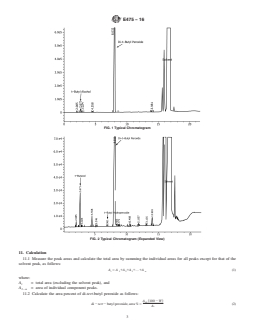
8.1 Carrier Gas (Helium), chromatographic grade. 11.1 Measure the peak areas and calculate the total area by
summing the individual areas for all peaks except for that of
8.2 Hydrogen, chromatographic grade.
the solvent peak, as follows:
8.3 Compressed Air, oil-free.
A 5 A 1A 1A 1…1A (1)
t 1 2 3 n
8.4 Dodecane, for use as a sample diluent, 99 % or greater
where:
chromatographic purity.
A = total area (excluding the solvent peak), and
t
A = area of individual component peaks.
1.n
9. Hazards
11.2 Calculate the area percent of di-tert-butyl peroxide as
9.1 Organic peroxides are strong oxidizing agents and
follows:
present potential fire and explosion hazards. While di-tert-
butylperoxideisoneofthemorestableperoxides,contactwith A ~100 2 W!
D
di 2 tert 2 butyl peroxide, area %
...
This document is not an ASTM standard and is intended only to provide the user of an ASTM standard an indication of what changes have been made to the previous version. Because
it may not be technically possible to adequately depict all changes accurately, ASTM recommends that users consult prior editions as appropriate. In all cases only the current version
of the standard as published by ASTM is to be considered the official document.
Designation: E475 − 10 E475 − 16
Standard Test Method for
Assay of Di-tert-Butyl Peroxide Using Gas Chromatography
This standard is issued under the fixed designation E475; the number immediately following the designation indicates the year of
original adoption or, in the case of revision, the year of last revision. A number in parentheses indicates the year of last reapproval. A
superscript epsilon (´) indicates an editorial change since the last revision or reapproval.
1. Scope*
1.1 This test method covers the assay of di-tert-butyl peroxide using gas chromatography. It is applicable to commercial
di-tert-butyl peroxide which may contain small amounts of isobutylene, tert-butanol, tert-butyl hydroperoxide, triisobutylenes, and
water as impurities.
1.2 Review the current appropriate Material Safety Data Sheets (MSDS) for detailed information concerning toxicity, first aid
procedures, and safety precautions.
1.2 The values stated in SI units are to be regarded as standard. No other units of measurement are included in this standard.
1.3 This standard does not purport to address all of the safety concerns, if any, associated with its use. It is the responsibility
of the user of this standard to establish appropriate safety and health practices and determine the applicability of regulatory
limitations prior to use. Specific hazards statements are given in Section 9.
2. Referenced Documents
2.1 ASTM Standards:
E203 Test Method for Water Using Volumetric Karl Fischer Titration
3. Terminology
3.1 Definitions:
3.1.1 active oxygen—the oxidizing power present in organic peroxides expressed as oxygen (equivalent = 8.00).
4. Summary of Test Method
4.1 A sample is diluted in dodecane and injected into a gas chromatograph containing a wide-bore capillary column with a
nonpolar stationary phase. A temperature program is used to separate di-tert-butyl peroxide from impurities using helium as a
carrier gas. The flame ionization detector response, proportional to component concentration, is recorded and the peak areas are
measured. The concentration of di-tert-butyl peroxide is determined by area normalization after correcting for the area of the
solvent peak. The assay of di-tert-butyl peroxide is corrected for water, which is determined using a separate Karl Fischer titration
since water is not detected using flame ionization detection. The area percent of di-tert-butyl peroxide is assumed to be equal to
mass percent.
5. Significance and Use
5.1 Di-tert-butyl peroxide is widely used as a catalyst and reaction initiator. Knowledge of the peroxide content is important
in such applications. This test method provides a procedure for determining the active peroxide content of commercial di-tert-butyl
peroxide.
6. Interferences
6.1 Interferences will be encountered if other components are present in the sample that have the same retention time as
di-tert-butyl peroxide.
This test method is under the jurisdiction of ASTM Committee E15 on Industrial and Specialty Chemicals and is the direct responsibility of Subcommittee E15.02 on
Product Standards.
Current edition approved March 1, 2010April 1, 2016. Published April 2010May 2016. Originally approved in 1973. Last previous edition approved in 20052010 as
E475 – 00 (2005).E475 – 10. DOI: 10.1520/E0475-10.10.1520/E0475-16.
For referenced ASTM standards, visit the ASTM website, www.astm.org, or contact ASTM Customer Service at service@astm.org. For Annual Book of ASTM Standards
volume information, refer to the standard’s Document Summary page on the ASTM website.
*A Summary of Changes section appears at the end of this standard
Copyright © ASTM International, 100 Barr Harbor Drive, PO Box C700, West Conshohocken, PA 19428-2959. United States
E475 − 16
7. Apparatus
7.1 Instrumentation—Gas chromatograph, capable of column oven temperature programming from 40 to 160°C at a rate of
10°C/min and from 160 to 240°C at a rate of 35°C/min.
7.2 Injection System—Glass-lined sample injection port, maintained at 150°C.
7.3 Sample Introduction—Microliter syringes or automatic syringe injectors, capable of delivering 0.5 μL of a liquid sample,
have been used successfully.
7.4 Detection—Flame ionization detector, maintained at 250°C.
7.5 Data Acquisition System—Electronic data acquisition and area integration capabilities are recommended.
7.6 Chromatographic Column—30 m wide-bore capillary column (0.53 mm inside diameter) with a 5.0 μm dimethylpolysi-
loxane stationary phase.
8. Reagents and Materials
8.1 Carrier Gas (Helium), chromatographic grade.
8.2 Hydrogen, chromatographic grade.
8.3 Compressed Air, oil-free.
8.4 Dodecane, for use as a sample diluent, 99 % or greater chromatographic purity.
9. Hazards
9.1 Organic peroxides are strong oxidizing agents and present potential fire and explosion hazards. While di-tert-butyl peroxide
is one of the more stable peroxides, contact with reducing agents and sources of heat, sparks, or open flames must be avoided.
Organic peroxides in general are irritating to the skin, eyes, and mucous membranes. Avoid bodily contact and handle only in a
well-ventilated area.
9.2 Consult current OSHA regulations and supplier’s Safety Data Sheets (SDS) for all materials used in this method.
10. Procedure
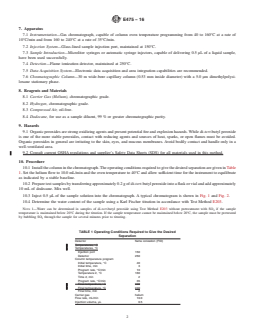
10.1 Install the column in the chromatograph. The operating conditions required to give the desired separation are given in Table
1. Set the helium flow to 10.0 mL/min and
...