

ASTM E298-17a
(Test Method)Standard Test Methods for Assay of Organic Peroxides
General Information
- Abstract
SIGNIFICANCE AND USE
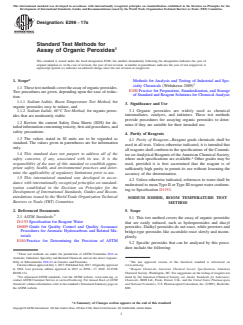
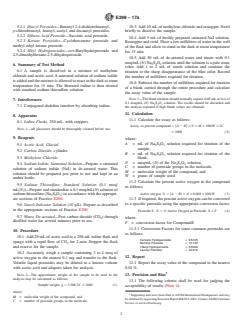
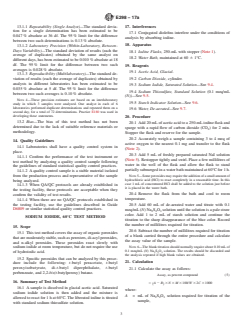
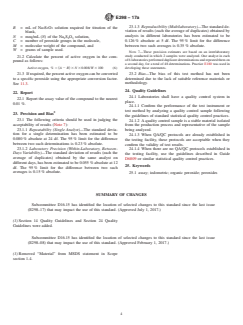
3.1 Organic peroxides are widely used as chemical intermediates, catalysts, and initiators. These test methods provide procedures for assaying organic peroxides to determine if they are suitable for their intended use.
SCOPE
1.1 These test methods cover the assay of organic peroxides. Two procedures are given, depending upon the ease of reduction:
1.1.1 Sodium Iodide, Room Temperature Test Method, for organic peroxides easy to reduce, and
1.1.2 Sodium Iodide, 60°C Test Method, for organic peroxides that are moderately stable.
1.2 Review the current Safety Data Sheets (SDS) for detailed information concerning toxicity, first-aid procedures, and safety precautions.
1.3 The values stated in SI units are to be regarded as standard. The values given in parentheses are for information only.
1.4 This standard does not purport to address all of the safety concerns, if any, associated with its use. It is the responsibility of the user of this standard to establish appropriate safety and health practices and determine the applicability of regulatory limitations prior to use.
1.5 This international standard was developed in accordance with internationally recognized principles on standardization established in the Decision on Principles for the Development of International Standards, Guides and Recommendations issued by the World Trade Organization Technical Barriers to Trade (TBT) Committee.
- Status
- Published
- Publication Date
- 30-Jun-2017
- Technical Committee
- D16 - Aromatic, Industrial, Specialty and Related Chemicals
- Drafting Committee
- D16.12 - Caustics and Peroxides
Overview
ASTM E298-17a: Standard Test Methods for Assay of Organic Peroxides is a globally recognized ASTM standard that establishes reliable test procedures for assaying organic peroxides. These compounds are widely utilized as chemical intermediates, catalysts, and initiators in industrial and laboratory applications. The standard outlines two iodometric methods, depending on the stability and ease of reduction of the peroxide being analyzed. Accurate peroxide assay is crucial to ensure these chemicals' suitability for intended use, quality control, and safety.
Key Topics
Test Methods Covered:
- Sodium Iodide, Room Temperature Method: Suitable for organic peroxides that are easy to reduce, such as hydroperoxides and diacyl peroxides.
- Sodium Iodide, 60°C Method: Designed for moderately stable peroxides including peresters, di-acyl peroxides, and n-alkyl peroxides.
Assay Principle:
- Organic peroxides react with sodium iodide, liberating iodine, which is titrated with standard sodium thiosulfate solution. The amount of sodium thiosulfate used provides a measure of the active oxygen content, indicating the peroxide's assay value.
Safety Considerations:
- Users are required to consult current Safety Data Sheets (SDS) for information on toxicity, first-aid, and safe handling.
- All safety and health practices must be established prior to use, including reviewing potential regulatory limitations.
Quality Assurance:
- Laboratories must maintain robust quality control systems.
- Performance verification through quality control samples and established statistical quality control practices is essential.
Applications
ASTM E298-17a supports various sectors requiring accurate assay of organic peroxides, including:
Industrial Manufacturing:
- Ensures the correct concentration of peroxides in catalysts and polymerization initiators.
- Critical for safe handling and process consistency in producing plastics, rubbers, and resins.
Quality Control Laboratories:
- Enables assessment of raw materials and finished products for compliance with specifications.
- Supports batch consistency and helps identify degradation or contamination.
Research and Development:
- Provides reliable methods for characterizing organic peroxides during chemical synthesis or material development projects.
Regulatory Compliance:
- Assists organizations in meeting international safety standards and regulatory requirements for hazardous chemicals.
Related Standards
- ASTM D1193: Specification for Reagent Water - Ensures water purity requirements are met in analytical procedures.
- ASTM D6809: Guide for Quality Control and Quality Assurance Procedures for Aromatic Hydrocarbons and Related Materials - Offers guidance on laboratory quality practices.
- ASTM E200: Practice for Preparation, Standardization, and Storage of Standard and Reagent Solutions for Chemical Analysis – Details procedures for making and standardizing solutions used in the assay.
- International Standards: Developed in accordance with WTO guidelines to support harmonization and best practices in chemical analysis worldwide.
Keywords: ASTM E298-17a, organic peroxides, peroxide assay, test methods, iodometric method, quality control, chemical analysis, sodium iodide, titration, catalyst, polymerization initiator, laboratory standard, chemical safety.
Relations
- Effective Date
- 01-Jul-2017
- Effective Date
- 01-Nov-2016
- Effective Date
- 01-Jun-2007
- Effective Date
- 01-Mar-2006
- Effective Date
- 10-Jun-2002
- Effective Date
- 10-Feb-1999
- Effective Date
- 10-Feb-1999
- Effective Date
- 01-Jul-2017
- Referred By
ASTM E1228-23 - Standard Test Method for Assay of Peroxy Esters-Catalyzed Iodometric Procedure - Effective Date
- 01-Jul-2017
- Effective Date
- 01-Jul-2017
Get Certified
Connect with accredited certification bodies for this standard

ECOCERT
Organic and sustainability certification.

Eurofins Food Testing Global
Global leader in food, environment, and pharmaceutical product testing.

Intertek Bangladesh
Intertek certification and testing services in Bangladesh.
Sponsored listings
Frequently Asked Questions
ASTM E298-17a is a standard published by ASTM International. Its full title is "Standard Test Methods for Assay of Organic Peroxides". This standard covers: SIGNIFICANCE AND USE 3.1 Organic peroxides are widely used as chemical intermediates, catalysts, and initiators. These test methods provide procedures for assaying organic peroxides to determine if they are suitable for their intended use. SCOPE 1.1 These test methods cover the assay of organic peroxides. Two procedures are given, depending upon the ease of reduction: 1.1.1 Sodium Iodide, Room Temperature Test Method, for organic peroxides easy to reduce, and 1.1.2 Sodium Iodide, 60°C Test Method, for organic peroxides that are moderately stable. 1.2 Review the current Safety Data Sheets (SDS) for detailed information concerning toxicity, first-aid procedures, and safety precautions. 1.3 The values stated in SI units are to be regarded as standard. The values given in parentheses are for information only. 1.4 This standard does not purport to address all of the safety concerns, if any, associated with its use. It is the responsibility of the user of this standard to establish appropriate safety and health practices and determine the applicability of regulatory limitations prior to use. 1.5 This international standard was developed in accordance with internationally recognized principles on standardization established in the Decision on Principles for the Development of International Standards, Guides and Recommendations issued by the World Trade Organization Technical Barriers to Trade (TBT) Committee.
SIGNIFICANCE AND USE 3.1 Organic peroxides are widely used as chemical intermediates, catalysts, and initiators. These test methods provide procedures for assaying organic peroxides to determine if they are suitable for their intended use. SCOPE 1.1 These test methods cover the assay of organic peroxides. Two procedures are given, depending upon the ease of reduction: 1.1.1 Sodium Iodide, Room Temperature Test Method, for organic peroxides easy to reduce, and 1.1.2 Sodium Iodide, 60°C Test Method, for organic peroxides that are moderately stable. 1.2 Review the current Safety Data Sheets (SDS) for detailed information concerning toxicity, first-aid procedures, and safety precautions. 1.3 The values stated in SI units are to be regarded as standard. The values given in parentheses are for information only. 1.4 This standard does not purport to address all of the safety concerns, if any, associated with its use. It is the responsibility of the user of this standard to establish appropriate safety and health practices and determine the applicability of regulatory limitations prior to use. 1.5 This international standard was developed in accordance with internationally recognized principles on standardization established in the Decision on Principles for the Development of International Standards, Guides and Recommendations issued by the World Trade Organization Technical Barriers to Trade (TBT) Committee.
ASTM E298-17a is classified under the following ICS (International Classification for Standards) categories: 71.080.99 - Other organic chemicals. The ICS classification helps identify the subject area and facilitates finding related standards.
ASTM E298-17a has the following relationships with other standards: It is inter standard links to ASTM E298-17, ASTM D6809-02(2016), ASTM D6809-02(2007), ASTM D1193-06, ASTM D6809-02, ASTM D1193-99, ASTM D1193-99e1, ASTM D4077-23, ASTM E1228-23, ASTM D7125-23. Understanding these relationships helps ensure you are using the most current and applicable version of the standard.
ASTM E298-17a is available in PDF format for immediate download after purchase. The document can be added to your cart and obtained through the secure checkout process. Digital delivery ensures instant access to the complete standard document.
Standards Content (Sample)
This international standard was developed in accordance with internationally recognized principles on standardization established in the Decision on Principles for the
Development of International Standards, Guides and Recommendations issued by the World Trade Organization Technical Barriers to Trade (TBT) Committee.
Designation: E298 − 17a
Standard Test Methods for
Assay of Organic Peroxides
This standard is issued under the fixed designation E298; the number immediately following the designation indicates the year of
original adoption or, in the case of revision, the year of last revision. A number in parentheses indicates the year of last reapproval. A
superscript epsilon (´) indicates an editorial change since the last revision or reapproval.
1. Scope* Methods for Analysis and Testing of Industrial and Spe-
cialty Chemicals (Withdrawn 2009)
1.1 Thesetestmethodscovertheassayoforganicperoxides.
E200 Practice for Preparation, Standardization, and Storage
Two procedures are given, depending upon the ease of reduc-
of Standard and Reagent Solutions for ChemicalAnalysis
tion:
1.1.1 Sodium Iodide, Room Temperature Test Method, for
3. Significance and Use
organic peroxides easy to reduce, and
3.1 Organic peroxides are widely used as chemical
1.1.2 Sodium Iodide, 60°C Test Method, for organic perox-
intermediates, catalysts, and initiators. These test methods
ides that are moderately stable.
provide procedures for assaying organic peroxides to deter-
1.2 Review the current Safety Data Sheets (SDS) for de-
mine if they are suitable for their intended use.
tailedinformationconcerningtoxicity,first-aidprocedures,and
safety precautions.
4. Purity of Reagents
1.3 The values stated in SI units are to be regarded as
4.1 Purity of Reagents—Reagent grade chemicals shall be
standard. The values given in parentheses are for information
used in all tests. Unless otherwise indicated, it is intended that
only.
all reagents shall conform to the specifications of the Commit-
1.4 This standard does not purport to address all of the
tee onAnalytical Reagents of theAmerican Chemical Society,
safety concerns, if any, associated with its use. It is the
where such specifications are available. Other grades may be
responsibility of the user of this standard to establish appro-
used, provided it is first ascertained that the reagent is of
priate safety, health, and environmental practices and deter-
sufficiently high purity to permit its use without lessening the
mine the applicability of regulatory limitations prior to use.
accuracy of the determination.
1.5 This international standard was developed in accor-
4.2 Unless otherwise indicated, references to water shall be
dance with internationally recognized principles on standard-
understood to meanType II orType III reagent water conform-
ization established in the Decision on Principles for the
ing to Specification D1193.
Development of International Standards, Guides and Recom-
mendations issued by the World Trade Organization Technical
SODIUM IODIDE, ROOM TEMPERATURE TEST
Barriers to Trade (TBT) Committee.
METHOD
2. Referenced Documents
5. Scope
2.1 ASTM Standards:
5.1 This test method covers the assay of organic peroxides
D1193 Specification for Reagent Water
that are easily reduced, such as hydroperoxides and diacyl
D6809 Guide for Quality Control and Quality Assurance
peroxides. Dialkyl peroxides do not react, while peresters and
Procedures for Aromatic Hydrocarbons and Related Ma-
bridge-type peroxides like ascaridole react slowly and incom-
terials
pletely.
E180 Practice for Determining the Precision of ASTM
5.2 Specific peroxides that can be analyzed by this proce-
dure include the following:
These test methods are under the jurisdiction of ASTM Committee D16 on
Aromatic, Industrial, Specialty and Related Chemicals and are the direct responsi-
bility of Subcommittee D16.12 on Caustics and Peroxides. The last approved version of this historical standard is referenced on
Current edition approved July 1, 2017. Published July 2017. Originally approved www.astm.org.
in 1966. Last previous edition approved in 2017 as E298 – 17. DOI: 10.1520/ Reagent Chemicals, American Chemical Society Specifications, American
E0298-17a. Chemical Society, Washington, DC. For suggestions on the testing of reagents not
For referenced ASTM standards, visit the ASTM website, www.astm.org, or listed by the American Chemical Society, see Analar Standards for Laboratory
contact ASTM Customer Service at service@astm.org. For Annual Book of ASTM Chemicals, BDH Ltd., Poole, Dorset, U.K., and the United States Pharmacopeia
Standards volume information, refer to the standard’s Document Summary page on and National Formulary, U.S. Pharmacopeial Convention, Inc. (USPC), Rockville,
the ASTM website. MD.
*A Summary of Changes section appears at the end of this standard
Copyright © ASTM International, 100 Barr Harbor Drive, PO Box C700, West Conshohocken, PA 19428-2959. United States
E298 − 17a
5.2.1 Diacyl Peroxides—Benzoyl 2,4-dichlorobenzoyl, 10.3 Add 10 mLof methylene chloride and restopper. Swirl
p-chlorobenzoyl, lauroyl, acetyl, and decanoyl peroxides. briefly to dissolve the sample.
5.2.2 Dibasic Acid Peroxide—Succinic acid peroxide.
10.4 Add 5 mL of freshly prepared saturated NaI solution.
5.2.3 Ketone Peroxides—Cyclohexanone peroxide and
Restopper and swirl. Place a few millilitres of water in the well
methyl ethyl ketone peroxide.
of the flask and allow to stand in the dark at room temperature
5.2.4 Alkyl Hydroperoxides—tert-Butylhydroperoxide and
for 15 min.
2,5-dimethylhexane-2,5-dihydroperoxide.
10.5 Add 50 mL of de-aerated water and titrate with 0.1
meq/mL(N)Na S O solution until the solution is a pale straw
2 2 3
6. Summary of Test Method
color. Add 1 to 2 mL of starch solution and continue the
6.1 A sample is dissolved in a mixture of methylene
titration to the sharp disappearance of the blue color. Record
chloride and acetic acid.Asaturated solution of sodium iodide
the number of millilitres required for titration.
is added and the mixture is allowed to react in the dark at room
10.6 Subtract the number of millilitres required for titration
temperature for 15 min. The liberated iodine is then titrated
of a blank carried through the entire procedure and calculate
with standard sodium thiosulfate solution.
the assay value of the sample.
NOTE 3—The blank titration should normally require 0.05 mLor less of
7. Interferences
0.1 meq/mL (N)Na S O solution. The results should be discarded and
2 2 3
7.1 Conjugated diolefins interfere by absorbing iodine.
the analysis repeated if high blank values are obtained.
11. Calculation
8. Apparatus
11.1 Calculate the assay as follows:
8.1 Iodine Flasks, 250-mL, with stoppers.
Assay, as percent compound 5 A 2 B 3 N 3 M 3100/W 32C
~ !
NOTE 1—All glassware should be thoroughly cleaned before use.
31000 (2)
9. Reagents
where:
A =mLofNa S O solution required for titration of the
9.1 Acetic Acid, Glacial.
2 2 3
sample,
9.2 Carbon Dioxide, cylinder.
B =mLofNa S O solution required for titration of the
2 2 3
9.3 Methylene Chloride.
blank,
N = meq/mL (N) of the Na S O solution,
9.4 Sodium Iodide, Saturated Solution—Prepare a saturated 2 2 3
C = number of peroxide groups in the molecule,
solution of sodium iodide (NaI) in de-aerated water. This
M = molecular weight of the compound, and
solution should be prepared just prior to use and kept in an
W = grams of sample used.
amber bottle.
11.2 Calculate the percent active oxygen in the compound
9.5 Sodium Thiosulfate, Standard Solution (0.1 meq/
as follows:
mL(N))—Prepare and standardize a 0.1 meq/mL(N) solution of
Active oxygen,% 5 A 2 B 3 N 30.008 3100/W (3)
~ !
sodium thiosulfate (Na S O ) in accordance with the appropri-
2 2 3
ate sections of Practice E200.
11.3 If required, the percent active oxygen can be converted
to a specific peroxide using the appropriate conversion factor.
9.6 Starch Indicator Solution (10 g/L), Prepare as described
in the appropriate sections of Practice E200. Peroxide X,% 5 % Active Oxygen in Peroxide X 3 F (4)
9.7 Water, De-aerated—Pass carbon dioxide (CO ) through
2 where:
distilled water for several minutes prior to use.
F = conversion factor for CompoundX
11.3.1 Conversion Factors for some common peroxides are
10. Procedure
as follows:
10.1 Add 20 mLof acetic acid to a 250-mLiodine flask and
Cumene Hydroperoxide = 9.5125
sparge with a rapid flow of CO for 2 min. Stopper the flask
2 Benzoyl Peroxide = 15.140
and reserve for the sample. t-Butyl Hydroperoxide = 5.6328
Lauroyl Peroxide = 24.915
10.2 Accurately weigh a sample containing 3 to 4 meq of
12. Report
active oxygen to the nearest 0.1 mg and transfer to the flask.
Volatile liquid peroxides may be diluted to a known volume 12.1 Report the assay value of the compound to the nearest
with acetic acid and aliquots taken for analysis. 0.01 %.
NOTE 2—The approximate weight of the sample to be used in the
13. Precision and Bias
analysis may be calculated as follows:
13.1 The following criteria shall be used for judging the
Sample weight, g 5 3.5M/2C 31000 (1)
acceptability of results (Note 4):
where:
Supporting data have been filed at ASTM International Headquarters and may
M = molecular weight of the compound, and
beobtainedbyrequestingResearchReportRR:E15-1001.ContactASTMCustomer
C = number of peroxide groups in the molecule.
Service at service@astm.org.
E298 − 17a
13.1.1 Repeatability (Single Analyst)—The standard devia- 17. Interferences
tion for a single determination has been estimated to be
17.1 Conjugated diolefins interfere under the conditions of
0.0
...
This document is not an ASTM standard and is intended only to provide the user of an ASTM standard an indication of what changes have been made to the previous version. Because
it may not be technically possible to adequately depict all changes accurately, ASTM recommends that users consult prior editions as appropriate. In all cases only the current version
of the standard as published by ASTM is to be considered the official document.
Designation: E298 − 17 E298 − 17a
Standard Test Methods for
Assay of Organic Peroxides
This standard is issued under the fixed designation E298; the number immediately following the designation indicates the year of
original adoption or, in the case of revision, the year of last revision. A number in parentheses indicates the year of last reapproval. A
superscript epsilon (´) indicates an editorial change since the last revision or reapproval.
1. Scope*
1.1 These test methods cover the assay of organic peroxides. Two procedures are given, depending upon the ease of reduction:
1.1.1 Sodium Iodide, Room Temperature Test Method, for organic peroxides easy to reduce, and
1.1.2 Sodium Iodide, 60°C Test Method, for organic peroxides that are moderately stable.
1.2 Review the current Safety Data Sheets (SDS) for detailed information concerning toxicity, first-aid procedures, and safety
precautions.
1.3 The values stated in SI units are to be regarded as standard. The values given in parentheses are for information only.
1.4 This standard does not purport to address all of the safety concerns, if any, associated with its use. It is the responsibility
of the user of this standard to establish appropriate safety and health practices and determine the applicability of regulatory
limitations prior to use.
1.4 Review the current Safety Data Sheets (SDS) for detailed information concerning toxicity, first-aid procedures, and safety
precautions.
1.5 This international standard was developed in accordance with internationally recognized principles on standardization
established in the Decision on Principles for the Development of International Standards, Guides and Recommendations issued
by the World Trade Organization Technical Barriers to Trade (TBT) Committee.
2. Referenced Documents
2.1 ASTM Standards:
D1193 Specification for Reagent Water
D6809 Guide for Quality Control and Quality Assurance Procedures for Aromatic Hydrocarbons and Related Materials
E180 Practice for Determining the Precision of ASTM Methods for Analysis and Testing of Industrial and Specialty Chemicals
(Withdrawn 2009)
E200 Practice for Preparation, Standardization, and Storage of Standard and Reagent Solutions for Chemical Analysis
3. Significance and Use
3.1 Organic peroxides are widely used as chemical intermediates, catalysts, and initiators. These test methods provide
procedures for assaying organic peroxides to determine if they are suitable for their intended use.
4. Purity of Reagents
4.1 Purity of Reagents—Reagent grade chemicals shall be used in all tests. Unless otherwise indicated, it is intended that all
reagents shall conform to the specifications of the Committee on Analytical Reagents of the American Chemical Society, where
such specifications are available. Other grades may be used, provided it is first ascertained that the reagent is of sufficiently high
purity to permit its use without lessening the accuracy of the determination.
These test methods are under the jurisdiction of ASTM Committee D16 on Aromatic Hydrocarbons Aromatic, Industrial, Specialty and Related Chemicals and are the
direct responsibility of Subcommittee D16.15 on Industrial and Specialty General Standards.
Current edition approved Feb. 1, 2017July 1, 2017. Published February 2017July 2017. Originally approved in 1966. Last previous edition approved in 20082017 as
E298 – 08.E298 – 17. DOI: 10.1520/E0298-17.10.1520/E0298-17a.
For referenced ASTM standards, visit the ASTM website, www.astm.org, or contact ASTM Customer Service at service@astm.org. For Annual Book of ASTM Standards
volume information, refer to the standard’s Document Summary page on the ASTM website.
The last approved version of this historical standard is referenced on www.astm.org.
Reagent Chemicals, American Chemical Society Specifications, American Chemical Society, Washington, DC. For suggestions on the testing of reagents not listed by
the American Chemical Society, see Analar Standards for Laboratory Chemicals, BDH Ltd., Poole, Dorset, U.K., and the United States Pharmacopeia and National
Formulary, U.S. Pharmacopeial Convention, Inc. (USPC), Rockville, MD.
*A Summary of Changes section appears at the end of this standard
Copyright © ASTM International, 100 Barr Harbor Drive, PO Box C700, West Conshohocken, PA 19428-2959. United States
E298 − 17a
4.2 Unless otherwise indicated, references to water shall be understood to mean Type II or Type III reagent water conforming
to Specification D1193.
SODIUM IODIDE, ROOM TEMPERATURE TEST METHOD
5. Scope
5.1 This test method covers the assay of organic peroxides that are easily reduced, such as hydroperoxides and diacyl peroxides.
Dialkyl peroxides do not react, while peresters and bridge-type peroxides like ascaridole react slowly and incompletely.
5.2 Specific peroxides that can be analyzed by this procedure include the following:
5.2.1 Diacyl Peroxides—Benzoyl 2,4-dichlorobenzoyl,
p-chlorobenzoyl, lauroyl, acetyl, and decanoyl peroxides.
5.2.2 Dibasic Acid Peroxide—Succinic acid peroxide.
5.2.3 Ketone Peroxides—Cyclohexanone peroxide and methyl ethyl ketone peroxide.
5.2.4 Alkyl Hydroperoxides—tert-Butylhydroperoxide and 2,5-dimethylhexane-2,5-dihydroperoxide.
5.1 This test method covers the assay of organic peroxides that are easily reduced, such as hydroperoxides and diacyl peroxides.
Dialkyl peroxides do not react, while peresters and bridge-type peroxides like ascaridole react slowly and incompletely.
5.2 Specific peroxides that can be analyzed by this procedure include the following:
5.2.1 Diacyl Peroxides—Benzoyl 2,4-dichlorobenzoyl,
p-chlorobenzoyl, lauroyl, acetyl, and decanoyl peroxides.
5.2.2 Dibasic Acid Peroxide—Succinic acid peroxide.
5.2.3 Ketone Peroxides—Cyclohexanone peroxide and methyl ethyl ketone peroxide.
5.2.4 Alkyl Hydroperoxides—tert-Butylhydroperoxide and 2,5-dimethylhexane-2,5-dihydroperoxide.
6. Summary of Test Method
6.1 A sample is dissolved in a mixture of methylene chloride and acetic acid. A saturated solution of sodium iodide is added
and the mixture is allowed to react in the dark at room temperature for 15 min. The liberated iodine is then titrated with standard
sodium thiosulfate solution.
7. Interferences
7.1 Conjugated diolefins interfere by absorbing iodine.
8. Apparatus
8.1 Iodine Flasks, 250-mL, with stoppers.
NOTE 1—All glassware should be thoroughly cleaned before use.
9. Reagents
9.1 Acetic Acid, Glacial.
9.2 Carbon Dioxide, cylinder.
9.3 Methylene Chloride.
9.4 Sodium Iodide, Saturated Solution—Prepare a saturated solution of sodium iodide (NaI) in de-aerated water. This solution
should be prepared just prior to use and kept in an amber bottle.
9.5 Sodium Thiosulfate, Standard Solution (0.1 meq/mL(N))—Prepare and standardize a 0.1 meq/mL(N) solution of sodium
thiosulfate (Na S O ) in accordance with the appropriate sections of Practice E200.
2 2 3
9.6 Starch Indicator Solution (10 g/L), Prepare as described in the appropriate sections of Practice E200.
9.7 Water, De-aerated—Pass carbon dioxide (CO ) through distilled water for several minutes prior to use.
10. Procedure
10.1 Add 20 mL of acetic acid to a 250-mL iodine flask and sparge with a rapid flow of CO for 2 min. Stopper the flask and
reserve for the sample.
10.2 Accurately weigh a sample containing 3 to 4 meq of active oxygen to the nearest 0.1 mg and transfer to the flask. Volatile
liquid peroxides may be diluted to a known volume with acetic acid and aliquots taken for analysis.
NOTE 2—The approximate weight of the sample to be used in the analysis may be calculated as follows:
Sample weight, g5 3.5M/2C 31000 (1)
E298 − 17a
where:
M = molecular weight of the compound, and
C = number of peroxide groups in the molecule.
10.3 Add 10 mL of methylene chloride and restopper. Swirl briefly to dissolve the sample.
10.4 Add 5 mL of freshly prepared saturated NaI solution. Restopper and swirl. Place a few millilitres of water in the well of
the flask and allow to stand in the dark at room temperature for 15 min.
10.5 Add 50 mL of de-aerated water and titrate with 0.1 meq/mL (N) Na S O solution until the solution is a pale straw color.
2 2 3
Add 1 to 2 mL of starch solution and continue the titration to the sharp disappearance of the blue color. Record the number of
millilitres required for titration.
10.6 Subtract the number of millilitres required for titration of a blank carried through the entire procedure and calculate the
assay value of the sample.
NOTE 3—The blank titration should normally require 0.05 mL or less of 0.1 meq/mL (N) Na S O solution. The results should be discarded and the
2 2 3
analysis repeated if high blank values are obtained.
11. Calculation
11.1 Calculate the assay as follows:
Assay, as percent compound 5 ~A 2 B! 3N 3M 3100/W 32C 31000 (2)
where:
A = mL of Na S O solution required for titration of the sample,
2 2 3
B = mL of Na S O solution required for titration of the blank,
2 2 3
N = meq/mL (N) of the Na S O solution,
2 2 3
C = number of peroxide groups in the molecule,
M = molecular weight of the compound, and
W = grams of sample used.
11.2 Calculate the percent active oxygen in the compound as follows:
Active oxygen,%5 ~A 2 B! 3N 30.008 3100/W (3)
11.3 If required, the percent active oxygen can be converted to a specific peroxide using the appropriate conversion factor.
Peroxide X, %5 % Active Oxygen in Peroxide X 3F (4)
where:
F = conversion factor for CompoundX
11.3.1 Conversion Factors for some common peroxides are as follows:
Cumene Hydroperoxide = 9.5125
Benzoyl Peroxide = 15.140
t-Butyl Hydroperoxide = 5.6328
Lauroyl Peroxide = 24.915
12. Report
12.1 Report the assay value of the compound to the nearest 0.01 %.
13. Precision and Bias
13.1 The following criteria shall be used for judging the acceptability of results (Note 4):
13.1.1 Repeatability (Single Analyst)—The standard deviation for a single determination has been estimated to be 0.047 %
absolute at 36 df. The 95 % limit for the difference bet
...