

ASTM C1817-16
(Test Method)Standard Test Method for The Determination of the Oxygen to Metal (O/M) Ratio in Sintered Mixed Oxide ((U, Pu)O2) Pellets by Gravimetry
General Information
- Abstract
SIGNIFICANCE AND USE
5.1 MOX is used as a nuclear-reactor fuel. This test method is designed to determine whether the O/M ratio meets the requirements of the fuel specification. Examples for establishing a fuel specification are given in Specification C833.
5.2 This method is suitable for all sintered MOX pellets containing up to 12 weight % PuO2 when the UO2 and PuO2 meet the requirements of Specifications C753 and C757.
SCOPE
1.1 This practice is an alternative method to Test Method C698 for the determination of the oxygen-to-metal atom ratio (O/M) in sintered mixed oxide fuel (MOX) pellets. The method presented in Test Method C698 is a one-step thermogravimetric method for determining O/M ratio in sintered MOX powders and pellets. As stated in Test Method C698, thermogravimetric methods using a two-step heating cycle are also satisfactory (1, 2).2 The method presented in this test method is a two-step heating cycle method. This test method is applicable to sintered MOX pellets containing up to 10 weight percent PuO2.
1.2 The values stated in SI units are to be regarded as standard. No other units of measurement are included in this standard.
1.3 This standard does not purport to address all of the safety concerns, if any, associated with its use. It is the responsibility of the user of this standard to establish appropriate safety and health practices and determine the applicability of regulatory limitations prior to use.
- Status
- Published
- Publication Date
- 14-Jan-2016
- Technical Committee
- C26 - Nuclear Fuel Cycle
- Drafting Committee
- C26.05 - Methods of Test
Buy Documents
ASTM C1817-16 - Standard Test Method for The Determination of the Oxygen to Metal (O/M) Ratio in Sintered Mixed Oxide ((U, Pu)O<inf>2</inf>) Pellets by Gravimetry
REDLINE ASTM C1817-16 - Standard Test Method for The Determination of the Oxygen to Metal (O/M) Ratio in Sintered Mixed Oxide ((U, Pu)O<inf>2</inf>) Pellets by Gravimetry
Overview
ASTM C1817-16 is a standard test method developed by ASTM International for the determination of the oxygen-to-metal (O/M) ratio in sintered mixed oxide (MOX) fuel pellets, specifically uranium-plutonium oxide ((U, Pu)O₂), using gravimetric techniques. MOX fuel is widely used in nuclear reactors, and accurate measurement of the O/M ratio is essential to ensure the fuel meets stringent safety and performance specifications. This standard provides an alternative two-step heating cycle gravimetric approach to previously established methods and is applicable to sintered MOX pellets containing up to 10 weight percent PuO₂, provided the starting materials meet the requirements specified in relevant ASTM standards.
Key Topics
- Oxygen-to-Metal (O/M) Ratio: Central to the stoichiometry of MOX pellets, impacting fuel performance and safety.
- Gravimetric Method: Utilizes mass measurement before and after controlled oxidation-reduction heat cycles to quantify changes in oxygen content.
- Two-Step Heating Cycle: Involves sequential oxidation in air and reduction in argon/hydrogen atmosphere at high temperatures to precisely adjust and measure the O/M ratio.
- Accuracy and Limitations:
- Impurities can affect results; the method assumes compliance with material specifications (ASTM C753 and C757).
- Accurate weighing, controlled furnace conditions, and use of inert crucible materials are critical.
- Safety Considerations:
- Handling of radioactive materials such as plutonium requires strict operational controls, typically within glove boxes.
- Safe operation of high-temperature equipment and management of combustible gases (hydrogen/argon) are emphasized.
Applications
- Nuclear Fuel Quality Assurance: Critical for verifying that sintered MOX pellets meet regulatory specifications concerning O/M ratio, directly influencing reactor fuel efficiency and safety.
- Nuclear Energy Research and Development: Supports laboratories and facilities that develop and test advanced nuclear fuel cycles, providing a reliable measurement method for MOX fuel materials.
- Manufacturing Control: Offers a standardized approach for MOX fuel producers to monitor production batches, maintain consistency, and meet contractual and regulatory obligations.
- Regulatory Compliance: Assists regulatory bodies and nuclear safety authorities in the oversight of fuel fabrication facilities by providing a recognized method for O/M ratio verification.
Related Standards
- ASTM C698: Provides alternative test methods for the chemical, mass spectrometric, and spectrochemical analysis of nuclear-grade mixed oxides, including O/M determination.
- ASTM C833: Specifies requirements for sintered uranium-plutonium dioxide pellets, referenced for fuel specification examples.
- ASTM C753 / C757: Establish powder quality standards for uranium and plutonium dioxides respectively, which are prerequisites for applying this test method.
- ASTM C1068: Offers guidance on laboratory qualification for measurement methods in the nuclear industry.
- ASTM C1672: Describes the determination of uranium or plutonium isotopic composition by thermal ionization mass spectrometry.
- ISO 21484: Specifies an analogous gravimetric test method for O/M ratio measurement in MOX pellets at the international level.
Practical Value
- Ensures Consistent Nuclear Fuel Quality: Enables precise measurement and control of the O/M ratio in MOX fuel, crucial for achieving reliable reactor operation.
- Aligns with International Standardization: Developed in accordance with WTO TBT principles, supporting harmonization and trade in nuclear materials.
- Supports Regulatory and Industry Best Practices: Facilitates compliance with established nuclear industry standards and enhances safety through rigorous material characterization.
- Globally Recognized Method: Referenced by both ASTM and ISO standards, making it widely applicable across international nuclear fuel manufacturing and research sectors.
Keywords: MOX fuel, oxygen-to-metal ratio, gravimetry, ASTM C1817-16, nuclear reactor fuel, uranium-plutonium oxide, mixed oxide pellets, nuclear fuel analysis, O/M ratio, quality assurance.
Relations
- Effective Date
- 15-Jan-2016
- Effective Date
- 01-Jan-2024
- Effective Date
- 01-Dec-2023
- Effective Date
- 01-Sep-2020
- Effective Date
- 15-Mar-2020
- Effective Date
- 01-Jan-2017
- Effective Date
- 01-Apr-2016
- Effective Date
- 01-Feb-2016
- Effective Date
- 15-Oct-2015
- Effective Date
- 01-Jul-2015
- Effective Date
- 01-Dec-2014
- Effective Date
- 15-Jun-2014
- Effective Date
- 01-May-2014
- Effective Date
- 15-Jan-2014
- Effective Date
- 15-Jan-2014
Buy Documents
ASTM C1817-16 - Standard Test Method for The Determination of the Oxygen to Metal (O/M) Ratio in Sintered Mixed Oxide ((U, Pu)O<inf>2</inf>) Pellets by Gravimetry
REDLINE ASTM C1817-16 - Standard Test Method for The Determination of the Oxygen to Metal (O/M) Ratio in Sintered Mixed Oxide ((U, Pu)O<inf>2</inf>) Pellets by Gravimetry
Get Certified
Connect with accredited certification bodies for this standard

DNV
DNV is an independent assurance and risk management provider.

Lloyd's Register
Lloyd's Register is a global professional services organisation specialising in engineering and technology.
DNV Energy Systems
Energy and renewable energy certification.
Sponsored listings
Frequently Asked Questions
ASTM C1817-16 is a standard published by ASTM International. Its full title is "Standard Test Method for The Determination of the Oxygen to Metal (O/M) Ratio in Sintered Mixed Oxide ((U, Pu)O<inf>2</inf>) Pellets by Gravimetry". This standard covers: SIGNIFICANCE AND USE 5.1 MOX is used as a nuclear-reactor fuel. This test method is designed to determine whether the O/M ratio meets the requirements of the fuel specification. Examples for establishing a fuel specification are given in Specification C833. 5.2 This method is suitable for all sintered MOX pellets containing up to 12 weight % PuO2 when the UO2 and PuO2 meet the requirements of Specifications C753 and C757. SCOPE 1.1 This practice is an alternative method to Test Method C698 for the determination of the oxygen-to-metal atom ratio (O/M) in sintered mixed oxide fuel (MOX) pellets. The method presented in Test Method C698 is a one-step thermogravimetric method for determining O/M ratio in sintered MOX powders and pellets. As stated in Test Method C698, thermogravimetric methods using a two-step heating cycle are also satisfactory (1, 2).2 The method presented in this test method is a two-step heating cycle method. This test method is applicable to sintered MOX pellets containing up to 10 weight percent PuO2. 1.2 The values stated in SI units are to be regarded as standard. No other units of measurement are included in this standard. 1.3 This standard does not purport to address all of the safety concerns, if any, associated with its use. It is the responsibility of the user of this standard to establish appropriate safety and health practices and determine the applicability of regulatory limitations prior to use.
SIGNIFICANCE AND USE 5.1 MOX is used as a nuclear-reactor fuel. This test method is designed to determine whether the O/M ratio meets the requirements of the fuel specification. Examples for establishing a fuel specification are given in Specification C833. 5.2 This method is suitable for all sintered MOX pellets containing up to 12 weight % PuO2 when the UO2 and PuO2 meet the requirements of Specifications C753 and C757. SCOPE 1.1 This practice is an alternative method to Test Method C698 for the determination of the oxygen-to-metal atom ratio (O/M) in sintered mixed oxide fuel (MOX) pellets. The method presented in Test Method C698 is a one-step thermogravimetric method for determining O/M ratio in sintered MOX powders and pellets. As stated in Test Method C698, thermogravimetric methods using a two-step heating cycle are also satisfactory (1, 2).2 The method presented in this test method is a two-step heating cycle method. This test method is applicable to sintered MOX pellets containing up to 10 weight percent PuO2. 1.2 The values stated in SI units are to be regarded as standard. No other units of measurement are included in this standard. 1.3 This standard does not purport to address all of the safety concerns, if any, associated with its use. It is the responsibility of the user of this standard to establish appropriate safety and health practices and determine the applicability of regulatory limitations prior to use.
ASTM C1817-16 is classified under the following ICS (International Classification for Standards) categories: 27.120.30 - Fissile materials and nuclear fuel technology. The ICS classification helps identify the subject area and facilitates finding related standards.
ASTM C1817-16 has the following relationships with other standards: It is inter standard links to ASTM C1817-15, ASTM C859-24, ASTM C1672-23, ASTM D1356-20a, ASTM D1356-20, ASTM C1672-17, ASTM C757-16, ASTM C753-16, ASTM D1356-15a, ASTM D1356-15, ASTM D1356-14b, ASTM C859-14a, ASTM D1356-14a, ASTM C859-14, ASTM D1356-14. Understanding these relationships helps ensure you are using the most current and applicable version of the standard.
ASTM C1817-16 is available in PDF format for immediate download after purchase. The document can be added to your cart and obtained through the secure checkout process. Digital delivery ensures instant access to the complete standard document.
Standards Content (Sample)
This international standard was developed in accordance with internationally recognized principles on standardization established in the Decision on Principles for the
Development of International Standards, Guides and Recommendations issued by the World Trade Organization Technical Barriers to Trade (TBT) Committee.
Designation: C1817 − 16
Standard Test Method for
The Determination of the Oxygen to Metal (O/M) Ratio in
Sintered Mixed Oxide ((U, Pu)O ) Pellets by Gravimetry
This standard is issued under the fixed designation C1817; the number immediately following the designation indicates the year of
original adoption or, in the case of revision, the year of last revision. A number in parentheses indicates the year of last reapproval. A
superscript epsilon (´) indicates an editorial change since the last revision or reapproval.
1. Scope C833 Specification for Sintered (Uranium-Plutonium) Diox-
ide Pellets
1.1 This practice is an alternative method to Test Method
C859 Terminology Relating to Nuclear Materials
C698 for the determination of the oxygen-to-metal atom ratio
C1068 Guide for Qualification of Measurement Methods by
(O/M)insinteredmixedoxidefuel(MOX)pellets.Themethod
a Laboratory Within the Nuclear Industry
presented in Test Method C698 is a one-step thermogravimet-
C1672 Test Method for Determination of Uranium or Pluto-
ric method for determining O/M ratio in sintered MOX
nium Isotopic Composition or Concentration by the Total
powders and pellets. As stated in Test Method C698, thermo-
Evaporation Method Using a Thermal Ionization Mass
gravimetric methods using a two-step heating cycle are also
2 Spectrometer
satisfactory (1, 2). The method presented in this test method is
D1193 Specification for Reagent Water
atwo-stepheatingcyclemethod.Thistestmethodisapplicable
D1356 Terminology Relating to Sampling and Analysis of
to sintered MOX pellets containing up to 10 weight percent
Atmospheres
PuO .
2.2 ISO Standards:
1.2 The values stated in SI units are to be regarded as
ISO 21484 Nuclear Fuel Technology – Determination of the
standard. No other units of measurement are included in this
O/M Ratio in MOX Pellets – Gravimetric Method – First
standard.
Edition
1.3 This standard does not purport to address all of the
safety concerns, if any, associated with its use. It is the
3. Terminology
responsibility of the user of this standard to establish appro-
3.1 For definitions of terms used in this test method but not
priate safety and health practices and determine the applica-
defined herein, refer to Terminology C859.
bility of regulatory limitations prior to use.
3.2 Definitions of Terms Specific to This Standard:
3.2.1 average of the relative atomic mass—the weighted
2. Referenced Documents
3 average of the relative atomic mass of an element calculated as
2.1 ASTM Standards:
a function of its isotopic composition.
C698 Test Methods for Chemical, Mass Spectrometric, and
3.2.2 mole fraction—the ratio of the number of molecules
Spectrochemical Analysis of Nuclear-Grade Mixed Ox-
(or moles) of a compound or element to the total number of
ides ((U, Pu)O )
molecules (or moles) present (Terminology D1356).
C753 Specification for Nuclear-Grade, Sinterable Uranium
Dioxide Powder
3.2.3 MOX—nuclearfuelcomposedofamixtureofuranium
C757 Specification for Nuclear-Grade Plutonium Dioxide
and plutonium oxides ((U, Pu)O ).
Powder, Sinterable
3.2.4 O/M—ratio of the oxygen atoms divided by the metal
atoms in the sample.
3.2.5 relative atomic mass—a dimensionless physical
This test method is under the jurisdiction ofASTM Committee C26 on Nuclear
quantity, the ratio of the average mass of atoms of an element
Fuel Cycle and is the direct responsibility of Subcommittee C26.05 on Methods of
Test. (from a single given sample or source) to ⁄12 of the mass of an
Current edition approved Jan. 15, 2016. Published February 2016. Originally
atom of carbon-12 (known as the unified atomic mass unit).
approved in 2015. Last previous edition approved in 2015 as C1817 – 15. DOI:
3.2.6 scavenging—the process of pushing a gas out by
10.1520/C1817-16.
The boldface numbers in parentheses refer to a list of references at the end of
introducing a fresh flow in.
this standard.
For referenced ASTM standards, visit the ASTM website, www.astm.org, or
contact ASTM Customer Service at service@astm.org. For Annual Book of ASTM
Standards volume information, refer to the standard’s Document Summary page on Available from International Organization for Standardization (ISO), 1, ch. de
the ASTM website. la Voie-Creuse, CP 56, CH-1211 Geneva 20, Switzerland, http://www.iso.org.
Copyright © ASTM International, 100 Barr Harbor Drive, PO Box C700, West Conshohocken, PA 19428-2959. United States
C1817 − 16
3.2.7 sintering—to increase the bonding in a mass of pow- 6. Interferences
der or a compact by heating below the melting point of the
6.1 Impurities in the sample may lead to inaccuracies in the
main constituent.
determination of O/M ratios either due to loss of volatiles or
gain due to redox reactions. Even inert impurities present in
4. Summary of Test Method
sufficiently high amounts compromise the accuracy of O/M
4.1 The purpose of the analysis is to test the stoichiometry
ratios because the true mass of the ((U, Pu)O ) subjected to the
of the MOX pellet by the determination of the O/M ratio. The
oxidation-reduction process remains unknown. When purified
principleofthemethodisthatoneoranumberofMOXpellets
PuO and UO powders with maximum total impurity contents
2 2
are heated under a specific set of atmospheric conditions in
specifiedinSpecificationsC753andC757areused,thechange
order to add or subtract oxygen molecules to the MOX pellets.
in mass due to the non-volatile and volatile impurities is
This process results in an O/M ratio of 2 in the MOX pellets
insignificant to the method. This method assumes that the
after heating. The mass of the oxygen molecules added to or
requirements of these two standards are met and therefore does
subtracted from the MOX pellets to achieve an O/M ratio of 2
not take into account the impact of impurities. If impurity
is quantified by weighing the MOX pellets before and after the
contents are higher than those specified in Specifications C753
heatingstep.Oncethedifferenceinmassisknown,thenumber
and C757, an evaluation should be performed to determine
of atoms of oxygen added to or subtracted from the MOX
their impact on the method. This test method assumes that
pellets can be determined. The resulting data are used to
pellets are sintered. It does not correct for moisture or volatile
calculate the O/M ratio in the pellets prior to heating.
additives as the content of these impurities is negligible after
4.2 Three or four MOX pellets are weighed before and after
sintering.
an oxidation-reduction heat treatment at specified time and
6.2 Thecruciblesifnotcleancanbeapotentialinterference.
temperature intervals.
If necessary, the crucibles are cleaned and fired before use as
4.3 The heating and atmospheric conditions required to
described in 10.1. If crucible cleanliness is tracked and if
achieve an O/M ratio of 2 in the MOX pellets are as follows
crucibles are cleaned when necessary, the potential for the
(3-5):
crucibles to be a source of interference is insignificant.
(1) Oxidation of the pellets in a current of air at 900 6
6.3 If crucibles are made from materials that oxidize under
20°C to increase the O/M ratio. There is no evidence that
the test conditions, they may prevent proper equilibration of
oxygen can be absorbed interstitially by plutonium dioxide to
the stoichiometry of the sample by consuming available
produce hyperstoichiometric oxide containing plutonium ions
oxygen. In addition, they would change weight and would
having a valency higher than four. On the contrary, uranium
impactthedifferenceinmasscalculation.Thismethodassumes
oxide can be hyperstoichiometric.
thatthecrucibleismadeoutofamaterialthatisinertunderthe
(2) Reduction of the pellets in a stream of argon/hydrogen
test conditions, such as platinum alloyed with 20 % rhodium.
gas at 900 6 20°C to reduce the O/M ratio to 2. Under these
6.4 Weighing accuracy of the samples is critical to the
conditions (temperature and reducing atmosphere), the O/M
method. If the balance meets the specification in 7.1,is
ratio is adjusted to 2. The choice of these parameters is based
calibrated in accordance with manufacturer’s guidance, and is
upon a compromise between selecting a temperature low
checked by procedure, the potential for the balance to be a
enough to prevent reduction of plutonium oxide to a hypostoi-
source of error is insignificant.
chiometricstatebuthighenoughtoreducehyperstoichiometric
uranium oxide to UO .
2 6.5 Loss of weight due to pellet chipping would invalidate
the analysis. Handle pellets with care.
NOTE 1—The O/M ratio increases during the cooling process after the
heat cycles described above unless it is done under Ar or Ar/H
6.6 The average of the relative atomic mass of the uranium
atmosphere. So, control of the cooling atmosphere is needed.
and plutonium in the samples impacts the accuracy of the
4.4 The reactions involved are:
calculation.Theaverageoftherelativeatomicmassofuranium
U ,Pu O 6x⁄2O → U ,Pu O (1) and plutonium are measured by Thermal Ionization Mass
~ ! ~ !
26x 2 21x
Spectrometry (TIMS) in accordance with Test Method C1672
~U ,Pu!O 1xH →~U ,Pu!O 1xH O (2)
21x 2 2.000 2
and this measured value is accounted for in the calculation.
4.5 The calculation of the stoichiometry is based on the
weight difference of the pellets before and after heat treatment 7. Apparatus
and the mean atomic mass of the heavy metals in the MOX
7.1 Analytical Balance, with precision 60.1 mg.
pellets (see Section 11 for details of the calculation).
7.2 Tube Furnace, capable of controlling temperatures 900
5. Significance and Use
6 20°C and fitted with a fused quartz tube chamber which
allows for sweeping the chamber with various gasses.
5.1 MOX is used as a nuclear-reactor fuel. This test method
is designed to determine whether the O/M ratio meets the
7.3 O/M Apparatus—See Fig. 1. This apparatus is not
requirements of the fuel specification. Examples for establish-
typically commercially available and users of this test method
ing a fuel specification are given in Specification C833.
must build a similar device.
5.2 This method is suitable for all sintered MOX pellets
NOTE 2—It is important that the thermocouple be located such that it
containing up to 12 weight % PuO when the UO and PuO
2 2 2 can monitor the temperature in the zone in which the sample is placed, or
meet the requirements of Specifications C753 and C757. can be calibrated to account for any physical offset. It is also important
C1817 − 16
FIG. 1 O/M Apparatus
that the furnace is designed so that the temperature remains stable across
8.1.3.1 Flow rate: 16 litres/hour.
theregioninwhichthesampleisplaced.Forsafetyreasons,itisimportant
8.1.3.2 Pressure: 200 kPa.
to ensure that the design of the furnace limits the possibility of mixing air
with the hydrogen/argon gas mixture.
8.2 Liquid Reagents:
8.2.1 Water (if using cleaning method 2)—Unless otherwise
7.4 Platinum sample crucibles—alloyed with 20 % rho-
indicated, references to water shall be understood to mean
dium.
laboratory accepted demineralized or deionized water in con-
7.5 Fused Quartz Boats (if needed), designed to hold
formance with Specification D1193, Type 1.
multiple platinum sample crucibles if more than one sample is
8.2.2 Nitric Acid (if using cleaning method 2)—(16 M
measured at the same time.
HNO ) concentrated, specific gravity 1.42.
7.6 Pair of Stainless Steel Tweezers.
8.2.3 NitricAcid 7M (if using cleaning method 2)—Add440
7.7 Pair of Tongs (if using cleaning method 2 described in
mL of concentrated HNO to 900 mL of DI water, dilute to a
10.1). final volume of 1 litre.
7.8 Hot Plate (if using cleaning method 2 described in
8.3 Reference Materials:
10.1).
8.3.1 There are no certified reference materials (MOX
pellets) for the O/M ratio determination by the thermogravi-
7.9 Beaker (if using cleaning method 2 described in 10.1).
metric treatment method (6).
7.10 Gas Flow Meter, Pressure Gauge, and Regulator.
8. Reagents and Materials 9. Precautions
8.1 Purge Gases:
9.1 Because of the toxicity of plutonium, all operations
-1
8.1.1 Argon—Certified 99.995 % purity (O
...
This document is not an ASTM standard and is intended only to provide the user of an ASTM standard an indication of what changes have been made to the previous version. Because
it may not be technically possible to adequately depict all changes accurately, ASTM recommends that users consult prior editions as appropriate. In all cases only the current version
of the standard as published by ASTM is to be considered the official document.
Designation: C1817 − 15 C1817 − 16
Standard Test Method for
The Determination of the Oxygen to Metal (O/M) Ratio in
Sintered Mixed Oxide ((U, Pu)O ) Pellets by Gravimetry
This standard is issued under the fixed designation C1817; the number immediately following the designation indicates the year of
original adoption or, in the case of revision, the year of last revision. A number in parentheses indicates the year of last reapproval. A
superscript epsilon (´) indicates an editorial change since the last revision or reapproval.
1. Scope
1.1 This practice is an alternative method to Test Method C698 for the determination of the oxygen-to-metal atom ratio (O/M)
in sintered mixed oxide fuel (MOX) pellets. The method presented in Test Method C698 is a one-step thermogravimetric method
for determining O/M ratio in sintered MOX powders and pellets. As stated in Test Method C698, thermogravimetric methods using
a two-step heating cycle are also satisfactory (1, 2). The method presented in this test method is a two-step heating cycle method.
This test method is applicable to sintered MOX pellets containing up to 10 weight percent PuO .
1.2 The values stated in SI units are to be regarded as standard. No other units of measurement are included in this standard.
1.3 This standard does not purport to address all of the safety concerns, if any, associated with its use. It is the responsibility
of the user of this standard to establish appropriate safety and health practices and determine the applicability of regulatory
limitations prior to use.
2. Referenced Documents
2.1 ASTM Standards:
C698 Test Methods for Chemical, Mass Spectrometric, and Spectrochemical Analysis of Nuclear-Grade Mixed Oxides ((U,
Pu)O )
C753 Specification for Nuclear-Grade, Sinterable Uranium Dioxide Powder
C757 Specification for Nuclear-Grade Plutonium Dioxide Powder, Sinterable
C833 Specification for Sintered (Uranium-Plutonium) Dioxide Pellets
C859 Terminology Relating to Nuclear Materials
C1068 Guide for Qualification of Measurement Methods by a Laboratory Within the Nuclear Industry
C1672 Test Method for Determination of Uranium or Plutonium Isotopic Composition or Concentration by the Total
Evaporation Method Using a Thermal Ionization Mass Spectrometer
D1193 Specification for Reagent Water
D1356 Terminology Relating to Sampling and Analysis of Atmospheres
2.2 ISO Standards:
ISO 21484 Nuclear Fuel Technology – Determination of the O/M Ratio in MOX Pellets – Gravimetric Method – First Edition
3. Terminology
3.1 For definitions of terms used in this test method but not defined herein, refer to Terminology C859.
3.2 Definitions of Terms Specific to This Standard:
3.2.1 average of the relative atomic mass—the weighted average of the relative atomic mass of an element calculated as a
function of its isotopic composition.
3.2.2 mole fraction—the ratio of the number of molecules (or moles) of a compound or element to the total number of molecules
(or moles) present (Terminology D1356).
3.2.3 MOX—nuclear fuel composed of a mixture of uranium and plutonium oxides ((U, Pu)O ).
This test method is under the jurisdiction of ASTM Committee C26 on Nuclear Fuel Cycle and is the direct responsibility of Subcommittee C26.05 on Methods of Test.
Current edition approved June 1, 2015Jan. 15, 2016. Published July 2015February 2016. Originally approved in 2015. Last previous edition approved in 2015 as
C1817 – 15. DOI: 10.1520/C1817-15.10.1520/C1817-16.
The boldface numbers in parentheses refer to a list of references at the end of this standard.
For referenced ASTM standards, visit the ASTM website, www.astm.org, or contact ASTM Customer Service at service@astm.org. For Annual Book of ASTM Standards
volume information, refer to the standard’s Document Summary page on the ASTM website.
Available from International Organization for Standardization (ISO), 1, ch. de la Voie-Creuse, CP 56, CH-1211 Geneva 20, Switzerland, http://www.iso.org.
Copyright © ASTM International, 100 Barr Harbor Drive, PO Box C700, West Conshohocken, PA 19428-2959. United States
C1817 − 16
3.2.4 O/M—ratio of the oxygen atoms divided by the metal atoms in the sample.
3.2.5 relative atomic mass—a dimensionless physical quantity, the ratio of the average mass of atoms of an element (from a
single given sample or source) to ⁄12 of the mass of an atom of carbon-12 (known as the unified atomic mass unit).
3.2.6 scavenging—the process of pushing a gas out by introducing a fresh flow in.
3.2.7 sintering—the process of forming a solid mass of material by heat or pressure, or both, without melting it to the point of
liquefaction.to increase the bonding in a mass of powder or a compact by heating below the melting point of the main constituent.
4. Summary of Test Method
4.1 The purpose of the analysis is to test the stoichiometry of the MOX pellet by the determination of the O/M ratio. The
principle of the method is that one or a number of MOX pellets are heated under a specific set of atmospheric conditions in order
to add or subtract oxygen molecules to the MOX pellets. This process results in an O/M ratio of 2 in the MOX pellets after heating.
The mass of the oxygen molecules added to or subtracted from the MOX pellets to achieve an O/M ratio of 2 is quantified by
weighing the MOX pellets before and after the heating step. Once the difference in mass is known, the number of atoms of oxygen
added to or subtracted from the MOX pellets can be determined. The resulting data are used to calculate the O/M ratio in the pellets
prior to heating.
4.2 Three or four MOX pellets are weighed before and after an oxidation-reduction heat treatment at specified time and
temperature intervals.
4.3 The heating and atmospheric conditions required to achieve an O/M ratio of 2 in the MOX pellets are as follows (3-5):
(1) Oxidation of the pellets in a current of air at 900 6 20°C to increase the O/M ratio. There is no evidence that oxygen can
be absorbed interstitially by plutonium dioxide to produce hyperstoichiometric oxide containing plutonium ions having a valency
higher than four. On the contrary, uranium oxide can be hyperstoichiometric.
(2) Reduction of the pellets in a stream of argon/hydrogen gas at 900 6 20°C to reduce the O/M ratio to 2. Under these
conditions (temperature and reducing atmosphere), the O/M ratio is adjusted to 2. The choice of these parameters is based upon
a compromise between selecting a temperature low enough to prevent reduction of plutonium oxide to a hypostoichiometric state
but high enough to reduce hyperstoichiometric uranium oxide to UO .
NOTE 1—The O/M ratio increases during the cooling process after the heat cycles described above unless it is done under Ar or Ar/H atmosphere.
So, control of the cooling atmosphere is needed.
4.4 The reactions involved are:
~U , P u!O 6x⁄2O →~U , P u!O (1)
26x 2 21x
~U , P u!O 1xH →~U , P u!O 1xH O (2)
21x 2 2.000 2
4.5 The calculation of the stoichiometry is based on the weight difference of the pellets before and after heat treatment and the
mean atomic mass of the heavy metals in the MOX pellets (see Section 11 for details of the calculation).
5. Significance and Use
5.1 MOX is used as a nuclear-reactor fuel. This test method is designed to determine whether the O/M ratio meets the
requirements of the fuel specification. Examples for establishing a fuel specification are given in Specification C833.
5.2 This method is suitable for all sintered MOX pellets containing up to 1012 weight % PuO when the UO and PuO meet
2 2 2
the requirements of Specifications C753 and C757.
6. Interferences
6.1 Impurities in the sample may lead to inaccuracies in the determination of O/M ratios either due to loss of volatiles or gain
due to redox reactions. Even inert impurities present in sufficiently high amounts compromise the accuracy of O/M ratios because
the true mass of the ((U, Pu)O ) subjected to the oxidation-reduction process remains unknown. When purified PuO and UO
2 2 2
powders with maximum total impurity contents specified in Specifications C753 and C757 are used, the change in mass due to the
non-volatile and volatile impurities is insignificant to the method. This method assumes that the requirements of these two
standards are met and therefore does not take into account the impact of impurities. If impurity contents are higher than those
specified in Specifications C753 and C757, an evaluation should be performed to determine their impact on the method. This test
method assumes that pellets are sintered. It does not correct for moisture or volatile additives as the content of these impurities
is negligible after sintering.
6.2 The crucibles if not clean can be a potential interference. If necessary, the crucibles are cleaned and fired before use as
described in 10.1. If crucible cleanliness is tracked and if crucibles are cleaned when necessary, the potential for the crucibles to
be a source of interference is insignificant.
6.3 If crucibles are made from materials that oxidize under the test conditions, they may prevent proper equilibration of the
stoichiometry of the sample by consuming available oxygen. In addition, they would change weight and would impact the
C1817 − 16
difference in mass calculation. This method assumes that the crucible is made out of a material that is inert under the test
conditions, such as platinum alloyed with 20 % rhodium.
6.4 Weighing accuracy of the samples is critical to the method. If the balance meets the specification in 7.1, is calibrated in
accordance with manufacturer’s guidance, and is checked by procedure, the potential for the balance to be a source of error is
insignificant.
6.5 Loss of weight due to pellet chipping would invalidate the analysis. Handle pellets with care.
6.6 The average of the relative atomic mass of the uranium and plutonium in the samples impacts the accuracy of the
calculation. The average of the relative atomic mass of uranium and plutonium are measured by Thermal Ionization Mass
Spectrometry (TIMS) in accordance with Test Method C1672 and this measured value is accounted for in the calculation.
7. Apparatus
7.1 Analytical Balance, with precision 60.1 mg.
7.2 Tube Furnace, capable of controlling temperatures 900 6 20°C and fitted with a fused quartz tube chamber which allows
for sweeping the chamber with various gasses.
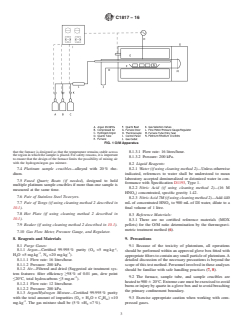
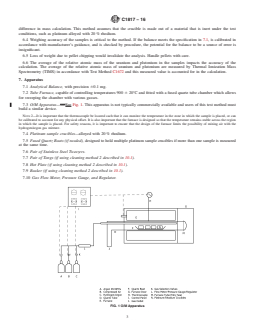
7.3 O/M Apparatus—seeSee Fig. 1. This apparatus is not typically commercially available and users of this test method must
build a similar device.
NOTE 2—It is important that the thermocouple be located such that it can monitor the temperature in the zone in which the sample is placed, or can
be calibrated to account for any physical offset. It is also important that the furnace is designed so that the temperature remains stable across the region
in which the sample is placed. For safety reasons, it is important to ensure that the design of the furnace limits the possibility of mixing air with the
hydrogen/argon gas mixture.
7.4 Platinum sample crucibles—alloyed with 20 % rhodium.
7.5 Fused Quartz Boats (if needed), designed to hold multiple platinum sample crucibles if more than one sample is measured
at the same time.
7.6 Pair of Stainless Steel Tweezers.
7.7 Pair of Tongs (if using cleaning method 2 described in 10.1).
7.8 Hot Plate (if using cleaning method 2 described in 10.1).
7.9 Beaker (if using cleaning method 2 described in 10.1).
7.10 Gas Flow Meter, Pressure Gauge, and Regulator.
FIG. 1 O/M Apparatus
C1817 − 16
8. Reagents and Materials
8.1 Purge Gases:
-1 -1 -1
8.1.1 Argon—Certified 99.995 % purity (O <5 mg.kg , H O <5 mg.kg , N <20 mg.kg ).
2 2 2
8.1.1.1 Flow rate: 16 litres/hour.
8.1.1.2 Pressure: 200 kPa.
-1
8.1.2 Air—Certified Synthetic (OFiltered and dried : 20-23 %, Moisture <5 mg.kg (Suggested air treatment system , Total
-1-3
Hydrocarbons <2 mg.kg features: filter efficiency ≥98 % of 0.01 μm, dew point ≤20°C, total hydrocarbons ≤5 mg.m ).
8.1.2.1 Flow rate: 12 litres/hour.
8.1.2.2 Pressure: 200 kPa.
-1
8.1.3 Argon/Hydrogen Mixture—Certified 99.995 % purity with the total amount of impurities (O + H O + C H ) <10 mg.kg .
2 2 n m
The gas mixture shall be (5 %
8.1.3.1 Flow rate: 16 litres/hour.
8.1.3.2 Pressure: 200 kPa.
8.
...