

ASTM E3087-18
(Test Method)Standard Test Method for Measuring Capture Efficiency of Domestic Range Hoods
General Information
- Abstract
SIGNIFICANCE AND USE
5.1 Cooking can be one of the most polluting activities commonly and regularly occurring in residential environments. Capturing airborne cooking contaminants before they can mix with the indoor air is a critical indoor air quality control method.
5.2 Range hoods are used in homes to remove cooking-generated contaminants above cooking surfaces before they mix with air in the rest of the house. This test method is used to measure the capture efficiency under specific conditions that permit comparisons and ratings of range hoods.
5.3 Range hoods may be manufactured and intended to operate at different flow rates or using different inserts such as filters. This test method may be used to determine capture efficiency over the range of rated air flows and operating configurations of a range hood. The rated air flows shall be listed and shall be tested in accordance with HVI Test Procedure 916, IEC 61591, ASHRAE 51/AMCA 210, or equivalent. The maximum air flow allowed for this test method is 200 L/s.
SCOPE
1.1 This test method measures the capture efficiency of wall-mounted domestic range hoods under controlled conditions in a test chamber.
1.2 This test method applies to range hoods that exhaust air to outside and does not apply to recirculating range hoods.
1.3 This test method only applies to range hood air flows up to 200 L/s and widths up to 0.91 m (36 in.).
1.4 This test method is intended to quantify the capture efficiency of range hoods under controlled laboratory conditions suitable for rating.
1.5 The values stated in SI units are to be regarded as standard. If a value for measurement is followed by a value in other units in parentheses, the second value may be approximate. The first stated value is the requirement.
1.6 This standard does not purport to address all of the safety concerns, if any, associated with its use. It is the responsibility of the user of this standard to establish appropriate safety, health, and environmental practices and determine the applicability of regulatory limitations prior to use.
1.7 This international standard was developed in accordance with internationally recognized principles on standardization established in the Decision on Principles for the Development of International Standards, Guides and Recommendations issued by the World Trade Organization Technical Barriers to Trade (TBT) Committee.
- Status
- Published
- Publication Date
- 30-Sep-2018
- Technical Committee
- E06 - Performance of Buildings
- Drafting Committee
- E06.41 - Air Leakage and Ventilation Performance
Overview
ASTM E3087-18 is the Standard Test Method for Measuring Capture Efficiency of Domestic Range Hoods, developed by ASTM International. This standard provides a rigorous, laboratory-based methodology for evaluating how efficiently wall-mounted residential kitchen range hoods capture and exhaust cooking-generated air contaminants. By measuring capture efficiency under controlled conditions, the standard enables the comparison and rating of different range hood products, supporting improved indoor air quality (IAQ) in homes.
Capture efficiency testing, as defined in ASTM E3087-18, is critical for preventing airborne pollutants produced during cooking from dispersing into living spaces. Residential range hoods exhaust air outside the home, ensuring that contaminants are effectively removed before they can affect indoor environments.
Key Topics
Scope and Applicability
- Applies exclusively to wall-mounted domestic range hoods that vent to the exterior.
- Not applicable for recirculating range hoods.
- Coverage includes hoods with a maximum air flow of 200 L/s and up to 0.91 m (36 in.) in width.
- Tests are conducted in controlled laboratory test chambers.
Test Methodology
- Utilizes tracer gas techniques to quantify the fraction of contaminants captured and exhausted by the range hood.
- Laboratory conditions ensure reproducible, accurate assessments suitable for product ratings and comparison.
- The test follows established airflow measurement procedures consistent with HVI 916, IEC 61591, and ASHRAE 51/AMCA 210.
Reporting Requirements
- Specifies detailed reporting of test chamber dimensions, equipment calibration, operational parameters, and measured results.
- Results include installed height, air flow rate, temperatures, tracer gas concentrations, capture efficiency, and uncertainties.
Significance for Indoor Air Quality (IAQ)
- Provides a standardized approach to evaluating the removal of cooking pollutants-a major IAQ concern.
- Supports manufacturers, regulators, and consumers in making informed decisions regarding kitchen ventilation.
Applications
ASTM E3087-18 is widely used by:
Appliance Manufacturers
- To assess the performance of new or existing range hood models and verify product claims.
- For product development, certification, and quality assurance.
Testing Laboratories
- As a uniform protocol for laboratory measurement of range hood capture efficiency.
- For third-party verification and compliance testing.
Regulators and Code Officials
- To support health and safety policies on residential ventilation.
- As a reference in establishing IAQ-related building codes and standards.
Designers and Builders
- In selecting range hood equipment that meets specific performance criteria for residential projects.
Ensuring compliance with ASTM E3087-18 helps improve kitchen ventilation, reduce indoor pollutant exposure, and enhance overall indoor air quality.
Related Standards
- ASTM E631 - Terminology of Building Constructions
- HVI 916 - Home Ventilating Institute Airflow Test Procedure
- ASHRAE 51/AMCA 210 - Laboratory Methods of Testing Fans for Certified Aerodynamic Performance Rating
- IEC 61591 - Household Range Hoods - Methods for Measuring Performance
These related documents underpin the airflow and measurement principles essential to the capture efficiency test method, forming a cohesive framework for residential kitchen ventilation performance assessment.
Keywords: ASTM E3087-18, range hood capture efficiency, indoor air quality, kitchen ventilation, tracer gas, residential, laboratory testing, airflow measurement, HVI 916, IEC 61591, ASHRAE 51/AMCA 210
Relations
- Replaces
ASTM E3087-17 - Standard Test Method for Measuring Capture Efficiency of Domestic Range Hoods - Effective Date
- 01-Oct-2018
- Effective Date
- 01-Mar-2015
- Effective Date
- 01-Nov-2014
- Effective Date
- 01-Jun-2006
- Effective Date
- 28-Jul-2000
Frequently Asked Questions
ASTM E3087-18 is a standard published by ASTM International. Its full title is "Standard Test Method for Measuring Capture Efficiency of Domestic Range Hoods". This standard covers: SIGNIFICANCE AND USE 5.1 Cooking can be one of the most polluting activities commonly and regularly occurring in residential environments. Capturing airborne cooking contaminants before they can mix with the indoor air is a critical indoor air quality control method. 5.2 Range hoods are used in homes to remove cooking-generated contaminants above cooking surfaces before they mix with air in the rest of the house. This test method is used to measure the capture efficiency under specific conditions that permit comparisons and ratings of range hoods. 5.3 Range hoods may be manufactured and intended to operate at different flow rates or using different inserts such as filters. This test method may be used to determine capture efficiency over the range of rated air flows and operating configurations of a range hood. The rated air flows shall be listed and shall be tested in accordance with HVI Test Procedure 916, IEC 61591, ASHRAE 51/AMCA 210, or equivalent. The maximum air flow allowed for this test method is 200 L/s. SCOPE 1.1 This test method measures the capture efficiency of wall-mounted domestic range hoods under controlled conditions in a test chamber. 1.2 This test method applies to range hoods that exhaust air to outside and does not apply to recirculating range hoods. 1.3 This test method only applies to range hood air flows up to 200 L/s and widths up to 0.91 m (36 in.). 1.4 This test method is intended to quantify the capture efficiency of range hoods under controlled laboratory conditions suitable for rating. 1.5 The values stated in SI units are to be regarded as standard. If a value for measurement is followed by a value in other units in parentheses, the second value may be approximate. The first stated value is the requirement. 1.6 This standard does not purport to address all of the safety concerns, if any, associated with its use. It is the responsibility of the user of this standard to establish appropriate safety, health, and environmental practices and determine the applicability of regulatory limitations prior to use. 1.7 This international standard was developed in accordance with internationally recognized principles on standardization established in the Decision on Principles for the Development of International Standards, Guides and Recommendations issued by the World Trade Organization Technical Barriers to Trade (TBT) Committee.
SIGNIFICANCE AND USE 5.1 Cooking can be one of the most polluting activities commonly and regularly occurring in residential environments. Capturing airborne cooking contaminants before they can mix with the indoor air is a critical indoor air quality control method. 5.2 Range hoods are used in homes to remove cooking-generated contaminants above cooking surfaces before they mix with air in the rest of the house. This test method is used to measure the capture efficiency under specific conditions that permit comparisons and ratings of range hoods. 5.3 Range hoods may be manufactured and intended to operate at different flow rates or using different inserts such as filters. This test method may be used to determine capture efficiency over the range of rated air flows and operating configurations of a range hood. The rated air flows shall be listed and shall be tested in accordance with HVI Test Procedure 916, IEC 61591, ASHRAE 51/AMCA 210, or equivalent. The maximum air flow allowed for this test method is 200 L/s. SCOPE 1.1 This test method measures the capture efficiency of wall-mounted domestic range hoods under controlled conditions in a test chamber. 1.2 This test method applies to range hoods that exhaust air to outside and does not apply to recirculating range hoods. 1.3 This test method only applies to range hood air flows up to 200 L/s and widths up to 0.91 m (36 in.). 1.4 This test method is intended to quantify the capture efficiency of range hoods under controlled laboratory conditions suitable for rating. 1.5 The values stated in SI units are to be regarded as standard. If a value for measurement is followed by a value in other units in parentheses, the second value may be approximate. The first stated value is the requirement. 1.6 This standard does not purport to address all of the safety concerns, if any, associated with its use. It is the responsibility of the user of this standard to establish appropriate safety, health, and environmental practices and determine the applicability of regulatory limitations prior to use. 1.7 This international standard was developed in accordance with internationally recognized principles on standardization established in the Decision on Principles for the Development of International Standards, Guides and Recommendations issued by the World Trade Organization Technical Barriers to Trade (TBT) Committee.
ASTM E3087-18 is classified under the following ICS (International Classification for Standards) categories: 97.040.20 - Cooking ranges, working tables, ovens and similar appliances. The ICS classification helps identify the subject area and facilitates finding related standards.
ASTM E3087-18 has the following relationships with other standards: It is inter standard links to ASTM E3087-17, ASTM E631-15, ASTM E631-14, ASTM E631-06, ASTM E631-93a(1998)e1. Understanding these relationships helps ensure you are using the most current and applicable version of the standard.
ASTM E3087-18 is available in PDF format for immediate download after purchase. The document can be added to your cart and obtained through the secure checkout process. Digital delivery ensures instant access to the complete standard document.
Standards Content (Sample)
This international standard was developed in accordance with internationally recognized principles on standardization established in the Decision on Principles for the
Development of International Standards, Guides and Recommendations issued by the World Trade Organization Technical Barriers to Trade (TBT) Committee.
Designation: E3087 − 18
Standard Test Method for
Measuring Capture Efficiency of Domestic Range Hoods
This standard is issued under the fixed designation E3087; the number immediately following the designation indicates the year of
original adoption or, in the case of revision, the year of last revision. A number in parentheses indicates the year of last reapproval. A
superscript epsilon (´) indicates an editorial change since the last revision or reapproval.
1. Scope 2.2 Other Standards:
HVI Publication 916 HVI Airflow Test Procedure
1.1 This test method measures the capture efficiency of
ASHRAE 51/AMCA 210 Laboratory Methods of Testing
wall-mounted domestic range hoods under controlled condi-
Fans for Certified Aerodynamic Performance Rating
tions in a test chamber.
IEC 61591 Household range hoods - Methods for measuring
performance
1.2 This test method applies to range hoods that exhaust air
to outside and does not apply to recirculating range hoods.
3. Terminology
1.3 This test method only applies to range hood air flows up
3.1 Definitions: For definitions used in this test method not
to 200 L/s and widths up to 0.91 m (36 in.).
otherwise defined below, refer to Terminology E631.
3.1.1 capture effıciency, n—the fraction of emitted tracer gas
1.4 This test method is intended to quantify the capture
that is directly exhausted by the range hood to be tested.
efficiency of range hoods under controlled laboratory condi-
tions suitable for rating.
3.1.2 range hood, n—a device for capturing cooking-
generated contaminants over a stove, range or cooktop, and
1.5 The values stated in SI units are to be regarded as
exhausting the contaminants to outside the building.
standard. If a value for measurement is followed by a value in
other units in parentheses, the second value may be approxi-
4. Summary of Test Method
mate. The first stated value is the requirement.
4.1 This method measures the capture efficiency of a range
1.6 This standard does not purport to address all of the
hood using tracer gas techniques in a defined test chamber.
safety concerns, if any, associated with its use. It is the
4.2 A tracer gas is emitted at the test surface at a fixed rate
responsibility of the user of this standard to establish appro-
with the range hood to be tested operating at specified
priate safety, health, and environmental practices and deter-
conditions.
mine the applicability of regulatory limitations prior to use.
4.3 Theconcentrationofthetracergasintheexhauststream
1.7 This international standard was developed in accor-
of the range hood, the test chamber and air entering the test
dance with internationally recognized principles on standard-
chamber are measured and used to determine the capture
ization established in the Decision on Principles for the
efficiency under steady-state conditions.
Development of International Standards, Guides and Recom-
mendations issued by the World Trade Organization Technical
5. Significance and Use
Barriers to Trade (TBT) Committee.
5.1 Cooking can be one of the most polluting activities
commonlyandregularlyoccurringinresidentialenvironments.
2. Referenced Documents
Capturing airborne cooking contaminants before they can mix
2.1 ASTM Standard:
with the indoor air is a critical indoor air quality control
E631 Terminology of Building Constructions
method.
5.2 Range hoods are used in homes to remove cooking-
generated contaminants above cooking surfaces before they
This test method is under the jurisdiction of ASTM Committee E06 on
Performance of Buildings and is the direct responsibility of Subcommittee E06.41
on Air Leakage and Ventilation Performance. Available from Home Ventilating Institute (HVI), 1740 Dell Range Blvd., Ste.
Current edition approved Oct. 1, 2018. Published October 2018. Originally H, PMB 450, Cheyenne, WY 82009, http://www.hvi.org.
approved in 2017. Last previous edition approved in 2017 as E3087–17. DOI: Available from American Society of Heating, Refrigerating, and Air-
10.1520/E3087–18. Conditioning Engineers, Inc. (ASHRAE), 1791 Tullie Circle, NE, Atlanta, GA
For referenced ASTM standards, visit the ASTM website, www.astm.org, or 30329, http://www.ashrae.org.
contact ASTM Customer Service at service@astm.org. For Annual Book of ASTM Available from International Electrotechnical Commission (IEC), 3, rue de
Standards volume information, refer to the standard’s Document Summary page on Varembé, 1st Floor, P.O. Box 131, CH-1211, Geneva 20, Switzerland, http://
the ASTM website. www.iec.ch.
Copyright © ASTM International, 100 Barr Harbor Drive, PO Box C700, West Conshohocken, PA 19428-2959. United States
E3087 − 18
mix with air in the rest of the house. This test method is used The test chamber shall have less than 2.5 Air Changes per
to measure the capture efficiency under specific conditions that Hour at 50 Pa leakage.
permit comparisons and ratings of range hoods.
6.1.3 The test chamber shall have one or more air inlets in
the test chamber.
5.3 Range hoods may be manufactured and intended to
6.1.3.1 The air inlets shall be sized so that the maximum air
operate at different flow rates or using different inserts such as
flow through the range hood depressurizes the test chamber by
filters. This test method may be used to determine capture
less than 5 Pa.
efficiency over the range of rated air flows and operating
configurations of a range hood. The rated air flows shall be 6.1.3.2 The inlets shall be constructed so that the air coming
listed and shall be tested in accordance with HVI Test through them will not directly impinge on the range hood or
Procedure 916, IEC 61591, ASHRAE 51/AMCA 210, or tracer gas emitters, incoming air is directed away from the wall
equivalent.The maximum air flow allowed for this test method where the range hood is mounted, and there is at least a 1 m
is 200 L/s. separationbetweentheairinletandtherangehoodbeingtested
or the cooktop, or both.
6. Apparatus for Wall-Mounted Range Hoods
6.1.3.3 The inlets shall be sized to have an average inlet
6.1 Test Chamber:
velocity less than 0.5 m/s. A diffuser shall be used on the air
6.1.1 The capture efficiency testing shall be performed
inlets to ensure uniform air flow entering the test chamber.The
inside a test chamber. The chamber shall have minimum wall
inlets shall be constructed such that air flow does not impinge
lengths of 2.5 m and 3.5 m. The wall height shall be 2.4 to
directly on the range hood being tested or on the area between
2.5 m. The volume (V) of the test chamber shall be calculated.
the range hood and the cooktop.
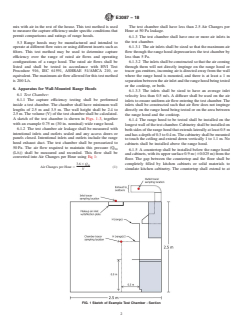
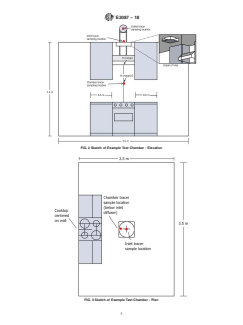
A sketch of the test chamber is shown in Figs. 1-3, together
6.1.4 The range hood to be tested shall be installed on the
with an example 0.75 m (30 in. nominal) wide range hood.
longestwallofthetestchamber.Cabinetryshallbeinstalledon
6.1.2 The test chamber air leakage shall be measured with
bothsidesoftherangehoodthatextendslaterallyatleast0.5 m
intentional inlets and outlets sealed and any access doors or
andhasadepthof0.3to0.4m.Thecabinetryshallbemounted
panels closed. Intentional inlets and outlets include the range
to touch the ceiling and extend down vertically 1 to 1.1 m. No
hood exhaust duct. The test chamber shall be pressurized to
cabinets shall be installed above the range hood.
50 Pa. The air flow required to maintain this pressure (Q
6.1.5 A countertop shall be installed below the range hood
(L/s)) shall be measured and recorded. This flow shall be
and cabinets, with its upper surface 0.9 m (60.025 m) from the
converted into Air Changes per Hour using Eq 1:
floor. The gap between the countertop and the floor shall be
3.6 3Q completely filled by kitchen cabinets or solid materials to
Air Changes per Hour 5 (1)
V simulate kitchen cabinetry. The countertop shall extend to at
FIG. 1 Sketch of Example Test Chamber - Section
E3087 − 18
FIG. 2 Sketch of Example Test Chamber - Elevation
FIG. 3 Sketch of Example Test Chamber - Plan
E3087 − 18
least 0.5 m on each side of the range hood and have a depth of tracer gas injection shall be less than 0.5 % of the air flow
from the wall of 0.65 m (60.025 m). through the range hood.
6.2.6 For 0.61 m (24 in. nominal) wide hoods, the tests shall
6.2 Electric Heating Elements, Tracer Gas Emitters, and
be performed using two emitter/pan/heating element locations
Tracer Gas Sample Locations:
simultaneously.The emitters shall be located with the center of
6.2.1 Each electric heating element shall be 200 6 10 mm
the emitters 500 mm (625 mm) from the back wall and
in diameter. The electric heating elements shall be coil ele-
ments (not induction or hot plate). For hoods up to 0.75 m 150 mm (610 mm) to the left and right of the centerline of the
(30 in. nominal) wide, two non-induction electric surface range hood. For 0.75 m (30 in. nominal) wide hoods, the tests
heating elements shall be used for testing. For hoods greater shall be performed using two emitter/pan/heating element
than 0.75 m (30 in. nominal) range hoods, three non-induction locationssimultaneously.Theemittersshallbelocatedwiththe
electric surface heating elements shall be used for testing.
center of the emitters 500 mm (625 mm) from the back wall
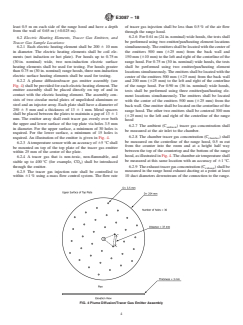
6.2.2 A plume diffusion/tracer gas emitter assembly (see
and 200 mm (625 mm) to the left and right of the centerline
Fig. 4) shall be provided for each electric heating element. The
of the range hood. For 0.90 m (36 in. nominal) wide hoods,
emitter assembly shall be placed directly on top of and in
tests shall be performed using three emitter/pan/heating ele-
contact with the electric heating element. The assembly con-
ment locations simultaneously. The emitters shall be located
sists of two circular metal plates of unpolished aluminum or
with the center of the emitters 500 mm (625 mm) from the
steel and an injector array. Each plate shall have a diameter of
back wall. One emitter shall be located on the centerline of the
250 6 5 mm and a thickness of 13 6 1 mm. Metal spacers
range hood. The other two emitters shall be centered 300 mm
shall be placed between the plates to maintain a gap of 13 6 1
(625 mm) to the left and right of the centerline of the range
mm. The emitter array shall emit tracer gas evenly over both
hood
the upper and lower
...
This document is not an ASTM standard and is intended only to provide the user of an ASTM standard an indication of what changes have been made to the previous version. Because
it may not be technically possible to adequately depict all changes accurately, ASTM recommends that users consult prior editions as appropriate. In all cases only the current version
of the standard as published by ASTM is to be considered the official document.
Designation: E3087 − 17 E3087 − 18
Standard Test Method for
Measuring Capture Efficiency of Domestic Range Hoods
This standard is issued under the fixed designation E3087; the number immediately following the designation indicates the year of
original adoption or, in the case of revision, the year of last revision. A number in parentheses indicates the year of last reapproval. A
superscript epsilon (´) indicates an editorial change since the last revision or reapproval.
1. Scope
1.1 This test method measures the capture efficiency of wall-mounted domestic range hoods under controlled conditions in a
test chamber.
1.2 This test method applies to range hoods that exhaust air to outside and does not apply to recirculating range hoods.
1.3 This test method only applies to range hood air flows up to 200 L/s and widths up to 0.91 m (36 in.).
1.4 This test method is intended to quantify the capture efficiency of range hoods under controlled laboratory conditions suitable
for rating.
1.5 The values stated in SI units are to be regarded as standard. If a value for measurement is followed by a value in other units
in parentheses, the second value may be approximate. The first stated value is the requirement.
1.6 This standard does not purport to address all of the safety concerns, if any, associated with its use. It is the responsibility
of the user of this standard to establish appropriate safety, health, and environmental practices and determine the applicability of
regulatory limitations prior to use.
1.7 This international standard was developed in accordance with internationally recognized principles on standardization
established in the Decision on Principles for the Development of International Standards, Guides and Recommendations issued
by the World Trade Organization Technical Barriers to Trade (TBT) Committee.
2. Referenced Documents
2.1 ASTM Standard:
E631 Terminology of Building Constructions
2.2 Other Standards:
HVI Publication 916 HVI Airflow Test Procedure
ASHRAE 51/AMCA 210 Laboratory Methods of Testing Fans for Certified Aerodynamic Performance Rating
IEC 61591 Household range hoods - Methods for measuring performance
3. Terminology
3.1 Definitions: For definitions used in this test method not otherwise defined below, refer to Terminology E631.
3.1.1 capture effıciency, n—the fraction of emitted tracer gas that is directly exhausted by the range hood to be tested.
3.1.2 range hood, n—a device for capturing cooking-generated contaminants over a stove, range or cooktop, and exhausting the
contaminants to outside the building.
4. Summary of Test Method
4.1 This method measures the capture efficiency of a range hood using tracer gas techniques in a defined test chamber.
4.2 A tracer gas is emitted at the test surface at a fixed rate with the range hood to be tested operating at specified conditions.
This test method is under the jurisdiction of ASTM Committee E06 on Performance of Buildings and is the direct responsibility of Subcommittee E06.41 on Air Leakage
and Ventilation Performance.
Current edition approved Oct. 1, 2017Oct. 1, 2018. Published November 2017October 2018. Originally approved in 2017. Last previous edition approved in 2017 as
E3087–17. DOI: 10.1520/E3087-17.10.1520/E3087–18.
For referenced ASTM standards, visit the ASTM website, www.astm.org, or contact ASTM Customer Service at service@astm.org. For Annual Book of ASTM Standards
volume information, refer to the standard’s Document Summary page on the ASTM website.
Available from Home Ventilating Institute (HVI), 1740 Dell Range Blvd., Ste. H, PMB 450, Cheyenne, WY 82009, http://www.hvi.org.
Available from American Society of Heating, Refrigerating, and Air-Conditioning Engineers, Inc. (ASHRAE), 1791 Tullie Circle, NE, Atlanta, GA 30329,
http://www.ashrae.org.
Available from International Electrotechnical Commission (IEC), 3, rue de Varembé, 1st Floor, P.O. Box 131, CH-1211, Geneva 20, Switzerland, http://www.iec.ch.
Copyright © ASTM International, 100 Barr Harbor Drive, PO Box C700, West Conshohocken, PA 19428-2959. United States
E3087 − 18
4.3 The concentration of the tracer gas in the exhaust stream of the range hood, the test chamber and air entering the test
chamber are measured and used to determine the capture efficiency under steady-state conditions.
5. Significance and Use
5.1 Cooking can be one of the most polluting activities commonly and regularly occurring in residential environments.
Capturing airborne cooking contaminants before they can mix with the indoor air is a critical indoor air quality control method.
5.2 Range hoods are used in homes to remove cooking-generated contaminants above cooking surfaces before they mix with
air in the rest of the house. This test method is used to measure the capture efficiency under specific conditions that permit
comparisons and ratings of range hoods.
5.3 Range hoods may be manufactured and intended to operate at different flow rates or using different inserts such as filters.
This test method may be used to determine capture efficiency over the range of rated air flows and operating configurations of a
range hood. The rated air flows shall be listed and shall be tested in accordance with HVI Test Procedure 916, IEC 61591,
ASHRAE 51/AMCA 210, or equivalent. The maximum air flow allowed for this test method is 200 L/s.
6. Apparatus for Wall-Mounted Range Hoods
6.1 Test Chamber:
6.1.1 The capture efficiency testing shall be performed inside a test chamber. The chamber shall have minimum wall lengths
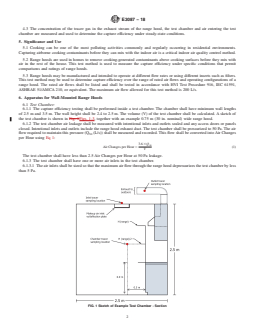
of 2.5 m and 3.5 m. The wall height shall be 2.4 to 2.5 m. The volume (V) of the test chamber shall be calculated. A sketch of
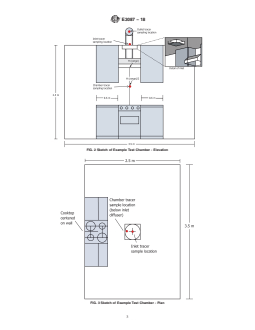
the test chamber is shown in Fig. 1Figs. 1-3, together with an example 0.75 m (30 in. nominal) wide range hood.
6.1.2 The test chamber air leakage shall be measured with intentional inlets and outlets sealed and any access doors or panels
closed. Intentional inlets and outlets include the range hood exhaust duct. The test chamber shall be pressurized to 50 Pa. The air
flow required to maintain this pressure (Q (L/s)) shall be measured and recorded. This flow shall be converted into Air Changes
per Hour using Eq 1:
3.6 3Q
Air Changes per Hour 5 (1)
V
The test chamber shall have less than 2.5 Air Changes per Hour at 50 Pa leakage.
6.1.3 The test chamber shall have one or more air inlets in the test chamber.
6.1.3.1 The air inlets shall be sized so that the maximum air flow through the range hood depressurizes the test chamber by less
than 5 Pa.
FIG. 1 Sketch of Example Test Chamber - Section
E3087 − 18
FIG. 2 Sketch of Example Test Chamber - Elevation
FIG. 3 Sketch of Example Test Chamber - Plan
E3087 − 18
6.1.3.2 The inlets shall be constructed so that the air coming through them will not directly impinge on the range hood or tracer
gas emitters, incoming air is directed away from the wall where the range hood is mounted, and there is at least a 1 m separation
between the air inlet and the range hood being tested or the cooktop, or both.
6.1.3.3 The inlets shall be sized to have an average inlet velocity less than 0.5 m/s. A diffuser shall be used on the air inlets to
ensure uniform air flow entering the test chamber. The inlets shall be constructed such that air flow does not impinge directly on
the range hood being tested or on the area between the range hood and the cooktop.
6.1.4 The range hood to be tested shall be installed on the longest wall of the test chamber. Cabinetry shall be installed on both
sides of the range hood that extends laterally at least 0.5 m and has a depth of 0.3 to 0.4 m. The cabinetry shall be mounted to
touch the ceiling and extend down vertically 1 to 1.1 m. No cabinets shall be installed above the range hood.
6.1.5 A countertop shall be installed below the range hood and cabinets, with its upper surface 0.9 m (60.025 m) from the floor.
The gap between the countertop and the floor shall be completely filled by kitchen cabinets or solid materials to simulate kitchen
cabinetry. The countertop shall extend to at least 0.5 m on each side of the range hood and have a depth from the wall of
0.65 m.0.65 m (60.025 m).
6.2 Electric Heating Elements, Tracer Gas Emitters, and Tracer Gas Sample Locations:
6.2.1 Each electric heating element shall be 200 6 10 mm in diameter. The average power input for each electric heating
element during the test shall be 1.0 6 0.1 kW. For 0.61 m (24 in. nominal) and 0.75 m (30 in. nominal) wide range hoods, electric
heating elements shall be coil elements (not induction or hot plate). For hoods up to 0.75 m (30 in. nominal) wide, two
non-induction electric surface heating elements shall be used for testing. For 0.90 m (36 hoods greater than 0.75 m (30 in. nominal)
range hoods, three non-induction electric surface heating elements shall be used for testing.
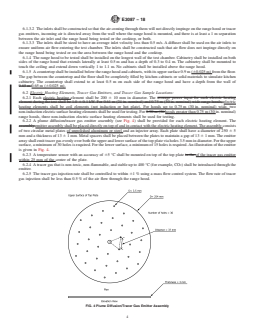
6.2.2 A plume diffusion/tracer gas emitter assembly (see Fig. 4) shall be provided for each electric heating element. The
assembly emitter assembly shall be placed directly on top of and in contact with the electric heating element. The assembly consists
of two circular metal plates of unpolished aluminum or steel and an injector array. Each plate shall have a diameter of 250 6 5
mm and a thickness of 13 6 1 mm. Metal spacers shall be placed between the plates to maintain a gap of 13 6 1 mm. The emitter
array shall emit tracer gas evenly over both the upper and lower surface of the top plate via holes 3.5 mm in diameter. For the upper
surface, a minimum of 30 holes is required. For the lower surface, a minimum of 15 holes is required. An illustration of the emitter
is given in Fig. 4.
6.2.3 A temperature sensor with an accuracy of 65 °C shall be mounted on top of the top plate in the of the tracer gas emitter
within 25 mm of the center of the plate.
6.2.4 A tracer gas that is non-toxic, non-flammable, and stable up to 400 °C (for example, CO ) shall be introduced through the
emitter.
6.2.5 The tracer gas injection rate shall be controlled to within 61 % using a mass flow control system. The flow rate of tracer
gas injection shall be less than 0.5 % of the air flow through the range hood.
FIG. 4 Plume Diffusion/Tracer Gas Emitter Assembly
E3087 − 18
FIG. 4 Plume Diffusion/Tracer Gas Emitter Assembly (continued)
FIG. 4 Plume Diffusion/Tracer Gas Emitter Assembly (continued)
6.2.6 For 0.61 m (24 in. nominal) wide hoods, the tests shall be performed using two emitter/pan/heating element locations
simultaneously. The emitt
...