

ASTM E631-15
(Terminology)Standard Terminology of Building Constructions
General Information
- Abstract
SCOPE
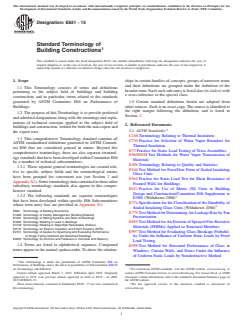
1.1 This Terminology consists of terms and definitions pertaining to the subject field of buildings and building construction, and in particular, terms related to the standards generated by ASTM Committee E06 on Performance of Buildings.
1.2 The purpose of this Terminology is to provide preferred and admitted designations along with the meanings and explanations of technical concepts applied in the subject field of buildings and construction, written for both the non-expert and the expert user.
1.3 This comprehensive Terminology standard contains all ASTM standardized definitions generated in ASTM Committee E06 that are considered general in nature. Beyond this comprehensive terminology, there are also separate terminology standards that have been developed within Committee E06 by a number of technical subcommittees.
1.3.1 These separate general terminologies are created relative to specific subject fields and the terminological entries have been grouped for convenient use (see Section 2 and Appendix X1). Some terminology data contained in those other subsidiary terminology standards also appear in this comprehensive standard.
1.3.2 The following standards are separate terminologies that have been developed within specific E06 Subcommittees whose term entry lists are provided in Appendix X1:
E833
Terminology of Building Economics
E1480
Terminology of Facility Management (Building-Related)
E1481
Terminology of Railing Systems and Rails for Buildings
E1605
Terminology Relating to Lead in Buildings
E1749
Terminology Relating to Rigid Wall Relocatable Shelters
E2110
Terminology for Exterior Insulation and Finish Systems (EIFS)
E2151
Terminology of Guides for Specifying and Evaluating Performance
of Single Family Attached and Detached Dwellings
E2265
Terminology for Anchors and Fasteners in Concrete and Masonry
1.4 Terms are listed in alphabetical sequence. Compound terms appear in the natural spoken order. To show the relationships in certain families of concepts, groups of narrower terms and their definitions are grouped under the definition of the broader term. Each such sub-entry is listed also (in italics) with a cross-reference to the special class.
1.5 Certain standard definitions herein are adopted from other sources. Each is an exact copy. The source is identified at the right margin following the definition, and is listed in Section 2.
- Status
- Published
- Publication Date
- 28-Feb-2015
- Technical Committee
- E06 - Performance of Buildings
- Drafting Committee
- E06.94 - Terminology and Editorial
Overview
ASTM E631-15: Standard Terminology of Building Constructions is a comprehensive terminology standard developed by ASTM International. The standard provides clear definitions and preferred designations for terms related to buildings and building construction, with a specific emphasis on terminology used in standards produced by ASTM Committee E06 on Performance of Buildings. ASTM E631-15 is designed for use by professionals, regulatory bodies, and non-experts, ensuring consistent and unambiguous communication within the construction industry.
The terminology in this standard covers a wide range of building construction concepts, including materials, components, methods, systems, building performance, and modifications. Terms are presented in an accessible, alphabetical format, with detailed explanations and cross-references that enhance user understanding.
Key Topics
- Standardized Building Terminology: Definitions for terms related to general building construction, ensuring consistency across various ASTM E06 standards.
- Building Types and Structures: Clear distinctions between buildings, building spaces, building components, and subsystems.
- Performance and Serviceability: Terms addressing building performance, durability, and serviceability.
- Building Envelope and Systems: Definitions relevant to the building envelope, insulation, air leakage, and system integration.
- Modification and Preservation: Terminology for building modifications, permits, and preservation activities.
- Testing and Measurement: Key descriptors for methods and practices in evaluating building components and systems, such as air leakage rate and tightness.
- Cross-referencing to Other Standards: Many definitions reference other ASTM standards, aiding in comprehensive understanding.
Applications
ASTM E631-15 is invaluable for a variety of stakeholders in the building and construction industry:
- Architects and Engineers: Use the standard to ensure that project documentation employs industry-accepted terminology, reducing the risk of miscommunication in design, specification, and construction phases.
- Code Officials and Inspectors: Refer to ASTM E631-15 for authoritative definitions when reviewing building plans, permits, and code compliance.
- Manufacturers and Suppliers: Standardized terms facilitate clear specifications for materials, components, and products.
- Contractors and Builders: Utilize the terminology to accurately interpret project requirements and communicate effectively with clients and officials.
- Educators and Students: An essential reference for academic programs in construction, architecture, and engineering, supporting teaching and research.
- Legal and Regulatory Professionals: The standard’s precise definitions assist with the interpretation of contracts, building codes, and regulatory requirements.
The terminology provided by ASTM E631-15 helps unify language across construction documents, regulatory materials, and technical standards, leading to higher quality outcomes and safer, more reliable buildings.
Related Standards
ASTM E631-15 references or complements several additional terminology standards developed by specific ASTM E06 subcommittees, including:
- ASTM E833: Terminology of Building Economics
- ASTM E1480: Terminology of Facility Management (Building-Related)
- ASTM E1481: Terminology of Railing Systems and Rails for Buildings
- ASTM E1605: Terminology Relating to Lead in Buildings
- ASTM E1749: Terminology Relating to Rigid Wall Relocatable Shelters
- ASTM E2110: Terminology for Exterior Insulation and Finish Systems (EIFS)
- ASTM E2151: Terminology of Guides for Specifying and Evaluating Performance of Single Family Attached and Detached Dwellings
- ASTM E2265: Terminology for Anchors and Fasteners in Concrete and Masonry
Additionally, other referenced standards provide further detail in areas such as thermal insulation (ASTM C168), testing methodologies, and building material performance.
Summary
ASTM E631-15 serves as the foundational resource for standardized building construction terminology. By adopting its definitions and preferred terms, stakeholders in all realms of the construction industry can enhance communication, reduce errors, and ensure compliance with relevant codes and standards. This terminology standard is a key instrument for promoting clarity, safety, and efficiency in building construction projects.
Relations
- Effective Date
- 01-Mar-2015
- Effective Date
- 15-Apr-2024
- Effective Date
- 01-Apr-2024
- Effective Date
- 01-Apr-2024
- Effective Date
- 01-Mar-2024
- Effective Date
- 01-Mar-2024
- Effective Date
- 01-Mar-2024
- Effective Date
- 01-Mar-2024
- Effective Date
- 15-Nov-2023
- Effective Date
- 01-Oct-2023
- Effective Date
- 01-Apr-2022
- Refers
ASTM C755-20 - Standard Practice for Selection of Water Vapor Retarders for Thermal Insulation - Effective Date
- 01-Mar-2020
- Refers
ASTM C755-19b - Standard Practice for Selection of Water Vapor Retarders for Thermal Insulation - Effective Date
- 15-Oct-2019
- Refers
ASTM C755-19a - Standard Practice for Selection of Water Vapor Retarders for Thermal Insulation - Effective Date
- 01-Sep-2019
- Refers
ASTM C755-19 - Standard Practice for Selection of Water Vapor Retarders for Thermal Insulation - Effective Date
- 15-Apr-2019
Get Certified
Connect with accredited certification bodies for this standard

DIBt (Deutsches Institut für Bautechnik)
German Institute for Building Technology.
DIN CERTCO
DIN Group product certification.

Aboma Certification B.V.
Specialized in construction, metal, and transport sectors.
Sponsored listings
Frequently Asked Questions
ASTM E631-15 is a standard published by ASTM International. Its full title is "Standard Terminology of Building Constructions". This standard covers: SCOPE 1.1 This Terminology consists of terms and definitions pertaining to the subject field of buildings and building construction, and in particular, terms related to the standards generated by ASTM Committee E06 on Performance of Buildings. 1.2 The purpose of this Terminology is to provide preferred and admitted designations along with the meanings and explanations of technical concepts applied in the subject field of buildings and construction, written for both the non-expert and the expert user. 1.3 This comprehensive Terminology standard contains all ASTM standardized definitions generated in ASTM Committee E06 that are considered general in nature. Beyond this comprehensive terminology, there are also separate terminology standards that have been developed within Committee E06 by a number of technical subcommittees. 1.3.1 These separate general terminologies are created relative to specific subject fields and the terminological entries have been grouped for convenient use (see Section 2 and Appendix X1). Some terminology data contained in those other subsidiary terminology standards also appear in this comprehensive standard. 1.3.2 The following standards are separate terminologies that have been developed within specific E06 Subcommittees whose term entry lists are provided in Appendix X1: E833 Terminology of Building Economics E1480 Terminology of Facility Management (Building-Related) E1481 Terminology of Railing Systems and Rails for Buildings E1605 Terminology Relating to Lead in Buildings E1749 Terminology Relating to Rigid Wall Relocatable Shelters E2110 Terminology for Exterior Insulation and Finish Systems (EIFS) E2151 Terminology of Guides for Specifying and Evaluating Performance of Single Family Attached and Detached Dwellings E2265 Terminology for Anchors and Fasteners in Concrete and Masonry 1.4 Terms are listed in alphabetical sequence. Compound terms appear in the natural spoken order. To show the relationships in certain families of concepts, groups of narrower terms and their definitions are grouped under the definition of the broader term. Each such sub-entry is listed also (in italics) with a cross-reference to the special class. 1.5 Certain standard definitions herein are adopted from other sources. Each is an exact copy. The source is identified at the right margin following the definition, and is listed in Section 2.
SCOPE 1.1 This Terminology consists of terms and definitions pertaining to the subject field of buildings and building construction, and in particular, terms related to the standards generated by ASTM Committee E06 on Performance of Buildings. 1.2 The purpose of this Terminology is to provide preferred and admitted designations along with the meanings and explanations of technical concepts applied in the subject field of buildings and construction, written for both the non-expert and the expert user. 1.3 This comprehensive Terminology standard contains all ASTM standardized definitions generated in ASTM Committee E06 that are considered general in nature. Beyond this comprehensive terminology, there are also separate terminology standards that have been developed within Committee E06 by a number of technical subcommittees. 1.3.1 These separate general terminologies are created relative to specific subject fields and the terminological entries have been grouped for convenient use (see Section 2 and Appendix X1). Some terminology data contained in those other subsidiary terminology standards also appear in this comprehensive standard. 1.3.2 The following standards are separate terminologies that have been developed within specific E06 Subcommittees whose term entry lists are provided in Appendix X1: E833 Terminology of Building Economics E1480 Terminology of Facility Management (Building-Related) E1481 Terminology of Railing Systems and Rails for Buildings E1605 Terminology Relating to Lead in Buildings E1749 Terminology Relating to Rigid Wall Relocatable Shelters E2110 Terminology for Exterior Insulation and Finish Systems (EIFS) E2151 Terminology of Guides for Specifying and Evaluating Performance of Single Family Attached and Detached Dwellings E2265 Terminology for Anchors and Fasteners in Concrete and Masonry 1.4 Terms are listed in alphabetical sequence. Compound terms appear in the natural spoken order. To show the relationships in certain families of concepts, groups of narrower terms and their definitions are grouped under the definition of the broader term. Each such sub-entry is listed also (in italics) with a cross-reference to the special class. 1.5 Certain standard definitions herein are adopted from other sources. Each is an exact copy. The source is identified at the right margin following the definition, and is listed in Section 2.
ASTM E631-15 is classified under the following ICS (International Classification for Standards) categories: 01.040.91 - Construction materials and building (Vocabularies); 91.010.01 - Construction industry in general. The ICS classification helps identify the subject area and facilitates finding related standards.
ASTM E631-15 has the following relationships with other standards: It is inter standard links to ASTM E631-14, ASTM C168-24, ASTM E1729-24, ASTM E1792-24, ASTM E96/E96M-24, ASTM E1783/E1783M-24, ASTM E1796-24, ASTM E1727-24, ASTM E96/E96M-23, ASTM E1554/E1554M-13(2023), ASTM E456-13a(2022)e1, ASTM C755-20, ASTM C755-19b, ASTM C755-19a, ASTM C755-19. Understanding these relationships helps ensure you are using the most current and applicable version of the standard.
ASTM E631-15 is available in PDF format for immediate download after purchase. The document can be added to your cart and obtained through the secure checkout process. Digital delivery ensures instant access to the complete standard document.
Standards Content (Sample)
This international standard was developed in accordance with internationally recognized principles on standardization established in the Decision on Principles for the
Development of International Standards, Guides and Recommendations issued by the World Trade Organization Technical Barriers to Trade (TBT) Committee.
Designation: E631 − 15
Standard Terminology of
Building Constructions
This standard is issued under the fixed designation E631; the number immediately following the designation indicates the year of
original adoption or, in the case of revision, the year of last revision. A number in parentheses indicates the year of last reapproval. A
superscript epsilon (´) indicates an editorial change since the last revision or reapproval.
1. Scope ships in certain families of concepts, groups of narrower terms
and their definitions are grouped under the definition of the
1.1 This Terminology consists of terms and definitions
broaderterm.Eachsuchsub-entryislistedalso(in italics)with
pertaining to the subject field of buildings and building
a cross-reference to the special class.
construction, and in particular, terms related to the standards
generated by ASTM Committee E06 on Performance of 1.5 Certain standard definitions herein are adopted from
Buildings. other sources. Each is an exact copy.The source is identified at
the right margin following the definition, and is listed in
1.2 The purpose of this Terminology is to provide preferred
Section 2.
and admitted designations along with the meanings and expla-
nations of technical concepts applied in the subject field of
2. Referenced Documents
buildings and construction, written for both the non-expert and
2.1 ASTM Standards:
the expert user.
C168 Terminology Relating to Thermal Insulation
1.3 This comprehensive Terminology standard contains all
C755 Practice for Selection of Water Vapor Retarders for
ASTM standardized definitions generated in ASTM Commit-
Thermal Insulation
tee E06 that are considered general in nature. Beyond this
E73 Practice for Static Load Testing of Truss Assemblies
comprehensive terminology, there are also separate terminol-
E96/E96M Test Methods for Water Vapor Transmission of
ogy standards that have been developed within Committee E06
Materials
by a number of technical subcommittees.
E456 Terminology Relating to Quality and Statistics
1.3.1 These separate general terminologies are created rela-
E546 Test Method for Frost/Dew Point of Sealed Insulating
tive to specific subject fields and the terminological entries
Glass Units
have been grouped for convenient use (see Section 2 and
E564 Practice for Static Load Test for Shear Resistance of
AppendixX1).Someterminologydatacontainedinthoseother
Framed Walls for Buildings
subsidiary terminology standards also appear in this compre-
E621 Practice for Use of Metric (SI) Units in Building
hensive standard.
Design and Construction(Committee E06 Supplement to
1.3.2 The following standards are separate terminologies
E380) (Withdrawn 2008)
that have been developed within specific E06 Subcommittees
E774 Specification for the Classification of the Durability of
whose term entry lists are provided in Appendix X1:
Sealed Insulating Glass Units (Withdrawn 2006)
E833 Terminology of Building Economics
E779 Test Method for DeterminingAir Leakage Rate by Fan
E1480 Terminology of Facility Management (Building-Related)
Pressurization
E1481 Terminology of Railing Systems and Rails for Buildings
E1605 Terminology Relating to Lead in Buildings
E859 Test Method forAir Erosion of Sprayed Fire-Resistive
E1749 Terminology Relating to Rigid Wall Relocatable Shelters
Materials (SFRMs) Applied to Structural Members
E2110 Terminology for Exterior Insulation and Finish Systems (EIFS)
E997 Test Method for Evaluating Glass Breakage Probabil-
E2151 Terminology of Guides for Specifying and Evaluating Performance
of Single Family Attached and Detached Dwellings
ity Under the Influence of Uniform Static Loads by Proof
E2265 Terminology for Anchors and Fasteners in Concrete and Masonry
Load Testing
1.4 Terms are listed in alphabetical sequence. Compound
E998 Test Method for Structural Performance of Glass in
terms appear in the natural spoken order. To show the relation-
Windows, Curtain Walls, and Doors Under the Influence
of Uniform Static Loads by Nondestructive Method
This terminology is under the jurisdiction of ASTM Committee E06 on
Performance of Buildings and is the direct responsibility of Subcommittee E06.94
on Terminology and Editorial. For referenced ASTM standards, visit the ASTM website, www.astm.org, or
Current edition approved March 1, 2015. Published April 2015. Originally contact ASTM Customer Service at service@astm.org. For Annual Book of ASTM
approved in 1978. Last previous edition approved in 2014 as E631 – 14. DOI: Standards volume information, refer to the standard’s Document Summary page on
10.1520/E0631-15. the ASTM website.
Those terms formerly contained in Definitions E540 – 77 are now contained in The last approved version of this historical standard is referenced on
this terminology. www.astm.org.
Copyright © ASTM International, 100 Barr Harbor Drive, PO Box C700, West Conshohocken, PA 19428-2959. United States
E631 − 15
E1186 Practices for Air Leakage Site Detection in Building 3. Terminology
Envelopes and Air Barrier Systems
3.1 Symbols:
E1334 Practice for Rating the Serviceability of a Building or
a—height of cantilevered shear wall, in metres (feet).
Building-Related Facility (Withdrawn 2013)
b—length of cantilevered shear wall, in metres (feet).
E1423 Practice for Determining Steady State Thermal
Transmittance of Fenestration Systems
2 2
C—initial length of the diagonal =a 1b , in metres (feet).
E1480 Terminology of Facility Management (Building-
Related) δ—diagonal elongation, in millimetres (inches).
E1553 Practice for Collection of Airborne Particulate Lead
∆—total horizontal displacement of the top of the wall mea-
During Abatement and Construction Activities (With-
sured with respect to the test apparatus, in millimetres
drawn 2002)
(inches). This value includes effects due to panel rotation,
E1554/E1554M Test Methods for Determining Air Leakage
translation, and shear.
of Air Distribution Systems by Fan Pressurization
E—modulus of elasticity of flange or web material, depending
E1613 Test Method for Determination of Lead by Induc-
upon which material is held constant in a transformed
tively Coupled Plasma Atomic Emission Spectrometry
section analysis, psi (or MPa)
(ICP-AES), Flame Atomic Absorption Spectrometry
(FAAS), or Graphite Furnace Atomic Absorption Spec-
G—shear modulus of the web material, psi (or MPa)
trometry (GFAAS) Techniques
G'—shear stiffness of the diaphragm obtained from test
E1644 Practice for Hot Plate Digestion of Dust Wipe
(includes shear deformation factor for the connection
Samples for the Determination of Lead
system), lbf/in. (or N/mm)
E1645 Practice for Preparation of Dried Paint Samples by
Hotplate or Microwave Digestion for Subsequent Lead
G—shear stiffness obtained from test, in newtons per metre
Analysis
(pound-force per inch).
E1677 Specification forAir Barrier (AB) Material or System
G'—global shear stiffness, includes rotation and translational
for Low-Rise Framed Building Walls
displacements as well as diaphragm shear displacement.
E1679 Practice for Setting the Requirements for the Service-
ability of a Building or Building-Related Facility, and for
G' —internalshearstiffness,includesonlythesheardisplace-
int
Determining What Serviceability is Provided or Proposed
ment of the wall in calculation.
E1726 Practice for Preparation of Soil Samples by Hotplate
I—moment of inertia of the transformed section of the dia-
Digestion for Subsequent Lead Analysis
4 4
phragm based on webs or flanges, in. (or mm )
E1727 Practice for Field Collection of Soil Samples for
Subsequent Lead Determination (Withdrawn 2014)
L—total span of a simply supported diaphragm, in. (or mm)
E1728 PracticeforCollectionofSettledDustSamplesUsing
P—concentrated load, lbf (or N)
Wipe Sampling Methods for Subsequent Lead Determi-
nation
P—concentrated load applied at the top edge of the wall at the
E1729 Practice for Field Collection of Dried Paint Samples
selected reference displacement, in newtons (pound-force).
for Subsequent Lead Determination (Withdrawn 2014)
P —highest load level held long enough to record gage
E1753 Practice for Use of Qualitative Chemical Spot Test u
measurements, in newtons (pound-force).
Kits for Detection of Lead in Dry Paint Films
E1775 Guide for Evaluating Performance of On-Site Extrac-
R —maximum diaphragm reaction, lbf (or N)
u
tion and Field-Portable Electrochemical or Spectrophoto-
S —ultimate shear strength of the diaphragm, lbf/ft (or N/m)
metric Analysis for Lead u
E1783/E1783M Specification for Preformed Architectural
a—span length of cantilever diaphragm, in. (or mm)
Strip Seals for Buildings and Parking Structures
b—depth of diaphragm, in. (or mm)
E1792 Specification for Wipe Sampling Materials for Lead
in Surface Dust
t—thickness of web material, in. (or mm)
E1796 Guide for Selection and Use of Liquid Coating
w—uniform load, lbf/in. (or N/mm)
Encapsulation Products for Leaded Paint in Buildings
E1827 Test Methods for Determining Airtightness of Build-
∆ —bending deflection of diaphragm, in. (or mm)
b
ings Using an Orifice Blower Door
E1828 Practice for Evaluating the Performance Characteris- ∆ —empirical expression for that portion of the diaphragm
k
tics of Qualitative Chemical Spot Test Kits for Lead in deflection contributed by the shear deformation of the
connection system, in. (or mm)
Paint (Withdrawn 2010)
E1918 Test Method for Measuring Solar Reflectance of
∆ —pure shear deformation of diaphragm, in. (or mm)
s
Horizontal and Low-Sloped Surfaces in the Field
E1925 Specification for Engineering and Design Criteria for
∆ '—apparent total shear deformation of the diaphragm based
s
Rigid Wall Relocatable Structures on test (see 8.1.2.2), in. (or mm). This factor includes both
E631 − 15
the pure shear deformation and that contributed by distortion air-leakage graph—the graph that shows the relationship of
of the connection system. measured air flow rates to the corresponding measured
pressure differences (usually plotted on a log-log scale).
∆ —total deflection of diaphragm, in. (or mm)
t
E779
∆ —deformation measured at Point 1, 2,---,in.(ormm)
1,2,
air leakage rate, Q , n—the total volume of air passing
env
3.2 Terms and Their Definitions:
through the test zone envelope per unit of time (m /s,
accreditation, n—official authorization, approval, or recogni-
ft /min). E1827
tion accorded an individual or organization based upon
air-leakage rate—the volume of air movement per unit time
specific qualification.
DISCUSSION—In specific use, it is necessary to include an identifica- across the building envelope. E779
tion of the type, scope, and limitations of the accreditation, and by
NOTE 1—This movement includes flow through joints, cracks, and
whom granted.
porous surfaces, or combination thereof. The driving force for such an air
leakage in service can be either mechanical pressurization and de-
ACH , n—the ratio of the air leakage rate at 50 Pa (0.2 in.
pressurization, natural wind pressures, or air temperatures differentials
H O), corrected for a standard air density, to the volume of
between the building interior and the outdoors, or combination thereof.
the test zone (1/h). E1827
air leakage rate—the time rate of air flow across the air
acid rain—rain having a pH of less than 5.65.
retarder. Expressed as cubic feet per minute per square foot
DISCUSSION—The pH of distilled water in equilibrium with carbon
of AR surface at a stated pressure differential across the AR
dioxide under laboratory conditions is 5.6.
expressed in inches of H O. (Cubic meters per second per
active solar energy system—See building subsystem.
square meter of AR surface at a pressure differential in
Pascals.) E1677
adapt—See building modification.
air leakage rate—the volume of air movement per unit time
add—See building modification.
across the building envelope. This movement includes flow
aged insulation value—thermal resistance (R-value) of a
through joints, cracks, and porous surfaces or combinations
thermal insulation material as determined after standard
thereof. The driving force for such air leakage in buildings
conditioning to simulate service exposure.
can be either mechanical pressurization or evacuation, natu-
ral wind pressures, or air temperature differentials between
air-change rate—air-leakage in volume units per hour divided
the building interior and the outdoors, or combinations
by the building space volume with identical volume units
thereof. E1186
(normally expressed as air changes per hour, ACH or
ACPH). E779
air-leakage rate—the volume of air movement per unit time
across the building envelope or the exterior envelope of the
air exfiltration—air leakage out of the building driven by
air distribution system. E1554/E1554M
negative pressure. E1677
DISCUSSION—This movement includes flow through joints, cracks,
negative pressure—air pressure on the outdoor side of a
and porous surfaces, or combinations thereof. The driving forces for
building envelope lower than on the indoor side. E1677
such air leakage in service can be mechanical pressurization and
depressurization, natural wind pressures, and air temperature differen-
air-handling unit—the distribution-system fan and portion of
tials between the building interior and the outdoors.
the distribution system that is integral to the furnace,
air-conditioner, or heat-pump. E1554/E1554M
air leakage site—alocationonthebuildingenvelopewhereair
enters or exits the building causing air leakage to occur.
air infiltration—air leakage into the building drive by positive
E1186
pressure. E1677
positive pressure—air pressure on the outdoor side of a
air retarder (AR)—a material or system in building construc-
building envelope higher than on the indoor side. E1677 tionthatisdesignedandinstalledtoreduceairleakageeither
into or through the opaque wall. E1677
air leakage, n—in buildings, the passage of uncontrolled air
through cracks or openings in the building envelope or its
air sampling pump—a portable, battery-powered air pump
components, such as ducts, because of air pressure or
that may be attached to a belt on a worker or to a stationary
temperature difference.
object. The pump is used to draw air through a filter holder
thatisplacedwithinthepersonalbreathingzoneofaworker.
air leakage—the movement/flow of air through the building
Alternatively, the pump may be attached to a stationary
envelope, which is driven by either or both positive (infil-
object in order that it may be used for area sampling. E1553
tration) and negative (exfiltration) pressure differences
across the envelope. E1677
airtightness, n—the degree to which a test zone envelope
DISCUSSION—These pressure differences are caused by wind, me-
resists the flow of air. E1827
chanical systems, and temperature differences (stack effect).
NOTE 2—ACH , air leakage rate, and effective leakage area are
examples of measures of building airtightness.
Boldface terms are defined in this terminology. alter—See building modification.
E631 − 15
analysis run—a period of measurement time on a given aspect, n—of serviceability, a broad component of
instrument during which data is calculated from a single serviceability, comprising several related topics of
calibration curve (or single set of curves). Recalibration of a serviceability. E1334
given instrument produces a new analysis run. E1613 DISCUSSION—The serviceability of a building or building-related
facility can be rated on each topic for which a scale has been prepared,
anchor, n—a device used to connect securely a building
but not for an aspect.
component to adjoining construction, to a supporting
aspect ratio—a ratio of long side to short side of glass plate.
member, or to the ground.
E998
anchorage, n—a means of connecting securely, by using an
attic—See building space.
anchor,a building component to adjoining construction,
supporting member(s), or to the ground.
average breaking stress (ABS)—the average maximum prin-
cipal tensile stress (MPTS) at failure, representative of the
anchorage system—a group of interacting elements,
glass under test. The ABS is dependent on a number of
components, and structures.
factors including geometry, time history of load, surface
anchoring system—a group of interacting anchors and ele-
condition, etc. Glasses with residual surface stresses, such as
ments.
heat-strengthenedorfullytempered,musthavetheirresidual
stresses added to the state of stress at the specified load. As
anodic stripping voltammetry—an electroanalytical tech-
definedforuseinthestandard,theABSisforannealedglass.
nique in which the concentration of analyte metal species
E998
dissolved in solution is determined in the following manner.
The analyte is first deposited (preconcentrated) electro-
average grade—See grade.
chemically by reducing the dissolved ion in solution to
immobilized metal species at a mercury electrode surface. back bedding—See windows and doors.
The metal is deposited in the form of an amalgam (with Hg)
back putty—See windows and doors.
at an applied potential (voltage) which is negative of the
standard oxidation potential for the metal/ion redox couple.
balance—See windows and doors.
After deposition, the preconcentrated metal species is then
“stripped”fromthemercuryelectrodebyapplyingapositive bar, n—a round, square, rectangular, or other polygonal solid
member having a length greater than its width or thickness;
potential sweep, which causes anodic oxidation of the
analyte metal species to dissolved ion. The current associ- and usually of rolled, drawn, or extruded metal (if of steel,
having dimensions of 0.204 in. (5.2 mm) or more in
ated with this reoxidation is measured. The peak current is
proportional to the original concentration of dissolved ana- thickness, and 8.0 in. (20.3 mm) or less in width).
lyte species over a wide range of concentrations. E1775
bar-size section—a hot-rolled steel angle, channel, tee, or zee
apartment—See dwelling unit. having a maximum cross-section dimension of less than (76
mm) (3.0 in.)
apartment building—See building.
base substrate—a material upon which films, treatments,
architectural strip seal—a preformed membrane or tubular
adhesives, sealants, membranes, and coatings are applied.
extrusion, manufactured from a fully cured elastomeric
The base substrate can also be considered to be the actual
alloy, having flanges or other means of mechanically or
material of construction that the surface is attached to. This
chemically securing it. E1783/E1783M
does not refer to the layers of paint under the outermost or
surface layer. E1796
area samples—air samples that are collected at various sta-
tionary sites, but not for a person; area samples are therefore
basement—See building space.
to be distinguished from personal air samples. E1553
batch—a group of samples (n > 2) that are obtained in a
artifact, n—an object (as a tool, ornament, or element of a
similar environment (for example, a set of area or personal
structure) showing human workmanship or modification.
samples) and are processed together using the same reagents
DISCUSSION—Examplesofbuildingelementartifactsarestainedglass
and equipment. E1553
windows and fine art finishes.
bathroom—See building space.
as-built, adj—pertaining to the as-constructed, as-fabricated,
as-manufactured, or as-furnished state of a finished product
bead—See windows and doors.
relating to size, shape, materials, and finish regardless of
drawings or specifications.
beadboard, n—molded expanded polystyrene thermal insu-
lation board; also called MEPS.
as-fabricated, adj—(1) of a milled metal product,pertainingto
the surface appearance and texture or temper produced by
beam, n—a structural member intended primarily to resist
the original forming process. (2) of a formed metal product,
transverse forces, and subject to bending by these forces.
pertaining to the surface appearance of the product to
removal of disfigurations caused by the forming process. bearing wall—See wall.
E631 − 15
bias, n—systematic error that contributes to the difference packaged building—Use manufactured building or precut
between a population mean of the measurements or test building.
results and an accepted reference or true value. E456
precut building—a manufactured building produced largely
bite—See windows and doors.
of elements cut to size in a factory and transported for
assembly at the erection site.
blow hole—a unintended hole or void in a metal casting
resulting from entrained gases.
prefabricated building—Use manufactured building.
blower door, n—a fan pressurization device incorporating a
building code—See code.
controllable fan and instruments for airflow measurement
and building pressure difference measurement that mounts building component, n—a building element using industrial
products that are manufactured as independent units capable
securely in a door or other opening. E1827
of being joined with other elements.
bracket, n—projecting element or hardware attached to the
surface of a member to support other members.
building construction, n—(1) the act or process of making or
forming a building by assembling or combining elements,
breather finish—coatingsystemallowingthepassageofwater
components, or systems. (2) the structure or part thereof so
vapor.
formed.
DISCUSSION—A breather finish has water-vapor permeance greater
than that acceptable for a water-vapor retarder.
closed construction—a method by which a building, system,
assembly, or component is manufactured, in such a manner
builder’s model, n—a reference standard of quality for spe-
that portions cannot be readily inspected at the installation
cific building components, denoting by example, the level
site without disassembly or destruction.
of quality adopted by a builder.
DISCUSSION—The examples, or samples of construction materials,
industrialized building process—the process of constructing
permit examination of quality level.
manufactured buildings.
building, n—(1) a shelter comprising a partially or totally
open construction—a method by which a building,
enclosed space, erected by means of a planned process of
component, assembly or system is manufactured in such a
forming and combining materials. (2) the act or process of
manner that all portions can be readily inspected on site
constructing.
without disassembly or destruction.
apartment building—a building containing more than two
dwelling units not intended for individual unit ownership. panelized construction—a building method using panels as
major elements.
condominium, n—an apartment building, group of
townhouses,orsingledwellingsinwhicheach dwelling unit building enclosure—Use building envelope.
is individually owned and each owner holds an interest in
building envelope—the outer elements of a building, both
common areas.Also commonly used to denote an individual
above and below ground, that divide the external from the
unit.
internal environments.
house, n—a building intended in its entirety as a dwelling.
building envelope—the boundary or barrier separating the
split-level house—one divided vertically so that the floor
interior volume of a building from the outside environment.
level of rooms in one part is approximately midway between
E1554/E1554M
the levels of two successive stories in an adjoining part.
building fabric—(1) elements, components, parts, materials,
industrialized building—a manufactured building (preferred
or systems of a building separately or in combination; (2)
term).
loadbearing part of a structure without windows, doors,
manufactured building—a structure wholly or substantially interior or exterior finishes.
made in a manufacturing plant for installation or assembly at
building modification—change or activity affecting the
the building site.
materials, structure, operations, or appearance of a building
manufactured home—a manufactured building intended to
or its systems.
be used as a dwelling.
adapt, v—in building, to make suitable for a particular purpose
DISCUSSION—The U.S. Department of Housing and Urban Develop-
ment (HUD) defines this term as “A structure, transportable in one or by means of change or modification.
more sections, which, in the traveling mode, is eight body feet or more
add, v—in building,toextendbymeansofnewconstruction,or
in length, or, when erected on site, is three hundred twenty or more
square feet; and which is built on a permanent chassis and designed to
by enclosing an existing structure.
be used as a dwelling with or without a permanent foundation when
connected to the required utilities, and includes the plumbing, heating, alter, v—in building, to make different, or to rearrange the
air conditioning, and electrical systems contained therein.”
layout.
(42USC5402). The 1980 Housing and Community Development Act
changed the term, mobile home, to manufactured home. improve, v—toenhancethequalityorvalueoflandorproperty.
E631 − 15
maintain, v—to keep in working order, or to preserve from cellar—a space wholly or partly below average grade having
decline or failure. more than one half of its clear height (measured from floor
level to ceiling level) below average grade.
modernize, v—in building, to adapt to current needs, tastes, or
environmental chamber, n—an enclosed space, used for testing
usage by remodeling or repair.
designed and constructed to provide control of interior
rebuild, v—to return to building to its previous state or
atmosphere to specified conditions.
condition.
habitable space—occupiable space normally used for living,
reconstruct, v—to reproduce in the exact form and detail a including such activities as sleeping, eating, and cooking.
building, structure, or artifact as it appeared at a specific DISCUSSION—Bath, lavatory, and toilet rooms are excluded.
period in time.
half bath—a room containing a lavatory (wash basin) and a
toilet (water closet).
reconstruction, n—the act or process of reproducing by new
construction the exact form and detail of a vanished
kitchen—a space containing facilities primarily for the prepa-
building, other structure, or artifact as it appeared at a
ration of food.
specific period in time.
occupiable space—space normally used by people.
remodel, v—to replace or improve a building or its parts.
DISCUSSION—Corridors, stairways, and spaces used for storage,
equipment, heating, cooling, and general maintenance are excluded.
repair, v—to replace or correct damaged or faulty components
offıce, n—a place, such as a room, suite, or building, in which
or subsystems of a building to maintain operating capabil-
business, clerical, or professional activities are conducted.
ity.
open-plan workstation—office workspace for one person, not
retrofit, v—in building, to add new materials or equipment not
enclosed by full-height walls.
provided at the time of original construction.
primary circulation area—portion of building area dedicated
building performance, n—the behavior in service of a con-
to public corridor, lobby, or atrium; or required for access to
struction as a whole, or of the building components.
stairs, elevators, restroom facilities, or building exits.
durability, n—the capability of a building, assembly,
secondary circulation area—portion of building area not
component, product, or construction to maintain service-
definedas primary circulation area,butrequiredforaccess
ability over at least a specified time.
to some subdivision of space, whether or not bounded by
walls.
serviceability, n—the capability of a building, assembly,
DISCUSSION—Anexamplemaybeacirculationareawithinatenantor
component, product, or construction to perform the func-
occupant space.
tion(s) for which it is designed and used.
story, n—a space excluding attics, basements, and cellars,
building permit, n—an authorization granted by the agency
between successive floor levels or between floor and roof.
having jurisdiction to an applicant to proceed with construc-
first story—the lowermost story of a building entirely above
tion on a specific project.
the average grade (also used as a synonym for ground
building preservation, n—measures taken to conserve,
floor).
protect, rehabilitate, restore, or stabilize a building. See
top story—the uppermost story of a building.
preservation.
building subsystem—a complete, integrated set of parts that
building pressure difference, P, n—the pressure difference
functions as a unit within the finished building. See also
across the test zone envelope (Pa, in. H O). E1827
cladding system, hard-coat system.
building pressure difference—the pressure difference across
solar energy system—a building subsystem to convert solar
the building envelope, expressed in pascals (inches of water,
energy into thermal energy for space heating or cooling,
pounds-force per square foot, or inches of mercury).
water heating, or process energy.
E1554/E1554M
active solar energy system—a building subsystem in which
building space:
solar energy is collected and transferred predominantly by
attic, n—an accessible enclosed space immediately below the
mechanical power not derived from solar radiation.
roof and wholly or partly within the roof framing.
passive solar energy system—a building subsystem in which
basement—a space partly below average grade having less
solar energy is collected and transferred predominantly by
thanonehalfofitsclearheight(measuredfromfloorlevelto
natural means, namely, conduction, convection, radiation, or
ceiling level) below average grade.
evaporation.
bathroom—a room containing a bathtub or shower, or both, building system—(1) group of structural or non-structural
and usually a lavatory (wash basin) and toilet (water closet). components or assemblies, or both, of a building interacting
E631 − 15
to serve a common purpose; (2) method for fabricating or cladding system, n—material assembly applied to a building
erecting an entire structure. See also anchorage system, as a non-load-bearing wall, or attached to a wall surface as
anchoring system, hard-coat system, structural system, a protective and ornamental covering.
exterior installation, finish system.
clip, n—a small fastening device, usually of metal, designed to
closed system—a building system having interchangeability of hold an element or component in place.
only its own subsystems, subassemblies, and components.
closed construction—See building construction.
industrialized building system—the integration of subsystems
closed system—See building system.
and components into an overall process, utilizing factors of
production, transportation, and on-site assembly techniques.
coating, n—a liquid, liquefiable, or mastic composition that,
after application as a thin layer, is converted to a solid
open system—abuildingsystem,designedtohaveinterchange-
protective, or decorative, or functional adherent film.
ability of its subsystems, subassemblies, components, or
DISCUSSION—Such coatings are one form of protective or decorative
building elements with like subsystems, subassemblies,
finish for building purposes. Other forms include gold leaf and metals
components, or elements of other systems.
deposited by electroplating or hot dipping.
prefabricated panel system—building-panel system fabricated
code, n (in the Law)—a collection of laws (regulations,
away from its ultimate position on a building.
ordinances, or statutory requirements) adopted by govern-
DISCUSSION—One example is a system consisting of an EIFS,
mental (legislative) authority.
internal integral structural framing, connections, internal sealant, when
required, and installation accessories.
building code, n—a code applicable to buildings, adopted and
administered with the primary intent of protecting public
butt joint—See joint.
health, safety, and welfare.
cantilever, n—an overhanging portion or a member or slab
model code, n—a proposed code that is established within the
projecting beyond support(s) sufficiently to induce bending
procedural framework of a group of knowledgeable people,
and shear stresses in projecting part(s) when subjected to
and is designed for adoption by governmental authority.
transverse loading including uniform, concentrated, or other
load types.
coefficient of variation—the ratio (decimal fraction) of the
standard deviation of the maximum principal tensile stress
capillary migration—of water, movement of water induced
(MPTS) at failure to the ABS. E998
by the force of molecular attraction (surface tension) be-
tween the water and the material it contacts. Compare rising
coefficient of variation, v—ratio of the standard deviation of
damp.
the failure load to the mean failure load. E997
carbonation, n— building(s), a process of chemical weather-
coherent unit system—system in which relations between
ing whereby minerals that contain sodium oxide, calcium
units contain as numerical factor only the number “one” or
oxide, potassium oxide, or other basic oxides are changed to
“unity,”becauseallderivedunitshaveaunityrelationshipto
carbonates by the action of carbonic acid derived from
the constituent base and supplementary units.
atmospheric carbon dioxide and water.
cold joint—See joint.
caulk, v—to fill joints, cracks, or crevices in order to prevent
colorimetry—an analytical technique that is similar to spectro-
the passage of air or water.
photometry except that ultraviolet-visible light of a single,
cellar—See building space.
narrow wavelength range is passed through a sample cell
containing dissolved analyte, and the absorption measured.
cellular polystyrene, n—polymerized styrene resin processed
E1775
to form a rigid foam having a predominately closed-cell
structure making it suitable as thermal insulation.
column, n—a building member, usually structural and vertical,
DISCUSSION—The manufacturing process can be an expansion of
subjected to longitudinal (axial) compression and also to
foamable beads under heat and pressure within a mold, or in-situ
lateral forces such as bending.
foaming of molten resin in an extrusion mode. See also rigid cellular
polystyrene thermal insulation board.
combination of features, n—of a facility, two or more features
which, when present together in a facility, affect a level of
cement, n—a general term for a binding element. See specific
serviceability of that facility. E1334
terms such as Portland cement, Keene’s cement, and adhe-
sive cement.
component—See building component.
certification, n—a written declaration that a particular product
condominium—See building.
or service complies with stated criteria.
connection—device or method used to fasten together two or
DISCUSSION—In specific use, it is necessary to include the scope and
more components of a structural system using mechanical
limitations of the certification; usually it is provided by the
manufacturer, producer, or vendor. means, welding, adhesives, or a combination of them.
E631 − 15
DISCUSSION—connection usually implies a junction of structural
digestion—the sample preparation process that will solubilize
members to make a safe, load-carrying system, for example, a truss.
(extract) targeted analytes present in the sample and results
Traditionally the term joint has been used in place of the term
in an acidified aqueous solution called the digestate. E1613
connection.
distribution-system pressure difference—the pressure differ-
consensus, n—substantial agreement achieved through a con-
ence across the exterior air-distribution envelope, expressed
sensus process, but not necessarily unanimity.
in pascals (inches of water, pounds-force per square foot, or
inches of mercury). E1554/E1554M
consensus process, n—a formal procedure for reaching con-
census that includes the elements of due process.
door, n—usually swinging or sliding barrier by which an entry
DISCUSSION—Anexampleofdueprocessrequirementsinaconsensus
is closed and opened.
procedure is found in 1.4 of the “Regulations Governing ASTM
Technical Committees” (September 1982).
drainage hole—an opening in a construction provided for the
escape of unwanted liquid, as in a retaining wall. Compare
conservation—See preservation.
vent hole, weep hole.
construction joint—See joints.
drawing, n—an architectural, structural, mechanical, or elec-
trical plan, elevation, or section indicating in isometric
control joint—See joint.
perspective or in axonometric perspective the detailed
core module—See module.
location, dimension, quantity, or extent of material, product,
or member to be furnished. Compare shop drawing, work-
core sample—a fragment of a dry paint film removed from the
ing drawing.
substrate with a coring tool which is designed to remove a
specified area (that is, a square centimetre) of dry paint film. duplicate sample—asecondportionofahomogenizedsample
E1753 carried through sample digestion. Analysis results for these
samples are used to provide information on the precision of
cover plate—Synonym for escutcheon.
the homogenization process. E1726
crack (building defect), n—a flaw consisting of complete or
drying, n—process of developing, solely by evaporation of
incomplete separation within a single element or between
volatile ingredients, ultimate properties of a finish or other
contiguous elements of constructions.
material over a specified period of time. Compare curing.
DISCUSSION—Occasionally the basic design, or the material
duplex dwelling—See dwelling.
characteristics, of a building element will be such that minor cracking
may occur. Such cracks are not flaws or defects.
dust wipe sample—a settled dust sample collected on a
criterion, n—an established precedent, rule, measure, norm, or moistened disposable towel. E1644
code upon which a decision may be based.
dwelling, n—a building designed or occupied as the living
quarters for one or more families or households.
curing, n—chemical process of developing ultimate properties
of a finish or other material over a specified period of time.
apartment—a separate part of a building intended as a
Compare drying.
dwelling unit for an individual, family, group, or small
household (also used as a synonym for apartment build-
curtain wall—See wall.
ing).
delamination—separation into constituent layers. E1925
detached dwelling—a dwelling unit standing by itself.
denier, n—the number of grams per 9000 m. E859
duplex dwelling—one of a pair of dwelling units, generally
detached dwelling—See dwelling.
joined by a common floor/ceiling.
deterministic design, n—design based on the physical and
modular dwelling—a manufactured home consisting com-
mechanical properties of the materials, elements, and struc-
pletely or in part of modules.
tures involved (compare probabilistic design).
semi-detached dwelling—one of a group of dwelling units
DISCUSSION—In this method of design, load and resistance to load are
joined by a common sidewall and occasionally by a garage,
assignedvaluesforeachparticularsituationasprovidedinthecodesfor
given conditions. Existing variability in and range of these values, carport, or similar structure.
probability of failure, residual deformation, shock absorption, damping
dwelling unit—a unit providing complete independent living
capacity, as well as load-sharing and torsional rigidity may or may not
facilities for one or more persons, including permanent
be given direct consideration. Under given conditions, deterministic
design is applicable to statically and dynamically exposed, relatively
provisions for living, sleeping, eating, cooking, and sanita-
rigid materials, elements, and structures; but not to those that can
tion. (See also house.)
absorb the surge of high external forces and return to their original
shape without permanent failure, or appearance of failure. environmental chamber—See building space.
digestate—an acidified aqueous solution that results from EPS, n—expandedpolystyrene.See rigid cellular polystyrene
digestion of the sample. E1644 thermal insulation board. See also cellular polystyrene.
E631 − 15
equivalent design load—a magnitude of 60-s duration uni- facility serviceability, n—the capability of a facility to perform
form load selected by specifying authority to represent the function(s) for which it is designed, used, or required to
design loads. E997 be used.
expansion joint—See joints.
facility use, n—the functions and activities that take place in a
facility.
exterior air-distribution envelope—the boundary or barrier
separating the interior volume of the air distribution system
facility serviceability profile, n—a graphic representation,
from the outside environment or unconditioned spaces.
usually as a bar chart, of the level of serviceability for each
E1554/E1554M
topic of serviceability. E1679
DISCUSSION—For the purpose of these test methods, the interior
volume is the deliberately conditioned space within a building, gener-
fan airflow rate, Q , n—the volume of airflow through the
fan
3 3
ally not including the attic space, basement space, and attached
blower door per unit of time (m /s, ft /min). E1827
structures, unless such spaces are part of the heating and air condition-
ing system, such as a crawl space that acts as a plenum.
feature, n—of a facility, a physical element of a building,
building component, building subsystem, unit of furnishing
extraction—the dissolution of target analytes from a solid
or equipment, or of a location, or of an aspect of design,
matrix into a liquid form. During sample digestion, target
arrangement, form or color, which helps or hinders the
analytes are extracted (solubilized) into an acid solution.
satisfaction of a requirement for serviceability. E1334
E1644
DISCUSSION—Afeaturemaybeaphysicalfeatureordesignfeature,or
fabricate, v—to manufacture, form, construct, or assemble a
both. For example, a particular sound absorbency in a ceiling may be
product or component. adequate in a carpeted space but may be inadequate in a space with a
hard floor covering.
facility, n—a physical setting used to serve a specific purpose.
feature, n—of a facility, a building element, building
DISCUSSION—A facility may be within a building, or a whole
building, or a building with its site and surrounding environment; or it
component, building subsystem, unit of furnishing or
maybeaconstructionthatisnotabuilding.Thetermencompassesboth
equipment, or aspects of design, arrangement, form of color,
the physical object and its use.
which helps or hinders the satisfaction of a requirement for
serviceability. E1334
facility durability, n—the capability of a facility to maintain
DISCUSSION—Afeaturemaybeaphysicalfeatureordesignfeature,or
serviceability for a specified time.
both. It may only have effect on meeting a requirement when some
DISCUSSION—It may be important that regular maintenance be pro-
other feature is also present; for example, a wall with a specified sound
vided as appropriate, to assist in attaining the desired durability.
transmission coefficient may only have effect on meeting a requirement
facility evaluation, n—comparison of the qualitative and quan-
when sound above a specified level is produced in an adjacent space.
titative results of observations, measurements, analyses, or
combination of features, n—of a facility, features which, when
other tests against criteria established for a specified purpose
present together in a facility, affect satisfying a requirement
and to a specified precision and reliability.
for serviceability. E1334
facility function, n—the purpose or activity for which the
field blank—a wipe that is exposed to the same handling as
facility is designed, used, or required to be used.
field samples except that no sample is collected (no surface
facility management—practice of planning and managing
is actually wiped).Analysis results from field blanks provide
workplaces.
information on the analyte background level in the wipe
DISCUSSION—Included are financial forecasting and budgeting; stra-
combined with the potential contamination experienced by
tegic and tactical (short term) facility planning; real estate acquisition
samples collected within the batch resulting from handling.
or disposal, or both: architectural and engineering planning and design;
E1728
new construction or renovation work, or both; interior space planning;
workplace specifications, installation, and space management; telecom-
field blank—a sample that is handled in exactly the same way
munications integration; security; maintenance and operations manage-
t
...
This document is not an ASTM standard and is intended only to provide the user of an ASTM standard an indication of what changes have been made to the previous version. Because
it may not be technically possible to adequately depict all changes accurately, ASTM recommends that users consult prior editions as appropriate. In all cases only the current version
of the standard as published by ASTM is to be considered the official document.
Designation: E631 − 14 E631 − 15
Standard Terminology of
Building Constructions
This standard is issued under the fixed designation E631; the number immediately following the designation indicates the year of
original adoption or, in the case of revision, the year of last revision. A number in parentheses indicates the year of last reapproval. A
superscript epsilon (´) indicates an editorial change since the last revision or reapproval.
1. Scope
1.1 This Terminology consists of terms and definitions pertaining to the subject field of buildings, and buildings and building
construction, and in particular, terms related to the standards generated by ASTM Committee E06 on Performance of Buildings.
1.2 The purpose of this Terminology is to provide preferred and admitted designations along with the meanings and
explanations of technical terms concepts applied in the buildings field, subject field of buildings and construction, written for both
the non-expert and the expert user.
1.3 This comprehensive Terminology standard contains all ASTM standardized definitions generated in ASTM Committee E06.
There are also subsidiary terminology standards. These special classes of terminology are grouped for convenient use (see
SectionE06 that are considered general in nature. Beyond this comprehensive terminology, there are also separate terminology
standards that have 2). Some subsidiary terminology standards appear in this comprehensive standard.been developed within
Committee E06 by a number of technical subcommittees.
1.3.1 These separate general terminologies are created relative to specific subject fields and the terminological entries have been
grouped for convenient use (see Section 2 and Appendix X1). Some terminology data contained in those other subsidiary
terminology standards also appear in this comprehensive standard.
1.3.2 The following standards are separate terminologies that have been developed within specific E06 Subcommittees whose
term entry lists are provided in Appendix X1:
E833 Terminology of Building Economics
E1480 Terminology of Facility Management (Building-Related)
E1481 Terminology of Railing Systems and Rails for Buildings
E1605 Terminology Relating to Lead in Buildings
E1749 Terminology Relating to Rigid Wall Relocatable Shelters
E2110 Terminology for Exterior Insulation and Finish Systems (EIFS)
E2151 Terminology of Guides for Specifying and Evaluating Performance
of Single Family Attached and Detached Dwellings
E2265 Terminology for Anchors and Fasteners in Concrete and Masonry
1.4 Terms are listed in alphabetical sequence. Compound terms appear in the natural spoken order. To show the relationships
in certain families of concepts, groups of narrower terms and their definitions are grouped under the definition of the broader term.
Each such sub-entry is listed also (in italics) with a cross-reference to the special class.
1.5 Certain standard definitions herein are adopted from other sources. Each is an exact copy. The source is identified at the right
margin following the definition, and is listed in Section 2.
2. Referenced Documents
2.1 ASTM Standards:
C168 Terminology Relating to Thermal Insulation
C755 Practice for Selection of Water Vapor Retarders for Thermal Insulation
E73 Practice for Static Load Testing of Truss Assemblies
E96/E96M Test Methods for Water Vapor Transmission of Materials
E456 Terminology Relating to Quality and Statistics
This terminology is under the jurisdiction of ASTM Committee E06 on Performance of Buildings and is the direct responsibility of Subcommittee E06.94 on Terminology
and Editorial.
Current edition approved Nov. 1, 2014March 1, 2015. Published April 2015. Originally approved in 1978. Last previous edition approved in 20062014 as
E631 – 06.E631 – 14. DOI: 10.1520/E0631-14.10.1520/E0631-15.
Those terms formerly contained in Definitions E540 – 77 are now contained in this terminology.
For referenced ASTM standards, visit the ASTM website, www.astm.org, or contact ASTM Customer Service at service@astm.org. For Annual Book of ASTM Standards
volume information, refer to the standard’s Document Summary page on the ASTM website.
Copyright © ASTM International, 100 Barr Harbor Drive, PO Box C700, West Conshohocken, PA 19428-2959. United States
E631 − 15
E546 Test Method for Frost/Dew Point of Sealed Insulating Glass Units
E564 Practice for Static Load Test for Shear Resistance of Framed Walls for Buildings
E621 Practice for Use of Metric (SI) Units in Building Design and Construction(Committee E06 Supplement to E380)
(Withdrawn 2008)
E774 Specification for the Classification of the Durability of Sealed Insulating Glass Units (Withdrawn 2006)
E779 Test Method for Determining Air Leakage Rate by Fan Pressurization
E859 Test Method for Air Erosion of Sprayed Fire-Resistive Materials (SFRMs) Applied to Structural Members
E997 Test Method for Evaluating Glass Breakage Probability Under the Influence of Uniform Static Loads by Proof Load
Testing
E998 Test Method for Structural Performance of Glass in Windows, Curtain Walls, and Doors Under the Influence of Uniform
Static Loads by Nondestructive Method
E1186 Practices for Air Leakage Site Detection in Building Envelopes and Air Barrier Systems
E1334 Practice for Rating the Serviceability of a Building or Building-Related Facility (Withdrawn 2013)
E1423 Practice for Determining Steady State Thermal Transmittance of Fenestration Systems
E1480 Terminology of Facility Management (Building-Related)
E1553 Practice for Collection of Airborne Particulate Lead During Abatement and Construction Activities (Withdrawn 2002)
E1554/E1554M Test Methods for Determining Air Leakage of Air Distribution Systems by Fan Pressurization
E1613 Test Method for Determination of Lead by Inductively Coupled Plasma Atomic Emission Spectrometry (ICP-AES),
Flame Atomic Absorption Spectrometry (FAAS), or Graphite Furnace Atomic Absorption Spectrometry (GFAAS) Techniques
E1644 Practice for Hot Plate Digestion of Dust Wipe Samples for the Determination of Lead
E1645 Practice for Preparation of Dried Paint Samples by Hotplate or Microwave Digestion for Subsequent Lead Analysis
E1677 Specification for Air Barrier (AB) Material or System for Low-Rise Framed Building Walls
E1679 Practice for Setting the Requirements for the Serviceability of a Building or Building-Related Facility, and for
Determining What Serviceability is Provided or Proposed
E1726 Practice for Preparation of Soil Samples by Hotplate Digestion for Subsequent Lead Analysis
E1727 Practice for Field Collection of Soil Samples for Subsequent Lead Determination (Withdrawn 2014)
E1728 Practice for Collection of Settled Dust Samples Using Wipe Sampling Methods for Subsequent Lead Determination
E1729 Practice for Field Collection of Dried Paint Samples for Subsequent Lead Determination (Withdrawn 2014)
E1753 Practice for Use of Qualitative Chemical Spot Test Kits for Detection of Lead in Dry Paint Films
E1775 Guide for Evaluating Performance of On-Site Extraction and Field-Portable Electrochemical or Spectrophotometric
Analysis for Lead
E1783/E1783M Specification for Preformed Architectural Strip Seals for Buildings and Parking Structures
E1792 Specification for Wipe Sampling Materials for Lead in Surface Dust
E1796 Guide for Selection and Use of Liquid Coating Encapsulation Products for Leaded Paint in Buildings
E1827 Test Methods for Determining Airtightness of Buildings Using an Orifice Blower Door
E1828 Practice for Evaluating the Performance Characteristics of Qualitative Chemical Spot Test Kits for Lead in Paint
(Withdrawn 2010)
E1918 Test Method for Measuring Solar Reflectance of Horizontal and Low-Sloped Surfaces in the Field
E1925 Specification for Engineering and Design Criteria for Rigid Wall Relocatable Structures
3. Terminology
3.1 Symbols:
a—height of cantilevered shear wall, in metres (feet).
b—length of cantilevered shear wall, in metres (feet).
2 2
C—initial length of the diagonal =a 1b , in metres (feet).
δ—diagonal elongation, in millimetres (inches).
Δ—total horizontal displacement of the top of the wall measured with respect to the test apparatus, in millimetres (inches). This
value includes effects due to panel rotation, translation, and shear.
E—modulus of elasticity of flange or web material, depending upon which material is held constant in a transformed section
analysis, psi (or MPa)
G—shear modulus of the web material, psi (or MPa)
G'—shear stiffness of the diaphragm obtained from test (includes shear deformation factor for the connection system), lbf/in. (or
N/mm)
The last approved version of this historical standard is referenced on www.astm.org.
E631 − 15
G—shear stiffness obtained from test, in newtons per metre (pound-force per inch).
G'—global shear stiffness, includes rotation and translational displacements as well as diaphragm shear displacement.
G' —internal shear stiffness, includes only the shear displacement of the wall in calculation.
int
4 4
I—moment of inertia of the transformed section of the diaphragm based on webs or flanges, in. (or mm )
L—total span of a simply supported diaphragm, in. (or mm)
P—concentrated load, lbf (or N)
P—concentrated load applied at the top edge of the wall at the selected reference displacement, in newtons (pound-force).
P —highest load level held long enough to record gage measurements, in newtons (pound-force).
u
R —maximum diaphragm reaction, lbf (or N)
u
S —ultimate shear strength of the diaphragm, lbf/ft (or N/m)
u
a—span length of cantilever diaphragm, in. (or mm)
b—depth of diaphragm, in. (or mm)
t—thickness of web material, in. (or mm)
w—uniform load, lbf/in. (or N/mm)
Δ —bending deflection of diaphragm, in. (or mm)
b
Δ —empirical expression for that portion of the diaphragm deflection contributed by the shear deformation of the connection
k
system, in. (or mm)
Δ —pure shear deformation of diaphragm, in. (or mm)
s
Δ '—apparent total shear deformation of the diaphragm based on test (see 8.1.2.2), in. (or mm). This factor includes both the pure
s
shear deformation and that contributed by distortion of the connection system.
Δ —total deflection of diaphragm, in. (or mm)
t
Δ —deformation measured at Point 1, 2, - - - , in. (or mm)
1,2,
3.2 Terms and Their Definitions:
accreditation, n—official authorization, approval, or recognition accorded an individual or organization based upon specific
qualification.
DISCUSSION—
In specific use, it is necessary to include an identification of the type, scope, and limitations of the accreditation, and by whom granted.
ACH ,n—the ratio of the air leakage rate at 50 Pa (0.2 in. H O), corrected for a standard air density, to the volume of the test zone
50 2
(1/h). E1827
acid rain—rain having a pH of less than 5.65.
DISCUSSION—
The pH of distilled water in equilibrium with carbon dioxide under laboratory conditions is 5.6.
active solar energy system—See building subsystem.
adapt—See building modification.
add—See building modification.
aged insulation value—thermal resistance (R-value) of a thermal insulation material as determined after standard conditioning to
simulate service exposure.
air-change rate—air-leakage in volume units per hour divided by the building space volume with identical volume units (normally
expressed as air changes per hour, ACH or ACPH). E779
Boldface terms are defined in this terminology.
E631 − 15
air exfiltration—air leakage out of the building driven by negative pressure. E1677
negative pressure—air pressure on the outdoor side of a building envelope lower than on the indoor side. E1677
air-handling unit—the distribution-system fan and portion of the distribution system that is integral to the furnace, air-conditioner,
or heat-pump. E1554/E1554M
air infiltration—air leakage into the building drive by positive pressure. E1677
positive pressure—air pressure on the outdoor side of a building envelope higher than on the indoor side. E1677
air leakage, n—in buildings, the passage of uncontrolled air through cracks or openings in the building envelope or its
components, such as ducts, because of air pressure or temperature difference.
air leakage—the movement/flow of air through the building envelope, which is driven by either or both positive (infiltration) and
negative (exfiltration) pressure differences across the envelope. E1677
DISCUSSION—
These pressure differences are caused by wind, mechanical systems, and temperature differences (stack effect).
air-leakage graph—the graph that shows the relationship of measured air flow rates to the corresponding measured pressure
differences (usually plotted on a log-log scale). E779
3 3
air leakage rate, Q , n—the total volume of air passing through the test zone envelope per unit of time (m /s, ft /min). E1827
env
air-leakage rate—the volume of air movement per unit time across the building envelope. E779
NOTE 1—This movement includes flow through joints, cracks, and porous surfaces, or combination thereof. The driving force for such an air leakage
in service can be either mechanical pressurization and de-pressurization, natural wind pressures, or air temperatures differentials between the building
interior and the outdoors, or combination thereof.
air leakage rate—the time rate of air flow across the air retarder. Expressed as cubic feet per minute per square foot of AR surface
at a stated pressure differential across the AR expressed in inches of H O. (Cubic meters per second per square meter of AR
surface at a pressure differential in Pascals.) E1677
air leakage rate—the volume of air movement per unit time across the building envelope. This movement includes flow through
joints, cracks, and porous surfaces or combinations thereof. The driving force for such air leakage in buildings can be either
mechanical pressurization or evacuation, natural wind pressures, or air temperature differentials between the building interior
and the outdoors, or combinations thereof. E1186
air-leakage rate—the volume of air movement per unit time across the building envelope or the exterior envelope of the air
distribution system. E1554/E1554M
DISCUSSION—
This movement includes flow through joints, cracks, and porous surfaces, or combinations thereof. The driving forces for such air leakage in service
can be mechanical pressurization and depressurization, natural wind pressures, and air temperature differentials between the building interior and the
outdoors.
air leakage site—a location on the building envelope where air enters or exits the building causing air leakage to occur. E1186
air retarder (AR)—a material or system in building construction that is designed and installed to reduce air leakage either into
or through the opaque wall. E1677
air sampling pump—a portable, battery-powered air pump that may be attached to a belt on a worker or to a stationary object.
The pump is used to draw air through a filter holder that is placed within the personal breathing zone of a worker. Alternatively,
the pump may be attached to a stationary object in order that it may be used for area sampling. E1553
airtightness, n—the degree to which a test zone envelope resists the flow of air. E1827
NOTE 2—ACH , air leakage rate, and effective leakage area are examples of measures of building airtightness.
alter—See building modification.
analysis run—a period of measurement time on a given instrument during which data is calculated from a single calibration curve
(or single set of curves). Recalibration of a given instrument produces a new analysis run. E1613
anchor, n—a device used to connect securely a building component to adjoining construction, to a supporting member, or to the
ground.
E631 − 15
anchorage, n—a means of connecting securely, by using an anchor, a building component to adjoining construction, supporting
member(s), or to the ground.
anchorage system—a group of interacting elements, components, and structures.
anchoring system—a group of interacting anchors and elements.
anodic stripping voltammetry—an electroanalytical technique in which the concentration of analyte metal species dissolved in
solution is determined in the following manner. The analyte is first deposited (preconcentrated) electrochemically by reducing
the dissolved ion in solution to immobilized metal species at a mercury electrode surface. The metal is deposited in the form
of an amalgam (with Hg) at an applied potential (voltage) which is negative of the standard oxidation potential for the metal/ion
redox couple. After deposition, the preconcentrated metal species is then “stripped” from the mercury electrode by applying a
positive potential sweep, which causes anodic oxidation of the analyte metal species to dissolved ion. The current associated
with this reoxidation is measured. The peak current is proportional to the original concentration of dissolved analyte species over
a wide range of concentrations. E1775
apartment—See dwelling unit.
apartment building—See building.
architectural strip seal—a preformed membrane or tubular extrusion, manufactured from a fully cured elastomeric alloy, having
flanges or other means of mechanically or chemically securing it. E1783/E1783M
area samples—air samples that are collected at various stationary sites, but not for a person; area samples are therefore to be
distinguished from personal air samples. E1553
artifact, n—an object (as a tool, ornament, or element of a structure) showing human workmanship or modification.
DISCUSSION—
Examples of building element artifacts are stained glass windows and fine art finishes.
as-built, adj—pertaining to the as-constructed, as-fabricated, as-manufactured, or as-furnished state of a finished product relating
to size, shape, materials, and finish regardless of drawings or specifications.
as-fabricated, adj—(1) of a milled metal product, pertaining to the surface appearance and texture or temper produced by the
original forming process. (2) of a formed metal product, pertaining to the surface appearance of the product to removal of
disfigurations caused by the forming process.
aspect, n—of serviceability, a broad component of serviceability, comprising several related topics of serviceability. E1334
DISCUSSION—
The serviceability of a building or building-related facility can be rated on each topic for which a scale has been prepared, but not for an aspect.
aspect ratio—a ratio of long side to short side of glass plate. E998
attic—See building space.
average breaking stress (ABS)—the average maximum principal tensile stress (MPTS) at failure, representative of the glass
under test. The ABS is dependent on a number of factors including geometry, time history of load, surface condition, etc. Glasses
with residual surface stresses, such as heat-strengthened or fully tempered, must have their residual stresses added to the state
of stress at the specified load. As defined for use in the standard, the ABS is for annealed glass. E998
average grade—See grade.
back bedding—See windows and doors.
back putty—See windows and doors.
balance—See windows and doors.
bar, n—a round, square, rectangular, or other polygonal solid member having a length greater than its width or thickness; and
usually of rolled, drawn, or extruded metal (if of steel, having dimensions of 0.204 in. (5.2 mm) or more in thickness, and 8.0
in. (20.3 mm) or less in width).
bar-size section—a hot-rolled steel angle, channel, tee, or zee having a maximum cross-section dimension of less than (76 mm)
(3.0 in.)
E631 − 15
base substrate—a material upon which films, treatments, adhesives, sealants, membranes, and coatings are applied. The base
substrate can also be considered to be the actual material of construction that the surface is attached to. This does not refer to
the layers of paint under the outermost or surface layer. E1796
basement—See building space.
batch—a group of samples (n > 2) that are obtained in a similar environment (for example, a set of area or personal samples) and
are processed together using the same reagents and equipment. E1553
bathroom—See building space.
bead—See windows and doors.
beadboard, n—molded expanded polystyrene thermal insulation board; also called MEPS.
beam, n—a structural member intended primarily to resist transverse forces, and subject to bending by these forces.
bearing wall—See wall.
bias, n—systematic error that contributes to the difference between a population mean of the measurements or test results and an
accepted reference or true value. E456
bite—See windows and doors.
blow hole—a unintended hole or void in a metal casting resulting from entrained gases.
blower door,n—a fan pressurization device incorporating a controllable fan and instruments for airflow measurement and building
pressure difference measurement that mounts securely in a door or other opening. E1827
bracket, n—projecting element or hardware attached to the surface of a member to support other members.
breather finish—coating system allowing the passage of water vapor.
DISCUSSION—
A breather finish has water-vapor permeance greater than that acceptable for a water-vapor retarder.
builder’s model, n—a reference standard of quality for specific building components, denoting by example, the level of quality
adopted by a builder.
DISCUSSION—
The examples, or samples of construction materials, permit examination of quality level.
building, n—(1) a shelter comprising a partially or totally enclosed space, erected by means of a planned process of forming and
combining materials. (2) the act or process of constructing.
apartment building—a building containing more than two dwelling units not intended for individual unit ownership.
condominium,n—an apartment building, group of townhouses, or single dwellings in which each dwelling unit is individually
owned and each owner holds an interest in common areas. Also commonly used to denote an individual unit.
house,n—a building intended in its entirety as a dwelling.
split-level house—one divided vertically so that the floor level of rooms in one part is approximately midway between the levels
of two successive stories in an adjoining part.
industrialized building—a manufactured building (preferred term).
manufactured building—a structure wholly or substantially made in a manufacturing plant for installation or assembly at the
building site.
manufactured home—a manufactured building intended to be used as a dwelling.
DISCUSSION—
The U.S. Department of Housing and Urban Development (HUD) defines this term as “A structure, transportable in one or more sections, which, in
the traveling mode, is eight body feet or more in length, or, when erected on site, is three hundred twenty or more square feet; and which is built on
a permanent chassis and designed to be used as a dwelling with or without a permanent foundation when connected to the required utilities, and
E631 − 15
includes the plumbing, heating, air conditioning, and electrical systems contained therein.” (42USC5402). The 1980 Housing and Community
Development Act changed the term, mobile home, to manufactured home.
packaged building—Use manufactured building or precut building.
precut building—a manufactured building produced largely of elements cut to size in a factory and transported for assembly at
the erection site.
prefabricated building—Use manufactured building.
building code—See code.
building component, n—a building element using industrial products that are manufactured as independent units capable of being
joined with other elements.
building construction, n—(1) the act or process of making or forming a building by assembling or combining elements,
components, or systems. (2) the structure or part thereof so formed.
closed construction—a method by which a building, system, assembly, or component is manufactured, in such a manner that
portions cannot be readily inspected at the installation site without disassembly or destruction.
industrialized building process—the process of constructing manufactured buildings.
open construction—a method by which a building, component, assembly or system is manufactured in such a manner that all
portions can be readily inspected on site without disassembly or destruction.
panelized construction—a building method using panels as major elements.
building enclosure—Use building envelope.
building envelope—the outer elements of a building, both above and below ground, that divide the external from the internal
environments.
building envelope—the boundary or barrier separating the interior volume of a building from the outside environment.
E1554/E1554M
building fabric—(1) elements, components, parts, materials, or systems of a building separately or in combination; (2)
loadbearing part of a structure without windows, doors, interior or exterior finishes.
building modification—change or activity affecting the materials, structure, operations, or appearance of a building or its systems.
adapt,v—in building, to make suitable for a particular purpose by means of change or modification.
add,v—in building, to extend by means of new construction, or by enclosing an existing structure.
alter,v—in building, to make different, or to rearrange the layout.
improve,v—to enhance the quality or value of land or property.
maintain,v—to keep in working order, or to preserve from decline or failure.
modernize,v—in building, to adapt to current needs, tastes, or usage by remodeling or repair.
rebuild,v—to return to building to its previous state or condition.
reconstruct,v—to reproduce in the exact form and detail a building, structure, or artifact as it appeared at a specific period in time.
reconstruction,n—the act or process of reproducing by new construction the exact form and detail of a vanished building, other
structure, or artifact as it appeared at a specific period in time.
remodel,v—to replace or improve a building or its parts.
repair,v—to replace or correct damaged or faulty components or subsystems of a building to maintain operating capability.
retrofit,v—in building, to add new materials or equipment not provided at the time of original construction.
building performance, n—the behavior in service of a construction as a whole, or of the building components.
durability,n—the capability of a building, assembly, component, product, or construction to maintain serviceability over at least
a specified time.
serviceability,n—the capability of a building, assembly, component, product, or construction to perform the function(s) for which
it is designed and used.
E631 − 15
building permit, n—an authorization granted by the agency having jurisdiction to an applicant to proceed with construction on
a specific project.
building preservation, n—measures taken to conserve, protect, rehabilitate, restore, or stabilize a building. See preservation.
building pressure difference, P,n—the pressure difference across the test zone envelope (Pa, in. H O). E1827
building pressure difference—the pressure difference across the building envelope, expressed in pascals (inches of water,
pounds-force per square foot, or inches of mercury). E1554/E1554M
building space:
attic,n—an accessible enclosed space immediately below the roof and wholly or partly within the roof framing.
basement—a space partly below average grade having less than one half of its clear height (measured from floor level to ceiling
level) below average grade.
bathroom—a room containing a bathtub or shower, or both, and usually a lavatory (wash basin) and toilet (water closet).
cellar—a space wholly or partly below average grade having more than one half of its clear height (measured from floor level
to ceiling level) below average grade.
environmental chamber,n—an enclosed space, used for testing designed and constructed to provide control of interior atmosphere
to specified conditions.
habitable space—occupiable space normally used for living, including such activities as sleeping, eating, and cooking.
DISCUSSION—
Bath, lavatory, and toilet rooms are excluded.
half bath—a room containing a lavatory (wash basin) and a toilet (water closet).
kitchen—a space containing facilities primarily for the preparation of food.
occupiable space—space normally used by people.
DISCUSSION—
Corridors, stairways, and spaces used for storage, equipment, heating, cooling, and general maintenance are excluded.
offıce,n—a place, such as a room, suite, or building, in which business, clerical, or professional activities are conducted.
open-plan workstation—office workspace for one person, not enclosed by full-height walls.
primary circulation area—portion of building area dedicated to public corridor, lobby, or atrium; or required for access to stairs,
elevators, restroom facilities, or building exits.
secondary circulation area—portion of building area not defined as primary circulation area, but required for access to some
subdivision of space, whether or not bounded by walls.
DISCUSSION—
An example may be a circulation area within a tenant or occupant space.
story,n—a space excluding attics, basements, and cellars, between successive floor levels or between floor and roof.
first story—the lowermost story of a building entirely above the average grade (also used as a synonym for ground floor).
top story—the uppermost story of a building.
building subsystem—a complete, integrated set of parts that functions as a unit within the finished building. See also cladding
system, hard-coat system.
solar energy system—a building subsystem to convert solar energy into thermal energy for space heating or cooling, water
heating, or process energy.
active solar energy system—a building subsystem in which solar energy is collected and transferred predominantly by mechanical
power not derived from solar radiation.
E631 − 15
passive solar energy system—a building subsystem in which solar energy is collected and transferred predominantly by natural
means, namely, conduction, convection, radiation, or evaporation.
building system—(1) group of structural or non-structural components or assemblies, or both, of a building interacting to serve
a common purpose; (2) method for fabricating or erecting an entire structure. See also anchorage system, anchoring system,
hard-coat system, structural system, exterior installation, finish system.
closed system—a building system having interchangeability of only its own subsystems, subassemblies, and components.
industrialized building system—the integration of subsystems and components into an overall process, utilizing factors of
production, transportation, and on-site assembly techniques.
open system—a building system, designed to have interchangeability of its subsystems, subassemblies, components, or building
elements with like subsystems, subassemblies, components, or elements of other systems.
prefabricated panel system—building-panel system fabricated away from its ultimate position on a building.
DISCUSSION—
One example is a system consisting of an EIFS, internal integral structural framing, connections, internal sealant, when required, and installation
accessories.
butt joint—See joint.
cantilever, n—an overhanging portion or a member or slab projecting beyond support(s) sufficiently to induce bending and shear
stresses in projecting part(s) when subjected to transverse loading including uniform, concentrated, or other load types.
capillary migration—of water, movement of water induced by the force of molecular attraction (surface tension) between the
water and the material it contacts. Compare rising damp.
carbonation, n— building(s), a process of chemical weathering whereby minerals that contain sodium oxide, calcium oxide,
potassium oxide, or other basic oxides are changed to carbonates by the action of carbonic acid derived from atmospheric carbon
dioxide and water.
caulk, v—to fill joints, cracks, or crevices in order to prevent the passage of air or water.
cellar—See building space.
cellular polystyrene, n—polymerized styrene resin processed to form a rigid foam having a predominately closed-cell structure
making it suitable as thermal insulation.
DISCUSSION—
The manufacturing process can be an expansion of foamable beads under heat and pressure within a mold, or in-situ foaming of molten resin in an
extrusion mode. See also rigid cellular polystyrene thermal insulation board.
cement, n—a general term for a binding element. See specific terms such as Portland cement, Keene’s cement, and adhesive
cement.
certification, n—a written declaration that a particular product or service complies with stated criteria.
DISCUSSION—
In specific use, it is necessary to include the scope and limitations of the certification; usually it is provided by the manufacturer, producer, or vendor.
cladding system, n—material assembly applied to a building as a non-load-bearing wall, or attached to a wall surface as a
protective and ornamental covering.
clip, n—a small fastening device, usually of metal, designed to hold an element or component in place.
closed construction—See building construction.
closed system—See building system.
coating, n—a liquid, liquefiable, or mastic composition that, after application as a thin layer, is converted to a solid protective, or
decorative, or functional adherent film.
E631 − 15
DISCUSSION—
Such coatings are one form of protective or decorative finish for building purposes. Other forms include gold leaf and metals deposited by
electroplating or hot dipping.
code, n (in the Law)—a collection of laws (regulations, ordinances, or statutory requirements) adopted by governmental
(legislative) authority.
building code,n—a code applicable to buildings, adopted and administered with the primary intent of protecting public health,
safety, and welfare.
model code,n—a proposed code that is established within the procedural framework of a group of knowledgeable people, and is
designed for adoption by governmental authority.
coefficient of variation—the ratio (decimal fraction) of the standard deviation of the maximum principal tensile stress (MPTS)
at failure to the ABS. E998
coefficient of variation, v—ratio of the standard deviation of the failure load to the mean failure load. E997
coherent unit system—system in which relations between units contain as numerical factor only the number “one” or “unity,”
because all derived units have a unity relationship to the constituent base and supplementary units.
cold joint—See joint.
colorimetry—an analytical technique that is similar to spectrophotometry except that ultraviolet-visible light of a single, narrow
wavelength range is passed through a sample cell containing dissolved analyte, and the absorption measured. E1775
column, n—a building member, usually structural and vertical, subjected to longitudinal (axial) compression and also to lateral
forces such as bending.
combination of features, n—of a facility, two or more features which, when present together in a facility, affect a level of
serviceability of that facility. E1334
component—See building component.
condominium—See building.
connection—device or method used to fasten together two or more components of a structural system using mechanical means,
welding, adhesives, or a combination of them.
DISCUSSION—
connection usually implies a junction of structural members to make a safe, load-carrying system, for example, a truss. Traditionally the term joint
has been used in place of the term connection.
consensus, n—substantial agreement achieved through a consensus process, but not necessarily unanimity.
consensus process, n—a formal procedure for reaching concensus that includes the elements of due process.
DISCUSSION—
An example of due process requirements in a consensus procedure is found in 1.4 of the “Regulations Governing ASTM Technical Committees”
(September 1982).
conservation—See preservation.
construction joint—See joints.
control joint—See joint.
core module—See module.
core sample—a fragment of a dry paint film removed from the substrate with a coring tool which is designed to remove a specified
area (that is, a square centimetre) of dry paint film. E1753
cover plate—Synonym for escutcheon.
crack (building defect),n—a flaw consisting of complete or incomplete separation within a single element or between contiguous
elements of constructions.
E631 − 15
DISCUSSION—
Occasionally the basic design, or the material characteristics, of a building element will be such that minor cracking may occur. Such cracks are not
flaws or defects.
criterion, n—an established precedent, rule, measure, norm, or code upon which a decision may be based.
curing, n—chemical process of developing ultimate properties of a finish or other material over a specified period of time.
Compare drying.
curtain wall—See wall.
delamination—separation into constituent layers. E1925
denier, n—the number of grams per 9000 m. E859
detached dwelling—See dwelling.
deterministic design, n—design based on the physical and mechanical properties of the materials, elements, and structures
involved (compare probabilistic design).
DISCUSSION—
In this method of design, load and resistance to load are assigned values for each particular situation as provided in the codes for given conditions.
Existing variability in and range of these values, probability of failure, residual deformation, shock absorption, damping capacity, as well as
load-sharing and torsional rigidity may or may not be given direct consideration. Under given conditions, deterministic design is applicable to statically
and dynamically exposed, relatively rigid materials, elements, and structures; but not to those that can absorb the surge of high external forces and
return to their original shape without permanent failure, or appearance of failure.
digestate—an acidified aqueous solution that results from digestion of the sample. E1644
digestion—the sample preparation process that will solubilize (extract) targeted analytes present in the sample and results in an
acidified aqueous solution called the digestate. E1613
distribution-system pressure difference—the pressure difference across the exterior air-distribution envelope, expressed in
pascals (inches of water, pounds-force per square foot, or inches of mercury). E1554/E1554M
door, n—usually swinging or sliding barrier by which an entry is closed and opened.
drainage hole—an opening in a construction provided for the escape of unwanted liquid, as in a retaining wall. Compare vent
hole, weep hole.
drawing, n—an architectural, structural, mechanical, or electrical plan, elevation, or section indicating in isometric perspective or
in axonometric perspective the detailed location, dimension, quantity, or extent of material, product, or member to be furnished.
Compare shop drawing, working drawing.
duplicate sample—a second portion of a homogenized sample carried through sample digestion. Analysis results for these samples
are used to provide information on the precision of the homogenization process. E1726
drying, n—process of developing, solely by evaporation of volatile ingredients, ultimate properties of a finish or other material
over a specified period of time. Compare curing.
duplex dwelling—See dwelling.
dust wipe sample—a settled dust sample collected on a moistened disposable towel. E1644
dwelling, n—a building designed or occupied as the living quarters for one or more families or households.
apartment—a separate part of a building intended as a dwelling unit for an individual, family, group, or small household (also
used as a synonym for apartment building).
detached dwelling—a dwelling unit standing by itself.
duplex dwelling—one of a pair of dwelling units, generally joined by a common floor/ceiling.
modular dwelling—a manufactured home consisting completely or in part of modules.
semi-detached dwelling—one of a group of dwelling units joined by a common sidewall and occasionally by a garage, carport,
or similar structure.
E631 − 15
dwelling unit—a unit providing complete independent living facilities for one or more persons, including permanent provisions
for living, sleeping, eating, cooking, and sanitation. (See also house.)
environmental chamber—See building space.
EPS, n—expanded polystyrene. See rigid cellular polystyrene thermal insulation board. See also cellular polystyrene.
equivalent design load—a magnitude of 60-s duration uniform load selected by specifying authority to represent design loads.
E997
expansion joint—See joints.
exterior air-distribution envelope—the boundary or barrier separating the interior volume of the air distribution system from the
outside environment or unconditioned spaces. E1554/E1554M
DISCUSSION—
For the purpose of these test methods, the interior volume is the deliberately conditioned space within a building, generally not including the attic space,
basement space, and attached structures, unless such spaces are part of the heating and air conditioning system, such as a crawl space that acts as a
plenum.
extraction—the dissolution of target analytes from a solid matrix into a liquid form. During sample digestion, target analytes are
extracted (solubilized) into an acid solution. E1644
fabricate, v—to manufacture, form, construct, or assemble a product or component.
facility, n—a physical setting used to serve a specific purpose.
DISCUSSION—
A facility may be within a building, or a whole building, or a building with its site and surrounding environment; or it may be a construction that is
not a building. The term encompasses both the physical object and its use.
facility durability,n—the capability of a facility to maintain serviceability for a specified time.
DISCUSSION—
It may be important that regular maintenance be provided as appropriate, to assist in attaining the desired durability.
facility evaluation,n—comparison of the qualitative and quantitative results of observations, measurements, analyses, or other tests
against criteria established for a specified purpose and to a specified precision and reliability.
facility function,n—the purpose or activity for which the facility is designed, used, or required to be used.
facility management—practice of planning and managing workplaces.
DISCUSSION—
Included are financial forecasting and budgeting; strategic and tactical (short term) facility planning; real estate acquisition or disposal, or both:
architectural and engineering planning and design; new construction or renovation work, or both; interior space planning; workplace specifications,
installation, and space management; telecommunications integration; security; maintenance and operations management of the physical plant.
facility performance,n—the behavior in service of a facility for a specified use.
DISCUSSION—
The scope of this performance is of the facility as a system including its subsystems, components, and materials and their interactions such as
acoustical, hydrothermal, air purity, and economic and the relative importance of each performance requirement.
facility project brief (statement of work)—document describing services to be provided by the design consultant (architect,
engineer, or interior designer) for a facility, in detail sufficient for the design to proceed.
DISCUSSION—
E631 − 15
In included is general project information specifically related to the project, such as functional, technical, and design requirements; time plan; cost plan;
and technical design data.
facility serviceability,n—the capability of a facility to perform the function(s) for which it is designed, used, or required to be used.
facility use,n—the functions and activities that take place in a facility.
facility serviceability profile, n—a graphic representation, usually as a bar chart, of the level of serviceability for each topic of
serviceability. E1679
3 3
fan airflow rate, Q , n—the volume of airflow through the blower door per unit of time (m /s, ft /min). E1827
fan
feature,n—of a facility, a physical element of a building, building component, buildi
...