


ASTM G82-98(2014)
(Guide)Standard Guide for Development and Use of a Galvanic Series for Predicting Galvanic Corrosion Performance
Standard Guide for Development and Use of a Galvanic Series for Predicting Galvanic Corrosion Performance
SIGNIFICANCE AND USE
4.1 When two dissimilar metals in electrical contact are exposed to a common electrolyte, one of the metals can undergo increased corrosion while the other can show decreased corrosion. This type of accelerated corrosion is referred to as galvanic corrosion. Because galvanic corrosion can occur at a high rate, it is important that a means be available to alert the user of products or equipment that involve the use of dissimilar metal combinations in an electrolyte of the possible effects of galvanic corrosion.
4.2 One method that is used to predict the effects of galvanic corrosion is to develop a galvanic series by arranging a list of the materials of interest in order of observed corrosion potentials in the environment and conditions of interest. The metal that will suffer increased corrosion in a galvanic couple in that environment can then be predicted from the relative position of the two metals in the series.
4.3 Types of Galvanic Series:
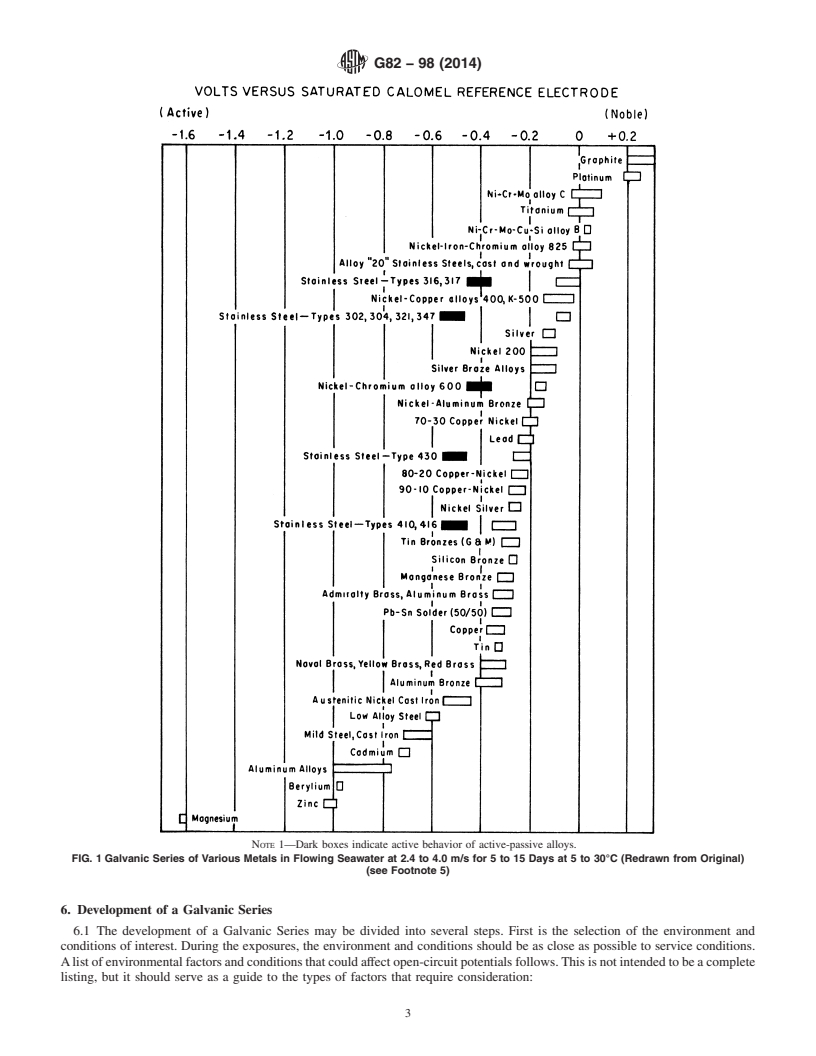
4.3.1 One type of Galvanic Series lists the metals of interest in order of their corrosion potentials, starting with the most active (electronegative) and proceeding in order to the most noble (electropositive). The potentials themselves (versus an appropriate reference half-cell) are listed so that the potential difference between metals in the series can be determined. This type of Galvanic Series has been put in graphical form as a series of bars displaying the range of potentials exhibited by the metal listed opposite each bar. Such a series is illustrated in Fig. 1.
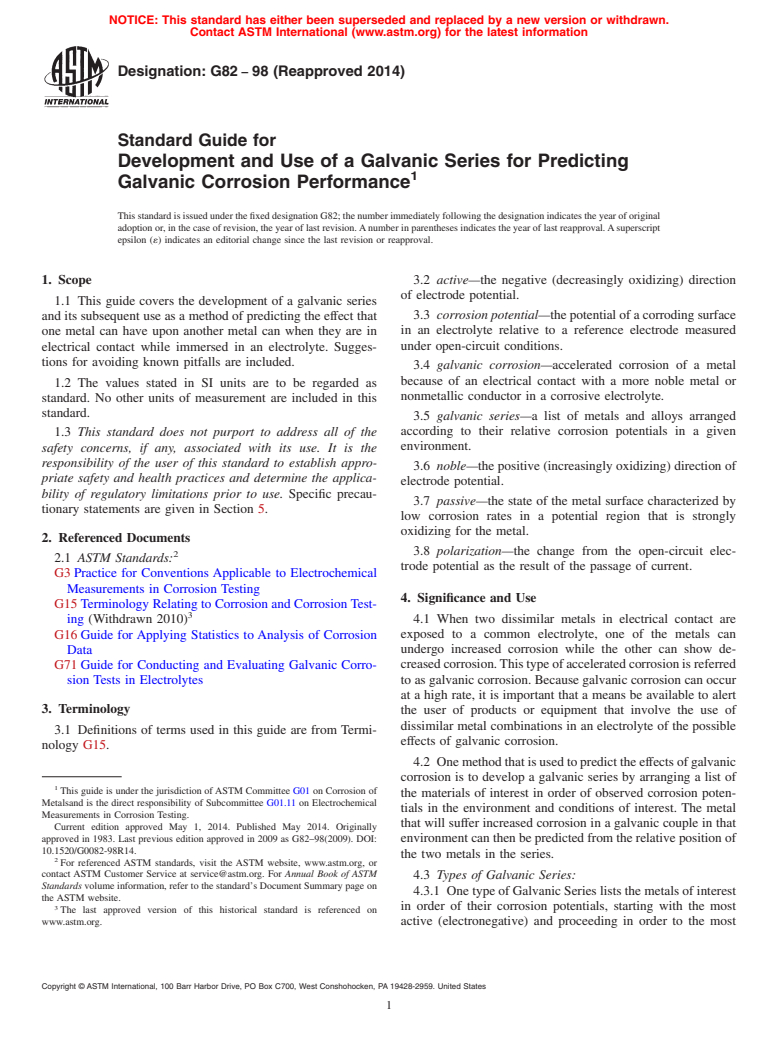
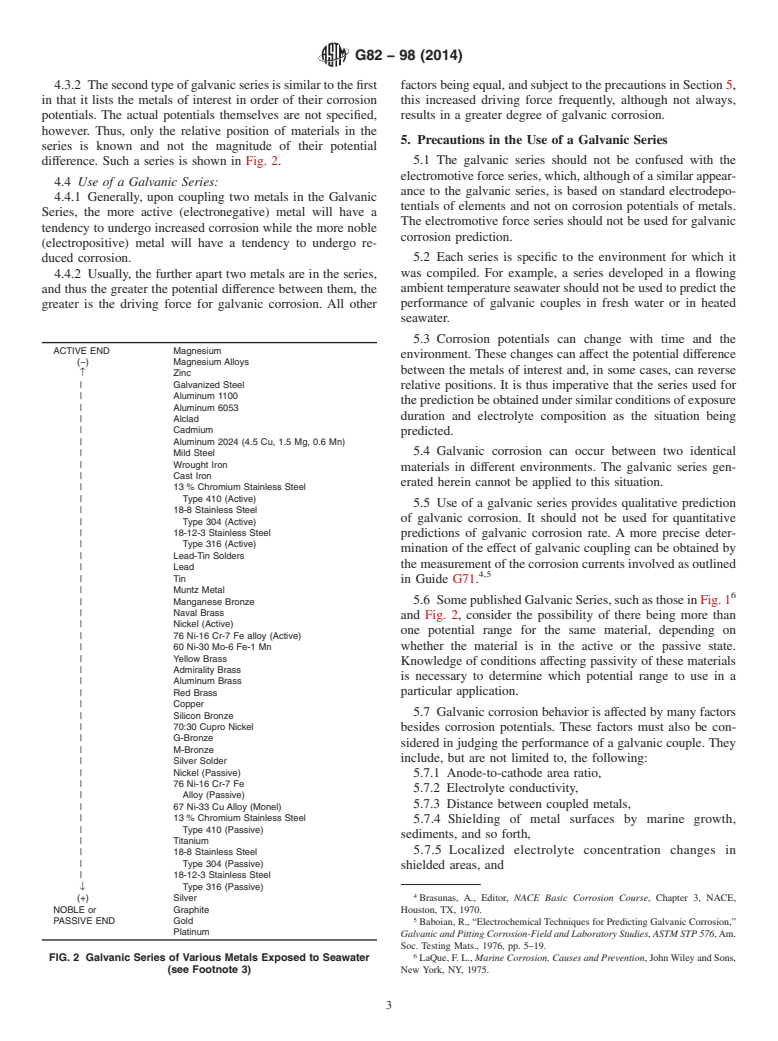
4.3.2 The second type of galvanic series is similar to the first in that it lists the metals of interest in order of their corrosion potentials. The actual potentials themselves are not specified, however. Thus, only the relative position of materials in the series is known and not the magnitude of their potential difference. Such a series is shown in Fig. 2.
4.4 Use of a Galvanic Series:
4.4.1 Generally, upon coupling two metals in the G...
SCOPE
1.1 This guide covers the development of a galvanic series and its subsequent use as a method of predicting the effect that one metal can have upon another metal can when they are in electrical contact while immersed in an electrolyte. Suggestions for avoiding known pitfalls are included.
1.2 The values stated in SI units are to be regarded as standard. No other units of measurement are included in this standard.
1.3 This standard does not purport to address all of the safety concerns, if any, associated with its use. It is the responsibility of the user of this standard to establish appropriate safety and health practices and determine the applicability of regulatory limitations prior to use. Specific precautionary statements are given in Section 5.
General Information
Buy Standard
Standards Content (Sample)
NOTICE: This standard has either been superseded and replaced by a new version or withdrawn.
Contact ASTM International (www.astm.org) for the latest information
Designation: G82 − 98 (Reapproved 2014)
Standard Guide for
Development and Use of a Galvanic Series for Predicting
Galvanic Corrosion Performance
ThisstandardisissuedunderthefixeddesignationG82;thenumberimmediatelyfollowingthedesignationindicatestheyearoforiginal
adoptionor,inthecaseofrevision,theyearoflastrevision.Anumberinparenthesesindicatestheyearoflastreapproval.Asuperscript
epsilon (´) indicates an editorial change since the last revision or reapproval.
1. Scope 3.2 active—the negative (decreasingly oxidizing) direction
of electrode potential.
1.1 This guide covers the development of a galvanic series
3.3 corrosionpotential—thepotentialofacorrodingsurface
and its subsequent use as a method of predicting the effect that
one metal can have upon another metal can when they are in in an electrolyte relative to a reference electrode measured
under open-circuit conditions.
electrical contact while immersed in an electrolyte. Sugges-
tions for avoiding known pitfalls are included.
3.4 galvanic corrosion—accelerated corrosion of a metal
because of an electrical contact with a more noble metal or
1.2 The values stated in SI units are to be regarded as
nonmetallic conductor in a corrosive electrolyte.
standard. No other units of measurement are included in this
standard.
3.5 galvanic series—a list of metals and alloys arranged
according to their relative corrosion potentials in a given
1.3 This standard does not purport to address all of the
environment.
safety concerns, if any, associated with its use. It is the
responsibility of the user of this standard to establish appro-
3.6 noble—thepositive(increasinglyoxidizing)directionof
priate safety and health practices and determine the applica-
electrode potential.
bility of regulatory limitations prior to use. Specific precau-
3.7 passive—the state of the metal surface characterized by
tionary statements are given in Section 5.
low corrosion rates in a potential region that is strongly
oxidizing for the metal.
2. Referenced Documents
3.8 polarization—the change from the open-circuit elec-
2.1 ASTM Standards:
trode potential as the result of the passage of current.
G3Practice for Conventions Applicable to Electrochemical
Measurements in Corrosion Testing
4. Significance and Use
G15TerminologyRelatingtoCorrosionandCorrosionTest-
4.1 When two dissimilar metals in electrical contact are
ing (Withdrawn 2010)
exposed to a common electrolyte, one of the metals can
G16Guide for Applying Statistics to Analysis of Corrosion
Data undergo increased corrosion while the other can show de-
creasedcorrosion.Thistypeofacceleratedcorrosionisreferred
G71Guide for Conducting and Evaluating Galvanic Corro-
sion Tests in Electrolytes toasgalvaniccorrosion.Becausegalvaniccorrosioncanoccur
at a high rate, it is important that a means be available to alert
3. Terminology
the user of products or equipment that involve the use of
dissimilar metal combinations in an electrolyte of the possible
3.1 Definitions of terms used in this guide are from Termi-
effects of galvanic corrosion.
nology G15.
4.2 Onemethodthatisusedtopredicttheeffectsofgalvanic
corrosion is to develop a galvanic series by arranging a list of
This guide is under the jurisdiction ofASTM Committee G01 on Corrosion of
the materials of interest in order of observed corrosion poten-
Metalsand is the direct responsibility of Subcommittee G01.11 on Electrochemical
tials in the environment and conditions of interest. The metal
Measurements in Corrosion Testing.
that will suffer increased corrosion in a galvanic couple in that
Current edition approved May 1, 2014. Published May 2014. Originally
approved in 1983. Last previous edition approved in 2009 as G82–98(2009). DOI:
environmentcanthenbepredictedfromtherelativepositionof
10.1520/G0082-98R14.
the two metals in the series.
For referenced ASTM standards, visit the ASTM website, www.astm.org, or
contact ASTM Customer Service at service@astm.org. For Annual Book of ASTM
4.3 Types of Galvanic Series:
Standards volume information, refer to the standard’s Document Summary page on
4.3.1 OnetypeofGalvanicSeriesliststhemetalsofinterest
the ASTM website.
in order of their corrosion potentials, starting with the most
The last approved version of this historical standard is referenced on
www.astm.org. active (electronegative) and proceeding in order to the most
Copyright © ASTM International, 100 Barr Harbor Drive, PO Box C700, West Conshohocken, PA 19428-2959. United States
G82 − 98 (2014)
noble (electropositive). The potentials themselves (versus an series of bars displaying the range of potentials exhibited by
appropriate reference half-cell) are listed so that the potential themetallistedoppositeeachbar.Suchaseriesisillustratedin
differencebetweenmetalsintheseriescanbedetermined.This
Fig. 1.
type of Galvanic Series has been put in graphical form as a
NOTE 1—Dark boxes indicate active behavior of active-passive alloys.
FIG. 1 Galvanic Series of Various Metals in Flowing Seawater at 2.4 to 4.0 m/s for 5 to 15 Days at 5 to 30°C (Redrawn from Original)
(see Footnote 5)
G82 − 98 (2014)
4.3.2 Thesecondtypeofgalvanicseriesissimilartothefirst factorsbeingequal,andsubjecttotheprecautionsinSection5,
in that it lists the metals of interest in order of their corrosion this increased driving force frequently, although not always,
potentials. The actual potentials themselves are not specified, results in a greater degree of galvanic corrosion.
however. Thus, only the relative position of materials in the
5. Precautions in the Use of a Galvanic Series
series is known and not the magnitude of their potential
5.1 The galvanic series should not be confused with the
difference. Such a series is shown in Fig. 2.
electromotiveforceseries,which,althoughofasimilarappear-
4.4 Use of a Galvanic Series:
ance to the galvanic series, is based on standard electrodepo-
4.4.1 Generally, upon coupling two metals in the Galvanic
tentials of elements and not on corrosion potentials of metals.
Series, the more active (electronegative) metal will have a
The electromotive force series should not be used for galvanic
tendency to undergo increased corrosion while the more noble
corrosion prediction.
(electropositive) metal will have a tendency to undergo re-
5.2 Each series is specific to the environment for which it
duced corrosion.
was compiled. For example, a series developed in a flowing
4.4.2 Usually, the further apart two metals are in the series,
ambienttemperatureseawatershouldnotbeusedtopredictthe
and thus the greater the potential difference between them, the
performance of galvanic couples in fresh water or in heated
greater is the driving force for galvanic corrosion. All other
seawater.
5.3 Corrosion potentials can change with time and the
ACTIVE END Magnesium
environment. These changes can affect the potential difference
(−) Magnesium Alloys
between the metals of interest and, in some cases, can reverse
↑ Zinc
| Galvanized Steel
relative positions. It is thus imperative that the series used for
| Aluminum 1100
thepredictionbeobtainedundersimilarconditionsofexposure
| Aluminum 6053
duration and electrolyte composition as the situation being
| Alclad
| Cadmium
predicted.
| Aluminum 2024 (4.5 Cu, 1.5 Mg, 0.6 Mn)
| Mild Steel 5.4 Galvanic corrosion can occur between two identical
| Wrought Iron
materials in different environments. The galvanic series gen-
| Cast Iron
erated herein cannot be applied to this situation.
| 13 % Chromium Stainless Steel
| Type 410 (Active)
5.5 Use of a galvanic series provides qualitative prediction
| 18-8 Stainless Steel
of galvanic corrosion. It should not be used for quantitative
| Type 304 (Active)
| 18-12-3 Stainless Steel
predictions of galvanic corrosion rate. A more precise deter-
| Type 316 (Active)
mination of the effect of galvanic coupling can be obtained by
| Lead-Tin Solders
themeasurementofthecorrosioncurrentsinvolvedasoutlined
| Lead
4,5
|Tin
in Guide G71.
| Muntz Metal
| Manganese Bronze 5.6 SomepublishedGalvanicSeries,suchasthoseinFig.1
| Naval Brass
and Fig. 2, consider the possibility of there being more than
| Nickel (Active)
one potential range for the same material, depending on
| 76 Ni-16 Cr-7 Fe alloy (Active)
whether the material is in the active or the passive state.
| 60 Ni-30 Mo-6 Fe-1 Mn
| Yellow Brass
Knowledge of conditions affecting passivity of these materials
| Admirality Brass
is necessary to determine which potential range to use in a
| Aluminum Brass
| Red Brass particular application.
| Copper
5.7 Galvanic corrosion behavior is affected by many factors
| Silicon Bronze
| 70:30 Cupro Nickel
besides corrosion potentials. These factors must also be con-
| G-Bronze
sidered in judging the performance of a galvanic couple. They
| M-Bronze
include, but are not limited to, the following:
| Silver Solder
| Nickel (Passive)
5.7.1 Anode-to-cathode area ratio,
| 76 Ni-16 Cr-7 Fe
5.7.2 Electrolyte conductivity,
| Alloy (Passive)
5.7.3 Distance between coupled metals,
| 67 Ni-33 Cu Alloy (Monel)
| 13 % Chromium Stainless Steel
5.7.4 Shielding of metal surfaces by marine growth,
| Type 410 (Passive)
sediments, and so forth,
| Titanium
5.7.5 Localized electrolyte concentration changes in
| 18-8 Stainless Steel
| Type 304 (Passive)
shielded areas, and
| 18-12-3 Stainless Steel
↓ Type 316 (Passive)
(+) Silver Brasunas, A., Editor, NACE Basic Corrosion Course, Chapter 3, NACE,
NOBLE or Graphite Houston, TX, 1970.
PASSIVE END Gold
Baboian, R., “ElectrochemicalTechniques for Predicting Galvanic Corrosion,”
Platinum
GalvanicandPittingCorrosion-FieldandLaboratoryStudies,ASTMSTP576,Am.
Soc. Testing Mats., 1976, pp. 5–19.
FIG. 2 Galvanic Series of Various Metals Exposed to Seawater LaQue,F.L.,MarineCorrosion,CausesandPrevention,JohnWileyandSons,
(see Footnote 3) New York, NY, 1975.
G82 − 98 (2014)
5.7.6 Polarization characteristics of the metals involved. anticipated duration of exposure, should be selected. During
exposure of the panels, their corrosion potential relative to the
5.8 Some materials that are subject to chemical attack in
reference half-cell will be measured periodically, using a
alkaline solutions may suffer increased attack when made the
voltmeter.
cathodeinagalvaniccoupleduetogenerationofhydroxylions
6.3.1 The size of the pa
...
This document is not an ASTM standard and is intended only to provide the user of an ASTM standard an indication of what changes have been made to the previous version. Because
it may not be technically possible to adequately depict all changes accurately, ASTM recommends that users consult prior editions as appropriate. In all cases only the current version
of the standard as published by ASTM is to be considered the official document.
Designation: G82 − 98 (Reapproved 2009) G82 − 98 (Reapproved 2014)
Standard Guide for
Development and Use of a Galvanic Series for Predicting
Galvanic Corrosion Performance
This standard is issued under the fixed designation G82; the number immediately following the designation indicates the year of original
adoption or, in the case of revision, the year of last revision. A number in parentheses indicates the year of last reapproval. A superscript
epsilon (´) indicates an editorial change since the last revision or reapproval.
1. Scope
1.1 This guide covers the development of a galvanic series and its subsequent use as a method of predicting the effect that one
metal can have upon another metal can when they are in electrical contact while immersed in an electrolyte. Suggestions for
avoiding known pitfalls are included.
1.2 The values stated in SI units are to be regarded as standard. No other units of measurement are included in this standard.
1.3 This standard does not purport to address all of the safety concerns, if any, associated with its use. It is the responsibility
of the user of this standard to establish appropriate safety and health practices and determine the applicability of regulatory
limitations prior to use. Specific precautionary statements are given in Section 5.
2. Referenced Documents
2.1 ASTM Standards:
G3 Practice for Conventions Applicable to Electrochemical Measurements in Corrosion Testing
G15 Terminology Relating to Corrosion and Corrosion Testing (Withdrawn 2010)
G16 Guide for Applying Statistics to Analysis of Corrosion Data
G71 Guide for Conducting and Evaluating Galvanic Corrosion Tests in Electrolytes
3. Terminology
3.1 Definitions of terms used in this guide are from Terminology G15.
3.2 active—the negative (decreasingly oxidizing) direction of electrode potential.
3.3 corrosion potential—the potential of a corroding surface in an electrolyte relative to a reference electrode measured under
open-circuit conditions.
3.4 galvanic corrosion—accelerated corrosion of a metal because of an electrical contact with a more noble metal or nonmetallic
conductor in a corrosive electrolyte.
3.5 galvanic series—a list of metals and alloys arranged according to their relative corrosion potentials in a given environment.
3.6 noble—the positive (increasingly oxidizing) direction of electrode potential.
3.7 passive—the state of the metal surface characterized by low corrosion rates in a potential region that is strongly oxidizing
for the metal.
3.8 polarization—the change from the open-circuit electrode potential as the result of the passage of current.
4. Significance and Use
4.1 When two dissimilar metals in electrical contact are exposed to a common electrolyte, one of the metals can undergo
increased corrosion while the other can show decreased corrosion. This type of accelerated corrosion is referred to as galvanic
corrosion. Because galvanic corrosion can occur at a high rate, it is important that a means be available to alert the user of products
or equipment that involve the use of dissimilar metal combinations in an electrolyte of the possible effects of galvanic corrosion.
This guide is under the jurisdiction of ASTM Committee G01 on Corrosion of Metalsand is the direct responsibility of Subcommittee G01.11 on Electrochemical
Measurements in Corrosion Testing.
Current edition approved May 1, 2009May 1, 2014. Published May 2009May 2014. Originally approved in 1983. Last previous edition approved in 20032009 as
G82–98(2003).G82–98(2009). DOI: 10.1520/G0082-98R09.10.1520/G0082-98R14.
For referenced ASTM standards, visit the ASTM website, www.astm.org, or contact ASTM Customer Service at service@astm.org. For Annual Book of ASTM Standards
volume information, refer to the standard’s Document Summary page on the ASTM website.
The last approved version of this historical standard is referenced on www.astm.org.
Copyright © ASTM International, 100 Barr Harbor Drive, PO Box C700, West Conshohocken, PA 19428-2959. United States
G82 − 98 (2014)
4.2 One method that is used to predict the effects of galvanic corrosion is to develop a galvanic series by arranging a list of the
materials of interest in order of observed corrosion potentials in the environment and conditions of interest. The metal that will
suffer increased corrosion in a galvanic couple in that environment can then be predicted from the relative position of the two
metals in the series.
4.3 Types of Galvanic Series:
4.3.1 One type of Galvanic Series lists the metals of interest in order of their corrosion potentials, starting with the most active
(electronegative) and proceeding in order to the most noble (electropositive). The potentials themselves (versus an appropriate
reference half-cell) are listed so that the potential difference between metals in the series can be determined. This type of Galvanic
Series has been put in graphical form as a series of bars displaying the range of potentials exhibited by the metal listed opposite
each bar. Such a series is illustrated in Fig. 1.
4.3.2 The second type of galvanic series is similar to the first in that it lists the metals of interest in order of their corrosion
potentials. The actual potentials themselves are not specified, however. Thus, only the relative position of materials in the series
is known and not the magnitude of their potential difference. Such a series is shown in Fig. 2.
4.4 Use of a Galvanic Series:
4.4.1 Generally, upon coupling two metals in the Galvanic Series, the more active (electronegative) metal will have a tendency
to undergo increased corrosion while the more noble (electropositive) metal will have a tendency to undergo reduced corrosion.
4.4.2 Usually, the further apart two metals are in the series, and thus the greater the potential difference between them, the
greater is the driving force for galvanic corrosion. All other factors being equal, and subject to the precautions in Section 5, this
increased driving force frequently, although not always, results in a greater degree of galvanic corrosion.
5. Precautions in the Use of a Galvanic Series
5.1 The galvanic series should not be confused with the electromotive force series, which, although of a similar appearance to
the galvanic series, is based on standard electrodepotentials of elements and not on corrosion potentials of metals. The
electromotive force series should not be used for galvanic corrosion prediction.
5.2 Each series is specific to the environment for which it was compiled. For example, a series developed in a flowing ambient
temperature seawater should not be used to predict the performance of galvanic couples in fresh water or in heated seawater.
5.3 Corrosion potentials can change with time and the environment. These changes can affect the potential difference between
the metals of interest and, in some cases, can reverse relative positions. It is thus imperative that the series used for the prediction
be obtained under similar conditions of exposure duration and electrolyte composition as the situation being predicted.
5.4 Galvanic corrosion can occur between two identical materials in different environments. The galvanic series generated
herein cannot be applied to this situation.
5.5 Use of a galvanic series provides qualitative prediction of galvanic corrosion. It should not be used for quantitative
predictions of galvanic corrosion rate. A more precise determination of the effect of galvanic coupling can be obtained by the
4,5
measurement of the corrosion currents involved as outlined in Guide G71.
5.6 Some published Galvanic Series, such as those in Fig. 1 and Fig. 2, consider the possibility of there being more than one
potential range for the same material, depending on whether the material is in the active or the passive state. Knowledge of
conditions affecting passivity of these materials is necessary to determine which potential range to use in a particular application.
5.7 Galvanic corrosion behavior is affected by many factors besides corrosion potentials. These factors must also be considered
in judging the performance of a galvanic couple. They include, but are not limited to, the following:
5.7.1 Anode-to-cathode area ratio,
5.7.2 Electrolyte conductivity,
5.7.3 Distance between coupled metals,
5.7.4 Shielding of metal surfaces by marine growth, sediments, and so forth,
5.7.5 Localized electrolyte concentration changes in shielded areas, and
5.7.6 Polarization characteristics of the metals involved.
5.8 Some materials that are subject to chemical attack in alkaline solutions may suffer increased attack when made the cathode
in a galvanic couple due to generation of hydroxyl ions by the cathodic reaction. Use of a galvanic series will not predict this
behavior.
5.9 A more detailed discussion of the theory of galvanic corrosion prediction is presented in Appendix X1 and in ASTM STP
576.
Brasunas, A., Editor, NACE Basic Corrosion Course, Chapter 3, NACE, Houston, TX, 1970.
Baboian, R., “Electrochemical Techniques for Predicting Galvanic Corrosion,” Galvanic and Pitting Corrosion-Field and Laboratory Studies, ASTM STP 576, Am. Soc.
Testing Mats., 1976, pp. 5–19.
LaQue, F. L., Marine Corrosion, Causes and Prevention, John Wiley and Sons, New York, NY, 1975.
G82 − 98 (2014)
NOTE 1—Dark boxes indicate active behavior of active-passive alloys.
FIG. 1 Galvanic Series of Various Metals in Flowing Seawater at 2.4 to 4.0 m/s for 5 to 15 Days at 5 to 30°C (Redrawn from Original)
(see Footnote 5)
6. Development of a Galvanic Series
6.1 The development of a Galvanic Series may be divided into several steps. First is the selection of the environment and
conditions of interest. During the exposures, the environment and conditions should be as close as possible to service conditions.
A list of environmental factors and conditions that could affect open-circuit potentials follows. This is not intended to be a complete
listing, but it should serve as a guide to the types of factors that require consideration:
G82 − 98 (2014)
ACTIVE END Magnesium
(−) Magnesium Alloys
↑ Zinc
| Galvanized Steel
| Aluminum 1100
| Aluminum 6053
| Alclad
| Cadmium
| Aluminum 2024 (4.5 Cu, 1.5 Mg, 0.6 Mn)
| Mild Steel
| Wrought Iron
| Cast Iron
| 13 % Chromium Stainless Steel
| Type 410 (Active)
| 18-8 Stainless Steel
| Type 304 (Active)
| 18-12-3 Stainless Steel
| Type 316 (Acti
...
Questions, Comments and Discussion
Ask us and Technical Secretary will try to provide an answer. You can facilitate discussion about the standard in here.