


ASTM F3357-19
(Guide)Standard Guide for Designing Reusable Medical Devices for Cleanability
Standard Guide for Designing Reusable Medical Devices for Cleanability
SIGNIFICANCE AND USE
4.1 Reusable medical devices have a range of cleanability. The equipment, effort, and time expended for cleaning devices should be feasible in the intended setting. For that reason, it is essential that cleanability be considered during the design phase.
4.2 The next section highlights features that either have a tendency to retain debris and/or make removing contamination difficult. Individually, the criteria listed in this document may not render a device difficult to clean. Furthermore, it is the manufacturer’s responsibility to consider feasibility and ease of cleaning the device in the clinical environment when designing their device. Although it may not be feasible to remove or modify all of the problematic design features from a device, device manufacturers should be aware of challenging designs for cleaning and take appropriate action for minimizing the impact of these features on cleaning. For example, disassembly may be necessary to thoroughly clean a device, or it may be determined that a device cannot be adequately cleaned, in which case that device would be designated single-use only. In addition, manufacturers should consider the compatibility of their device design with subsequent sterilization or disinfection.
SCOPE
1.1 This guide is intended to provide manufacturers of reusable medical devices design feature guidance to minimize debris retention after use and increase ease of removal of contaminants and cleaning product residuals from devices during cleaning/rinsing and also prepare for subsequent processing steps (for example, sterilization or disinfection).
1.2 This standard does not purport to address all of the safety concerns, if any, associated with its use. It is the responsibility of the user of this standard to establish appropriate safety, health, and environmental practices and determine the applicability of regulatory limitations prior to use.
1.3 This international standard was developed in accordance with internationally recognized principles on standardization established in the Decision on Principles for the Development of International Standards, Guides and Recommendations issued by the World Trade Organization Technical Barriers to Trade (TBT) Committee.
General Information
- Status
- Published
- Publication Date
- 31-Jul-2019
- Technical Committee
- F04 - Medical and Surgical Materials and Devices
- Drafting Committee
- F04.15 - Material Test Methods
Relations
- Effective Date
- 01-Aug-2019
Overview
ASTM F3357-19: Standard Guide for Designing Reusable Medical Devices for Cleanability provides manufacturers with essential guidance for optimizing the cleanability of reusable medical devices. Developed by ASTM International, this guide highlights the importance of considering cleanability during the design phase to minimize debris retention and enhance the removal of contaminants and cleaning product residues. Ensuring that medical devices can be easily and effectively cleaned not only promotes patient safety but also supports compliance with infection control standards in healthcare settings.
Key Topics
- Cleanability in Design: Emphasizes incorporating design features that facilitate thorough cleaning and disinfection, both manually and via automated processes.
- Debris Retention Risks: Identifies device features such as lumens, crevices, O-rings, and narrow channels that may harbor contaminants if not properly designed.
- Device Disassembly: Recommends designing devices for intuitive disassembly and reassembly to access hard-to-clean areas, with clear manufacturer instructions.
- Material and Surface Compatibility: Encourages selecting materials and surface finishes that withstand repeated cleaning and chemical exposure without degradation.
- Component Design Considerations: Addresses special features like weld junctions, hinges, grooves, capillary gaps, and fluid reservoirs that impact ease of cleaning.
- Visual Inspection: Advises incorporating design elements that facilitate post-cleaning visual inspection to confirm cleanliness.
- Comprehensive Processing Compatibility: Recommends evaluating device design for compatibility with subsequent sterilization or disinfection procedures.
Applications
Implementing the ASTM F3357-19 standard is critical across different stages of the medical device lifecycle:
- Design and Development: Guides engineers and designers in creating reusable medical devices that are safe, durable, and cleanable within real-world clinical workflows, thereby reducing the risk of healthcare-associated infections.
- Manufacturing: Informs material selection and assembly techniques to avoid features that could impede cleaning or increase contamination risks.
- Healthcare Settings: Assists hospitals, surgical centers, and reprocessing facilities in evaluating whether devices can be adequately cleaned according to manufacturer instructions.
- Regulatory Compliance: Helps manufacturers align with global standards and regulatory requirements for medical device cleanability, essential for market access.
- Device Selection and Procurement: Enables healthcare organizations to choose products that can be safely reused, supporting sustainability and cost-effectiveness.
By following ASTM F3357-19, manufacturers can reduce the possibility of residual contamination, improve device longevity, and promote patient safety.
Related Standards
The guidance in ASTM F3357-19 references several important related documents and standards in the field of medical device reprocessing:
- ANSI/AAMI/ISO 17664: Processing of health care products - Information to be provided by the medical device manufacturer for the processing of medical devices.
- ANSI/AAMI/ISO 11139 & 17665-1: Sterilization of health care products - Vocabulary and requirements.
- AAMI TIR30 and AAMI TIR34: Compendium of processes and guidance related to cleaning, water quality, and compatibility for reusable medical devices.
- CDC Guidelines: CDC Guideline for Disinfection and Sterilization in Healthcare Facilities, which outlines best practices for infection prevention.
Practical Value
By applying the recommendations in ASTM F3357-19, manufacturers and healthcare providers can:
- Enhance infection control practices by minimizing debris retention in reusable medical devices.
- Reduce cleaning time and effort, making reprocessing more efficient and reliable.
- Extend the service life of devices by selecting materials and designs that withstand repeated cleaning and disinfection.
- Ensure patient safety by improving the effectiveness of device cleaning, reducing healthcare-associated infection risks.
- Meet international regulatory expectations for medical device reprocessing, facilitating broader market reach.
Keywords: cleanability, reusable medical devices, medical device design, healthcare infection control, device cleaning, ASTM F3357-19, reprocessing, disinfection, sterilization, debris retention.
Get Certified
Connect with accredited certification bodies for this standard

BSI Group
BSI (British Standards Institution) is the business standards company that helps organizations make excellence a habit.

TÜV Rheinland
TÜV Rheinland is a leading international provider of technical services.

TÜV SÜD
TÜV SÜD is a trusted partner of choice for safety, security and sustainability solutions.
Sponsored listings
Frequently Asked Questions
ASTM F3357-19 is a guide published by ASTM International. Its full title is "Standard Guide for Designing Reusable Medical Devices for Cleanability". This standard covers: SIGNIFICANCE AND USE 4.1 Reusable medical devices have a range of cleanability. The equipment, effort, and time expended for cleaning devices should be feasible in the intended setting. For that reason, it is essential that cleanability be considered during the design phase. 4.2 The next section highlights features that either have a tendency to retain debris and/or make removing contamination difficult. Individually, the criteria listed in this document may not render a device difficult to clean. Furthermore, it is the manufacturer’s responsibility to consider feasibility and ease of cleaning the device in the clinical environment when designing their device. Although it may not be feasible to remove or modify all of the problematic design features from a device, device manufacturers should be aware of challenging designs for cleaning and take appropriate action for minimizing the impact of these features on cleaning. For example, disassembly may be necessary to thoroughly clean a device, or it may be determined that a device cannot be adequately cleaned, in which case that device would be designated single-use only. In addition, manufacturers should consider the compatibility of their device design with subsequent sterilization or disinfection. SCOPE 1.1 This guide is intended to provide manufacturers of reusable medical devices design feature guidance to minimize debris retention after use and increase ease of removal of contaminants and cleaning product residuals from devices during cleaning/rinsing and also prepare for subsequent processing steps (for example, sterilization or disinfection). 1.2 This standard does not purport to address all of the safety concerns, if any, associated with its use. It is the responsibility of the user of this standard to establish appropriate safety, health, and environmental practices and determine the applicability of regulatory limitations prior to use. 1.3 This international standard was developed in accordance with internationally recognized principles on standardization established in the Decision on Principles for the Development of International Standards, Guides and Recommendations issued by the World Trade Organization Technical Barriers to Trade (TBT) Committee.
SIGNIFICANCE AND USE 4.1 Reusable medical devices have a range of cleanability. The equipment, effort, and time expended for cleaning devices should be feasible in the intended setting. For that reason, it is essential that cleanability be considered during the design phase. 4.2 The next section highlights features that either have a tendency to retain debris and/or make removing contamination difficult. Individually, the criteria listed in this document may not render a device difficult to clean. Furthermore, it is the manufacturer’s responsibility to consider feasibility and ease of cleaning the device in the clinical environment when designing their device. Although it may not be feasible to remove or modify all of the problematic design features from a device, device manufacturers should be aware of challenging designs for cleaning and take appropriate action for minimizing the impact of these features on cleaning. For example, disassembly may be necessary to thoroughly clean a device, or it may be determined that a device cannot be adequately cleaned, in which case that device would be designated single-use only. In addition, manufacturers should consider the compatibility of their device design with subsequent sterilization or disinfection. SCOPE 1.1 This guide is intended to provide manufacturers of reusable medical devices design feature guidance to minimize debris retention after use and increase ease of removal of contaminants and cleaning product residuals from devices during cleaning/rinsing and also prepare for subsequent processing steps (for example, sterilization or disinfection). 1.2 This standard does not purport to address all of the safety concerns, if any, associated with its use. It is the responsibility of the user of this standard to establish appropriate safety, health, and environmental practices and determine the applicability of regulatory limitations prior to use. 1.3 This international standard was developed in accordance with internationally recognized principles on standardization established in the Decision on Principles for the Development of International Standards, Guides and Recommendations issued by the World Trade Organization Technical Barriers to Trade (TBT) Committee.
ASTM F3357-19 is classified under the following ICS (International Classification for Standards) categories: 11.040.01 - Medical equipment in general. The ICS classification helps identify the subject area and facilitates finding related standards.
ASTM F3357-19 has the following relationships with other standards: It is inter standard links to ASTM E3106-22. Understanding these relationships helps ensure you are using the most current and applicable version of the standard.
ASTM F3357-19 is available in PDF format for immediate download after purchase. The document can be added to your cart and obtained through the secure checkout process. Digital delivery ensures instant access to the complete standard document.
Standards Content (Sample)
This international standard was developed in accordance with internationally recognized principles on standardization established in the Decision on Principles for the
Development of International Standards, Guides and Recommendations issued by the World Trade Organization Technical Barriers to Trade (TBT) Committee.
Designation: F3357 − 19
Standard Guide for
Designing Reusable Medical Devices for Cleanability
This standard is issued under the fixed designation F3357; the number immediately following the designation indicates the year of
original adoption or, in the case of revision, the year of last revision. A number in parentheses indicates the year of last reapproval. A
superscript epsilon (´) indicates an editorial change since the last revision or reapproval.
1. Scope ANSI/AAMI/ISO 17664:2017 Processing of health care
product – Information to be provided by the medical
1.1 This guide is intended to provide manufacturers of
device manufacturer for the processing of medical devices
reusable medical devices design feature guidance to minimize
2.2 CDC Document:
debris retention after use and increase ease of removal of
CDC Guideline for Disinfection and Sterilization in Health-
contaminants and cleaning product residuals from devices
care Facilities, 2008
during cleaning/rinsing and also prepare for subsequent pro-
cessing steps (for example, sterilization or disinfection).
3. Terminology
1.2 This standard does not purport to address all of the
3.1 Definitions:
safety concerns, if any, associated with its use. It is the
3.1.1 automated cleaning—cleaning performed using a ma-
responsibility of the user of this standard to establish appro-
chine that soaks and flushes a device with detergent under
priate safety, health, and environmental practices and deter-
specified conditions using pulsating or high pressure and then
mine the applicability of regulatory limitations prior to use.
rinses it with suitable water allowing its subsequent use or
1.3 This international standard was developed in accor-
further processing (AAMI TIR 34:2014/(R)2017).
dance with internationally recognized principles on standard-
ization established in the Decision on Principles for the
3.1.2 cleaning—removal of contamination from an item to
Development of International Standards, Guides and Recom-
the extent necessary for further processing or for the intended
mendations issued by the World Trade Organization Technical
use.
Barriers to Trade (TBT) Committee.
3.1.2.1 Discussion—In healthcare facilities, cleaning con-
sists of the removal, usually with detergent and water, of
2. Referenced Documents
adherent organic and inorganic soil (for example, blood,
protein substances, and other debris) from the surfaces,
2.1 AAMI Standards:
crevices, serrations, joints, and lumens of instruments, devices,
AAMI TIR30:2011/(R)2016 A compendium of processes,
and equipment by a manual or mechanical process that
materials, test methods, and acceptance criteria for clean-
prepares the items for safe handling and/or further decontami-
ing reusable medical devices
nation (ANSI/AAMI ST79:2010 and A1:2010).
AAMITIR34:2014/(R)2017 Waterforreprocessingofmedi-
cal devices
3.1.3 manual cleaning—removal of contaminants from an
ANSI/AAMIST79:2010andA1:2010 Comprehensiveguide
item to the extent necessary for further processing or for
to steam sterilization and sterility assurance in health care
intended use without the use of an automated process (ANSI/
facilities
AAMI/ISO 17664:2017).
ANSI/AAMI/ISO 11139:2018 Sterilization of health care
3.1.4 O-ring—acirculargasketthatservestosealandfillthe
products – Vocabulary of terms used in sterilization and
space between two objects or surfaces, generally to prevent
related equipment and process standards
leakage of liquids or gases.
ANSI/AAMI/ISO 17665-1:2006(R)2013 Sterilization of
3.1.5 sterile—free from viable microorganisms. (ANSI/
health care products – Moist heat – Part 1: Requirements
AAMI/ISO 17665-1:2006 and ANSI/AAMI/ISO 11139:2018)
for the development, validation and routine control of a
3.1.6 sterilization—a process that destroys or eliminates all
sterilization process for medical devices
forms of microbial life and is carried out in healthcare facilities
by physical or chemical methods (CDC Guideline for Disin-
This guide is under the jurisdiction of ASTM Committee F04 on Medical and
fection and Sterilization in Healthcare Facilities, 2008).
Surgical Materials and Devices and is the direct responsibility of Subcommittee
F04.15 on Material Test Methods.
Current edition approved Aug. 1, 2019. Published September 2019. DOI:
10.1520/F3357-19. Available from Centers for Disease Control and Prevention (CDC), 1600
Available from Association for the Advancement of Medical Instrumentation Clifton Road, Atlanta, GA 30329, https://www.cdc.gov/infectioncontrol/guidelines/
(AAMI), 901 N Glebe Rd Ste 300, Arlington, VA 22203, http://www.aami.org. disinfection/index.html.
Copyright © ASTM International, 100 Barr Harbor Drive, PO Box C700, West Conshohocken, PA 19428-2959. United States
F3357 − 19
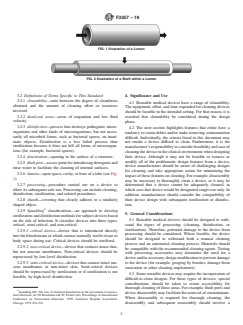
FIG. 1 Illustration of a Lumen
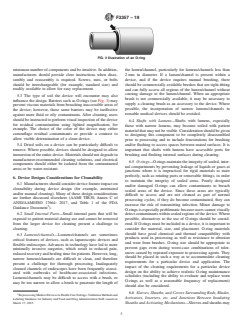
FIG. 2 Illustration of a Shaft within a Lumen
3.2 Definitions of Terms Specific to This Standard: 4. Significance and Use
3.2.1 cleanability—ratio between the degree of cleanliness
4.1 Reusable medical devices have a range of cleanability.
obtained and the amount of cleaning effort or resources
The equipment, effort, and time expended for cleaning devices
invested.
should be feasible in the intended setting. For that reason, it is
3.2.2 dead-end zones—areas of stagnation and low fluid
essential that cleanability be considered during the design
velocity.
phase.
3.2.3 disinfection—process that destroys pathogenic micro-
4.2 The next section highlights features that either have a
organisms and other kinds of microorganisms, but not neces-
tendency to retain debris and/or make removing contamination
sarily all microbial forms, such as bacterial spores, on inani-
difficult. Individually, the criteria listed in this document may
mate objects. Disinfection is a less lethal process than
not render a device difficult to clean. Furthermore, it is the
sterilization because it does not kill all forms of microorgan-
manufacturer’sresponsibilitytoconsiderfeasibilityandeaseof
isms (for example, bacterial spores).
cleaning the device in the clinical environment when designing
their device. Although it may not be feasible to remove or
3.2.4 fenestration—opening in the surface of a structure.
modify all of the problematic design features from a device,
3.2.5 flush port—accesspointforintroducingdetergentsand
device manufacturers should be aware of challenging designs
rinse water to facilitate the cleaning of internal surfaces.
for cleaning and take appropriate action for minimizing the
3.2.6 lumens—open space, cavity, or bore of a tube (see Fig.
impact of these features on cleaning. For example, disassembly
1).
may be necessary to thoroughly clean a device, or it may be
3.2.7 processing—procedure carried out on a device to
determined that a device cannot be adequately cleaned, in
allow its subsequent safe use. Processing can include cleaning,
which case that device would be designated single-use only. In
disinfection, sterilization, and related procedures.
addition, manufacturers should consider the compatibility of
their device design with subsequent sterilization or disinfec-
3.2.8 sheath—covering that closely adheres to a similarly
tion.
shaped object.
3.2.9 Spaulding classifications—an approach to develop
5. General Considerations
sterilization and disinfection methods for subject devices based
5.1 Reusable medical devices should be designed to with-
on the risk of infection. It classifies devices into three types:
stand the rigors of processing (cleaning, disinfection, or
critical, semi-critical, and non-critical.
sterilization). Therefore, potential damage to the device from
3.2.9.1 critical device—device that is introduced directly
processing should be considered. Where feasible, the device
into the bloodstream or which contact normally sterile tissue or
should be designed to withstand both a manual cleaning
body space during use. Critical devices should be sterilized.
process and an automated cleaning process. Materials should
3.2.9.2 non-critical device—device that contacts intact skin,
be compatible with the recommended cleaning agents. Testing
but not mucous membranes. Non-critical devices should be
with processing accessories may determine the need for a
reprocessed by low-level disinfection.
deviceand/oraccessorydesignmodificationtopreventdamage
3.2.9.3 semi-critical device—devices that contact intact mu-
to the device (for example, gouging by brushes, damage from
cous membranes or non-intact skin. Semi-critical devices
sonication or other cleaning implements).
should be reprocessed by sterilization or if sterilization is not
5.2 Some reusable devices may require the incorporation of
feasible, by high-level disinfection.
difficult-to-clean designs. For these types of devices, special
considerations should be taken to create accessibility for
thorough cleaning of those areas. For example, flush ports and
Spaulding EH. The role of chemical disinfection in the prevention of nosoco-
devicedisassemblymayfacilitatetheremovalofcontaminants.
mial infections. In: PS Brachman and TC Eickof (ed), Proceedings of International
When disassembly is required for thorough cleaning, the
Conference on Nosocomial Infections, 1970. American Hospital Association,
Chicago. 1971:254-274. disassembly and subsequent reassembly should involve a
F3357 − 19
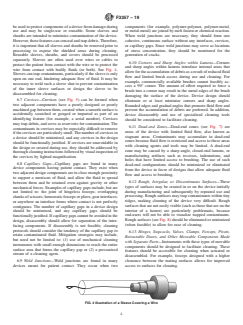
FIG. 3 Illustration of an O-ring
minimum number of components and be intuitive. In addition, the lumen/channel, particularly for lumens/channels less than
manufacturers should provide clear instructions when disas- 2 mm in diameter. If a lumen/channel is present within a
sembly and reassembly is required. Screws, nuts, or bolts device, and if the device requires manual brushing, there
should be interchangeable (for example, standard size) and should be commercially available brushes that are tight-fitting
readily available to allow for easy replacement.
and can fully access all regions of the lumen/channel without
causing damage to the lumen/channel. When an appropriate
5.3 The type of soil the device will encounter may also
brush is not commercially available, it may be necessary to
influence the design. Barriers such as O-rings (see Fig. 3) may
supply a cleaning brush as an accessory to the device. Where
prevent viscous materials from breaching inaccessible areas of
possible, the incorporation of narrow lumens/channels in
the device; however, those same barriers may be ineffective
reusable medical devices should be avoided.
against more fluid or oily contaminants. After cleaning, users
should be instructed to perform visual inspection of the device
6.4 Shafts with Lumens—Shafts with lumens, especially
for residual contamination using lighted magnification, for
those with narrow lumens, may become soiled with patient
example. The choice of the color of the device may either
material that may not be visible. Consideration should be given
camouflage residual contaminants or provide a contrast to
to designing this component to be completely disassembled
allow visible determination of a clean device.
prior to processing and to include fenestrations for brushing
5.4 Dried soils on a device can be particularly difficult to and/or flushing to access spaces between mated surfaces. It is
important that shafts with lumens have accessible ports for
remove. Where possible, devices should be designed to allow
immersionoftheentiredevice.Materialsshouldnotdegradein brushing and flushing internal surfaces during cleaning.
manufacturer-recommended cleaning solutions, and electrical
6.5 O-rings—O-rings maintain the integrity of sealed, inter-
components should either be isolated from the contaminated
nal compartments by preventing leakage of liquids or gases at
areas or be water-resistant.
junctions where it is impractical for rigid materials to mate
perfectly, such as rotating parts or removable fittings, in order
6. Device Designs Considerations for Cleanability
to maintain the integrity of sealed areas. Poorly designed
6.1 Manufacturers should consider device feature impact on
and/or damaged O-rings can allow contaminants to breach
cleanability during device design (for example, automated
sealed areas of the device. Since these areas are typically
and/or manual cleaning). Many of these design considerations
difficult to access and are not cleaned as part of normal
are further discussed elsewhere (AAMI TIR30, Annex C of
processing cycles, if they do become contaminated, they can
ANSI/AAMI/ISO 17664: 2017, and Table 1 of the FDA
increase the risk of transmitting infection. Minor damage to
Guidance Document ).
O-rings is especially problematic because users cannot visually
6.2 Small Internal Parts—Small internal parts that will be detect contaminants within sealed regions of the device.Where
exposed to patient material during use and cannot be removed possible, alternatives to the use of O-rings should be consid-
from the larger device for cleaning present a challenge to
ered. If O-rings must be included in a device, it is important to
cleaning. consider the material, size, and placement. O-ring materials
should have good chemical and thermal compatibility with
6.3 Lumens/channels—Lumens/channels are sometimes
products used in processing as well as resistance to abrasion
critical features of devices, such as laparoscopic devices and
and wear from brushes. O-ring size should be appropriate to
flexible endoscopes. Advances in technology have led to more
prevent gaps even during worst-case combinations of toler-
minimally invasive surgeries, which result in reduced pain,
ances caused by repeated exposure to processing agents. They
reduced recovery and healing time for patients. However, long,
should be placed in such a way as to accommodate cleaning
narrow lumens/channels are difficult to clean, and therefore
requirements for a particular device and application. The
present a challenge for thorough processing. Inadequately
impact of the cleaning requirements for a particular device
cleaned channels of endoscopes have been frequently associ-
design on the ability to achieve realistic O-ring maintenance
ated with outbreaks of healthcare-associated infections.
schedules (including the ability to evaluate and replace worn
Lumens/channels may be difficult to access with a brush, or
O-rings as well as a reasonable frequency of replacement)
may be too narrow to allow a brush to penetrate the length of
should also be considered.
6.6 Sleeves, Sheaths, and Covers Surrounding Rods, Blades,
ReprocessingMedic
...
Questions, Comments and Discussion
Ask us and Technical Secretary will try to provide an answer. You can facilitate discussion about the standard in here.
Loading comments...