


ASTM D6406-99(2014)
(Test Method)Standard Test Method for Analysis of Sugar in Vegetable Tanning Materials
Standard Test Method for Analysis of Sugar in Vegetable Tanning Materials
SIGNIFICANCE AND USE
5.1 This test method is used to determine the quantity of sugar present in vegetable tanning materials or vegetable tannin extracts. The amount of the reducing sugars, total sugars, and non-reducing sugars in a sample of material or extract can be determined by this method.
5.2 Because of the possibility of errors in this test method it is essential that the method be followed exactly in order to obtain reproducible results both among specimens within a laboratory and for analyses between laboratories.
SCOPE
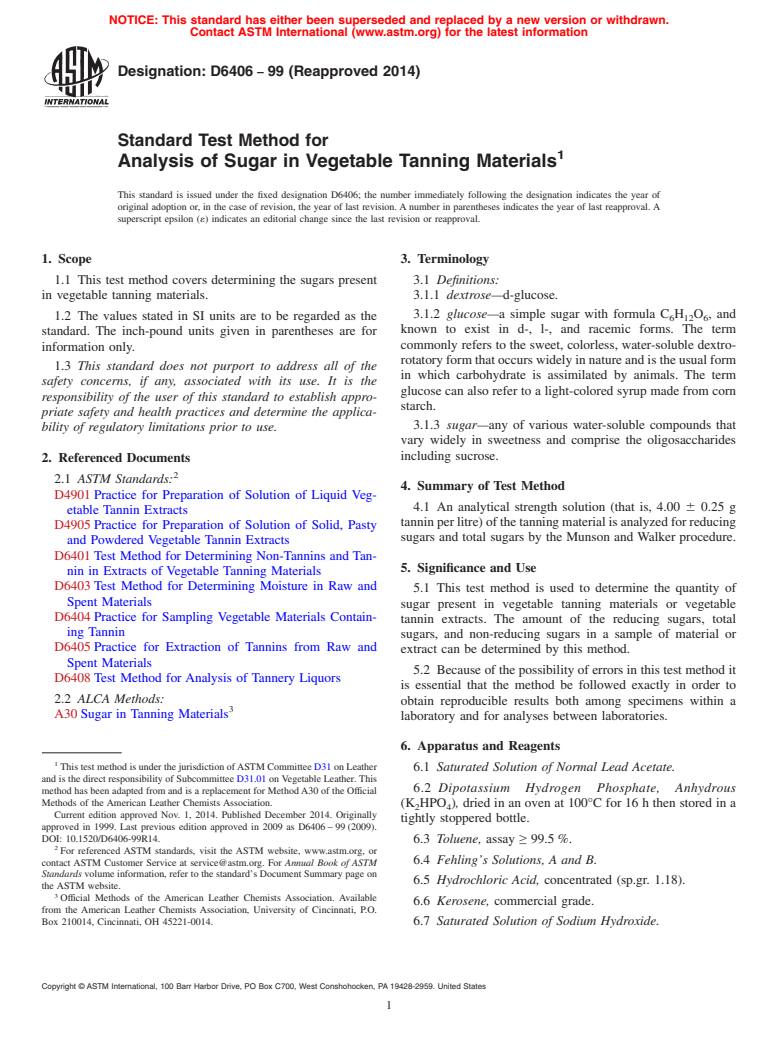
1.1 This test method covers determining the sugars present in vegetable tanning materials.
1.2 The values stated in SI units are to be regarded as the standard. The inch-pound units given in parentheses are for information only.
1.3 This standard does not purport to address all of the safety concerns, if any, associated with its use. It is the responsibility of the user of this standard to establish appropriate safety and health practices and determine the applicability of regulatory limitations prior to use.
General Information
Buy Standard
Standards Content (Sample)
NOTICE: This standard has either been superseded and replaced by a new version or withdrawn.
Contact ASTM International (www.astm.org) for the latest information
Designation: D6406 − 99 (Reapproved 2014)
Standard Test Method for
Analysis of Sugar in Vegetable Tanning Materials
This standard is issued under the fixed designation D6406; the number immediately following the designation indicates the year of
original adoption or, in the case of revision, the year of last revision. A number in parentheses indicates the year of last reapproval. A
superscript epsilon (´) indicates an editorial change since the last revision or reapproval.
1. Scope 3. Terminology
1.1 This test method covers determining the sugars present 3.1 Definitions:
in vegetable tanning materials. 3.1.1 dextrose—d-glucose.
3.1.2 glucose—a simple sugar with formula C H O , and
1.2 The values stated in SI units are to be regarded as the
6 12 6
known to exist in d-, l-, and racemic forms. The term
standard. The inch-pound units given in parentheses are for
commonly refers to the sweet, colorless, water-soluble dextro-
information only.
rotatoryformthatoccurswidelyinnatureandistheusualform
1.3 This standard does not purport to address all of the
in which carbohydrate is assimilated by animals. The term
safety concerns, if any, associated with its use. It is the
glucose can also refer to a light-colored syrup made from corn
responsibility of the user of this standard to establish appro-
starch.
priate safety and health practices and determine the applica-
3.1.3 sugar—any of various water-soluble compounds that
bility of regulatory limitations prior to use.
vary widely in sweetness and comprise the oligosaccharides
including sucrose.
2. Referenced Documents
2.1 ASTM Standards:
4. Summary of Test Method
D4901 Practice for Preparation of Solution of Liquid Veg-
4.1 An analytical strength solution (that is, 4.00 6 0.25 g
etable Tannin Extracts
tanninperlitre)ofthetanningmaterialisanalyzedforreducing
D4905 Practice for Preparation of Solution of Solid, Pasty
sugars and total sugars by the Munson and Walker procedure.
and Powdered Vegetable Tannin Extracts
D6401 Test Method for Determining Non-Tannins and Tan-
5. Significance and Use
nin in Extracts of Vegetable Tanning Materials
D6403 Test Method for Determining Moisture in Raw and
5.1 This test method is used to determine the quantity of
Spent Materials
sugar present in vegetable tanning materials or vegetable
D6404 Practice for Sampling Vegetable Materials Contain-
tannin extracts. The amount of the reducing sugars, total
ing Tannin
sugars, and non-reducing sugars in a sample of material or
D6405 Practice for Extraction of Tannins from Raw and
extract can be determined by this method.
Spent Materials
5.2 Because of the possibility of errors in this test method it
D6408 Test Method for Analysis of Tannery Liquors
is essential that the method be followed exactly in order to
2.2 ALCA Methods:
obtain reproducible results both among specimens within a
A30 Sugar in Tanning Materials
laboratory and for analyses between laboratories.
6. Apparatus and Reagents
This test method is under the jurisdiction ofASTM Committee D31 on Leather
6.1 Saturated Solution of Normal Lead Acetate.
and is the direct responsibility of Subcommittee D31.01 on Vegetable Leather. This
6.2 Dipotassium Hydrogen Phosphate, Anhydrous
method has been adapted from and is a replacement for MethodA30 of the Official
Methods of the American Leather Chemists Association.
(K HPO ), dried in an oven at 100°C for 16 h then stored in a
2 4
Current edition approved Nov. 1, 2014. Published December 2014. Originally
tightly stoppered bottle.
approved in 1999. Last previous edition approved in 2009 as D6406 – 99 (2009).
DOI: 10.1520/D6406-99R14.
6.3 Toluene, assay ≥ 99.5 %.
For referenced ASTM standards, visit the ASTM website, www.astm.org, or
6.4 Fehling’s Solutions, A and B.
contact ASTM Customer Service at service@astm.org. For Annual Book of ASTM
Standards volume information, refer to the standard’s Document Summary page on
6.5 Hydrochloric Acid, concentrated (sp.gr. 1.18).
the ASTM website.
Official Methods of the American Leather Chemists Association. Available
6.6 Kerosene, commercial grade.
from the American Leather Chemists Association, University of Cincinnati, P.O.
Box 210014, Cincinnati, OH 45221-0014. 6.7 Saturated Solution of Sodium Hydroxide.
Copyright © ASTM International, 100 Barr Harbor Drive, PO Box C700, West Conshohocken, PA 19428-2959. United States
D6406 − 99 (2014)
6.8 Phenolphthalein Solution, 0.5 g dissolved in 100 mL of 6.26 Balance,analyticalbalancewhichwillweighupto100
95 % ethanol. g with an accuracy of 6 0.1 mg (6 0.0001 g).
6.9 Tartaric Acid, powdered.
6.27 Drying Oven, a forced-air convection oven (or
mechanical-convection draft oven) capable of maintaining a
6.10 Copper Sulfate Solution, prepared by dissolving
temperature of 100 6 2.0°C.
69.278 g of CuSO •5H O in 1 Lof distilled water and filtering
4 2
through asbestos.
6.28 Thermometer, accurate to 6 0.2°C used to check and
monitor the oven set point.
6.11 Alkaline Tartrate Solution, prepared by dissolving 346
g of Rochelle salt (sodium potassium tartrate tetrahydrate) and
6.29 Dessicator, any convenient form or size, using any
100 g of sodium hydroxide in 1 L of distilled water. After
normal desiccant.
standing for two days the solution shall be filtered through
asbestos.
7. Test Specimen
6.12 Alcohol, 95 % ethyl alcohol.
7.1 The specimen for the sugar analysis shall consist of 400
mL of a solution of the tanning material of analytical strength
6.13 Ether, diethyl ether.
(4.006 0.25 g tannin per L).
6.14 Filter Paper , 21.5 cm diameter, pleated to contain 32
evenly divided creases.
8. Procedure
6.15 Funnel,100-125mmtopdiameter,60°anglebowl,and
8.1 Sample the tanning material using Practice D6404, and
150 mm stem length.
preparetheanalyticalsolutionasdescribedinPracticesD4901,
6.16 Watch Glasses, a suitable size (approximately 150 mm
D4905, D6405,or D6408.
diameter) to be used as a cover for the funnel and filter paper.
8.2 Detannization of Analytical Solution:
6.17 Graduated Cylinder, standard laboratory grade with
8.2.1 Add to 400 mL of the analytical solution 50 mL of a
500 mL capacity.
saturated lead acetate solution. Shake the mixture well and
6.18 Pipets, capable of measuring and transferring 100 mL,
allow to stand for 5 to 10 min.
50 mL, and 7.5 mL.
NOTE 1—It is important that the mixture of liquor and lead acetate
6.19 Beakers, 400 mL, low form. solution be very well shaken. Good results are obtained by placing the
solution mixture in shake bottles and running in the shake machine for 10
6.20 Erlenmeyer Flasks, 500 mL capacity.
min (as described in Test Method D6401) to ensure complete detanniza-
tion of the liquor. The mixture filters better after complete detannization.
6.21 Reflux Condensers, to connect to the top of the
Complete detannization also results in less danger of residual quantities of
Erlenmeyer flasks.
unreacted lead which may exceed the capacity of the potassium phosphate
to remove and which could then interfere in the final copper precipitation
6.22 Heat Source, either a Bunsen burner or a hotplate.
step.
6.23 Volumetric Flasks, 200 mL capacity.
8.2.2 Then filter the mixture through a folded filter paper
6.24 Filtering Crucibles, either porcelain crucibles of Fine
and return the filtrate to the filter until it is clear. Continue
porosity or Gooch-asbestos crucibles prepared as follows:
filtration until 360 to 380 mL of the clear filtrate has been
6.24.1 Digestfinelydividedlongfiberedasbestoswithnitric
collected; this may take an hour or more to accomplish. Cover
acid (diluted 1 to 3) for 2 to 3 days.
the funnel during the filtration.
6.24.2 Wash the asbestos free from acid.
8.2.3 Measure the volume of the collected filtrate in a
6.24.3 Digest the asbestos with 10 % sodium hydroxide
graduated cylinder. Remove the excess lead from this filtrate
solution for two to three days.
by adding dried dipotassium hydrogen phosphate (K HPO)at
2 4
6.24.4 Wash the asbestos free from alkali.
the rate of 2.5 g (6 0.1 g) phosphate per 100 mLof the filtrate.
6.24.5 PreparetheGoochcruciblebymakingabottomlayer
After addition of the phosphate shake the mixture well for 4 to
of 6.4 mm ( ⁄4 in.) thickness using the coarser particles of
5 min and then filter through a folded filter paper. Allow time
asbestos on the bottom and dress off the mat with the finer
for the solution to drain completely from the lead phosphate.
asbestos particles.
Cover the funnel during the filtration.
6.24.6 Wash the mat with boiling Fehling’s solution.
8.3 Determination of Reducing Sugars:
6.24.7 Wash the mat with nitric acid diluted 1 to 3.
8.3.1 Add to 100 mL of the clarified (de-tanned) and
6.24.8 Wash and rinse the mat with hot distilled water.
de-leaded filtrate solution obtained from 8.2.3 33.3 mL of
6.24.9 Crucibles so prepared can be used for a long time.
distilled water. If the reduction is not to be made at once also
6.25 Suction Flask and Crucible Holder, with connections
add eight to ten drops of toluene. Shake this mixture well and
to a vacuum.
stopper with a plug of cotton. Keep the prepared solution in a
cool place and make the reduction within 24 h.When ready for
4 reduction, filter the solution if toluene has been added. Deter-
The sole source of supply of S&S No. 610 filter paper known to the committee
at this time is Schleicher & Schuell, 10 OpticalAvenue, P.O. Box 2012, Keene, NH mine reducing sugars by the Munson and Walker procedure in
03431. If you are aware of alternative suppliers, please provide this information to
8.4 using duplicate 50 mL aliquots.
ASTMHeadquarters.Yourcommentswillreceivecarefulconsiderationatameeting
of the responsible technical committee, which you may attend. 8.4 Munson and Walker Method for Sugar Analysis:
D6406 − 99 (2014)
8.4.1 Measure a 50 mL aliquot by pipet into a 400 mL 8.5 Determination of Total Sugars:
beaker containing a mixture of 25 mL of the alkaline tartrate
8.5.1 To a 500 mL Erlenmeyer flask add 150 mL aliquot of
solutionand25mLofthecoppersulfatesolutionandcoverthe
the clarified (de-tanned) and deleaded filtrate solution obtained
beaker. Heat this mixture to 100°C, as indicated by a
from 8.2.3 and 7.5 mL of concentrated hydrochloric acid.
thermometer, in exactly 4 min and continue boiling for exactly
ConnectarefluxcondensertotheErlenmeyerflaskandboilthe
2 min.
mixture under refluxing conditions for exactly1hto hydrolyze
8.4.1.1 Regulatetherateofheatingbeforethedetermination
the sugars. If the solution foams at the start, which is unusual,
is started by adjusting the burner or hotplate so that 50 mL of
add five to ten drops of kerosene to the mixture. Then remove
water, 25 mL of the tartrate solution, and 25 mL of the copper
the flask from the heat source, loosely stopper when moder-
sulfate solution in a 400 mL beaker will be heated to 100°C in
ately cool, and allow to stand until ready for reduction, usually
exactly 4 min.
overnight.
8.4.2 Filter the solution, without dilution, immediately
8.5.2 When ready for reduction, cool the hydrolyzed solu-
through a tared crucible. Wash the residue thoroughly with hot
tion in ice-water for 20 to 30 min and add two drops of
water, then with alcohol, and finally with ether. Prepare the
phenolphthalein solution as an indicator. Neutralize the cooled
tared crucibles ahead of time by oven drying and weighing as
described in Test Method D6403. solution carefully with a saturated solution of sodium hydrox-
ide. Then add concentrated hydrochloric acid, drop by drop,
8.4.3 Dry the crucible and contents for 30 min in the oven,
cool in a dessicator, and weigh. until the red or pink color of the indicator is just discharged.
A
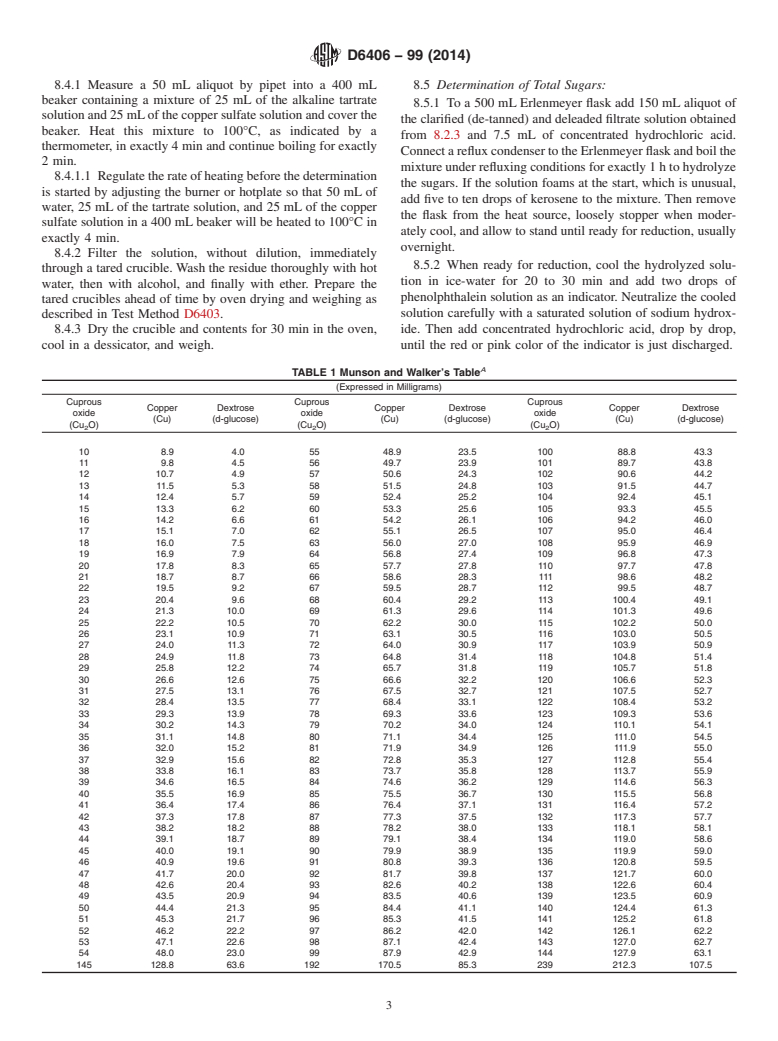
TABLE 1 Munson and Walker’s Table
(Expressed in Milligrams)
Cuprous Cuprous Cuprous
Copper Dextrose Copper Dextrose Copper Dextrose
oxide oxide oxide
(Cu) (d-glucose) (Cu) (d-glucose) (Cu) (d-glucose)
(Cu O) (Cu O) (Cu O)
2 2 2
10 8.9 4.0 55 48.9 23.5 100 88.8 43.3
11 9.8 4.5 56 49.7 23.9 101 89.7 43.8
12 10.7 4.9 57 50.6 24.3 102 90.6 44.2
13 11.5 5.3 58 51.5 24.8 103 91.5 44.7
14 12.4 5.7 59 52.4 25.2 104 92.4 45.1
15 13.3 6.2 60 53.3 25.6 105 93.3 45.5
16 14.2 6.6 61 54.2 26.1 106 94.2 46.0
17 15.1 7.0 62 55.1 26.5 107 95.0 46.4
18 16.0 7.5 63 56.0 27.0 108 95.9 46.9
19 16.9 7.9 64 56.8 27.4 109 96.8 47.3
20 17.8 8.3 65 57.7 27.8 110 97.7 47.8
21 18.7 8.7 66 58.6 28.3 111 98.6 48.2
22 19.5 9.2 67 59.5 28.7 112 99.5 48.7
23 20.4 9.6 68 60.4 29.2 113 100.4 49.1
24 21.3 10.0 69 61.3 29.6 114 101.3 49.6
25 22.2 10.5 70 62.2 30.0 115 102.2 50.0
26 23.1 10.9 71 63.1 30.5 116 103.0 50.5
27 24.0 11.3 72 64.0 30.9 117 103.9 50.9
28 24.9 11.8 73 64.8 31.4 118 104.8 51.4
29 25.8 12.2 74 65.7 31.8 119 105.7 51.8
30 26.6 12.6 75 66.6 32.2 120 106.6 52.3
31 27.5 13.1 76 67.5 32.7 121 107.5 52.7
32 28.4 13.5 77 68.4 33.1 122 108.4 53.2
33 29.3 13.9 78 69.3 33.6 123 109.3 53.6
34 30.2 14.3 79 70.2 34.0 124 110.1 54.1
35 31.1 14.8 80 71.1 34.4 125 111.0 54.5
36 32.0 15.2 81 71.9 34.9 126 111.9 55.0
37 32.9 15.6 82 72.8 35.3 127 112.8 55.4
38 33.8 16.1 83 73.7 35.8 128 113.7 55.9
39 34.6 16.5 84 74.6 36.2 129 114.6 56.3
40 35.5 16.9 85 75.5 36.7 130 115.5 56.8
41 36.4 17.4 86 76.4 37.1 131 116.4 57.2
42 37.3 17.8 87 77.3 37.5 132 117.3 57.7
43 38.2 18.2 88 78.2 38.0 133 118.1 58.1
44 39.1 18.7 89 79.1 38.4 134 119.0 58.6
45 40.0 19.1 90 79.9 38.9 135 119.9 59.0
46 40.9 19.6 91 80.8 39.3 136 120.8 59.5
47 41.7 20.0 92 81.7 39.8 137 121.7 60.0
48 42.6 20.4 93 82.6 40.2 138 122.6 60.4
49 43.5 20.9 94 83.5 40.6 139 123.5 60.9
50 44.4 21.3 95 84.4 41.1 140 124.4 61.3
51 45.3 21.7 96 85.3 41.5 141 125.2 61.8
52 46.2 22.2 97 86.2 42.0 142 126.1 62.2
53 47.1 22.6 98 87.1 42.4 143 127.0 62.7
54 48.0 23.0 99 87.9 42.9 144 127.9 63.1
145 128.8 63.6 192 170.5 85.3 239 212.3 107.5
D6406 − 99 (2014)
TABLE 1 Continued
(Expressed in Milligrams)
Cuprous Cuprous Cuprous
Copper Dextrose Copper Dextrose Copper Dextrose
oxide oxide oxide
(Cu) (d-glucose) (Cu) (d-glucose) (Cu) (d-glucose)
(Cu O) (Cu O) (Cu O)
2 2 2
146 129.7 64.0 193 171.4 85.7 240 213.2 108.0
147 130.6 64.5 194 172.3 86.2 241 214.1 108.4
148 131.5 65.0 195 173.2 86.7 242 215.0 108.9
149 132.4 65.4 196 174.1 87.1 243 215.8 109.4
150 133.2 65.9 197 175.0 87.6 244 216.7 109.0
151 134.1 66.3 198 175.9 88.1 245 217.6 110.4
152 135.0 66.8 199 176.8 88.5 246 218.5 110.8
153 135.9 67.2 200 177.7 89.0 247 219.4 111.3
154 136.8 67.7 201 178.5 89.5 248 220.2 111.8
155 137.7 68.2 202 179.4 89.8 249 221.2 112.3
156 138.6 68.6 203 180.3 90.4 250 222.1 112.8
157 139.5 69.1 204 181.2 90.9 251 223.0 113.2
158 140.3 69.5 205 182.1 91.4 252 223.8 113.7
159 141.2 70.0 206 183.0 91.8 253 224.7 114.2
160 142.2 70.4 207 183.9 92.3 254 225.6 114.7
161 143.0 70.9 208 184.8 92.8 255 226.5 115.2
162 143.9 71.4 209 185
...
This document is not an ASTM standard and is intended only to provide the user of an ASTM standard an indication of what changes have been made to the previous version. Because
it may not be technically possible to adequately depict all changes accurately, ASTM recommends that users consult prior editions as appropriate. In all cases only the current version
of the standard as published by ASTM is to be considered the official document.
Designation: D6406 − 99 (Reapproved 2009) D6406 − 99 (Reapproved 2014)
Standard Test Method for
Analysis of Sugar in Vegetable Tanning Materials
This standard is issued under the fixed designation D6406; the number immediately following the designation indicates the year of
original adoption or, in the case of revision, the year of last revision. A number in parentheses indicates the year of last reapproval. A
superscript epsilon (´) indicates an editorial change since the last revision or reapproval.
1. Scope
1.1 This test method covers determining the sugars present in vegetable tanning materials.
1.2 The values stated in SI units are to be regarded as the standard. The inch-pound units given in parentheses are for
information only.
1.3 This standard does not purport to address all of the safety concerns, if any, associated with its use. It is the responsibility
of the user of this standard to establish appropriate safety and health practices and determine the applicability of regulatory
limitations prior to use.
2. Referenced Documents
2.1 ASTM Standards:
D4901 Practice for Preparation of Solution of Liquid Vegetable Tannin Extracts
D4905 Practice for Preparation of Solution of Solid, Pasty and Powdered Vegetable Tannin Extracts
D6401 Test Method for Determining Non-Tannins and Tannin in Extracts of Vegetable Tanning Materials
D6403 Test Method for Determining Moisture in Raw and Spent Materials
D6404 Practice for Sampling Vegetable Materials Containing Tannin
D6405 Practice for Extraction of Tannins from Raw and Spent Materials
D6408 Test Method for Analysis of Tannery Liquors
2.2 ALCA Methods:
A30 Sugar in Tanning Materials
3. Terminology
3.1 Definitions:
3.1.1 dextrose—d-glucose.
3.1.2 glucose—a simple sugar with formula C H O , and known to exist in d-, l-, and racemic forms. The term commonly
6 12 6
refers to the sweet, colorless, water-soluble dextrorotatory form that occurs widely in nature and is the usual form in which
carbohydrate is assimilated by animals. The term glucose can also refer to a light-colored syrup made from corn starch.
3.1.3 sugar—any of various water-soluble compounds that vary widely in sweetness and comprise the oligosaccharides
including sucrose.
4. Summary of Test Method
4.1 An analytical strength solution (that is, 4.00 6 0.25 g tannin per litre) of the tanning material is analyzed for reducing sugars
and total sugars by the Munson and Walker procedure.
5. Significance and Use
5.1 This test method is used to determine the quantity of sugar present in vegetable tanning materials or vegetable tannin
extracts. The amount of the reducing sugars, total sugars, and non-reducing sugars in a sample of material or extract can be
determined by this method.
This test method is under the jurisdiction of ASTM Committee D31 on Leather and is the direct responsibility of Subcommittee D31.01 on Vegetable Leather. This
method has been adapted from and is a replacement for Method A30 of the Official Methods of the American Leather Chemists Association.
Current edition approved April 1, 2009Nov. 1, 2014. Published July 2009December 2014. Originally approved in 1999. Last previous edition approved in 20042009 as
D6406 – 99 (2004).(2009). DOI: 10.1520/D6406-99R09.10.1520/D6406-99R14.
For referenced ASTM standards, visit the ASTM website, www.astm.org, or contact ASTM Customer Service at service@astm.org. For Annual Book of ASTM Standards
volume information, refer to the standard’s Document Summary page on the ASTM website.
Official Methods of the American Leather Chemists Association. Available from the American Leather Chemists Association, University of Cincinnati, P.O. Box 210014,
Cincinnati, OH 45221-0014.
Copyright © ASTM International, 100 Barr Harbor Drive, PO Box C700, West Conshohocken, PA 19428-2959. United States
D6406 − 99 (2014)
5.2 Because of the possibility of errors in this test method it is essential that the method be followed exactly in order to obtain
reproducible results both among specimens within a laboratory and for analyses between laboratories.
6. Apparatus and Reagents
6.1 Saturated Solution of Normal Lead Acetate.
6.2 Dipotassium Hydrogen Phosphate, Anhydrous (K HPO ),dried in an oven at 100°C for 16 h then stored in a tightly
2 4
stoppered bottle.
6.3 Toluene, assay ≥ 99.5 %.
6.4 Fehling’s Solutions, A and B.
6.5 Hydrochloric Acid, concentrated (sp.gr. 1.18).
6.6 Kerosene, commercial grade.
6.7 Saturated Solution of Sodium Hydroxide.
6.8 Phenolphthalein Solution, 0.5 g dissolved in 100 mL of 95 % ethanol.
6.9 Tartaric Acid, powdered.
6.10 Copper Sulfate Solution, prepared by dissolving 69.278 g of CuSO • 5H O in 1 L of distilled water and filtering through
4 2
asbestos.
6.11 Alkaline Tartrate Solution, prepared by dissolving 346 g of Rochelle salt (sodium potassium tartrate tetrahydrate) and 100
g of sodium hydroxide in 1 L of distilled water. After standing for two days the solution shall be filtered through asbestos.
6.12 Alcohol, 95 % ethyl alcohol.
6.13 Ether, diethyl ether.
6.14 Filter Paper ,21.5 cm diameter, pleated to contain 32 evenly divided creases.
6.15 Funnel, 100-125 mm top diameter, 60° angle bowl, and 150 mm stem length.
6.16 Watch Glasses, a suitable size (approximately 150 mm diameter) to be used as a cover for the funnel and filter paper.
6.17 Graduated Cylinder, standard laboratory grade with 500 mL capacity.
6.18 Pipets, capable of measuring and transferring 100 mL, 50 mL, and 7.5 mL.
6.19 Beakers, 400 mL, low form.
6.20 Erlenmeyer Flasks, 500 mL capacity.
6.21 Reflux Condensers, to connect to the top of the Erlenmeyer flasks.
6.22 Heat Source, either a Bunsen burner or a hotplate.
6.23 Volumetric Flasks, 200 mL capacity.
6.24 Filtering Crucibles, either porcelain crucibles of Fine porosity or Gooch-asbestos crucibles prepared as follows:
6.24.1 Digest finely divided long fibered asbestos with nitric acid (diluted 1 to 3) for 2 to 3 days.
6.24.2 Wash the asbestos free from acid.
6.24.3 Digest the asbestos with 10 % sodium hydroxide solution for two to three days.
6.24.4 Wash the asbestos free from alkali.
6.24.5 Prepare the Gooch crucible by making a bottom layer of 6.4 mm ( ⁄4 in.) thickness using the coarser particles of asbestos
on the bottom and dress off the mat with the finer asbestos particles.
6.24.6 Wash the mat with boiling Fehling’s solution.
6.24.7 Wash the mat with nitric acid diluted 1 to 3.
6.24.8 Wash and rinse the mat with hot distilled water.
6.24.9 Crucibles so prepared can be used for a long time.
6.25 Suction Flask and Crucible Holder, with connections to a vacuum.
6.26 Balance, analytical balance which will weigh up to 100 g with an accuracy of 6 0.1 mg (6 0.0001 g).
6.27 Drying Oven, a forced-air convection oven (or mechanical-convection draft oven) capable of maintaining a temperature
of 100 6 2.0°C.
The sole source of supply of S&S No. 610 filter paper known to the committee at this time is Schleicher & Schuell, 10 Optical Avenue, P.O. Box 2012, Keene, NH 03431.
If you are aware of alternative suppliers, please provide this information to ASTM Headquarters. Your comments will receive careful consideration at a meeting of the
responsible technical committee, which you may attend.
D6406 − 99 (2014)
6.28 Thermometer, accurate to 6 0.2°C used to check and monitor the oven set point.
6.29 Dessicator, any convenient form or size, using any normal desiccant.
7. Test Specimen
7.1 The specimen for the sugar analysis shall consist of 400 mL of a solution of the tanning material of analytical strength
(4.006 0.25 g tannin per L).
8. Procedure
8.1 Sample the tanning material using Practice D6404, and prepare the analytical solution as described in Practices D4901,
D4905, D6405, or D6408.
8.2 Detannization of Analytical Solution:
8.2.1 Add to 400 mL of the analytical solution 50 mL of a saturated lead acetate solution. Shake the mixture well and allow
to stand for 5 to 10 min.
NOTE 1—It is important that the mixture of liquor and lead acetate solution be very well shaken. Good results are obtained by placing the solution
mixture in shake bottles and running in the shake machine for 10 min (as described in Test Method D6401) to ensure complete detannization of the liquor.
The mixture filters better after complete detannization. Complete detannization also results in less danger of residual quantities of unreacted lead which
may exceed the capacity of the potassium phosphate to remove and which could then interfere in the final copper precipitation step.
8.2.2 Then filter the mixture through a folded filter paper and return the filtrate to the filter until it is clear. Continue filtration
until 360 to 380 mL of the clear filtrate has been collected; this may take an hour or more to accomplish. Cover the funnel during
the filtration.
8.2.3 Measure the volume of the collected filtrate in a graduated cylinder. Remove the excess lead from this filtrate by adding
dried dipotassium hydrogen phosphate (K HPO ) at the rate of 2.5 g (6 0.1 g) phosphate per 100 mL of the filtrate. After addition
2 4
of the phosphate shake the mixture well for 4 to 5 min and then filter through a folded filter paper. Allow time for the solution
to drain completely from the lead phosphate. Cover the funnel during the filtration.
8.3 Determination of Reducing Sugars:
8.3.1 Add to 100 mL of the clarified (de-tanned) and de-leaded filtrate solution obtained from 8.2.3 33.3 mL of distilled water.
If the reduction is not to be made at once also add eight to ten drops of toluene. Shake this mixture well and stopper with a plug
of cotton. Keep the prepared solution in a cool place and make the reduction within 24 h. When ready for reduction, filter the
solution if toluene has been added. Determine reducing sugars by the Munson and Walker procedure in 8.4 using duplicate 50 mL
aliquots.
8.4 Munson and Walker Method for Sugar Analysis:
8.4.1 Measure a 50 mL aliquot by pipet into a 400 mL beaker containing a mixture of 25 mL of the alkaline tartrate solution
and 25 mL of the copper sulfate solution and cover the beaker. Heat this mixture to 100°C, as indicated by a thermometer, in
exactly 4 min and continue boiling for exactly 2 min.
8.4.1.1 Regulate the rate of heating before the determination is started by adjusting the burner or hotplate so that 50 mL of water,
25 mL of the tartrate solution, and 25 mL of the copper sulfate solution in a 400 mL beaker will be heated to 100°C in exactly
4 min.
8.4.2 Filter the solution, without dilution, immediately through a tared crucible. Wash the residue thoroughly with hot water,
then with alcohol, and finally with ether. Prepare the tared crucibles ahead of time by oven drying and weighing as described in
Test Method D6403.
8.4.3 Dry the crucible and contents for 30 min in the oven, cool in a dessicator, and weigh.
8.5 Determination of Total Sugars:
8.5.1 To a 500 mL Erlenmeyer flask add 150 mL aliquot of the clarified (de-tanned) and deleaded filtrate solution obtained from
8.2.3 and 7.5 mL of concentrated hydrochloric acid. Connect a reflux condenser to the Erlenmeyer flask and boil the mixture under
refluxing conditions for exactly 1 h to hydrolyze the sugars. If the solution foams at the start, which is unusual, add five to ten drops
of kerosene to the mixture. Then remove the flask from the heat source, loosely stopper when moderately cool, and allow to stand
until ready for reduction, usually overnight.
8.5.2 When ready for reduction, cool the hydrolyzed solution in ice-water for 20 to 30 min and add two drops of phenolphthalein
solution as an indicator. Neutralize the cooled solution carefully with a saturated solution of sodium hydroxide. Then add
concentrated hydrochloric acid, drop by drop, until the red or pink color of the indicator is just discharged.
A
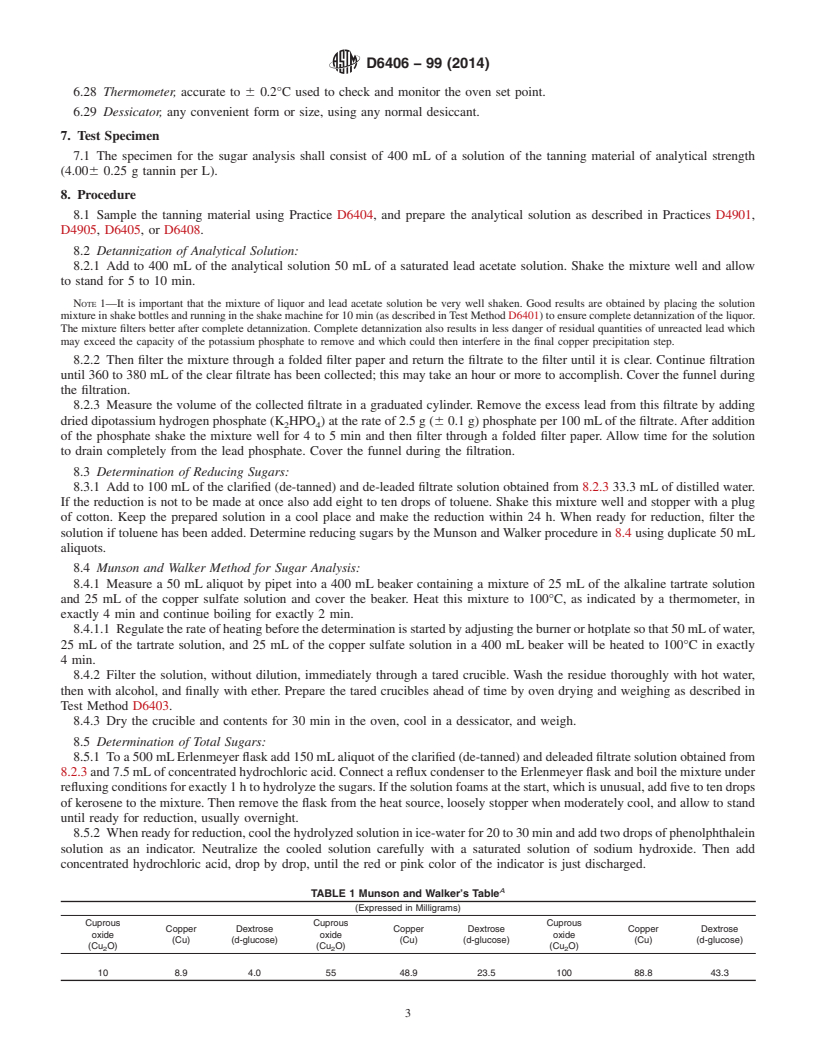
TABLE 1 Munson and Walker’s Table
(Expressed in Milligrams)
Cuprous Cuprous Cuprous
Copper Dextrose Copper Dextrose Copper Dextrose
oxide oxide oxide
(Cu) (d-glucose) (Cu) (d-glucose) (Cu) (d-glucose)
(Cu O) (Cu O) (Cu O)
2 2 2
10 8.9 4.0 55 48.9 23.5 100 88.8 43.3
D6406 − 99 (2014)
TABLE 1 Continued
(Expressed in Milligrams)
Cuprous Cuprous Cuprous
Copper Dextrose Copper Dextrose Copper Dextrose
oxide oxide oxide
(Cu) (d-glucose) (Cu) (d-glucose) (Cu) (d-glucose)
(Cu O) (Cu O) (Cu O)
2 2 2
11 9.8 4.5 56 49.7 23.9 101 89.7 43.8
12 10.7 4.9 57 50.6 24.3 102 90.6 44.2
13 11.5 5.3 58 51.5 24.8 103 91.5 44.7
14 12.4 5.7 59 52.4 25.2 104 92.4 45.1
15 13.3 6.2 60 53.3 25.6 105 93.3 45.5
16 14.2 6.6 61 54.2 26.1 106 94.2 46.0
17 15.1 7.0 62 55.1 26.5 107 95.0 46.4
18 16.0 7.5 63 56.0 27.0 108 95.9 46.9
19 16.9 7.9 64 56.8 27.4 109 96.8 47.3
20 17.8 8.3 65 57.7 27.8 110 97.7 47.8
21 18.7 8.7 66 58.6 28.3 111 98.6 48.2
22 19.5 9.2 67 59.5 28.7 112 99.5 48.7
23 20.4 9.6 68 60.4 29.2 113 100.4 49.1
24 21.3 10.0 69 61.3 29.6 114 101.3 49.6
25 22.2 10.5 70 62.2 30.0 115 102.2 50.0
26 23.1 10.9 71 63.1 30.5 116 103.0 50.5
27 24.0 11.3 72 64.0 30.9 117 103.9 50.9
28 24.9 11.8 73 64.8 31.4 118 104.8 51.4
29 25.8 12.2 74 65.7 31.8 119 105.7 51.8
30 26.6 12.6 75 66.6 32.2 120 106.6 52.3
31 27.5 13.1 76 67.5 32.7 121 107.5 52.7
32 28.4 13.5 77 68.4 33.1 122 108.4 53.2
33 29.3 13.9 78 69.3 33.6 123 109.3 53.6
34 30.2 14.3 79 70.2 34.0 124 110.1 54.1
35 31.1 14.8 80 71.1 34.4 125 111.0 54.5
36 32.0 15.2 81 71.9 34.9 126 111.9 55.0
37 32.9 15.6 82 72.8 35.3 127 112.8 55.4
38 33.8 16.1 83 73.7 35.8 128 113.7 55.9
39 34.6 16.5 84 74.6 36.2 129 114.6 56.3
40 35.5 16.9 85 75.5 36.7 130 115.5 56.8
41 36.4 17.4 86 76.4 37.1 131 116.4 57.2
42 37.3 17.8 87 77.3 37.5 132 117.3 57.7
43 38.2 18.2 88 78.2 38.0 133 118.1 58.1
44 39.1 18.7 89 79.1 38.4 134 119.0 58.6
45 40.0 19.1 90 79.9 38.9 135 119.9 59.0
46 40.9 19.6 91 80.8 39.3 136 120.8 59.5
47 41.7 20.0 92 81.7 39.8 137 121.7 60.0
48 42.6 20.4 93 82.6 40.2 138 122.6 60.4
49 43.5 20.9 94 83.5 40.6 139 123.5 60.9
50 44.4 21.3 95 84.4 41.1 140 124.4 61.3
51 45.3 21.7 96 85.3 41.5 141 125.2 61.8
52 46.2 22.2 97 86.2 42.0 142 126.1 62.2
53 47.1 22.6 98 87.1 42.4 143 127.0 62.7
54 48.0 23.0 99 87.9 42.9 144 127.9 63.1
145 128.8 63.6 192 170.5 85.3 239 212.3 107.5
146 129.7 64.0 193 171.4 85.7 240 213.2 108.0
147 130.6 64.5 194 172.3 86.2 241 214.1 108.4
148 131.5 65.0 195 173.2 86.7 242 215.0 108.9
149 132.4 65.4 196 174.1 87.1 243 215.8 109.4
150 133.2 65.9 197 175.0 87.6 244 216.7 109.0
151 134.1 66.3 198 175.9 88.1 245 217.6 110.4
152 135.0 66.8 199 176.8 88.5 246
...
Questions, Comments and Discussion
Ask us and Technical Secretary will try to provide an answer. You can facilitate discussion about the standard in here.