


ASTM A270/A270M-24
(Specification)Standard Specification for Seamless and Welded Austenitic and Ferritic/Austenitic Stainless Steel Sanitary Tubing
Standard Specification for Seamless and Welded Austenitic and Ferritic/Austenitic Stainless Steel Sanitary Tubing
ABSTRACT
This specification covers grades of seamless, welded, and heavily cold worked austenitic and ferritic/austenitic stainless steel sanitary tubing. Seamless tubes shall be manufactured by a process that does not involve welding at any stage. Welded tubes shall be made using an automated welding process with no addition of filler metal during the welding process. Heavily cold worked tubes shall be made by applying cold working of not less than 35% reduction of thickness of both wall and weld to a welded tube prior to the final anneal. No filler shall be used in making the weld. All material shall be furnished in the heat-treated condition. A chemical analysis of either one length of flat-rolled stock or one tube shall be made for each heat. Each tube shall be subjected to mechanical tests like reverse flattening test, hydrostatic test or nondestructive electric test. The following surface finishes may be specified: mill finish, mechanically polished surface finish, finish No. 80, finish No. 120, finish No. 180, finish No. 240, electropolished finish, and maximum roughness average surface finish. Longitudinally polished finish shall be performed on the inside surface only while a circumferential polished finish shall be done on either the inside surface, outside surface, or both.
SCOPE
1.1 This specification covers grades of seamless, welded, and heavily cold worked welded austenitic and ferritic/austenitic stainless steel sanitary tubing intended for use in the dairy and food industry and having special surface finishes. Pharmaceutical quality may be requested, as a supplementary requirement.
1.2 This specification covers tubes in sizes up to and including 12 in. [300 mm] in outside diameter.
1.3 The values stated in either SI units or inch-pound units are to be regarded separately as standard. The values stated in each system may not be exact equivalents; therefore, each system shall be used independently of the other. Combining values from the two systems may result in non-conformance with the standard.
1.4 Optional supplementary requirements are provided, and when one or more of these are desired, each shall be so stated in the order.
1.5 This international standard was developed in accordance with internationally recognized principles on standardization established in the Decision on Principles for the Development of International Standards, Guides and Recommendations issued by the World Trade Organization Technical Barriers to Trade (TBT) Committee.
General Information
- Status
- Published
- Publication Date
- 29-Feb-2024
- Technical Committee
- A01 - Steel, Stainless Steel and Related Alloys
- Drafting Committee
- A01.10 - Stainless and Alloy Steel Tubular Products
Relations
- Effective Date
- 01-Mar-2024
- Effective Date
- 01-Mar-2024
Overview
ASTM A270/A270M-24 establishes standard specifications for seamless, welded, and heavily cold worked austenitic and ferritic/austenitic stainless steel sanitary tubing. Published by ASTM International, this standard addresses the requirements for tubes intended primarily for sanitary service in the dairy and food industries, with options for pharmaceutical quality. The specification covers tubing with special surface finishes, dimensions up to and including 12 inches [300 mm] in outside diameter, and requirements for manufacturing, heat treatment, chemical composition, and mechanical testing. ASTM A270/A270M-24 provides clear guidance to ensure product quality and interoperability, supporting both SI and inch-pound units, but requiring each unit system to be used independently.
Key Topics
- Product Types: Covers seamless tubes, welded tubes (using no filler metal), and heavily cold worked welded tubes.
- Material Grades: Applies to a wide range of austenitic and ferritic/austenitic (duplex) stainless steels, including popular alloys used for sanitary service.
- Surface Finishes: Specifies several finish types such as mill finish, various mechanically polished finishes (No. 80, 120, 180, 240), electropolished finish, and maximum roughness average (Ra) requirements. Finishes can be applied to inside, outside, or both surfaces, as specified by the purchaser.
- Testing and Quality Control: Mandatory mechanical tests include reverse flattening tests and either hydrostatic or nondestructive electric testing for each tube to ensure integrity and performance.
- Dimensional Tolerances: Precise permissible variations in outside diameter, wall thickness, and length, designed to meet industry requirements for sanitary applications.
- Heat Treatment: All sanitary tubing must be supplied in the heat-treated condition to ensure corrosion resistance and mechanical properties.
Applications
ASTM A270/A270M-24 is widely recognized for its applications in industries where hygiene and corrosion-resistance are critical:
- Dairy Processing: Used in piping and transport lines requiring clean and smooth surfaces to prevent bacterial growth and facilitate cleaning.
- Food & Beverage Production: Essential for processing and handling equipment such as conveyors, tanks, and pipelines where sanitary conditions must be maintained.
- Pharmaceutical Manufacturing: When the supplementary pharmaceutical requirement is specified, tubing must comply with stricter quality, surface finish, and cleanliness requirements, supporting the production of medicines and sterile fluids.
- Other Sanitary Applications: Used in breweries, biotechnology, and cosmetic production where product purity is paramount.
Manufacturers, engineers, procurement specialists, and quality assurance professionals benefit from using tubing specified to ASTM A270/A270M-24 for sanitary process systems, ensuring regulatory compliance, consistency, and effective cleaning.
Related Standards
ASTM A270/A270M-24 references and aligns with several related standards to ensure comprehensive quality and performance:
- ASTM A262 - Practices for Detecting Susceptibility to Intergranular Attack in Austenitic Stainless Steels
- ASTM A480/A480M - General Requirements for Flat-Rolled Stainless and Heat-Resisting Steel Plate, Sheet, and Strip
- ASTM A1016/A1016M - General Requirements for Ferritic Alloy Steel, Austenitic Alloy Steel, and Stainless Steel Tubes
- ASTM A967/A967M - Chemical Passivation Treatments for Stainless Steel Parts
- ASME B46.1 - Surface Texture (Surface Roughness, Waviness, and Lay)
- SAE J1086 - Practice for Numbering Metals and Alloys (UNS)
- ASME Boiler and Pressure Vessel Code - Section VIII for Pressure Vessels
For enhanced performance in demanding sanitary environments, refer to ASTM A270/A270M-24 and its related standards to select the optimal stainless steel sanitary tubing for your application.
Buy Documents
ASTM A270/A270M-24 - Standard Specification for Seamless and Welded Austenitic and Ferritic/Austenitic Stainless Steel Sanitary Tubing
REDLINE ASTM A270/A270M-24 - Standard Specification for Seamless and Welded Austenitic and Ferritic/Austenitic Stainless Steel Sanitary Tubing
Get Certified
Connect with accredited certification bodies for this standard

Institut za varilstvo d.o.o. (Welding Institute)
Slovenia's leading welding institute since 1952. ISO 3834, EN 1090, pressure equipment certification, NDT personnel, welder qualification. Only IIW Au
Sponsored listings
Frequently Asked Questions
ASTM A270/A270M-24 is a technical specification published by ASTM International. Its full title is "Standard Specification for Seamless and Welded Austenitic and Ferritic/Austenitic Stainless Steel Sanitary Tubing". This standard covers: ABSTRACT This specification covers grades of seamless, welded, and heavily cold worked austenitic and ferritic/austenitic stainless steel sanitary tubing. Seamless tubes shall be manufactured by a process that does not involve welding at any stage. Welded tubes shall be made using an automated welding process with no addition of filler metal during the welding process. Heavily cold worked tubes shall be made by applying cold working of not less than 35% reduction of thickness of both wall and weld to a welded tube prior to the final anneal. No filler shall be used in making the weld. All material shall be furnished in the heat-treated condition. A chemical analysis of either one length of flat-rolled stock or one tube shall be made for each heat. Each tube shall be subjected to mechanical tests like reverse flattening test, hydrostatic test or nondestructive electric test. The following surface finishes may be specified: mill finish, mechanically polished surface finish, finish No. 80, finish No. 120, finish No. 180, finish No. 240, electropolished finish, and maximum roughness average surface finish. Longitudinally polished finish shall be performed on the inside surface only while a circumferential polished finish shall be done on either the inside surface, outside surface, or both. SCOPE 1.1 This specification covers grades of seamless, welded, and heavily cold worked welded austenitic and ferritic/austenitic stainless steel sanitary tubing intended for use in the dairy and food industry and having special surface finishes. Pharmaceutical quality may be requested, as a supplementary requirement. 1.2 This specification covers tubes in sizes up to and including 12 in. [300 mm] in outside diameter. 1.3 The values stated in either SI units or inch-pound units are to be regarded separately as standard. The values stated in each system may not be exact equivalents; therefore, each system shall be used independently of the other. Combining values from the two systems may result in non-conformance with the standard. 1.4 Optional supplementary requirements are provided, and when one or more of these are desired, each shall be so stated in the order. 1.5 This international standard was developed in accordance with internationally recognized principles on standardization established in the Decision on Principles for the Development of International Standards, Guides and Recommendations issued by the World Trade Organization Technical Barriers to Trade (TBT) Committee.
ABSTRACT This specification covers grades of seamless, welded, and heavily cold worked austenitic and ferritic/austenitic stainless steel sanitary tubing. Seamless tubes shall be manufactured by a process that does not involve welding at any stage. Welded tubes shall be made using an automated welding process with no addition of filler metal during the welding process. Heavily cold worked tubes shall be made by applying cold working of not less than 35% reduction of thickness of both wall and weld to a welded tube prior to the final anneal. No filler shall be used in making the weld. All material shall be furnished in the heat-treated condition. A chemical analysis of either one length of flat-rolled stock or one tube shall be made for each heat. Each tube shall be subjected to mechanical tests like reverse flattening test, hydrostatic test or nondestructive electric test. The following surface finishes may be specified: mill finish, mechanically polished surface finish, finish No. 80, finish No. 120, finish No. 180, finish No. 240, electropolished finish, and maximum roughness average surface finish. Longitudinally polished finish shall be performed on the inside surface only while a circumferential polished finish shall be done on either the inside surface, outside surface, or both. SCOPE 1.1 This specification covers grades of seamless, welded, and heavily cold worked welded austenitic and ferritic/austenitic stainless steel sanitary tubing intended for use in the dairy and food industry and having special surface finishes. Pharmaceutical quality may be requested, as a supplementary requirement. 1.2 This specification covers tubes in sizes up to and including 12 in. [300 mm] in outside diameter. 1.3 The values stated in either SI units or inch-pound units are to be regarded separately as standard. The values stated in each system may not be exact equivalents; therefore, each system shall be used independently of the other. Combining values from the two systems may result in non-conformance with the standard. 1.4 Optional supplementary requirements are provided, and when one or more of these are desired, each shall be so stated in the order. 1.5 This international standard was developed in accordance with internationally recognized principles on standardization established in the Decision on Principles for the Development of International Standards, Guides and Recommendations issued by the World Trade Organization Technical Barriers to Trade (TBT) Committee.
ASTM A270/A270M-24 is classified under the following ICS (International Classification for Standards) categories: 23.040.10 - Iron and steel pipes. The ICS classification helps identify the subject area and facilitates finding related standards.
ASTM A270/A270M-24 has the following relationships with other standards: It is inter standard links to ASTM A270/A270M-23, ASTM A1016/A1016M-23. Understanding these relationships helps ensure you are using the most current and applicable version of the standard.
ASTM A270/A270M-24 is available in PDF format for immediate download after purchase. The document can be added to your cart and obtained through the secure checkout process. Digital delivery ensures instant access to the complete standard document.
Standards Content (Sample)
This international standard was developed in accordance with internationally recognized principles on standardization established in the Decision on Principles for the
Development of International Standards, Guides and Recommendations issued by the World Trade Organization Technical Barriers to Trade (TBT) Committee.
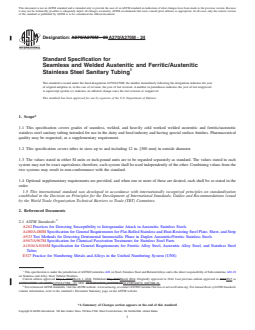
Designation: A270/A270M − 24
Standard Specification for
Seamless and Welded Austenitic and Ferritic/Austenitic
Stainless Steel Sanitary Tubing
This standard is issued under the fixed designation A270/A270M; the number immediately following the designation indicates the year
of original adoption or, in the case of revision, the year of last revision. A number in parentheses indicates the year of last reapproval.
A superscript epsilon (´) indicates an editorial change since the last revision or reapproval.
This standard has been approved for use by agencies of the U.S. Department of Defense.
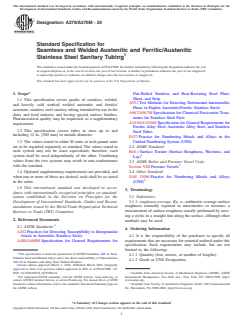
1. Scope* Flat-Rolled Stainless and Heat-Resisting Steel Plate,
Sheet, and Strip
1.1 This specification covers grades of seamless, welded,
A923 Test Methods for Detecting Detrimental Intermetallic
and heavily cold worked welded austenitic and ferritic/
Phase in Duplex Austenitic/Ferritic Stainless Steels
austenitic stainless steel sanitary tubing intended for use in the
A967/A967M Specification for Chemical Passivation Treat-
dairy and food industry and having special surface finishes.
ments for Stainless Steel Parts
Pharmaceutical quality may be requested, as a supplementary
A1016/A1016M Specification for General Requirements for
requirement.
Ferritic Alloy Steel, Austenitic Alloy Steel, and Stainless
1.2 This specification covers tubes in sizes up to and
Steel Tubes
including 12 in. [300 mm] in outside diameter.
E527 Practice for Numbering Metals and Alloys in the
1.3 The values stated in either SI units or inch-pound units Unified Numbering System (UNS)
are to be regarded separately as standard. The values stated in
2.2 ASME Standard:
each system may not be exact equivalents; therefore, each
B46.1 Surface Texture (Surface Roughness, Waviness, and
system shall be used independently of the other. Combining
Lay)
values from the two systems may result in non-conformance
2.3 ASME Boiler and Pressure Vessel Code:
with the standard.
Section VIII Pressure Vessels
1.4 Optional supplementary requirements are provided, and 2.4 Other Standard:
when one or more of these are desired, each shall be so stated SAE J1086 Practice for Numbering Metals and Alloys
in the order. (UNS)
1.5 This international standard was developed in accor-
3. Terminology
dance with internationally recognized principles on standard-
3.1 Definitions:
ization established in the Decision on Principles for the
3.1.1 roughness average, Ra, n—arithmetic average surface
Development of International Standards, Guides and Recom-
roughness normally reported in microinches or microns; a
mendations issued by the World Trade Organization Technical
measurement of surface roughness usually performed by mov-
Barriers to Trade (TBT) Committee.
ing a stylus in a straight line along the surface, although other
2. Referenced Documents
methods may be used.
2.1 ASTM Standards:
4. Ordering Information
A262 Practices for Detecting Susceptibility to Intergranular
4.1 It is the responsibility of the purchaser to specify all
Attack in Austenitic Stainless Steels
requirements that are necessary for material ordered under this
A480/A480M Specification for General Requirements for
specification. Such requirements may include, but are not
limited to, the following:
This specification is under the jurisdiction of ASTM Committee A01 on Steel,
4.1.1 Quantity (feet, metres, or number of lengths),
Stainless Steel and Related Alloys and is the direct responsibility of Subcommittee
4.1.2 Grade or UNS Designation,
A01.10 on Stainless and Alloy Steel Tubular Products.
Current edition approved March 1, 2024. Published March 2024. Originally
approved in 1944. Last previous edition approved in 2023 as A270/A270M – 23.
DOI: 10.1520/A0270_A0270M-24. Available from American Society of Mechanical Engineers (ASME), ASME
For referenced ASTM standards, visit the ASTM website, www.astm.org, or International Headquarters, Two Park Ave., New York, NY 10016-5990, http://
contact ASTM Customer Service at service@astm.org. For Annual Book of ASTM www.asme.org.
Standards volume information, refer to the standard’s Document Summary page on Available from Society of Automotive Engineers (SAE), 400 Commonwealth
the ASTM website. Dr., Warrendale, PA 15096-0001, http://www.sae.org.
*A Summary of Changes section appears at the end of this standard
Copyright © ASTM International, 100 Barr Harbor Drive, PO Box C700, West Conshohocken, PA 19428-2959. United States
A270/A270M − 24
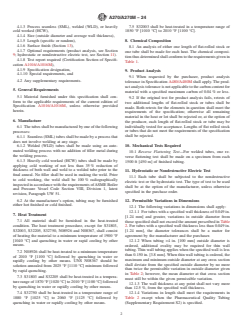
4.1.3 Process seamless (SML), welded (WLD), or heavily 7.5 S32003 shall be heat-treated in a temperature range of
cold worked (HCW), 1850 °F [1010 °C] to 2010 °F [1100 °C].
4.1.4 Size (outside diameter and average wall thickness),
8. Chemical Composition
4.1.5 Length (specific or random),
4.1.6 Surface finish (Section 13),
8.1 An analysis of either one length of flat-rolled stock or
4.1.7 Optional requirements (product analysis, see Section
one tube shall be made for each heat. The chemical composi-
9; hydrostatic or nondestructive electric test, see Section 11).
tion thus determined shall conform to the requirements given in
4.1.8 Test report required (Certification Section of Specifi-
Table 1.
cation A1016/A1016M),
4.1.9 Specification designation,
9. Product Analysis
4.1.10 Special requirements, and
9.1 When requested by the purchaser, product analysis
4.2 Any supplementary requirements.
tolerance in Specification A480/A480M shall apply. The prod-
uct analysis tolerance is not applicable to the carbon content for
5. General Requirements
material with a specified maximum carbon of 0.04 % or less.
5.1 Material furnished under this specification shall con-
9.2 If the original test for product analysis fails, retests of
form to the applicable requirements of the current edition of
two additional lengths of flat-rolled stock or tubes shall be
Specification A1016/A1016M, unless otherwise provided
made. Both retests for the elements in question shall meet the
herein.
requirements of the specification; otherwise all remaining
material in the heat or lot shall be rejected or, at the option of
6. Manufacture
the producer, each length of flat-rolled stock or tube may be
individually tested for acceptance. Lengths of flat rolled stock
6.1 The tubes shall be manufactured by one of the following
or tubes that do not meet the requirements of the specification
processes:
shall be rejected.
6.1.1 Seamless (SML) tubes shall be made by a process that
does not involve welding at any stage.
10. Mechanical Tests Required
6.1.2 Welded (WLD) tubes shall be made using an auto-
mated welding process with no addition of filler metal during
10.1 Reverse Flattening Test—For welded tubes, one re-
the welding process.
verse flattening test shall be made on a specimen from each
6.1.3 Heavily cold worked (HCW) tubes shall be made by
1500 ft [450 m] of finished tubing.
applying cold working of not less than 35 % reduction of
thickness of both wall and weld to a welded tube prior to the
11. Hydrostatic or Nondestructive Electric Test
final anneal. No filler shall be used in making the weld. Prior
11.1 Each tube shall be subjected to the nondestructive
to cold working, the weld shall be 100 % radiographically
electric test or the hydrostatic test. The type of test to be used
inspected in accordance with the requirements of ASME Boiler
shall be at the option of the manufacturer, unless otherwise
and Pressure Vessel Code Section VIII, Division 1, latest
specified in the purchase order.
revision, Paragraph UW 51.
6.2 At the manufacturer’s option, tubing may be furnished
12. Permissible Variations in Dimensions
either hot finished or cold finished.
12.1 The following variations in dimensions shall apply:
12.1.1 For tubes with a specified wall thickness of 0.049 in.
7. Heat Treatment
[1.24 mm] and greater, variations in outside diameter from
7.1 All material shall be furnished in the heat-treated those specified shall not exceed the amount prescribed in Table
condition. The heat treatment procedure, except for S31803, 2. For tubes with a specified wall thickness less than 0.049 in.
S32003, S32205, S32750, N08926 and N08367, shall consist
[1.24 mm], the diameter tolerances shall be a matter for
of heating the material to a minimum temperature of 1900 °F agreement by the manufacturer and the purchaser.
[1040 °C] and quenching in water or rapid cooling by other
12.1.2 When tubing >4 in. [100 mm] outside diameter is
means. ordered, additional ovality may be required for thin wall
tubing. Thin wall tubing applies when the specified wall is less
7.2 N08926 shall be heat-treated to a minimum temperature
than 0.150 in. [3.8 mm]. When thin wall tubing is ordered, the
of 2010 °F [1100 °C] followed by quenching in water or
maximum and minimum outside diameter at any cross section
rapidly cooling by other means. UNS N08367 should be
shall deviate from the specified outside diameter by no more
solution annealed from 2025 °F [1110 °C] minimum followed
than twice the permissible variation in outside diameter given
by rapid quenching.
in Table 2; however, the mean diameter at that cross section
7.3 S31803 and S32205 shall be heat-treated in a tempera-
must still be within the given permissible variation.
ture range of 1870 °F [1020 °C] to 2010 °F [1100 °C] followed
12.1.3 The wall thickness at any point shall not vary more
by quenching in water or rapidly cooling by other means.
than 12.5 %, from the specified wall thickness.
7.4 S32750 shall be heat-treated in a temperature range of 12.1.4 Variations in length shall meet the requirements in
1880 °F [1025 °C] to 2060 °F [1125 °C] followed by Table 2 except when the Pharmaceutical Quality Tubing
quenching in water or rapidly cooling by other means. (Supplementary Requirement S2) is specified.
A270/A270M − 24
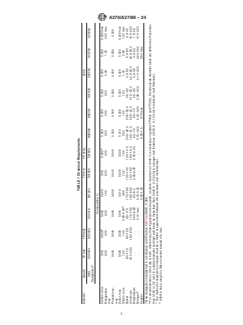
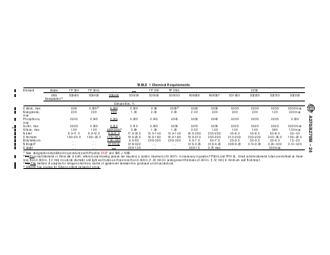
TABLE 1 Chemical Requirements
Element Grade TP 304 TP 304L . . . . . . TP 316 TP 316L . . . . . . . . . 2205 . . . . . .
UNS S30400 S30403 S30416 S31254 S31600 S31603 N08926 N08367 S31803 S32205 S32750 S32003
A
Designation
Composition, %
B B
Carbon, max 0.08 0.035 0.030 0.020 0.08 0.035 0.020 0.030 0.030 0.030 0.030 0.030 max
Manganese, 2.00 2.00 2.00 1.00 2.00 2.00 2.00 2.00 2.00 2.00 1.20 2.00 max
max
Phosphorus, 0.045 0.045 0.045 0.030 0.045 0.045 0.030 0.040 0.030 0.030 0.035 0.030
max
Sulfur, max 0.030 0.030 0.015 0.010 0.030 0.030 0.010 0.030 0.020 0.020 0.020 0.020 max
D
Silicon, max 1.00 1.00 0.80–2.00 0.80 1.00 1.00 0.50 1.00 1.00 1.00 0.80 1.00 max
Nickel 8.0–11.0 8.0–12.0 9.0–11.0 17.5–18.5 10.0–14.0 10.0–14.0 24.0–26.0 23.5–25.5 4.5–6.5 4.5–6.5 6.0–8.0 3.0–4.0
Chromium 18.0–20.0 18.0–20.0 17.5–19.5 19.5–20.5 16.0–18.0 16.0–18.0 19.0–21.0 20.0–22.0 21.0–23.0 22.0–23.0 24.0–26.0 19.5–22.5
Molybdenum . . . . . . 0.40–0.80 6.0–6.5 2.00–3.00 2.00–3.00 6.0–7.0 6.0–7.0 2.5–3.5 3.0–3.5 3.0–5.0 1.5–2.0
C
Nitrogen . . . . . . 0.10 max 0.18–0.22 . . . . . . 0.15–0.25 0.18–0.25 0.08–0.20 0.14–0.20 0.24–0.32 0.14–0.20
Copper . . . . . . . . . 0.50–1.00 . . . . . . 0.50–1.5 0.75 max . . . . . . 0.50 max
A
New des
...
This document is not an ASTM standard and is intended only to provide the user of an ASTM standard an indication of what changes have been made to the previous version. Because
it may not be technically possible to adequately depict all changes accurately, ASTM recommends that users consult prior editions as appropriate. In all cases only the current version
of the standard as published by ASTM is to be considered the official document.
Designation: A270/A270M − 23 A270/A270M − 24
Standard Specification for
Seamless and Welded Austenitic and Ferritic/Austenitic
Stainless Steel Sanitary Tubing
This standard is issued under the fixed designation A270/A270M; the number immediately following the designation indicates the year
of original adoption or, in the case of revision, the year of last revision. A number in parentheses indicates the year of last reapproval.
A superscript epsilon (´) indicates an editorial change since the last revision or reapproval.
This standard has been approved for use by agencies of the U.S. Department of Defense.
1. Scope*
1.1 This specification covers grades of seamless, welded, and heavily cold worked welded austenitic and ferritic/austenitic
stainless steel sanitary tubing intended for use in the dairy and food industry and having special surface finishes. Pharmaceutical
quality may be requested, as a supplementary requirement.
1.2 This specification covers tubes in sizes up to and including 12 in. [300 mm] in outside diameter.
1.3 The values stated in either SI units or inch-pound units are to be regarded separately as standard. The values stated in each
system may not be exact equivalents; therefore, each system shall be used independently of the other. Combining values from the
two systems may result in non-conformance with the standard.
1.4 Optional supplementary requirements are provided, and when one or more of these are desired, each shall be so stated in the
order.
1.5 This international standard was developed in accordance with internationally recognized principles on standardization
established in the Decision on Principles for the Development of International Standards, Guides and Recommendations issued
by the World Trade Organization Technical Barriers to Trade (TBT) Committee.
2. Referenced Documents
2.1 ASTM Standards:
A262 Practices for Detecting Susceptibility to Intergranular Attack in Austenitic Stainless Steels
A480/A480M Specification for General Requirements for Flat-Rolled Stainless and Heat-Resisting Steel Plate, Sheet, and Strip
A923 Test Methods for Detecting Detrimental Intermetallic Phase in Duplex Austenitic/Ferritic Stainless Steels
A967/A967M Specification for Chemical Passivation Treatments for Stainless Steel Parts
A1016/A1016M Specification for General Requirements for Ferritic Alloy Steel, Austenitic Alloy Steel, and Stainless Steel
Tubes
E527 Practice for Numbering Metals and Alloys in the Unified Numbering System (UNS)
This specification is under the jurisdiction of ASTM Committee A01 on Steel, Stainless Steel and Related Alloys and is the direct responsibility of Subcommittee A01.10
on Stainless and Alloy Steel Tubular Products.
Current edition approved May 1, 2023March 1, 2024. Published May 2023March 2024. Originally approved in 1944. Last previous edition approved in 20192023 as
A270/A270M – 15 (2019).A270/A270M – 23. DOI: 10.1520/A0270_A0270M-23.10.1520/A0270_A0270M-24.
For referenced ASTM standards, visit the ASTM website, www.astm.org, or contact ASTM Customer Service at service@astm.org. For Annual Book of ASTM Standards
volume information, refer to the standard’s Document Summary page on the ASTM website.
*A Summary of Changes section appears at the end of this standard
Copyright © ASTM International, 100 Barr Harbor Drive, PO Box C700, West Conshohocken, PA 19428-2959. United States
A270/A270M − 24
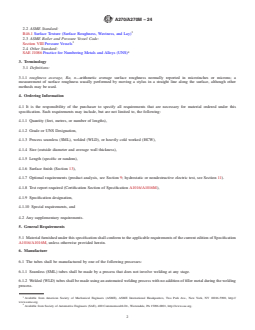
2.2 ASME Standard:
B46.1 Surface Texture (Surface Roughness, Waviness, and Lay)
2.3 ASME Boiler and Pressure Vessel Code:
Section VIII Pressure Vessels
2.4 Other Standard:
SAE J1086 Practice for Numbering Metals and Alloys (UNS)
3. Terminology
3.1 Definitions:
3.1.1 roughness average, Ra, n—arithmetic average surface roughness normally reported in microinches or microns; a
measurement of surface roughness usually performed by moving a stylus in a straight line along the surface, although other
methods may be used.
4. Ordering Information
4.1 It is the responsibility of the purchaser to specify all requirements that are necessary for material ordered under this
specification. Such requirements may include, but are not limited to, the following:
4.1.1 Quantity (feet, metres, or number of lengths),
4.1.2 Grade or UNS Designation,
4.1.3 Process seamless (SML), welded (WLD), or heavily cold worked (HCW),
4.1.4 Size (outside diameter and average wall thickness),
4.1.5 Length (specific or random),
4.1.6 Surface finish (Section 13),
4.1.7 Optional requirements (product analysis, see Section 9; hydrostatic or nondestructive electric test, see Section 11).
4.1.8 Test report required (Certification Section of Specification A1016/A1016M),
4.1.9 Specification designation,
4.1.10 Special requirements, and
4.2 Any supplementary requirements.
5. General Requirements
5.1 Material furnished under this specification shall conform to the applicable requirements of the current edition of Specification
A1016/A1016M, unless otherwise provided herein.
6. Manufacture
6.1 The tubes shall be manufactured by one of the following processes:
6.1.1 Seamless (SML) tubes shall be made by a process that does not involve welding at any stage.
6.1.2 Welded (WLD) tubes shall be made using an automated welding process with no addition of filler metal during the welding
process.
Available from American Society of Mechanical Engineers (ASME), ASME International Headquarters, Two Park Ave., New York, NY 10016-5990, http://
www.asme.org.
Available from Society of Automotive Engineers (SAE), 400 Commonwealth Dr., Warrendale, PA 15096-0001, http://www.sae.org.
A270/A270M − 24
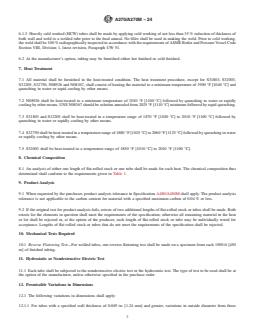
6.1.3 Heavily cold worked (HCW) tubes shall be made by applying cold working of not less than 35 % reduction of thickness of
both wall and weld to a welded tube prior to the final anneal. No filler shall be used in making the weld. Prior to cold working,
the weld shall be 100 % radiographically inspected in accordance with the requirements of ASME Boiler and Pressure Vessel Code
Section VIII, Division 1, latest revision, Paragraph UW 51.
6.2 At the manufacturer’s option, tubing may be furnished either hot finished or cold finished.
7. Heat Treatment
7.1 All material shall be furnished in the heat-treated condition. The heat treatment procedure, except for S31803, S32003,
S32205, S32750, N08926 and N08367, shall consist of heating the material to a minimum temperature of 1900 °F [1040 °C] and
quenching in water or rapid cooling by other means.
7.2 N08926 shall be heat-treated to a minimum temperature of 2010 °F [1100 °C] followed by quenching in water or rapidly
cooling by other means. UNS N08367 should be solution annealed from 2025 °F [1110 °C] minimum followed by rapid quenching.
7.3 S31803 and S32205 shall be heat-treated in a temperature range of 1870 °F [1020 °C] to 2010 °F [1100 °C] followed by
quenching in water or rapidly cooling by other means.
7.4 S32750 shall be heat-treated in a temperature range of 1880 °F [1025 °C] to 2060 °F [1125 °C] followed by quenching in water
or rapidly cooling by other means.
7.5 S32003 shall be heat-treated in a temperature range of 1850 °F [1010 °C] to 2010 °F [1100 °C].
8. Chemical Composition
8.1 An analysis of either one length of flat-rolled stock or one tube shall be made for each heat. The chemical composition thus
determined shall conform to the requirements given in Table 1.
9. Product Analysis
9.1 When requested by the purchaser, product analysis tolerance in Specification A480/A480M shall apply. The product analysis
tolerance is not applicable to the carbon content for material with a specified maximum carbon of 0.04 % or less.
9.2 If the original test for product analysis fails, retests of two additional lengths of flat-rolled stock or tubes shall be made. Both
retests for the elements in question shall meet the requirements of the specification; otherwise all remaining material in the heat
or lot shall be rejected or, at the option of the producer, each length of flat-rolled stock or tube may be individually tested for
acceptance. Lengths of flat rolled stock or tubes that do not meet the requirements of the specification shall be rejected.
10. Mechanical Tests Required
10.1 Reverse Flattening Test—For welded tubes, one reverse flattening test shall be made on a specimen from each 1500 ft [450
m] of finished tubing.
11. Hydrostatic or Nondestructive Electric Test
11.1 Each tube shall be subjected to the nondestructive electric test or the hydrostatic test. The type of test to be used shall be at
the option of the manufacturer, unless otherwise specified in the purchase order.
12. Permissible Variations in Dimensions
12.1 The following variations in dimensions shall apply:
12.1.1 For tubes with a specified wall thickness of 0.049 in. [1.24 mm] and greater, variations in outside diameter from those
A270/A270M − 24
TABLE 1 Chemical Requirements
Element Grade TP 304 TP 304L . . . . . . TP 316 TP 316L . . . . . . . . . 2205 . . . . . .
UNS S30400 S30403 S30416 S31254 S31600 S31603 N08926 N08367 S31803 S32205 S32750 S32003
A
Designation
Composition, %
B B
Carbon, max 0.08 0.035 0.030 0.020 0.08 0.035 0.020 0.030 0.030 0.030 0.030 0.030 max
Manganese, 2.00 2.00 2.00 1.00 2.00 2.00 2.00 2.00 2.00 2.00 1.20 2.00 max
max
Phosphorus, 0.045 0.045 0.045 0.030 0.045 0.045 0.030 0.040 0.030 0.030 0.035 0.030
max
Sulfur, max 0.030 0.030 0.015 0.010 0.030 0.030 0.010 0.030 0.020 0.020 0.020 0.020 max
D
Silicon, max 1.00 1.00 0.80–2.00 0.80 1.00 1.00 0.50 1.00 1.00 1.00 0.80 1.00 max
Nickel 8.0–11.0 8.0–12.0 9.0–11.0 17.5–18.5 10.0–14.0 10.0–14.0 24.0–26.0 23.5–25.5 4.5–6.5 4.5–6.5 6.0–8.0 3.0–4.0
Chromium 18.0–20.0 18.0–20.0 17.5–19.5 19.5–20.5 16.0–18.0 16.0–18.0 19.0–21.0 20.0–22.0 21.0–23.0 22.0–23.0 24.0–26.0 19.5–22.5
Molybdenum . . . . . . 0.40–0.80 6.0–6.5 2.00–3.00 2.00–3.00 6.0–7.0 6.0–7.0 2.5–3.5 3.0–3.5 3.0–5.0 1.5–2.0
C
Nitrogen . . . . . . 0.10 max 0.18–0.22 . . . . . . 0.15–0.25 0.18–0.25 0.08–0.20 0.14–0.20 0.24–0.32 0.14–0.20
Copper . . . . . . . . . 0.50–1.00 . . . . . . 0.50–1.5 0.75 max . . . . . . 0.50 max
A
New designation established in accordance with Practice E527 and SAE J 1086.
B
For For small diameter or thin walls or both, where many drawing passes are required, a carbon maximum of 0.040 % is necessary in grades TP304L and TP316L. Small outside diameter tubes are defined as those
less than 0.500 in. [12 mm] in outside diameter and light wall tubes as those less than 0.049 in. [1.24 mm] in average wall thickness (0.044 in. [1.12 mm] in minimum wall thickness).
C
The The method of analysis for nitrogen shall be a matter of agreement between the purchaser and manufacturer.
D
S30416 has a range for Silicon content instead of a max.
A270/A270M − 24
specified shall not exceed the amount prescribed in Table 2. For tubes with a specified wall thickness less than 0.049 in. [1.24 mm],
the diameter tolerances shall be a matter for agreement by the manufacturer and the purchaser.
12.1.2
...
Questions, Comments and Discussion
Ask us and Technical Secretary will try to provide an answer. You can facilitate discussion about the standard in here.
Loading comments...