


ASTM D494-11(2019)
(Test Method)Standard Test Method for Acetone Extraction of Phenolic Molded or Laminated Products
Standard Test Method for Acetone Extraction of Phenolic Molded or Laminated Products
SIGNIFICANCE AND USE
4.1 For molded phenolic products, acetone extraction shall be considered solely as a quantitative expression of a property normally associated with degree of cure. There is no demonstrably rigorous relation between the optimum mechanical and electrical properties of a well-cured piece and the numerical value of the acetone test. The amount of acetone-soluble matter is affected by: (1) nature of resin and filler, (2) lubricant, (3) molding temperature, (4) length of cure, (5) thickness of the section from which sample is taken, (6) nature of molded piece, (7) technique used in molding, (8) distribution of fines in the material to be extracted, and (9) method of grinding the specimen. These variations under some conditions will cause a difference of 3 to 4 % in acetone-extractable matter. For this reason, the test method shall be used only as a comparative test for measuring undercure.
4.2 For laminated phenolic products, acetone extraction indicates change in stage of cure, change in resin content, change in type of resin used, presence of plasticizers or other acetone-extractable addition agents, and is affected in general by the same factors as stated in 6.1
SCOPE
1.1 This test method covers the determination of the amount of acetone-soluble matter in molded or laminated phenolic products.
1.2 The values stated in SI units are to be regarded as standard. The values given in parentheses are mathematical conversions to inch-pound units that are provided for information only and are not considered standard.
1.3 This standard does not purport to address all of the safety concerns, if any, associated with its use. It is the responsibility of the user of this standard to establish appropriate safety, health, and environmental practices and determine the applicability of regulatory limitations prior to use.
Note 1: This test method is similar to ISO 308.
1.4 This international standard was developed in accordance with internationally recognized principles on standardization established in the Decision on Principles for the Development of International Standards, Guides and Recommendations issued by the World Trade Organization Technical Barriers to Trade (TBT) Committee.
General Information
- Status
- Published
- Publication Date
- 31-Oct-2019
- Technical Committee
- D20 - Plastics
- Drafting Committee
- D20.70 - Analytical Methods
Relations
- Replaces
ASTM D494-11 - Standard Test Method for Acetone Extraction of Phenolic Molded or Laminated Products - Effective Date
- 01-Nov-2019
- Effective Date
- 01-Feb-2024
- Effective Date
- 01-Nov-2023
- Effective Date
- 01-Jan-2020
- Effective Date
- 01-Aug-2019
- Effective Date
- 15-Apr-2019
- Effective Date
- 01-Feb-2019
- Effective Date
- 01-Dec-2018
- Effective Date
- 01-Nov-2018
- Effective Date
- 15-Aug-2017
- Effective Date
- 01-Oct-2013
- Effective Date
- 01-May-2013
- Effective Date
- 15-Nov-2012
- Effective Date
- 01-Nov-2011
- Effective Date
- 15-May-2011
Overview
ASTM D494-11(2019) is an internationally recognized standard test method developed by ASTM International for determining the amount of acetone-soluble matter in molded or laminated phenolic products. Acetone extraction is used primarily as a quantitative indicator associated with the degree of cure in phenolic products. However, it is important to note that the result does not directly correlate with the optimum mechanical or electrical properties of the phenolic material.
This standard underpins quality control processes in the phenolic molding and laminating industry, aiding in the consistent evaluation and comparison of product cure levels, formulation changes, and the presence of additives.
Key Topics
- Acetone Extraction Test: Provides a systematic approach to quantify acetone-soluble matter from phenolic products for process or quality comparisons.
- Scope of Application: Applies to both molded and laminated phenolic products, taking into account variations introduced by raw materials, additives, process parameters, and specimen preparation methods.
- Comparative Test: The test is primarily comparative and is best suited for identifying relative undercure or changes in phenolic formulation.
- Influencing Factors: The amount of acetone-extractable matter can be affected by:
- Nature of the resin and filler
- Lubricant present
- Molding temperature and length of cure
- Sample thickness and particle size
- Molding technique and fines distribution
- Grinding and sample preparation method
- Standard Conditions: Reports should follow standard laboratory conditions as outlined in ASTM D618 to ensure consistency and reliability.
- Safety and Compliance: Emphasizes compliance with health, safety, and environmental regulations, especially regarding handling volatile organic solvents like acetone.
Applications
- Quality Control: Enables manufacturers to monitor and manage the degree of cure in phenolic plastics, which is crucial for product consistency.
- Comparative Analysis: Supports comparative assessments within production batches or between different material formulations to identify variations in cure, resin content, or processing conditions.
- Change Detection: For laminated phenolic products, acetone extraction helps identify changes in cure stage, resin content, resin type, and the presence of plasticizers or other additives.
- Process Optimization: Process engineers use this method to refine molding or lamination parameters, minimize undercure, and optimize performance characteristics.
The test method is essential for:
- Phenolic resin compounders and processors
- Plastics quality assurance laboratories
- Laminated product manufacturers ensuring compliance with industry standards
Related Standards
- ISO 308: Plastics – Phenolic moulding materials – Determination of acetone-soluble matter (apparent resin content in the unmoulded state). ASTM D494 is similar in scope and procedure to ISO 308, providing international alignment.
- ASTM D618: Practice for Conditioning Plastics for Testing, referenced for standardizing specimen conditioning and test atmospheres.
- ASTM D883: Terminology Relating to Plastics, for definitions used within the phenolic plastics sector.
- ASTM E11: Specification for Woven Wire Test Sieve Cloth and Test Sieves, governing equipment used in sample preparation.
- ASTM E691: Practice for Conducting an Interlaboratory Study to Determine the Precision of a Test Method, underpinning precision and bias statements for comparative assessments.
Using ASTM D494-11(2019) ensures rigorous, consistent, and internationally recognized methods for acetone extraction testing of phenolic molded or laminated products, supporting reliability in plastics manufacturing and quality assurance.

Get Certified
Connect with accredited certification bodies for this standard

Smithers Quality Assessments
US management systems and product certification.

DIN CERTCO
DIN Group product certification.
Sponsored listings
Frequently Asked Questions
ASTM D494-11(2019) is a standard published by ASTM International. Its full title is "Standard Test Method for Acetone Extraction of Phenolic Molded or Laminated Products". This standard covers: SIGNIFICANCE AND USE 4.1 For molded phenolic products, acetone extraction shall be considered solely as a quantitative expression of a property normally associated with degree of cure. There is no demonstrably rigorous relation between the optimum mechanical and electrical properties of a well-cured piece and the numerical value of the acetone test. The amount of acetone-soluble matter is affected by: (1) nature of resin and filler, (2) lubricant, (3) molding temperature, (4) length of cure, (5) thickness of the section from which sample is taken, (6) nature of molded piece, (7) technique used in molding, (8) distribution of fines in the material to be extracted, and (9) method of grinding the specimen. These variations under some conditions will cause a difference of 3 to 4 % in acetone-extractable matter. For this reason, the test method shall be used only as a comparative test for measuring undercure. 4.2 For laminated phenolic products, acetone extraction indicates change in stage of cure, change in resin content, change in type of resin used, presence of plasticizers or other acetone-extractable addition agents, and is affected in general by the same factors as stated in 6.1 SCOPE 1.1 This test method covers the determination of the amount of acetone-soluble matter in molded or laminated phenolic products. 1.2 The values stated in SI units are to be regarded as standard. The values given in parentheses are mathematical conversions to inch-pound units that are provided for information only and are not considered standard. 1.3 This standard does not purport to address all of the safety concerns, if any, associated with its use. It is the responsibility of the user of this standard to establish appropriate safety, health, and environmental practices and determine the applicability of regulatory limitations prior to use. Note 1: This test method is similar to ISO 308. 1.4 This international standard was developed in accordance with internationally recognized principles on standardization established in the Decision on Principles for the Development of International Standards, Guides and Recommendations issued by the World Trade Organization Technical Barriers to Trade (TBT) Committee.
SIGNIFICANCE AND USE 4.1 For molded phenolic products, acetone extraction shall be considered solely as a quantitative expression of a property normally associated with degree of cure. There is no demonstrably rigorous relation between the optimum mechanical and electrical properties of a well-cured piece and the numerical value of the acetone test. The amount of acetone-soluble matter is affected by: (1) nature of resin and filler, (2) lubricant, (3) molding temperature, (4) length of cure, (5) thickness of the section from which sample is taken, (6) nature of molded piece, (7) technique used in molding, (8) distribution of fines in the material to be extracted, and (9) method of grinding the specimen. These variations under some conditions will cause a difference of 3 to 4 % in acetone-extractable matter. For this reason, the test method shall be used only as a comparative test for measuring undercure. 4.2 For laminated phenolic products, acetone extraction indicates change in stage of cure, change in resin content, change in type of resin used, presence of plasticizers or other acetone-extractable addition agents, and is affected in general by the same factors as stated in 6.1 SCOPE 1.1 This test method covers the determination of the amount of acetone-soluble matter in molded or laminated phenolic products. 1.2 The values stated in SI units are to be regarded as standard. The values given in parentheses are mathematical conversions to inch-pound units that are provided for information only and are not considered standard. 1.3 This standard does not purport to address all of the safety concerns, if any, associated with its use. It is the responsibility of the user of this standard to establish appropriate safety, health, and environmental practices and determine the applicability of regulatory limitations prior to use. Note 1: This test method is similar to ISO 308. 1.4 This international standard was developed in accordance with internationally recognized principles on standardization established in the Decision on Principles for the Development of International Standards, Guides and Recommendations issued by the World Trade Organization Technical Barriers to Trade (TBT) Committee.
ASTM D494-11(2019) is classified under the following ICS (International Classification for Standards) categories: 83.140.20 - Laminated sheets. The ICS classification helps identify the subject area and facilitates finding related standards.
ASTM D494-11(2019) has the following relationships with other standards: It is inter standard links to ASTM D494-11, ASTM D883-24, ASTM D883-23, ASTM D883-20, ASTM D883-19c, ASTM D883-19a, ASTM D883-19, ASTM D883-18a, ASTM D883-18, ASTM D883-17, ASTM E11-13, ASTM E691-13, ASTM D883-12e1, ASTM E691-11, ASTM D883-11. Understanding these relationships helps ensure you are using the most current and applicable version of the standard.
ASTM D494-11(2019) is available in PDF format for immediate download after purchase. The document can be added to your cart and obtained through the secure checkout process. Digital delivery ensures instant access to the complete standard document.
Standards Content (Sample)
This international standard was developed in accordance with internationally recognized principles on standardization established in the Decision on Principles for the
Development of International Standards, Guides and Recommendations issued by the World Trade Organization Technical Barriers to Trade (TBT) Committee.
Designation: D494 − 11 (Reapproved 2019)
Standard Test Method for
Acetone Extraction of Phenolic Molded or Laminated
Products
This standard is issued under the fixed designation D494; the number immediately following the designation indicates the year of
original adoption or, in the case of revision, the year of last revision. A number in parentheses indicates the year of last reapproval. A
superscript epsilon (´) indicates an editorial change since the last revision or reapproval.
1. Scope content of material in the unmoulded state)
1.1 This test method covers the determination of the amount
3. Terminology
of acetone-soluble matter in molded or laminated phenolic
products.
3.1 All definitions are in accordance with Terminology
D883.
1.2 The values stated in SI units are to be regarded as
standard. The values given in parentheses are mathematical
4. Significance and Use
conversions to inch-pound units that are provided for informa-
tion only and are not considered standard.
4.1 For molded phenolic products, acetone extraction shall
1.3 This standard does not purport to address all of the
be considered solely as a quantitative expression of a property
safety concerns, if any, associated with its use. It is the
normally associated with degree of cure. There is no demon-
responsibility of the user of this standard to establish appro-
strably rigorous relation between the optimum mechanical and
priate safety, health, and environmental practices and deter-
electrical properties of a well-cured piece and the numerical
mine the applicability of regulatory limitations prior to use.
valueoftheacetonetest.Theamountofacetone-solublematter
is affected by: (1) nature of resin and filler, (2) lubricant, (3)
NOTE 1—This test method is similar to ISO 308.
molding temperature, (4) length of cure, (5) thickness of the
1.4 This international standard was developed in accor-
sectionfromwhichsampleistaken,(6)natureofmoldedpiece,
dance with internationally recognized principles on standard-
(7) technique used in molding, (8) distribution of fines in the
ization established in the Decision on Principles for the
material to be extracted, and (9) method of grinding the
Development of International Standards, Guides and Recom-
specimen. These variations under some conditions will cause a
mendations issued by the World Trade Organization Technical
difference of 3 to 4 % in acetone-extractable matter. For this
Barriers to Trade (TBT) Committee.
reason, the test method shall be used only as a comparative test
for measuring undercure.
2. Referenced Documents
2.1 ASTM Standards: 4.2 For laminated phenolic products, acetone extraction
D618 Practice for Conditioning Plastics for Testing
indicates change in stage of cure, change in resin content,
D883 Terminology Relating to Plastics
change in type of resin used, presence of plasticizers or other
E11 Specification for Woven Wire Test Sieve Cloth and Test
acetone-extractable addition agents, and is affected in general
Sieves
by the same factors as stated in 6.1
E691 Practice for Conducting an Interlaboratory Study to
Determine the Precision of a Test Method
5. Apparatus
2.2 ISO Standards:
5.1 Sieves—The set of sieves used shall consist of sieves
ISO 308 Plastics—Phenolic moulding materials—
Nos. 40 (425-µm) and 140 (106-µm), with a cover and
Determination of acetone-soluble matter (apparent resin
receiving pan, conforming to the requirements of Specification
E11.
This test method is under the jurisdiction ofASTM Committee D20 on Plastics
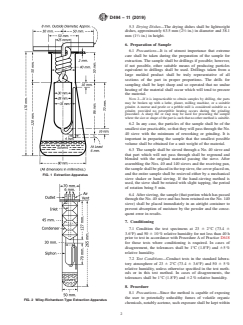
5.2 Extraction Apparatus—The apparatus may be of the
and is the direct responsibility of Subcommittee D20.70 on Analytical Methods.
type shown in Fig. 1, or a Wiley-Richardson type, as shown in
Current edition approved Nov. 1, 2019. Published November 2019. Originally
Fig. 2. The former type is more suitable for use with small
approved in 1946. Last previous edition approved in 2011 as D494 - 11. DOI:
10.1520/D0494-11R19.
electric hot plates, while the latter is more suitable for use with
For referenced ASTM standards, visit the ASTM website, www.astm.org, or
oil or water baths. In either case, it shall be possible to control
contact ASTM Customer Service at service@astm.org. For Annual Book of ASTM
the temperature so that the rate of extraction can be regulated
Standards volume information, refer to the standard’s Document Summary page on
the ASTM website. accurately.
Copyright © ASTM International, 100 Barr Harbor Drive, PO Box C700, West Conshohocken, PA 19428-2959. United States
D494 − 11 (2019)
5.3 Drying Dishes—The drying dishes shall be lightweight
dishes, approximately 63.5 mm (2 ⁄2 in.) in diameter and 38.1
mm (1 ⁄2 in.) in height.
6. Preparation of Sample
6.1 Precautions—It is of utmost importance that extreme
care shall be taken during the preparation of the sample for
extraction. The sample shall be drillings if possible; however,
if not possible, other suitable means of producing particles
equivalent to drillings shall be used. Drillings taken from a
large molded product shall be truly representative of all
sections of the part in proper proportions. The drills for
sampling shall be kept sharp and so operated that no undue
heating of the material shall occur which will tend to precure
the material.
NOTE 2—If it is impracticable to obtain samples by drilling, the parts
may be broken up with a lathe, planer, milling machine, or a suitable
grinder. A mortar and pestle or a pebble mill is considered suitable as a
grinder, provided no perceptible heating occurs during the grinding
procedure. A sharp file or rasp may be used for procuring the sample
where the size or shape of the part is such that no other method is suitable.
6.2 In any case, the particles of the sample shall be of the
smallest size practicable, so that they will pass through the No.
40 sieve with the minimum of reworking or grinding. It is
important in preparing the sample that the smallest possible
volume shall be obtained for a unit weight of the material.
6.3 The sample shall be sieved through a No. 40 sieve and
that part which will not pass through shall be reground and
blended with the original material passing the sieve. After
assembling the Nos. 40 and 140 sieves and the receiving pan,
the sample shall be placed in the top sieve, the cover placed on,
and the entire sample shall be resieved either by a mechanical
FIG. 1 Extraction Apparatus
sieve shaker or hand sieving. If the hand-sieving method is
used, the sieve shall be rotated with slight tapping, the period
...
Questions, Comments and Discussion
Ask us and Technical Secretary will try to provide an answer. You can facilitate discussion about the standard in here.
Loading comments...