

ASTM D8484-23
(Specification)Standard Specification for Plastic Lumber Materials and Wood-Plastic Composite Materials Used as Exterior Wall Coverings
General Information
- Abstract
SCOPE
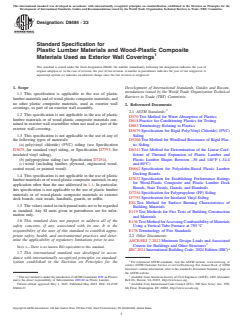
1.1 This specification is applicable to the use of plastic lumber materials and of wood-plastic composite materials, and no other plastic composite materials, used as exterior wall coverings, as part of an exterior wall assembly.
1.2 This specification is not applicable to the use of plastic lumber materials or of wood-plastic composite materials contained in exterior wall assemblies when not used as part of the exterior wall covering.
1.3 This specification is not applicable to the use of any of the following types of materials:
(a) poly(vinyl chloride) (PVC) siding (see Specification D3679, for standard vinyl siding, or Specification D7793, for insulated vinyl siding),
(b) polypropylene siding (see Specification D7254),
(c) wood (including lumber, plywood, engineered wood, coated wood, or painted wood).
1.4 This specification is not applicable to the use of plastic lumber materials or of wood-plastic composite materials in any application other than the one addressed in 1.1. In particular, this specification is not applicable to the use of plastic lumber materials or of wood-plastic composite materials as exterior deck boards, stair treads, handrails, guards, or soffits.
1.5 The values stated in inch-pound units are to be regarded as standard. Any SI units given in parentheses are for information only.
1.6 This standard does not purport to address all of the safety concerns, if any, associated with its use. It is the responsibility of the user of this standard to establish appropriate safety, health, and environmental practices and determine the applicability of regulatory limitations prior to use.
Note 1: There is no known ISO equivalent to this standard.
1.7 This international standard was developed in accordance with internationally recognized principles on standardization established in the Decision on Principles for the Development of International Standards, Guides and Recommendations issued by the World Trade Organization Technical Barriers to Trade (TBT) Committee.
- Status
- Published
- Publication Date
- 30-Apr-2023
- Technical Committee
- D20 - Plastics
- Drafting Committee
- D20.20 - Plastic Lumber
Overview
ASTM D8484-23 is the internationally recognized standard specification for plastic lumber materials and wood-plastic composite (WPC) materials used specifically as exterior wall coverings. Developed and published by ASTM International, this standard establishes requirements for the use of these innovative materials as part of exterior wall assemblies in building construction.
ASTM D8484-23 targets plastic lumber and wood-plastic composites, setting them apart from other plastic-based or traditional wood exterior solutions. It provides clear guidance for manufacturers, designers, and builders to ensure the safety, durability, and code compliance of exterior walls that utilize plastic-based covering materials.
Key Topics
Scope and Applicability
The standard covers only plastic lumber and wood-plastic composites as exterior wall coverings. It does not apply to uses as deck boards, stair treads, handrails, guards, soffits, or to other materials such as PVC siding, polypropylene siding, or any form of wood.Performance Requirements
ASTM D8484-23 references testing and criteria for:- Wind load resistance (per IBC/IRC and ASTM D5206)
- Coefficient of linear thermal expansion
- Moisture absorption and freeze-thaw resistance
- UV/weathering durability
- Biodeterioration (resistance to termites and fungal decay)
- Fire performance, including flame spread index (ASTM E84), ignitability (NFPA 268), fire propagation (NFPA 285), and maintenance of any required fire resistance rating of the wall assembly
Installation and Compliance
Exterior wall coverings made from plastic lumber or WPC must be installed following manufacturer instructions, code requirements, and with appropriate flashing and water-resistive barriers.Exclusions
The standard is not applicable for products made of PVC siding (see ASTM D3679/D7793), polypropylene siding (ASTM D7254), traditional wood materials, or composites used only as structural elements of the wall rather than as exterior coverings.
Applications
The practical value of ASTM D8484-23 is in guiding the safe and effective use of plastic lumber and wood-plastic composite materials for cladding and exterior wall finishes in residential, commercial, and institutional construction. Real-world applications include:
- Enhancing building exteriors with durable, low-maintenance cladding solutions
- Providing alternatives to traditional wood or vinyl siding for improved resistance to moisture, insects, and decay
- Ensuring compliance with fire safety and building code requirements for exterior building assemblies
- Supporting sustainable construction by utilizing recycled plastic materials in architectural applications
Adherence to ASTM D8484-23 ensures that builders, architects, and manufacturers can select and specify plastic-based wall coverings that meet rigorous standards for safety, wind resistance, weathering, and durability.
Related Standards
To ensure comprehensive compliance and performance, ASTM D8484-23 references several related standards and codes:
- ASTM D7032 - Specification for Wood-Plastic Composite and Plastic Lumber Deck Boards, Stair Treads, Guards, and Handrails
- ASTM D6662 - Specification for Polyolefin-Based Plastic Lumber Decking Boards
- ASTM D5206 - Test Method for Windload Resistance of Rigid Plastic Siding
- ASTM D6341 - Test Method for Coefficient of Linear Thermal Expansion of Plastic Lumber
- ASTM E84, E119, E136 - Test Methods for Fire Performance of Building Materials
- NFPA 268/285 - Fire test methods for exterior wall assemblies
- International Building Code (IBC) and International Residential Code (IRC)
- ICC-ES AC524 - Acceptance criteria for wood-plastic composite products as exterior siding
ASTM D8484-23 helps unify performance expectations and testing protocols for plastic lumber and wood-plastic composite exterior wall coverings, ensuring wider adoption, increased safety, and long-term serviceability in modern building envelopes. By referencing this standard, professionals contribute to safer, more durable, and sustainable construction practices.
Relations
- Effective Date
- 01-Apr-2024
- Effective Date
- 01-Apr-2024
- Effective Date
- 01-Apr-2024
- Effective Date
- 01-Mar-2024
- Effective Date
- 01-Feb-2024
- Effective Date
- 01-Feb-2024
- Effective Date
- 01-Jan-2024
- Effective Date
- 01-Dec-2023
- Effective Date
- 01-Nov-2023
- Effective Date
- 01-Sep-2023
- Effective Date
- 01-Jan-2020
- Effective Date
- 15-Nov-2019
- Effective Date
- 01-Oct-2019
- Effective Date
- 01-Aug-2019
- Effective Date
- 01-Jul-2019
Get Certified
Connect with accredited certification bodies for this standard

DIN CERTCO
DIN Group product certification.

Smithers Quality Assessments
US management systems and product certification.
Sponsored listings
Frequently Asked Questions
ASTM D8484-23 is a technical specification published by ASTM International. Its full title is "Standard Specification for Plastic Lumber Materials and Wood-Plastic Composite Materials Used as Exterior Wall Coverings". This standard covers: SCOPE 1.1 This specification is applicable to the use of plastic lumber materials and of wood-plastic composite materials, and no other plastic composite materials, used as exterior wall coverings, as part of an exterior wall assembly. 1.2 This specification is not applicable to the use of plastic lumber materials or of wood-plastic composite materials contained in exterior wall assemblies when not used as part of the exterior wall covering. 1.3 This specification is not applicable to the use of any of the following types of materials: (a) poly(vinyl chloride) (PVC) siding (see Specification D3679, for standard vinyl siding, or Specification D7793, for insulated vinyl siding), (b) polypropylene siding (see Specification D7254), (c) wood (including lumber, plywood, engineered wood, coated wood, or painted wood). 1.4 This specification is not applicable to the use of plastic lumber materials or of wood-plastic composite materials in any application other than the one addressed in 1.1. In particular, this specification is not applicable to the use of plastic lumber materials or of wood-plastic composite materials as exterior deck boards, stair treads, handrails, guards, or soffits. 1.5 The values stated in inch-pound units are to be regarded as standard. Any SI units given in parentheses are for information only. 1.6 This standard does not purport to address all of the safety concerns, if any, associated with its use. It is the responsibility of the user of this standard to establish appropriate safety, health, and environmental practices and determine the applicability of regulatory limitations prior to use. Note 1: There is no known ISO equivalent to this standard. 1.7 This international standard was developed in accordance with internationally recognized principles on standardization established in the Decision on Principles for the Development of International Standards, Guides and Recommendations issued by the World Trade Organization Technical Barriers to Trade (TBT) Committee.
SCOPE 1.1 This specification is applicable to the use of plastic lumber materials and of wood-plastic composite materials, and no other plastic composite materials, used as exterior wall coverings, as part of an exterior wall assembly. 1.2 This specification is not applicable to the use of plastic lumber materials or of wood-plastic composite materials contained in exterior wall assemblies when not used as part of the exterior wall covering. 1.3 This specification is not applicable to the use of any of the following types of materials: (a) poly(vinyl chloride) (PVC) siding (see Specification D3679, for standard vinyl siding, or Specification D7793, for insulated vinyl siding), (b) polypropylene siding (see Specification D7254), (c) wood (including lumber, plywood, engineered wood, coated wood, or painted wood). 1.4 This specification is not applicable to the use of plastic lumber materials or of wood-plastic composite materials in any application other than the one addressed in 1.1. In particular, this specification is not applicable to the use of plastic lumber materials or of wood-plastic composite materials as exterior deck boards, stair treads, handrails, guards, or soffits. 1.5 The values stated in inch-pound units are to be regarded as standard. Any SI units given in parentheses are for information only. 1.6 This standard does not purport to address all of the safety concerns, if any, associated with its use. It is the responsibility of the user of this standard to establish appropriate safety, health, and environmental practices and determine the applicability of regulatory limitations prior to use. Note 1: There is no known ISO equivalent to this standard. 1.7 This international standard was developed in accordance with internationally recognized principles on standardization established in the Decision on Principles for the Development of International Standards, Guides and Recommendations issued by the World Trade Organization Technical Barriers to Trade (TBT) Committee.
ASTM D8484-23 is classified under the following ICS (International Classification for Standards) categories: 83.140.20 - Laminated sheets. The ICS classification helps identify the subject area and facilitates finding related standards.
ASTM D8484-23 has the following relationships with other standards: It is inter standard links to ASTM D3679-24, ASTM D7793-24, ASTM D5206-24, ASTM E136-24a, ASTM D883-24, ASTM E136-24, ASTM E176-24, ASTM E84-23d, ASTM D883-23, ASTM E84-23c, ASTM D883-20, ASTM D5206-19, ASTM E119-19, ASTM D883-19c, ASTM E84-19b. Understanding these relationships helps ensure you are using the most current and applicable version of the standard.
ASTM D8484-23 is available in PDF format for immediate download after purchase. The document can be added to your cart and obtained through the secure checkout process. Digital delivery ensures instant access to the complete standard document.
Standards Content (Sample)
This international standard was developed in accordance with internationally recognized principles on standardization established in the Decision on Principles for the
Development of International Standards, Guides and Recommendations issued by the World Trade Organization Technical Barriers to Trade (TBT) Committee.
Designation: D8484 − 23
Standard Specification for
Plastic Lumber Materials and Wood-Plastic Composite
Materials Used as Exterior Wall Coverings
This standard is issued under the fixed designation D8484; the number immediately following the designation indicates the year of
original adoption or, in the case of revision, the year of last revision. A number in parentheses indicates the year of last reapproval. A
superscript epsilon (´) indicates an editorial change since the last revision or reapproval.
1. Scope Development of International Standards, Guides and Recom-
mendations issued by the World Trade Organization Technical
1.1 This specification is applicable to the use of plastic
Barriers to Trade (TBT) Committee.
lumber materials and of wood-plastic composite materials, and
no other plastic composite materials, used as exterior wall
2. Referenced Documents
coverings, as part of an exterior wall assembly.
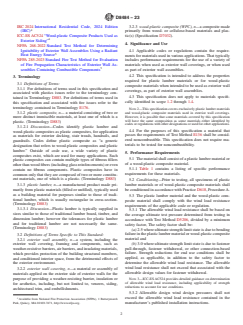
2.1 ASTM Standards:
1.2 This specification is not applicable to the use of plastic
D570 Test Method for Water Absorption of Plastics
lumber materials or of wood-plastic composite materials con-
D618 Practice for Conditioning Plastics for Testing
tained in exterior wall assemblies when not used as part of the
D883 Terminology Relating to Plastics
exterior wall covering.
D3679 Specification for Rigid Poly(Vinyl Chloride) (PVC)
1.3 This specification is not applicable to the use of any of Siding
the following types of materials: D5206 Test Method for Windload Resistance of Rigid Plas-
(a) poly(vinyl chloride) (PVC) siding (see Specification tic Siding
D3679, for standard vinyl siding, or Specification D7793, for D6341 Test Method for Determination of the Linear Coef-
insulated vinyl siding), ficient of Thermal Expansion of Plastic Lumber and
(b) polypropylene siding (see Specification D7254), Plastic Lumber Shapes Between –30 and 140°F (–34.4
(c) wood (including lumber, plywood, engineered wood, and 60°C)
coated wood, or painted wood). D6662 Specification for Polyolefin-Based Plastic Lumber
Decking Boards
1.4 This specification is not applicable to the use of plastic
D7032 Specification for Establishing Performance Ratings
lumber materials or of wood-plastic composite materials in any
for Wood-Plastic Composite and Plastic Lumber Deck
application other than the one addressed in 1.1. In particular,
Boards, Stair Treads, Guards, and Handrails
this specification is not applicable to the use of plastic lumber
D7254 Specification for Polypropylene (PP) Siding
materials or of wood-plastic composite materials as exterior
D7793 Specification for Insulated Vinyl Siding
deck boards, stair treads, handrails, guards, or soffits.
E84 Test Method for Surface Burning Characteristics of
1.5 The values stated in inch-pound units are to be regarded
Building Materials
as standard. Any SI units given in parentheses are for infor-
E119 Test Methods for Fire Tests of Building Construction
mation only.
and Materials
1.6 This standard does not purport to address all of the
E136 Test Method for Assessing Combustibility of Materials
safety concerns, if any, associated with its use. It is the Using a Vertical Tube Furnace at 750 °C
responsibility of the user of this standard to establish appro-
E176 Terminology of Fire Standards
priate safety, health, and environmental practices and deter- 2.2 Other Documents:
mine the applicability of regulatory limitations prior to use.
ASCE/SEI 7-2022 Minimum Design Loads and Associated
Criteria for Buildings and Other Structures
NOTE 1—There is no known ISO equivalent to this standard.
IBC 2024 International Building Code, 2024 Edition (IBC)
1.7 This international standard was developed in accor-
dance with internationally recognized principles on standard-
For referenced ASTM standards, visit the ASTM website, www.astm.org, or
ization established in the Decision on Principles for the
contact ASTM Customer Service at service@astm.org. For Annual Book of ASTM
Standards volume information, refer to the standard’s Document Summary page on
the ASTM website.
1 3
This test method is under the jurisdiction of ASTM Committee D20 on Plastics Available from American Society of Civil Engineers (ASCE), 1801 Alexander
and is the direct responsibility of Subcommittee D20.20 on Plastic Lumber. Bell Dr., Reston, VA 20191, http://www.asce.org.
Current edition approved May 1, 2023. Published May 2023. DOI: 10.1520/ Available from International Code Council (ICC), 500 New Jersey Ave., NW,
D8484-23 6th Floor, Washington, DC 20001, http://www.iccsafe.org.
Copyright © ASTM International, 100 Barr Harbor Drive, PO Box C700, West Conshohocken, PA 19428-2959. United States
D8484 − 23
IRC 2024 International Residential Code, 2024 Edition 3.2.3 wood-plastic composite (WPC), n—a composite made
(IRC) primarily from wood- or cellulose-based materials and plas-
ICC-ES AC524 “Wood-plastic Composite Products Used as tic(s) (Specification D7032).
Exterior Siding”
4. Significance and Use
NFPA 268-2022 Standard Test Method for Determining
Ignitability of Exterior Wall Assemblies Using a Radiant 4.1 Applicable codes or regulations contain the require-
Heat Energy Source
ments for materials used in various applications. That typically
NFPA 285-2023 Standard Fire Test Method for Evaluation includes performance requirements for the use of a variety of
of Fire Propagation Characteristics of Exterior Wall As-
materials when used as exterior wall coverings, or when used
semblies Containing Combustible Components as part of exterior wall assemblies.
4.2 This specification is intended to address the properties
3. Terminology
required for plastic lumber materials or for wood-plastic
3.1 Definitions of Terms:
composite materials when intended to be used as exterior wall
3.1.1 For definitions of terms used in this specification and
coverings, as part of exterior wall assemblies.
associated with plastics issues refer to the terminology con-
4.3 This specification does not apply to materials specifi-
tained in Terminology D883. For definitions of terms used in
cally identified in scope 1.2 through 1.4.
this specification and associated with fire issues refer to the
terminology contained in Terminology E176.
NOTE 2—This specification covers exclusively plastic lumber materials
3.1.2 plastic composite, n— a material consisting of two or and wood-plastic composite materials used in exterior wall coverings.
However, it is possible that some materials covered by this specification
more distinct immiscible materials, at least one of which is a
will have the same composition as some materials either identified by
plastic. (Terminology D883)
codes or regulations with other designations or used for other applications.
3.1.2.1 Discussion—Codes identify plastic lumber and
4.4 For the purposes of this specification a material that
wood-plastic composites as plastic composites, for application
passes the requirements of Test Method E136 shall be consid-
as materials for exterior decking, stair treads, handrails, and
ered noncombustible. This specification does not require ma-
guardrails. Codes define plastic composite as “a generic
terials to be tested for noncombustibility.
designation that refers to wood-plastic composites and plastic
lumber.” Outside of code use, a wide variety of plastic
5. Performance Requirements
composites exist, which are used for many applications. Such
5.1 The material shall consist of a plastic lumber material or
plastic composites can contain multiple types of fibrous fillers
of a wood-plastic composite material.
other than wood fibers (including glass reinforcements) or even
5.1.1 Table 1 contains a listing of specific performance
contain no fibrous components. Plastic composites have in
requirements for these materials.
common only that they are composed of two or more constitu-
ent materials, one of which is a plastic. (Terminology D883)
5.2 Conditioning—Prior to testing, all specimens of plastic
lumber materials or of wood-plastic composite materials shall
3.1.3 plastic lumber, n—a manufactured product made pri-
be conditioned in accordance with Practice D618, Procedure A.
marily from plastic materials (filled or unfilled), typically used
as a building material for purposes similar to those of tradi-
5.3 The plastic lumber material and the wood-plastic com-
tional lumber, which is usually rectangular in cross-section.
posite material shall comply with the wind load resistance
(Terminology D883)
requirements of the applicable code or regulation.
3.1.3.1 Discussion—Plastic lumber is typically supplied in
5.3.1 The allowable wind load resistance shall be based on
sizes similar to those of traditional lumber board, timber, and
the average ultimate test pressure determined from testing in
dimension lumber; however the tolerances for plastic lumber
accordance with Test Method D5206, divided by a minimum
and for traditional lumber are not necessarily the same.
safety factor, The safety factor shall be:
(Terminology D883)
(a) 2.5 where ultimate strength limit state is due to bending
failure in the plastic lumber material or wood-plastic composite
3.2 Definitions of Terms Specific to This Standard:
material and
3.2.1 exterior wall assembly, n—a system, including the
(b) 3.0 where ultimate strength limit state is due to fastener
exterior wall covering, framing and components, such as
pull-through, fastener withdrawal, or other connection-based
weather-resistive barriers, air barriers, and insulating materials,
failure. Strength reductions for end use conditions shall be
which provides protection of the building structural members,
applied, as applicable, in addition to the safety factor to
and conditioned interior space, from the detrimental effects of
determine the allowable wind load resistance. The allowable
the exterior environment.
wind load resistance shall not exceed that associated with the
3.2.2 exterior wall covering, n—a material or assembly of
allowable design values for fastener withdrawal.
materials applied on the exterior side of exterior walls for the
purpose of providing a weather-resisting barrier, insulation or
NOTE 3—ICC-ES AC524 provides detailed guidance on determination
of allowable wind load resistance, including applicability of strength
for aesthetics, including, but not limited to, veneers, siding,
reductions to account for use conditions.
architectural trim, and embellishments.
5.3.2 Allowable design wind design pressures shall not
exceed the allowable wind load resistance contained in the
Available from National Fire Protection Association (NFPA), 1 Batterymarch
Park, Quincy, MA 02169-7471, http://www.nfpa.org. manufacturer’s published installation instructions.
D8484 − 23
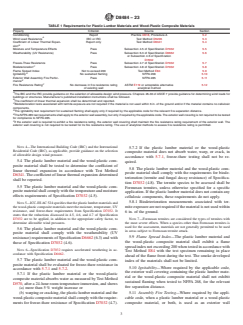
TABLE 1 Requirements for Plastic Lumber Materials and Wood-Plastic Composite Materials
Property Criterion Source Section
Conditioning Report Practice D618, Procedure A 5.2
...