


ASTM D5671-95(2019)
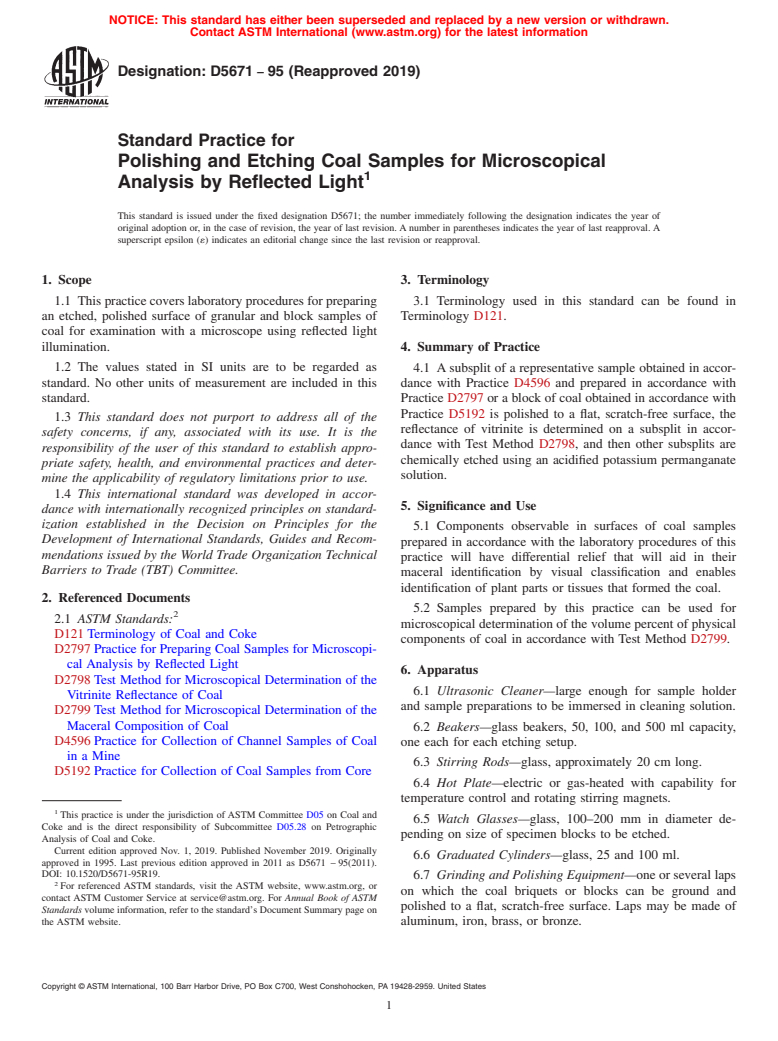
(Practice)Standard Practice for Polishing and Etching Coal Samples for Microscopical Analysis by Reflected Light
Standard Practice for Polishing and Etching Coal Samples for Microscopical Analysis by Reflected Light
SIGNIFICANCE AND USE
5.1 Components observable in surfaces of coal samples prepared in accordance with the laboratory procedures of this practice will have differential relief that will aid in their maceral identification by visual classification and enables identification of plant parts or tissues that formed the coal.
5.2 Samples prepared by this practice can be used for microscopical determination of the volume percent of physical components of coal in accordance with Test Method D2799.
SCOPE
1.1 This practice covers laboratory procedures for preparing an etched, polished surface of granular and block samples of coal for examination with a microscope using reflected light illumination.
1.2 The values stated in SI units are to be regarded as standard. No other units of measurement are included in this standard.
1.3 This standard does not purport to address all of the safety concerns, if any, associated with its use. It is the responsibility of the user of this standard to establish appropriate safety, health, and environmental practices and determine the applicability of regulatory limitations prior to use.
1.4 This international standard was developed in accordance with internationally recognized principles on standardization established in the Decision on Principles for the Development of International Standards, Guides and Recommendations issued by the World Trade Organization Technical Barriers to Trade (TBT) Committee.
General Information
Buy Standard
Standards Content (Sample)
NOTICE: This standard has either been superseded and replaced by a new version or withdrawn.
Contact ASTM International (www.astm.org) for the latest information
Designation:D5671 −95 (Reapproved 2019)
Standard Practice for
Polishing and Etching Coal Samples for Microscopical
Analysis by Reflected Light
This standard is issued under the fixed designation D5671; the number immediately following the designation indicates the year of
original adoption or, in the case of revision, the year of last revision. A number in parentheses indicates the year of last reapproval. A
superscript epsilon (´) indicates an editorial change since the last revision or reapproval.
1. Scope 3. Terminology
1.1 This practice covers laboratory procedures for preparing 3.1 Terminology used in this standard can be found in
an etched, polished surface of granular and block samples of Terminology D121.
coal for examination with a microscope using reflected light
illumination. 4. Summary of Practice
1.2 The values stated in SI units are to be regarded as
4.1 Asubsplit of a representative sample obtained in accor-
standard. No other units of measurement are included in this dance with Practice D4596 and prepared in accordance with
standard.
Practice D2797 or a block of coal obtained in accordance with
Practice D5192 is polished to a flat, scratch-free surface, the
1.3 This standard does not purport to address all of the
reflectance of vitrinite is determined on a subsplit in accor-
safety concerns, if any, associated with its use. It is the
dance with Test Method D2798, and then other subsplits are
responsibility of the user of this standard to establish appro-
chemically etched using an acidified potassium permanganate
priate safety, health, and environmental practices and deter-
solution.
mine the applicability of regulatory limitations prior to use.
1.4 This international standard was developed in accor-
5. Significance and Use
dance with internationally recognized principles on standard-
ization established in the Decision on Principles for the
5.1 Components observable in surfaces of coal samples
Development of International Standards, Guides and Recom-
prepared in accordance with the laboratory procedures of this
mendations issued by the World Trade Organization Technical
practice will have differential relief that will aid in their
Barriers to Trade (TBT) Committee.
maceral identification by visual classification and enables
identification of plant parts or tissues that formed the coal.
2. Referenced Documents
5.2 Samples prepared by this practice can be used for
2.1 ASTM Standards:
microscopical determination of the volume percent of physical
D121 Terminology of Coal and Coke
components of coal in accordance with Test Method D2799.
D2797 Practice for Preparing Coal Samples for Microscopi-
cal Analysis by Reflected Light
6. Apparatus
D2798 Test Method for Microscopical Determination of the
6.1 Ultrasonic Cleaner—large enough for sample holder
Vitrinite Reflectance of Coal
and sample preparations to be immersed in cleaning solution.
D2799 Test Method for Microscopical Determination of the
Maceral Composition of Coal
6.2 Beakers—glass beakers, 50, 100, and 500 ml capacity,
D4596 Practice for Collection of Channel Samples of Coal one each for each etching setup.
in a Mine
6.3 Stirring Rods—glass, approximately 20 cm long.
D5192 Practice for Collection of Coal Samples from Core
6.4 Hot Plate—electric or gas-heated with capability for
temperature control and rotating stirring magnets.
This practice is under the jurisdiction of ASTM Committee D05 on Coal and
6.5 Watch Glasses—glass, 100–200 mm in diameter de-
Coke and is the direct responsibility of Subcommittee D05.28 on Petrographic
pending on size of specimen blocks to be etched.
Analysis of Coal and Coke.
Current edition approved Nov. 1, 2019. Published November 2019. Originally
6.6 Graduated Cylinders—glass, 25 and 100 ml.
approved in 1995. Last previous edition approved in 2011 as D5671 – 95(2011).
DOI: 10.1520/D5671-95R19.
6.7 Grinding and Polishing Equipment—one or several laps
For referenced ASTM standards, visit the ASTM website, www.astm.org, or
on which the coal briquets or blocks can be ground and
contact ASTM Customer Service at service@astm.org. For Annual Book of ASTM
polished to a flat, scratch-free surface. Laps may be made of
Standards volume information, refer to the standard’s Document Summary page on
the ASTM website. aluminum, iron, brass, or bronze.
Copyright © ASTM International, 100 Barr Harbor Drive, PO Box C700, West Conshohocken, PA 19428-2959. United States
D5671−95 (2019)
TABLE 1 Suggested Plans for Grinding and Polishing of Briquets
7. Reagents
and Blocks
7.1 Purity of Reagents—Reagent grade chemicals shall be
Grinding with Silicon Carbide Paper Polishing
Plan
used in all tests. Unless otherwise indicated, it is intended that
No.
Stage 1 Stage 2 Stage 3 Stage 1 Stage 2
all reagents conform to the specifications of the Committee on
1 45µ m 22 µm 15 µm 1 µm Alumina 0.06 µm
Analytical Reagents of the American Chemical Society where
(240 grit) (400 grit) (600 grit)
Colloidal
such specifications are available. Other grades may be used,
Silica
provided it is first ascertained that the reagent is of sufficiently
222µm 15 µm . 1 µm Alumina 0.06 µm
highpuritytopermititsusewithoutlesseningthequalityofthe
(400 grit) (600 grit)
etch. Colloidal Silica
7.2 Potassium Permanganate (KMnO ), crystals.
7.3 Sodium Sulfite (Na SO ), anhydrous, granular.
2 3
9.2 Coal Blocks:
7.4 Sulfuric Acid (H SO ), 47 % H SO .
9.2.1 Obtain specimens from core or as blocks of coal from
2 4 2 4
a mining face.
7.5 Sodium Hydroxide solution, dissolve 10 g NaOH crys-
9.2.2 Trim specimens to about 0.5 mm smaller than the
tals in 90 g deionized water at room temperature.
volume of the silicone rubber molds.
8. Materials
9.2.3 Air dry the specimens to remove visible surface
moisture.
8.1 Grinding Abrasives—Water-resistant, adhesive-backed
silicon carbide papers of 45, 32, and 15 µm (240, 400, and
NOTE 2—Overdrying specimens of low rank coals at any point in
preparation can cause slaking or severe desiccation of specimen. In
600 grit).Two or more of these can be used according to a plan
contrast, underdrying of specimens will prevent epoxy from setting
such as one of those listed in Table 1.
properly.
8.2 Polishing Abrasives—Levigated aluminum oxide pow-
9.2.4 Mix resin and hardener according to manufacturer’s
ders of 1.0 µm size (aqueous suspension) and colloidal silica of
instructions.
0.06 µm size (in a prepared NaOH suspension).
9.2.5 Place specimens and labels into silicone rubber molds
8.3 Lap Coverings—Chemotextile material backed with
and pour resin mixture over the specimens and labels up to the
water-resistant adhesive or similar quality lap coverings. Rec-
level of the top of the molds. Allow to cure, then remove the
ommendations of the manufacturer of the polishing abrasive
specimens from the molds.
used should be followed for choice of lap covering.
10. Preparation of Sample
...
This document is not an ASTM standard and is intended only to provide the user of an ASTM standard an indication of what changes have been made to the previous version. Because
it may not be technically possible to adequately depict all changes accurately, ASTM recommends that users consult prior editions as appropriate. In all cases only the current version
of the standard as published by ASTM is to be considered the official document.
Designation: D5671 − 95 (Reapproved 2011) D5671 − 95 (Reapproved 2019)
Standard Practice for
Polishing and Etching Coal Samples for Microscopical
Analysis by Reflected Light
This standard is issued under the fixed designation D5671; the number immediately following the designation indicates the year of
original adoption or, in the case of revision, the year of last revision. A number in parentheses indicates the year of last reapproval. A
superscript epsilon (´) indicates an editorial change since the last revision or reapproval.
1. Scope
1.1 This practice covers laboratory procedures for preparing an etched, polished surface of granular and block samples of coal
for examination with a microscope using reflected light illumination.
1.2 The values stated in SI units are to be regarded as standard. No other units of measurement are included in this standard.
1.3 This standard does not purport to address all of the safety concerns, if any, associated with its use. It is the responsibility
of the user of this standard to establish appropriate safety safety, health, and healthenvironmental practices and determine the
applicability of regulatory limitations prior to use.
1.4 This international standard was developed in accordance with internationally recognized principles on standardization
established in the Decision on Principles for the Development of International Standards, Guides and Recommendations issued
by the World Trade Organization Technical Barriers to Trade (TBT) Committee.
2. Referenced Documents
2.1 ASTM Standards:
D121 Terminology of Coal and Coke
D2797 Practice for Preparing Coal Samples for Microscopical Analysis by Reflected Light
D2798 Test Method for Microscopical Determination of the Vitrinite Reflectance of Coal
D2799 Test Method for Microscopical Determination of the Maceral Composition of Coal
D4596 Practice for Collection of Channel Samples of Coal in a Mine
D5192 Practice for Collection of Coal Samples from Core
3. Terminology
3.1 Terminology used in this standard can be found in Terminology D121.
4. Summary of Practice
4.1 A subsplit of a representative sample obtained in accordance with Practice D4596 and prepared in accordance with Practice
D2797 or a block of coal obtained in accordance with Practice D5192 is polished to a flat, scratch-free surface, the reflectance of
vitrinite is determined on a subsplit in accordance with Test Method D2798, and then other subsplits are chemically etched using
an acidified potassium permanganate solution.
5. Significance and Use
5.1 Components observable in surfaces of coal samples prepared in accordance with the laboratory procedures of this practice
will have differential relief that will aid in their maceral identification by visual classification and enables identification of plant
parts or tissues that formed the coal.
5.2 Samples prepared by this practice can be used for microscopical determination of the volume percent of physical
components of coal in accordance with Test Method D2799.
This practice is under the jurisdiction of ASTM Committee D05 on Coal and Coke and is the direct responsibility of Subcommittee D05.28 on Petrographic Analysis
of Coal and Coke.
Current edition approved April 1, 2011Nov. 1, 2019. Published June 2011November 2019. Originally approved in 1995. Last previous edition approved in 20052011 as
D5671D5671 - 95(2005). – 95(2011). DOI: 10.1520/D5671-95R11.10.1520/D5671-95R19.
For referenced ASTM standards, visit the ASTM website, www.astm.org, or contact ASTM Customer Service at service@astm.org. For Annual Book of ASTM Standards
volume information, refer to the standard’s Document Summary page on the ASTM website.
Copyright © ASTM International, 100 Barr Harbor Drive, PO Box C700, West Conshohocken, PA 19428-2959. United States
D5671 − 95 (2019)
6. Apparatus
6.1 Ultrasonic Cleaner—large enough for sample holder and sample preparations to be immersed in cleaning solution.
6.2 Beakers—glass beakers, 50, 100, and 500 ml capacity, one each for each etching setup.
6.3 Stirring Rods—glass, approximately 20 cm long.
6.4 Hot Plate—electric or gas-heated with capability for temperature control and rotating stirring magnets.
6.5 Watch Glasses—glass, 100–200 mm in diameter depending on size of specimen blocks to be etched.
6.6 Graduated Cylinders—glass, 25 and 100 ml.
6.7 Grinding and Polishing Equipment—one or several laps on which the coal briquets or blocks can be ground and polished
to a flat, scratch-free surface. Laps may be made of aluminum, iron, brass, or bronze.
7. Reagents
7.1 Purity of Reagents—Reagent grade chemicals shall be used in all tests. Unless otherwise indicated, it is intended that all
reagents conform to the specifications of the Committee on Analytical Reagents of the American Chemical Society where such
specifications are available. Other grades may be used, provided it is first ascertained that the reagent is of sufficiently high purity
to permit its use without lessening the quality of the etch.
7.2 Potassium Permanganate (KMnO ), crystals.
7.3 Sodium Sulfite (Na SO ), anhydrous, granular.
2 3
7.4 Sulfuric Acid (H SO ), 47 % H SO .
2 4 2 4
7.5 Sodium Hydroxide solution, dissolve 10 g NaOH crystals in 90 g deionized water at room temperature.
8. Materials
8.1 Grinding Abrasives—Water-resistant, adhesive-backed silicon carbide papers of 45, 32, and 15 μm (240, 400, and 600 grit).
600 grit). Two or more of these can be used according to a plan such as one of those listed in Table 1.
8.2 Polishing Abrasives—Levigated aluminum oxide powders of 1.0 μm size (aqueous suspension) and colloidal silica of 0.06
μm size (in a prepared NaOH suspension).
8.3 Lap Coverings—Chemotextile material backed with water-resistant adhesive or similar quality lap coverings. Recommen-
dations of the manufacturer of the polishing abrasive used should be followed for choice of lap covering.
8.4 Diamond Impregnated Lap Wheel—Impregnated with diamonds of 6 μm size.
8.5 Detergent or Sonic Cleaning Solution—Any nonoxidizing detergent may be used for cleaning sample surfaces after each
grinding and polishing stage.
8.6 Binder—A potting epoxy resin and hardener or potting polyester resin and hardener that has a curing temperature less than
100°C.100 °C.
8.7 Sample Molds—Prepared for block samples and is made from potting-type silicone rubber.
8.8 Release Agent—Spray silicon or any other preparation that does not damage the molds or adversely affect the coal or
mounting medium may be used to coat the inside of the briquette mold and facilitate ejection of the briquet.
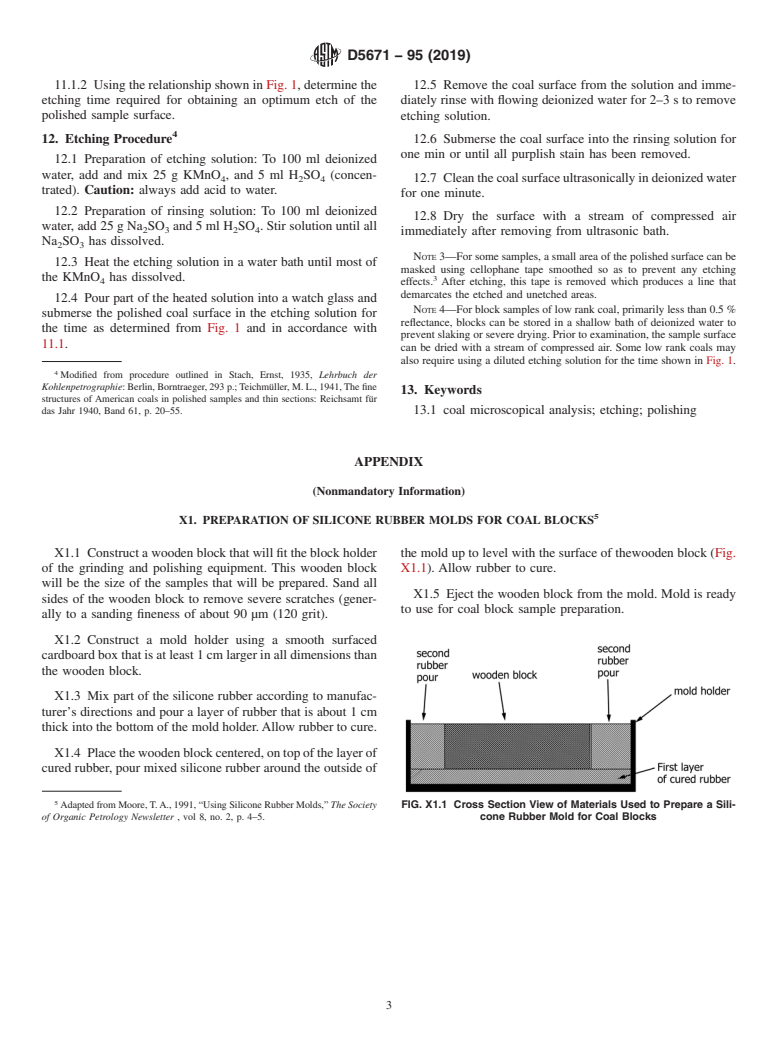
TABLE 1 Suggested Plans for Grinding and Polishing of Briquets
and Blocks
Grinding with Silicon Carbide Paper Polishing
Plan
No.
Stage 1 Stage 2 Stage 3 Stage 1 Stage 2
1 45μ m 22 μm 15 μm 1 μm Alumina 0.06 μm
(240 grit) (400 grit) (600 grit)
Colloidal
Silica
2 22 μm 15 μm . 1 μm Alumina 0
...
Questions, Comments and Discussion
Ask us and Technical Secretary will try to provide an answer. You can facilitate discussion about the standard in here.