

ASTM F820-21
(Test Method)Standard Test Method for Measuring Air Performance Characteristics of Central Vacuum Cleaning Systems
General Information
- Abstract
SIGNIFICANCE AND USE
4.1 The test results allow the comparison of the maximum air power available when no dirt has been introduced into the vacuum cleaning system, that is, a completely clean filter or an empty, clean dirt container.
SCOPE
1.1 This test method covers procedures for determining air performance characteristics of household central vacuum cleaning systems, which use a flexible cleaning hose assembly and incorporates a series universal motor(s). This test method does not apply to the carpet cleaning mode of operation where dirt or debris is involved.
1.2 These tests and calculations include determination of suction, airflow, air power, maximum air power, and input power under standard operating conditions (see Note 1).
Note 1: For more information on air performance characteristics, see Refs (1-6).2
1.3 The values stated in inch-pound units are to be regarded as the standard. The values given in parentheses are provided for information only.
1.4 This standard does not purport to address all of the safety concerns, if any, associated with its use. It is the responsibility of the user of this standard to establish appropriate safety, health, and environmental practices and determine the applicability of regulatory limitations prior to use. A specific precautionary statement is given in Note 4.
1.5 This international standard was developed in accordance with internationally recognized principles on standardization established in the Decision on Principles for the Development of International Standards, Guides and Recommendations issued by the World Trade Organization Technical Barriers to Trade (TBT) Committee.
- Status
- Published
- Publication Date
- 31-Jan-2021
- Technical Committee
- F11 - Vacuum Cleaners
- Drafting Committee
- F11.22 - Air Performance
Buy Documents
ASTM F820-21 - Standard Test Method for Measuring Air Performance Characteristics of Central Vacuum Cleaning Systems
REDLINE ASTM F820-21 - Standard Test Method for Measuring Air Performance Characteristics of Central Vacuum Cleaning Systems
Overview
ASTM F820-21, developed by ASTM International, establishes the standard test method for measuring air performance characteristics of household central vacuum cleaning systems. This method focuses on determining the suction, airflow, air power, maximum air power, and input power of central vacuum units under clean conditions-specifically, when the system’s filter or dirt container is empty and clean. The standard ensures consistent, reliable comparison of vacuum performance metrics, supporting both manufacturers and end-users in evaluating system efficiency.
This document applies exclusively to household central vacuum cleaning systems that utilize a flexible cleaning hose assembly and series universal motors. It does not apply to carpet cleaning operations or tests involving the collection of dirt or debris.
Key Topics
- Scope of Testing: Establishes procedures for measuring key air performance variables such as suction, airflow, and input power for central vacuum systems under standard operating conditions.
- Clean System Requirement: Tests are performed only on systems with clean filters or empty, clean dirt containers, providing a baseline for comparing maximum air power prior to any debris introduction.
- Test Apparatus & Procedures:
- Use of specified manometers, barometers, plenum chambers, thermometers, and power analyzers.
- Protocols for the correct installation and configuration of hoses, adapters, and exhaust systems.
- Detailed instructions for conducting repeatable and reliable test runs.
- Corrected Measurements: Incorporates correction factors for environmental conditions (e.g., ambient temperature, barometric pressure) to standardize results for cross-laboratory consistency.
- Repeatability & Reproducibility: Provides statistical guidelines for ensuring test precision, including minimum sample requirements and confidence intervals for population estimates.
- Reporting Requirements: Outlines the necessary data to be recorded, including corrected input power, vacuum, airflow, and air power, as well as product model details used during testing.
Applications
The ASTM F820-21 standard is vital for several stakeholders:
- Manufacturers: Ensures product development is guided by repeatable, comparable performance criteria, supporting internal quality control and product differentiation.
- Testing Laboratories: Provides a validated process for evaluating central vacuum systems, enabling objective comparison of performance features, and aiding laboratory accreditation.
- Retailers & Distributors: Facilitates credible product comparisons, aiding in the selection and specification of central vacuum systems for consumers.
- End-Users: Offers greater transparency and reliability when comparing the air performance of household central vacuum cleaning systems.
- Regulatory Compliance: Supports manufacturers in complying with international measurement standards and technical barriers to trade as established by the World Trade Organization (WTO) TBT Committee.
Related Standards
Several related standards and referenced documents enhance the robustness and applicability of ASTM F820-21:
- ASTM F431: Specification for air performance measurement plenum chamber for vacuum cleaners.
- IEC 62885-2: International test methods for measuring the performance of dry vacuum cleaners for household or similar use.
- AMCA 210: Laboratory methods of testing fans for rating by the Air Movement and Control Association.
- ASTM E1, E177, E691, E2251: Supporting standards for measurement precision, testing terminology, and instrument specifications.
For accurate implementation, laboratories and manufacturers should refer to these related standards to ensure complete compliance and optimal test conditions.
Keywords: air performance, central vacuum cleaning systems, suction power, airflow measurement, ASTM F820-21, household vacuum standards, vacuum test method, vacuum cleaner performance, repeatability, input power, maximum air power.
Relations
- Effective Date
- 01-May-2014
- Effective Date
- 01-May-2013
- Effective Date
- 01-May-2013
- Effective Date
- 01-May-2013
- Effective Date
- 01-Nov-2011
- Effective Date
- 01-May-2011
- Effective Date
- 01-Nov-2010
- Effective Date
- 01-Oct-2010
- Effective Date
- 01-Nov-2008
- Effective Date
- 01-Oct-2008
- Effective Date
- 01-Oct-2008
- Effective Date
- 01-Nov-2007
- Effective Date
- 01-Nov-2007
- Refers
ASTM E177-06b - Standard Practice for Use of the Terms Precision and Bias in ASTM Test Methods - Effective Date
- 15-Nov-2006
- Refers
ASTM E177-06a - Standard Practice for Use of the Terms Precision and Bias in ASTM Test Methods - Effective Date
- 01-Nov-2006
Buy Documents
ASTM F820-21 - Standard Test Method for Measuring Air Performance Characteristics of Central Vacuum Cleaning Systems
REDLINE ASTM F820-21 - Standard Test Method for Measuring Air Performance Characteristics of Central Vacuum Cleaning Systems
Frequently Asked Questions
ASTM F820-21 is a standard published by ASTM International. Its full title is "Standard Test Method for Measuring Air Performance Characteristics of Central Vacuum Cleaning Systems". This standard covers: SIGNIFICANCE AND USE 4.1 The test results allow the comparison of the maximum air power available when no dirt has been introduced into the vacuum cleaning system, that is, a completely clean filter or an empty, clean dirt container. SCOPE 1.1 This test method covers procedures for determining air performance characteristics of household central vacuum cleaning systems, which use a flexible cleaning hose assembly and incorporates a series universal motor(s). This test method does not apply to the carpet cleaning mode of operation where dirt or debris is involved. 1.2 These tests and calculations include determination of suction, airflow, air power, maximum air power, and input power under standard operating conditions (see Note 1). Note 1: For more information on air performance characteristics, see Refs (1-6).2 1.3 The values stated in inch-pound units are to be regarded as the standard. The values given in parentheses are provided for information only. 1.4 This standard does not purport to address all of the safety concerns, if any, associated with its use. It is the responsibility of the user of this standard to establish appropriate safety, health, and environmental practices and determine the applicability of regulatory limitations prior to use. A specific precautionary statement is given in Note 4. 1.5 This international standard was developed in accordance with internationally recognized principles on standardization established in the Decision on Principles for the Development of International Standards, Guides and Recommendations issued by the World Trade Organization Technical Barriers to Trade (TBT) Committee.
SIGNIFICANCE AND USE 4.1 The test results allow the comparison of the maximum air power available when no dirt has been introduced into the vacuum cleaning system, that is, a completely clean filter or an empty, clean dirt container. SCOPE 1.1 This test method covers procedures for determining air performance characteristics of household central vacuum cleaning systems, which use a flexible cleaning hose assembly and incorporates a series universal motor(s). This test method does not apply to the carpet cleaning mode of operation where dirt or debris is involved. 1.2 These tests and calculations include determination of suction, airflow, air power, maximum air power, and input power under standard operating conditions (see Note 1). Note 1: For more information on air performance characteristics, see Refs (1-6).2 1.3 The values stated in inch-pound units are to be regarded as the standard. The values given in parentheses are provided for information only. 1.4 This standard does not purport to address all of the safety concerns, if any, associated with its use. It is the responsibility of the user of this standard to establish appropriate safety, health, and environmental practices and determine the applicability of regulatory limitations prior to use. A specific precautionary statement is given in Note 4. 1.5 This international standard was developed in accordance with internationally recognized principles on standardization established in the Decision on Principles for the Development of International Standards, Guides and Recommendations issued by the World Trade Organization Technical Barriers to Trade (TBT) Committee.
ASTM F820-21 is classified under the following ICS (International Classification for Standards) categories: 97.080 - Cleaning appliances. The ICS classification helps identify the subject area and facilitates finding related standards.
ASTM F820-21 has the following relationships with other standards: It is inter standard links to ASTM E177-14, ASTM E1-13, ASTM E177-13, ASTM E691-13, ASTM E691-11, ASTM E2251-11, ASTM E2251-10, ASTM E177-10, ASTM F431-04(2008), ASTM E691-08, ASTM E177-08, ASTM E1-07, ASTM E2251-07, ASTM E177-06b, ASTM E177-06a. Understanding these relationships helps ensure you are using the most current and applicable version of the standard.
ASTM F820-21 is available in PDF format for immediate download after purchase. The document can be added to your cart and obtained through the secure checkout process. Digital delivery ensures instant access to the complete standard document.
Standards Content (Sample)
This international standard was developed in accordance with internationally recognized principles on standardization established in the Decision on Principles for the
Development of International Standards, Guides and Recommendations issued by the World Trade Organization Technical Barriers to Trade (TBT) Committee.
Designation: F820 − 21
Standard Test Method for
Measuring Air Performance Characteristics of Central
Vacuum Cleaning Systems
ThisstandardisissuedunderthefixeddesignationF820;thenumberimmediatelyfollowingthedesignationindicatestheyearoforiginal
adoption or, in the case of revision, the year of last revision.Anumber in parentheses indicates the year of last reapproval.Asuperscript
epsilon (´) indicates an editorial change since the last revision or reapproval.
1. Scope E177 Practice for Use of the Terms Precision and Bias in
ASTM Test Methods
1.1 This test method covers procedures for determining air
E691 Practice for Conducting an Interlaboratory Study to
performance characteristics of household central vacuum
Determine the Precision of a Test Method
cleaning systems, which use a flexible cleaning hose assembly
E2251 Specification for Liquid-in-Glass ASTM Thermom-
and incorporates a series universal motor(s). This test method
eters with Low-Hazard Precision Liquids
does not apply to the carpet cleaning mode of operation where
F431 Specification for Air Performance Measurement Ple-
dirt or debris is involved.
num Chamber for Vacuum Cleaners
1.2 These tests and calculations include determination of
2.2 AMCA Standard:
suction, airflow, air power, maximum air power, and input
210–85 Laboratory Methods of Testing Fans for Rating
power under standard operating conditions (see Note 1).
2.3 IEC Standard:
NOTE 1—For more information on air performance characteristics, see
IEC 62885-2 Surface Cleaning Appliances – Part 2: Dry
Refs (1-6).
Vacuum Cleaners for Household or Similar Use – Meth-
1.3 The values stated in inch-pound units are to be regarded
ods for Measuring the Performance
as the standard. The values given in parentheses are provided
for information only. 3. Terminology
1.4 This standard does not purport to address all of the
3.1 Definitions:
safety concerns, if any, associated with its use. It is the
3.1.1 air power, AP, W, n—in a vacuum cleaner, the net time
responsibility of the user of this standard to establish appro-
rate of work performed by an air stream while expending
priate safety, health, and environmental practices and deter-
energy to produce an airflow by a vacuum cleaner under
mine the applicability of regulatory limitations prior to use. A
specified air resistance conditions.
specific precautionary statement is given in Note 4.
3.1.2 automatic bleed valve, n—any device a part of a
1.5 This international standard was developed in accor-
vacuum cleaner’s design, which automatically introduces an
dance with internationally recognized principles on standard-
intentional leak within the vacuum cleaner’s system when
ization established in the Decision on Principles for the
manufacturer specified conditions are met.
Development of International Standards, Guides and Recom-
3.1.3 corrected airflow, Q, cfm, n—in a vacuum cleaner, the
mendations issued by the World Trade Organization Technical
volume of air movement per unit of time under standard
Barriers to Trade (TBT) Committee.
atmospheric conditions.
2. Referenced Documents
3.1.4 input power, W, n—the rate at which electrical energy
2.1 ASTM Standards:
is absorbed by a vacuum cleaner.
E1 Specification for ASTM Liquid-in-Glass Thermometers
3.1.5 model, n—the designation of a group of vacuum
cleaners having the same mechanical and electrical construc-
This test method is under the jurisdiction ofASTM Committee F11 on Vacuum
tion with only cosmetic or nonfunctional differences.
Cleaners and is the direct responsibility of Subcommittee F11.22 on Air Perfor-
mance. 3.1.6 population, n—the total of all units of a particular
Current edition approved Feb. 1, 2021. Published February 2021. Originally
model vacuum cleaner being tested.
approved in 1988. Last previous edition approved in 2018 as F820 – 18. DOI:
10.1520/F0820-21.
The boldface numbers in parentheses refer to the list of references at the end of
this standard. Available from Air Movement and Control Association, Inc., 30 West Univer-
For referenced ASTM standards, visit the ASTM website, www.astm.org, or sity Dr., Arlington Heights, IL 60004–1893, http://www.amca.org.
contact ASTM Customer Service at service@astm.org. For Annual Book of ASTM Available from the IEC Web store, webstore.iec.ch, or American National
Standards volume information, refer to the standard’s Document Summary page on Standards Institute (ANSI), 25 W. 43rd St., 4th Floor, New York, NY 10036,
the ASTM website. http://www.ansi.org.
Copyright © ASTM International, 100 Barr Harbor Drive, PO Box C700, West Conshohocken, PA 19428-2959. United States
F820 − 21
3.1.7 repeatability limit (r), n—the value below which the 5.3 Power analyzer, to provide measurements accurate to
absolutedifferencebetweentwoindividualtestresultsobtained within 61%.
under repeatability conditions may be expected to occur with a
5.4 Barometer, with an accuracy of 60.05 in. (1.27 mm) of
probability of approximately 0.95 (95 %).
mercury, capable of measuring and displaying absolute baro-
3.1.8 reproducibilitylimit(R),n—thevaluebelowwhichthe
metric pressure, scale divisions 0.02 in. (0.51 mm) or finer.
absolute difference between two test results obtained under
5.4.1 Mercury barometers, in general, measure and display
reproducibility conditions may be expected to occur with a
the absolute barometric pressure. Some corrections may be
probability of approximately 0.95 (95 %).
needed for temperature and gravity. Consult the owner’s
manual.
3.1.9 repeatability standard deviation (S ), n—the standard
r
5.4.2 When purchasing an aneroid or electronic barometer,
deviation of test results obtained under repeatability condi-
be sure to purchase one which displays the absolute barometric
tions.
pressure,notthemeansealevelequivalentbarometricpressure
3.1.10 reproducibility standard deviation (S ), n—the stan-
R
value. These types of barometers generally have temperature
dard deviation of test results obtained under reproducibility
compensation built into them and do not need to be corrected
conditions.
for gravity.
3.1.11 sample, n—a group of vacuum cleaners taken from a
5.5 Orifice Plates—See Specification F431.
large collection of vacuum cleaners of one particular model,
whichservestoprovideinformationthatmaybeusedasabasis 5.6 Thermometer—Solid-stem, ambient thermometer hav-
for making a decision concerning the larger collection. ing a range from 18 °F to 89 °F (or –8 °C to +32°C) with
graduations in 0.2 °F (0.1 °C), conforming to the requirements
3.1.12 standard air density, ρ , lb/ft,n—atmospheric air
std
3 3
for thermometer 63 °F (17 °C) as prescribed in Specification
density of 0.075 lb/ft (1.2014 kg/m ).
E1. As an alternative, thermometers S63F or S63C, as pre-
3.1.12.1 Discussion—This value of air density corresponds
scribed in Specification E2251, may be used. In addition,
toatmosphericairatatemperatureof68°F(20°C),14.696psi
thermometric devices such as resistance temperature detectors
(101.325 kPa), and approximately 30 % relative humidity.
(RTDs), thermistors, or thermocouples of equal or better
3.1.13 suction, inch of water, n—in a vacuum cleaner, the
accuracy may be used.
absolute difference between ambient and subatmospheric pres-
5.7 Psychrometer—Thermometers graduated in 0.2 °F (0.1
sure.
°C).
3.1.14 test run, n—the definitive procedure that produces
5.8 Voltage-Regulator System, to control the input voltage
the singular result of calculated maximum air power.
tothevacuumcleaner.Theregulatorsystemshallbecapableof
3.1.15 test station pressure, B, inch of mercury, n—for a
t
maintaining the vacuum cleaner’s rated voltage 61 % and
vacuum cleaner, the absolute barometric pressure at the test
rated frequency 61 Hz having a wave form that is essentially
location (elevation) and test time.
sinusoidal with 3 % maximum harmonic distortion for the
3.1.15.1 Discussion—It is not the equivalent mean sea level
duration of the test.
value of barometric pressure typically reported by the airport
and weather bureaus. It is sometimes referred to as the 5.9 Orifice Adapter Tube—See Fig. 1.
uncorrected barometric pressure (that is, not corrected to the
6. Sampling
mean sea level equivalent value). Refer to 5.4 for additional
information.
6.1 A minimum of three units of the same model vacuum
cleaner selected at random in accordance with good statistical
3.1.16 unit, n—a single vacuum cleaner of the model being
practice, shall constitute the population sample.
tested.
6.1.1 To determine the best estimate of maximum air power
4. Significance and Use
for the population of the vacuum cleaner model being tested,
the arithmetic mean of the maximum air power of the sample
4.1 The test results allow the comparison of the maximum
from the population shall be established by testing it to a 90 %
air power available when no dirt has been introduced into the
confidence level within 65%.
vacuum cleaning system, that is, a completely clean filter or an
6.1.2 Annex A2 provides a procedural example for deter-
empty, clean dirt container.
mining the 90 % confidence level and when the sample size
5. Apparatus shall be increased.
5.1 Plenum Chamber—See Specification F431 or IEC
NOTE 2—See Annex A2 for method of determining 90 % confidence
level.
62885-2, Section 5.8.3.
5.2 Water Manometers, or equivalent instruments. One to
7. Test Vacuum Cleaners
measure from 0 in. to 6 in. (152.4 mm) in increments of 0.01
7.1 New Test Vacuum Cleaner—Run the vacuum cleaner in
in. (0.254 mm), and one with increments of 0.1 in. (2.54 mm)
at rated voltage 61 % and rated frequency with filters in place
for use in making measurements above 6 in. (152.4 mm). A
for 1 h with a wide-open inlet (without hose).
single instrument having a resolution of 0.01 in. (0.254 mm)
over the entire required range may be used instead of two 7.2 Used Test Vacuum Cleaners—Recondition a used test
separate instruments. vacuum cleaner; prior to the initial test run as follows:
F820 − 21
FIG. 1 Orifice Adapter Tube
7.2.1 Thoroughly remove excess dirt from the vacuum 8. Procedure
cleaner. Without using tools for disassembly, clean the entire
8.1 Preparation for Test:
outer surface, brushes, nozzle chamber, ductwork, inside of the
8.1.1 Prepare the test unit in accordance with Section 7.
chamber surrounding the primary filter, and inside hose and
Set-up the test system as shown in Fig. 2. On the intake side,
wands.
use an adapter terminating with the wall inlet valve. This wall
7.2.2 For vacuum cleaners using disposable filters as the
inlet is to be the one specified for installation with the power
primary filters, use a new disposable primary filter from the
unit being tested.All joints should be made in accordance with
manufacturer for each test. Install it as recommended by the
the manufacturer’s specifications and be free of leaks. Insert
vacuum cleaner manufacturer.
intothewallvalveaflexiblecleaninghoseasprovidedwiththe
7.2.3 For vacuum cleaners using non-disposable dirt
system. The hose assembly should be that which is offered
receptacles, empty in accordance with the manufacturer’s
normally with the particular unit being tested. For those
instructions and clean the receptacle until its weight is within
systems, which provide for an external exhaust, connect 2 ft
0.07 oz (2 g) of its original weight and install it as recom-
(0.6 m) of exhaust comprised of tubing and exhaust muffler, if
mended by the vacuum cleaner manufacturer.
a muffler is provided as part of the system.
7.2.4 For vacuum cleaners using non-disposable dirt
8.1.2 Set the manometers to zero and check all instruments
receptacles, empty in accordance with the manufacturer’s
for proper operation.
instructions and clean the receptacle until its weight is within
8.1.3 Record the test station pressure and the dry-bulb and
0.07 oz (2 g) of its original weight and install it as recom-
wet-bulb temperature readings within 6 ft (1.8 m) of the test
mended by the vacuum cleaner manufacturer.
area. Read the barometric pressure to the nearest 0.02 in. (0.51
mm) of mercury, and the dry-bulb and wet-bulb temperatures
NOTE3—Itispreferabletoconductthistestmethodonnewtestvacuum
cleanerspriortoanyotherASTMtestmethodstoavoidcontaminationthat
to the nearest 0.2 °F (or 0.1 °C).
could cause performance variations.
8.1.3.1 The test area shall be free of major fluctuating
7.3 Test Vacuum Cleaner Settings—If various settings are temperature conditions due to air conditioners or air drafts that
provided, set the motor speed setting or suction regulator using would be indicated by a thermometer at the immediate test
the manufacturer’s specifications as provided in the instruction area.
manual for normal operation. If a different setting is used, 8.1.4 Connect the manometer or equivalent instrument to
make a note of the deviation in the test report. the plenum chamber.
F820 − 21
NOTE 1—Hose is to be supported in a straight line.
FIG. 2 Vacuum Cleaning System Test Set-up
8.1.5 Connect a power analyzer. plates also may be used: 2.5, 2.25, 1.75, 1.375, 1.125 in. (63.5,
57.2, 44.5, 34.9, 28.6 mm).
8.2 Test Procedure:
8.2.6 For each orifice plate, record the suction, h, and input
8.2.1 Connect the hose assembly to the plenum chamber
power, P, in that order.All readings should be taken within 10
hose adapter and seal only this connection (see Fig. 3).
s of the orifice insertion. For orifices less than 0.750 in. allow
8.2.1.1 The end of the hose assembly should be inserted
the vacuum cleaner to operate at the open orifice for 1 to 2 min
inside the hose connector adapter and be perpendicular to the
before inserting the next orifice.
plenum chamber.
8.2.6.1 Read the suction to the nearest graduation of the
8.2.1.2 The end of the hose assembly shall not project into
instrument. Readings should be taken as soon as the manom-
the plenum chamber.
eter reaches a true peak. When using a fluid type manometer,
8.2.1.3 Any automatic bleed valve, which affects the air
the liquid level may peak, drop, and peak again. The second
performance of the vacuum cleaner, shall not be defeated.
peak is the true peak reading. A person conducting the test for
8.2.2 The hose should be supported and kept straight and
the first time shall observe at least one run before recording
horizontal over its entire length.Allowance should be made for
data. See Specification F431 for instructions on how to
the foreshortening of the hose assembly under the vacuum.
minimize the overshoot (first peak) of the liquid level.
Maintain the power unit and dirt canister in their normal
operating orientation.
9. Calculation
8.2.3 Operate the vacuum cleaner with no orifice plate
9.1 Correction of Data to Standard Conditions:
insertedintheplenumchamberinletatnameplateratedvoltage
9.1.1 AirDensityRatio—Thedensityratio,D ,istheratioof
r
61 % and frequency 61 Hz prior to the start of the test run to
the air density at the time of test ρ , to the standard air
test
allow the unit to reach its normal operating temperature. For
3 3
density, ρ = 0.075 lb/ft (1.2014 kg/m ). It is used to correct
std
vacuum cleaners with dual nameplate voltage ratings, conduct
the vacuum and wattage readings to standard conditions. Find
testingatthehighestvoltage.Allowtheunittoreachitsnormal
3 3
ρ (lb/ft or kg/m ) from standard psychometric charts or
test
operating temperature before each test run.
ASHRAE tables and calculate D as follows:
r
8.2.4 The vacuum cleaner is to be operated at its nameplate
rated voltage 61 % and frequency 61 Hz throughout the test. ρ
test
D 5 (1)
r
For vacuum cleaners with dual nameplate voltage ratings,
ρ
std
conduct the test at the highest voltage.
where:
8.2.4.1 Allow the vacuum cleaner to operate at the open
3 3
ρ = the air density at the time of test, lb/ft (kg/m ), and
test
orifice for 15 seconds minimum between test runs.
3 3
ρ = the standard air density, 0.075 lb/ft (1.2014 kg/m ).
std
8.2.5 While operating the vacuum cleaner in accordance
with 8.2.4, insert orifice plates sequentially into the orifice 9.1.1.1 As an alternative, the following equation is intended
plate holder of the plenum chamber starting with the largest to be used for correcting ambient conditions where the baro-
size orifice and following it with the next smaller orifice plate. metric pressure exceeds 27 in mercury and the dry-bulb and
Usethefollowingorificeplates:2.0,1.5,1.25,1.0,0.875,0.75, wet-bulb temperatures are less than 100 °F (37.8 °C); and, may
0.625, 0.5, 0.375, 0.25, 0.0 in. (50.8, 38.1, 31.7, 25.4, 22.2, be used as an alternate method of calculating D (see Appendix
r
19.0, 15.8, 12.7, 9.5, 6.3 mm). The following optional orifice X1 for derivation and accuracy analysis).
F820 − 21
FIG. 3 Diagram of Hose and Adapter Connection
TABLE 1 Orifice Flow Coefficient Equations (K )
17.68 B 2 0.001978 T 10.1064 T 1
t w w
F G
NOTE 1—K was determined experimentally using an ASTM Plenum
0.0024575B T 2 T 2 2.741
~ !
t d w
D 5 (2) Chamber (see Specification F431) and an ASME Flowmeter (1).
r
T 1459.7
d
NOTE 2—Equations for K in terms of B and h, are given in Appendix
1 t
where:
X6.
A
B = test station pressure at time of test, inch of mercury,
Orifice Diameter, in. (mm) Orifice Flow Coefficient Equation
t
T = dry-bulb temperature at time of test, °F, and
d 0.5575r20.5955
0.250 (6.3)
K 5
T = wet-bulb temperature at time of test, °F. r21.0468
w
0.375 (9.5) 0.5553r20.5754
9.1.2 Corrected Suction—Corrected suction, h , is the ma-
s K 5
r21.0263
nometer reading, h, times the correction factor, C , as follows:
s
0.5694r20.5786
0.500 (12.7)
K 5
h 5 C h (3) 1
s s r21.0138
0.5692r20.5767
0.625 (15.8)
9.1.2.1 For series universal motors (6) the correction factor,
K 5
r21.0104
C , is calculated as follows:
s
0.5715r20.5807
0.750 (19.0)
K 5
C 5 110.667~1 2 D ! (4)
r21.0138
s r
0.5740r20.5841
0.875 (22.2)
9.1.2.2 This test method does not have any formulas avail-
K 5
r21.0158
able for correcting input power for any other type of motor
0.5687r20.5785
1.000 (25.4)
(permanent magnet, induction, etc.). K 5
r21.0146
9.1.3 Corrected Input Power—Corrected input power, P ,
s
0.5675r20.5819
1.125 (28.6)
K 5
expressed in watts, is the wattmeter reading, P, times the
r21.0225
correction factor, C , as follows:
p
0.5717r20.5814
1.250 (31.7)
K 5
r21.0152
P 5 C P (5)
s p
0.5680r20.5826
1.375 (34.9)
9.1.3.1 For series universal motors the correction factor, C , K 5
p
r21.0235
is calculated as follows:
0.5719r20.5820
1.500 (38.1)
K 5
r21.0165
C 5 110.5 1 2 D (6)
~ !
p r
0.5695r20.5839
1.750 (44.5)
K 5
9.1.3.2 This test method does not have any formulas avail-
r21.0235
able for correcting input power for any other types of motor
0.5757r20.5853
2.000 (50.8)
K 5
(permanent magnet, induction, etc.).
r21.0157
0.5709r20.5878
2.250 (57.2)
9.2 Corrected Airflow—Calculate the corrected airflow, Q,
K 5
r21.0279
expressed in cubic feet per minute (see Note 4 and Appendix
0.5660r20.59024
2.500 (63.5)
X2) as follows:
K 5
r21.0400
Q 5 21.844 D K =h (7)
1 s
B 0.4912 2h 0.03607
s d s d
t
A
r5
B s0.4912d
t
where:
where:
Q = corrected flow, cfm,
B = test station pressure at time of test, in. of mercury, and
t
D = orifice diameter, in.,
h = uncorrected suction (manometer reading), in. of water.
K = constant (dimensionless) orifice flow coefficients for
orifices in the plenum chamber. See Table 1 for values
for each orifice. See Ref (1) for the derivation of these
flow coefficients, and
NOTE 4—For the corrected airflow expressed in liters per second, use
h = corrected suction, water, in.
s
the following equation:
F820 − 21
TABLE 2 Repeatability and Reproducibility
Q 5 10.309D K =h (8)
1 s
Coefficient of Repeatability Coefficient of Reproducibility
where:
Variation, Limit, r Variation, Limit, R
CV % CV %
r R
Q = corrected flow, L/s,
D = orifice diameter, m,
1.5 4.3 9.0 25.1
K = constant (dimensionless),
h = corrected suction, Pa.
s
9.3 Air Power—Calculate the air power, AP, in watts, as
11.5.1 The expected coefficient of variation of the measured
follows:
results within a laboratory, CV % , has been found to be the
r
AP 5 0.117354 Q h (9)
~ !~ ! respective values listed in Table 2.
s
11.5.2 The 95 % repeatability limit within a laboratory, r,
where:
has been found to be the respective values listed in Table 2,
AP = air power, W,
where r = 2.8 (CV % ).
r
Q = corrected flow, cfm, and
11.5.3 With 95 % confidence, it can be stated that within a
h = corrected suction, inch of water (see Appendix X3 for
s
laboratory a set of measured results derived from testing a unit
derivation).
should be considered suspect if the difference between any two
9.4 Maximum Air Power—Determine the maximum air
of the three values is greater than the respective value of the
power using the method in Annex A1.
repeatability limit, r, listed in Table 2.
11.5.4 If the absolute value of the difference of any pair of
10. Report
measured results from three test runs performed within a single
10.1 For each vacuum cleaner sample from the population
laboratory is not equal to or less than the respective repeatabil-
being tested, report the following information:
ity limit listed in Table 2, that set of test results shall be
10.1.1 Manufacturer’s name and product model name or
considered suspect.
number, or both.
11.6 Reproducibility (Multiday Testing and Single Operator
10.1.2 Type of filtration; that is, paper bag, cloth bag, foam
Within Multilaboratories)—The ability to repeat the test with
filter, centrifugal, etc.
multiple laboratories.
10.1.3 The corrected input power, corrected vacuum, cor-
11.6.1 The expected coefficient of variation of reproducibil-
rected airflow, and air power for each orifice.
ity of the average of a set of measured results between multiple
10.1.4 Manufacturer’s parts, catalog, or model number of
laboratories, CV % , has been found to be the respective
R
the ductwork, fittings, and flexible cleaning hose assembly
values listed in Table 2.
used in the test.
11.6.2 The95 %reproducibilitylimitwithinalaboratory, R,
10.1.5 Calculated or measured maximum air power, which-
has been found to be the respective values listed in Table 2,
ever is greater.
where R = 2.8 (CV % ).
R
11. Precision and Bias
11.6.3 With 95 % confidence, it can be stated that the
average of the measured results from a set of three test runs
11.1 The following precision statements are based on inter-
performed in one laboratory, as compared to a second
laboratory tests involving nine laboratories and four units.
laboratory, should be considered suspect if the difference
11.2 The statistics have been calculated as recommended in
between those two values is greater than the respective values
Practice E691.
of the reproducibility limit, R, listed in Table 2.
11.3 The following statements regarding repeatability limit
11.6.4 If the absolute value of the difference between the
and reproducibility limit are used as directed in Practice E177.
averageofthemeasuredresultsfromthetwolaboratoriesisnot
equal to or less than the respective reproducibility limit listed
11.4 The Coefficients of Variation of repeatability and
in Table 2, the set of results from both laboratories shall be
reproducibility of the measured results have been derived from
considered suspect.
nine sets of data, where each set has been performed by a
single analyst within each of the nine laboratories on two
11.7 Bias—No justifiable statement can be made on the bias
separate days using the same unit test.
of this test method for testing the properties listed. The true
values of the properties cannot be established by acceptable
11.5 Repeatability (Single Operator and Laboratory; Mul-
referee methods.
tiday Testing)—The ability of a single analyst to repeat the test
within a single laboratory.
12. Keywords
12.1 airflow; air performance; air power; residential central
Complete data on the round-robin test is available from ASTM Headquarters.
Request RR:F11-1003. Contact ASTM Customer Service at service@astm.org. vacuum cleaners; suction; suction power; vacuum cleaners
F820 − 21
ANNEXES
(Mandatory Information)
A1. MATHEMATICAL METHOD FOR DETERMINING MAXIMUM AIR POWER POINT
dy d
A1.1 The following, second degree polynomial equation, is
5 A 1A X1A X 50 (A1.5)
@ #
1 2 3
assumedtoprovidethebestmathematicalapproximationofthe dx dx
air power versus airflow relationship (see Ref (4) for additional
dy
information).
5 A 12A X 5 0
2 3
dx
Y 5 A 1A X1A X (A1.1)
1 2 3
Substitute X as the value of X at Y and solve for X :
m max m
where:
A
X 52 (A1.6)
m
Y = air power (AP),
2A
X = airflow (Q), and
Substituting this value of X , and A , A , and A , into Eq
m 1 2 3
A,A , and A = arbitrary constants.
1 2 3
A1.1 will determine the value of Y (AP ) as follows:
max max
A1.1.1 Use X and Y values obtained from only five specific
Y 5 A 1A X 1A X (A1.7)
max 1 2 m 3 m
orifices selected as follows:
A1.1.1.1 Using the test data, determine the orifice size that
A1.4 Calculate the goodness of fit, R (correlation
produced the highest air power value.
coefficient), as follows:
A1.1.1.2 Use the air power and airflow values at this orifice,
and the next two smaller and the next two larger orifices in the Y 2 Y
~ !
( i OBS i CAL
R 5 1 2 (A1.8)
following computations.
Y 2 Y
~ !
( i OBS OBS
A1.1.1.3 If the highest air power value calculated from the
where:
observed data is at the 2.0 in. (50.8 mm) orifice or larger, then
Y 5 A 1A X 1A X (A1.9)
use the air power and airflow values from the five largest i CAL 1 2 i OBS 3 i OBS
orifices.
and:
A1.2 To determine the values of A , A , and A , use the X
1 2 3
Y 5 Y (A1.10)
OBS i OBS
(
N
and Y values obtained from the five specified orifices and solve
the following set of normalized equations:
and:
i =1to N orifices used in 8.2,
Y 5 NA 1A X 1A X (A1.2)
( i 1 2 ( i 3 ( i
OBS = observed data,
2 3
X Y 5 A X 1A X 1A X (A1.3)
( i i 1 ( i 2 ( i 3 ( i
CAL = calculated data, and
2 2 3 4 Y = istheairpower(AP)obtainedfromthecalculations
X Y 5 A X 1A X 1A X (A1.4) i OBS
( i i 1 ( i 2 ( i 3 ( i
in 9.3 for the corresponding value X (airflow,
i OBS
where:
Q) at any of the N orifices selected.
N = 5 (number of orifices selected),
A1.4.1 If R is not greater than or equal to 0.900, the test
I =1to N, and
must be performed again and the new set of data used.
X and Y = the values obtained during testing (X Y , X Y ,
i i 1 1 2 2
... X Y ) at the five orifices specified in A1.1.1.
N N
A1.4.2 The measured or calculated value for maximum air
power shall be recorded, whichever is greater.
A1.3 Setting the derivative of Eq A1.1 equal to zero and
solving for X will determine the value of X where Y is at its
m
maximum value (Y ) as follows:
max
F820 − 21
A2. DETERMINATION OF 90 % CONFIDENCE INTERVAL
TABLE A2.1 Percentiles of the t Distribution
level.
df t
0.95
NOTEA2.1—The value of t is defined as t and is read as “t at 95 %
1-α/2
1 6.314
confidence.”
2 2.920
3 2.353
t statistic 5 t 5 t (A2.3)
12α/2 0.95
4 2.132
5 2.015
where:
6 1.943
1-α/2 = 1 – 0.10/2=1– 0.05 = 0.95 or 95 %.
7 1.895
8 1.860
A2.1.6 The following equations establish the upper and
9 1.833
10 1.812 lowerlimitsofanintervalcenteredaboutx¯ thatwillprovidethe
11 1.796
level of confidence required to assert that the true population
12 1.782
mean lies within this interval:
13 1.771
14 1.761
=
CI 5 x¯1ts/ n (A2.4)
15 1.753
U
=
CI 5 x¯ 2 ts/ n (A2.5)
L
where:
A2.1 Theory:
CI = Confidence Interval (U - upper limit; L - lower limit),
x¯ = mean score of the sample taken from the population,
A2.1.1 The most common and ordinarily the best estimate
t = t statistic from Table A2.1 at 95 % confidence level,
of the population mean, µ, is simply the arithmetic mean, x¯,of
s = standard deviation of the sample taken from the
the individual scores (measurements) of the units comprising a
population, and
sample taken from the population. The average score of these
n = number of units tested.
units will seldom be exactly the same as the population mean;
however, it is expected to be fairly close so that in using the A2.1.7 It is desired to assert with 90 % confidence that the
following procedure it can be stated with 90 % confidence that
true population mean, µ, lies within the interval, CI to CI ,
U L
the true mean of the population, µ, lies within 5 % of the centered about the sample mean, x¯; therefore, the quantity
calculated mean, x¯, of the sample taken from the population as
ts/=n shall be less than some value, A, which shall be 5 % of
stated in Section 6.
x¯ in a
...
This document is not an ASTM standard and is intended only to provide the user of an ASTM standard an indication of what changes have been made to the previous version. Because
it may not be technically possible to adequately depict all changes accurately, ASTM recommends that users consult prior editions as appropriate. In all cases only the current version
of the standard as published by ASTM is to be considered the official document.
Designation: F820 − 18 F820 − 21 An American National Standard
Standard Test Method for
Measuring Air Performance Characteristics of Central
Vacuum Cleaning Systems
This standard is issued under the fixed designation F820; the number immediately following the designation indicates the year of original
adoption or, in the case of revision, the year of last revision. A number in parentheses indicates the year of last reapproval. A superscript
epsilon (´) indicates an editorial change since the last revision or reapproval.
1. Scope
1.1 This test method covers procedures for determining air performance characteristics of household central vacuum cleaning
systems, which use a flexible cleaning hose assembly and incorporates a series universal motor(s). This test method does not apply
to the carpet cleaning mode of operation where dirt or debris is involved.
1.2 These tests and calculations include determination of suction, airflow, air power, maximum air power, and input power under
standard operating conditions (see Note 1).
NOTE 1—For more information on air performance characteristics, see Refs (1-6).
1.3 The values stated in inch-pound units are to be regarded as the standard. The values given in parentheses are provided for
information only.
1.4 This standard does not purport to address all of the safety concerns, if any, associated with its use. It is the responsibility
of the user of this standard to establish appropriate safety, health, and environmental practices and determine the applicability of
regulatory limitations prior to use. A specific precautionary statement is given in Note 4.
1.5 This international standard was developed in accordance with internationally recognized principles on standardization
established in the Decision on Principles for the Development of International Standards, Guides and Recommendations issued
by the World Trade Organization Technical Barriers to Trade (TBT) Committee.
2. Referenced Documents
2.1 ASTM Standards:
E1 Specification for ASTM Liquid-in-Glass Thermometers
E177 Practice for Use of the Terms Precision and Bias in ASTM Test Methods
E691 Practice for Conducting an Interlaboratory Study to Determine the Precision of a Test Method
E2251 Specification for Liquid-in-Glass ASTM Thermometers with Low-Hazard Precision Liquids
F431 Specification for Air Performance Measurement Plenum Chamber for Vacuum Cleaners
2.2 AMCA Standard:
210–85 Laboratory Methods of Testing Fans for Rating
This test method is under the jurisdiction of ASTM Committee F11 on Vacuum Cleaners and is the direct responsibility of Subcommittee F11.22 on Air Performance.
Current edition approved Oct. 1, 2018Feb. 1, 2021. Published October 2018February 2021. Originally approved in 1988. Last previous edition approved in 20172018 as
F820 – 17.F820 – 18. DOI: 10.1520/F0820-18.10.1520/F0820-21.
The boldface numbers in parentheses refer to the list of references at the end of this standard.
For referenced ASTM standards, visit the ASTM website, www.astm.org, or contact ASTM Customer Service at service@astm.org. For Annual Book of ASTM Standards
volume information, refer to the standard’s Document Summary page on the ASTM website.
Available from Air Movement and Control Association, Inc., 30 West University Dr., Arlington Heights, IL 60004–1893.60004–1893, http://www.amca.org.
Copyright © ASTM International, 100 Barr Harbor Drive, PO Box C700, West Conshohocken, PA 19428-2959. United States
F820 − 21
2.3 IEC Standard:
IEC 62885-2 Surface Cleaning Appliances – Part 2: Dry Vacuum Cleaners for Household or Similar Use – Methods for
Measuring the Performance
3. Terminology
3.1 Definitions:
3.1.1 air power, AP, W, n—in a vacuum cleaner, the net time rate of work performed by an air stream while expending energy to
produce an airflow by a vacuum cleaner under specified air resistance conditions.
3.1.2 automatic bleed valve, n—any device a part of a vacuum cleaner’s design, which automatically introduces an intentional leak
within the vacuum cleaner’s system when manufacturer specified conditions are met.
3.1.3 corrected airflow, Q, cfm, n—in a vacuum cleaner, the volume of air movement per unit of time under standard atmospheric
conditions.
3.1.4 input power, W, n—the rate at which electrical energy is absorbed by a vacuum cleaner.
3.1.5 model, n—the designation of a group of vacuum cleaners having the same mechanical and electrical construction with only
cosmetic or nonfunctional differences.
3.1.6 population, n—the total of all units of a particular model vacuum cleaner being tested.
3.1.7 repeatability limit (r), n—the value below which the absolute difference between two individual test results obtained under
repeatability conditions may be expected to occur with a probability of approximately 0.95 (95 %).
3.1.8 reproducibility limit (R), n—the value below which the absolute difference between two test results obtained under
reproducibility conditions may be expected to occur with a probability of approximately 0.95 (95 %).
3.1.9 repeatability standard deviation (S ),n—the standard deviation of test results obtained under repeatability conditions.
r
3.1.10 reproducibility standard deviation (S ),n—the standard deviation of test results obtained under reproducibility conditions.
R
3.1.11 sample, n—a group of vacuum cleaners taken from a large collection of vacuum cleaners of one particular model, which
serves to provide information that may be used as a basis for making a decision concerning the larger collection.
3 3 3
3.1.12 standard air density, ρ , lb/ft ,n—atmospheric air density of 0.075 lb/ft (1.2014 kg/m ).
std
3.1.12.1 Discussion—
This value of air density corresponds to atmospheric air at a temperature of 68 °F (20 °C), 14.696 psi (101.325 kPa), and
approximately 30 % relative humidity.
3.1.13 suction, inch of water, n—in a vacuum cleaner, the absolute difference between ambient and subatmospheric pressure.
3.1.14 test run, n—the definitive procedure that produces the singular result of calculated maximum air power.
3.1.15 test station pressure, B , inch of mercury,n—for a vacuum cleaner, the absolute barometric pressure at the test location
t
(elevation) and test time.
3.1.15.1 Discussion—
It is not the equivalent mean sea level value of barometric pressure typically reported by the airport and weather bureaus. It is
sometimes referred to as the uncorrected barometric pressure (that is, not corrected to the mean sea level equivalent value). Refer
to 5.4 for additional information.
Available from the IEC Web store, webstore.iec.ch, or American National Standards Institute (ANSI), 25 W. 43rd St., 4th Floor, New York, NY 10036. 10036,
http://www.ansi.org.
F820 − 21
3.1.16 unit, n—a single vacuum cleaner of the model being tested.
4. Significance and Use
4.1 The test results allow the comparison of the maximum air power available when no dirt has been introduced into the vacuum
cleaning system, that is, a completely clean filter or an empty, clean dirt container.
5. Apparatus
5.1 Plenum Chamber—See Specification F431 or IEC 62885-2, Section 5.8.3.
5.2 Water Manometers, or equivalent instruments. One to measure from 00 in. to 6 in. (152.4 mm) in increments of 0.01 in. (0.254
mm), and one with increments of 0.1 in. (2.54 mm) for use in making measurements above 6 in. (152.4 mm). A single instrument
having a resolution of 0.01 in. (0.254 mm) over the entire required range may be used instead of two separate instruments.
5.3 Power analyzer, to provide measurements accurate to within 61 %.
5.4 Barometer, with an accuracy of 60.05 in. (1.27 mm) of mercury, capable of measuring and displaying absolute barometric
pressure, scale divisions 0.02 in. (0.51 mm) or finer.
5.4.1 Mercury barometers, in general, measure and display the absolute barometric pressure. Some corrections may be needed for
temperature and gravity. Consult the owner’s manual.
5.4.2 When purchasing an aneroid or electronic barometer, be sure to purchase one which displays the absolute barometric
pressure, not the mean sea level equivalent barometric pressure value. These types of barometers generally have temperature
compensation built into them and do not need to be corrected for gravity.
5.5 Sharp-Edge Orifice Plates—See Specification F431.
5.6 Thermometer—Solid-stem, ambient thermometer having a range from 1818 °F to 89°F89 °F (or –8–8 °C to +32°C) with
graduations in 0.2°F (0.1°C),0.2 °F (0.1 °C), conforming to the requirements for thermometer 63°F (17°C)63 °F (17 °C) as
prescribed in Specification E1. As an alternative, thermometers S63F or S63C, as prescribed in Specification E2251, may be used.
In addition, thermometric devices such as resistance temperature detectors (RTDs), thermistors, or thermocouples of equal or better
accuracy may be used.
5.7 Psychrometer—Thermometers graduated in 0.2 °F (0.1 °C).
5.8 Voltage-Regulator System, to control the input voltage to the vacuum cleaner. The regulator system shall be capable of
maintaining the vacuum cleaner’s rated voltage 61 % and rated frequency 61 Hz having a wave form that is essentially sinusoidal
with 3 % maximum harmonic distortion for the duration of the test.
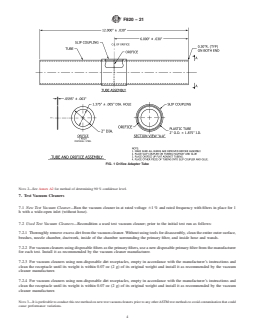
5.9 Orifice Adapter Tube—See Fig. 1.
6. Sampling
6.1 A minimum of three units of the same model vacuum cleaner selected at random in accordance with good statistical practice,
shall constitute the population sample.
6.1.1 To determine the best estimate of maximum air power for the population of the vacuum cleaner model being tested, the
arithmetic mean of the maximum air power of the sample from the population shall be established by testing it to a 90 % confidence
level within 65 %.
6.1.2 Annex A2 provides a procedural example for determining the 90 % confidence level and when the sample size shall be
increased.
F820 − 21
FIG. 1 Orifice Adapter Tube
NOTE 2—See Annex A2 for method of determining 90 % confidence level.
7. Test Vacuum Cleaners
7.1 New Test Vacuum Cleaner—Run the vacuum cleaner in at rated voltage 61 % and rated frequency with filters in place for 1
h with a wide-open inlet (without hose).
7.2 Used Test Vacuum Cleaners—Recondition a used test vacuum cleaner; prior to the initial test run as follows:
7.2.1 Thoroughly remove excess dirt from the vacuum cleaner. Without using tools for disassembly, clean the entire outer surface,
brushes, nozzle chamber, ductwork, inside of the chamber surrounding the primary filter, and inside hose and wands.
7.2.2 For vacuum cleaners using disposable filters as the primary filters, use a new disposable primary filter from the manufacturer
for each test. Install it as recommended by the vacuum cleaner manufacturer.
7.2.3 For vacuum cleaners using non-disposable dirt receptacles, empty in accordance with the manufacturer’s instructions and
clean the receptacle until its weight is within 0.07 oz (2 g) of its original weight and install it as recommended by the vacuum
cleaner manufacturer.
7.2.4 For vacuum cleaners using non-disposable dirt receptacles, empty in accordance with the manufacturer’s instructions and
clean the receptacle until its weight is within 0.07 oz (2 g) of its original weight and install it as recommended by the vacuum
cleaner manufacturer.
NOTE 3—It is preferable to conduct this test method on new test vacuum cleaners prior to any other ASTM test methods to avoid contamination that could
cause performance variations.
F820 − 21
NOTE 1—Hose is to be supported in a straight line.
FIG. 2 Vacuum Cleaning System Test Set-up
7.3 Test Vacuum Cleaner Settings—If various settings are provided, set the motor speed setting or suction regulator using the
manufacturer’s specifications as provided in the instruction manual for normal operation. If a different setting is used, make a note
of the deviation in the test report.
8. Procedure
8.1 Preparation for Test:
8.1.1 Prepare the test unit in accordance with Section 7. Set-up the test system as shown in Fig. 2. On the intake side, use an
adapter terminating with the wall inlet valve. This wall inlet is to be the one specified for installation with the power unit being
tested. All joints should be made in accordance with the manufacturer’s specifications and be free of leaks. Insert into the wall
valve a flexible cleaning hose as provided with the system. The hose assembly should be that which is offered normally with the
particular unit being tested. For those systems, which provide for an external exhaust, connect 2 ft (0.6 m) of exhaust comprised
of tubing and exhaust muffler, if a muffler is provided as part of the system.
8.1.2 Set the manometers to zero and check all instruments for proper operation.
8.1.3 Record the test station pressure and the dry-bulb and wet-bulb temperature readings within 6 ft (1.8 m) of the test area. Read
the barometric pressure to the nearest 0.02 in. (0.51 mm) of mercury, and the dry-bulb and wet-bulb temperatures to the nearest
0.2 °F (or 0.1 °C).
8.1.3.1 The test area shall be free of major fluctuating temperature conditions due to air conditioners or air drafts that would be
indicated by a thermometer at the immediate test area.
8.1.4 Connect the manometer or equivalent instrument to the plenum chamber.
8.1.5 Connect a power analyzer.
8.2 Test Procedure:
8.2.1 Connect the hose assembly to the plenum chamber hose adapter and seal only this connection (see Fig. 3).
8.2.1.1 The end of the hose assembly should be inserted inside the hose connector adapter and be perpendicular to the plenum
chamber.
8.2.1.2 The end of the hose assembly shall not project into the plenum chamber.
F820 − 21
FIG. 3 Diagram of Hose and Adapter Connection
8.2.1.3 Any automatic bleed valve, which affects the air performance of the vacuum cleaner, shall not be defeated.
8.2.2 The hose should be supported and kept straight and horizontal over its entire length. Allowance should be made for the
foreshortening of the hose assembly under the vacuum. Maintain the power unit and dirt canister in their normal operating
orientation.
8.2.3 Operate the vacuum cleaner with no orifice plate inserted in the plenum chamber inlet at nameplate rated voltage 61 % and
frequency 61 Hz prior to the start of the test run to allow the unit to reach its normal operating temperature. For vacuum cleaners
with dual nameplate voltage ratings, conduct testing at the highest voltage. Allow the unit to reach its normal operating temperature
before each test run.
8.2.4 The vacuum cleaner is to be operated at its nameplate rated voltage 61 % and frequency 61 Hz throughout the test. For
vacuum cleaners with dual nameplate voltage ratings, conduct the test at the highest voltage.
8.2.4.1 Allow the vacuum cleaner to operate at the open orifice for 15 seconds minimum between test runs.
8.2.5 While operating the vacuum cleaner in accordance with 8.2.4, insert orifice plates sequentially into the orifice plate holder
of the plenum chamber starting with the largest size orifice and following it with the next smaller orifice plate. Use the following
orifice plates: 2.0, 1.5, 1.25, 1.0, 0.875, 0.75, 0.625, 0.5, 0.375, 0.25, 0.0 in. (50.8, 38.1, 31.7, 25.4, 22.2, 19.0, 15.8, 12.7, 9.5, 6.3
mm). The following optional orifice plates also may be used: 2.5, 2.25, 1.75, 1.375, 1.125 in. (63.5, 57.2, 44.5, 34.9, 28.6 mm).
8.2.6 For each orifice plate, record the suction, h, and input power, P, in that order. All readings should be taken within 10 s of
the orifice insertion. For orifices less than 0.750 in. allow the vacuum cleaner to operate at the open orifice for 1 to 2 min before
inserting the next orifice.
8.2.6.1 Read the suction to the nearest graduation of the instrument. Readings should be taken as soon as the manometer reaches
a true peak. When using a fluid type manometer, the liquid level may peak, drop, and peak again. The second peak is the true peak
reading. A person conducting the test for the first time shall observe at least one run before recording data. See Specification F431
for instructions on how to minimize the overshoot (first peak) of the liquid level.
9. Calculation
9.1 Correction of Data to Standard Conditions:
9.1.1 Air Density Ratio—The density ratio, D , is the ratio of the air density at the time of test ρ , to the standard air density,
r test
3 3 3
ρ = 0.075 lb/ft (1.2014 kg/m ). It is used to correct the vacuum and wattage readings to standard conditions. Find ρ (lb/ft
std test
or kg/m ) from standard psychometric charts or ASHRAE tables and calculate D as follows:
r
ρ
test
D 5 (1)
r
ρ
std
where:
3 3
ρ = the air density at the time of test, lb/ft (kg/m ), and
test
F820 − 21
3 3
ρ = the standard air density, 0.075 lb/ft (1.2014 kg/m ).
std
9.1.1.1 As an alternative, the following equation is intended to be used for correcting ambient conditions where the barometric
pressure exceeds 27 in mercury and the dry-bulb and wet-bulb temperatures are less than 100°F (37.8°C);100 °F (37.8 °C); and,
may be used as an alternate method of calculating D (see Appendix X1 for derivation and accuracy analysis).
r
17.68 B 2 0.001978 T 10.1064 T 1
t w w
F G
0.0024575B ~T 2 T ! 2 2.741
t d w
D 5 (2)
r
T 1459.7
d
where:
B = test station pressure at time of test, inch of mercury,
t
T = dry-bulb temperature at time of test, °F, and
d
T = wet-bulb temperature at time of test, °F.
w
9.1.2 Corrected Suction—Corrected suction, h , is the manometer reading, h, times the correction factor, C , as follows:
s s
h 5 C h (3)
s s
9.1.2.1 For series universal motors (6) the correction factor, C , is calculated as follows:
s
C 5 110.667 12 D (4)
~ !
s r
9.1.2.2 This test method does not have any formulas available for correcting input power for any other type of motor (permanent
magnet, induction, etc.).
9.1.3 Corrected Input Power—Corrected input power, P , expressed in watts, is the wattmeter reading, P, times the correction
s
factor, C , as follows:
p
P 5 C P (5)
s p
9.1.3.1 For series universal motors the correction factor, C , is calculated as follows:
p
C 5 110.5 12 D (6)
~ !
p r
9.1.3.2 This test method does not have any formulas available for correcting input power for any other types of motor (permanent
magnet, induction, etc.).
9.2 Corrected Airflow—Calculate the corrected airflow, Q, expressed in cubic feet per minute (see Note 4 and Appendix X2) as
follows:
Q 5 21.844 D K =h (7)
1 s
where:
Q = corrected flow, cfm,
D = orifice diameter, in.,
K = constant (dimensionless) orifice flow coefficients for orifices in the plenum chamber. See Table 1 for values for each orifice.
See Ref (1) for the derivation of these flow coefficients, and
h = corrected suction, water, in.
s
NOTE 4—For the corrected airflow expressed in liters per second, use the following equation:
Q 5 10.309D K =h (8)
1 s
where:
Q = corrected flow, L/s,
D = orifice diameter, m,
F820 − 21
TABLE 1 Orifice Flow Coefficient Equations (K )
NOTE 1—K was determined experimentally using an ASTM Plenum
Chamber (see Specification F431) and an ASME Flowmeter (1).
NOTE 2—Equations for K in terms of B and h, are given in Appendix
1 t
X6.
A
Orifice Diameter, in. (mm) Orifice Flow Coefficient Equation
0.5575r20.5955
0.250 (6.3)
K 5
r21.0468
0.5553r20.5754
0.375 (9.5)
K 5
r21.0263
0.5694r20.5786
0.500 (12.7)
K 5
r21.0138
0.625 (15.8) 0.5692r20.5767
K 5
r21.0104
0.5715r20.5807
0.750 (19.0)
K 5
r21.0138
0.5740r20.5841
0.875 (22.2)
K 5
r21.0158
0.5687r20.5785
1.000 (25.4)
K 5
r21.0146
0.5675r20.5819
1.125 (28.6)
K 5
r21.0225
0.5717r20.5814
1.250 (31.7)
K 5
r21.0152
0.5680r20.5826
1.375 (34.9)
K 5
r21.0235
0.5719r20.5820
1.500 (38.1)
K 5
r21.0165
0.5695r20.5839
1.750 (44.5)
K 5
r21.0235
0.5757r20.5853
2.000 (50.8)
K 5
r21.0157
0.5709r20.5878
2.250 (57.2)
K 5
r21.0279
0.5660r20.59024
2.500 (63.5)
K 5
r21.0400
B s0.4912d2hs0.03607d
t
A
r5
B s0.4912d
t
where:
B = test station pressure at time of test, in. of mercury, and
t
h = uncorrected suction (manometer reading), in. of water.
K = constant (dimensionless),
h = corrected suction, Pa.
s
9.3 Air Power—Calculate the air power, AP, in watts, as follows:
AP 5 0.117354 Q h (9)
~ !~ !
s
where:
AP = air power, W,
Q = corrected flow, cfm, and
h = corrected suction, inch of water (see Appendix X3 for derivation).
s
9.4 Maximum Air Power—Determine the maximum air power using the method in Annex A1.
10. Report
10.1 For each vacuum cleaner sample from the population being tested, report the following information:
F820 − 21
TABLE 2 Repeatability and Reproducibility
Coefficient of Repeatability Coefficient of Reproducibility
Variation, Limit, r Variation, Limit, R
CV % CV %
r R
1.5 4.3 9.0 25.1
10.1.1 Manufacturer’s name and product model name or number, or both.
10.1.2 Type of filtration; that is, paper bag, cloth bag, foam filter, centrifugal, etc.
10.1.3 The corrected input power, corrected vacuum, corrected airflow, and air power for each orifice.
10.1.4 Manufacturer’s parts, catalog, or model number of the ductwork, fittings, and flexible cleaning hose assembly used in the
test.
10.1.5 Calculated or measured maximum air power, whichever is greater.
11. Precision and Bias
11.1 The following precision statements are based on interlaboratory tests involving nine laboratories and four units.
11.2 The statistics have been calculated as recommended in Practice E691.
11.3 The following statements regarding repeatability limit and reproducibility limit are used as directed in Practice E177.
11.4 The Coefficients of Variation of repeatability and reproducibility of the measured results have been derived from nine sets
of data, where each set has been performed by a single analyst within each of the nine laboratories on two separate days using the
same unit test.
11.5 Repeatability (Single Operator and Laboratory; Multiday Testing)—The ability of a single analyst to repeat the test within
a single laboratory.
11.5.1 The expected coefficient of variation of the measured results within a laboratory, CV % , has been found to be the respective
r
values listed in Table 2.
11.5.2 The 95 % repeatability limit within a laboratory, r, has been found to be the respective values listed in Table 2, where r
= 2.8 (CV % ).
r
11.5.3 With 95 % confidence, it can be stated that within a laboratory a set of measured results derived from testing a unit should
be considered suspect if the difference between any two of the three values is greater than the respective value of the repeatability
limit, r, listed in Table 2.
11.5.4 If the absolute value of the difference of any pair of measured results from three test runs performed within a single
laboratory is not equal to or less than the respective repeatability limit listed in Table 2, that set of test results shall be considered
suspect.
11.6 Reproducibility (Multiday Testing and Single Operator Within Multilaboratories)—The ability to repeat the test with multiple
laboratories.
11.6.1 The expected coefficient of variation of reproducibility of the average of a set of measured results between multiple
laboratories, CV % , has been found to be the respective values listed in Table 2.
R
Complete data on the round-robin test is available from ASTM Headquarters. Request RR:F11-1003. Contact ASTM Customer Service at service@astm.org.
F820 − 21
11.6.2 The 95 % reproducibility limit within a laboratory, R, has been found to be the respective values listed in Table 2, where
R = 2.8 (CV % ).
R
11.6.3 With 95 % confidence, it can be stated that the average of the measured results from a set of three test runs performed in
one laboratory, as compared to a second laboratory, should be considered suspect if the difference between those two values is
greater than the respective values of the reproducibility limit, R, listed in Table 2.
11.6.4 If the absolute value of the difference between the average of the measured results from the two laboratories is not equal
to or less than the respective reproducibility limit listed in Table 2, the set of results from both laboratories shall be considered
suspect.
11.7 Bias—No justifiable statement can be made on the bias of this test method for testing the properties listed. The true values
of the properties cannot be established by acceptable referee methods.
12. Keywords
12.1 airflow; air performance; air power; residential central vacuum cleaners; suction; suction power; vacuum cleaners
ANNEXES
(Mandatory Information)
A1. MATHEMATICAL METHOD FOR DETERMINING MAXIMUM AIR POWER POINT
A1.1 The following, second degree polynomial equation, is assumed to provide the best mathematical approximation of the air
power versus airflow relationship (see Ref (4) for additional information).
Y 5 A 1A X1A X (A1.1)
1 2 3
where:
Y = air power (AP),
X = airflow (Q), and
A , A , andA = arbitrary constants.
1 2 3
A1.1.1 Use X and Y values obtained from only five specific orifices selected as follows:
A1.1.1.1 Using the test data, determine the orifice size that produced the highest air power value.
A1.1.1.2 Use the air power and airflow values at this orifice, and the next two smaller and the next two larger orifices in the
following computations.
A1.1.1.3 If the highest air power value calculated from the observed data is at the 2.0 in. (50.8 mm) orifice or larger, then use the
air power and airflow values from the five largest orifices.
A1.2 To determine the values of A , A , and A , use the X and Y values obtained from the five specified orifices and solve the
1 2 3
following set of normalized equations:
Y 5 NA 1A X 1A X (A1.2)
i 1 2 i 3 i
( ( (
F820 − 21
2 3
X Y 5 A X 1A X 1A X (A1.3)
( i i 1 ( i 2 ( i 3 ( i
2 2 3 4
X Y 5 A X 1A X 1A X (A1.4)
i i 1 i 2 i 3 i
( ( ( (
where:
N = 5 (number of orifices selected),
I = 1 to N, and
X andY = the values obtained during testing (X Y , X Y , . X Y ) at the five orifices specified in A1.1.1.
i i 1 1 2 2 N N
A1.3 Setting the derivative of Eq A1.1 equal to zero and solving for X will determine the value of X where Y is at its maximum
m
value (Y ) as follows:
max
dy d
5 A 1A X1A X 5 0 (A1.5)
@ #
1 2 3
dx dx
dy
5 A 12A X 5 0
2 3
dx
Substitute X as the value of X at Y and solve for X :
m max m
A
X 52 (A1.6)
m
2A
Substituting this value of X , and A , A , and A , into Eq A1.1 will determine the value of Y (AP ) as follows:
m 1 2 3 max max
Y 5 A 1A X 1A X (A1.7)
max 1 2 m 3 m
A1.4 Calculate the goodness of fit, R (correlation coefficient), as follows:
Y 2 Y
~ i OBS i CAL!
(
R 5 12 (A1.8)
Y 2 Y
~ !
( i OBS OBS
where:
Y 5 A 1A X 1A X (A1.9)
i CAL 1 2 i OBS 3 i OBS
and:
Y 5 Y (A1.10)
OBS ( i OBS
N
and:
i = 1 to N orifices used in 8.2,
OBS = observed data,
CAL = calculated data, and
Y = is the air power (AP) obtained from the calculations in 9.3 for the corresponding value X (airflow, Q) at any of the
i OBS i OBS
N orifices selected.
A1.4.1 If R is not greater than or equal to 0.900, the test must be performed again and the new set of data used.
A1.4.2 The measured or calculated value for maximum air power shall be recorded, whichever is greater.
F820 − 21
TABLE A2.1 Percentiles of the t Distribution
df t
0.95
1 6.314
2 2.920
3 2.353
4 2.132
5 2.015
6 1.943
7 1.895
8 1.860
9 1.833
10 1.812
11 1.796
12 1.782
13 1.771
14 1.761
15 1.753
A2. DETERMINATION OF 90 % CONFIDENCE INTERVAL
A2.1 Theory:
A2.1.1 The most common and ordinarily the best estimate of the population mean, μ, is simply the arithmetic mean, x¯, of the
individual scores (measurements) of the units comprising a sample taken from the population. The average score of these units will
seldom be exactly the same as the population mean; however, it is expected to be fairly close so that in using the following
procedure it can be stated with 90 % confidence that the true mean of the population, μ, lies within 5 % of the calculated mean,
x¯, of the sample taken from the population as stated in Section 6.
A2.1.2 The following procedure provides a confidence interval about the sample mean which is expected to bracket μ, the true
population mean, 100(1-α) % of the time where α is the chance of being wrong; therefore, 1-α is the probability or level of
confidence of being correct.
A2.1.3 The desired level of confidence is 1-α = 0.90 or 90 % as stated in Section 11; therefore, α = 0.10 or 10 %.
A2.1.4 Compute the mean, x¯, and the standard deviation, s, of the individual scores of the sample taken from the population:
n
¯
X 5 X (A2.1)
i
(
n
i51
n n 2
n X 2 X
S D
( i ( i
i51 i51
s 5 (A2.2)
!
n n 2 1
~ !
where:
n = number of units tested, and
X = the value of the individual test unit score of the ith test unit. As will be seen in the procedural example to follow, this is
i
the average value of the results from three test runs performed on an individual test unit with the resulting set of data
meeting the repeatability requirements of Section 11.
A2.1.5 Determine the value of the t statistic for n – 1 degrees of freedom, df, from Table A2.1 at a 95 % confidence level.
F820 − 21
NOTE A2.1—The value of t is defined as t and is read as “t at 95 % confidence.”
1-α/2
t statistic 5 t 5 t (A2.3)
12α/2 0.95
wher
...