


ASTM D596-01(2018)
(Guide)Standard Guide for Reporting Results of Analysis of Water
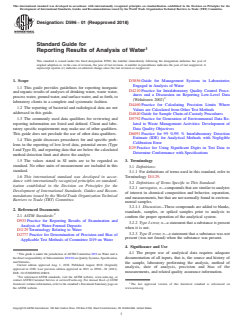
Standard Guide for Reporting Results of Analysis of Water
SIGNIFICANCE AND USE
4.1 The proper use of analytical data requires adequate documentation of all inputs, that is, the source and history of the sample, laboratory performing the analysis, method of analysis, date of analysis, precision and bias of the measurements, and related quality assurance information.
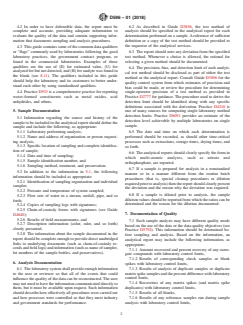
4.2 In order to have defensible data, the report must be complete and accurate, providing adequate information to evaluate the quality of the data and contain supporting information that documents sampling and analysis procedures.
4.3 This guide contains some of the common data qualifiers or “flags” commonly used by laboratories following the good laboratory practices, the government contract program, or found in the commercial laboratories. Examples of these qualifiers are the use of (E) for estimated value, (U) for analyzed for but not detected, and (B) for analyte was found in the blank (see 8.11). The qualifiers included in this guide should help the laboratory and its customers to better understand each other by using standardized qualifiers.
4.4 Practice D933 is a comprehensive practice for reporting water-formed constituents such as metal oxides, acid anhydrides, and others.
SCOPE
1.1 This guide provides guidelines for reporting inorganic and organic results of analyses of drinking water, waste water, process water, ground water, and surface water, and so forth, to laboratory clients in a complete and systematic fashion.
1.2 The reporting of bacterial and radiological data are not addressed in this guide.
1.3 The commonly used data qualifiers for reviewing and reporting information are listed and defined. Client and laboratory specific requirements may make use of other qualifiers. This guide does not preclude the use of other data qualifiers.
1.4 This guide discusses procedures for and specific problems in the reporting of low level data, potential errors (Type I and Type II), and reporting data that are below the calculated method detection limit and above the analyte.
1.5 The values stated in SI units are to be regarded as standard. No other units of measurement are included in this standard.
1.6 This international standard was developed in accordance with internationally recognized principles on standardization established in the Decision on Principles for the Development of International Standards, Guides and Recommendations issued by the World Trade Organization Technical Barriers to Trade (TBT) Committee.
General Information
- Status
- Published
- Publication Date
- 31-Jul-2018
- Technical Committee
- D19 - Water
- Drafting Committee
- D19.02 - Quality Systems, Specification, and Statistics
Relations
- Effective Date
- 01-Nov-2023
- Effective Date
- 01-May-2020
- Effective Date
- 01-May-2020
- Effective Date
- 15-Aug-2018
- Effective Date
- 01-Sep-2015
- Effective Date
- 15-Jun-2012
- Effective Date
- 01-Jan-2012
- Refers
ASTM D3856-11 - Standard Guide for Management Systems in Laboratories Engaged in Analysis of Water - Effective Date
- 15-Nov-2011
- Effective Date
- 01-Dec-2010
- Effective Date
- 01-Mar-2010
- Effective Date
- 01-Feb-2010
- Effective Date
- 01-Dec-2009
- Effective Date
- 01-Oct-2008
- Effective Date
- 15-Jan-2008
- Effective Date
- 01-Dec-2007
Overview
ASTM D596-01(2018), Standard Guide for Reporting Results of Analysis of Water, sets out best practices and essential requirements for reporting both inorganic and organic test results derived from water analysis. The objective of this guide is to ensure that analytical data provided to clients - whether concerning drinking water, wastewater, process water, groundwater, or surface water - is complete, accurate, and adequately documented. By clearly detailing sample source, laboratory methods, quality assurance, and data qualifiers, this standard enables transparent communication between laboratories and their clients. Bacterial and radiological data reporting are outside the scope of this guide.
Key Topics
Comprehensive Documentation
Analytical reports should include details about:- Sample source and history (including sampling location, date, and time)
- Laboratory and personnel involved in sampling and analysis
- Analytical methods used, including deviations and reasons
- Precision, bias, and method detection limits
- Results of quality assurance checks (surrogate recovery, blanks, duplicates, spikes)
- Chain-of-custody records and field logs
Standardized Data Qualifiers
Use of common data qualifiers improves clarity and reliability of reports. Examples include:- (E): Estimated value due to interference
- (U): Analyzed for but not detected
- (B): Analyte found in the blank Qualifiers help in correctly interpreting results, especially for low-level data or measurements at or near detection limits.
Low-Level Data and Error Types
The guide addresses challenges in reporting data below method detection limits and distinguishes between Type I (false positive) and Type II (false negative) errors, fostering defensible and evaluatable analytical documentation.Significant Figures and Units
Results must be expressed using appropriate significant figures and standard SI units, supporting accurate representation of measurement precision and consistency across laboratories.Review and Quality Assurance
Peer review of analytical data prior to finalization is required to ensure accuracy and adherence to reporting protocols. The report should include, when appropriate, a quality assurance narrative to explain deviations, anomalies, or uncertainties.
Applications
ASTM D596-01(2018) is widely used in the following contexts:
- Water Quality Laboratories
Laboratories use this guide to standardize the reporting of water analysis results for municipal, industrial, and environmental clients. - Regulatory Compliance
Enables organizations to meet documentation and reporting requirements for regulatory submissions related to water quality. - Environmental Assessment
Supports consultants and environmental scientists in providing reliable, transparent data for site assessments, remediation projects, and resource management. - Quality Assurance Programs
Integrates with internal and external quality systems to ensure traceability, data defensibility, and comparability in water testing.
By following this standard, professionals ensure that results can be correctly interpreted and validated, minimizing miscommunication and supporting sound decision-making in water management.
Related Standards
ASTM D596-01(2018) references and complements several other key standards, including:
- ASTM D933: Practice for Reporting Results of Examination and Analysis of Water-Formed Deposits
- ASTM D1129: Terminology Relating to Water
- ASTM D2777: Practice for Determination of Precision and Bias
- ASTM D3856: Guide for Management Systems in Laboratories Engaged in Analysis of Water
- ASTM D4840: Guide for Sample Chain-of-Custody Procedures
- ASTM D5792: Practice for Generation of Environmental Data Related to Waste Management Activities
- ASTM D6091: Practice for Interlaboratory Detection Limit Estimates
- ASTM E29: Practice for Using Significant Digits in Test Data
Practical Value
Implementing ASTM D596-01(2018) yields significant benefits in analytical water testing, fostering:
- Trust and transparency between laboratories and clients
- Auditable records for regulatory and legal defensibility
- Consistency in reporting across different laboratories and projects
- Clarity in data interpretation, particularly for low-level analyses
Keywords: water analysis reporting, analytical data, ASTM D596, quality assurance, data qualifiers, laboratory reports, water testing standards, environmental compliance
Get Certified
Connect with accredited certification bodies for this standard

CIS Institut d.o.o.
Personal Protective Equipment (PPE) certification body. Notified Body NB-2890 for EU Regulation 2016/425 PPE.

Kiwa BDA Testing
Building and construction product certification.
Kmetijski inštitut Slovenije
Agricultural Institute of Slovenia. Soil testing, plant health, agricultural product analysis.
Sponsored listings
Frequently Asked Questions
ASTM D596-01(2018) is a guide published by ASTM International. Its full title is "Standard Guide for Reporting Results of Analysis of Water". This standard covers: SIGNIFICANCE AND USE 4.1 The proper use of analytical data requires adequate documentation of all inputs, that is, the source and history of the sample, laboratory performing the analysis, method of analysis, date of analysis, precision and bias of the measurements, and related quality assurance information. 4.2 In order to have defensible data, the report must be complete and accurate, providing adequate information to evaluate the quality of the data and contain supporting information that documents sampling and analysis procedures. 4.3 This guide contains some of the common data qualifiers or “flags” commonly used by laboratories following the good laboratory practices, the government contract program, or found in the commercial laboratories. Examples of these qualifiers are the use of (E) for estimated value, (U) for analyzed for but not detected, and (B) for analyte was found in the blank (see 8.11). The qualifiers included in this guide should help the laboratory and its customers to better understand each other by using standardized qualifiers. 4.4 Practice D933 is a comprehensive practice for reporting water-formed constituents such as metal oxides, acid anhydrides, and others. SCOPE 1.1 This guide provides guidelines for reporting inorganic and organic results of analyses of drinking water, waste water, process water, ground water, and surface water, and so forth, to laboratory clients in a complete and systematic fashion. 1.2 The reporting of bacterial and radiological data are not addressed in this guide. 1.3 The commonly used data qualifiers for reviewing and reporting information are listed and defined. Client and laboratory specific requirements may make use of other qualifiers. This guide does not preclude the use of other data qualifiers. 1.4 This guide discusses procedures for and specific problems in the reporting of low level data, potential errors (Type I and Type II), and reporting data that are below the calculated method detection limit and above the analyte. 1.5 The values stated in SI units are to be regarded as standard. No other units of measurement are included in this standard. 1.6 This international standard was developed in accordance with internationally recognized principles on standardization established in the Decision on Principles for the Development of International Standards, Guides and Recommendations issued by the World Trade Organization Technical Barriers to Trade (TBT) Committee.
SIGNIFICANCE AND USE 4.1 The proper use of analytical data requires adequate documentation of all inputs, that is, the source and history of the sample, laboratory performing the analysis, method of analysis, date of analysis, precision and bias of the measurements, and related quality assurance information. 4.2 In order to have defensible data, the report must be complete and accurate, providing adequate information to evaluate the quality of the data and contain supporting information that documents sampling and analysis procedures. 4.3 This guide contains some of the common data qualifiers or “flags” commonly used by laboratories following the good laboratory practices, the government contract program, or found in the commercial laboratories. Examples of these qualifiers are the use of (E) for estimated value, (U) for analyzed for but not detected, and (B) for analyte was found in the blank (see 8.11). The qualifiers included in this guide should help the laboratory and its customers to better understand each other by using standardized qualifiers. 4.4 Practice D933 is a comprehensive practice for reporting water-formed constituents such as metal oxides, acid anhydrides, and others. SCOPE 1.1 This guide provides guidelines for reporting inorganic and organic results of analyses of drinking water, waste water, process water, ground water, and surface water, and so forth, to laboratory clients in a complete and systematic fashion. 1.2 The reporting of bacterial and radiological data are not addressed in this guide. 1.3 The commonly used data qualifiers for reviewing and reporting information are listed and defined. Client and laboratory specific requirements may make use of other qualifiers. This guide does not preclude the use of other data qualifiers. 1.4 This guide discusses procedures for and specific problems in the reporting of low level data, potential errors (Type I and Type II), and reporting data that are below the calculated method detection limit and above the analyte. 1.5 The values stated in SI units are to be regarded as standard. No other units of measurement are included in this standard. 1.6 This international standard was developed in accordance with internationally recognized principles on standardization established in the Decision on Principles for the Development of International Standards, Guides and Recommendations issued by the World Trade Organization Technical Barriers to Trade (TBT) Committee.
ASTM D596-01(2018) is classified under the following ICS (International Classification for Standards) categories: 13.060.45 - Examination of water in general. The ICS classification helps identify the subject area and facilitates finding related standards.
ASTM D596-01(2018) has the following relationships with other standards: It is inter standard links to ASTM D5792-10(2023), ASTM D933-20, ASTM D1129-13(2020)e2, ASTM D4840-99(2018)e1, ASTM D5792-10(2015), ASTM D2777-12, ASTM D933-84(2012), ASTM D3856-11, ASTM D5792-10, ASTM D1129-10, ASTM D4840-99(2010), ASTM D4460-97(2009), ASTM E29-08, ASTM D2777-08, ASTM D933-84(2007). Understanding these relationships helps ensure you are using the most current and applicable version of the standard.
ASTM D596-01(2018) is available in PDF format for immediate download after purchase. The document can be added to your cart and obtained through the secure checkout process. Digital delivery ensures instant access to the complete standard document.
Standards Content (Sample)
This international standard was developed in accordance with internationally recognized principles on standardization established in the Decision on Principles for the
Development of International Standards, Guides and Recommendations issued by the World Trade Organization Technical Barriers to Trade (TBT) Committee.
Designation: D596 − 01 (Reapproved 2018)
Standard Guide for
Reporting Results of Analysis of Water
This standard is issued under the fixed designation D596; the number immediately following the designation indicates the year of
original adoption or, in the case of revision, the year of last revision. A number in parentheses indicates the year of last reapproval. A
superscript epsilon (´) indicates an editorial change since the last revision or reapproval.
1. Scope D3856 Guide for Management Systems in Laboratories
Engaged in Analysis of Water
1.1 This guide provides guidelines for reporting inorganic
D4210 Practice for Intralaboratory Quality Control Proce-
and organic results of analyses of drinking water, waste water,
dures and a Discussion on Reporting Low-Level Data
process water, ground water, and surface water, and so forth, to
(Withdrawn 2002)
laboratory clients in a complete and systematic fashion.
D4460 Practice for Calculating Precision Limits Where
1.2 The reporting of bacterial and radiological data are not
Values are Calculated from Other Test Methods
addressed in this guide.
D4840 Guide for Sample Chain-of-Custody Procedures
1.3 The commonly used data qualifiers for reviewing and D5792 Practice for Generation of Environmental Data Re-
lated to Waste Management Activities: Development of
reporting information are listed and defined. Client and labo-
ratory specific requirements may make use of other qualifiers. Data Quality Objectives
D6091 Practice for 99 %/95 % Interlaboratory Detection
This guide does not preclude the use of other data qualifiers.
Estimate (IDE) for Analytical Methods with Negligible
1.4 This guide discusses procedures for and specific prob-
Calibration Error
lems in the reporting of low level data, potential errors (Type
E29 Practice for Using Significant Digits in Test Data to
I and Type II), and reporting data that are below the calculated
Determine Conformance with Specifications
method detection limit and above the analyte.
1.5 The values stated in SI units are to be regarded as 3. Terminology
standard. No other units of measurement are included in this
3.1 Definitions:
standard.
3.1.1 For definitions of terms used in this standard, refer to
1.6 This international standard was developed in accor-
Terminology D1129.
dance with internationally recognized principles on standard-
3.2 Definitions of Terms Specific to This Standard:
ization established in the Decision on Principles for the
3.2.1 surrogates, n—compounds that are similar to analytes
Development of International Standards, Guides and Recom-
of interest in chemical composition and behavior, separation,
mendations issued by the World Trade Organization Technical
and measurements, but that are not normally found in environ-
Barriers to Trade (TBT) Committee.
mental samples.
3.2.1.1 Discussion—These compounds are added to blanks,
2. Referenced Documents
standards, samples, or spiked samples prior to analysis to
2.1 ASTM Standards:
confirm the proper operation of the analytical system.
D933 Practice for Reporting Results of Examination and
3.2.2 Type I error, n—a statement that a substance is present
Analysis of Water-Formed Deposits
when it is not.
D1129 Terminology Relating to Water
3.2.3 Type II error, n—a statement that a substance was not
D2777 Practice for Determination of Precision and Bias of
present (was not found) when the substance was present.
Applicable Test Methods of Committee D19 on Water
4. Significance and Use
1 4.1 The proper use of analytical data requires adequate
This guide is under the jurisdiction ofASTM Committee D19 on Water and is
thedirectresponsibilityofSubcommitteeD19.02onQualitySystems,Specification, documentation of all inputs, that is, the source and history of
and Statistics.
the sample, laboratory performing the analysis, method of
Current edition approved Aug. 1, 2018. Published August 2018. Originally
analysis, date of analysis, precision and bias of the
approved in 1940. Last previous edition approved in 2011 as D596 – 01 (2011).
measurements, and related quality assurance information.
DOI: 10.1520/D0596-01R18.
For referenced ASTM standards, visit the ASTM website, www.astm.org, or
contact ASTM Customer Service at service@astm.org. For Annual Book of ASTM
Standards volume information, refer to the standard’s Document Summary page on The last approved version of this historical standard is referenced on
the ASTM website. www.astm.org.
Copyright © ASTM International, 100 Barr Harbor Drive, PO Box C700, West Conshohocken, PA 19428-2959. United States
D596 − 01 (2018)
4.2 In order to have defensible data, the report must be 6.2 As described in Guide D3856, the test method of
complete and accurate, providing adequate information to analysis should be specified in the analytical report for each
evaluate the quality of the data and contain supporting infor- determination performed on a sample.Areference of sufficient
mation that documents sampling and analysis procedures. definition or a copy of the test method should be provided to
the requestor of the analytical services.
4.3 This guide contains some of the common data qualifiers
or “flags” commonly used by laboratories following the good 6.3 The report should note any deviation from the specified
laboratory practices, the government contract program, or test method. Whenever a choice is allowed, the rational for
found in the commercial laboratories. Examples of these selecting a given method should be documented.
qualifiers are the use of (E) for estimated value, (U) for
6.4 The precision, bias, and detection limit of each analyti-
analyzed for but not detected, and (B) for analyte was found in
cal test method should be disclosed as part of either the test
the blank (see 8.11). The qualifiers included in this guide
method or the analytical report. Consult Guide D3856 for the
should help the laboratory and its customers to better under-
quality control system from which estimates of precision and
stand each other by using standardized qualifiers.
bias could be made, or review the procedure for determining
4.4 Practice D933 is a comprehensive practice for reporting
single-operator precision of a test method as provided in
water-formed constituents such as metal oxides, acid
Practice D2777 for guidance. The procedure used to derive the
anhydrides, and others.
detection limit should be identified along with any specific
definitions associated with the derivation. Practice D4210 is
5. Sample Documentation one of many sources for computing single laboratory method
detection limits. Practice D6091 provides an estimate of the
5.1 Information regarding the source and history of the
detection level achievable by multiple laboratories on single
sample to be included in the analytical report should define the
sample.
sample and include the following, as appropriate:
5.1.1 Laboratory performing analysis; 6.5 The date and time on which each determination is
5.1.2 Name and address of organization or person request-
performed should be recorded, as should other time-critical
ing analysis; processes such as extractions, storage times, drying times, and
5.1.3 Specific location of sampling and complete identifica-
so forth.
tion of sample;
6.6 The analytical reports should clearly specify the form in
5.1.4 Date and time of sampling;
which multi-atomic analytes, such as nitrate and
5.1.5 Sample identification number; and
orthophosphate, are reported.
5.1.6 Sampling method, treatment, and preservation.
6.7 If a sample is prepared for analysis in a nonstandard
5.2 In addition to the information in 5.1, the following
manner or in a manner different from the routine batch
information should be included as appropriate:
procedures (that is, special cleanup procedures or dilution
5.2.1 Identification of sampling organization and individual
requiredpriortoanalysis)thenthereportshouldclearlypresent
sampler;
the deviation and the reason why the deviation was required.
5.2.2 Pressure and temperature of system sampled;
6.8 If a sample is diluted prior to analysis, the sample
5.2.3 Flow rate of water in a stream, outfall, pipe, and so
dilution values should be reported from which the ratios can be
forth;
determined and the reason for the dilution documented.
5.2.4 Copies of sampling logs with signatures;
5.2.5 Chain-of-custody forms with signatures (see Guide
7. Documentation of Quality
D4840);
5.2.6 Results of field measurements; and
7.1 Each sample analysis may have different quality needs
5.2.7 Description information (color, odor, and so forth)
based on the use of the data or the data quality objectives (see
clearly presented.
Practice D5792). This information should be determined be-
5.2.8 The information about the sample documented in the
fore sampling and analysis. Based on the information, an
report should be complete enough to provide direct unabridged
analytical report may include the following information, as
links to underlying documents (such as chain-of-custody re-
appropriate:
cordsandfieldlogs)andinformation(suchasnameofsampler,
7.1.1 Amount recovered and percent recovery of any surro-
lot numbers of the sample bottles, and preservatives).
gate compounds with laboratory control limits,
7.1.2 Results of corresponding check samples or blank
6. Analysis Documentation
spikes with laboratory control limits,
7.1.3 Results of analysis of duplicate samples or duplicate
6.1 The laboratory system shall provide enough information
matrixspikesamplesandthepercentdifferencewithlaboratory
to the user or reviewer so that all of the events that could
control limits,
influence the quality of the data can be reconstructed. The user
7.1.4 Recoveries of any matrix spikes (and matrix spike
maynotneedtohavetheinformationcommunicateddirectlyto
duplicates) with laboratory control limits,
them, but it must be available upon request. Such information
shoulddescribehoweffectivelyallprocedureswerecarriedout 7.1.5 Results of all blanks,
and how processes were controlled so that they meet industry 7.1.6 Results of any reference samples run during sample
and government standards for performance. analysis with laboratory control limits,
D596 − 01 (2018)
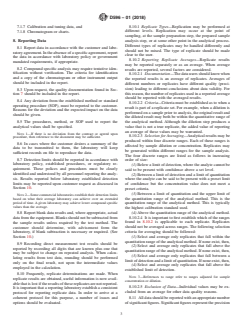
7.1.7 Calibration and tuning data, and 8.10.1 Replicate Types—Replication may be performed at
7.1.8 Chromatogram or charts. different levels. Replication may occur at the point of
sampling, at the sample preparation step, the prepared sample
8. Reporting Data analysis step, or at some other point in the analytical process.
Different types of replicates may be handled differently and
8.1 Report data in accordance with the customer and labo-
should not be mixed. The type of replicate should be made
ratoryagreement.Intheabsenceofaspecificagreement,report
clear to the user.
the data in accordance with laboratory policy or government
8.10.2 Reporting Replicate Averages—Replicate results
mandated requirements, if appropriate.
may be reported separately or as an average. When average
8.2 Compound specific analysis may require tentative iden-
results are reported, several factors are considered.
tification without verification. The criteria for identification
8.10.2.1 Documentation—Thedatausersshouldknowwhen
and a copy of the chromatogram or other instrument output
the reported results is an average of replicates. Averages of
should be included in the report.
different numbers or replicates have different quality (preci-
sion) leading to different conclusions about data validity. For
8.3 Upon request, the quality documentation found in Sec-
this reason, the number of replicates used in a reported average
tion 7 should be included in the report.
should be reported with the averaged results.
8.4 Any deviation from the established method or standard
8.10.2.2 Criteria—Criteria must be established as to when a
operating procedure (SOP), must be reported to the customer.
result is part of a replicate set. For example, when a dilution is
Reasons for the deviation and the expected impact on the data
performed on a sample prior to analysis, the original result and
should be given.
the diluted result may both be within the quantitative range of
8.5 The procedures, method, or SOP used to report the
the analytical method. Although the dilution step produces a
analytical values shall be specified.
value that is not a true replicate, the added value of reporting
an average of these values may be warranted.
NOTE 1—If there is no deviation from the contract or agreed upon
8.10.2.3 Selection for Averaging—Analytical results may be
procedure, then reference to the document may be sufficient.
produced within four discrete ranges. Each of these ranges is
8.6 In cases where the customer desires a summary of the
affected by sample dilution or concentration. Replicates may
data to be transmitted to them, the laboratory will keep
be generated within different ranges for the sample analysis.
sufficient records on file to reproduce the data.
The four discrete ranges are listed as follows in increasing
8.7 Detection limits should be reported in accordance with
order of size:
laboratory policy, established procedures, or regulatory re-
(1) Below a limit of detection, where the analyte cannot be
quirement. These polices and procedures must be clearly
said to be present with confidence above a set level.
identified and understood by all personnel reporting the analy-
(2) Between a limit of detection and a limit of quantitation
sis. Results reported below laboratory established detection
where the analyte can be said to be present with a preset limit
limits may be reported upon customer request as discussed in
of confidence but the concentration value does not meet a
Section 10.
preset criteria.
(3) Between a limit of quantitation and the upper limit of
NOTE 2—Some commercial laboratories establish their detection limits
the quantitation range of the analytical method. This is the
based on what their average laboratory can achieve over an extended
period of time. A given laboratory may achieve lower compound specific quantitation range of the analytical method. This is typically
values than the average.
the highest calibration standard used.
(4) Above the quantitation range of the analytical method.
8.8 Report blank data results and, where appropriate, actual
8.10.2.4 It is important to first establish which of the ranges
data from the equipment. Blanks should not be subtracted from
found in 8.10.2 is applicable to each replicate. Replicates
the sample results unless required by the test method. The
should not be averaged across ranges. The following selection
customer should determine, with advisement form the
criteria for averaging should be followed:
laboratory, if blank subtraction is necessary or required. (See
(1) Select and average only replicates that fall within the
Section 10.)
quantitation range of the analytical method. If none exist, then,
8.9 Recording direct measurement test results should be
(2) Select and average only replicates that fall above the
reported by recording all digits that are known plus one that
quantitation range of the analytical method. If none exist, then,
may be subject to change on repeated analysis. When calcu-
(3) Select and average only replicates that fall between a
lating results from test data, rounding should be perform
...
Questions, Comments and Discussion
Ask us and Technical Secretary will try to provide an answer. You can facilitate discussion about the standard in here.
Loading comments...