

ASTM B240-22
(Specification)Standard Specification for Zinc and Zinc-Aluminum (ZA) Alloys in Ingot Form for Foundry and Die Castings
General Information
- Abstract
ABSTRACT
This specification covers commercial zinc and zinc-aluminum alloys in ingot form for remelting for the manufacture of pressure die castings, foundry castings and continuous cast bar stock. Seven alloy compositions are specified, which includes Z33521, Z33522, Z35530, Z35540, for zinc alloys and Z35635, Z35630, Z35840, for zinc-aluminum alloys. The material shall be of uniform quality and reasonably free from dross, adhering foreign matter, and surafce oxide. The determination of chemical composition shall be made in accordance with suitable analytical methods.
SCOPE
1.1 This specification covers commercial zinc and zinc-aluminum (ZA) alloys in ingot form for remelting for the manufacture of pressure die castings, foundry castings and continuous cast bar stock as designated and specified in Table 1. Seven alloy compositions are specified, designated as follows:
Common
Traditional
ASTMA
UNSA
Alloy 3
Zamak 3
AG 40A
Z33524
Alloy 7
Zamak 7
AG 40B
Z33526
Alloy 5
Zamak 5
AC 41A
Z35532
Alloy 2
Zamak 2
AC 43A
Z35544
ZA-8
ZA-8
...
Z35637
ZA-12
ZA-12
...
Z35632
ZA-27
ZA-27
...
Z35842
ACuZinc52
ACuZinc5
...
Z46540
1.2 Zinc alloys Z33524, Z33526, Z35532, Z46540, and Z35544 are used primarily for remelting in the manufacture of pressure die castings. Zinc-aluminum alloys Z35637, Z35632, and Z35842 are used for remelting in the manufacture of both foundry and pressure die castings. Castings made from these ingots are specified in Specification B86, Standard Specification for Zinc and Zinc-Aluminum Alloys for Foundry and Die Castings.
1.3 The values stated in inch-pound units are to be regarded as standard. No other units of measurement are included in this standard.
1.4 Systems of nomenclature used to designate zinc and zinc-aluminum (ZA) alloys used for casting are described in Appendix X1.
1.5 This standard does not purport to address all of the safety concerns, if any, associated with its use. It is the responsibility of the user of this standard to become familiar with all hazards including those identified in the appropriate Safety Data Sheet (SDS) for this product/material as provided by the manufacturer, to establish appropriate safety, health, and environmental practices, and determine the applicability of regulatory limitations prior to use.
1.6 This international standard was developed in accordance with internationally recognized principles on standardization established in the Decision on Principles for the Development of International Standards, Guides and Recommendations issued by the World Trade Organization Technical Barriers to Trade (TBT) Committee.
- Status
- Published
- Publication Date
- 31-Mar-2022
- Technical Committee
- B02 - Nonferrous Metals and Alloys
- Drafting Committee
- B02.04 - Zinc and Cadmium
Buy Documents
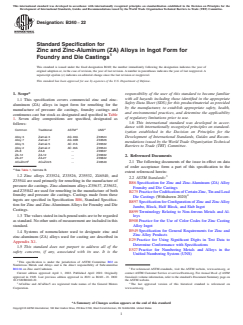
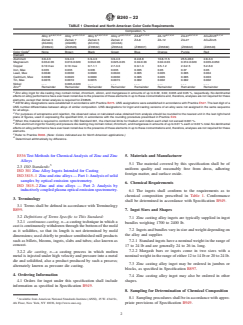
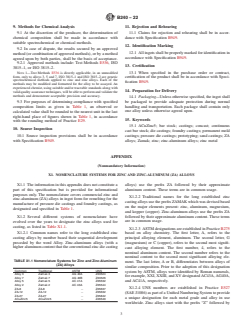

ASTM B240-22 - Standard Specification for Zinc and Zinc-Aluminum (ZA) Alloys in Ingot Form for Foundry and Die Castings
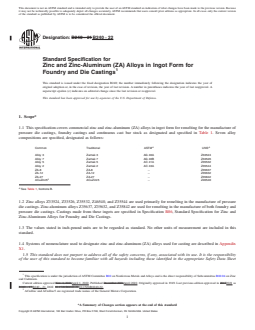
REDLINE ASTM B240-22 - Standard Specification for Zinc and Zinc-Aluminum (ZA) Alloys in Ingot Form for Foundry and Die Castings
Overview
ASTM B240-22: Standard Specification for Zinc and Zinc-Aluminum (ZA) Alloys in Ingot Form for Foundry and Die Castings sets out requirements for commercial zinc and zinc-aluminum alloys supplied as ingots for remelting. These ingots are used in the manufacture of pressure die castings, foundry castings, and continuous cast bar stock. The standard applies to several specific alloy compositions, providing guidelines for chemical composition, quality, identification, and related testing methods. This specification ensures a uniform and reliable material supply for casting operations in various industries.
Key Topics
- Alloy Types Covered: The standard details seven key alloy compositions, including traditional Zamak alloys (Alloy 2, 3, 5, 7) and zinc-aluminum (ZA) alloys (ZA-8, ZA-12, ZA-27, and ACuZinc5). Each alloy is identified by its common name, traditional designation, ASTM code, and Unified Numbering System (UNS) designation.
- Forms and Uses: Focuses on zinc and zinc-aluminum alloy ingots for remelting to produce pressure die castings, foundry castings, and continuous cast bar stock.
- Material Quality Requirements: Ingots must be of uniform quality and reasonably free of dross, foreign matter, and surface oxide, ensuring consistent melting and casting performance.
- Chemical Composition: Strict limits are set for aluminum, magnesium, copper, iron, lead, cadmium, tin, and, where applicable, nickel. These limits are critical to maintaining purity and performance in the final cast products.
- Testing and Certification: Chemical composition is verified using suitable analytical methods, including spectrochemical analysis and reference to practices such as ASTM E536 or ISO 3815. Certification and identification marking practices are defined for traceability.
- Nomenclature Systems: Different nomenclatures (Common, Traditional, ASTM, UNS) are explained to ensure global understanding and proper specification.
Applications
The alloys covered by ASTM B240-22 are versatile and widely used in the production of cast components for multiple industries. Key applications include:
- Pressure Die Castings: Critical for automotive, electronics, hardware, and appliance sectors where dimensional stability and strength are required.
- Foundry Castings: Used in general industrial machinery and components, benefiting from the alloys’ high fluidity and castability.
- Continuous Cast Bar Stock: Ideal for further processing, machining, and prototyping.
- Permanent Mold and Sand Castings: Some alloys are also suited for specialty casting applications, supporting rapid prototyping and custom part manufacture.
The ingot compositions covered enable optimal mechanical properties, corrosion resistance, and manufacturability adapted to demanding industrial processes.
Related Standards
For comprehensive control and specification of materials, ASTM B240-22 references and aligns with several related international standards:
- ASTM B86: Specification for Zinc and Zinc-Aluminum Alloy Foundry and Die Castings – covers requirements for the finished castings produced from ingots.
- ASTM B949: General Requirements for Zinc and Zinc Alloy Products – sets out broad production and inspection rules.
- ASTM B899: Terminology Relating to Nonferrous Metals and Alloys – defines essential terms in zinc metallurgy.
- ASTM B908: Practice for the Use of Color Codes for Zinc Casting Alloy Ingot – details identification by color for safe and efficient handling.
- ISO 301: International standard for zinc alloy ingots intended for casting.
- ISO 3815-1 / ISO 3815-2: Describe analytical methods for verifying chemical composition of zinc and zinc alloys.
Practical Value
By adhering to ASTM B240-22, manufacturers and foundries benefit from:
- Consistent Material Quality: Ensures uniform ingots that support reliable casting operations.
- Global Sourcing Compatibility: Clear cross-referencing to international nomenclature and standards streamlines supply chain management.
- Regulatory and Quality Assurance: Supports safety, environmental, and performance obligations.
- Traceability and Certification: Defined marking and documentation requirements make compliance and quality verification straightforward.
Implementing ASTM B240-22 helps organizations in die casting and foundry industries meet high standards for product integrity, performance, and supply chain efficiency.
Relations
- Refers
ASTM B86-23 - Standard Specification for Zinc and Zinc-Aluminum (ZA) Alloy Foundry and Die Castings - Effective Date
- 01-Nov-2023
- Effective Date
- 01-Oct-2016
- Effective Date
- 01-Oct-2015
- Effective Date
- 01-Jun-2015
- Effective Date
- 01-Oct-2014
- Effective Date
- 01-Oct-2014
- Effective Date
- 01-Oct-2014
- Effective Date
- 01-Dec-2013
- Effective Date
- 01-Dec-2013
- Effective Date
- 01-Dec-2013
- Effective Date
- 01-Aug-2013
- Refers
ASTM B949-13 - Standard Specification for General Requirements for Zinc and Zinc Alloy Products - Effective Date
- 01-Aug-2013
- Refers
ASTM B86-13 - Standard Specification for Zinc and Zinc-Aluminum (ZA) Alloy Foundry and Die Castings - Effective Date
- 01-Feb-2013
- Effective Date
- 01-Feb-2013
- Refers
ASTM B86-11 - Standard Specification for Zinc and Zinc-Aluminum (ZA) Alloy Foundry and Die Castings - Effective Date
- 01-Jun-2011
Buy Documents
ASTM B240-22 - Standard Specification for Zinc and Zinc-Aluminum (ZA) Alloys in Ingot Form for Foundry and Die Castings
REDLINE ASTM B240-22 - Standard Specification for Zinc and Zinc-Aluminum (ZA) Alloys in Ingot Form for Foundry and Die Castings
Get Certified
Connect with accredited certification bodies for this standard

Element Materials Technology
Materials testing and product certification.

Inštitut za kovinske materiale in tehnologije
Institute of Metals and Technology. Materials testing, metallurgical analysis, NDT.
Sponsored listings
Frequently Asked Questions
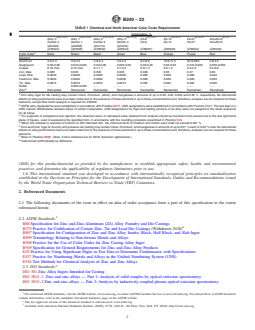
ASTM B240-22 is a technical specification published by ASTM International. Its full title is "Standard Specification for Zinc and Zinc-Aluminum (ZA) Alloys in Ingot Form for Foundry and Die Castings". This standard covers: ABSTRACT This specification covers commercial zinc and zinc-aluminum alloys in ingot form for remelting for the manufacture of pressure die castings, foundry castings and continuous cast bar stock. Seven alloy compositions are specified, which includes Z33521, Z33522, Z35530, Z35540, for zinc alloys and Z35635, Z35630, Z35840, for zinc-aluminum alloys. The material shall be of uniform quality and reasonably free from dross, adhering foreign matter, and surafce oxide. The determination of chemical composition shall be made in accordance with suitable analytical methods. SCOPE 1.1 This specification covers commercial zinc and zinc-aluminum (ZA) alloys in ingot form for remelting for the manufacture of pressure die castings, foundry castings and continuous cast bar stock as designated and specified in Table 1. Seven alloy compositions are specified, designated as follows: Common Traditional ASTMA UNSA Alloy 3 Zamak 3 AG 40A Z33524 Alloy 7 Zamak 7 AG 40B Z33526 Alloy 5 Zamak 5 AC 41A Z35532 Alloy 2 Zamak 2 AC 43A Z35544 ZA-8 ZA-8 ... Z35637 ZA-12 ZA-12 ... Z35632 ZA-27 ZA-27 ... Z35842 ACuZinc52 ACuZinc5 ... Z46540 1.2 Zinc alloys Z33524, Z33526, Z35532, Z46540, and Z35544 are used primarily for remelting in the manufacture of pressure die castings. Zinc-aluminum alloys Z35637, Z35632, and Z35842 are used for remelting in the manufacture of both foundry and pressure die castings. Castings made from these ingots are specified in Specification B86, Standard Specification for Zinc and Zinc-Aluminum Alloys for Foundry and Die Castings. 1.3 The values stated in inch-pound units are to be regarded as standard. No other units of measurement are included in this standard. 1.4 Systems of nomenclature used to designate zinc and zinc-aluminum (ZA) alloys used for casting are described in Appendix X1. 1.5 This standard does not purport to address all of the safety concerns, if any, associated with its use. It is the responsibility of the user of this standard to become familiar with all hazards including those identified in the appropriate Safety Data Sheet (SDS) for this product/material as provided by the manufacturer, to establish appropriate safety, health, and environmental practices, and determine the applicability of regulatory limitations prior to use. 1.6 This international standard was developed in accordance with internationally recognized principles on standardization established in the Decision on Principles for the Development of International Standards, Guides and Recommendations issued by the World Trade Organization Technical Barriers to Trade (TBT) Committee.
ABSTRACT This specification covers commercial zinc and zinc-aluminum alloys in ingot form for remelting for the manufacture of pressure die castings, foundry castings and continuous cast bar stock. Seven alloy compositions are specified, which includes Z33521, Z33522, Z35530, Z35540, for zinc alloys and Z35635, Z35630, Z35840, for zinc-aluminum alloys. The material shall be of uniform quality and reasonably free from dross, adhering foreign matter, and surafce oxide. The determination of chemical composition shall be made in accordance with suitable analytical methods. SCOPE 1.1 This specification covers commercial zinc and zinc-aluminum (ZA) alloys in ingot form for remelting for the manufacture of pressure die castings, foundry castings and continuous cast bar stock as designated and specified in Table 1. Seven alloy compositions are specified, designated as follows: Common Traditional ASTMA UNSA Alloy 3 Zamak 3 AG 40A Z33524 Alloy 7 Zamak 7 AG 40B Z33526 Alloy 5 Zamak 5 AC 41A Z35532 Alloy 2 Zamak 2 AC 43A Z35544 ZA-8 ZA-8 ... Z35637 ZA-12 ZA-12 ... Z35632 ZA-27 ZA-27 ... Z35842 ACuZinc52 ACuZinc5 ... Z46540 1.2 Zinc alloys Z33524, Z33526, Z35532, Z46540, and Z35544 are used primarily for remelting in the manufacture of pressure die castings. Zinc-aluminum alloys Z35637, Z35632, and Z35842 are used for remelting in the manufacture of both foundry and pressure die castings. Castings made from these ingots are specified in Specification B86, Standard Specification for Zinc and Zinc-Aluminum Alloys for Foundry and Die Castings. 1.3 The values stated in inch-pound units are to be regarded as standard. No other units of measurement are included in this standard. 1.4 Systems of nomenclature used to designate zinc and zinc-aluminum (ZA) alloys used for casting are described in Appendix X1. 1.5 This standard does not purport to address all of the safety concerns, if any, associated with its use. It is the responsibility of the user of this standard to become familiar with all hazards including those identified in the appropriate Safety Data Sheet (SDS) for this product/material as provided by the manufacturer, to establish appropriate safety, health, and environmental practices, and determine the applicability of regulatory limitations prior to use. 1.6 This international standard was developed in accordance with internationally recognized principles on standardization established in the Decision on Principles for the Development of International Standards, Guides and Recommendations issued by the World Trade Organization Technical Barriers to Trade (TBT) Committee.
ASTM B240-22 is classified under the following ICS (International Classification for Standards) categories: 77.150.60 - Lead, zinc and tin products. The ICS classification helps identify the subject area and facilitates finding related standards.
ASTM B240-22 has the following relationships with other standards: It is inter standard links to ASTM B86-23, ASTM B899-16, ASTM B899-15, ASTM E536-15, ASTM B275-14, ASTM B908-14, ASTM B899-14, ASTM B275-13e1, ASTM B275-13, ASTM B897-13, ASTM B275-05(2013), ASTM B949-13, ASTM B86-13, ASTM B899-13, ASTM B86-11. Understanding these relationships helps ensure you are using the most current and applicable version of the standard.
ASTM B240-22 is available in PDF format for immediate download after purchase. The document can be added to your cart and obtained through the secure checkout process. Digital delivery ensures instant access to the complete standard document.
Standards Content (Sample)
This international standard was developed in accordance with internationally recognized principles on standardization established in the Decision on Principles for the
Development of International Standards, Guides and Recommendations issued by the World Trade Organization Technical Barriers to Trade (TBT) Committee.
Designation: B240 −22
Standard Specification for
Zinc and Zinc-Aluminum (ZA) Alloys in Ingot Form for
Foundry and Die Castings
This standard is issued under the fixed designation B240; the number immediately following the designation indicates the year of
original adoption or, in the case of revision, the year of last revision. A number in parentheses indicates the year of last reapproval. A
superscript epsilon (´) indicates an editorial change since the last revision or reapproval.
This standard has been approved for use by agencies of the U.S. Department of Defense.
1. Scope* responsibility of the user of this standard to become familiar
with all hazards including those identified in the appropriate
1.1 This specification covers commercial zinc and zinc-
Safety Data Sheet (SDS) for this product/material as provided
aluminum (ZA) alloys in ingot form for remelting for the
by the manufacturer, to establish appropriate safety, health,
manufacture of pressure die castings, foundry castings and
and environmental practices, and determine the applicability
continuous cast bar stock as designated and specified in Table
of regulatory limitations prior to use.
1. Seven alloy compositions are specified, designated as
1.6 This international standard was developed in accor-
follows:
dance with internationally recognized principles on standard-
A A
Common Traditional ASTM UNS
ization established in the Decision on Principles for the
Alloy 3 Zamak 3 AG 40A Z33524 Development of International Standards, Guides and Recom-
Alloy 7 Zamak 7 AG 40B Z33526
mendations issued by the World Trade Organization Technical
Alloy 5 Zamak 5 AC 41A Z35532
Barriers to Trade (TBT) Committee.
Alloy 2 Zamak 2 AC 43A Z35544
ZA-8 ZA-8 . Z35637
ZA-12 ZA-12 . Z35632
2. Referenced Documents
ZA-27 ZA-27 . Z35842
ACuZinc5 ACuZinc5 . Z46540
2.1 The following documents of the issue in effect on data
of order acceptance form a part of this specification to the
A
See Table 1, footnote B.
extent referenced herein:
1.2 Zinc alloys Z33524, Z33526, Z35532, Z46540, and 3
2.2 ASTM Standards:
Z35544 are used primarily for remelting in the manufacture of
B86 Specification for Zinc and Zinc-Aluminum (ZA) Alloy
pressure die castings. Zinc-aluminum alloys Z35637, Z35632,
Foundry and Die Castings
and Z35842 are used for remelting in the manufacture of both
B275 PracticeforCodificationofCertainZinc,TinandLead
foundry and pressure die castings. Castings made from these 4
Die Castings (Withdrawn 2020)
ingots are specified in Specification B86, Standard Specifica-
B897 Specification for Configuration of Zinc and ZincAlloy
tion for Zinc and Zinc-AluminumAlloys for Foundry and Die
Jumbo, Block, Half Block, and Slab Ingot
Castings.
B899 Terminology Relating to Non-ferrous Metals and Al-
1.3 The values stated in inch-pound units are to be regarded loys
as standard. No other units of measurement are included in this
B908 Practice for the Use of Color Codes for Zinc Casting
standard. Alloy Ingot
B949 Specification for General Requirements for Zinc and
1.4 Systems of nomenclature used to designate zinc and
Zinc Alloy Products
zinc-aluminum (ZA) alloys used for casting are described in
E29 Practice for Using Significant Digits in Test Data to
Appendix X1.
Determine Conformance with Specifications
1.5 This standard does not purport to address all of the
E527 Practice for Numbering Metals and Alloys in the
safety concerns, if any, associated with its use. It is the
Unified Numbering System (UNS)
This specification is under the jurisdiction of ASTM Committee B02 on
Nonferrous Metals and Alloys and is the direct responsibility of Subcommittee
B02.04 on Zinc and Cadmium. For referenced ASTM standards, visit the ASTM website, www.astm.org, or
Current edition approved April 1, 2022. Published April 2022. Originally contact ASTM Customer Service at service@astm.org. For Annual Book of ASTM
approved in 1949. Last previous edition approved in 2021 as B240 – 21. DOI: Standards volume information, refer to the standard’s Document Summary page on
10.1520/B0240-22. the ASTM website.
ACuZinc and ACuZinc5 are registered trade names of the General Motors The last approved version of this historical standard is referenced on
Corporation. www.astm.org.
*A Summary of Changes section appears at the end of this standard
Copyright © ASTM International, 100 Barr Harbor Drive, PO Box C700, West Conshohocken, PA 19428-2959. United States
B240 − 22
TABLE 1 Chemical and North American Color Code Requirements
Composition, %
A,B,C,D,G A,B,C,D,G A,B,C,D,G A,B,C,D,G B,C,E,G B,C,E,G B,C,E,G B,C,G
Alloy 3 Alloy 7 Alloy 5 Alloy 2 ZA-8 ZA-12 ZA-27 ACuZinc5
Zamak 3 Zamak 7 Zamak 5 Zamak 2 ZA-8 ZA-12 ZA-27 ACuZinc5
(AG40A) (AG40B) (AC41A) (AC43A)
(Z33524) (Z33526) (Z35532) (Z35544) (Z35637) (Z35632) (Z35842) (Z46540)
F
Color Code None Brown Black Green Blue Orange Purple Red
Element
Aluminum 3.9-4.3 3.9-4.3 3.9-4.3 3.9-4.3 8.2-8.8 10.8-11.5 25.5-28.0 2.8-3.3
Magnesium 0.03-0.06 0.010-0.020 0.03-0.06 0.025-0.05 0.02-0.03 0.02-0.03 0.012-0.020 0.035-0.050
Copper 0.10 max 0.10 max 0.7-1.1 2.7-3.3 0.9-1.3 0.5-1.2 2.0-2.5 5.2-6.0
Iron, Max 0.035 0.035 0.035 0.035 0.035 0.05 0.07 0.05
Lead, Max 0.0040 0.0030 0.0040 0.0040 0.005 0.005 0.005 0.004
Cadmium, Max 0.0030 0.0020 0.0030 0.0030 0.005 0.005 0.005 0.003
Tin, Max 0.0015 0.0010 0.0015 0.0015 0.002 0.002 0.002 0.002
Nickel - - - 0.005-0.020 - - - - - - - - - - - - - - - - - -
G
Zinc Remainder Remainder Remainder Remainder Remainder Remainder Remainder Remainder
A
Zinc alloy ingot for die casting may contain nickel, chromium, silicon, and manganese in amounts of up to 0.02, 0.02, 0.035 and 0.05 %, respectively. No detrimental
effectsonalloyperformancehaveeverbeennotedduetothepresenceoftheseelementsinuptotheseconcentrationsand,therefore,analysesarenotrequiredforthese
elements, except that nickel analysis is required for Z33526.
B
ASTM alloy designations were established in accordance with Practice B275. UNS assignations were established in accordance with Practice E527. The last digit of a
UNS number differentiates between alloys of similar composition. UNS designations for ingot and casting versions of an alloy were not assigned in the same sequence
for all alloys.
C
For purposes of acceptance and rejection, the observed value or calculated value obtained from analysis should be rounded to the nearest unit in the last right-hand
place of figures, used in expressing the specified limit, in accordance with the rounding procedure prescribed in Practice E29.
D
When this material is required to conform to ISO Standard 301, the chemical limits for thallium and indium each shall not exceed 0.001 %.
E
Zinc-aluminumingotforfoundryandpressurediecastingmaycontainnickel,chromium,andmanganeseinamountsofupto0.01 %eachor0.03 %total.Nodetrimental
effectsonalloyperformancehaveeverbeennotedduetothepresenceoftheseelementsinuptotheseconcentrationsand,therefore,analysesarenotrequiredforthese
elements.
F
Refer to Practice B908. (Note: Colors indicated are for North American applications.)
G
Determined arithmetically by difference.
E536 Test Methods for ChemicalAnalysis of Zinc and Zinc 5. Materials and Manufacturer
Alloys
5.1 The material covered by this specification shall be of
2.3 ISO Standards:
uniform quality and reasonably free from dross, adhering
ISO 301 Zinc Alloy Ingots Intended for Casting
foreign matter, and surface oxide.
ISO3815–1 Zincandzincalloys—Part1:Analysisofsolid
samples by optical emission spectrometry.
6. Chemical Requirements
ISO 3815–2 Zinc and zinc alloys — Part 2: Analysis by
inductivelycoupledplasmaopticalemissionspectrometry.
6.1 The ingots shall conform to the requirements as to
chemical composition prescribed in Table 1. Conformance
3. Terminology
shall be determined in accordance with Specification B949.
3.1 Terms shall be defined in accordance with Terminology
B899. 7. Ingot Sizes and Shapes
3.2 Definitions of Terms Specific to This Standard:
7.1 Zinc casting alloy ingots are typically supplied in ingot
3.2.1 continuous casting, n—a casting technique in which a
bundles weighing 1700 to 2400 lb.
cast is continuously withdrawn through the bottom of the mold
7.2 Ingotsandbundlesvaryinsizeandweightdependi
...
This document is not an ASTM standard and is intended only to provide the user of an ASTM standard an indication of what changes have been made to the previous version. Because
it may not be technically possible to adequately depict all changes accurately, ASTM recommends that users consult prior editions as appropriate. In all cases only the current version
of the standard as published by ASTM is to be considered the official document.
Designation: B240 − 21 B240 − 22
Standard Specification for
Zinc and Zinc-Aluminum (ZA) Alloys in Ingot Form for
Foundry and Die Castings
This standard is issued under the fixed designation B240; the number immediately following the designation indicates the year of
original adoption or, in the case of revision, the year of last revision. A number in parentheses indicates the year of last reapproval. A
superscript epsilon (´) indicates an editorial change since the last revision or reapproval.
This standard has been approved for use by agencies of the U.S. Department of Defense.
1. Scope*
1.1 This specification covers commercial zinc and zinc-aluminum (ZA) alloys in ingot form for remelting for the manufacture of
pressure die castings, foundry castings and continuous cast bar stock as designated and specified in Table 1. Seven alloy
compositions are specified, designated as follows:
A A
Common Traditional ASTM UNS
Alloy 3 Zamak 3 AG 40A Z33524
Alloy 7 Zamak 7 AG 40B Z33526
Alloy 5 Zamak 5 AC 41A Z35532
Alloy 2 Zamak 2 AC 43A Z35544
ZA-8 ZA-8 . Z35637
ZA-12 ZA-12 . Z35632
ZA-27 ZA-27 . Z35842
ACuZinc5 ACuZinc5 . Z46540
A
See Table 1, footnote B.
1.2 Zinc alloys Z33524, Z33526, Z35532, Z46540, and Z35544 are used primarily for remelting in the manufacture of pressure
die castings. Zinc-aluminum alloys Z35637, Z35632, and Z35842 are used for remelting in the manufacture of both foundry and
pressure die castings. Castings made from these ingots are specified in Specification B86, Standard Specification for Zinc and
Zinc-Aluminum Alloys for Foundry and Die Castings.
1.3 The values stated in inch-pound units are to be regarded as standard. No other units of measurement are included in this
standard.
1.4 Systems of nomenclature used to designate zinc and zinc-aluminum (ZA) alloys used for casting are described in Appendix
X1.
1.5 This standard does not purport to address all of the safety concerns, if any, associated with its use. It is the responsibility
of the user of this standard to become familiar with all hazards including those identified in the appropriate Safety Data Sheet
This specification is under the jurisdiction of ASTM Committee B02 on Nonferrous Metals and Alloys and is the direct responsibility of Subcommittee B02.04 on Zinc
and Cadmium.
Current edition approved Nov. 1, 2021April 1, 2022. Published December 2021April 2022. Originally approved in 1949. Last previous edition approved in 20172021 as
B240 – 17.B240 – 21. DOI: 10.1520/B0240-21.10.1520/B0240-22.
ACuZinc and ACuZinc5 are registered trade names of the General Motors Corporation.
*A Summary of Changes section appears at the end of this standard
Copyright © ASTM International, 100 Barr Harbor Drive, PO Box C700, West Conshohocken, PA 19428-2959. United States
B240 − 22
TABLE 1 Chemical and North American Color Code Requirements
Composition, %
A,B,C,D,G A,B,C,D,G A,B,C,D,G A,B,C,D,G B,C,E,G B,C,E,G B,C,E,G B,C,G
Alloy 3 Alloy 7 Alloy 5 Alloy 2 ZA-8 ZA-12 ZA-27 ACuZinc5
Zamak 3 Zamak 7 Zamak 5 Zamak 2 ZA-8 ZA-12 ZA-27 ACuZinc5
(AG40A) (AG40B) (AC41A) (AC43A)
(Z33524) (Z33526) (Z35532) (Z35544) (Z35637) (Z35632) (Z35842) (Z46540)
F
Color Code None Brown Black Green Blue Orange Purple Red
Element
Aluminum 3.9-4.3 3.9-4.3 3.9-4.3 3.9-4.3 8.2-8.8 10.8-11.5 25.5-28.0 2.8-3.3
Magnesium 0.03-0.06 0.010-0.020 0.03-0.06 0.025-0.05 0.02-0.03 0.02-0.03 0.012-0.020 0.035-0.050
Copper 0.10 max 0.10 max 0.7-1.1 2.7-3.3 0.9-1.3 0.5-1.2 2.0-2.5 5.2-6.0
Iron, Max 0.035 0.035 0.035 0.035 0.035 0.05 0.07 0.05
Lead, Max 0.0040 0.0030 0.0040 0.0040 0.005 0.005 0.005 0.004
Cadmium, Max 0.0030 0.0020 0.0030 0.0030 0.005 0.005 0.005 0.003
Tin, Max 0.0015 0.0010 0.0015 0.0015 0.002 0.002 0.002 0.002
Nickel - - - 0.005-0.020 - - - - - - - - - - - - - - - - - -
G
Zinc Remainder Remainder Remainder Remainder Remainder Remainder Remainder Remainder
A
Zinc alloy ingot for die casting may contain nickel, chromium, silicon, and manganese in amounts of up to 0.02, 0.02, 0.035 and 0.05 %, respectively. No detrimental
effects on alloy performance have ever been noted due to the presence of these elements in up to these concentrations and, therefore, analyses are not required for these
elements, except that nickel analysis is required for Z33526.
B
ASTM alloy designations were established in accordance with Practice B275. UNS assignations were established in accordance with Practice E527. The last digit of a
UNS number differentiates between alloys of similar composition. UNS designations for ingot and casting versions of an alloy were not assigned in the same sequence
for all alloys.
C
For purposes of acceptance and rejection, the observed value or calculated value obtained from analysis should be rounded to the nearest unit in the last right-hand
place of figures, used in expressing the specified limit, in accordance with the rounding procedure prescribed in Practice E29.
D
When this material is required to conform to ISO Standard 301, the chemical limits for thallium and indium each shall not exceed 0.001 %.
E
Zinc-aluminum ingot for foundry and pressure die casting may contain nickel, chromium, and manganese in amounts of up to 0.01 % each or 0.03 % total. No detrimental
effects on alloy performance have ever been noted due to the presence of these elements in up to these concentrations and, therefore, analyses are not required for these
elements.
F
Refer to Practice B908. (Note: Colors indicated are for North American applications.)
G
Determined arithmetically by difference.
(SDS) for this product/material as provided by the manufacturer, to establish appropriate safety, health, and environmental
practices, and determine the applicability of regulatory limitations prior to use.
1.6 This international standard was developed in accordance with internationally recognized principles on standardization
established in the Decision on Principles for the Development of International Standards, Guides and Recommendations issued
by the World Trade Organization Technical Barriers to Trade (TBT) Committee.
2. Referenced Documents
2.1 The following documents of the issue in effect on data of order acceptance form a part of this specification to the extent
referenced herein:
2.2 ASTM Standards:
B86 Specification for Zinc and Zinc-Aluminum (ZA) Alloy Foundry and Die Castings
B275 Practice for Codification of Certain Zinc, Tin and Lead Die Castings (Withdrawn 2020)
B897 Specification for Configuration of Zinc and Zinc Alloy Jumbo, Block, Half Block, and Slab Ingot
B899 Terminology Relating to Non-ferrous Metals and Alloys
B908 Practice for the Use of Color Codes for Zinc Casting Alloy Ingot
B949 Specification for General Requirements for Zinc and Zinc Alloy Products
E29 Practice for Using Significant Digits in Test Data to Determine Conformance with Specifications
E527 Practice for Numbering Metals and Alloys in the Unified Numbering System (UNS)
E536 Test Methods for Chemical Analysis of Zinc and Zinc Alloys
2.3 ISO Standards:
ISO 301 Zinc Alloy Ingots Intended for Casting
ISO 3815–1 Zinc and zinc alloys — Part 1: Analysis of solid samples by optical emission spectrometry.
ISO 3815–2 Zinc and zinc alloys — Part 2: Analysis by inductively coupled plasma optical emission spectrometry.
For referenced ASTM standards, visit the ASTM website, www.astm.org, or contact ASTM Customer Service at service@astm.org. For Annual Book of ASTM Standards
volume information, refer to the standard’s Document Summary page on the ASTM website.
The last approved version of this historical standard is referenced on www.astm.org.
Available from American National Standards Institute (ANSI), 25 W. 43rd St., 4th Floor, New York, NY 10036, http://www.ansi.org.
B240 − 22
3. Terminology
3.1 Terms shall be defined in accordance with Terminology B899.
3.2 Definitions of Terms Specific to This Standard:
3.2.1 continuous casting, n—a casting technique in which a cast is continuously withdrawn through the bottom of the mold as it
solidifies, so that its length is not determined by mold dimensions; used chiefly to produce semifinished mill products such as
billets, blooms, ingots, slabs and tubes; also known as concast.
3.2.2 die casting, n—a casting process in which molten metal is injected under high velocity and pressure into a metal die a
...